Microscopic origin of polytype-dependent melting in SiC revealed by machine-learning molecular dynamics
Pith reviewed 2026-06-28 21:27 UTC · model grok-4.3
The pith
Stacking-dependent shear modes cause the 9R SiC polytype to melt at lower temperatures than 3C or 2H.
A machine-rendered reading of the paper's core claim, the machinery that carries it, and where it could break.
Core claim
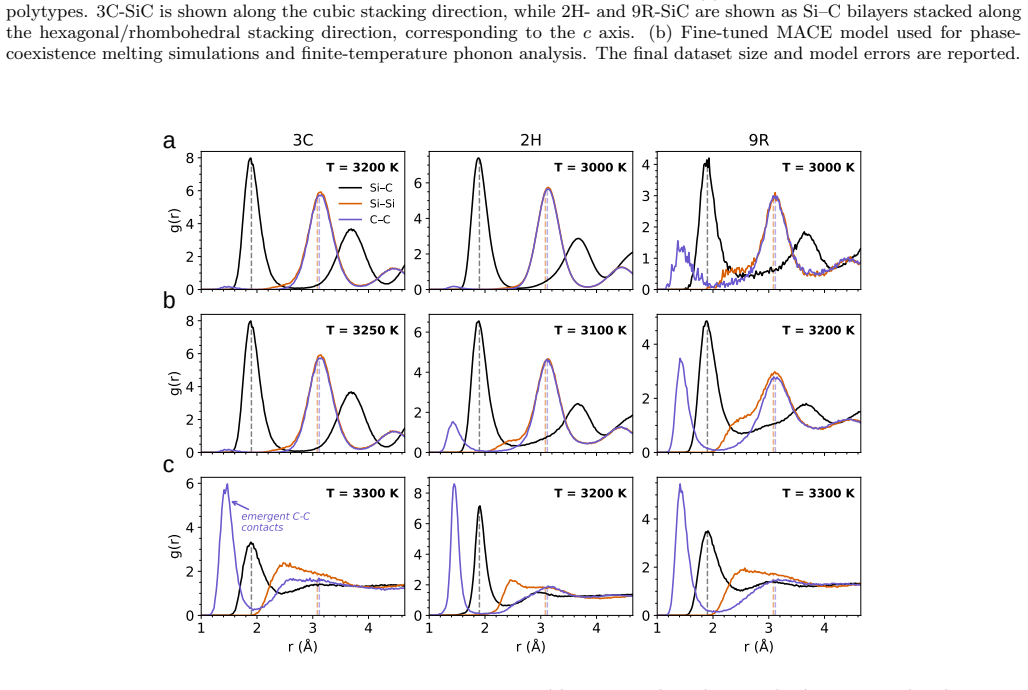
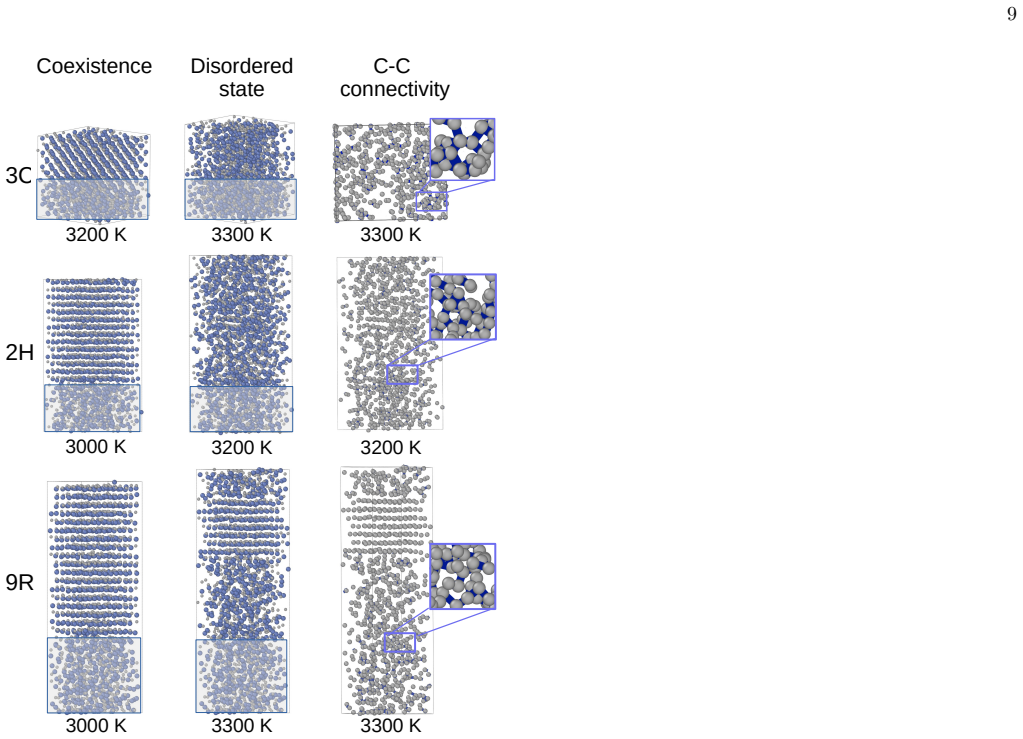
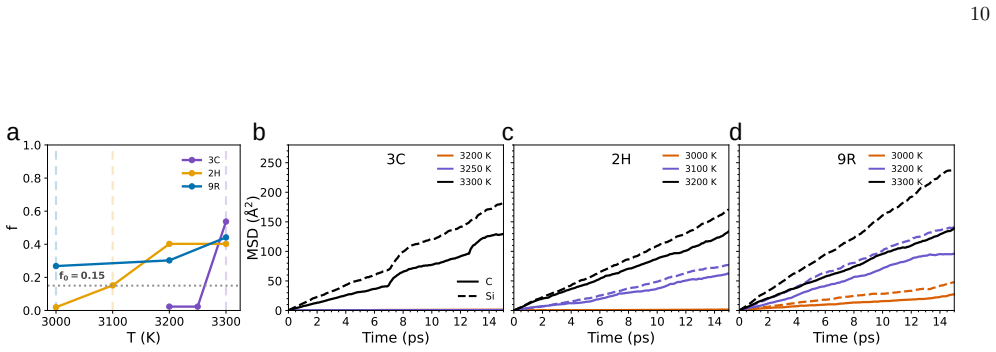
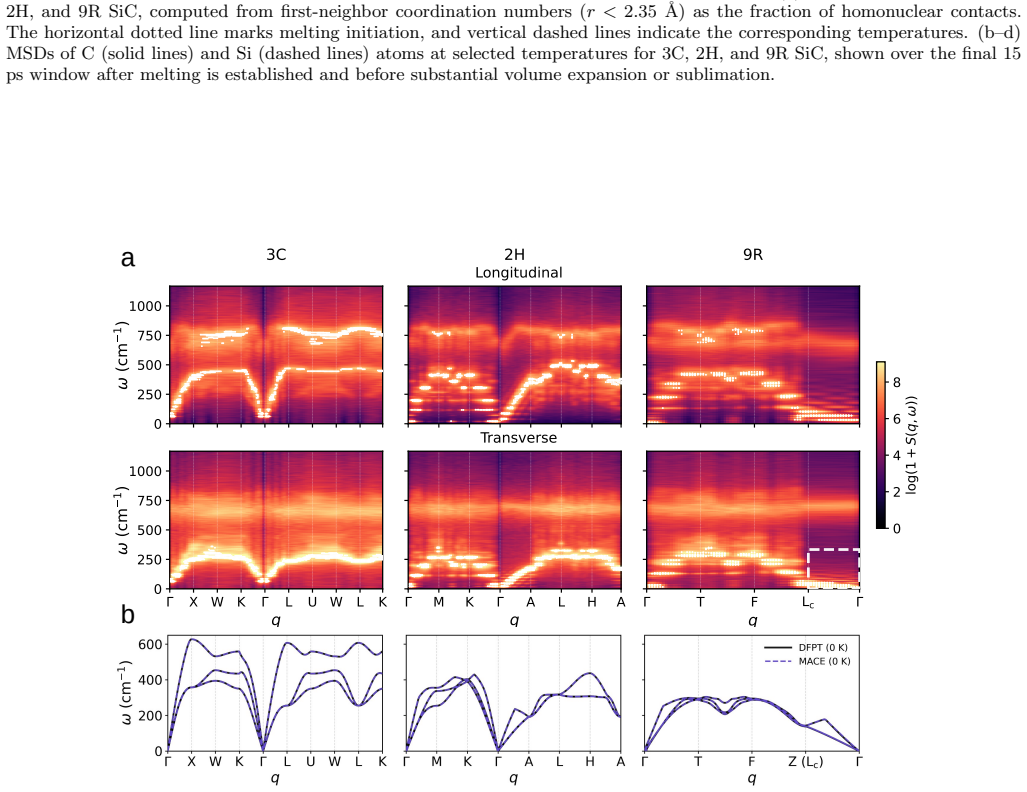
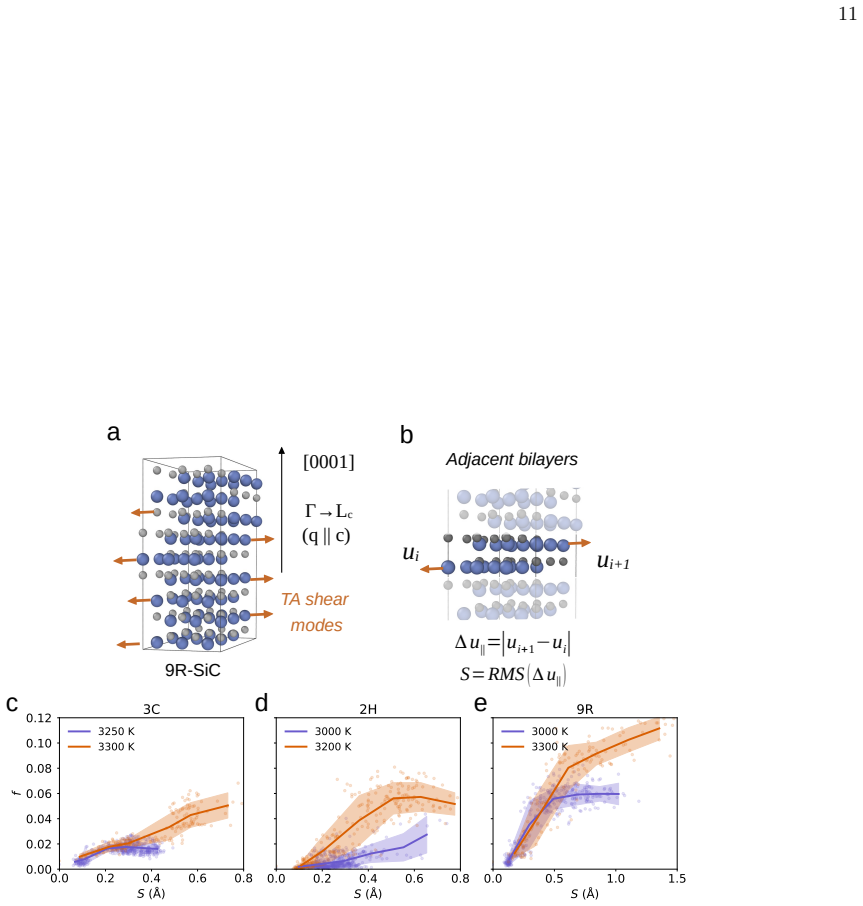
The reduced stability of the long-period 9R polytype is traced to low-frequency transverse-acoustic shear modes associated with relative bilayer sliding, which are already present in the 0 K phonon spectra and soften further at high temperature. These modes generate larger lateral bilayer displacements, linking enhanced interlayer sliding to local chemical disordering and ultimately melting. Across all polytypes, melting initiates through the formation of short C-C contacts and carbon-rich local regions, followed by a progressive loss of tetrahedral Si-C connectivity. The stability ordering 3C > 2H > 9R is reflected consistently in structural disordering, interlayer sliding, and finite-tempe
What carries the argument
Low-frequency transverse-acoustic shear modes associated with relative bilayer sliding in the phonon spectra.
If this is right
- Melting begins with short C-C contacts and carbon-rich regions before tetrahedral Si-C order is lost.
- The 9R polytype exhibits greater interlayer sliding and mode softening than 3C or 2H at elevated temperature.
- High-temperature stability in polytypic covalent materials is controlled by stacking-dependent transverse dynamics in addition to local bond strength.
- Phase-coexistence molecular dynamics combined with finite-temperature phonon analysis ranks polytype stabilities consistently.
Where Pith is reading between the lines
- The bilayer-sliding mechanism identified here may operate in other polytypic covalent solids whose stacking sequences differ in periodicity.
- Targeted modifications that raise the frequencies of these shear modes could increase the usable temperature range of less stable polytypes.
- Phonon-based screening of hypothetical stackings could be used to predict new high-stability polytypes before synthesis.
Load-bearing premise
The machine-learned interatomic potential accurately reproduces crystalline, high-temperature, and disordered configurations for all studied SiC polytypes.
What would settle it
Direct measurement of the melting temperatures of 3C, 2H, and 9R SiC under identical conditions, or experimental tracking of the temperature-dependent frequencies of the transverse acoustic modes specific to each polytype.
Figures
read the original abstract
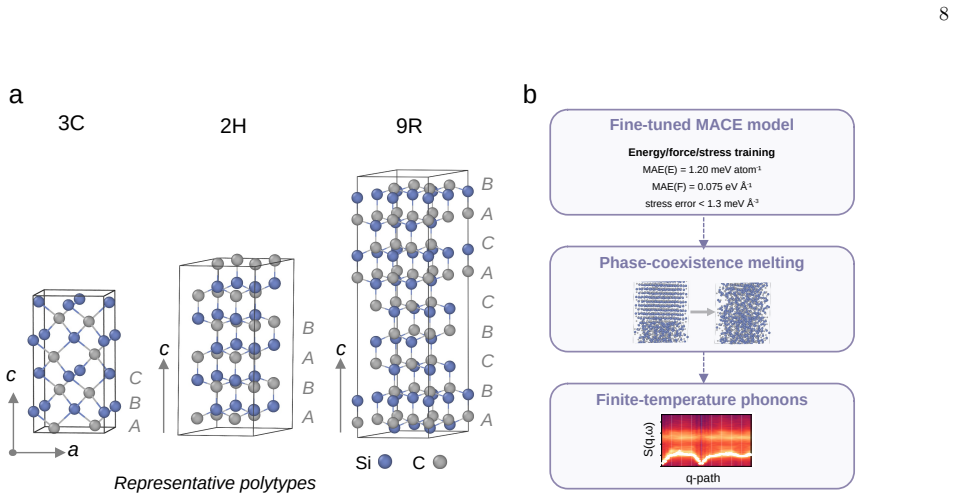
Predicting how crystal structure influences high-temperature stability remains a key challenge in materials modelling and design. Silicon carbide (SiC), one of the most thermally and chemically stable materials known, provides an ideal system for studying this problem because its many polytypes preserve similar local tetrahedral bonding while differing in long-range stacking geometry. Here, we combine phase-coexistence machine-learning molecular dynamics with finite-temperature phonon analysis, enabled by a fine-tuned MACE interatomic potential that accurately describes crystalline, high-temperature, and disordered configurations across multiple SiC polytypes. We identify a clear relative stability ordering, 3C > 2H > 9R, reflected consistently in structural disordering, interlayer sliding, and finite-temperature phonon spectra. Across all polytypes, melting initiates through the formation of short C-C contacts and carbon-rich local regions, followed by a progressive loss of tetrahedral Si-C connectivity. The reduced stability of the long-period 9R polytype is traced to low-frequency transverse-acoustic shear modes associated with relative bilayer sliding, which are already present in the 0 K phonon spectra and soften further at high temperature. These modes generate larger lateral bilayer displacements, linking enhanced interlayer sliding to local chemical disordering and ultimately melting. More broadly, our results show that high-temperature stability in polytypic covalent materials is governed not only by local bond strength, but also by stacking-dependent transverse dynamics.
Editorial analysis
A structured set of objections, weighed in public.
Referee Report
Summary. The manuscript employs phase-coexistence machine-learning molecular dynamics and finite-temperature phonon calculations, enabled by a fine-tuned MACE interatomic potential, to examine melting in SiC polytypes. It reports a consistent stability ordering 3C > 2H > 9R, identifies melting initiation via short C-C contacts and loss of tetrahedral connectivity, and attributes the reduced stability of 9R to low-frequency transverse-acoustic shear modes linked to bilayer sliding that are present at 0 K and soften at high temperature.
Significance. If the central results hold, the work supplies a concrete microscopic mechanism connecting stacking-dependent transverse dynamics to polytype-dependent high-temperature stability in a technologically important covalent material. The combination of phase-coexistence sampling with phonon analysis across multiple polytypes is a methodological strength that could generalize to other polytypic systems.
major comments (1)
- [Abstract] Abstract (and implied Methods/Results sections): The claim that the fine-tuned MACE potential 'accurately describes crystalline, high-temperature, and disordered configurations across multiple SiC polytypes' is load-bearing for the reported stability ordering, sliding mechanism, and melting pathway, yet the manuscript provides no quantitative benchmarks (e.g., force or energy RMSE versus DFT reference data, melting-temperature agreement with experiment, or validation on disordered/liquid-like configurations specific to each polytype). Without these, the transferability to the high-T and disordered regimes central to the conclusions cannot be assessed.
Simulated Author's Rebuttal
We thank the referee for their constructive review and positive assessment of the work's significance. We address the single major comment below.
read point-by-point responses
-
Referee: [Abstract] Abstract (and implied Methods/Results sections): The claim that the fine-tuned MACE potential 'accurately describes crystalline, high-temperature, and disordered configurations across multiple SiC polytypes' is load-bearing for the reported stability ordering, sliding mechanism, and melting pathway, yet the manuscript provides no quantitative benchmarks (e.g., force or energy RMSE versus DFT reference data, melting-temperature agreement with experiment, or validation on disordered/liquid-like configurations specific to each polytype). Without these, the transferability to the high-T and disordered regimes central to the conclusions cannot be assessed.
Authors: We agree that explicit quantitative benchmarks are necessary to substantiate the transferability claims for the fine-tuned MACE potential. Although the Methods section outlines the fine-tuning procedure and notes validation against DFT, the main text does not present specific metrics such as force/energy RMSE values, melting-temperature comparisons with experiment, or polytype-specific tests on disordered configurations. In the revised manuscript we will add a dedicated validation subsection (with accompanying tables) reporting these quantities for crystalline, high-temperature, and disordered/liquid-like structures across the 3C, 2H, and 9R polytypes. This addition will directly address the referee's concern and allow readers to evaluate the potential's performance in the regimes relevant to the melting simulations. revision: yes
Circularity Check
No circularity; stability ordering and mechanism emerge from direct MD observables
full rationale
The paper derives the polytype stability ordering (3C > 2H > 9R) and the role of bilayer-sliding shear modes from phase-coexistence MLMD trajectories and finite-temperature phonon spectra. These are simulation outputs, not quantities defined in terms of themselves or obtained by fitting parameters to the target melting behavior. The MACE potential is presented as an enabling tool whose accuracy is asserted rather than derived within the paper; this is a correctness assumption, not a self-referential reduction. No self-citation chains, ansatzes smuggled via prior work, or renamings of known results appear in the load-bearing steps. The derivation chain is therefore self-contained against external benchmarks.
Axiom & Free-Parameter Ledger
axioms (1)
- domain assumption The fine-tuned MACE interatomic potential accurately describes crystalline, high-temperature, and disordered configurations across multiple SiC polytypes.
Reference graph
Works this paper leans on
-
[1]
Born, The Journal of Chemical Physics7, 591 (1939)
M. Born, The Journal of Chemical Physics7, 591 (1939)
1939
-
[2]
Katoh and L
Y. Katoh and L. L. Snead, Journal of Nuclear Materials526, 151849 (2019)
2019
-
[3]
Koyanagi, Y
T. Koyanagi, Y. Katoh, T. Nozawa, L. Snead, S. Kondo, C. Henager, M. Ferraris, T. Hinoki, and Q. Huang, Journal of Nuclear Materials511, 544 (2018), special Section on ”18th International Conference on Fusion Reactor Materials”
2018
-
[4]
Sizyuk, J
T. Sizyuk, J. Brooks, T. Abrams, and A. Hassanein, Nuclear Fusion64, 086036 (2024)
2024
-
[5]
Cheung,Silicon Carbide Microelectromechanical Systems for Harsh Environments(Imperial College Press, 2006)
R. Cheung,Silicon Carbide Microelectromechanical Systems for Harsh Environments(Imperial College Press, 2006)
2006
-
[6]
C. H. Park, B.-H. Cheong, K.-H. Lee, and K. J. Chang, Phys. Rev. B49, 4485 (1994)
1994
-
[7]
W.-W. Xu, F. Xia, L. Chen, M. Wu, T. Gang, and Y. Huang, Journal of Alloys and Compounds768, 722 (2018)
2018
-
[8]
S. K. Bhaumik, C. Divakar, M. Mohan, and A. K. Singh, Review of Scientific Instruments67, 3679 (1996)
1996
-
[9]
Togaya and S
M. Togaya and S. Sugiyama, THE REVIEW OF HIGH PRESSURE SCIENCE AND TECHNOLOGY7, 1037 (1998)
1998
-
[10]
E. A. Ekimov, R. A. Sadykov, S. Gierlotka, A. Presz, E. V. Tatyanin, V. N. Slesarev, and N. N. Kuzin, Instruments and Experimental Techniques47, 276 (2004)
2004
-
[11]
K. Daviau and K. K. M. Lee, Crystals8, 10.3390/cryst8050217 (2018)
-
[12]
P. S. Sokolov, V. A. Mukhanov, T. Chauveau, and V. L. Solozhenko, Journal of Superhard Materials34, 339 (2012)
2012
-
[13]
Vashishta, R
P. Vashishta, R. K. Kalia, A. Nakano, and J. P. Rino, Journal of Applied Physics101, 103515 (2007)
2007
-
[14]
W. Yan, T. Gao, X. Guo, Y. Qin, and Q. Xie, Science China Physics, Mechanics and Astronomy56, 1699 (2013)
2013
-
[15]
A. Kubo and Y. Umeno, Materials14, 10.3390/ma14071597 (2021)
-
[16]
MacIsaac, S
M. MacIsaac, S. Bavdekar, D. Spearot, and G. Subhash, The Journal of Physical Chemistry C128, 12213 (2024)
2024
-
[17]
Y. Xie, J. Vandermause, S. Ramakers, N. H. Protik, A. Johansson, and B. Kozinsky, npj Computational Materials9, 36 (2023)
2023
-
[18]
Y. Xie, M. Wang, S. Ramakers, F. Spaepen, and B. Kozinsky, npj Computational Materials 10.1038/s41524-026-01976-4 (2026)
-
[19]
J. Wu, Z. Shao, J. Zhao, F. Djurabekova, K. Nordlund, F. Granberg, Q. Zhang, and J. Byggm¨ astar, An accurate and efficient machine-learned potential for sic from ambient to extreme environments (2025), arXiv:2510.01827 [cond-mat.mtrl- sci]
Pith/arXiv arXiv 2025
-
[20]
Y. Liu, H. Wang, L. Guo, Z. Yan, J. Zheng, W. Zhou, and J. Xue, Computational Materials Science233, 112693 (2024)
2024
-
[21]
Mounet and N
N. Mounet and N. Marzari, Phys. Rev. B71, 205214 (2005)
2005
-
[22]
X. Luo, X. Lu, C. Cong, T. Yu, Q. Xiong, and S. Ying Quek, Scientific Reports5, 14565 (2015)
2015
-
[23]
Boutaiba, A
F. Boutaiba, A. Belabbes, M. Ferhat, and F. Bechstedt, Phys. Rev. B89, 245308 (2014)
2014
-
[24]
Giannozzi, S
P. Giannozzi, S. Baroni, N. Bonini, M. Calandra, R. Car, C. Cavazzoni, D. Ceresoli, G. L. Chiarotti, M. Cococcioni, I. Dabo, A. Dal Corso, S. de Gironcoli, S. Fabris, G. Fratesi, R. Gebauer, U. Gerstmann, C. Gougoussis, A. Kokalj, M. Lazzeri, L. Martin-Samos, N. Marzari, F. Mauri, R. Mazzarello, S. Paolini, A. Pasquarello, L. Paulatto, C. Sbraccia, S. Sca...
2009
-
[25]
Giannozzi, O
P. Giannozzi, O. Andreussi, T. Brumme, O. Bunau, M. Buongiorno Nardelli, M. Calandra, R. Car, C. Cavazzoni, D. Ceresoli, M. Cococcioni, N. Colonna, I. Carnimeo, A. Dal Corso, S. de Gironcoli, P. Delugas, R. A. DiStasio, A. Fer- retti, A. Floris, G. Fratesi, G. Fugallo, R. Gebauer, U. Gerstmann, F. Giustino, T. Gorni, J. Jia, M. Kawamura, H.-Y. Ko, A. Koka...
2017
-
[26]
Giannozzi, O
P. Giannozzi, O. Baseggio, P. Bonf` a, D. Brunato, R. Car, I. Carnimeo, C. Cavazzoni, S. de Gironcoli, P. Delugas, F. Fer- rari Ruffino, A. Ferretti, N. Marzari, I. Timrov, A. Urru, and S. Baroni, The Journal of Chemical Physics152, 154105 (2020)
2020
-
[27]
J. P. Perdew, A. Ruzsinszky, G. I. Csonka, O. A. Vydrov, G. E. Scuseria, L. A. Constantin, X. Zhou, and K. Burke, Phys. Rev. Lett.100, 136406 (2008)
2008
-
[28]
Dal Corso, Computational Materials Science95, 337 (2014)
A. Dal Corso, Computational Materials Science95, 337 (2014)
2014
-
[29]
Kobayashi and S
K. Kobayashi and S. Komatsu, Journal of the Physical Society of Japan81, 024714 (2012)
2012
-
[30]
Marzari, D
N. Marzari, D. Vanderbilt, A. De Vita, and M. C. Payne, Phys. Rev. Lett.82, 3296 (1999)
1999
-
[31]
A. Togo, L. Chaput, T. Tadano, and I. Tanaka, J. Phys. Condens. Matter35, 353001 (2023)
2023
-
[32]
A. Togo, J. Phys. Soc. Jpn.92, 012001 (2023)
2023
-
[33]
Batatia, P
I. Batatia, P. Benner, Y. Chiang, A. M. Elena, D. P. Kov’acs, J. Riebesell, X. R. Advincula, M. Asta, M. Avaylon, W. J. Baldwin, F. Berger, N. Bernstein, A. Bhowmik, F. Bigi, S. M. Blau,et al., The Journal of Chemical Physics163, 184110 (2025)
2025
-
[34]
S. J. Magorrian, L. Stojanovi’c, L. Kabalan, A. Shkurti, R. N. White, F. L. Thiemann, and V. Z’olyomi, Computational tuning of the elastic properties of low- and high-entropy ultra-high temperature ceramics (2025), arXiv:2512.13204
arXiv 2025
-
[35]
D. P. Kingma and J. Ba, CoRRabs/1412.6980(2014)
Pith/arXiv arXiv 2014
-
[36]
S. J. Reddi, S. Kale, and S. Kumar, inInternational Conference on Learning Representations(2018)
2018
-
[37]
Sugino and R
O. Sugino and R. Car, Phys. Rev. Lett.74, 1823 (1995)
1995
-
[38]
Alf` e, G
D. Alf` e, G. D. Price, and M. J. Gillan, Phys. Rev. B65, 165118 (2002)
2002
-
[39]
Triestram and F.-X
L. Triestram and F.-X. Coudert, Chem. Sci.17, 6734 (2026)
2026
-
[40]
Della Pia, A
F. Della Pia, A. Zen, V. Kapil, F. L. Thiemann, D. Alf` e, and A. Michaelides, The Journal of Chemical Physics161, 224706 S11 (2024)
2024
-
[41]
Gurlek, S
B. Gurlek, S. Sharma, P. Lazzaroni, A. Rubio, and M. Rossi, npj Computational Materials11, 318 (2025)
2025
-
[42]
J. R. Espinosa, E. Sanz, C. Valeriani, and C. Vega, The Journal of Chemical Physics139, 144502 (2013)
2013
-
[43]
W. G. Hoover, Phys. Rev. A31, 1695 (1985)
1985
-
[44]
D. J. Evans and B. L. Holian, The Journal of Chemical Physics83, 4069 (1985)
1985
-
[45]
G. J. Martyna, D. J. Tobias, and M. L. Klein, The Journal of Chemical Physics101, 4177 (1994)
1994
-
[46]
G. J. Martyna, M. E. Tuckerman, D. J. Tobias, and M. L. Klein, Molecular Physics87, 1117 (1996)
1996
-
[47]
A. P. Thompson, H. M. Aktulga, R. Berger, D. S. Bolintineanu, W. M. Brown, P. S. Crozier, P. J. in ’t Veld, A. Kohlmeyer, S. G. Moore, T. D. Nguyen, R. Shan, M. J. Stevens, J. Tranchida, C. Trott, and S. J. Plimpton, Computer Physics Communications271, 108171 (2022)
2022
-
[48]
Van Hove, Phys
L. Van Hove, Phys. Rev.95, 249 (1954)
1954
-
[49]
Hansen and I
J.-P. Hansen and I. R. McDonald,Theory of Simple Liquids: With Applications to Soft Matter, 4th ed. (Academic Press, Oxford, 2013)
2013
-
[50]
Fransson, M
E. Fransson, M. Slabanja, P. Erhart, and G. Wahnstr¨ om, Advanced Theory and Simulations4, 2000240 (2021)
2021
-
[51]
McInnes, J
L. McInnes, J. Healy, N. Saul, and L. Großberger, Journal of Open Source Software3, 861 (2018)
2018
-
[52]
R. D. CARNAHAN, Journal of the American Ceramic Society51, 223 (1968)
1968
-
[53]
D. W. Feldman, J. H. Parker, W. J. Choyke, and L. Patrick, Phys. Rev.173, 787 (1968)
1968
discussion (0)
Sign in with ORCID, Apple, or X to comment. Anyone can read and Pith papers without signing in.