Pre-Deployment Robustness Stress Testing for CT Segmentation Systems Using Clinically Motivated Multi-Corruption Augmentation
Pith reviewed 2026-06-28 19:03 UTC · model grok-4.3
The pith
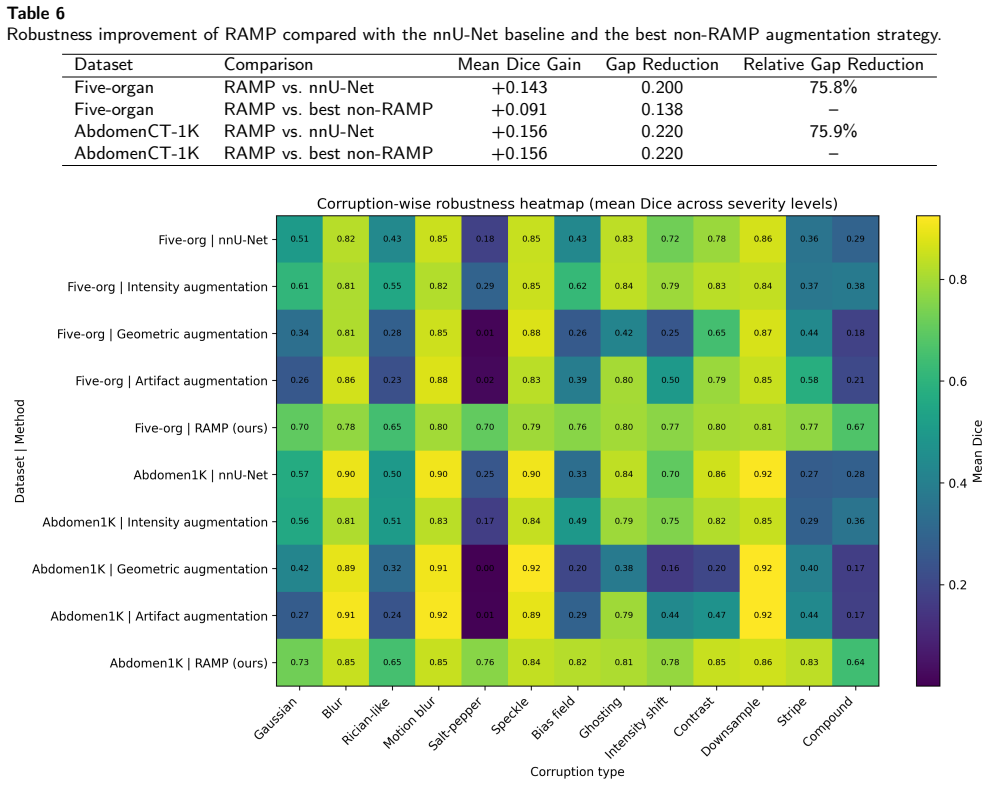
RAMP multi-corruption augmentation narrows the clean-to-corrupted Dice gap in CT segmentation from 0.26 to 0.06.
A machine-rendered reading of the paper's core claim, the machinery that carries it, and where it could break.
Core claim
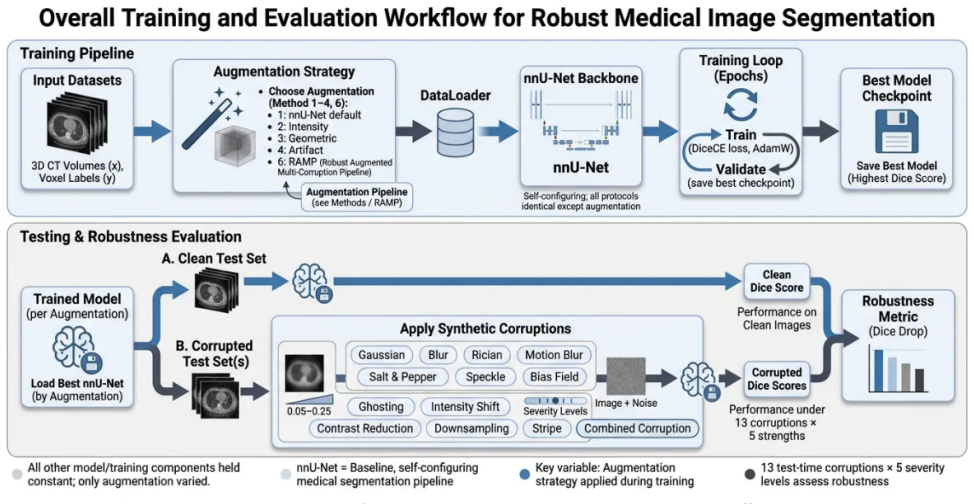
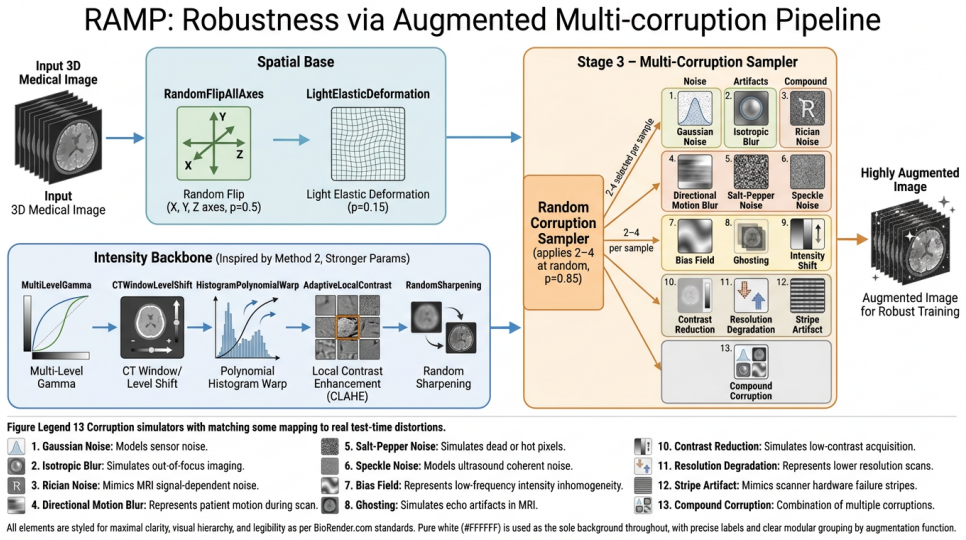
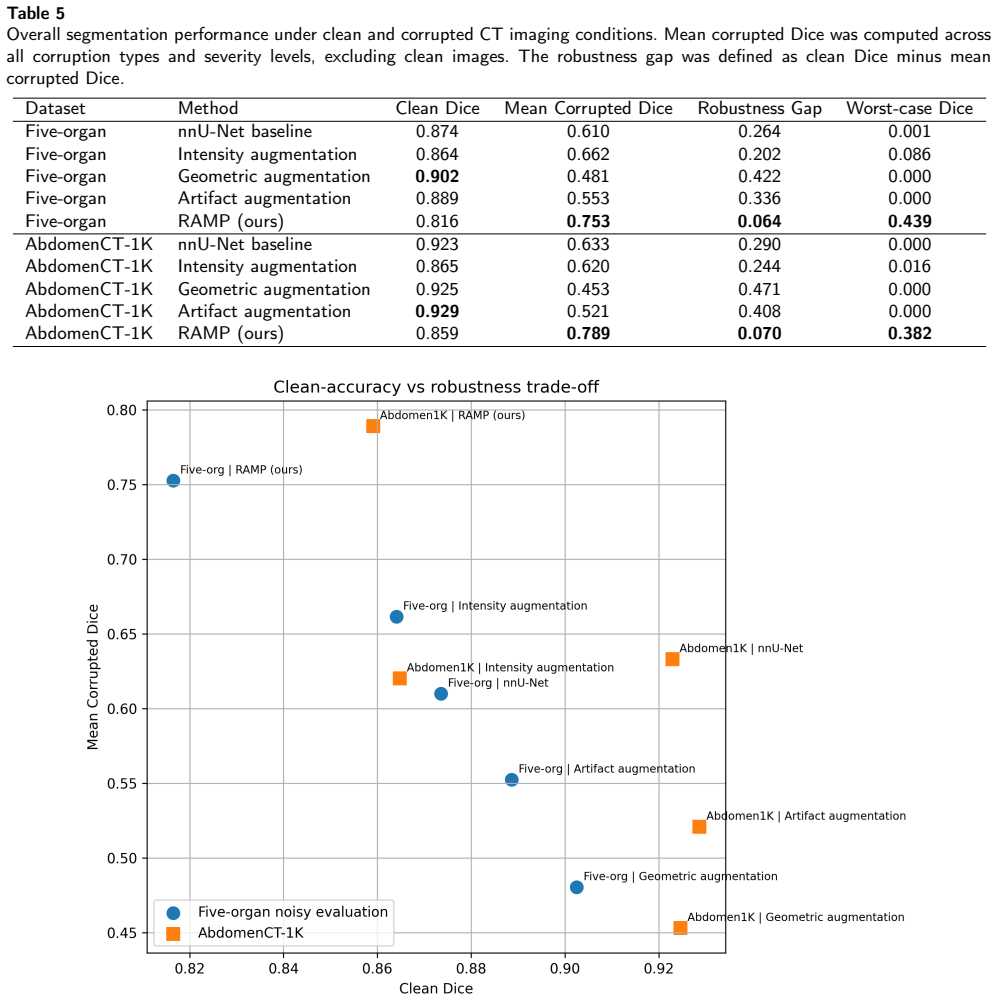
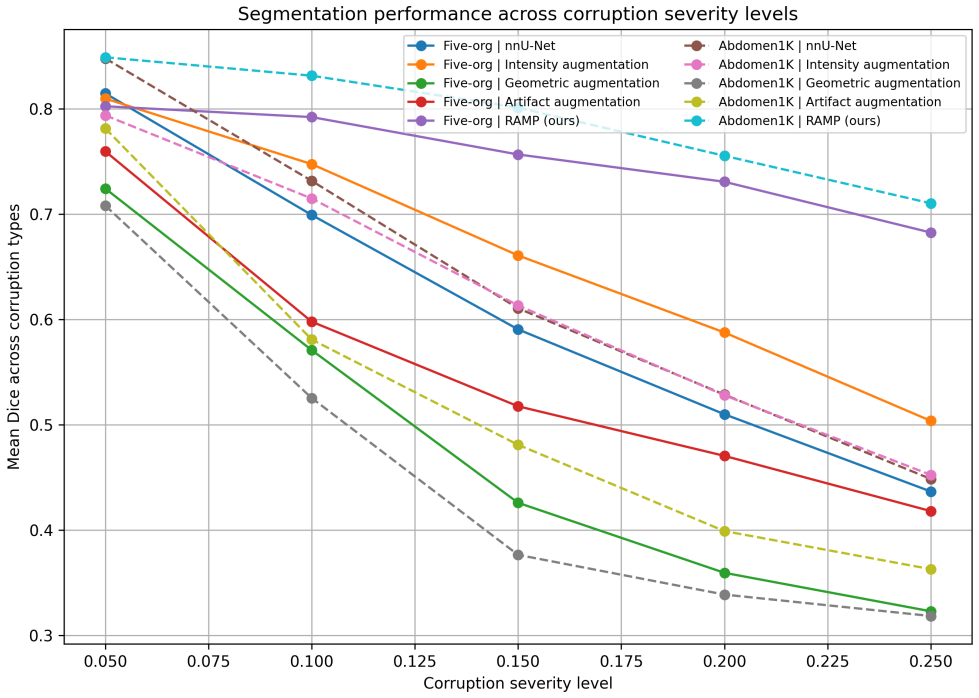
RAMP combines anatomically constrained spatial perturbations, CT intensity transformations, and stochastic multi-corruption composition to expose models to clinically plausible image degradation during training. Across two CT segmentation evaluation settings, RAMP achieved the strongest corrupted-image performance and the smallest clean-to-corrupted robustness gap. In the five-organ noisy evaluation benchmark, RAMP improved mean corrupted Dice from 0.610 to 0.753 and reduced the robustness gap from 0.264 to 0.064 compared with the nnU-Net baseline. In Abdomen1K, RAMP improved mean corrupted Dice from 0.633 to 0.789 and reduced the robustness gap from 0.290 to 0.070.
What carries the argument
Robustness via Augmented Multi-corruption Pipeline (RAMP), which uses stochastic composition of spatial, intensity, and artifact corruptions to simulate heterogeneous clinical conditions during training.
If this is right
- In the five-organ noisy benchmark, mean corrupted Dice rose from 0.610 to 0.753.
- The robustness gap dropped from 0.264 to 0.064 in that setting.
- Similar gains occurred in the Abdomen1K dataset with gap reduction from 0.290 to 0.070.
- Models avoid severe segmentation collapse under strong degradation even if not topping clean-image scores.
- Multi-corruption augmentation serves as a practical pre-deployment reliability strategy for heterogeneous clinical environments.
Where Pith is reading between the lines
- Similar augmentation strategies could be adapted for MRI or ultrasound segmentation tasks where image quality also varies.
- Deployed systems might benefit from periodic re-training with site-specific corruption profiles drawn from local scanner data.
- Combining RAMP with ensemble or uncertainty methods could further stabilize outputs when facing conditions outside the training corruptions.
Load-bearing premise
The specific set of corruptions and their stochastic composition rules used in RAMP are representative of the heterogeneous imaging conditions that will actually appear at deployment time.
What would settle it
A RAMP-trained model showing large Dice drops on real clinical CT scans that contain degradation types not included in the augmentation set would indicate the central claim does not hold.
Figures
read the original abstract
Deep learning-based CT segmentation systems often achieve high accuracy on clean benchmark images, but their performance may degrade under heterogeneous clinical imaging conditions such as noise, resolution loss, contrast variation, intensity shift, and artifacts. This instability can limit reliable deployment in real-world medical imaging workflows. We propose Robustness via Augmented Multi-corruption Pipeline (RAMP), a robustness-oriented augmentation framework for CT segmentation. RAMP combines anatomically constrained spatial perturbations, CT intensity transformations, and stochastic multi-corruption composition to expose models to clinically plausible image degradation during training. Across two CT segmentation evaluation settings, RAMP achieved the strongest corrupted-image performance and the smallest clean-to-corrupted robustness gap. In the five-organ noisy evaluation benchmark, RAMP improved mean corrupted Dice from 0.610 to 0.753 and reduced the robustness gap from 0.264 to 0.064 compared with the nnU-Net baseline. In Abdomen1K, RAMP improved mean corrupted Dice from 0.633 to 0.789 and reduced the robustness gap from 0.290 to 0.070. Although RAMP did not achieve the highest clean-image Dice, it substantially mitigated worst-case segmentation collapse under severe image degradation. These results suggest that multi-corruption augmentation can serve as a practical pre-deployment strategy for improving the reliability of CT segmentation systems in heterogeneous clinical environments.
Editorial analysis
A structured set of objections, weighed in public.
Referee Report
Summary. The manuscript proposes Robustness via Augmented Multi-corruption Pipeline (RAMP), an augmentation framework combining anatomically constrained spatial perturbations, CT intensity transformations, and stochastic multi-corruption composition to train CT segmentation models. It reports that RAMP yields the strongest corrupted-image performance and smallest clean-to-corrupted robustness gap on two benchmarks, improving mean corrupted Dice from 0.610 to 0.753 (gap reduced from 0.264 to 0.064) on a five-organ noisy evaluation benchmark and from 0.633 to 0.789 (gap from 0.290 to 0.070) on Abdomen1K, relative to an nnU-Net baseline.
Significance. If the robustness gains generalize beyond the specific corruptions used in training, the approach could provide a practical pre-deployment method for mitigating segmentation collapse under heterogeneous clinical imaging conditions. The reported numeric improvements in corrupted Dice and robustness gap are substantial and directly address a known deployment limitation of CT segmentation systems.
major comments (2)
- [Evaluation] The evaluation uses test images generated from the identical stochastic multi-corruption composition rules employed inside RAMP training. This measures in-distribution robustness rather than generalization to the broader heterogeneous clinical degradations claimed in the abstract (e.g., metal streak, motion blur, or scanner-specific ring artifacts absent from the augmentation set). Without held-out corruption families, the central claim that RAMP improves reliability under 'clinically plausible image degradation' is not fully supported. (Abstract; evaluation benchmarks description)
- [Methods] Exact corruption parameters, stochastic composition rules, and any post-hoc selection of corruption strengths are not reported, nor are statistical significance tests for the Dice improvements. These omissions prevent assessment of whether the gains are robust or reproducible. (Methods section)
minor comments (1)
- [Abstract] The abstract refers to a 'five-organ noisy evaluation benchmark' without specifying its construction details, relation to public datasets, or how the clean vs. corrupted splits were formed.
Simulated Author's Rebuttal
We thank the referee for the constructive comments, which help strengthen the manuscript. We address each major point below and will revise accordingly to improve clarity, reproducibility, and the scope of the claims.
read point-by-point responses
-
Referee: [Evaluation] The evaluation uses test images generated from the identical stochastic multi-corruption composition rules employed inside RAMP training. This measures in-distribution robustness rather than generalization to the broader heterogeneous clinical degradations claimed in the abstract (e.g., metal streak, motion blur, or scanner-specific ring artifacts absent from the augmentation set). Without held-out corruption families, the central claim that RAMP improves reliability under 'clinically plausible image degradation' is not fully supported. (Abstract; evaluation benchmarks description)
Authors: We agree that the reported benchmarks evaluate robustness to the same corruption families used in training and thus constitute in-distribution evaluation. While the corruptions were selected to reflect common clinical issues (noise, resolution loss, contrast/intensity variation), this does not demonstrate generalization to entirely unseen artifact types. In the revision we will add a new experiment section using held-out corruption families (metal streak artifacts, motion blur, and ring artifacts) that are not part of the RAMP training distribution. We will also revise the abstract and discussion to state more precisely that the gains apply to the clinically motivated degradations included in the augmentation pipeline. revision: yes
-
Referee: [Methods] Exact corruption parameters, stochastic composition rules, and any post-hoc selection of corruption strengths are not reported, nor are statistical significance tests for the Dice improvements. These omissions prevent assessment of whether the gains are robust or reproducible. (Methods section)
Authors: We accept this criticism. The revised manuscript will include a detailed supplementary appendix that specifies all corruption parameters (noise variances, blur kernel sizes, intensity shift ranges, etc.), the exact stochastic composition probabilities and ordering rules, and the procedure used to select corruption strengths. We will also add statistical significance testing (paired Wilcoxon signed-rank tests with Bonferroni correction) for all reported Dice improvements and include the resulting p-values in the main results tables. revision: yes
Circularity Check
No circularity: purely empirical comparison with no derivation chain
full rationale
The paper proposes an augmentation framework (RAMP) and reports empirical results on two CT segmentation benchmarks, measuring Dice scores and robustness gaps under applied corruptions. No mathematical derivations, predictions from fitted parameters, uniqueness theorems, or ansatzes are claimed. The central results (e.g., Dice improvements from 0.610 to 0.753) are direct experimental measurements on test images, not reductions to inputs by construction. Self-citations, if present, are not load-bearing for any premise. The work is self-contained as an experimental study; the skeptic concern about corruption overlap is a question of experimental design validity, not circularity in a derivation.
Axiom & Free-Parameter Ledger
Reference graph
Works this paper leans on
-
[1]
and Fischer, P
Ronneberger, O. and Fischer, P. and Brox, T. , title =. Medical Image Computing and Computer-Assisted Intervention -- MICCAI 2015 , volume =. 2015 , pages =
2015
-
[2]
2016 , pages =
3D U-Net: Learning Dense Volumetric Segmentation from Sparse Annotation , booktitle =. 2016 , pages =
2016
-
[3]
and Navab, N
Milletari, F. and Navab, N. and Ahmadi, S.-A. , title =. Proceedings of the Fourth International Conference on 3D Vision , volume =. 2016 , pages =
2016
-
[4]
and Jaeger, P
Isensee, F. and Jaeger, P. F. and Kohl, S. A. A. and Petersen, J. and Maier-Hein, K. H. , title =. Nat. Methods , volume =. 2021 , pages =
2021
-
[5]
and Kooi, T
Litjens, G. and Kooi, T. and Bejnordi, B. E. and Setio, A. A. A. and Ciompi, F. and Ghafoorian, M. and van der Laak, J. A. W. M. and van Ginneken, B. and S. A Survey on Deep Learning in Medical Image Analysis , journal =. 2017 , pages =
2017
-
[6]
and Reinke, A
Antonelli, M. and Reinke, A. and Bakas, S. and Farahani, K. and Kopp-Schneider, A. and Landman, B. A. and Litjens, G. and Menze, B. and Ronneberger, O. and Summers, R. M. and others , title =. Nat. Commun. , volume =. 2022 , pages =
2022
-
[7]
and Zhang, Y
Ma, J. and Zhang, Y. and Gu, S. and Zhu, C. and Ge, C. and Zhang, Y. and An, X. and Wang, C. and Wang, Q. and Liu, X. and Cao, S. and Zhang, Q. and Liu, S. and Wang, Y. and Li, Y. and He, J. and Yang, X. , title =. IEEE Trans. Pattern Anal. Mach. Intell. , volume =. 2022 , pages =
2022
-
[8]
and Breit, H.-C
Wasserthal, J. and Breit, H.-C. and Meyer, M. T. and Pradella, M. and Hinck, D. and Sauter, A. W. and Heye, T. and Boll, D. and Cyriac, J. and Yang, S. and Bach, M. and Segeroth, M. , title =. Radiol. Artif. Intell. , volume =. 2023 , pages =
2023
-
[9]
and Liu, M
Guan, H. and Liu, M. , title =. IEEE Trans. Biomed. Eng. , volume =. 2022 , pages =
2022
-
[10]
Zech, J. R. and Badgeley, M. A. and Liu, M. and Costa, A. B. and Titano, J. J. and Oermann, E. K. , title =. PLOS Med. , volume =. 2018 , pages =
2018
-
[11]
and Dietterich, T
Hendrycks, D. and Dietterich, T. , title =. International Conference on Learning Representations , volume =. 2019 , pages =
2019
-
[12]
and Jacobsen, J.-H
Geirhos, R. and Jacobsen, J.-H. and Michaelis, C. and Zemel, R. and Brendel, W. and Bethge, M. and Wichmann, F. A. , title =. Nat. Mach. Intell. , volume =. 2020 , pages =
2020
-
[13]
Kelly, C. J. and Karthikesalingam, A. and Suleyman, M. and Corrado, G. and King, D. , title =. BMC Med. , volume =. 2019 , pages =
2019
-
[14]
and Saria, S
Wiens, J. and Saria, S. and Sendak, M. and Ghassemi, M. and Liu, V. X. and Doshi-Velez, F. and Jung, K. and Heller, K. and Kale, D. and Saeed, M. and Ossorio, P. N. and Thadaney-Israni, S. and Goldenberg, A. , title =. Nat. Med. , volume =. 2019 , pages =
2019
-
[15]
and Beam, A
Yu, K.-H. and Beam, A. L. and Kohane, I. S. , title =. Nat. Biomed. Eng. , volume =. 2018 , pages =
2018
-
[16]
Topol, E. J. , title =. Nat. Med. , volume =. 2019 , pages =
2019
-
[17]
and Chen, Y
Nagendran, M. and Chen, Y. and Lovejoy, C. A. and Gordon, A. C. and Komorowski, M. and Harvey, H. and Topol, E. J. and Ioannidis, J. P. A. and Collins, G. S. and Maruthappu, M. , title =. BMJ , volume =. 2020 , pages =
2020
-
[18]
and Moy, L
Mongan, J. and Moy, L. and Kahn, C. E. Jr. , title =. Radiol. Artif. Intell. , volume =. 2020 , pages =
2020
-
[19]
and Nagendran, M
Vasey, B. and Nagendran, M. and Campbell, B. and Clifton, D. A. and Collins, G. S. and Denaxas, S. and Denniston, A. K. and Faes, L. and Geerts, B. and Ibrahim, M. and Liu, X. and Mateen, B. A. and Mathur, P. and McCradden, M. D. and Morgan, L. and Ordish, J. and Rogers, C. and Saria, S. and Ting, D. S. W. and Watkinson, P. and Weber, W. and Wheatstone, P...
2022
-
[20]
and Dunnmon, J
Oakden-Rayner, L. and Dunnmon, J. and Carneiro, G. and R. Hidden Stratification Causes Clinically Meaningful Failures in Machine Learning for Medical Imaging , booktitle =. 2020 , pages =
2020
-
[21]
Goodfellow, I. J. and Shlens, J. and Szegedy, C. , title =. International Conference on Learning Representations , volume =. 2015 , pages =
2015
-
[22]
Finlayson, S. G. and Bowers, J. D. and Ito, J. and Zittrain, J. L. and Beam, A. L. and Kohane, I. S. , title =. Science , volume =. 2019 , pages =
2019
-
[23]
and Khoshgoftaar, T
Shorten, C. and Khoshgoftaar, T. M. , title =. J. Big Data , volume =. 2019 , pages =
2019
-
[24]
Cubuk, E. D. and Zoph, B. and Mane, D. and Vasudevan, V. and Le, Q. V. , title =. Proceedings of the IEEE/CVF Conference on Computer Vision and Pattern Recognition , volume =. 2019 , pages =
2019
-
[25]
and Mu, N
Hendrycks, D. and Mu, N. and Cubuk, E. D. and Zoph, B. and Gilmer, J. and Lakshminarayanan, B. , title =. International Conference on Learning Representations , volume =. 2020 , pages =
2020
-
[26]
TorchIO: A Python Library for Efficient Loading, Preprocessing, Augmentation and Patch-Based Sampling of Medical Images in Deep Learning , journal =
P. TorchIO: A Python Library for Efficient Loading, Preprocessing, Augmentation and Patch-Based Sampling of Medical Images in Deep Learning , journal =. 2021 , pages =
2021
-
[27]
and Li, W
Gibson, E. and Li, W. and Sudre, C. and Fidon, L. and Shakir, D. I. and Wang, G. and Eaton-Rosen, Z. and Gray, R. and Doel, T. and Hu, Y. and Whyntie, T. and Nachev, P. and Modat, M. and Barratt, D. C. and Ourselin, S. and Cardoso, M. J. and Vercauteren, T. , title =. Comput. Methods Programs Biomed. , volume =. 2018 , pages =
2018
-
[28]
Cardoso, M. J. and Li, W. and Brown, R. and Ma, N. and Kerfoot, E. and Wang, Y. and Murrey, B. and Myronenko, A. and Zhao, C. and Yang, D. and Nath, V. and He, Y. and Xu, Z. and Hatamizadeh, A. and Zhu, W. and Liu, Y. and Zheng, M. and Tang, Y. and Yang, I. and Zephyr, M. and Hashemian, B. and Alle, S. and Darestani, M. Z. and Budd, C. and Modat, M. and V...
work page internal anchor Pith review Pith/arXiv arXiv 2022
-
[29]
and Sodha, V
Zhou, Z. and Sodha, V. and Rahman Siddiquee, M. M. and Feng, R. and Tajbakhsh, N. and Gotway, M. B. and Liang, J. , title =. Med. Image Anal. , volume =. 2021 , pages =
2021
-
[30]
and Yang, D
Hatamizadeh, A. and Yang, D. and Roth, H. and Xu, D. , title =. Proceedings of the IEEE/CVF Winter Conference on Applications of Computer Vision , volume =. 2022 , pages =
2022
-
[31]
Menze, B. H. and Jakab, A. and Bauer, S. and Kalpathy-Cramer, J. and Farahani, K. and Kirby, J. and Burren, Y. and Porz, N. and Slotboom, J. and Wiest, R. and Lanczi, L. and Gerstner, E. and Weber, M.-A. and Arbel, T. and Avants, B. B. and Ayache, N. and Buendia, P. and Collins, D. L. and Cordier, N. and Corso, J. J. and Criminisi, A. and Das, T. and Deli...
2015
-
[32]
and Bai, H
Ji, Y. and Bai, H. and Yang, J. and Ge, C. and Zhu, Y. and Zhang, R. and Li, Z. and Zhang, L. and Ma, W. and Wan, X. and Luo, P. , title =. Advances in Neural Information Processing Systems , volume =. 2022 , pages =
2022
discussion (0)
Sign in with ORCID, Apple, or X to comment. Anyone can read and Pith papers without signing in.