Hunting for Compact Object Binaries from eRASS1 Optical Counterparts through ZTF Time-domain Photometry and Multi-wavelength Census
Pith reviewed 2026-06-28 16:53 UTC · model grok-4.3
The pith
Coupling eRASS1 X-ray data with ZTF photometry and radio observations identifies dozens of compact object binary candidates.
A machine-rendered reading of the paper's core claim, the machinery that carries it, and where it could break.
Core claim
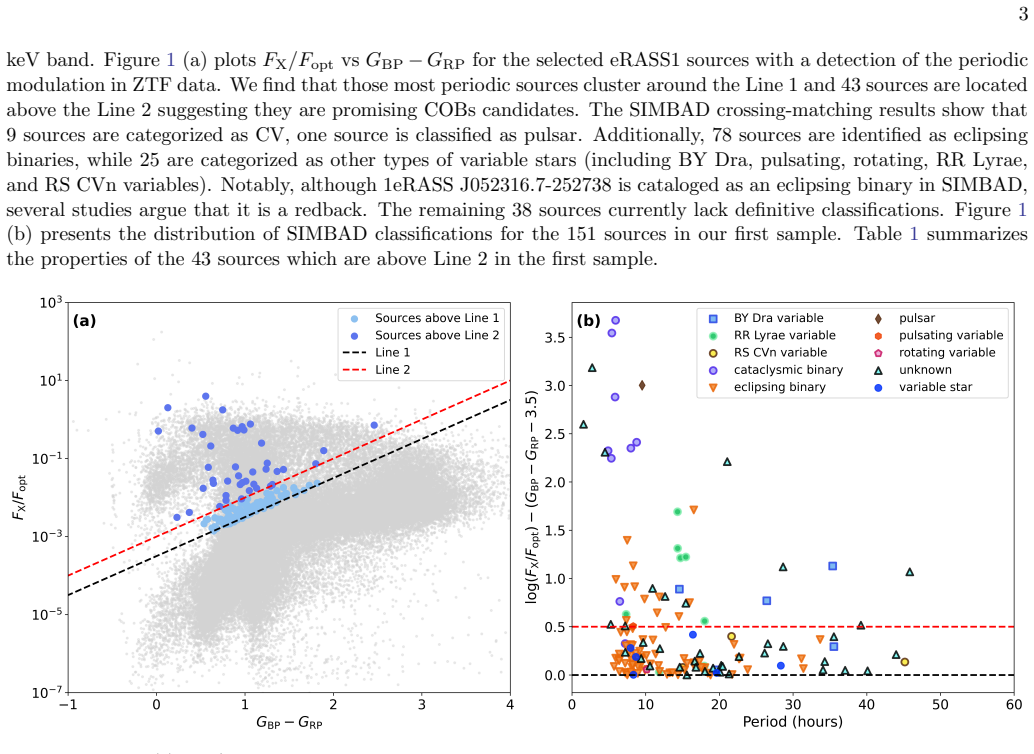
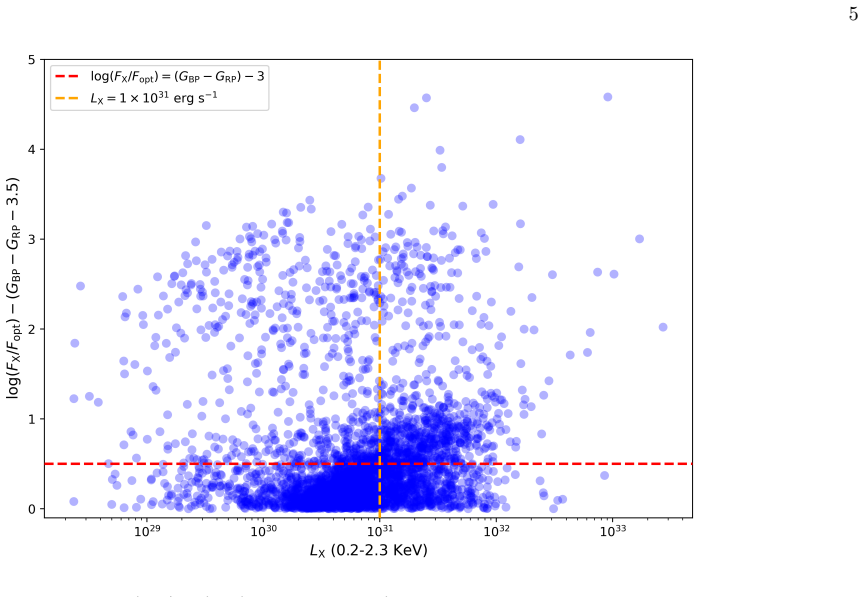
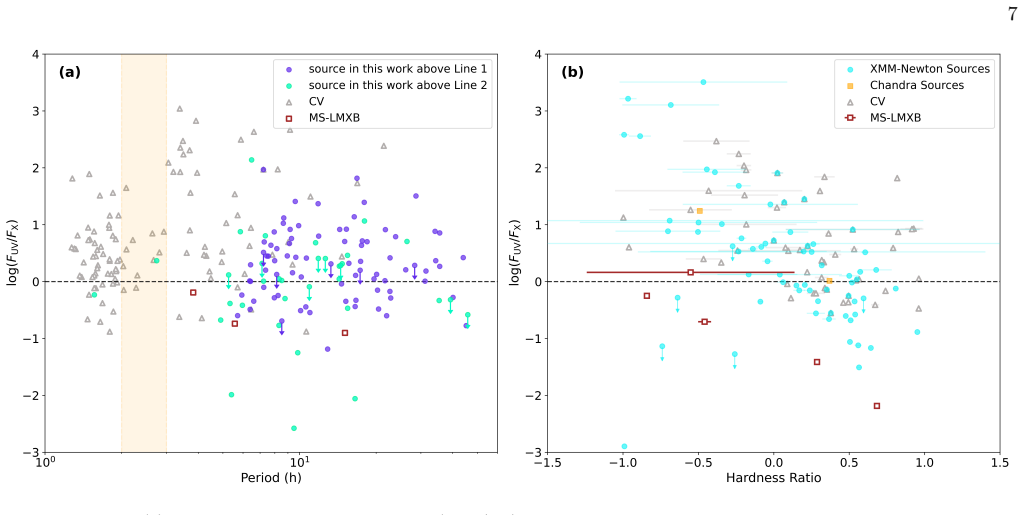
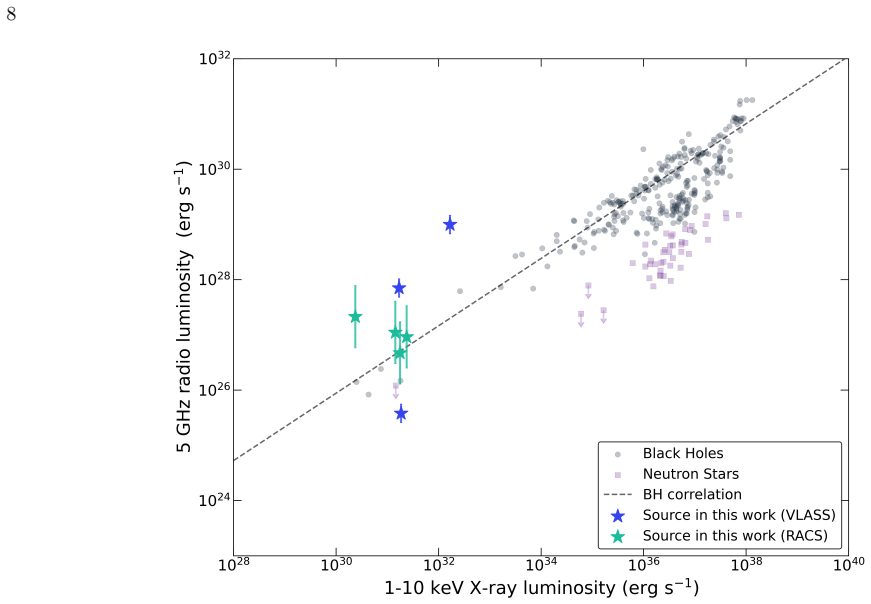
Capitalizing on the eRASS1 optical counterpart catalog, the study conducts a systematic census of compact object binary candidates by integrating ZTF time-domain photometry with multi-wavelength observations, yielding two samples—one of 151 periodically variable sources refined to 43 high-priority candidates and one of 1958 sources selected by X-ray luminosity or flux ratio—then cross-matches both with radio catalogs to reveal seven radio-emitting sources as promising candidates.
What carries the argument
Two complementary pipelines—one selecting periodically variable sources from ZTF photometry and the other selecting sources by elevated X-ray luminosities or high log(F_X/F_opt) ratios—followed by radio catalog cross-matching.
If this is right
- The 43 high-priority candidates become targets for targeted follow-up to confirm binary nature and orbital parameters.
- Radio detections strengthen the case for four sources as X-ray binaries by adding an independent indicator of non-thermal emission.
- The same selection criteria can be applied to future eRASS data releases to enlarge the known population of compact object binaries.
- Distance constraints in the second sample allow rough estimates of X-ray luminosities that help prioritize the most luminous systems.
Where Pith is reading between the lines
- Population synthesis models could be tested by comparing the observed candidate numbers against predicted space densities of black-hole and neutron-star binaries.
- If many candidates prove to be quiescent black-hole systems, the method could increase the known sample of such objects available for dynamical mass measurements.
- Extending the radio cross-match to deeper surveys such as VLASS or ASKAP might uncover additional faint compact object binaries missed in current catalogs.
Load-bearing premise
Periodic variability combined with high X-ray to optical flux ratios and radio emission reliably picks out compact object binaries while keeping contamination from other variable sources low.
What would settle it
Spectroscopic or multi-epoch follow-up showing that most of the 43 high-priority candidates are actually cataclysmic variables, active stars, or unrelated variables rather than compact object binaries would undermine the low-contamination claim.
Figures
read the original abstract
Capitalizing on the eRASS1 optical counterpart catalog, we conduct a systematic census of compact object binary (COB) candidates, with a primary focus on X-ray binaries (XRBs), by integrating ZTF time-domain photometry with multi-wavelength observations. This framework establishes two complementary pipelines, yielding two distinct source samples. The first sample consists of 151 periodically variable sources, from which a highly refined subset of 43 high-priority COB candidates is identified. The second sample comprises 1958 distance-constrained sources selected based on elevated X-ray luminosities or high $\log (F_{\mathrm{X}}/F_{\mathrm{opt}})$. Crucially, cross-matching both samples with radio catalogs reveals seven radio-emitting sources, highlighting four promising XRB candidates. Our results underscore that coupling eROSITA with wide-field time-domain photometric and multi-wavelength surveys offers a highly efficient strategy for uncovering the hidden population of COBs.
Editorial analysis
A structured set of objections, weighed in public.
Referee Report
Summary. The manuscript describes a systematic search for compact object binary (COB) candidates, focusing on X-ray binaries (XRBs), by cross-matching the eRASS1 optical counterpart catalog with ZTF time-domain photometry and multi-wavelength data. Two pipelines are presented: one identifying 151 periodically variable sources, refined to 43 high-priority COB candidates, and another selecting 1958 distance-constrained sources based on elevated X-ray luminosities or high log(F_X/F_opt) ratios. Cross-matching with radio catalogs yields seven radio-emitting sources, including four promising XRB candidates. The authors conclude that integrating eROSITA with wide-field surveys provides a highly efficient strategy for uncovering hidden COB populations.
Significance. If the reported selections prove reliable with quantified low contamination, this work would establish a practical multi-survey framework for discovering compact object binaries missed by single-wavelength approaches, potentially expanding the known Galactic XRB population and informing binary evolution models.
major comments (3)
- [Abstract] Abstract: The refinement from 151 periodically variable sources to a 'highly refined subset of 43 high-priority COB candidates' is stated without any description of the additional selection criteria, validation metrics, purity estimates, or explicit rejection of common contaminants (e.g., CVs, active stars, AGN). This directly undermines assessment of the central claim that the pipeline yields reliable COB identifications.
- [Abstract] Abstract: The second sample of 1958 'distance-constrained sources selected based on elevated X-ray luminosities or high log(F_X/F_opt)' provides no numerical thresholds, justification for the cuts, completeness estimates, or comparison against known non-COB populations that can satisfy the same X-ray/optical criteria. Without these, the efficiency assertion cannot be evaluated.
- [Abstract] Abstract: The cross-match yielding 'four promising XRB candidates' from seven radio-emitting sources offers no definition of 'promising,' no false-positive rate assessment, and no discussion of how radio emission combined with the prior cuts excludes alternative interpretations. This is load-bearing for the multi-wavelength census claim.
Simulated Author's Rebuttal
We thank the referee for the constructive comments, which identify opportunities to make the abstract more self-contained and transparent regarding our selection processes. We agree that expanding the abstract with concise references to the key criteria will improve readability while preserving its summary nature. Details of all selections, metrics, and contaminant rejection are already present in the main text; the revisions will primarily involve adding brief summaries and cross-references in the abstract.
read point-by-point responses
-
Referee: [Abstract] Abstract: The refinement from 151 periodically variable sources to a 'highly refined subset of 43 high-priority COB candidates' is stated without any description of the additional selection criteria, validation metrics, purity estimates, or explicit rejection of common contaminants (e.g., CVs, active stars, AGN). This directly undermines assessment of the central claim that the pipeline yields reliable COB identifications.
Authors: The additional selection criteria (including periodicity significance thresholds, color cuts, and explicit rejection of CVs, active stars, and AGN via multi-wavelength diagnostics), validation metrics, and purity estimates are fully described in Sections 3.2, 4.1, and 5. We will revise the abstract to include a brief clause summarizing the main refinement steps (e.g., 'after applying variability amplitude and color cuts to exclude common contaminants') and direct readers to the methods for full details. This addresses the concern without lengthening the abstract excessively. revision: yes
-
Referee: [Abstract] Abstract: The second sample of 1958 'distance-constrained sources selected based on elevated X-ray luminosities or high log(F_X/F_opt)' provides no numerical thresholds, justification for the cuts, completeness estimates, or comparison against known non-COB populations that can satisfy the same X-ray/optical criteria. Without these, the efficiency assertion cannot be evaluated.
Authors: The specific numerical thresholds (log L_X > 10^32 erg/s and log(F_X/F_opt) > -1), their justification based on known XRB properties, completeness estimates, and comparisons to non-COB populations are provided in Section 3.3. We will revise the abstract to state the thresholds explicitly (e.g., 'selected with log L_X > ... or log(F_X/F_opt) > ...') and note that full justification appears in the text. This will allow direct evaluation of the efficiency claim from the abstract. revision: yes
-
Referee: [Abstract] Abstract: The cross-match yielding 'four promising XRB candidates' from seven radio-emitting sources offers no definition of 'promising,' no false-positive rate assessment, and no discussion of how radio emission combined with the prior cuts excludes alternative interpretations. This is load-bearing for the multi-wavelength census claim.
Authors: The definition of 'promising' (based on radio detection combined with high X-ray luminosity, periodic variability or elevated F_X/F_opt, and exclusion of AGN via spectral indices and optical colors), along with false-positive considerations, is detailed in Section 4.3. We will revise the abstract to briefly define the criteria (e.g., 'four sources meeting radio + X-ray + variability criteria consistent with XRBs') and reference the section for the exclusion of alternatives. This strengthens the multi-wavelength aspect without requiring new analysis. revision: yes
Circularity Check
No circularity: purely observational selection with no derivations or fitted predictions
full rationale
The paper performs a census by applying observational cuts (periodic ZTF variability, elevated L_X or log(F_X/F_opt), radio cross-matches) to eRASS1 counterparts and reports raw counts of candidates. No equations, parameter fits, model predictions, or uniqueness theorems appear in the provided text. Selection criteria are stated directly from multi-wavelength properties without reduction to prior fitted inputs or self-citations. The central efficiency claim rests on the empirical yield of candidates rather than any self-referential derivation, making the work self-contained as an observational study.
Axiom & Free-Parameter Ledger
free parameters (1)
- selection thresholds for periodic variability, X-ray luminosity, and log(F_X/F_opt)
axioms (1)
- domain assumption Periodic optical variability combined with high X-ray to optical flux ratios indicates the presence of a compact object binary.
Reference graph
Works this paper leans on
-
[1]
2018, Radio/X-ray correlation database for X-ray binaries, v0.1 Zenodo, doi: 10.5281/zenodo.1252036
Bahramian, A., Miller-Jones, J., Strader, J., et al. 2018, Radio/X-ray correlation database for X-ray binaries, v0.1 Zenodo, doi: 10.5281/zenodo.1252036
-
[2]
Bahramian, A., Heinke, C. O., Kennea, J. A., et al. 2021, Monthly Notices of the Royal Astronomical Society, 501, 2790, doi: 10.1093/mnras/staa3868
-
[3]
Demleitner, M., & Andrae, R. 2021, AJ, 161, 147, doi: 10.3847/1538-3881/abd806
work page internal anchor Pith review doi:10.3847/1538-3881/abd806 2021
-
[4]
2025, A&A, 704, A107, doi: 10.1051/0004-6361/202556747
Bao, T., Ponti, G., Haberl, F., et al. 2025, A&A, 704, A107, doi: 10.1051/0004-6361/202556747
-
[5]
Belloni, D., & Schreiber, M. R. 2023, in Handbook of X-ray and Gamma-ray Astrophysics, 129, doi: 10.1007/978-981-16-4544-0 98-1
-
[6]
2017, ApJS, 230, 24, doi: 10.3847/1538-4365/aa7053
Bianchi, L., Shiao, B., & Thilker, D. 2017, ApJS, 230, 24, doi: 10.3847/1538-4365/aa7053
-
[7]
Boller, T., Freyberg, M. J., Tr¨ umper, J., et al. 2016, A&A, 588, A103, doi: 10.1051/0004-6361/201525648
work page internal anchor Pith review doi:10.1051/0004-6361/201525648 2016
-
[8]
Burgio, G., Schulze, H.-J., Vida˜ na, I., & Wei, J.-B. 2021, Progress in Particle and Nuclear Physics, 120, 103879, doi: https://doi.org/10.1016/j.ppnp.2021.103879
-
[9]
M., Casares J., Mu \ n oz-Darias T., Bauer F
Corral-Santana, J. M., Casares, J., Mu˜ noz-Darias, T., et al. 2016, A&A, 587, A61, doi: 10.1051/0004-6361/201527130
-
[10]
2024, Publications of the Astronomical Society of Australia, 41, doi: 10.1017/pasa.2024.72
Driessen, L., Pritchard, J., Murphy, T., et al. 2024, Publications of the Astronomical Society of Australia, 41, doi: 10.1017/pasa.2024.72
-
[11]
Driessen, L. N., Williams, D. R. A., McDonald, I., et al. 2022, MNRAS, 510, 1083, doi: 10.1093/mnras/stab3461
-
[12]
Evans, I. N., Evans, J. D., Mart´ ınez-Galarza, J. R., et al. 2024, ApJS, 274, 22, doi: 10.3847/1538-4365/ad6319
-
[13]
1992, Accretion power in astrophysics., Vol
Frank, J., King, A., & Raine, D. 1992, Accretion power in astrophysics., Vol. 21
1992
-
[14]
Galiullin, I., Rodriguez, A. C., El-Badry, K., et al. 2024, A&A, 690, A374, doi: 10.1051/0004-6361/202450734
-
[15]
Gordon, Y. A., Boyce, M. M., O’Dea, C. P., et al. 2021, ApJS, 255, 30, doi: 10.3847/1538-4365/ac05c0
-
[16]
Hale, C. L., McConnell, D., Thomson, A. J. M., et al. 2021, PASA, 38, e058, doi: 10.1017/pasa.2021.47
-
[17]
Heinke, C. O., Grindlay, J. E., Edmonds, P. D., et al. 2005, ApJ, 625, 796, doi: 10.1086/429899
-
[18]
Jonker, P. G., Bassa, C. G., Nelemans, G., et al. 2011, ApJS, 194, 18, doi: 10.1088/0067-0049/194/2/18
-
[19]
Jansky Very Large Array Sky Survey (VLASS)
Lacy, M., Baum, S. A., Chandler, C. J., et al. 2020, PASP, 132, 035001, doi: 10.1088/1538-3873/ab63eb
-
[20]
2025, ApJ, 991, 125, doi: 10.3847/1538-4357/adfecd
Liu, H.-B., Gu, W.-M., Lu, Y., Liu, T., & Liu, J.-Z. 2025, ApJ, 991, 125, doi: 10.3847/1538-4357/adfecd
-
[21]
Maan, V., Katira, A., & Mooley, K. P. 2025, MNRAS, 544, 885, doi: 10.1093/mnras/staf1752
-
[22]
L., Lenc, E., Banfield, et al.\ 2020
McConnell, D., Hale, C. L., Lenc, E., et al. 2020, PASA, 37, e048, doi: 10.1017/pasa.2020.41
-
[23]
Merloni, A., Lamer, G., Liu, T., et al. 2024, A&A, 682, A34, doi: 10.1051/0004-6361/202347165
work page internal anchor Pith review doi:10.1051/0004-6361/202347165 2024
-
[24]
Morrissey, P., Conrow, T., Barlow, T. A., et al. 2007, ApJS, 173, 682, doi: 10.1086/520512 Mu˜ noz-Giraldo, D., Stelzer, B., Schwope, A., et al. 2026, A&A, 707, A62, doi: 10.1051/0004-6361/202557266
-
[25]
2017, PASP, 129, 062001, doi: 10.1088/1538-3873/aa6736
Mukai, K. 2017, PASP, 129, 062001, doi: 10.1088/1538-3873/aa6736
-
[26]
Olejak, A., Belczynski, K., Bulik, T., & Sobolewska, M. 2020, A&A, 638, A94, doi: 10.1051/0004-6361/201936557
-
[27]
Plotkin, R. M., Gallo, E., & Jonker, P. G. 2013, ApJ, 773, 59, doi: 10.1088/0004-637X/773/1/59
-
[28]
2021, A&A, 647, A1, doi: 10.1051/0004-6361/202039313
Predehl, P., Andritschke, R., Arefiev, V., et al. 2021, A&A, 647, A1, doi: 10.1051/0004-6361/202039313
-
[29]
Reis, R. C., Wheatley, P. J., G¨ ansicke, B. T., & Osborne, J. P. 2013, MNRAS, 430, 1994, doi: 10.1093/mnras/stt025
-
[30]
Remillard, R. A., & McClintock, J. E. 2006, ARA&A, 44, 49, doi: 10.1146/annurev.astro.44.051905.092532 10
work page internal anchor Pith review Pith/arXiv arXiv doi:10.1146/annurev.astro.44.051905.092532 2006
-
[31]
2003, A&A, 404, 301, doi: 10.1051/0004-6361:20030330
Ritter, H., & Kolb, U. 2003, A&A, 404, 301, doi: 10.1051/0004-6361:20030330
-
[32]
Rodriguez, A. C. 2024, PASP, 136, 054201, doi: 10.1088/1538-3873/ad357c
-
[33]
C., El-Badry, K., Suleimanov, V., et al
Rodriguez, A. C., El-Badry, K., Suleimanov, V., et al. 2025, PASP, 137, 014201, doi: 10.1088/1538-3873/ada185
-
[34]
Russell, D. M., Fender, R. P., Hynes, R. I., et al. 2006, MNRAS, 371, 1334, doi: 10.1111/j.1365-2966.2006.10756.x
-
[35]
2025, A&A, 704, A344, doi: 10.1051/0004-6361/202556142
Salvato, M., Wolf, J., Dwelly, T., et al. 2025, A&A, 704, A344, doi: 10.1051/0004-6361/202556142
-
[36]
2024, A&A, 686, A110, doi: 10.1051/0004-6361/202348426
Schwope, A., Kurpas, J., Baecke, P., et al. 2024, A&A, 686, A110, doi: 10.1051/0004-6361/202348426
-
[37]
Smith, R. C. 2006, Contemporary Physics, 47, 363, doi: 10.1080/00107510601181175
-
[38]
2022, A&A, 657, A138, doi: 10.1051/0004-6361/202141259 Tr¨ umper, J
Tranin, H., Godet, O., Webb, N., & Primorac, D. 2022, A&A, 657, A138, doi: 10.1051/0004-6361/202141259 Tr¨ umper, J. 1982, Advances in Space Research, 2, 241, doi: https://doi.org/10.1016/0273-1177(82)90070-9
-
[39]
, year = 1997, volume = 35, pages =
Ulrich, M.-H., Maraschi, L., & Urry, C. 2003, Annual Review of Astronomy and Astrophysics, 35, 445, doi: 10.1146/annurev.astro.35.1.445
-
[40]
2025, A&A, 698, A321, doi: 10.1051/0004-6361/202452230
Wang, X., & Takata, J. 2025, A&A, 698, A321, doi: 10.1051/0004-6361/202452230
-
[41]
Wang, Y. D., Bellm, E. C., Hynes, R. I., et al. 2026, ApJS, 284, 13, doi: 10.3847/1538-4365/ae5247
-
[42]
A., Coriat, M., Traulsen, I., et al
Webb, N. A., Coriat, M., Traulsen, I., et al. 2020, A&A, 641, A136, doi: 10.1051/0004-6361/201937353
-
[43]
2026, arXiv e-prints, arXiv:2603.09228, doi: 10.48550/arXiv.2603.09228
Xu, Y.-J., Gu, W.-M., Fang, X.-Y., Weng, S.-S., & An, T. 2026, arXiv e-prints, arXiv:2603.09228, doi: 10.48550/arXiv.2603.09228
-
[44]
2026, MNRAS, 546, stag058, doi: 10.1093/mnras/stag058
Zhao, Y., Gandhi, P., Knigge, C., et al. 2026, MNRAS, 546, stag058, doi: 10.1093/mnras/stag058
discussion (0)
Sign in with ORCID, Apple, or X to comment. Anyone can read and Pith papers without signing in.