On Jean-Marie Souriau's geometric quantization of the relativistic electron
Pith reviewed 2026-06-28 16:39 UTC · model grok-4.3
The pith
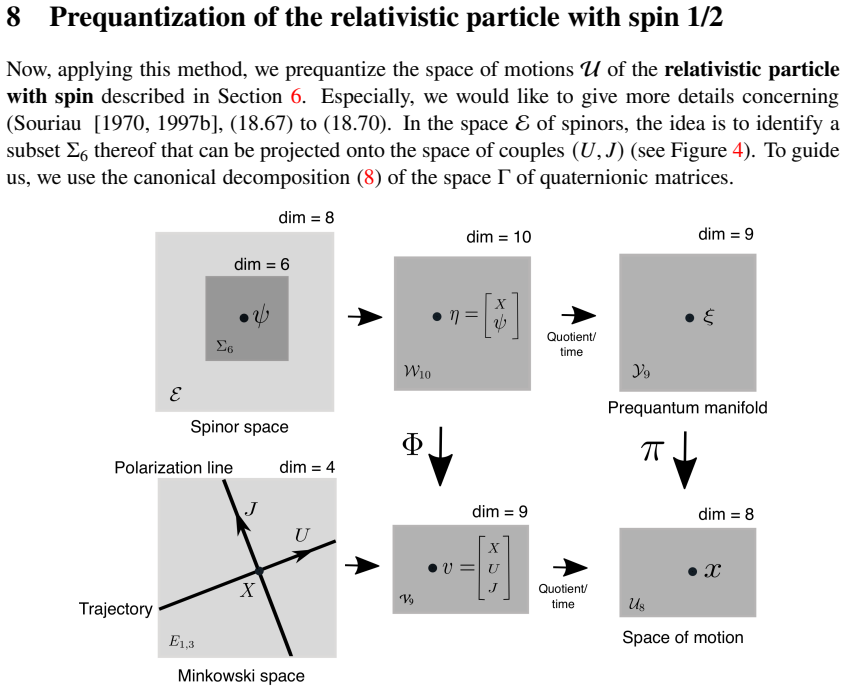
Two theorems equip the prequantum manifold of the relativistic spin-1/2 particle with symplectic and contact structures, yielding the Dirac equation.
A machine-rendered reading of the paper's core claim, the machinery that carries it, and where it could break.
Core claim
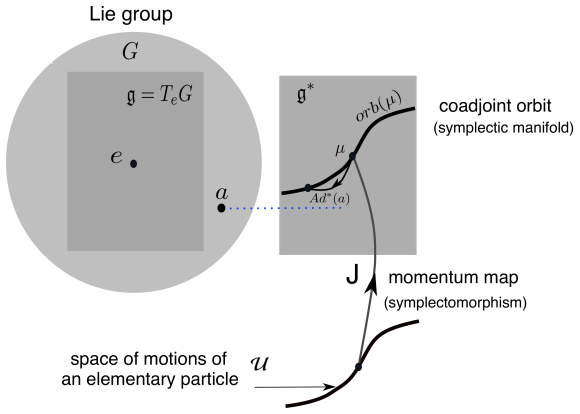
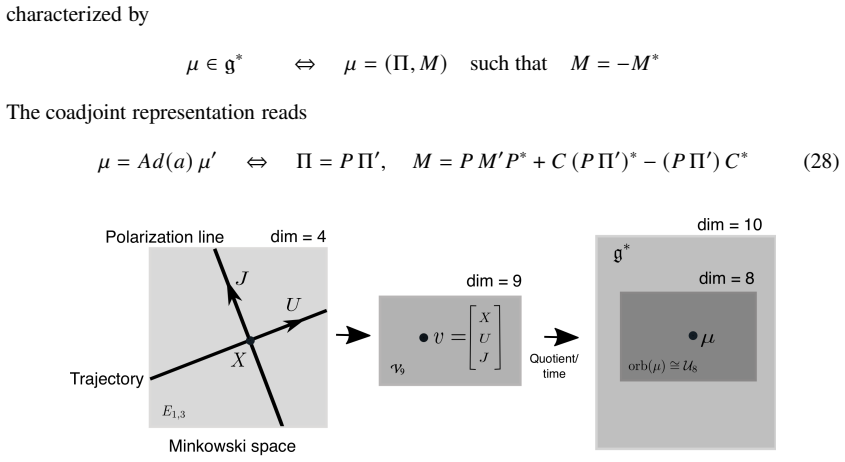
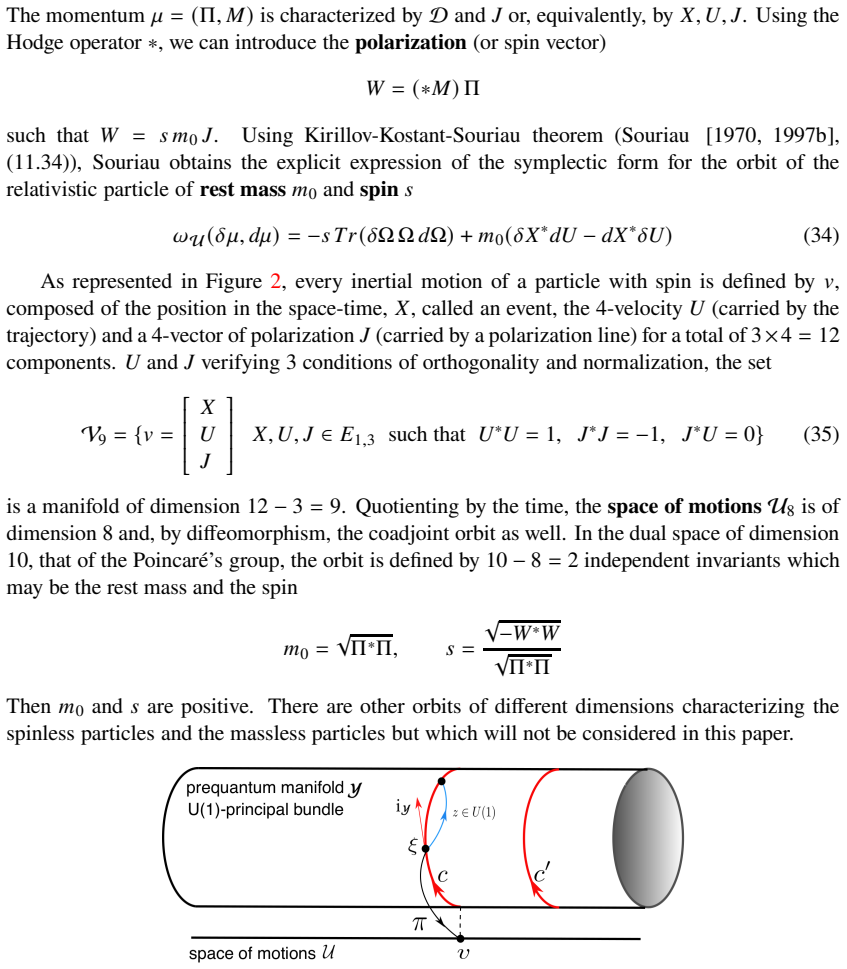
The coadjoint orbit method, together with two keystone theorems that equip the prequantum manifold with symplectic and contact structures, applied to the relativistic particle with spin 1/2, leads directly to the Dirac equation, the conservation of the probability current, an identity of conservation for the spin current, and a systematic construction of the C, P, and T symmetries via Kaluza-Klein theory.
What carries the argument
The coadjoint orbit method, which realizes the phase space as orbits of the Poincaré group, combined with two theorems that install symplectic and contact structures on the prequantum manifold.
If this is right
- The Dirac equation appears as the quantum evolution law for the spin-1/2 particle.
- The probability current satisfies a continuity equation.
- The spin current obeys a stated conservation identity.
- The discrete symmetries C, P, and T arise from the Kaluza-Klein lift in a unified geometric way.
Where Pith is reading between the lines
- The proved theorems make the missing steps in Souriau's book directly verifiable by the reader.
- The same geometric route may be examined for consistency when external electromagnetic fields are added to the manifold.
Load-bearing premise
The coadjoint orbit method and the two keystone theorems can be applied to the prequantum manifold of the relativistic particle with spin to produce the required symplectic and contact structures.
What would settle it
A direct computation of the quantum evolution equation from the contact structure on the prequantum manifold that fails to recover the standard Dirac operator would falsify the derivation.
Figures
read the original abstract
The aim of this paper is to revisit, in Souriau's book "Structure of Dynamical Systems", the chapter devoted to the geometric quantization where the justifications of important results and formulae are not given and are difficult to prove. After recalling the coadjoint orbit method and its application to the relativistic particle with spin, we state and prove two keystone theorems that allow to equip its prequantum manifold with the symplectic and contact structures. We apply them to the relativistic particle with spin 1/2, leading to the Dirac equation and the conservation of the probability current. We propose also an identity of conservation of the spin current and, invoking the Kaluza-Klein theory, a systematic construction of the symmetries of charge conjugation, parity transformation and time reversal which seems to us more convenient and readable than that of the classical presentations.
Editorial analysis
A structured set of objections, weighed in public.
Referee Report
Summary. The paper revisits the geometric quantization chapter in Souriau's 'Structure of Dynamical Systems', supplying missing justifications for the coadjoint orbit method applied to the relativistic particle with spin. It states and proves two keystone theorems equipping the prequantum manifold with the required symplectic and contact structures. These are applied to the spin-1/2 case to derive the Dirac equation together with conservation of the probability current, an identity for spin-current conservation, and (via Kaluza-Klein reduction) explicit constructions of the C, P, and T symmetries.
Significance. If the two keystone theorems and the subsequent derivations hold, the manuscript supplies the explicit proofs and intermediate steps that were omitted in Souriau's original treatment. This strengthens the geometric-quantization route to the Dirac equation and yields a systematic, orbit-based account of the discrete symmetries, which may prove useful for further work on relativistic particles with internal degrees of freedom.
minor comments (3)
- The abstract refers to 'two keystone theorems' without naming or briefly characterizing them; a one-sentence description of each theorem would help readers locate the central technical contribution.
- Several intermediate formulae are recalled from Souriau's book without restating the precise definitions or notation used in the present manuscript; adding a short 'Notation and recall' subsection would reduce dependence on the original text.
- The Kaluza-Klein construction of the C, P, T symmetries is presented as 'more convenient' than classical treatments, but the comparison is not made explicit; a brief side-by-side indication of the differences would strengthen the claim.
Simulated Author's Rebuttal
We thank the referee for the positive assessment of the manuscript, the recognition of the two keystone theorems, and the recommendation of minor revision. No specific major comments appear in the report, so we have nothing further to address point by point. We remain ready to incorporate any minor editorial or presentational suggestions the editor may request.
Circularity Check
No significant circularity; derivations rest on explicitly proved theorems
full rationale
The paper recalls the coadjoint orbit method from Souriau but then states and proves two keystone theorems that supply the missing symplectic and contact structures on the prequantum manifold. These theorems are presented as independent contributions whose proofs are supplied in the manuscript. Application to the spin-1/2 case then yields the Dirac equation, current conservations, and C/P/T symmetries via standard Kaluza-Klein theory. No step reduces a claimed result to a fitted parameter, a self-citation chain, or an unverified ansatz imported from the authors' own prior work; the central claims therefore remain self-contained against external benchmarks.
Axiom & Free-Parameter Ledger
axioms (2)
- domain assumption The coadjoint orbit method applies to the relativistic particle with spin
- domain assumption Kaluza-Klein theory supplies a systematic construction of CPT symmetries
Reference graph
Works this paper leans on
-
[1]
New York, McGraw-Hill, 1964
Bjorken, J., Drell, S., Relativistic Quantum Mechanics . New York, McGraw-Hill, 1964
1964
-
[2]
Breban, R., The Four Dimensional Dirac Equation in Five Dimensions, Annalen der Physik, 530, 1800042 (2018)
2018
-
[3]
de Saxc\'e, G., Which symmetry group for elementary particles with an electric charge today and in the past? Journal of Geometry and Physics , 213, 105491 (2025)
2025
-
[4]
Physique et Sciences de la Matière
C. Duval, Mécanique hamiltonienne, symétries et quantification, Master "Physique et Sciences de la Matière" Lecture Notes, 2011
2011
-
[5]
Differential geometric methods in mathematical physics , Lecture Notes in Mathematics 570, Springer, 97-108 (1977)
Kijowski, J., Geometric structure of quantization. Differential geometric methods in mathematical physics , Lecture Notes in Mathematics 570, Springer, 97-108 (1977)
1977
-
[6]
Kostant, B., Quantization and unitary representations. 1. Prequantisation, Lecture Notes in Mathematics 170, Springer (1970)
1970
-
[7]
Réimprimé par les éditions Jacques Gabay, Paris
Souriau, J.-M., Géométrie et relativité , Hermann, collection enseignement des sciences, Paris, 1964. Réimprimé par les éditions Jacques Gabay, Paris
1964
-
[8]
Réimprimé en un seul volume par les éditions Jacques Gabay, Paris
Souriau, J.-M., Calcul linéaire , Presses universitaires de France, collection Euclide, Paris, tome I, 1964, et tome II, 1965. Réimprimé en un seul volume par les éditions Jacques Gabay, Paris
1964
-
[9]
Souriau, J.-M., Quantification Géométrique, Commun. math. Phys. , 1, 374-398 (1966)
1966
-
[10]
Réimprimé par les éditions Jacques Gabay, Paris
Souriau, J.-M., Structure des systèmes dynamique , Dunod, collection Dunod Université, Paris, 1970. Réimprimé par les éditions Jacques Gabay, Paris
1970
-
[11]
Souriau, J.-M., Geometric quantization and general relativity. In R. Ruffini, editor, Marcel Grossmann Meeting on general Relativity, pages 89–99, Trieste, 1975. North-Holland
1975
-
[12]
A Symplectic View of Physics
Souriau, J.-M., Structure of Dynamical Systems. A Symplectic View of Physics . Translated by C. H. Cushman-de Vries. Translation Editors R. H. Cushman and G. M. Tuynman. Progress in Mathematics Volume 149, Birkhäuser, Boston, 1997
1997
-
[13]
Woodhouse, N.M.J., Geometric Quantization , Clarendon Press (1991)
1991
discussion (0)
Sign in with ORCID, Apple, or X to comment. Anyone can read and Pith papers without signing in.