Gravitational-wave astronomy with a space-based optical clock network
Pith reviewed 2026-06-28 14:00 UTC · model grok-4.3
The pith
Space-based optical clock networks extract astrophysical information from binary gravitational-wave sources using one-way Doppler tracking.
A machine-rendered reading of the paper's core claim, the machinery that carries it, and where it could break.
Core claim
By using one-way Doppler tracking in space-based atomic clock networks, critical astrophysical information about binary gravitational-wave sources can be extracted, as shown by the development of measurement protocols, noise analysis, and parameter estimation on simulated signals.
What carries the argument
One-way Doppler tracking in space-based optical clock networks, enabling tunable sensitivity from millihertz to hertz frequencies.
If this is right
- The detectors can access the millihertz band inaccessible to ground-based instruments.
- Sensitivity can be tuned across a broad band up to the hertz regime.
- They provide complementary capabilities to optical interferometers like LISA.
- Parameter estimation can yield astrophysical details on binary sources.
Where Pith is reading between the lines
- Combining such networks with ground-based detectors could enable multi-band gravitational wave astronomy.
- The approach might improve source localization for electromagnetic follow-up.
Load-bearing premise
Dominant noise sources can be characterized and mitigated sufficiently for reliable parameter estimation based on simulations.
What would settle it
Experimental data from a space-based clock network demonstrating that noise mitigation allows accurate recovery of binary parameters from real signals.
Figures
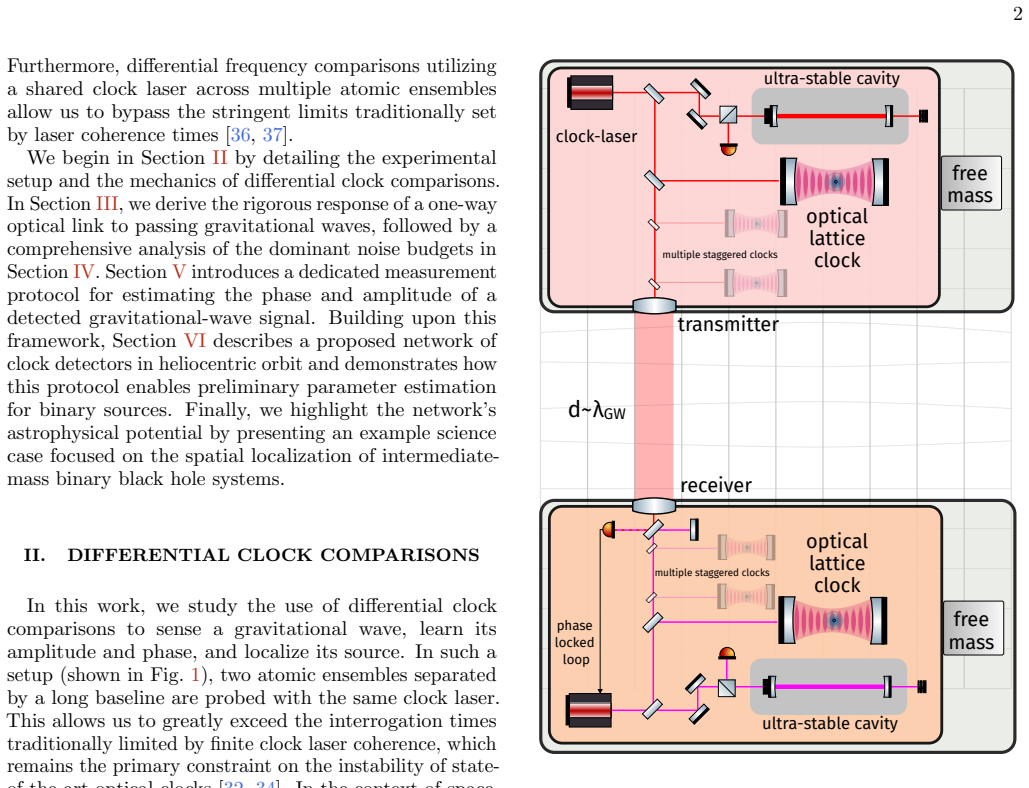
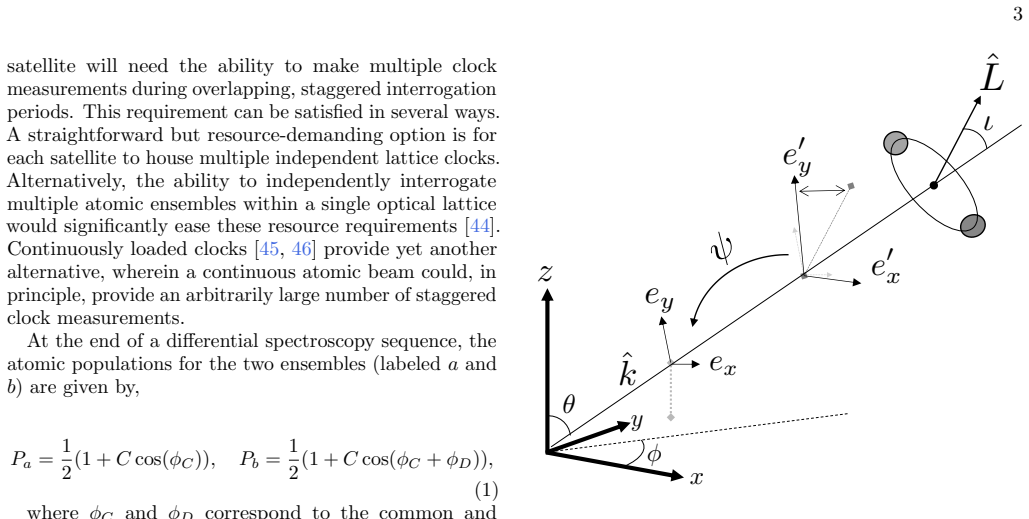
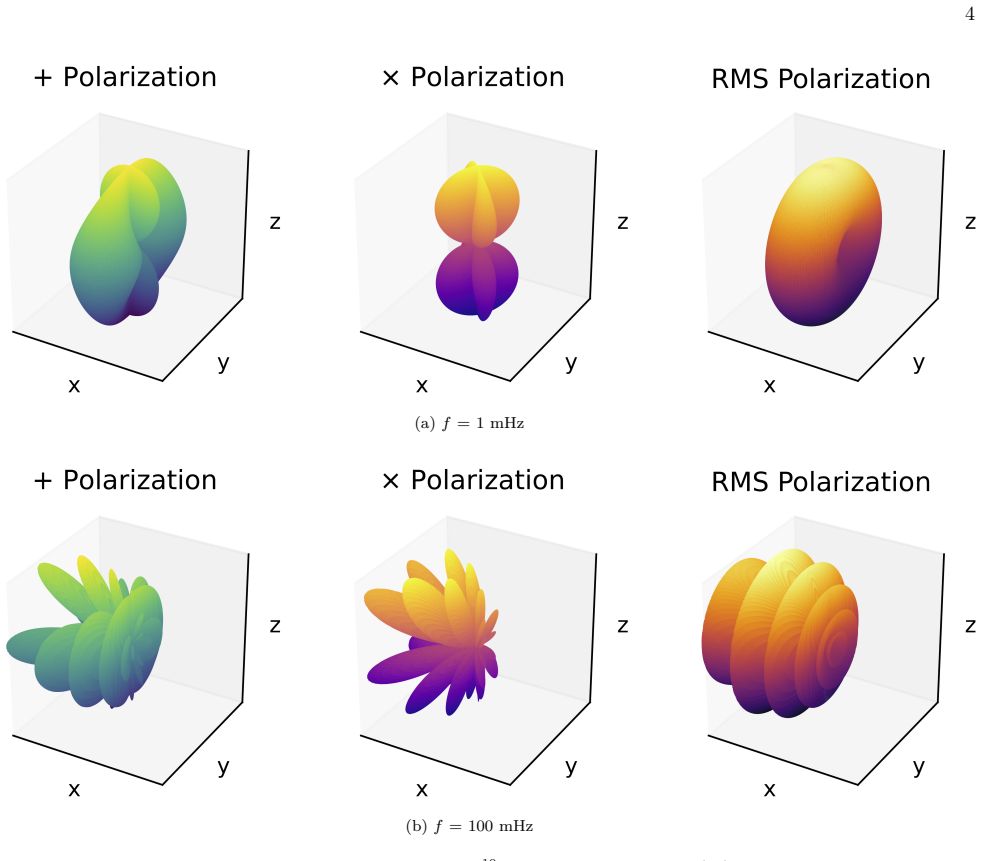
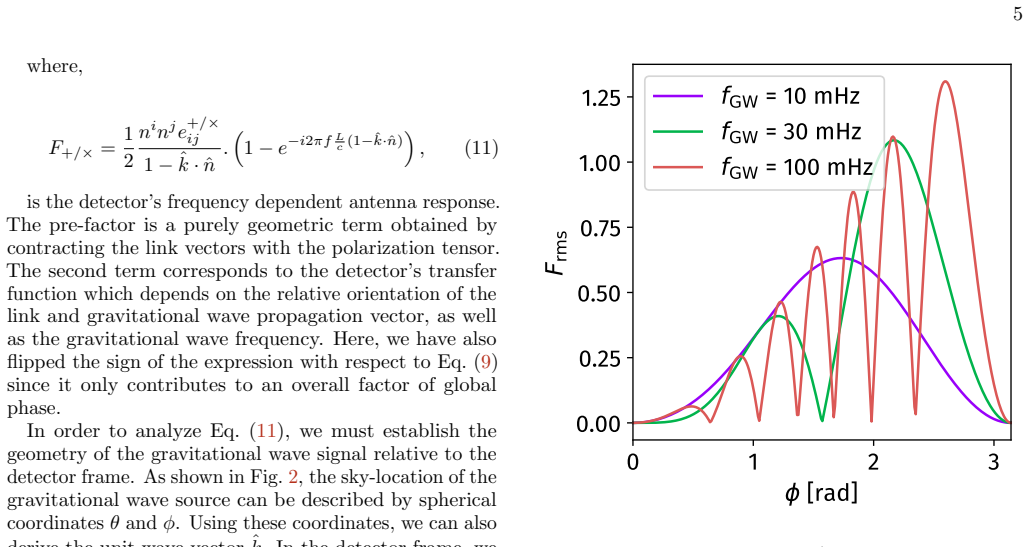
read the original abstract
Since the first detection of a merging binary black hole system a decade ago, gravitational-wave astronomy has emerged as a powerful tool for astrophysics. Future space-based observatories, such as the Laser Interferometer Space Antenna (LISA), will unlock the millihertz (mHz) band, which remains entirely inaccessible to ground-based detectors due to terrestrial noise. In parallel, proposed atom-based gravitational-wave detectors, specifically those based on space-based optical clocks and atom interferometers, offer capabilities that are unique and complementary to traditional optical interferometers. Their highly tunable character enable sensitive measurements across a broad frequency band extending from the mHz up to and possibly even above the Hz regime. In this work, we investigate the use of one-way Doppler tracking in space-based atomic clock networks operating in concert with detectors like LISA. We develop dedicated measurement protocols, analyze dominant noise sources, and perform preliminary parameter estimation on simulated gravitational-wave signals. Ultimately, we demonstrate how these detectors could be used to extract critical astrophysical information about binary gravitational-wave sources.
Editorial analysis
A structured set of objections, weighed in public.
Referee Report
Summary. The manuscript proposes combining one-way Doppler tracking in space-based optical clock networks with LISA-like interferometers for gravitational-wave detection. It develops dedicated measurement protocols, analyzes dominant noise sources, and performs parameter estimation on simulated signals from binary sources, claiming this enables extraction of critical astrophysical information about those sources across a tunable mHz-to-Hz band.
Significance. If the noise models and mitigation strategies hold under realistic conditions, the work could provide a complementary channel to LISA with tunable sensitivity, potentially improving parameter recovery for millihertz binaries. The simulation-based demonstration of parameter estimation is a positive step, but its value depends on the fidelity of the unshown noise budgets.
major comments (2)
- [Abstract / parameter estimation section] Abstract and results sections: the central claim that the network 'could be used to extract critical astrophysical information' rests on parameter estimation performed solely on simulated signals. No quantitative error budgets, residual noise levels after mitigation, or tests against unmodeled systematics are provided, which is load-bearing for whether simulated recovery translates to real observability.
- [Noise analysis] Noise analysis section: the dominant noise sources are stated to be analyzed and mitigated, yet the manuscript supplies no explicit equations for the noise power spectral densities, no comparison of mitigated versus unmitigated residuals, and no validation against independent constraints (e.g., existing clock or LISA noise data). This leaves the efficacy of the protocols unverified.
minor comments (1)
- [Abstract] The abstract refers to 'preliminary parameter estimation' without specifying the waveform model, priors, or recovered parameters; adding these details would improve clarity.
Simulated Author's Rebuttal
We thank the referee for their detailed review and constructive feedback. We address the major comments point by point below, indicating planned revisions where appropriate. The manuscript presents a conceptual proposal with preliminary simulations; we agree that additional quantitative details will strengthen the presentation.
read point-by-point responses
-
Referee: [Abstract / parameter estimation section] Abstract and results sections: the central claim that the network 'could be used to extract critical astrophysical information' rests on parameter estimation performed solely on simulated signals. No quantitative error budgets, residual noise levels after mitigation, or tests against unmodeled systematics are provided, which is load-bearing for whether simulated recovery translates to real observability.
Authors: We agree that the parameter estimation is performed on simulated signals and constitutes a preliminary demonstration rather than a full observability study. The simulations incorporate the dominant noise sources discussed in the noise analysis, but we acknowledge the absence of explicit quantitative error budgets and residual levels. In revision we will add these budgets and clarify the scope as a proof-of-concept for the proposed protocols. Tests against unmodeled systematics lie beyond the present scope and will be noted as future work. revision: yes
-
Referee: [Noise analysis] Noise analysis section: the dominant noise sources are stated to be analyzed and mitigated, yet the manuscript supplies no explicit equations for the noise power spectral densities, no comparison of mitigated versus unmitigated residuals, and no validation against independent constraints (e.g., existing clock or LISA noise data). This leaves the efficacy of the protocols unverified.
Authors: The referee correctly notes that explicit PSD equations, mitigated-versus-unmitigated comparisons, and direct validation against external data are not provided. The current text discusses the dominant sources and mitigation strategies at a descriptive level. We will incorporate the requested explicit equations, residual comparisons, and relevant cross-checks with published LISA and optical-clock noise models in the revised manuscript. revision: yes
Circularity Check
No circularity; analysis relies on simulations of established concepts without self-referential reduction
full rationale
The paper develops dedicated measurement protocols for one-way Doppler tracking in clock networks, analyzes dominant noise sources, and performs parameter estimation on simulated gravitational-wave signals. No equations or derivations are shown that reduce outputs to inputs by construction, nor are there fitted parameters renamed as predictions. Claims build on prior LISA and optical clock literature without load-bearing self-citations or uniqueness theorems imported from the authors' own work. The derivation chain is self-contained against external benchmarks and does not exhibit any of the enumerated circular patterns.
Axiom & Free-Parameter Ledger
Reference graph
Works this paper leans on
-
[1]
and the Einstein Telescope [13], hold immense promise for the advancement of gravitational-wave astronomy, the detection band of ground-based interferometers is fundamentally limited by seismic and technical noise at low frequencies [ 14, 15]. To overcome this limitation, space-based observatories such as the Laser Interferometer Space Antenna (LISA) are ...
Pith/arXiv arXiv 1975
-
[2]
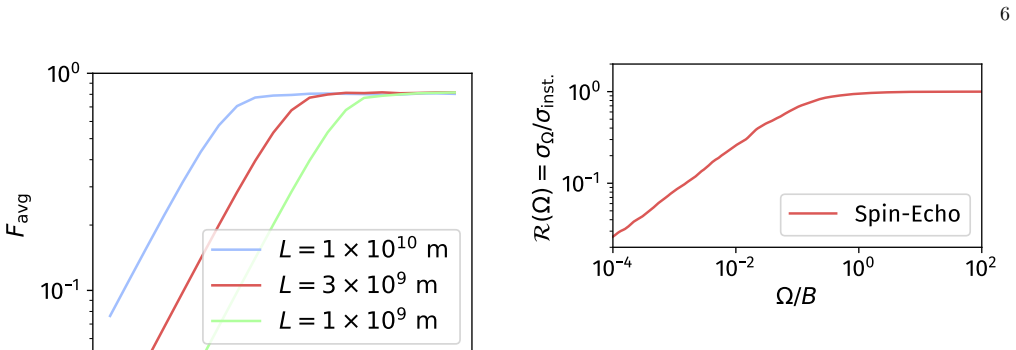
While atom numbers of this magnitude in one- dimensional optical lattices typically introduce density- dependent frequency shifts, the time-varying fluctuations of these shifts, which are the primary concern for AC 6 10 3 10 2 10 1 100 f [Hz] 10 1 100 Favg L = 1 × 10¹⁰ m L = 3 × 10⁹ m L = 1 × 10⁹ m FIG. 5. Sky and polarization averaged frequency response ...
-
[3]
B. Abbott et al. (LIGO Scientific Collaboration and Virgo Collaboration), Phys. Rev. Lett.116, 061102 (2016), URL http://dx.doi.org/10.1103/PhysRevLett. 116.061102
-
[4]
R. Abbott, T. D. Abbott, F. Acernese, K. Ackley, C. Adams, N. Adhikari, R. X. Adhikari, V. B. Adya, C. Affeldt, D. Agarwal, et al. (LIGO Scientific Collabora- tion, Virgo Collaboration, and KAGRA Collaboration), Phys. Rev. X13, 041039 (2023), URL https://link.aps. org/doi/10.1103/PhysRevX.13.041039
-
[5]
LIGO Scientific Collaboration, Virgo Collaboration, and KAGRA Collaboration (2025), 2508.18082, URL https: //arxiv.org/abs/2508.18082
Pith/arXiv arXiv 2025
-
[6]
LIGO Scientific Collaboration, Virgo Collaboration, and KAGRA Collaboration,Gravitational-Wave Candidate Event Database (GraceDB): O4 Public Superevents, https://gracedb.ligo.org/superevents/public/O4/ (2024), accessed: 2026-05-29
2024
-
[7]
Abbott, T
R. Abbott, T. D. Abbott, S. Abraham, F. Acernese, K. Ackley, A. Adams, C. Adams, R. X. Adhikari, V. B. Adya, C. Affeldt, et al., The Astrophysical Journal Letters913, L7 (2021), URL https://dx.doi.org/10. 3847/2041-8213/abe949
2021
-
[8]
B. P. Abbott et al. (LIGO Scientific Collaboration and Virgo Collaboration), Phys. Rev. Lett.122, 061104 (2019), URL https://link.aps.org/doi/10. 1103/PhysRevLett.122.061104
2019
-
[9]
Abbott et al., Physical Review Letters121(2018), URL https://doi.org/10.1103\%2Fphysrevlett.121
B. Abbott et al., Physical Review Letters121(2018), URL https://doi.org/10.1103\%2Fphysrevlett.121. 161101
2018
-
[10]
D. Kasen, B. Metzger, J. Barnes, E. Quataert, and E. Ramirez-Ruiz, Nature551, 80 (2017), URL https: 18 //doi.org/10.1038/nature24453
-
[11]
Abbott, R., Abbott, T. D., Acernese, F., Ackley, K., Adams, C., Adhikari, N., Adhikari, R. X., Adya, V. B., Affeldt, C., Agarwal, D., et al., A&A659, A84 (2022), URLhttps://doi.org/10.1051/0004-6361/202141452
-
[12]
Abbott and others
R. Abbott and others. (LIGO Scientific Collabora- tion and Virgo Collaboration), Phys. Rev. D103, 122002 (2021), URL https://link.aps.org/doi/10. 1103/PhysRevD.103.122002
2021
-
[13]
R. Abbott, H. Abe, F. Acernese, K. Ackley, N. Adhikari, R. X. Adhikari, V. K. Adkins, V. B. Adya, C. Affeldt, D. Agarwal, et al., The Astrophysical Journal949, 76 (2023), URL https://dx.doi.org/10.3847/1538-4357/ ac74bb
-
[14]
M. Evans, R. X. Adhikari, C. Afle, S. W. Ballmer, S. Biscoveanu, S. Borhanian, D. A. Brown, Y. Chen, R. Eisenstein, A. Gruson, et al.,A horizon study for cosmic explorer: Science, observatories, and community (2021), 2109.09882, URL https://doi.org/10.48550/ arXiv.2109.09882
Pith/arXiv arXiv 2021
-
[15]
Punturo, M
M. Punturo, M. Abernathy, F. Acernese, B. Allen, N. Andersson, K. Arun, F. Barone, B. Barr, M. Barsuglia, M. Beker, et al., Classical and Quantum Gravity 27, 194002 (2010), URL https://dx.doi.org/10.1088/ 0264-9381/27/19/194002
2010
-
[16]
Aasi et al
J. Aasi et al. (LIGO Scientific), Classical and Quantum Gravity32, 074001 (2015), URL https://doi.org/10. 1088/0264-9381/32/7/074001
2015
-
[17]
Harms, Living Reviews in Relativity22, 6 (2019), URL https://doi.org/10.1007/s41114-019-0022-2
J. Harms, Living Reviews in Relativity22, 6 (2019), URL https://doi.org/10.1007/s41114-019-0022-2
-
[18]
M. Colpi, K. Danzmann, M. Hewitson, K. Holley- Bockelmann, P. Jetzer, G. Nelemans, A. Petiteau, D. Shoemaker, C. Sopuerta, R. Stebbins, et al.,Lisa definition study report(2024), 2402.07571, URL https: //arxiv.org/abs/2402.07571
Pith/arXiv arXiv 2024
-
[19]
T. Robson, N. J. Cornish, and C. Liu, Classical and Quantum Gravity36, 105011 (2019), URL https://doi. org/10.1088/1361-6382/ab1101
-
[20]
M. A. Sedda, C. P. L. Berry, K. Jani, P. Amaro-Seoane, P. Auclair, J. Baird, T. Baker, E. Berti, K. Breivik, A. Burrows, et al., Classical and Quantum Gravity 37, 215011 (2020), URL https://doi.org/10.1088/ 1361-6382/abb5c1
2020
-
[21]
Kawamura et al., Classical and Quantum Gravity 28, 094011 (2011), URL https://doi.org/10.1088/ 0264-9381/28/9/094011
S. Kawamura et al., Classical and Quantum Gravity 28, 094011 (2011), URL https://doi.org/10.1088/ 0264-9381/28/9/094011
2011
-
[22]
G. M. Harry, P. Fritschel, D. A. Shaddock, W. Folkner, and E. S. Phinney, Classical and Quantum Gravity 23, 4887 (2006), URL https://doi.org/10.1088/ 0264-9381/23/15/008
2006
-
[23]
M. A. Norcia, J. R. K. Cline, and J. K. Thompson, Phys. Rev. A96, 042118 (2017), URL https://link.aps.org/ doi/10.1103/PhysRevA.96.042118
-
[24]
Kolkowitz, I
S. Kolkowitz, I. Pikovski, N. Langellier, M. D. Lukin, R. L. Walsworth, and J. Ye, Phys. Rev. D94, 124043 (2016), URL https://link.aps.org/doi/10. 1103/PhysRevD.94.124043
2016
-
[25]
M. Abe, P. Adamson, M. Borcean, D. Bortoletto, K. Bridges, S. P. Carman, S. Chattopadhyay, J. Coleman, N. M. Curfman, K. DeRose, et al., Quantum Science and Technology6, 044003 (2021), URL https://dx.doi.org/ 10.1088/2058-9565/abf719
-
[26]
Vutha, New Journal of Physics17, 063030 (2015), ISSN 1367-2630, URL http://stacks.iop.org/1367-2630/ 17/i=6/a=063030
A. Vutha, New Journal of Physics17, 063030 (2015), ISSN 1367-2630, URL http://stacks.iop.org/1367-2630/ 17/i=6/a=063030
2015
-
[27]
Yu and M
N. Yu and M. Tinto, General Relativity and Gravitation 43, 1943 (2011), URL https://doi.org/10.1007/ s10714-010-1055-8
1943
-
[28]
F. B. Estabrook and H. D. Wahlquist, General Relativity and Gravitation6, 439 (1975), URL https://doi.org/ 10.1007/BF00762449
-
[29]
R. W. Hellings and G. S. Downs, Apjl265, L39 (1983), URL https://ui.adsabs.harvard.edu/abs/1983ApJ... 265L..39H
1983
-
[30]
Agazie et al
G. Agazie et al. (NANOGrav), The Astrophysical Journal Letters951, L8 (2023), URL https://doi.org/10.3847/ 2041-8213/acdac6
2023
-
[31]
J. Antoniadis et al. (EPTA and InPTA), Astronomy & Astrophysics678, A50 (2023), URL https://doi.org/ 10.1051/0004-6361/202346844
-
[32]
D. J. Reardon et al. (PPTA), The Astrophysical Journal Letters951, L6 (2023), URL https://doi.org/10.3847/ 2041-8213/acdd02
2023
-
[33]
H. Xu et al. (CPTA), Research in Astronomy and Astrophysics23, 075024 (2023), URL https://doi.org/ 10.1088/1674-4527/acdfa5
-
[34]
A. D. Ludlow, M. M. Boyd, J. Ye, E. Peik, and P. O. Schmidt, Rev. Mod. Phys.87, 637 (2015), URL https: //link.aps.org/doi/10.1103/RevModPhys.87.637
-
[35]
A. Aeppli, K. Kim, W. Warfield, M. S. Safronova, and J. Ye, Phys. Rev. Lett.133, 023401 (2024), URL https:// link.aps.org/doi/10.1103/PhysRevLett.133.023401
-
[36]
Oelker, R
E. Oelker, R. B. Hutson, C. J. Kennedy, L. Sonderhouse, T. Bothwell, A. Goban, D. Kedar, C. Sanner, J. M. Robinson, G. E. Marti, et al., Nature Photonics 13, 714 (2019), URL https://doi.org/10.1038/ s41566-019-0493-4
2019
-
[37]
I. Courtillot, A. Quessada, R. P. Kovacich, A. Brusch, D. Kolker, J.-J. Zondy, G. D. Rovera, and P. Lemonde, Phys. Rev. A68, 030501 (2003), URL https://link.aps. org/doi/10.1103/PhysRevA.68.030501
-
[38]
X. Zheng, J. Dolde, V. Lochab, B. N. Merriman, H. Li, and S. Kolkowitz, Nature602, 425 (2022), URL https: //doi.org/10.1038/s41586-021-04344-y
-
[39]
Zheng, J
X. Zheng, J. Dolde, M. C. Cambria, H. M. Lim, and S. Kolkowitz, Nature Communications14, 4886 (2023), ISSN 2041-1723, URL https://doi.org/10. 1038/s41467-023-40629-8
2023
-
[40]
F. Guo, W. Tan, C.-h. Zhou, J. Xia, Y.-x. Chen, T. Liang, Q. Liu, Y. Liu, D.-j. He, Y.-z. Zhou, et al., AIP Advances 11(2021)
2021
-
[41]
Xia et al., Review of Scientific Instruments96, 093201 (2025)
J. Xia et al., Review of Scientific Instruments96, 093201 (2025)
2025
-
[42]
N. Yu, Z. Pan, and H. Zheng, inThird Advanced Imaging and Information Processing Conference (AIIP 2025) (SPIE, 2025), vol. 13817, p. 138170D
2025
-
[43]
P. McNamara, S. Vitale, K. Danzmann, and (on behalf of the LISA Pathfinder Science Working Team), Classical and Quantum Gravity25, 114034 (2008), URL https: //doi.org/10.1088/0264-9381/25/11/114034
-
[44]
Armano, H
M. Armano, H. Audley, G. Auger, J. T. Baird, M. Bassan, P. Binetruy, M. Born, D. Bortoluzzi, N. Brandt, M. Caleno, et al., Phys. Rev. Lett.116, 231101 (2016), URL https://link.aps.org/doi/10. 1103/PhysRevLett.116.231101
2016
-
[45]
M. Armano, H. Audley, J. Baird, P. Binetruy, M. Born, D. Bortoluzzi, E. Castelli, A. Cavalleri, A. Cesarini, A. M. Cruise, et al., Phys. Rev. Lett. 19 120, 061101 (2018), URL https://link.aps.org/doi/ 10.1103/PhysRevLett.120.061101
-
[46]
Zheng, J
X. Zheng, J. Dolde, and S. Kolkowitz, Phys. Rev. X 14, 011006 (2024), URL https://link.aps.org/doi/10. 1103/PhysRevX.14.011006
2024
-
[47]
Katori, Applied Physics Express14, 072006 (2021), URLhttps://doi.org/10.35848/1882-0786/ac0e16
H. Katori, Applied Physics Express14, 072006 (2021), URLhttps://doi.org/10.35848/1882-0786/ac0e16
-
[48]
S. Okaba, R. Takeuchi, S. Tsuji, and H. Katori, Phys. Rev. Appl.21, 034006 (2024), URL https://link.aps. org/doi/10.1103/PhysRevApplied.21.034006
-
[49]
P. Niroula, J. Dolde, X. Zheng, J. Bringewatt, A. Ehrenberg, K. C. Cox, J. Thompson, M. J. Gullans, S. Kolkowitz, and A. V. Gorshkov, Phys. Rev. Lett. 133, 080801 (2024), URL https://link.aps.org/doi/ 10.1103/PhysRevLett.133.080801
-
[50]
S. Ma, J. Dolde, X. Zheng, D. Ganapathy, A. Shtov, J. Chen, A. St¨ oltzel, B. J. Christensen, and S. Kolkowitz, PRX Quantum6, 040340 (2025), URL https://link. aps.org/doi/10.1103/2rqf-r9gw
-
[51]
J. Dolde, D. Ganapathy, X. Zheng, S. Ma, K. Beloy, and S. Kolkowitz, Phys. Rev. A112, 023121 (2025), URL https://link.aps.org/doi/10.1103/f6pt-flnt
-
[52]
K. Kim, A. Aeppli, W. Warfield, A. Chu, A. M. Rey, and J. Ye, Phys. Rev. Lett.135, 103601 (2025), URL https://link.aps.org/doi/10.1103/3wtv-sty2
-
[53]
G. W. Biedermann, K. Takase, X. Wu, L. Deslauriers, S. Roy, and M. A. Kasevich, Phys. Rev. Lett.111, 170802 (2013), URL https://link.aps.org/doi/10. 1103/PhysRevLett.111.170802
2013
-
[54]
M. Schioppo, R. C. Brown, W. F. McGrew, N. Hinkley, R. J. Fasano, K. Beloy, T. H. Yoon, G. Milani, D. Nicolodi, J. A. Sherman, et al., Nature Photonics11, 48 (2017), URLhttps://doi.org/10.1038/nphoton.2016.231
-
[55]
J. D. Romano and N. J. Cornish, Living Reviews in Relativity20, 2 (2017), URL https://doi.org/10.1007/ s41114-017-0004-1
2017
-
[56]
N. J. Cornish and S. L. Larson, Classical and Quantum Gravity18, 3473 (2001), URL https://doi.org/10. 1088/0264-9381/18/17/308
2001
-
[57]
A. G. Polnarev and D. Baskaran, Phys. Rev. D77, 124013 (2008), URL https://link.aps.org/doi/10. 1103/PhysRevD.77.124013
2008
-
[58]
D. Baskaran, A. G. Polnarev, M. S. Pshirkov, and K. A. Postnov, Phys. Rev. D78, 044018 (2008), URL https: //link.aps.org/doi/10.1103/PhysRevD.78.044018
-
[59]
W. J. Eckner, N. Darkwah Oppong, A. Cao, A. W. Young, W. R. Milner, J. M. Robinson, J. Ye, and A. M. Kaufman, Nature621, 734 (2023), URL https: //doi.org/10.1038/s41586-023-06360-6
-
[60]
J. M. Robinson, M. Miklos, Y. M. Tso, C. J. Kennedy, T. Bothwell, D. Kedar, J. K. Thompson, and J. Ye, Nature Physics20, 208 (2024), URL https://doi.org/10.1038/ s41567-023-02310-1
2024
-
[61]
M. Bishof, X. Zhang, M. J. Martin, and J. Ye, Phys. Rev. Lett.111, 093604 (2013), URL https://link.aps.org/ doi/10.1103/PhysRevLett.111.093604
-
[62]
S. L. Larson, W. A. Hiscock, and R. W. Hellings, Phys. Rev. D62, 062001 (2000), URL https://link.aps.org/ doi/10.1103/PhysRevD.62.062001
-
[63]
Batkis et al., Classical and Quantum Gravity42, 235007 (2025)
M. Batkis et al., Classical and Quantum Gravity42, 235007 (2025)
2025
-
[64]
C. Lisdat, S. D¨ orscher, I. Nosske, and U. Sterr, Phys. Rev. Res.3, L042036 (2021), URL https://link.aps. org/doi/10.1103/PhysRevResearch.3.L042036
-
[65]
M. S. Safronova, S. G. Porsev, U. I. Safronova, M. G. Kozlov, and C. W. Clark, Phys. Rev. A87, 012509 (2013), URL https://link.aps.org/doi/10. 1103/PhysRevA.87.012509
2013
-
[66]
Y. S. Hassan, K. Beloy, J. L. Siegel, T. Kobayashi, E. Swiler, T. Grogan, R. C. Brown, T. Rojo, T. Bothwell, B. D. Hunt, et al., Phys. Rev. Lett.135, 063402 (2025), URLhttps://link.aps.org/doi/10.1103/4tky-jmsm
-
[67]
Ohmae, F
N. Ohmae, F. Bregolin, N. Nemitz, and H. Katori, Opt. Express28, 15112 (2020), URL https://opg.optica. org/oe/abstract.cfm?URI=oe-28-10-15112
2020
-
[68]
P. G. Westergaard, J. Lodewyck, L. Lorini, A. Lecallier, E. A. Burt, M. Zawada, J. Millo, and P. Lemonde, Phys. Rev. Lett.106, 210801 (2011), URLhttps://link.aps. org/doi/10.1103/PhysRevLett.106.210801
-
[69]
I. Ushijima, M. Takamoto, and H. Katori, Phys. Rev. Lett.121, 263202 (2018), URL https://link.aps.org/ doi/10.1103/PhysRevLett.121.263202
-
[70]
A. Arvanitaki and A. A. Geraci, Phys. Rev. Lett. 110, 071105 (2013), URL https://link.aps.org/doi/ 10.1103/PhysRevLett.110.071105
-
[71]
N. Aggarwal, G. P. Winstone, M. Teo, M. Baryakhtar, S. L. Larson, V. Kalogera, and A. A. Geraci, Phys. Rev. Lett.128, 111101 (2022), URL https://link.aps.org/ doi/10.1103/PhysRevLett.128.111101
-
[72]
Goryachev and M
M. Goryachev and M. E. Tobar, Phys. Rev. D90, 102005 (2014), URL https://link.aps.org/doi/10. 1103/PhysRevD.90.102005
2014
-
[73]
P. Saini, S. A. Bhat, and K. G. Arun, Phys. Rev. D 106, 104015 (2022), URL https://link.aps.org/doi/ 10.1103/PhysRevD.106.104015
-
[74]
P. W. Graham and S. Jung, Phys. Rev. D97, 024052 (2018), URL https://link.aps.org/doi/10. 1103/PhysRevD.97.024052
2018
-
[75]
C. Zhang, T. Ooi, J. S. Higgins, J. F. Doyle, L. von der Wense, K. Beeks, A. Leitner, G. A. Kazakov, P. Li, P. G. Thirolf, et al., Nature633, 63 (2024), URL https://doi. org/10.1038/s41586-024-07839-6
-
[76]
A. Derevianko, K. Gibble, L. Hollberg, N. R. Newbury, C. Oates, M. S. Safronova, L. C. Sinclair, and N. Yu, Quantum Science and Technology7, 044002 (2022), URL https://dx.doi.org/10.1088/2058-9565/ac7df9
-
[77]
Alonso, C
I. Alonso, C. Alpigiani, B. Altschul, H. Ara´ ujo, G. Arduini, J. Arlt, L. Badurina, A. Balaˇ z, S. Bandarupally, B. C. Barish, et al., EPJ Quantum Technology9, 30 (2022), ISSN 2196-0763, URL https://doi.org/10. 1140/epjqt/s40507-022-00147-w
2022
-
[78]
B. M. Roberts, G. Blewitt, C. Dailey, M. Murphy, M. Pospelov, A. Rollings, J. Sherman, W. Williams, and A. Derevianko, Nature Communications8, 1195 (2017), ISSN 2041-1723, URL https://doi.org/10. 1038/s41467-017-01440-4
2017
-
[79]
J. S. Speagle, Monthly Notices of the Royal Astronomical Society493, 3132 (2020), ISSN 0035-8711, https://academic.oup.com/mnras/article- pdf/493/3/3132/32890730/staa278.pdf, URL https://doi.org/10.1093/mnras/staa278
-
[80]
G. Ashton, M. H¨ ubner, P. D. Lasky, C. Talbot, K. Ackley, S. Biscoveanu, Q. Chu, A. Divakarla, P. J. Easter, B. Goncharov, et al., The Astrophysical Journal Supplement Series241, 27 (2019), URL https://doi. org/10.3847/1538-4365/ab06fc
discussion (0)
Sign in with ORCID, Apple, or X to comment. Anyone can read and Pith papers without signing in.