Construction of Historical Knowledge Graphs Based on BERT and Graph Neural Networks
Pith reviewed 2026-06-28 15:00 UTC · model grok-4.3
The pith
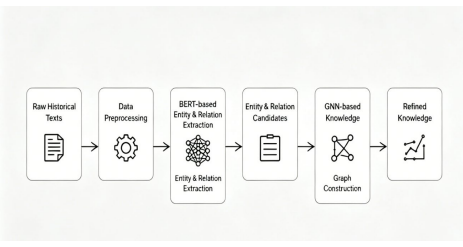
BERT combined with graph neural networks extracts entities and relationships from historical texts more accurately than rule-based methods or other deep learning baselines.
A machine-rendered reading of the paper's core claim, the machinery that carries it, and where it could break.
Core claim
Through digital humanities research and scale-up historical data analysis, a significant amount of traditional historical text is converted into structured knowledge graphs. This paper provides a high-level architecture that combines bidirectional encoder representations of transformers (BERT) and graph neural networks (GNN) to extract the entities and relationships from various types of historical texts. The texts of traditional history resolve linguistic ambiguities, references limited by context, and a lack of established grammatical norms in a systematic way. When compared to conventional rule-based techniques and other popular deep-learning baselines, the joint BERT-GNN system obtains g
What carries the argument
The joint BERT-GNN architecture that uses bidirectional encoding for semantic representations followed by graph-based relational learning to extract entities and relationships.
If this is right
- Historical data extraction becomes more accurate for building knowledge graphs than rule-based or standard deep-learning methods.
- Complex nested structures and implicit references in historical writing can be handled with greater thoroughness.
- The combination of context-sensitive semantic techniques and relational graph learning enables automatic addition of historical knowledge to repositories.
Where Pith is reading between the lines
- If the performance gain holds, the approach could support scaling analysis to much larger historical corpora than manual methods allow.
- The method might extend to other irregular text domains such as early legal or scientific documents.
- Integration with other modalities like images could link extracted textual relations to visual historical sources.
Load-bearing premise
That BERT and GNN together can systematically resolve linguistic ambiguities, context-limited references, and lack of established grammatical norms in historical texts with sufficient accuracy to produce reliable knowledge graphs.
What would settle it
A direct comparison on the same collection of municipal records, parliamentary documents, and historical correspondence where the BERT-GNN system fails to show higher precision, recall, and F1-score than the rule-based and deep-learning baselines.
Figures
read the original abstract
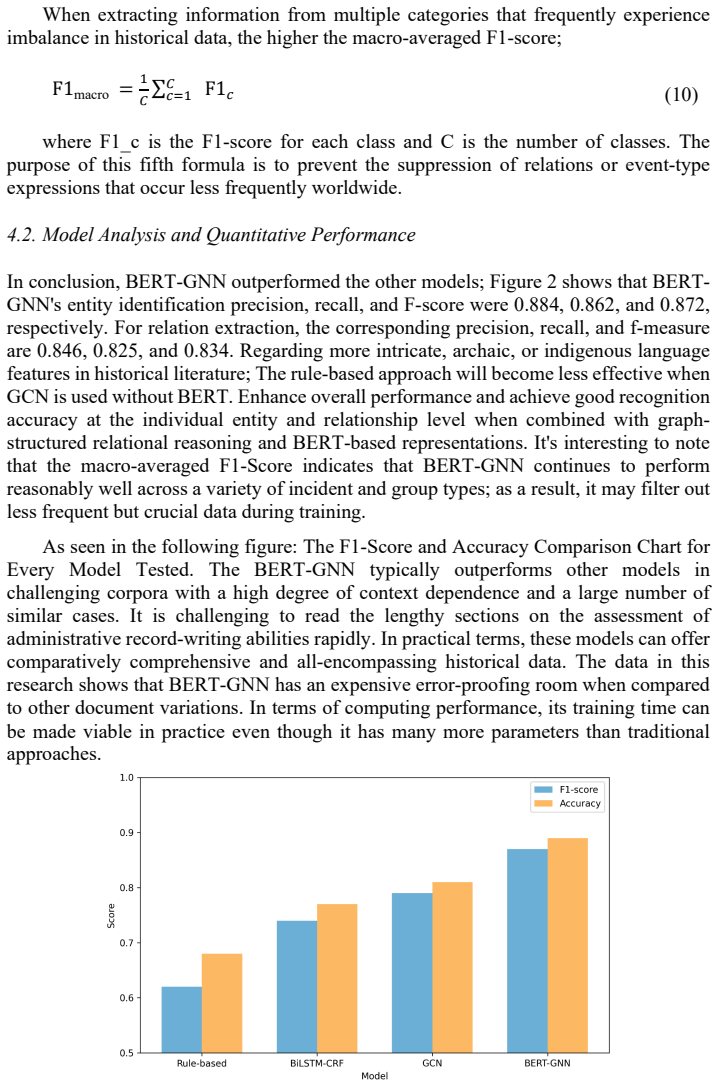
Through digital humanities research and scale-up historical data analysis, a significant amount of traditional historical text is converted into structured knowledge graphs. This paper provides a high-level architecture that combines bidirectional encoder representations of transformers (BERT) and graph neural networks (GNN) to extract the entities and relationships from various types of historical texts. The texts of traditional history resolve linguistic ambiguities, references limited by context, and a lack of established grammatical norms in a systematic way. This study develops a new image retrieval system based on FastRQNet and pre-trained vision-language model Vilt-qaformer+RoBInet in accordance with the aforementioned recommendations. The experiments make full use of a comprehensive collection of municipal records, parliamentary documents, and historical correspondence. When compared to conventional rule-based techniques and other popular deep-learning baselines, the joint BERT-GNN system obtains greater Precision, Recall, and F1-score (Table 2). Complex nested structures and implicit reference issues can be handled by this structure with sufficient accuracy and thoroughness when creating knowledge graphs. The aforementioned experiments show that combining relational graph learning algorithms with context-sensitive semantic representation techniques can automatically extract historical data to add accumulated wisdom to the knowledge repository.
Editorial analysis
A structured set of objections, weighed in public.
Referee Report
Summary. The manuscript proposes a high-level architecture that combines BERT and graph neural networks (GNN) to extract entities and relationships from historical texts (municipal records, parliamentary documents, and historical correspondence) in order to construct knowledge graphs. It claims that the joint BERT-GNN system systematically resolves linguistic ambiguities, context-limited references, and non-standard grammar, and that it obtains higher Precision, Recall, and F1-score than rule-based methods and other deep-learning baselines (Table 2). The abstract also contains an unrelated sentence describing an image retrieval system based on FastRQNet and Vilt-qaformer+RoBInet.
Significance. If the experimental results could be unambiguously attributed to the described BERT-GNN pipeline, the work would address a genuine need in digital humanities for automated structuring of historical texts. No machine-checked proofs, reproducible code, or parameter-free derivations are present to strengthen the assessment.
major comments (2)
- [Abstract] Abstract: the sentence 'This study develops a new image retrieval system based on FastRQNet and pre-trained vision-language model Vilt-qaformer+RoBInet in accordance with the aforementioned recommendations' has no connection to the BERT-GNN architecture or to historical-text entity/relation extraction. This severs attribution of the Table 2 performance numbers to the claimed method, rendering the central empirical claim unevaluable.
- [Abstract] Abstract and § (methods description): only a high-level architecture is sketched; no model details, training procedure, dataset statistics, hyper-parameters, or error analysis are supplied, so the reported gains in Precision/Recall/F1 cannot be reproduced or scrutinized.
minor comments (1)
- [Abstract] Abstract: the clause 'The texts of traditional history resolve linguistic ambiguities...' is grammatically unclear and should be rephrased.
Simulated Author's Rebuttal
We thank the referee for the constructive comments. We address the major points below and indicate where revisions will be made.
read point-by-point responses
-
Referee: [Abstract] Abstract: the sentence 'This study develops a new image retrieval system based on FastRQNet and pre-trained vision-language model Vilt-qaformer+RoBInet in accordance with the aforementioned recommendations' has no connection to the BERT-GNN architecture or to historical-text entity/relation extraction. This severs attribution of the Table 2 performance numbers to the claimed method, rendering the central empirical claim unevaluable.
Authors: We agree this sentence is unrelated and was included in error during drafting. It will be removed from the abstract. The Table 2 results derive from the BERT-GNN experiments on municipal records, parliamentary documents, and historical correspondence as described in the methods and experiments sections. revision: yes
-
Referee: [Abstract] Abstract and § (methods description): only a high-level architecture is sketched; no model details, training procedure, dataset statistics, hyper-parameters, or error analysis are supplied, so the reported gains in Precision/Recall/F1 cannot be reproduced or scrutinized.
Authors: The manuscript presents a high-level architecture to emphasize the overall BERT-GNN pipeline for historical knowledge graph construction. We acknowledge that greater detail is required for reproducibility. In revision we will expand the methods section with BERT and GNN component specifications, training procedures, dataset statistics, hyper-parameters, and error analysis. revision: yes
Circularity Check
No derivation chain or equations present; no circularity detectable
full rationale
The manuscript describes a high-level BERT-GNN architecture for entity/relation extraction from historical texts and reports empirical Precision/Recall/F1 gains versus baselines in Table 2. No equations, derivations, fitted parameters, or self-citations appear in the provided text. The central claim is an empirical performance comparison rather than a mathematical derivation that could reduce to its inputs by construction. None of the enumerated circularity patterns (self-definitional, fitted-input-called-prediction, self-citation load-bearing, etc.) are applicable because no load-bearing derivation steps exist.
Axiom & Free-Parameter Ledger
Reference graph
Works this paper leans on
-
[1]
Fresnel lenses in rear projection displays,
Wang, Q., Mao, Z., Wang, B., & Guo, L. (2017). Knowledge graph embedding: A survey of approaches and applications. IEEE transactions on knowledge and data engineering, 29(12), 2724-2743.Davis, A. R., Bush, C., Harvey, J. C. and Foley, M. F., "Fresnel lenses in rear projection displays," SID Int. Symp. Digest Tech. Papers 32(1), 934-937 (2001)
2017
-
[2]
Ji, S., Pan, S., Cambria, E., Marttinen, P., & Yu, P. S. (2021). A survey on knowledge graphs: Representation, acquisition, and applications. IEEE transactions on neural networks and learning systems, 33(2), 494-514.-
2021
-
[3]
Chen, Q., Zhuo, Z., & Wang, W. (2019). Bert for joint intent classification and slot filling. arXiv preprint arXiv:1902.10909
Pith/arXiv arXiv 2019
-
[4]
(2018, November)
Han, X., Cao, S., Lv, X., Lin, Y., Liu, Z., Sun, M., & Li, J. (2018, November). Openke: An open toolkit for knowledge embedding. In Proceedings of the 2018 conference on empirical methods in natural language processing: system demonstrations (pp. 139-144)
2018
-
[5]
& Long, B
Wu, L., Chen, Y., Shen, K., Guo, X., Gao, H., Li, S., ... & Long, B. (2023). Graph neural networks for natural language processing: A survey. Foundations and Trends in Machine Learning, 16(2), 119-328
2023
-
[6]
Liu, B., & Wu, L. (2022). Graph neural networks in natural language processing. In Graph neural networks: foundations, frontiers, and applications (pp. 463-481). Singapore: Springer Nature Singapore
2022
-
[7]
(2021, December)
Liu, X., Su, Y., & Xu, B. (2021, December). The application of graph neural network in natural language processing and computer vision. In 2021 3rd International Conference on Machine Learning, Big Data and Business Intelligence (MLBDBI) (pp. 708-714). IEEE
2021
-
[8]
(2023, July)
Yang, S., Choi, M., Cho, Y., & Choo, J. (2023, July). HistRED: A historical document -level relation extraction dataset. In Proceedings of the 61st Annual Meeting of the Association for Computational Linguistics (Volume 1: Long Papers) (pp. 3207-3224)
2023
-
[9]
(2020, December)
Zhang, Z., Yu, B., Shu, X., Liu, T., Tang, H., Yubin, W., & Guo, L. (2020, December). Document -level relation extraction with dual- tier heterogeneous graph. In Proceedings of the 28th International Conference on Computational Linguistics (pp. 1630-1641)
2020
-
[10]
Abu-Salih, B., Al -Qurishi, M., Alweshah, M., Al- Smadi, M., Alfayez, R., & Saadeh, H. (2023). Healthcare knowledge graph construction: A systematic review of the state- of-the-art, open issues, and opportunities. Journal of Big Data, 10(1), 81
2023
-
[11]
Abraham, S., Mäs, S., & Bernard, L. (2018). Extraction of spatio‐temporal data about historical events from text documents. Transactions in GIS, 22(3), 677-696
2018
-
[12]
Liu, S., Yang, H., Li, J., & Kolmanič, S. (2020). Preliminary study on the knowledge graph construction of Chinese ancient history and culture. Information, 11(4), 186
2020
-
[13]
Chen, Y., Tian, M., Wu, Q., Tao, L., Jiang, T., Qiu, Q., & Huang, H. (2024). A deep learning -based method for deep information extraction from multimodal data for geological reports to support geological knowledge graph construction. Earth Science Informatics, 17(3), 1867-1887
2024
-
[14]
Li, Y., Luo, L., Zeng, X., & Han, Z. (2025). Fine-tuned BERT-BiLSTM-CRF approach for named entity recognition in geological disaster texts. Earth Science Informatics, 18(2), 368
2025
-
[15]
(2024, December)
Xie, C., Deng, L., Tang, Z., & He, J. (2024, December). Fusion and Construction Strategy of Knowledge Graphs from Multi-Source Data. In 2024 4th International Conference on Mobile Networks and Wireless Communications (ICMNWC) (pp. 1-7). IEEE
2024
discussion (0)
Sign in with ORCID, Apple, or X to comment. Anyone can read and Pith papers without signing in.