Role of System-Bath Interaction in Non-Markovian Quantum Brownian Otto Cycles
Pith reviewed 2026-06-28 12:39 UTC · model grok-4.3
The pith
System-bath interaction energy reduces work output in non-Markovian quantum Otto engines and places their power below Markovian bounds at fixed efficiency.
A machine-rendered reading of the paper's core claim, the machinery that carries it, and where it could break.
Core claim
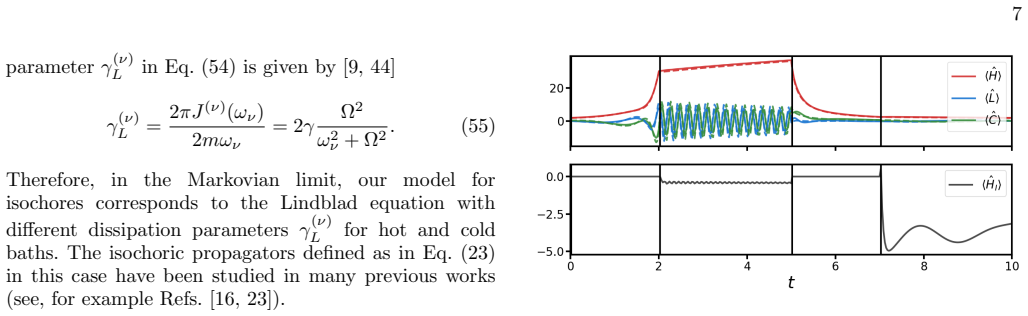
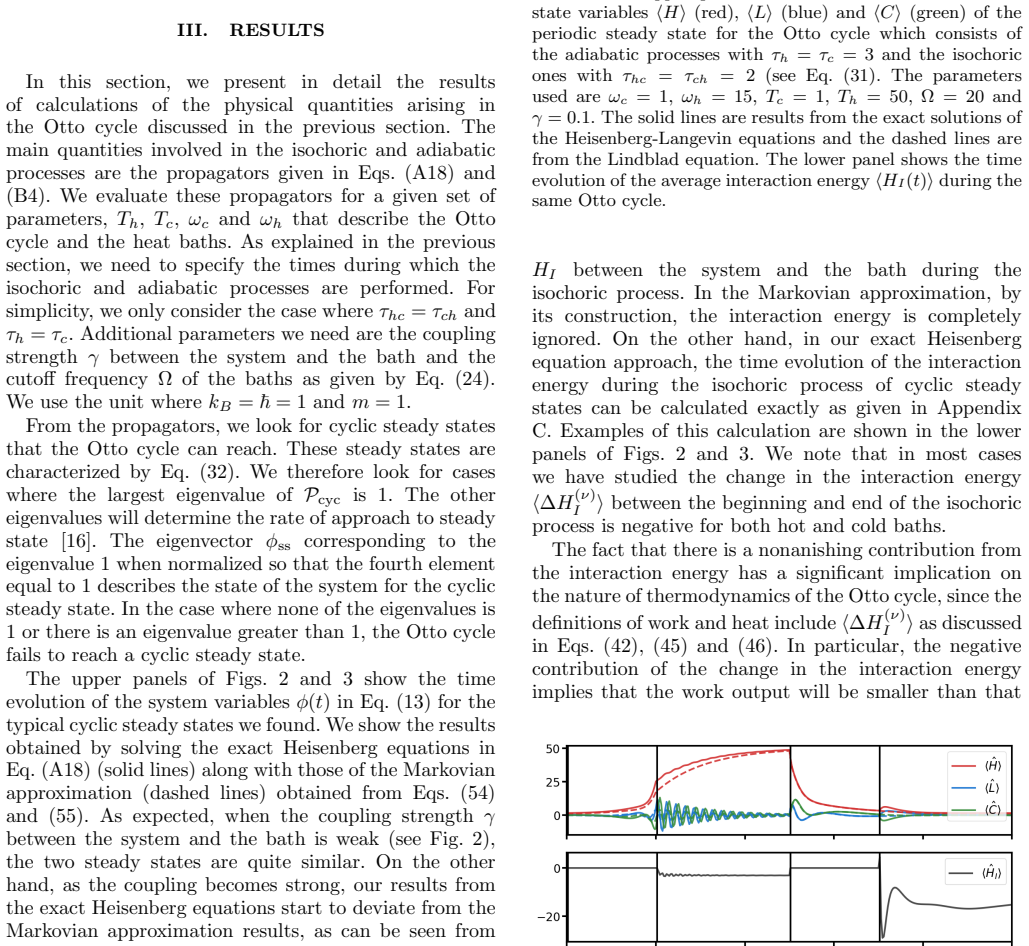
When the Otto cycle operates as an engine, the effect of the interaction energy is to reduce the work output. The power of our non-Markovian engine for a given efficiency value falls below the Markovian power-efficiency bound.
What carries the argument
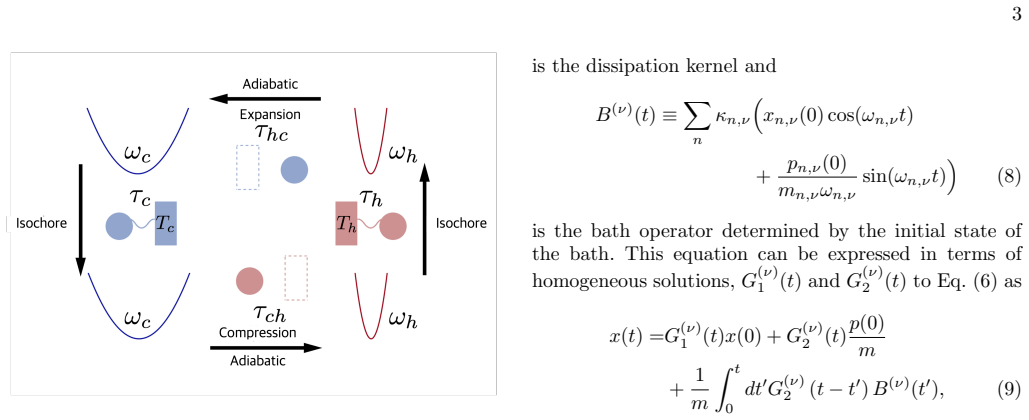
Exact analytic solution of the Heisenberg-Langevin equations for the harmonic oscillator and the interaction energy with the bath under the Caldeira-Leggett model during finite-time isochoric processes.
If this is right
- The change in interaction energy during isochoric processes contributes to both work and heat.
- Thermodynamic quantities of the cycle depend on the strength of system-bath coupling and on bath parameters.
- Cyclic steady states exist and can be obtained exactly for the non-Markovian dynamics.
- The non-Markovian power-efficiency relation deviates from the Markovian trade-off bound.
Where Pith is reading between the lines
- Strong-coupling effects captured this way may set practical performance ceilings for quantum heat engines that operate away from weak-coupling or Markovian limits.
- The same interaction-energy accounting could be applied to other finite-time quantum thermodynamic cycles to check whether similar reductions appear.
Load-bearing premise
The Caldeira-Leggett model together with the exact solvability of the Heisenberg-Langevin equations for the interaction energy during finite-time isochoric processes accurately captures the non-Markovian strong-coupling regime.
What would settle it
An experimental measurement of a non-Markovian quantum Brownian Otto engine whose power at a given efficiency exceeds the Markovian power-efficiency bound would falsify the reported reduction.
Figures
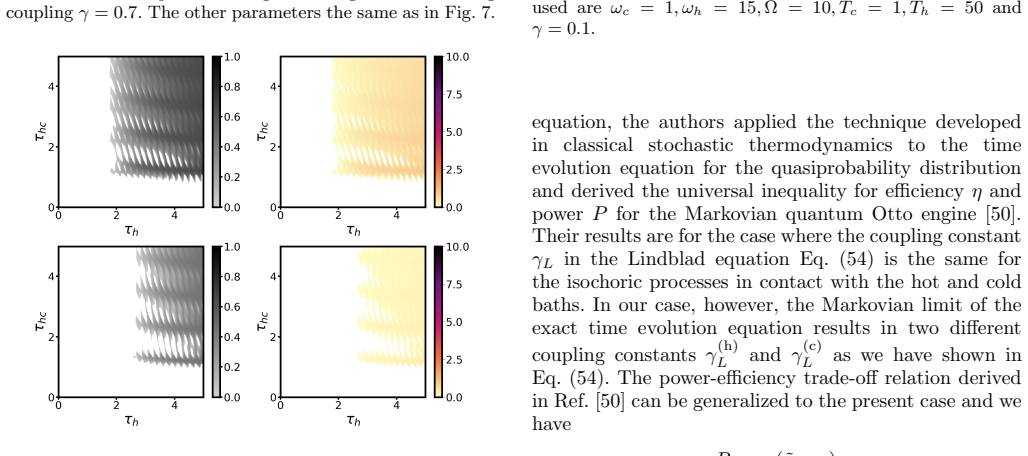

read the original abstract
We study finite-time quantum Otto cycles whose working medium is a harmonic oscillator undergoing a quantum Brownian motion described by the Caldeira-Leggett model when the oscillator is in contact with heat baths in isochoric processes. The time evolution of the Otto cycle is studied by analytically solving the exact Heisenberg-Langevin equations for the system variables and the interaction energy between the system and the bath. This enables us to investigate non-Markovian strong-coupling effects on the quantum Otto cycle. We obtain cyclic steady states and study the thermodynamic properties of the Otto cycle for various values of the parameters describing the heat baths and the coupling between the system and the bath. We compare our results with those obtained in the Markovian limit, where the time evolution is described by the Lindblad equation. We find that the change in the interaction energy during the isochoric process contributes to both work and heat, and plays a crucial role in determining thermodynamic behavior of the cycle. In particular, we find that when the Otto cycle operates as an engine, the effect of the interaction energy is to reduce the work output. We also compare our results with the power-efficiency trade-off relation recently proposed for the Markovian quantum Otto engine. We find that the power of our non-Markovian engine for a given efficiency value falls below the Markovian power-efficiency bound.
Editorial analysis
A structured set of objections, weighed in public.
Referee Report
Summary. The paper analyzes finite-time quantum Otto cycles with a harmonic oscillator as working medium in the Caldeira-Leggett model. Exact solutions of the Heisenberg-Langevin equations are used to track system variables and system-bath interaction energy during isochoric strokes, yielding cyclic steady states. Thermodynamic quantities are computed for varying bath parameters and coupling strengths, with direct comparison to the Markovian Lindblad limit. Key findings are that interaction-energy changes contribute to both work and heat, reduce net work output in engine operation, and cause the non-Markovian power-efficiency curve to lie below the previously derived Markovian bound.
Significance. If the central claims hold after clarification of efficiency definitions, the work supplies a concrete, exactly solvable illustration of how strong-coupling interaction energy modifies quantum heat-engine performance, an effect usually omitted in weak-coupling treatments. The analytic access to non-Markovian dynamics and the explicit inclusion of interaction energy constitute technical strengths that could inform future studies of finite-time thermodynamics beyond the Lindblad regime.
major comments (2)
- [Abstract; comparison-to-Markovian section] Abstract and the section comparing to the Markovian bound: the claim that 'the power of our non-Markovian engine for a given efficiency value falls below the Markovian power-efficiency bound' rests on the assumption that efficiency η = W/Q is defined identically in both cases. Because the present calculation includes interaction-energy contributions in both W and Q while the referenced Markovian bound is derived for the weak-coupling Lindblad case (where interaction energy is neglected), the comparison may not isolate non-Markovian effects. An explicit statement of the efficiency definition used for the bound and a check that the same definition is applied to both curves is required.
- [Thermodynamic-properties section] Section on thermodynamic properties and cyclic steady states: the statement that interaction energy 'plays a crucial role' and 'reduces the work output' is load-bearing for the engine-mode conclusion. The manuscript should supply the explicit decomposition (e.g., the separate contributions ΔE_int to W and to Q) together with numerical values or plots that quantify the reduction relative to the interaction-free case, so that readers can verify the magnitude and sign of the effect.
minor comments (2)
- [Model section] The model section should list all free parameters (bath temperatures, cutoff frequency, coupling strength, cycle times) with their symbols and ranges used in the figures, to facilitate reproducibility.
- [Figures] Figure captions should state whether the plotted quantities include or exclude the interaction-energy term, and should indicate the Markovian reference curve for direct visual comparison.
Simulated Author's Rebuttal
We thank the referee for the careful reading and constructive comments on our manuscript. We address each major comment below and will revise the manuscript accordingly to improve clarity.
read point-by-point responses
-
Referee: [Abstract; comparison-to-Markovian section] Abstract and the section comparing to the Markovian bound: the claim that 'the power of our non-Markovian engine for a given efficiency value falls below the Markovian power-efficiency bound' rests on the assumption that efficiency η = W/Q is defined identically in both cases. Because the present calculation includes interaction-energy contributions in both W and Q while the referenced Markovian bound is derived for the weak-coupling Lindblad case (where interaction energy is neglected), the comparison may not isolate non-Markovian effects. An explicit statement of the efficiency definition used for the bound and a check that the same definition is applied to both curves is required.
Authors: We agree that an explicit statement of the efficiency definition is needed for a transparent comparison. In our work, efficiency is consistently defined as η = W_net / Q_in, with both quantities incorporating the contributions from ΔE_int during the isochoric strokes. The referenced Markovian bound applies specifically to the weak-coupling Lindblad regime where interaction energy is omitted by construction. In the revision we will add a clear statement of this definition in the abstract and comparison section, together with a note that the bound is derived under the weak-coupling approximation. This makes the comparison one between a strong-coupling non-Markovian engine (with interaction energy included) and the established weak-coupling Markovian bound; the fact that our power-efficiency curve lies below the bound therefore illustrates the combined effect of strong coupling and non-Markovian dynamics rather than isolating non-Markovianity alone. The same definition is applied uniformly to all curves presented in the manuscript. revision: yes
-
Referee: [Thermodynamic-properties section] Section on thermodynamic properties and cyclic steady states: the statement that interaction energy 'plays a crucial role' and 'reduces the work output' is load-bearing for the engine-mode conclusion. The manuscript should supply the explicit decomposition (e.g., the separate contributions ΔE_int to W and to Q) together with numerical values or plots that quantify the reduction relative to the interaction-free case, so that readers can verify the magnitude and sign of the effect.
Authors: We accept that an explicit decomposition will strengthen the presentation. Although the manuscript already states that ΔE_int contributes to both work and heat, we will add the explicit breakdown of the first-law contributions (ΔE_int entering W during the isochoric strokes and entering Q via the energy balance) together with numerical tables or supplementary plots that compare the net work output with and without the interaction-energy term for representative parameter sets. This will allow direct verification of the sign and magnitude of the reduction. revision: yes
Circularity Check
No significant circularity in derivation chain
full rationale
The paper derives its results by analytically solving the exact Heisenberg-Langevin equations for the Caldeira-Leggett model to obtain cyclic steady states and thermodynamic quantities (work, heat, efficiency, power) in the non-Markovian regime. The Markovian comparison uses the independent Lindblad equation, and the referenced power-efficiency bound is an external prior result. No parameters are fitted and then relabeled as predictions, no self-definitions appear, and no load-bearing steps reduce to self-citations or ansatzes by construction. The derivation remains self-contained against external benchmarks.
Axiom & Free-Parameter Ledger
axioms (1)
- domain assumption Caldeira-Leggett model accurately describes quantum Brownian motion in the strong-coupling non-Markovian regime
Reference graph
Works this paper leans on
-
[1]
Role of System-Bath Interaction in Non-Markovian Quantum Brownian Otto Cycles
described by the Caldeira-Leggett model [46]. The non-Markovian features of this process have been studied in Ref. [47]. We note that compared to Refs. [35, 42] where the working medium is a single qubit, our system is more complex, where the frequency of the harmonic oscillator changes during adiabatic processes of the cycle. Unlike the qubit system, in ...
work page internal anchor Pith review Pith/arXiv arXiv 2026
-
[2]
Kosloff and A
R. Kosloff and A. Levy, Annual Review of Physical Chemistry65, 365 (2014)
2014
-
[3]
L. M. Cangemi, C. Bhadra, and A. Levy, Physics Reports 1087, 1–71 (2024)
2024
-
[4]
O. Abah, J. Roßnagel, G. Jacob, S. Deffner, F. Schmidt- Kaler, K. Singer, and E. Lutz, Physical Review Letters 109, 203006 (2012)
2012
-
[5]
Roßnagel, S
J. Roßnagel, S. T. Dawkins, K. N. Tolazzi, O. Abah, E. Lutz, F. Schmidt-Kaler, and K. Singer, Science352, 325 (2016)
2016
-
[6]
N. M. Myers, O. Abah, and S. Deffner, AVS Quantum Science4, 027101 (2022)
2022
-
[7]
Binder, L
F. Binder, L. A. Correa, C. Gogolin, J. Anders, and G. Adesso, eds.,Thermodynamics in the quantum regime, Fundamental Theories of Physics (Springer International Publishing, Cham, Switzerland, 2019)
2019
-
[8]
Kosloff, Entropy15, 2100–2128 (2013)
R. Kosloff, Entropy15, 2100–2128 (2013)
2013
-
[9]
Vinjanampathy and J
S. Vinjanampathy and J. Anders, Contemporary Physics 57, 545–579 (2016)
2016
-
[10]
Breuer and F
H.-P. Breuer and F. Petruccione,The Theory of Open Quantum Systems(Oxford University Press, 2007)
2007
-
[11]
Rivas and S
A. Rivas and S. F. Huelga,Open Quantum Systems (Springer, Heidelberg, 2012)
2012
-
[12]
Weiss,Quantum Dissipative Systems, 4th ed
U. Weiss,Quantum Dissipative Systems, 4th ed. (World Scientific, 2012)
2012
-
[13]
Feldmann and R
T. Feldmann and R. Kosloff, Physical Review E70, 046110 (2004)
2004
-
[14]
Rezek and R
Y. Rezek and R. Kosloff, New Journal of Physics8, 83–83 (2006)
2006
-
[15]
G. S. Agarwal and S. Chaturvedi, Physical Review E88, 012130 (2013)
2013
-
[16]
Zheng and D
Y. Zheng and D. Poletti, Physical Review E90, 012145 15 (2014)
2014
-
[17]
Kosloff and Y
R. Kosloff and Y. Rezek, Entropy19, 136 (2017)
2017
-
[18]
Insinga, B
A. Insinga, B. Andresen, P. Salamon, and R. Kosloff, Physical Review E97, 062153 (2018)
2018
-
[19]
M. Kloc, P. Cejnar, and G. Schaller, Physical Review E 100, 042126 (2019)
2019
-
[20]
Abah and M
O. Abah and M. Paternostro, Physical Review E99, 022110 (2019)
2019
-
[21]
J.-M. Park, S. Lee, H.-M. Chun, and J. D. Noh, Physical Review E100, 012148 (2019)
2019
-
[22]
Chen, C.-P
J.-F. Chen, C.-P. Sun, and H. Dong, Physical Review E 100, 032144 (2019)
2019
-
[23]
R. Dann, R. Kosloff, and P. Salamon, Entropy22, 1255 (2020)
2020
-
[24]
S. Lee, M. Ha, J.-M. Park, and H. Jeong, Physical Review E101, 022127 (2020)
2020
-
[25]
Lindblad, Comm
G. Lindblad, Comm. Math. Phys.48, 119 (1976)
1976
-
[26]
Gorini, A
V. Gorini, A. Kossakowski, and E. C. G. Sudarshan, J. Math. Phys.17, 821 (1976)
1976
-
[27]
A. S. Trushechkin, M. Merkli, J. D. Cresser, and J. Anders, AVS Quantum Sci.4, 012301 (2022)
2022
-
[28]
X. Y. Zhang, X. L. Huang, and X. X. Yi, Journal of Physics A: Mathematical and Theoretical47, 455002 (2014)
2014
-
[29]
Pozas-Kerstjens, E
A. Pozas-Kerstjens, E. G. Brown, and K. V. Hovhannisyan, New Journal of Physics20, 043034 (2018)
2018
-
[30]
Thomas, N
G. Thomas, N. Siddharth, S. Banerjee, and S. Ghosh, Physical Review E97, 062108 (2018)
2018
-
[31]
Pezzutto, M
M. Pezzutto, M. Paternostro, and Y. Omar, Quantum Science and Technology4, 025002 (2019)
2019
-
[32]
Mukherjee, A
V. Mukherjee, A. G. Kofman, and G. Kurizki, Communications Physics3, 8 (2020)
2020
-
[33]
Wiedmann, J
M. Wiedmann, J. T. Stockburger, and J. Ankerhold, New Journal of Physics22, 033007 (2020)
2020
-
[34]
J. Liu, K. A. Jung, and D. Segal, Physical Review Letters 127, 200602 (2021)
2021
-
[35]
Wiedmann, J
M. Wiedmann, J. T. Stockburger, and J. Ankerhold, The European Physical Journal Special Topics230, 851–857 (2021)
2021
-
[36]
Shirai, K
Y. Shirai, K. Hashimoto, R. Tezuka, C. Uchiyama, and N. Hatano, Physical Review Research3, 023078 (2021)
2021
-
[37]
Chakraborty, A
S. Chakraborty, A. Das, and D. Chru´ sci´ nski, Physical Review E106, 064133 (2022)
2022
-
[38]
Ptaszy´ nski, Physical Review E106, 014114 (2022)
K. Ptaszy´ nski, Physical Review E106, 014114 (2022)
2022
-
[39]
Cavaliere, M
F. Cavaliere, M. Carrega, G. De Filippis, V. Cataudella, G. Benenti, and M. Sassetti, Physical Review Research 4, 033233 (2022)
2022
-
[40]
Carrega, L
M. Carrega, L. M. Cangemi, G. De Filippis, V. Cataudella, G. Benenti, and M. Sassetti, PRX Quantum3, 010323 (2022)
2022
-
[41]
Arısoy, J.-T
O. Arısoy, J.-T. Hsiang, and B.-L. Hu, Physical Review E105, 014108 (2022)
2022
-
[42]
L. Razzoli, F. Cavaliere, M. Carrega, M. Sassetti, and G. Benenti, The European Physical Journal Special Topics (2023), 10.1140/epjs/s11734-023-00949-8
-
[43]
Ishizaki, N
M. Ishizaki, N. Hatano, and H. Tajima, Physical Review Research5, 023066 (2023)
2023
-
[44]
Maity and A
A. Maity and A. Ghoshal, Physical Review A109, 022207 (2024)
2024
-
[45]
I. A. Picatoste, A. Colla, and H.-P. Breuer, Phys. Rev. Res.6, 013258 (2024)
2024
-
[46]
Grabert, P
H. Grabert, P. Schramm, and G.-L. Ingold, Phys. Rep. 168, 115 (1988)
1988
-
[47]
Caldeira and A
A. Caldeira and A. Leggett, Physica A121, 587 (1983)
1983
-
[48]
Einsiedler, A
S. Einsiedler, A. Ketterer, and H.-P. Breuer, Phys. Rev. A102, 022228 (2020)
2020
-
[49]
Kosloff and T
R. Kosloff and T. Feldmann, Physical Review E65, 055102 (2002)
2002
-
[50]
Plastina, A
F. Plastina, A. Alecce, T. Apollaro, G. Falcone, G. Francica, F. Galve, N. Lo Gullo, and R. Zambrini, Physical Review Letters113, 260601 (2014)
2014
-
[51]
Chun and J.-M
H.-M. Chun and J.-M. Park, Physical Review E112, L012101 (2025)
2025
-
[52]
Dechant and S.-i
A. Dechant and S.-i. Sasa, Physical Review E97, 062101 (2018)
2018
-
[53]
Quantum Otto cycle in the Anderson impurity model
S. Gatto, A. Colla, H.-P. Breuer, and M. Thoss, “Quantum otto cycle in the anderson impurity model,” (2026), arXiv:2601.21546 [cond-mat.mes-hall]
work page internal anchor Pith review Pith/arXiv arXiv 2026
-
[54]
Shiraishi, K
N. Shiraishi, K. Saito, and H. Tasaki, Physical Review Letters117, 190601 (2016)
2016
-
[55]
Pietzonka and U
P. Pietzonka and U. Seifert, Physical Review Letters120, 190602 (2018)
2018
discussion (0)
Sign in with ORCID, Apple, or X to comment. Anyone can read and Pith papers without signing in.