Improved Amenability Bounds for Local Coordination Games
Pith reviewed 2026-06-28 12:33 UTC · model grok-4.3
The pith
If average disagreement is at most ε in a binary unbiased local coordination game, the underlying graph must be (O(ε log(1/ε)), r)-amenable.
A machine-rendered reading of the paper's core claim, the machinery that carries it, and where it could break.
Core claim
In the binary unbiased setting, if the average disagreement among players is at most ε, then the graph is (O(ε log(1/ε)), r)-amenable. This sharpens the earlier square-root loss while remaining inside the local pure coordination framework.
What carries the argument
Shapley values of a mutual-information game defined on the players' local outputs.
If this is right
- The quantitative converse between local coordination efficiency and amenability becomes nearly linear instead of square-root.
- Amenability parameters can now be bounded directly in terms of observed disagreement without the previous ε^{1/2} degradation.
- The result continues to apply only inside the binary unbiased local pure coordination model.
Where Pith is reading between the lines
- The Shapley-value technique might yield similar improvements if the unbiased or binary restrictions are later removed.
- The same mutual-information game could be examined on infinite or random graphs to test whether the log factor is necessary.
Load-bearing premise
The bound holds only in the binary unbiased case and depends on the existing definitions of local pure coordination games.
What would settle it
A finite graph and a local coordination strategy whose average disagreement is ε yet whose amenability parameter exceeds any constant times ε log(1/ε).
Figures
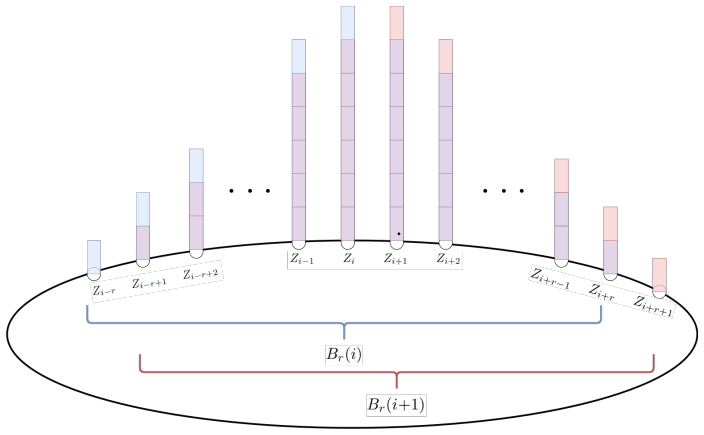
read the original abstract
We study local pure coordination games on finite social networks, continuing the framework of Hutchcroft, Rospuskova, and Tamuz. They showed that low inefficiency in local coordination forces the underlying graph to be amenable, with a square-root loss in the amenability parameter. We improve this loss in the binary unbiased setting. Using Shapley values of a mutual-information game associated with the players' local outputs, we prove that if the average disagreement is at most $\varepsilon$, then the graph is $(O(\varepsilon\log(1/\varepsilon)),r)$-amenable. This gives a sharper quantitative converse between local coordination and graph amenability.
Editorial analysis
A structured set of objections, weighed in public.
Referee Report
Summary. The manuscript improves the quantitative converse between inefficiency in local pure coordination games and graph amenability. Building on Hutchcroft, Rospuskova, and Tamuz, it shows that in the binary unbiased setting, average disagreement at most ε implies the graph is (O(ε log(1/ε)), r)-amenable. The proof associates a mutual-information game to the players' local outputs and applies Shapley values to obtain the sharper bound.
Significance. If the result holds, the sharper O(ε log(1/ε)) loss strengthens the link between local coordination and amenability, with potential implications for equilibrium analysis on networks. The application of Shapley values to a mutual-information game is a methodological contribution that may extend to other settings in algorithmic game theory.
minor comments (2)
- [Abstract] Abstract: the phrase '(O(ε log(1/ε)),r)-amenable' uses r without a parenthetical reminder of its meaning; a one-sentence gloss would improve immediate readability even though the definition appears later.
- [Introduction] The restriction to the binary unbiased case is stated clearly, but a short remark in the introduction on why the Shapley-value argument does not immediately extend would help readers assess the scope.
Simulated Author's Rebuttal
We thank the referee for the positive summary, significance assessment, and recommendation of minor revision. No major comments appear in the report.
Circularity Check
No significant circularity identified
full rationale
The paper's central derivation associates a mutual-information game with players' local outputs and applies Shapley values to obtain the improved O(ε log(1/ε)) amenability bound from average disagreement ≤ ε. This is an explicit mathematical argument that builds on the external Hutchcroft-Rospuskova-Tamuz framework for local pure coordination games and does not reduce any load-bearing step to a self-definition, fitted input renamed as prediction, or self-citation chain. The result is stated only for the binary unbiased case and presents an independent quantitative improvement rather than a tautology.
Axiom & Free-Parameter Ledger
axioms (1)
- domain assumption Definitions and framework of local pure coordination games from Hutchcroft, Rospuskova, and Tamuz
Reference graph
Works this paper leans on
-
[1]
Tom Hutchcroft, Olga Rospuskova, and Omer Tamuz.Local Coordination and the Geometry of Social Networks, 2026. Arxiv Preprint. url=https://arxiv.org/abs/2602.12571
Pith/arXiv arXiv 2026
-
[2]
Owen.Sobol’ Indices and Shapley Value
Art B. Owen.Sobol’ Indices and Shapley Value. SIAM/ASA Journal on Uncertainty Quantifi- cation, 2(1):245–251, 2014. doi=10.1137/130936233
-
[3]
On shapley value for measur- ing importance of dependent inputs,
Art B. Owen and Cl´ ementine Prieur.On Shapley Value for Measuring Importance of De- pendent Inputs. SIAM/ASA Journal on Uncertainty Quantification, 5(1):986–1002, 2017. doi=10.1137/16M1097717. 9
-
[4]
Annales de l’Institut Henri Poincar´ e, Probabilit´ es et Statistiques, 56(4), 2020
Endre Cs´ oka, Viktor Harangi and B´ alint Vir´ ag.Entropy and expansion. Annales de l’Institut Henri Poincar´ e, Probabilit´ es et Statistiques, 56(4), 2020. doi=10.1214/19-aihp1044
-
[5]
Jon Kleinberg and ´Eva Tardos. Approximation Algorithms for Classification Problems with Pairwise Relationships: Metric Labeling and Markov Random Fields.Journal of the ACM, 49(5):616–639, 2002. doi=10.1145/585265.585268
-
[6]
Omer Angel and Yinon Spinka.Pairwise Optimal Coupling of Multiple Random Variables, 2019. Arxiv Preprint. url=https://arxiv.org/abs/1903.00632
arXiv 2019
-
[7]
Cover and Joy A
Thomas M. Cover and Joy A. Thomas.Elements of Information Theory. Second edition. Wiley- Interscience, 2006
2006
-
[8]
Yeung.Information Theory and Network Coding
Raymond W. Yeung.Information Theory and Network Coding. Springer, 2008
2008
-
[9]
Shapley.A Value forn-Person Games
Lloyd S. Shapley.A Value forn-Person Games. In Harold W. Kuhn and Albert W. Tucker, editors,Contributions to the Theory of Games II, Annals of Mathematics Studies, Vol. 28, pp. 307–317. Princeton University Press, 1953
1953
-
[10]
Cambridge University Press, 2014
Ryan O’Donnell.Analysis of Boolean Functions. Cambridge University Press, 2014
2014
-
[11]
Peking University Press, 1993
Rong Long.Martingale Spaces and Inequalities. Peking University Press, 1993
1993
-
[12]
G. H. Hardy, J. E. Littlewood, and G. P´ olya.Inequalities. Second edition. Cambridge University Press, 1952
1952
-
[13]
D. L. Burkholder. Martingale Transforms.Annals of Mathematical Statistics, 37(6):1494–1504,
-
[14]
doi=10.1214/aoms/1177699141. Appendix Bound on the Total variation Distance of Shapley measures in Variance Game The proof of Theorem 2.5, presented in the previous section, relies on redefining the underlying TU game. This allows us to bypass the main obstacle arising from the variance game vX(S) = Var E[X|Z S] . we show here another proof of the improve...
discussion (0)
Sign in with ORCID, Apple, or X to comment. Anyone can read and Pith papers without signing in.