Convex Distance Operator Transport: A Convex and Geometry-Preserving Formulation
Pith reviewed 2026-06-28 12:54 UTC · model grok-4.3
The pith
CDOT is a convex optimal transport method that aligns distributions from different domains while preserving both feature correspondence and intrinsic geometric structure.
A machine-rendered reading of the paper's core claim, the machinery that carries it, and where it could break.
Core claim
CDOT is the first convex optimal transport framework that aligns distributions across heterogeneous domains by jointly preserving feature correspondence and intrinsic geometric structure; the resulting discrepancy is a valid pseudometric on attributed compact metric-measure spaces, with non-asymptotic risk consistency under Frank-Wolfe.
What carries the argument
Operator-based regularization with distance and conditional expectation operators that aligns aggregated distance structures to enforce convexity while improving robustness to local geometric variations.
Load-bearing premise
The distance and conditional expectation operators align aggregated distance structures sufficiently to guarantee both convexity and pseudometric properties without introducing hidden non-convexity.
What would settle it
A pair of attributed compact metric-measure spaces where the CDOT value violates the triangle inequality, or where Frank-Wolfe optimization fails to reach a global minimum with the claimed risk bound, would falsify the central claims.
Figures
read the original abstract
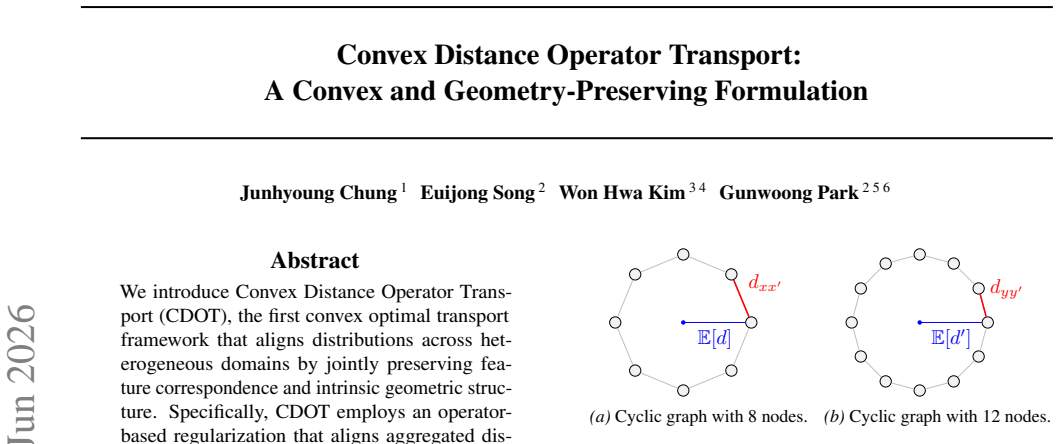
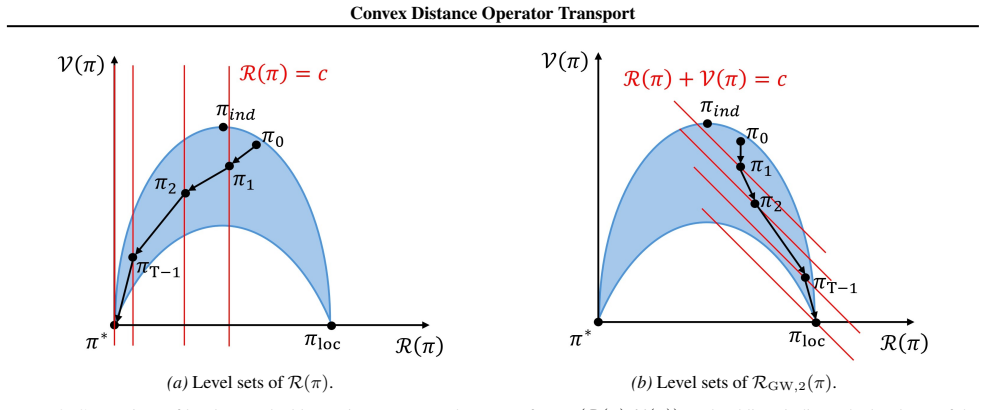
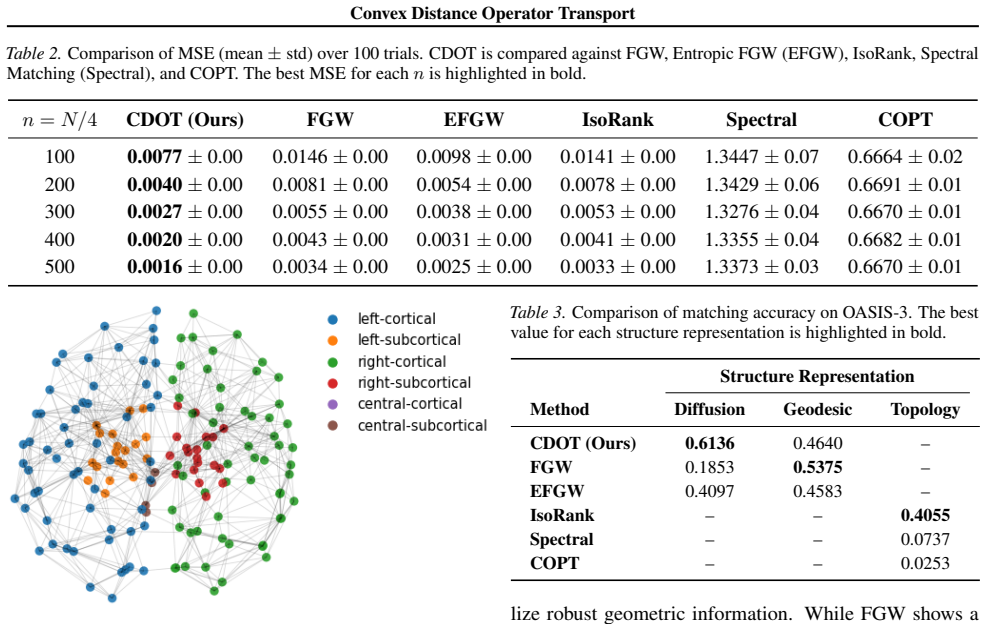
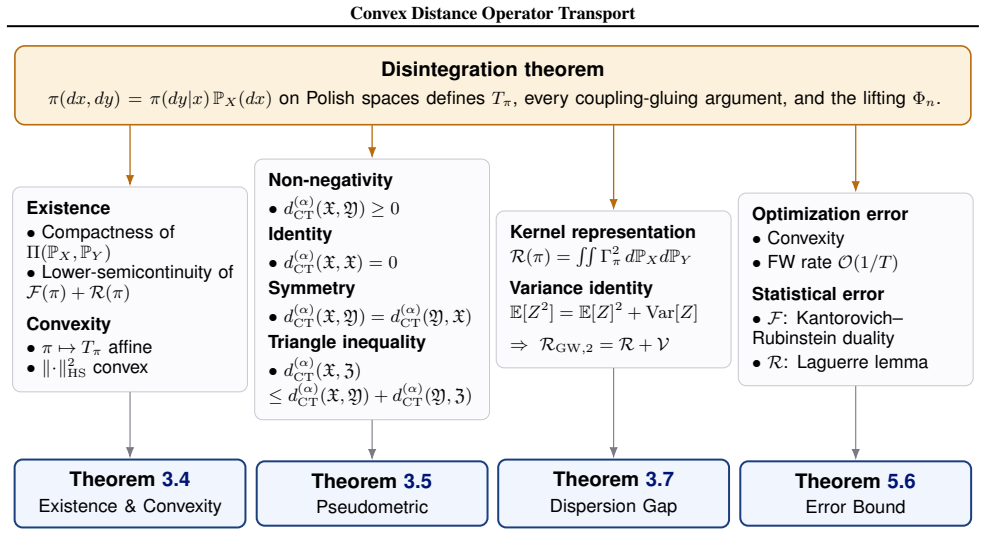
We introduce Convex Distance Operator Transport (CDOT), the first convex optimal transport framework that aligns distributions across heterogeneous domains by jointly preserving feature correspondence and intrinsic geometric structure. Specifically, CDOT employs an operator-based regularization that aligns aggregated distance structures by introducing distance and conditional expectation operators. Consequently, the proposed regularization improves the robustness to local geometric variations. We further prove that the resulting CDOT discrepancy is a valid pseudometric on the space of attributed compact metric-measure spaces. In addition, we characterize the relationship between CDOT and Gromov--Wasserstein (GW) through a new notion of dispersion gap, formally elucidating the geometric source of non-convexity in GW compared to the convexity of CDOT. In the finite-sample regime, we derive a non-asymptotic risk bound decomposed into optimization and statistical errors, establishing risk consistency under a globally convergent Frank--Wolfe algorithm. Experiments on synthetic point clouds, brain connectomes, and graph classification benchmarks demonstrate better performance over existing methods, with stable and reliable behavior in practice.
Editorial analysis
A structured set of objections, weighed in public.
Referee Report
Summary. The paper introduces Convex Distance Operator Transport (CDOT), a convex optimal transport framework for aligning distributions across heterogeneous domains. It uses distance and conditional expectation operators to regularize the objective, jointly preserving feature correspondence and intrinsic geometry. The manuscript claims to prove that the resulting discrepancy is a valid pseudometric on attributed compact metric-measure spaces, introduces a dispersion-gap notion to relate CDOT to Gromov-Wasserstein (GW) and explain GW's non-convexity, derives non-asymptotic risk bounds decomposed into optimization and statistical errors, and establishes consistency under a globally convergent Frank-Wolfe algorithm. Experiments on synthetic point clouds, brain connectomes, and graph classification tasks are reported to show improved performance and stability.
Significance. If the convexity of the objective and the pseudometric property hold with the stated proofs, CDOT would provide a theoretically grounded convex alternative to non-convex GW distances, enabling reliable optimization while retaining geometric fidelity. The dispersion-gap characterization and non-asymptotic bounds under Frank-Wolfe would be notable contributions for understanding and mitigating non-convexity in geometric OT. The empirical results on heterogeneous data would support practical utility in domain alignment tasks.
major comments (3)
- [Abstract / CDOT objective definition] Abstract and the section defining the CDOT objective: the central convexity claim rests on the assertion that the distance and conditional-expectation operators yield a jointly convex functional in the coupling π. However, conditional expectation is measure-dependent; without an explicit expansion of the regularized objective as a function of π (showing linearity or convexity preservation in each term), it remains possible that the marginal dependence introduces a non-convex term. This is load-bearing for the claim that CDOT is convex while GW is not.
- [Pseudometric proof section] Section proving the pseudometric property: the proof that CDOT satisfies the pseudometric axioms (non-negativity, symmetry, triangle inequality) on attributed compact metric-measure spaces must be verified against the operator definitions. If the operators are defined in a manner that depends on the marginals in a non-linear way, the triangle inequality may fail to hold in the claimed form; the manuscript should supply the full derivation rather than asserting the result.
- [Risk bound theorem] Section on non-asymptotic risk bounds: the decomposition into optimization and statistical errors and the consistency result under Frank-Wolfe assumes global convergence of the algorithm on the CDOT objective. The bound's dependence on the dispersion gap and the operator norms should be stated explicitly (e.g., via the relevant theorem number); without the explicit assumptions on the operators, it is unclear whether the statistical error term remains controlled when the conditional expectation couples back to the empirical measures.
minor comments (2)
- [Notation / operator definitions] Notation for the distance operator and conditional expectation operator should be introduced with explicit functional forms (e.g., as maps from measures to operators) before their use in the objective; current presentation leaves their precise action on the coupling implicit.
- [Experiments] The experimental section would benefit from reporting the specific values of any hyperparameters controlling the operator regularization strength, together with sensitivity analysis, to allow reproduction of the reported stability advantages.
Simulated Author's Rebuttal
We thank the referee for the careful reading and constructive comments. We address each major point below and will revise the manuscript to incorporate explicit expansions and full derivations as requested.
read point-by-point responses
-
Referee: [Abstract / CDOT objective definition] Abstract and the section defining the CDOT objective: the central convexity claim rests on the assertion that the distance and conditional-expectation operators yield a jointly convex functional in the coupling π. However, conditional expectation is measure-dependent; without an explicit expansion of the regularized objective as a function of π (showing linearity or convexity preservation in each term), it remains possible that the marginal dependence introduces a non-convex term. This is load-bearing for the claim that CDOT is convex while GW is not.
Authors: We agree that an explicit expansion of the objective as a function of π would strengthen the convexity claim. In the revision we will provide the full expansion, showing that the distance-operator term is linear in π while the conditional-expectation term, under the operator definition on compact metric-measure spaces, preserves joint convexity in the coupling. revision: yes
-
Referee: [Pseudometric proof section] Section proving the pseudometric property: the proof that CDOT satisfies the pseudometric axioms (non-negativity, symmetry, triangle inequality) on attributed compact metric-measure spaces must be verified against the operator definitions. If the operators are defined in a manner that depends on the marginals in a non-linear way, the triangle inequality may fail to hold in the claimed form; the manuscript should supply the full derivation rather than asserting the result.
Authors: We will include the complete step-by-step derivation of all pseudometric axioms in the revised main text (moving the appendix sketch forward), explicitly verifying each step against the operator definitions and confirming that the triangle inequality holds via the metric properties of the distance and conditional-expectation operators. revision: yes
-
Referee: [Risk bound theorem] Section on non-asymptotic risk bounds: the decomposition into optimization and statistical errors and the consistency result under Frank-Wolfe assumes global convergence of the algorithm on the CDOT objective. The bound's dependence on the dispersion gap and the operator norms should be stated explicitly (e.g., via the relevant theorem number); without the explicit assumptions on the operators, it is unclear whether the statistical error term remains controlled when the conditional expectation couples back to the empirical measures.
Authors: We will revise the risk-bound section to state the explicit dependence on the dispersion gap and operator norms (with theorem references), clarify the operator assumptions, and demonstrate control of the statistical error term under the empirical measures given the global convergence of Frank-Wolfe. revision: yes
Circularity Check
No circularity; derivation self-contained with independent proofs
full rationale
The abstract and provided text introduce CDOT via operator regularization, prove it is a pseudometric on attributed compact metric-measure spaces, characterize its relation to GW via a new dispersion gap notion, and derive non-asymptotic risk bounds under Frank-Wolfe. No equations, definitions, or steps reduce by construction to fitted inputs, self-definitions, or self-citation chains. The central convexity and pseudometric claims are presented as derived from the operator construction and standard measure-theoretic arguments rather than presupposing the target result. This is the normal case of a self-contained theoretical contribution.
Axiom & Free-Parameter Ledger
axioms (1)
- domain assumption Attributed compact metric-measure spaces form the underlying domain on which the pseudometric is defined.
invented entities (1)
-
Distance operator and conditional expectation operator
no independent evidence
Reference graph
Works this paper leans on
-
[1]
Communications on pure and applied mathematics , volume=
Polar factorization and monotone rearrangement of vector-valued functions , author=. Communications on pure and applied mathematics , volume=. 1991 , publisher=
1991
-
[2]
Vayer, Titouan and Chapel, Laetitia and Flamary, R. Fused. Algorithms , volume=. 2020 , publisher=
2020
-
[3]
2008 , publisher=
Optimal transport: old and new , author=. 2008 , publisher=
2008
-
[4]
Foundations and Trends
Computational optimal transport: With applications to data science , author=. Foundations and Trends. 2019 , publisher=
2019
-
[5]
Convergence of a
Kitagawa, Jun and M. Convergence of a. Journal of the European Mathematical Society , volume=
-
[6]
2015 , publisher=
Optimal transport for applied mathematicians , author=. 2015 , publisher=
2015
-
[7]
Sharp asymptotic and finite-sample rates of convergence of empirical measures in
Weed, Jonathan and Bach, Francis , journal=. Sharp asymptotic and finite-sample rates of convergence of empirical measures in. 2019 , publisher=
2019
-
[8]
On the rate of convergence in
Fournier, Nicolas and Guillin, Arnaud , journal=. On the rate of convergence in. 2015 , publisher=
2015
-
[9]
Cognitive Neurodynamics , volume=
The braingraph.org database of high resolution structural connectomes and the brain graph tools , author=. Cognitive Neurodynamics , volume=. 2017 , publisher=
2017
-
[10]
1998 , publisher=
Mass Transportation Problems: Volume I: Theory , author=. 1998 , publisher=
1998
-
[11]
2021 , publisher=
Topics in optimal transportation , author=. 2021 , publisher=
2021
-
[12]
International journal of computer vision , volume=
The earth mover's distance as a metric for image retrieval , author=. International journal of computer vision , volume=. 2000 , publisher=
2000
-
[13]
IEEE signal processing magazine , volume=
Optimal mass transport: Signal processing and machine-learning applications , author=. IEEE signal processing magazine , volume=. 2017 , publisher=
2017
-
[14]
Statistical aspects of
Panaretos, Victor M and Zemel, Yoav , journal=. Statistical aspects of. 2019 , publisher=
2019
-
[15]
Advances in Neural Information Processing Systems , volume=
Deep shells: Unsupervised shape correspondence with optimal transport , author=. Advances in Neural Information Processing Systems , volume=
-
[16]
IEEE transactions on pattern analysis and machine intelligence , volume=
Optimal transport for domain adaptation , author=. IEEE transactions on pattern analysis and machine intelligence , volume=. 2016 , publisher=
2016
-
[17]
Joint European conference on machine learning and knowledge discovery in databases , pages=
Domain adaptation with regularized optimal transport , author=. Joint European conference on machine learning and knowledge discovery in databases , pages=. 2014 , organization=
2014
-
[18]
Proceedings of the European conference on computer vision (ECCV) , pages=
Damodaran, Bharath Bhushan and Kellenberger, Benjamin and Flamary, R. Proceedings of the European conference on computer vision (ECCV) , pages=
-
[19]
Foundations of computational mathematics , volume=
M. Foundations of computational mathematics , volume=. 2011 , publisher=
2011
-
[20]
International Conference on Machine Learning , pages=
Peyr. International Conference on Machine Learning , pages=. 2016 , organization=
2016
-
[21]
Semidefinite relaxations of the
Chen, Junyu and Nguyen, Binh T and Koh, Shang and Soh, Yong Sheng , journal=. Semidefinite relaxations of the
-
[22]
Entropic
Rioux, Gabriel and Goldfeld, Ziv and Kato, Kengo , journal=. Entropic
-
[23]
Journal of Machine Learning Research , volume=
Flamary, R. Journal of Machine Learning Research , volume=
-
[24]
1993 , publisher=
Network Flows: Theory, Algorithms, and Applications , author=. 1993 , publisher=
1993
-
[25]
Cuturi, Marco , booktitle=
-
[26]
Near-linear time approximation algorithms for optimal transport via
Altschuler, Jason and Weed, Jonathan and Rigollet, Philippe , booktitle=. Near-linear time approximation algorithms for optimal transport via
-
[27]
, journal=
Kuhn, Harold W. , journal=. The
-
[28]
Computing , volume=
A shortest augmenting path algorithm for dense and sparse linear assignment problems , author=. Computing , volume=
-
[29]
Acta Mathematica , volume=
On the geometry of metric measure spaces , author=. Acta Mathematica , volume=. 2006 , publisher=
2006
-
[30]
Proceedings of the National Academy of Sciences , volume=
Generalized multidimensional scaling: a framework for isometry-invariant partial surface matching , author=. Proceedings of the National Academy of Sciences , volume=. 2006 , publisher=
2006
-
[31]
ACM Transactions on Graphics (ToG) , volume=
Functional maps: a flexible representation of maps between shapes , author=. ACM Transactions on Graphics (ToG) , volume=. 2012 , publisher=
2012
-
[32]
Chowdhury, Samir and Needham, Tom , booktitle=
-
[33]
Naval Research Logistics Quarterly , volume=
An algorithm for quadratic programming , author=. Naval Research Logistics Quarterly , volume=. 1956 , publisher=
1956
-
[34]
USSR Computational mathematics and mathematical physics , volume=
Constrained minimization methods , author=. USSR Computational mathematics and mathematical physics , volume=. 1966 , publisher=
1966
-
[35]
Revisiting
Jaggi, Martin , booktitle=. Revisiting. 2013 , organization=
2013
-
[36]
2004 , publisher=
Convex optimization , author=. 2004 , publisher=
2004
-
[37]
2013 , publisher=
Introductory lectures on convex optimization: A basic course , author=. 2013 , publisher=
2013
-
[38]
Foundations and Trends
Convex optimization: Algorithms and complexity , author=. Foundations and Trends. 2015 , publisher=
2015
-
[39]
Boosting
Combettes, Cyrille and Pokutta, Sebastian , booktitle=. Boosting. 2020 , organization=
2020
-
[40]
Operations Research Letters , volume=
Complexity of linear minimization and projection on some sets , author=. Operations Research Letters , volume=. 2021 , publisher=
2021
-
[41]
2021 , publisher=
Bomze, Immanuel M and Rinaldi, Francesco and Zeffiro, Damiano , journal=. 2021 , publisher=
2021
-
[42]
A tight upper bound on the rate of convergence of
Canon, Michael D and Cullum, Clifton D , journal=. A tight upper bound on the rate of convergence of. 1968 , publisher=
1968
-
[43]
ACM Transactions on Graphics (ToG) , volume=
Entropic metric alignment for correspondence problems , author=. ACM Transactions on Graphics (ToG) , volume=. 2016 , publisher=
2016
-
[44]
Titouan, Vayer and Flamary, R. Sliced. Advances in Neural Information Processing Systems , volume=
-
[45]
The unbalanced
S. The unbalanced. Advances in Neural Information Processing Systems , volume=
-
[46]
Semi-relaxed
Vincent-Cuaz, C. Semi-relaxed. Colloque GRETSI 2022-XXVIII
2022
-
[47]
Proceedings of the National Academy of Sciences , volume=
On convex relaxation of graph isomorphism , author=. Proceedings of the National Academy of Sciences , volume=. 2015 , publisher=
2015
-
[48]
IEEE transactions on pattern analysis and machine intelligence , volume=
A path following algorithm for the graph matching problem , author=. IEEE transactions on pattern analysis and machine intelligence , volume=. 2008 , publisher=
2008
-
[49]
Asian Conference on Machine Learning , pages=
A convex-concave relaxation procedure based subgraph matching algorithm , author=. Asian Conference on Machine Learning , pages=. 2012 , organization=
2012
-
[50]
Quadratic programming relaxations for metric labeling and
Ravikumar, Pradeep and Lafferty, John , booktitle=. Quadratic programming relaxations for metric labeling and
-
[51]
Image and Vision Computing , volume=
Evaluation of a convex relaxation to a quadratic assignment matching approach for relational object views , author=. Image and Vision Computing , volume=. 2007 , publisher=
2007
-
[52]
International Workshop on Energy Minimization Methods in Computer Vision and Pattern Recognition , pages=
Probabilistic subgraph matching based on convex relaxation , author=. International Workshop on Energy Minimization Methods in Computer Vision and Pattern Recognition , pages=. 2005 , organization=
2005
-
[53]
Proceedings of the IEEE/CVF Conference on Computer Vision and Pattern Recognition , pages=
A convex relaxation for multi-graph matching , author=. Proceedings of the IEEE/CVF Conference on Computer Vision and Pattern Recognition , pages=
-
[54]
Stability of optimal transport maps on
Kitagawa, Jun and Letrouit, Cyril and M. Stability of optimal transport maps on. arXiv preprint arXiv:2504.05412 , year=
-
[55]
Polar factorization of maps on
McCann, Robert J , journal=. Polar factorization of maps on. 2001 , publisher=
2001
-
[56]
Volume II: Advanced theory , author=
Fundamentals of the theory of operator algebras. Volume II: Advanced theory , author=. 1986 , publisher=
1986
-
[57]
Real analysis: measure theory, integration, and
Stein, Elias M and Shakarchi, Rami , year=. Real analysis: measure theory, integration, and
-
[58]
2019 , publisher=
A course in functional analysis , author=. 2019 , publisher=
2019
-
[59]
2006 , publisher=
Infinite dimensional analysis: a hitchhiker’s guide , author=. 2006 , publisher=
2006
-
[60]
Wu, Zhirong and Song, Shuran and Khosla, Aditya and Yu, Fisher and Zhang, Linguang and Tang, Xiaoou and Xiao, Jianxiong , booktitle=
-
[61]
Applied and computational harmonic analysis , volume=
Diffusion maps , author=. Applied and computational harmonic analysis , volume=. 2006 , publisher=
2006
-
[62]
Neuron , volume=
Cooperative and competitive spreading dynamics on the human connectome , author=. Neuron , volume=. 2015 , publisher=
2015
-
[63]
Neuroimage , volume=
Network diffusion accurately models the relationship between structural and functional brain connectivity networks , author=. Neuroimage , volume=. 2014 , publisher=
2014
-
[64]
Advances in Neural Information Processing Systems , volume=
Co-optimal transport , author=. Advances in Neural Information Processing Systems , volume=
-
[65]
Dong, Yihe and Sawin, Will , journal=
-
[66]
A novel sliced fused
Piening, Moritz and Beinert, Robert , journal=. A novel sliced fused
-
[67]
Linear-time
Scetbon, Meyer and Peyr. Linear-time. International Conference on Machine Learning , pages=. 2022 , organization=
2022
-
[68]
Orthogonal
Jin, Hongwei and Yu, Zishun and Zhang, Xinhua , booktitle=. Orthogonal. 2022 , organization=
2022
-
[69]
Tenth IEEE International Conference on Computer Vision (ICCV'05) Volume 1 , volume=
A spectral technique for correspondence problems using pairwise constraints , author=. Tenth IEEE International Conference on Computer Vision (ICCV'05) Volume 1 , volume=. 2005 , organization=
2005
-
[70]
Proceedings of the National Academy of Sciences , volume=
Global alignment of multiple protein interaction networks with application to functional orthology detection , author=. Proceedings of the National Academy of Sciences , volume=. 2008 , publisher=
2008
-
[71]
Econometrica: journal of the Econometric Society , pages=
Assignment problems and the location of economic activities , author=. Econometrica: journal of the Econometric Society , pages=. 1957 , publisher=
1957
-
[72]
Kriege and Franka Bause and Kristian Kersting and Petra Mutzel and Marion Neumann , booktitle=
Christopher Morris and Nils M. Kriege and Franka Bause and Kristian Kersting and Petra Mutzel and Marion Neumann , booktitle=
-
[73]
Journal of the American Statistical Association , volume=
Optimal Transport based Cross-Domain Integration for Heterogeneous Data , author=. Journal of the American Statistical Association , volume=. 2025 , publisher=
2025
-
[74]
The Annals of Statistics , volume=
Plugin estimation of smooth optimal transport maps , author=. The Annals of Statistics , volume=. 2024 , publisher=
2024
-
[75]
The Annals of Statistics , volume=
Minimax estimation of smooth optimal transport maps , author=. The Annals of Statistics , volume=. 2021 , publisher=
2021
-
[76]
The Annals of Statistics , volume=
Optimal transport map estimation in general function spaces , author=. The Annals of Statistics , volume=. 2025 , publisher=
2025
-
[77]
Advances in Neural Information Processing Systems , volume=
Rates of estimation of optimal transport maps using plug-in estimators via barycentric projections , author=. Advances in Neural Information Processing Systems , volume=
-
[78]
Combinatorica , volume=
Fractional isomorphism of graphons , author=. Combinatorica , volume=. 2022 , publisher=
2022
-
[79]
The Annals of Applied Probability , volume=
Stability of martingale optimal transport and weak optimal transport , author=. The Annals of Applied Probability , volume=. 2022 , publisher=
2022
discussion (0)
Sign in with ORCID, Apple, or X to comment. Anyone can read and Pith papers without signing in.