Entropy Production and the Gravitational Origin of the Second Law
Pith reviewed 2026-06-28 13:11 UTC · model grok-4.3
The pith
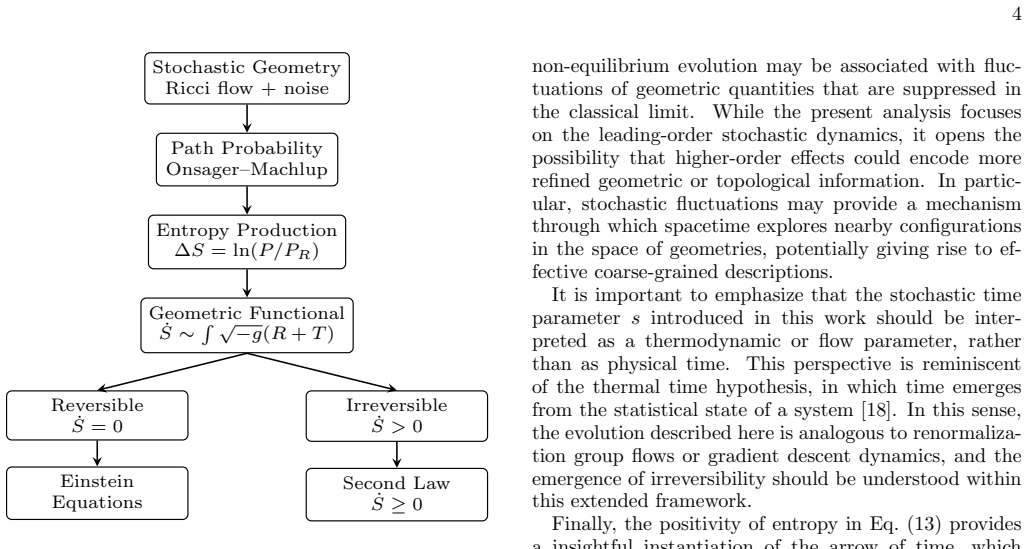
A stochastic geometric flow for the spacetime metric makes the Einstein equations the configurations where entropy production vanishes.
A machine-rendered reading of the paper's core claim, the machinery that carries it, and where it could break.
Core claim
By modeling spacetime metric evolution as a stochastic geometric flow, the paper defines entropy production via the ratio of forward to reversed trajectory probabilities. This quantity is shown to be determined by the curvature of spacetime and the matter content. Setting entropy production to zero recovers the Einstein field equations exactly. Consequently, general relativity appears as the reversible limit of an underlying stochastic geometro-dynamics, while the second law of thermodynamics arises naturally from the non-equilibrium evolution of the system.
What carries the argument
stochastic geometric flow for the spacetime metric, with entropy production defined as the ratio of probabilities of forward versus time-reversed trajectories
If this is right
- Entropy production vanishes if and only if the metric satisfies the Einstein field equations.
- Classical general relativity is recovered exactly as the reversible limit of the stochastic geometro-dynamics.
- The second law of thermodynamics arises directly from the non-equilibrium evolution of the gravitational flow.
- Curvature and matter contributions together determine the value of entropy production at each step.
Where Pith is reading between the lines
- Deviations from Einstein gravity in modified theories could correspond to regimes of persistently non-zero entropy production.
- The framework supplies a possible first-principles link between the gravitational arrow of time and the expansion history of the universe.
- If the stochastic flow can be quantized, it may connect to approaches where spacetime fluctuations generate thermodynamic irreversibility.
Load-bearing premise
A well-defined stochastic geometric flow for the spacetime metric must exist so that entropy production can be consistently defined as the ratio of probabilities of forward versus time-reversed trajectories.
What would settle it
An explicit calculation of the entropy production functional from the stochastic flow that fails to vanish precisely on solutions of the Einstein equations, or a concrete trajectory where the ratio is one without satisfying those equations.
Figures
read the original abstract
We investigate the relation between gravitational dynamics and the second law of thermodynamics in a non-equilibrium framework. Extending Jacobson's thermodynamic derivation of the Einstein equations, we introduce a stochastic geometric flow for the spacetime metric and define entropy production as the ratio between forward and time-reversed trajectories. We show that entropy production is governed by curvature and matter contributions, and that its vanishing selects configurations satisfying the Einstein field equations. Classical general relativity thus emerges as the reversible limit of an underlying stochastic geometro-dynamics, while the second law arises from its non-equilibrium evolution.
Editorial analysis
A structured set of objections, weighed in public.
Referee Report
Summary. The manuscript extends Jacobson's local Rindler thermodynamic derivation of the Einstein equations by introducing a stochastic geometric flow on the spacetime metric. Entropy production is defined as the log-ratio of probabilities of forward versus time-reversed trajectories; the paper claims this quantity is governed by curvature and matter contributions and vanishes precisely on solutions of the Einstein field equations. Classical GR is thereby presented as the reversible (zero-production) limit of an underlying stochastic geometro-dynamics, with the second law arising from its non-equilibrium evolution.
Significance. If a diffeomorphism-invariant stochastic flow and an independent entropy-production formula can be constructed, the result would supply a dynamical, non-equilibrium origin for both the Einstein equations and the second law, extending thermodynamic approaches to gravity. The absence of free parameters and the direct link to trajectory probabilities would be notable strengths.
major comments (1)
- [Abstract / Introduction] Abstract and opening sections: the central claim requires an explicit stochastic geometric flow (SDE on the metric, path-space measure, and demonstration that the forward/reverse probability ratio is independent of auxiliary choices and vanishes exactly when the Einstein tensor vanishes). No such construction, invariance proof, or explicit expression for the production rate is supplied, rendering the mapping from vanishing production to the field equations unverifiable and open to the circularity concern that equilibrium is defined to coincide with the Einstein equations.
Simulated Author's Rebuttal
We thank the referee for their careful reading and for identifying the need for greater explicitness in the construction. We respond to the single major comment below.
read point-by-point responses
-
Referee: [Abstract / Introduction] Abstract and opening sections: the central claim requires an explicit stochastic geometric flow (SDE on the metric, path-space measure, and demonstration that the forward/reverse probability ratio is independent of auxiliary choices and vanishes exactly when the Einstein tensor vanishes). No such construction, invariance proof, or explicit expression for the production rate is supplied, rendering the mapping from vanishing production to the field equations unverifiable and open to the circularity concern that equilibrium is defined to coincide with the Einstein equations.
Authors: We agree that the manuscript presents the stochastic geometric flow at a conceptual level by extending Jacobson’s local Rindler argument, without supplying an explicit SDE on the metric components, a concrete path-space measure, or a proof that the forward/reverse Radon–Nikodym derivative is independent of auxiliary regularizations. The entropy-production rate is stated to be proportional to the Einstein tensor contracted with the null generators plus matter terms, vanishing exactly on solutions of the field equations, but the explicit mapping is not derived from a specified stochastic process. We will therefore revise the manuscript to include (i) a concrete Langevin-type SDE for the metric, (ii) the associated path measure, and (iii) a direct calculation showing that the log-ratio is independent of auxiliary choices and vanishes if and only if the Einstein tensor vanishes. On the circularity concern: the probability ratio is defined from the stochastic dynamics alone; the Einstein equations appear as the dynamical condition for zero production rather than being presupposed in the definition of the ratio. revision: yes
Circularity Check
No significant circularity detected in derivation chain
full rationale
The paper extends Jacobson's 1995 thermodynamic derivation of the Einstein equations by positing a stochastic geometric flow on the metric and defining entropy production via the log-ratio of forward to time-reversed trajectory probabilities. It then claims to derive an explicit expression for this production in terms of curvature and matter terms whose vanishing recovers the field equations. No quoted step reduces the central result to a definition or fitted input by construction; the stochastic flow is introduced as an independent ansatz whose consequences are computed rather than presupposed. No self-citation chain is load-bearing, and the derivation is presented as a calculation from the flow measure to the entropy expression. The result is therefore self-contained against external benchmarks such as Jacobson's prior work.
Axiom & Free-Parameter Ledger
invented entities (1)
-
stochastic geometric flow for the spacetime metric
no independent evidence
Reference graph
Works this paper leans on
-
[1]
(B2) for vanishing noiseξ a — in order to explicit the noise contribution from the matter sector to the geometric gradient flow, we made use of the previous expansion
+ +O(α2) +g µνη ,(B3) whereϕ 0 is the solution to the Langevin equation Eq. (B2) for vanishing noiseξ a — in order to explicit the noise contribution from the matter sector to the geometric gradient flow, we made use of the previous expansion. Thus, the differenceϕ−ϕ 0 is proportional to the am- plitude of the stochastic fluctuationαξ a. If we consider δR...
-
[2]
Onsager–Machlup contribution Using the action (E6), the antisymmetric part under time reversal yields ∆SOM ∝ − Z ds d4x √−g gµν∂sgµν 2R+ D VPl N , (G6) with N constant. Then, further manipulating, one finds ∆SOM =− 1 8D Z dsd4x∂s √−g(2R+N D VP l ) = =− 1 2D Z d4x Z ds ∂√−g ∂s ∂(SEH + R d4y N ′D VPl √−g) ∂√−g = =− 1 2D ∆SEH − Z d4x∆√−g N ′ 2VPl ,(G7) withS...
-
[3]
Fokker–Planck contribution The Fokker–Planck term corresponds to the ratio of prob- ability densities, ∆SFP =−lnP[g f] + lnP[g i].(G9) Using the stationary distribution (C6), this contributes terms proportional to ∆SFP ∼ 1 2D ∆SEH −C Z d4x∆√−g VPl .(G10) In regimes close to stationarity or at leading order inD, this contribution does not affect the antisy...
-
[4]
It is then straightforward to show that this is a property of the Langevin equations endowed with a drift term that can be written as a derivative of another quantity
Geometric entropy production Combining the two contributions and retaining leading- order antisymmetric terms yields for the entropy produc- tion in the Universe ⟨∆SU⟩ ∝ − DZ ds d4x∆( √−g) 1 VPl E .(G11) As we can see, the terms related to the drift disappear. It is then straightforward to show that this is a property of the Langevin equations endowed wit...
-
[5]
Local entropy production and positivity Defining SOM = Z d4x √−g σ(x, s),(G17) one finds ∂sσ= 1 4D ∆R+ 1 2D RµνRµν − 1 2 δR δη .(G18) Near the Einstein sector it holds Xµν =R µν −κR T µν −Λg µν,(G19) 9 and the stochastic flow then implies ∂sgµν ∼ −2X µν.(G20) Hence, δSOM δs ∼ Z d4x √−g XµνX µν +O(D).(G21) This provides an explicit quadratic form ensuring ...
-
[6]
Appendix H: Time–temperature relation The stochastic parametersshould be interpreted as a thermodynamic flow parameter, not as physical time
Jensen inequality and fluctuation relation Independently of the approximation, entropy production satisfies the exact identity e−∆S = 1,(G22) which implies, by Jensen’s inequality, ⟨∆S⟩ ≥0.(G23) Thus positivity is guaranteed both: •structurally (quadratic form near Einstein solu- tions); •statistically (fluctuation theorem). Appendix H: Time–temperature r...
-
[7]
thermal time
and find thatA µν has the form Aµν =AG µν +Bg µν ,(I3) withAandBconstants. The traceless condition then provides gµνAµν =Ag µνGµν + 4B=−AR+ 4B= 0.(I4) SinceRis not a constant, the only solution to the previous equation isA=B= 0. Thus, if we require that the transformation is re- versible (δS U = 0) — together with the conservation of the energy and the re...
-
[8]
Jacobson, Phys
T. Jacobson, Phys. Rev. Lett.75, 1260 (1995)
1995
-
[9]
Padmanabhan, Rep
T. Padmanabhan, Rep. Prog. Phys.73, 046901 (2010)
2010
-
[10]
Parisi and Y.-S
G. Parisi and Y.-S. Wu, Sci. Sin.24, 483 (1981)
1981
- [11]
-
[12]
C. Eling, R. Guedens, and T. Jacobson, Physical Review Letters96, 121301 (2006), arXiv:gr-qc/0602001
Pith/arXiv arXiv 2006
-
[13]
G. Chirco and S. Liberati, Physical Review D81, 024016 (2010), arXiv:0909.4194 [gr-qc]
Pith/arXiv arXiv 2010
-
[14]
C. Barcel´ o, S. Liberati, and M. Visser, International Journal of Modern Physics D10, 799 (2001), arXiv:gr- qc/0106002
arXiv 2001
-
[15]
Seifert, Rep
U. Seifert, Rep. Prog. Phys.75, 126001 (2012)
2012
-
[16]
Onsager and S
L. Onsager and S. Machlup, Phys. Rev.91, 1505 (1953)
1953
-
[17]
R. S. Hamilton, J. Diff. Geom.17, 255 (1982)
1982
- [18]
-
[19]
E. A. Novikov, Sov. Phys. JETP20, 1290 (1965)
1965
-
[20]
Furutsu, J
K. Furutsu, J. Res. Natl. Bur. Stand. D67, 303 (1963)
1963
-
[21]
C. W. Gardiner,Handbook of Stochastic Methods (Springer, 2009)
2009
-
[22]
Risken,The Fokker-Planck Equation(Springer, 1996)
H. Risken,The Fokker-Planck Equation(Springer, 1996)
1996
-
[23]
P. C. Martin, E. D. Siggia, and H. A. Rose, Phys. Rev. A8, 423 (1973)
1973
-
[24]
De Dominicis, J
C. De Dominicis, J. Phys. Colloques37, C1 (1976)
1976
-
[25]
Rovelli, Class
C. Rovelli, Class. Quant. Grav.10, 1549 (1993)
1993
-
[26]
Verlinde, JHEP1104, 029 (2011)
E. Verlinde, JHEP1104, 029 (2011)
2011
-
[27]
F.Fox, Physical Review A33(1986)
R. F.Fox, Physical Review A33(1986)
1986
-
[28]
J. M. Sancho and M. S. M. et al., Physical Review A26 (1982)
1982
-
[29]
M. E. Cates, . Fodor, T. Markovich, C. Nardini, and E. Tjhung, Entropy24(2022), 10.3390/e24020254
-
[30]
G. E. Crooks, Phys. Rev. E61, 2361 (2000)
2000
-
[31]
D.Lovelock, Journal of Mathematical Physics.12(1971), 10.1063/1.1665613
-
[32]
S. H. G. Gibbons, Physical Review D15(1977)
1977
-
[33]
York, Foundations of Physics16(1986)
J. York, Foundations of Physics16(1986)
1986
-
[34]
Gourgoulhon, Lecture Notes in Physics (Springer, Berlin)846(2012)
E. Gourgoulhon, Lecture Notes in Physics (Springer, Berlin)846(2012)
2012
-
[35]
R. M. Wald,General Relativity(University of Chicago Press, 1984)
1984
-
[36]
Smarr, Physical Review Letters129(1973)
L. Smarr, Physical Review Letters129(1973)
1973
discussion (0)
Sign in with ORCID, Apple, or X to comment. Anyone can read and Pith papers without signing in.