Auditing Engagement Incentives in the Kidfluencer Ecosystem: A Multimodal Weak Supervision Approach
Pith reviewed 2026-06-28 08:23 UTC · model grok-4.3
The pith
Kidfluencer videos with higher exploitation signals receive substantially more views on YouTube.
A machine-rendered reading of the paper's core claim, the machinery that carries it, and where it could break.
Core claim
Using weak supervision to aggregate labeling functions from text and vision models, the analysis assigns probabilistic exploitation scores and shows through mixed-effects regression that these scores correlate with higher viewership, specifically a 4.4 times increase per unit score, with notable boosts from emotional and performative elements but not from explicit advertising.
What carries the argument
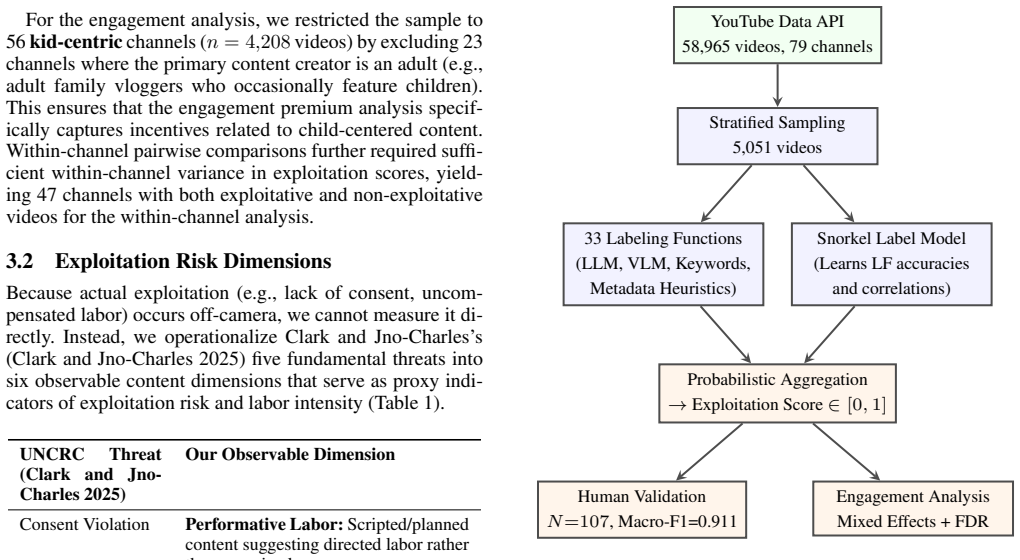
The multimodal weak supervision pipeline that combines LLM classification and GPT-4 Vision analysis across six literature-grounded dimensions to generate a probabilistic exploitation score.
If this is right
- A one-unit increase in exploitation score multiplies views by 4.4 after accounting for channel variation.
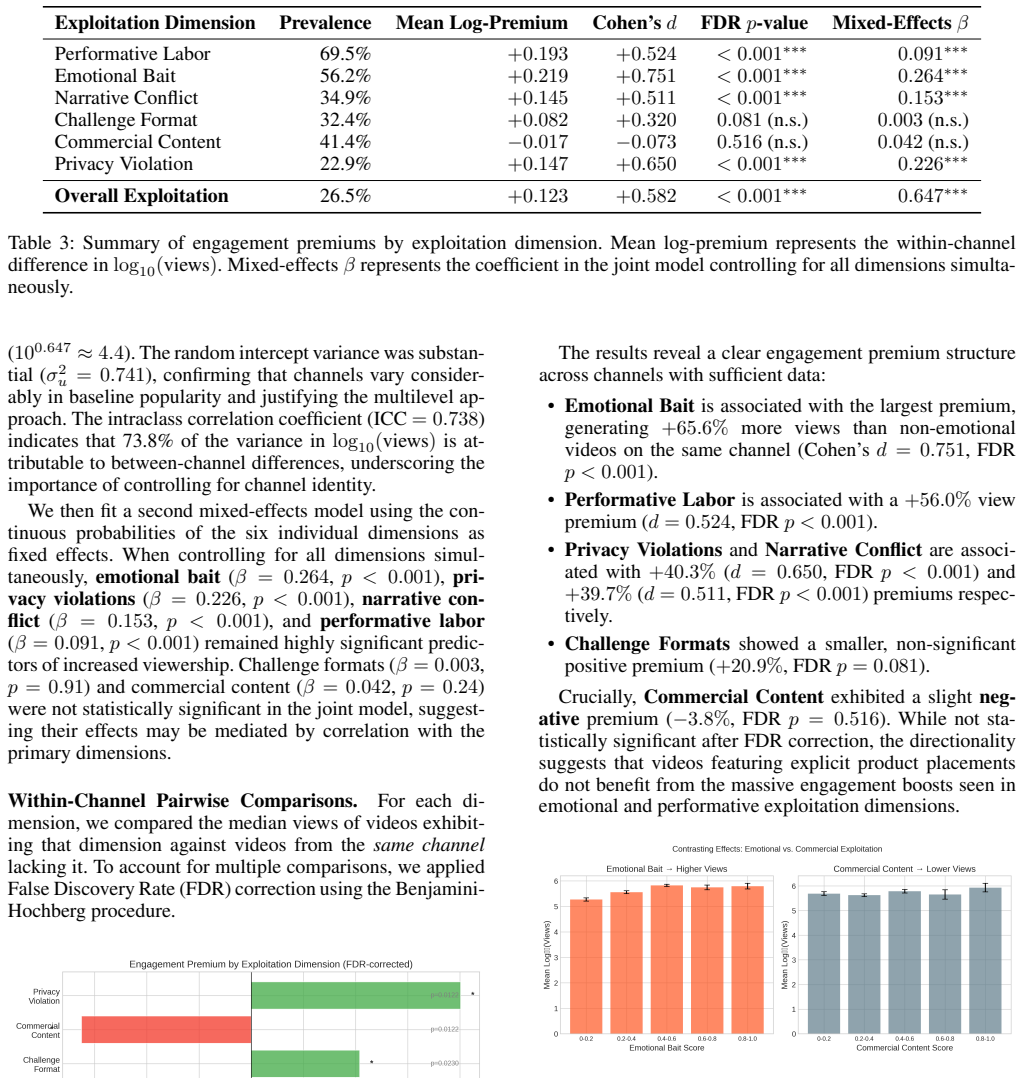
- Emotional bait yields a 65.6% median view increase within channels.
- Performative content yields a 56.0% median view increase within channels.
- Explicit commercial content shows no significant view premium.
- Engagement is linked to intensive child labor rather than traditional product placement.
Where Pith is reading between the lines
- The approach could extend to auditing similar content on other social media platforms.
- Platform recommendation systems may inadvertently incentivize exploitative practices.
- Policy interventions might need to target algorithmic rewards for identity commodification.
- Creators might shift strategies if such content is deprioritized.
Load-bearing premise
The six labeling functions and their aggregation accurately reflect real exploitation risk rather than content style or platform biases.
What would settle it
Observing whether view counts drop for channels after a policy that flags or downranks videos with high exploitation scores.
Figures
read the original abstract
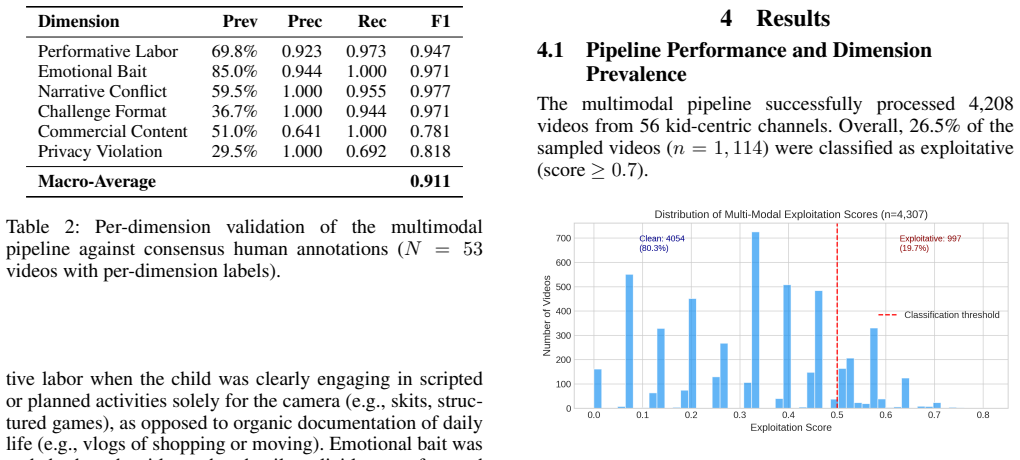
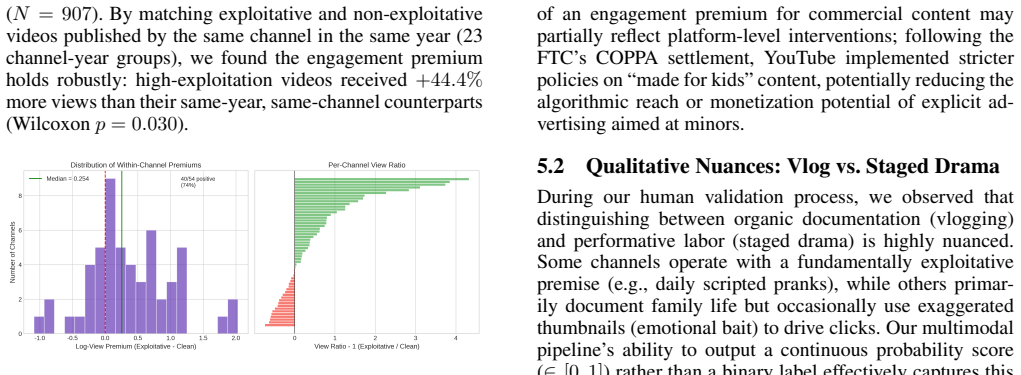
The rise of `kidfluencers' on YouTube has raised ethical concerns about child digital labor and exploitation. While emerging legislation attempts to regulate this ecosystem, empirical evidence linking exploitation to engagement remains scarce, given the difficulty of operationalizing exploitation at scale. This study presents a multimodal AI audit of 5,051 videos across 79 kidfluencer channels, using weak supervision to detect exploitation signals without large-scale manual labels. We aggregate noisy labeling functions -- including LLM-based classification of titles and GPT-4 Vision analysis of thumbnails and descriptions across six literature-grounded dimensions -- to assign a probabilistic exploitation score to each video. A multi-annotator validation study (N=107) shows strong agreement with human judgment (macro-average F1 $= 0.911$) and high sensitivity for overall exploitation risk (recall $= 0.960$, F1 $= 0.793$). Our findings reveal a significant engagement premium for performative labor, emotional bait, and privacy violations. Exploitation scores correlate with view counts (Spearman $\rho = 0.229$, $p < 10^{-50}$), and mixed-effects regression controlling for channel-level variation shows that a one-unit increase in exploitation score yields a $4.4\times$ increase in views ($p < 0.001$). Within-channel analyses indicate median view boosts of $+65.6\%$ for emotional bait and $+56.0\%$ for performative content (FDR-corrected $p<0.001$), with effects holding in same-year robustness checks ($p=0.030$). Explicit commercial content (product placement), by contrast, shows no premium ($-3.8\%$, n.s.), suggesting the platform rewards commodification of the child's identity and labor over traditional advertising. These findings challenge policy frameworks focused solely on financial trusts, showing that engagement is systematically tied to the intensive, performative labor of children.
Editorial analysis
A structured set of objections, weighed in public.
Referee Report
Summary. The paper audits 5,051 YouTube videos from 79 kidfluencer channels using multimodal weak supervision. Six literature-grounded labeling functions (LLM title classification plus GPT-4V analysis of thumbnails and descriptions) are aggregated into a probabilistic exploitation score. Human validation (N=107) yields macro F1=0.911. The score correlates with views (Spearman ρ=0.229); mixed-effects regression controlling for channel effects finds a 4.4× view multiplier per unit increase in score (p<0.001). Within-channel contrasts show +65.6% median view boost for emotional bait and +56.0% for performative content (FDR-corrected), while explicit commercial content shows no premium. The authors conclude that platform engagement rewards identity commodification over traditional advertising and that policy should address performative labor.
Significance. If the exploitation score is shown to be independent of platform visibility features, the work supplies the first large-scale empirical link between exploitation signals and engagement metrics in the kidfluencer ecosystem. The within-channel design and FDR correction are strengths; the scale and validation study add credibility. The result would directly inform ongoing legislative efforts by demonstrating that engagement premiums attach to specific non-financial dimensions of child labor.
major comments (2)
- [Abstract / §4] Abstract and §4 (regression): the six labeling functions explicitly encode emotional bait and performative labor—dimensions already known to drive platform engagement. The mixed-effects model then reports a 4.4× view multiplier and within-channel boosts of +65.6% / +56.0% for precisely these dimensions. No ablation, feature-importance analysis, or test of LF independence from visibility bias is described; therefore the reported coefficient and ρ=0.229 may be partly mechanical rather than evidence that exploitation causes engagement. This assumption is load-bearing for the causal interpretation advanced in the abstract and conclusion.
- [§3.2] §3.2 (weak-supervision pipeline): the aggregation method, weighting of the six LFs, and handling of label dependence are not specified. Because the downstream regression treats the resulting probabilistic score as an independent variable, lack of detail on how the score is constructed prevents verification that it is not reducible to engagement-predictive content features.
minor comments (2)
- [Abstract] Abstract: exact definitions of the six dimensions, the aggregation function, and robustness checks to video sampling frame rate or thumbnail selection are omitted; these details are needed for reproducibility.
- [§5] §5 (validation): the N=107 study reports macro F1 but does not break down agreement by dimension or report inter-annotator reliability statistics beyond the aggregate figure.
Simulated Author's Rebuttal
We thank the referee for their constructive comments, which help clarify the robustness of our findings. We address each major comment below and commit to revisions that directly respond to the concerns raised.
read point-by-point responses
-
Referee: [Abstract / §4] Abstract and §4 (regression): the six labeling functions explicitly encode emotional bait and performative labor—dimensions already known to drive platform engagement. The mixed-effects model then reports a 4.4× view multiplier and within-channel boosts of +65.6% / +56.0% for precisely these dimensions. No ablation, feature-importance analysis, or test of LF independence from visibility bias is described; therefore the reported coefficient and ρ=0.229 may be partly mechanical rather than evidence that exploitation causes engagement. This assumption is load-bearing for the causal interpretation advanced in the abstract and conclusion.
Authors: We acknowledge the validity of this concern. The labeling functions target literature-derived exploitation dimensions, but without explicit checks it remains possible that the associations partly reflect known engagement drivers rather than a distinct exploitation signal. We will add an ablation analysis in §4 that recomputes the exploitation score after removing the emotional-bait and performative-labor LFs, then re-estimates both the Spearman correlation and the mixed-effects model. We will also report the view-count correlations of each individual LF and include a simple feature-importance check. In addition, we will revise the abstract and conclusion to replace causal language (“yields a 4.4× increase”) with associative language consistent with the observational design. These changes will be incorporated in the revised manuscript. revision: yes
-
Referee: [§3.2] §3.2 (weak-supervision pipeline): the aggregation method, weighting of the six LFs, and handling of label dependence are not specified. Because the downstream regression treats the resulting probabilistic score as an independent variable, lack of detail on how the score is constructed prevents verification that it is not reducible to engagement-predictive content features.
Authors: We agree that the current description of the aggregation step is insufficient for independent verification. In the revised manuscript we will expand §3.2 to specify (i) the exact procedure used to combine the six labeling functions into the final probabilistic score, (ii) the weighting scheme applied to each LF, and (iii) how any label dependence among the LFs is modeled or assumed. These additions will allow readers to assess whether the resulting score is reducible to engagement-predictive features. revision: yes
Circularity Check
No significant circularity detected
full rationale
The paper constructs an exploitation score via weak supervision from six literature-grounded labeling functions (LLM title classification and GPT-4V analysis of thumbnails/descriptions) applied to content features, then validates the score against independent human annotators (N=107) before performing separate statistical tests (Spearman correlation and mixed-effects regression) against external view-count data. No step reduces by construction to its inputs: the labeling functions are not fitted to views, the regression coefficients are not renamed fitted parameters, and no self-citation chains, uniqueness theorems, or ansatzes are invoked to force the result. The derivation chain remains self-contained against external benchmarks.
Axiom & Free-Parameter Ledger
axioms (1)
- domain assumption Labeling functions derived from literature are sufficiently accurate proxies for exploitation when aggregated probabilistically
Reference graph
Works this paper leans on
-
[1]
Auditing radicalization pathways on
Ribeiro, Manoel Horta and Ottoni, Raphael and West, Robert and Almeida, Virg. Auditing radicalization pathways on. Proceedings of the 2020 Conference on Fairness, Accountability, and Transparency , pages=
2020
-
[2]
Algorithmic amplification of politics on
Husz. Algorithmic amplification of politics on. Proceedings of the National Academy of Sciences , volume=
-
[3]
Auditing
Haroon, Muhammad and Wojcieszak, Magdalena and Chhabra, Anshuman and Liu, Xin and Mohammadi, Piyush and Shrestha, Prasanta and Muric, Goran , journal=. Auditing
-
[4]
Measuring misinformation in video search platforms: An audit study on
Hussein, Eslam and Juneja, Prerna and Mitra, Tanushree , journal=. Measuring misinformation in video search platforms: An audit study on
-
[5]
Applied Network Science , volume=
Auditing the audits: Evaluating methodologies for social media platform audits , author=. Applied Network Science , volume=
-
[6]
arXiv preprint arXiv:2501.15048 , year=
Auditing algorithmic bias with emotionally-agentic sock puppets , author=. arXiv preprint arXiv:2501.15048 , year=
-
[7]
Proceedings of the ACM on Human-Computer Interaction , volume=
360 sociotechnical audits , author=. Proceedings of the ACM on Human-Computer Interaction , volume=
-
[8]
Disturbed
Papadamou, Kostantinos and Papasavva, Antonis and Zannettou, Savvas and Blackburn, Jeremy and Kourtellis, Nicolas and Leontiadis, Ilias and Stringhini, Gianluca and Sirivianos, Michael , booktitle=. Disturbed
-
[9]
Medium , year=
Something is wrong on the internet , author=. Medium , year=
-
[10]
Bringing the kid back into
Tahir, Rashid and others , booktitle=. Bringing the kid back into
-
[11]
Journal of Business Ethics , year=
The child labor in social media: Kidfluencers, ethics of care, and exploitation , author=. Journal of Business Ethics , year=
-
[12]
Digital capitalism and child labor exploitation on
Bakio. Digital capitalism and child labor exploitation on. Sociology Lens , year=
-
[13]
New Media & Society , year=
Children as concealed commodities , author=. New Media & Society , year=
-
[14]
Growing up online: Children, family vlogs, and the monetization of childhood , author=
-
[15]
Jurimetrics , volume=
Family vlogging and child harm , author=. Jurimetrics , volume=
-
[16]
M/C Journal , volume=
Micromicrocelebrity: Branding babies on the internet , author=. M/C Journal , volume=
-
[17]
Emory Law Journal , volume=
Sharenting: Children's privacy in the age of social media , author=. Emory Law Journal , volume=
-
[18]
Children and Youth Services Review , volume=
The phenomenon of sharenting and its risks in the online environment , author=. Children and Youth Services Review , volume=
-
[19]
Cureus , volume=
Sharenting syndrome: An appropriate use of social media? , author=. Cureus , volume=
-
[20]
Proceedings of the VLDB Endowment , volume=
Snorkel: Rapid training data creation with weak supervision , author=. Proceedings of the VLDB Endowment , volume=
-
[21]
Advances in Neural Information Processing Systems , volume=
Data programming: Creating large training sets, quickly , author=. Advances in Neural Information Processing Systems , volume=
-
[22]
Bach, Stephen H and others , booktitle=. Snorkel
-
[23]
ACM Journal of Data and Information Quality , volume=
A survey on classifying big data with label noise , author=. ACM Journal of Data and Information Quality , volume=
-
[24]
arXiv preprint , year=
Adapting large language models for content moderation , author=. arXiv preprint , year=
-
[25]
Gilardi, Fabrizio and Alizadeh, Meysam and Kubli, Maël , journal=
-
[26]
arXiv preprint , year=
T. arXiv preprint , year=
-
[27]
Children's Online Privacy Protection Act (
-
[28]
Kids Online Safety Act (
-
[29]
Illinois Child Influencer Act , note=
-
[30]
The 4Cs: Classifying online risk to children , author=
-
[31]
Trends in online platform regulation and children's rights , author=
-
[32]
Deep neural networks for
Covington, Paul and Adams, Jay and Sargin, Emre , booktitle=. Deep neural networks for
-
[33]
The impact of
Zhou, Renjie and Khemmarat, Samamon and Gao, Lixin , booktitle=. The impact of
-
[34]
From ranking algorithms to `ranking cultures': Investigating the modulation of visibility in
Rieder, Bernhard and Matamoros-Fern. From ranking algorithms to `ranking cultures': Investigating the modulation of visibility in. Convergence , volume=
-
[35]
Data and Discrimination: Converting Critical Concerns into Productive Inquiry , year=
Auditing algorithms: Research methods for detecting discrimination on internet platforms , author=. Data and Discrimination: Converting Critical Concerns into Productive Inquiry , year=
-
[36]
Foundations and Trends in Human-Computer Interaction , volume=
Auditing algorithms: Understanding algorithmic systems from the outside in , author=. Foundations and Trends in Human-Computer Interaction , volume=
-
[37]
Communication, Simulation, and Intelligent Agents: Implications of Personal Intelligent Machines for Medical Education
Clancey, William J. Communication, Simulation, and Intelligent Agents: Implications of Personal Intelligent Machines for Medical Education. Proceedings of the Eighth International Joint Conference on Artificial Intelligence (IJCAI-83)
-
[38]
Classification Problem Solving
Clancey, William J. Classification Problem Solving. Proceedings of the Fourth National Conference on Artificial Intelligence
-
[39]
, title =
Robinson, Arthur L. , title =. 1980 , doi =. https://science.sciencemag.org/content/208/4447/1019.full.pdf , journal =
1980
-
[40]
New Ways to Make Microcircuits Smaller---Duplicate Entry
Robinson, Arthur L. New Ways to Make Microcircuits Smaller---Duplicate Entry. Science
-
[41]
International Journal of Man-Machine Studies , volume = 20, number = 1, pages =
Diane Warner Hasling and William J. Clancey and Glenn Rennels , abstract =. Strategic explanations for a diagnostic consultation system , journal =. 1984 , issn =. doi:https://doi.org/10.1016/S0020-7373(84)80003-6 , url =
-
[42]
and Rennels, Glenn R
Hasling, Diane Warner and Clancey, William J. and Rennels, Glenn R. and Test, Thomas. Strategic Explanations in Consultation---Duplicate. The International Journal of Man-Machine Studies
-
[43]
Poligon: A System for Parallel Problem Solving
Rice, James. Poligon: A System for Parallel Problem Solving
-
[44]
Transfer of Rule-Based Expertise through a Tutorial Dialogue
Clancey, William J. Transfer of Rule-Based Expertise through a Tutorial Dialogue
-
[45]
The Engineering of Qualitative Models
Clancey, William J. The Engineering of Qualitative Models
-
[46]
2017 , eprint=
Attention Is All You Need , author=. 2017 , eprint=
2017
-
[47]
Pluto: The 'Other' Red Planet
NASA. Pluto: The 'Other' Red Planet
discussion (0)
Sign in with ORCID, Apple, or X to comment. Anyone can read and Pith papers without signing in.