Long-Term and Short-Term Transistor Aging in Deep Neural Networks: Impact and Mitigation
Pith reviewed 2026-06-28 09:05 UTC · model grok-4.3
The pith
Aging-aware retraining produces resilient DNNs that maintain accuracy with reduced timing guardbands despite transistor aging.
A machine-rendered reading of the paper's core claim, the machinery that carries it, and where it could break.
Core claim
An aging-aware retraining methodology generates DNNs resilient to long-term and short-term transistor aging, allowing aggressive guardbands while preserving inference accuracy in the presence of aging-induced degradation.
What carries the argument
Aging-aware retraining, which incorporates modeled aging-induced timing changes into the training process to compensate for slowdowns without hardware changes.
If this is right
- DNNs can use smaller guardbands and therefore higher clock speeds or throughput while meeting lifetime reliability targets.
- Inference accuracy remains stable as transistors age without needing larger initial guardbands.
- No circuit redesign or extra hardware is required to counteract aging effects.
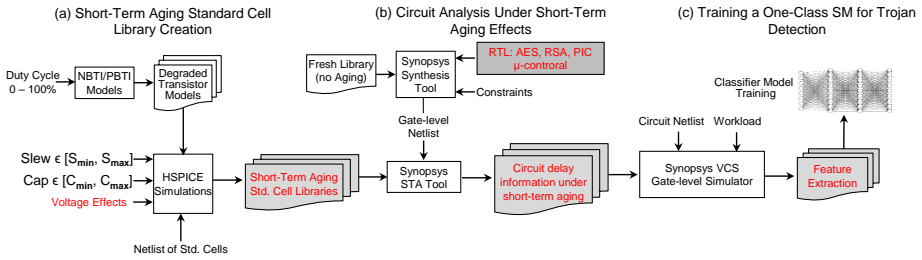
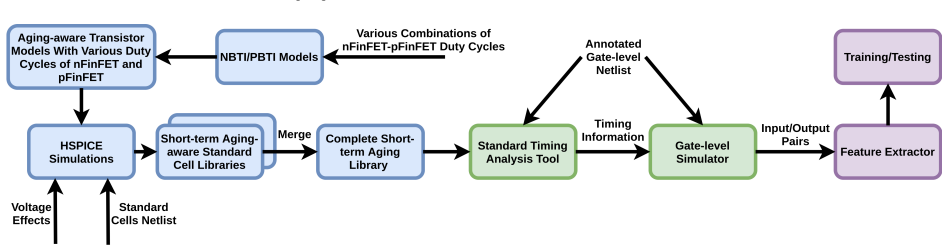
- Short-term aging stress can be applied as a controlled excitation for hardware Trojan detection.
Where Pith is reading between the lines
- The method could be combined with other reliability techniques such as voltage scaling to further reduce power.
- Results on image classification suggest the approach may apply to other DNN tasks like object detection or speech recognition.
- Extending the aging models to include process variation or temperature would test broader applicability.
Load-bearing premise
The effects of transistor aging on circuit timing can be sufficiently modeled and compensated via retraining without introducing new failure modes or requiring hardware modifications.
What would settle it
Measure accuracy of an aging-aware retrained DNN versus a standard DNN on the same hardware under accelerated aging with reduced guardbands; the claim fails if accuracy degradation is not reduced.
Figures






read the original abstract
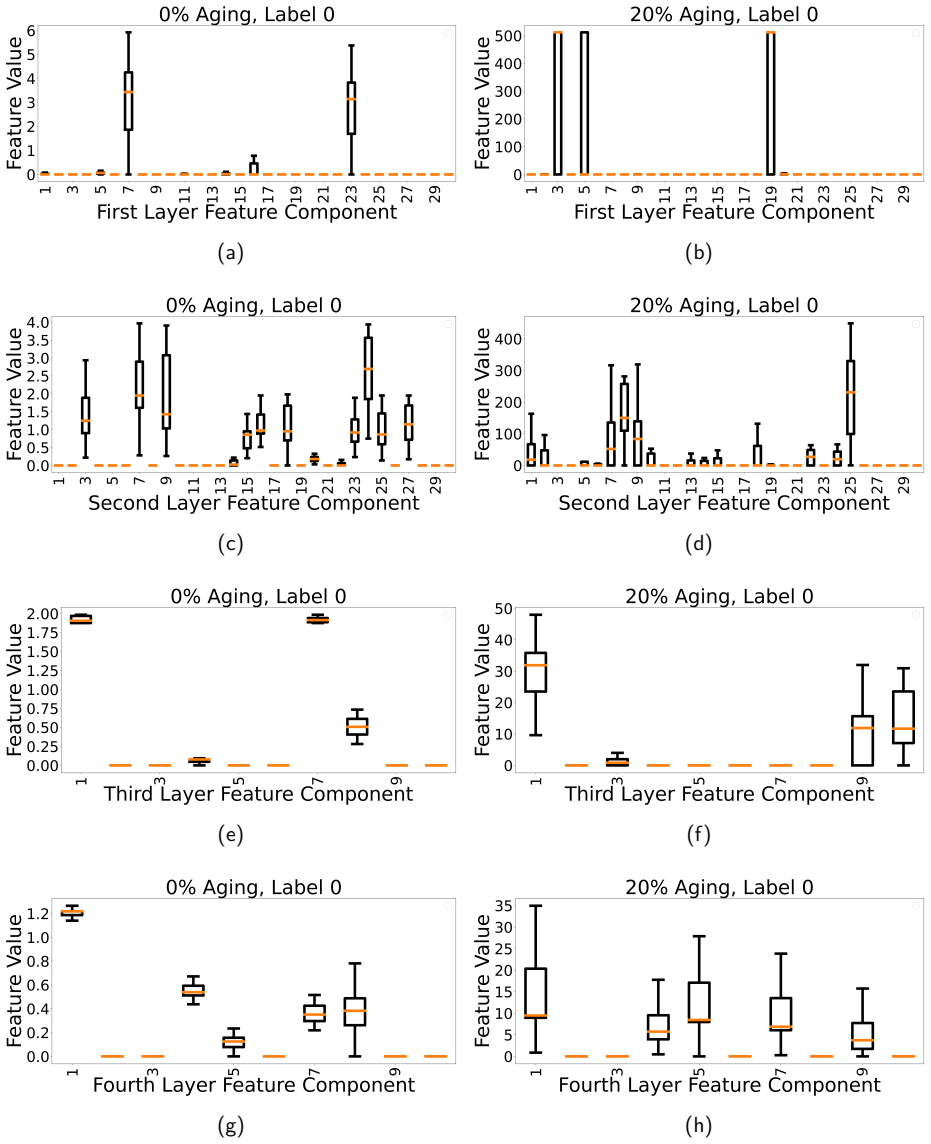
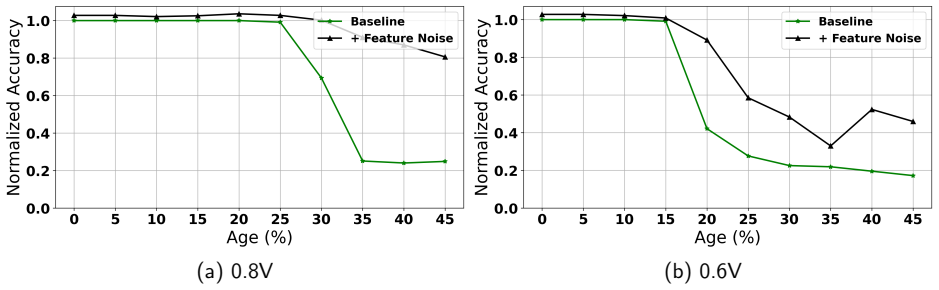
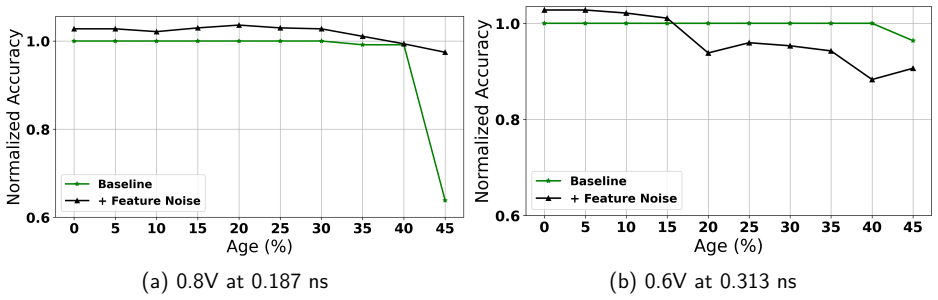
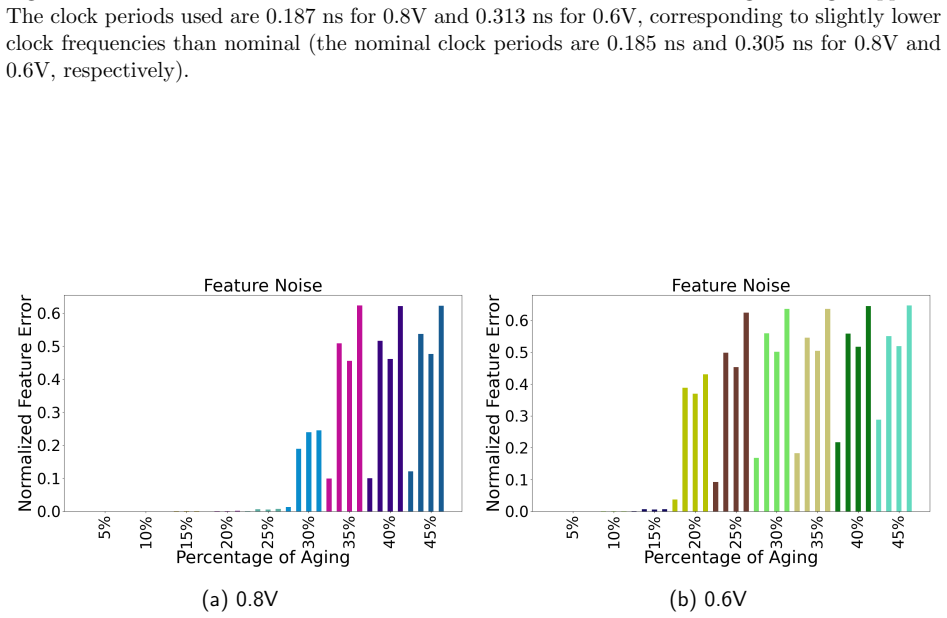
Deep neural networks (DNNs) are used in a variety of real-world applications including, for example, image classification and speech recognition. The inference accuracy of DNN implemented on hardware in integrated circuits (ICs) degrades under phenomena such as transistor aging. Aging slows down the switching speed of transistors, resulting in system-level timing violations due to unsustainable clocks. To maintain reliability for the entire projected lifetime, designers add guardbands to prevent timing violations; however, adding large timing guardbands causes losses in performance (speed or throughput). This chapter provides a detailed discussion of the effects of long-term and short-term transistor aging on DNN inference accuracy. Furthermore, to mitigate aging effects on DNN's accuracy and keep them at bay, a methodology for aging-aware retraining is presented in order to generate a resilient DNN even when aggressive (i.e., smaller than required) guardbands are used. This improves the inference accuracy of the DNNs even in the presence of aging-induced degradation. These effects are discussed in this chapter along with mitigation strategies on a hardware implementation of a DNN for image classification on an off-the-shelf image dataset. The application of short-term aging as an excitation mechanism for the detection of hardware Trojans in integrated circuits is also briefly discussed.
Editorial analysis
A structured set of objections, weighed in public.
Referee Report
Summary. The paper claims that long-term and short-term transistor aging degrades DNN inference accuracy via timing violations in hardware implementations. It proposes an aging-aware retraining methodology to generate resilient DNNs that maintain accuracy even when using aggressive (smaller-than-required) guardbands. The approach is illustrated via a hardware DNN for image classification on an off-the-shelf dataset, with a brief discussion of short-term aging as an excitation mechanism for hardware Trojan detection.
Significance. If validated, the aging-aware retraining technique could enable meaningful reductions in guardband overhead for DNN accelerators, improving performance and energy efficiency while preserving long-term reliability. This hardware-software co-design angle addresses a practical deployment barrier for real-world DNN systems.
major comments (1)
- [Abstract] Abstract: the central claim that aging-aware retraining improves inference accuracy under aging-induced degradation is presented without any quantitative results, error bars, baseline comparisons, or experimental details on the hardware test setup, aging models, or retraining procedure. This absence is load-bearing for the primary contribution.
minor comments (1)
- The manuscript refers to itself as 'this chapter,' which may indicate it is excerpted from a larger work; ensure the submission is self-contained with all necessary methodological and result details for a journal article.
Simulated Author's Rebuttal
We thank the referee for the constructive feedback. The major comment highlights a valid issue with the abstract. We agree that strengthening the abstract with quantitative support will improve the manuscript and will revise it in the next version. Our point-by-point response follows.
read point-by-point responses
-
Referee: [Abstract] Abstract: the central claim that aging-aware retraining improves inference accuracy under aging-induced degradation is presented without any quantitative results, error bars, baseline comparisons, or experimental details on the hardware test setup, aging models, or retraining procedure. This absence is load-bearing for the primary contribution.
Authors: We agree that the abstract would be strengthened by including key quantitative results. The full manuscript reports experiments on a hardware DNN implementation for image classification using an off-the-shelf dataset, with aging models for long-term and short-term effects, and details the aging-aware retraining procedure. We will revise the abstract to concisely incorporate representative quantitative findings (e.g., accuracy degradation percentages under aging and recovery achieved by the proposed method relative to baselines), along with brief references to the hardware setup and aging models, while respecting length limits. This addresses the load-bearing nature of the claim. revision: yes
Circularity Check
No significant circularity identified
full rationale
The paper presents an empirical methodology for aging-aware retraining of DNNs to mitigate transistor aging effects on inference accuracy, validated through hardware implementation on an image classification task. No derivation chain, equations, or load-bearing claims reduce to self-definitions, fitted inputs renamed as predictions, or self-citation chains. The approach relies on external aging models and experimental results rather than internal circular reductions.
Axiom & Free-Parameter Ledger
Reference graph
Works this paper leans on
-
[1]
Reliability-aware design to suppress aging
Hussam Amrouch, Behnam Khaleghi, Andreas Gerstlauer, and J¨ org Henkel. Reliability-aware design to suppress aging. InProceedings of ACM/EDAC/IEEE Design Automation Confer- ence, pages 1–6, Austin,TX, June 2016. IEEE. 23 Table 1: Performance of the one-class SVM classifier for Trojan detection for ICs with 14nm FinFET technology. Each bin has 5 inputs. Bi...
2016
-
[2]
Arechiga and Alan J
Austin P. Arechiga and Alan J. Michaels. The effect of weight errors on neural networks. In Proceesings of IEEE Annual Computing and Communication Workshop and Conference, pages 190–196, Las Vegas, NV, 2018. IEEE
2018
-
[3]
Arechiga and Alan J
Austin P. Arechiga and Alan J. Michaels. The robustness of modern deep learning architectures against single event upset errors. InProceedings of IEEE High Performance extreme Computing Conference, pages 1–6, Waltham, MA, 2018. IEEE
2018
-
[4]
Joshi, Matthew M
Nandhini Chandramoorthy, Karthik Swaminathan, Martin Cochet, Arun Paidimarri, Schuyler Eldridge, Rajiv V. Joshi, Matthew M. Ziegler, Alper Buyuktosunoglu, and Pradip Bose. Re- silient low voltage accelerators for high energy efficiency. InProceedings of IEEE International Symposium on High Performance Computer Architecture, pages 147–158, Washington, DC,
-
[5]
Academic Press, Cambridge, MA, 2015
Yogesh Singh Chauhan, Darsen Duane Lu, Sriramkumar Venugopalan, Sourabh Khandelwal, Juan Pablo Duarte, Navid Paydavosi, Ai Niknejad, and Chenming Hu.FinFET modeling for IC simulation and design: using the BSIM-CMG standard. Academic Press, Cambridge, MA, 2015
2015
-
[6]
Emer, and Vivienne Sze
Yu-Hsin Chen, Tushar Krishna, Joel S. Emer, and Vivienne Sze. Eyeriss: An energy-efficient reconfigurable accelerator for deep convolutional neural networks.IEEE Journal of Solid-State Circuits, 52(1):127–138, 2017
2017
-
[7]
Sensitivity based error resilient techniques for energy efficient deep neural network accelerators
Wonseok Choi, Dongyeob Shin, Jongsun Park, and Swaroop Ghosh. Sensitivity based error resilient techniques for energy efficient deep neural network accelerators. InProceedings of ACM/IEEE Design Automation Conference, pages 1–6, Las Vegas, NV, 2019. IEEE
2019
-
[8]
Hardware-oriented approximation of convolutional neural networks, 2016
Philipp Gysel, Mohammad Motamedi, and Soheil Ghiasi. Hardware-oriented approximation of convolutional neural networks, 2016
2016
-
[9]
Training modern deep neural networks for memory-fault robustness
Ghouthi Boukli Hacene, Fran¸ cois Leduc-Primeau, Amal Ben Soussia, Vincent Gripon, and Fran¸ cois Gagnon. Training modern deep neural networks for memory-fault robustness. In Proceedings of IEEE International Symposium on Circuits and Systems, pages 1–5, Sapporo, Japan, 2019. IEEE
2019
-
[10]
Horowitz, and William J
Song Han, Xingyu Liu, Huizi Mao, Jing Pu, Ardavan Pedram, Mark A. Horowitz, and William J. Dally. EIE: Efficient inference engine on compressed deep neural network. InPro- ceedings of IEEE International Symposium on Computer Architecture, page 243–254, Seoul, Republic of Korea, 2016. IEEE
2016
-
[11]
Deep compression: Compressing deep neural networks with pruning, trained quantization and huffman coding, 2015
Song Han, Huizi Mao, and William J Dally. Deep compression: Compressing deep neural networks with pruning, trained quantization and huffman coding, 2015
2015
-
[12]
Termi- nal brain damage: Exposing the graceless degradation in deep neural networks under hardware fault attacks
Sanghyun Hong, Pietro Frigo, Yigitcan Kaya, Cristiano Giuffrida, and Tudor Dumitras. Termi- nal brain damage: Exposing the graceless degradation in deep neural networks under hardware fault attacks. InProceedings of USENIX Security Symposium, pages 497–514, Santa Clara, CA, 2019. USENIX Association
2019
-
[13]
Calibrating process variation at system level with in-situ low-precision transfer learning for analog neural network processors
Kaige Jia, Zheyu Liu, Qi Wei, Fei Qiao, Xinjun Liu, Yi Yang, Hua Fan, and Huazhong Yang. Calibrating process variation at system level with in-situ low-precision transfer learning for analog neural network processors. InProceedings of ACM/ESDA/IEEE Design Automation Conference, pages 1–6, San Francisco, CA, 2018. IEEE
2018
-
[14]
Xun Jiao, Mulong Luo, Jeng-Hau Lin, and Rajesh K. Gupta. An assessment of vulnerability of hardware neural networks to dynamic voltage and temperature variations. InProceedings of IEEE/ACM International Conference on Computer-Aided Design, pages 945–950, Irvine, CA, 2017. IEEE
2017
-
[15]
MATIC: Learning around errors for efficient low-voltage neural network accelerators
Sung Kim, Patrick Howe, Thierry Moreau, Armin Alaghi, Luis Ceze, and Visvesh Sathe. MATIC: Learning around errors for efficient low-voltage neural network accelerators. InPro- ceedings of IEEE Design, Automation & Test in Europe Conference & Exhibition, pages 1–6, Dresden, Germany, 2018. IEEE
2018
-
[16]
Understanding error propagation in deep learning neural network (DNN) accelerators and applications
Guanpeng Li, Siva Kumar Sastry Hari, Michael Sullivan, Timothy Tsai, Karthik Pattabiraman, Joel Emer, and Stephen W Keckler. Understanding error propagation in deep learning neural network (DNN) accelerators and applications. InProceedings of IEEE International Conference 25 for High Performance Computing, Networking, Storage and Analysis, pages 1–12, Denver, CO,
-
[17]
Analysis of circuit aging on accuracy degradation of deep neural network accelerator
Wenye Liu and Chip-Hong Chang. Analysis of circuit aging on accuracy degradation of deep neural network accelerator. InProceedings of IEEE International Symposium on Circuits and Systems, pages 1–5, Sapporo, Japan, 2019. IEEE
2019
-
[18]
Mahapatra, N
S. Mahapatra, N. Goel, S. Desai, S. Gupta, B. Jose, S. Mukhopadhyay, K. Joshi, A. Jain, A. E. Islam, and M. A. Alam. A comparative study of different physics-based NBTI models. IEEE Transactions on Electron Devices, 60(3):901–916, 2013
2013
-
[19]
Springer, New Delhi, India, 2016
Souvik Mahapatra.Fundamentals of bias temperature instability in mos transistors. Springer, New Delhi, India, 2016
2016
-
[20]
A simulation study of NBTI impact on 14-nm node FinFET technology for logic applications: Device degradation to circuit-level interaction
Subrat Mishra, Hussam Amrouch, Jerin Joe, Chetan K Dabhi, Karansingh Thakor, Yogesh S Chauhan, Joerg Henkel, and Souvik Mahapatra. A simulation study of NBTI impact on 14-nm node FinFET technology for logic applications: Device degradation to circuit-level interaction. IEEE Transactions on Electron Devices, 66(1):271–278, 2018
2018
-
[21]
A 0.3–2.6 TOPS/W precision-scalable processor for real- time large-scale ConvNets
Bert Moons and Marian Verhelst. A 0.3–2.6 TOPS/W precision-scalable processor for real- time large-scale ConvNets. InProceedings of IEEE Symposium on VLSI Circuits, pages 1–2, Honolulu, HI, 2016. IEEE
2016
-
[22]
An energy-efficient precision-scalable convnet processor in 40-nm CMOS.IEEE Journal of Solid-State Circuits, 52(4):903–914, 2017
Bert Moons and Marian Verhelst. An energy-efficient precision-scalable convnet processor in 40-nm CMOS.IEEE Journal of Solid-State Circuits, 52(4):903–914, 2017
2017
-
[23]
Adding gradient noise improves learning for very deep networks, 2015
Arvind Neelakantan, Luke Vilnis, Quoc V Le, Ilya Sutskever, Lukasz Kaiser, Karol Kurach, and James Martens. Adding gradient noise improves learning for very deep networks, 2015
2015
-
[24]
Neggaz, Ihsen Alouani, Pablo R
Mohamed A. Neggaz, Ihsen Alouani, Pablo R. Lorenzo, and Smail Niar. A reliability study on CNNs for critical embedded systems. InProceedings of IEEE International Conference on Computer Design, pages 476–479, Orlando, FL, 2018. IEEE
2018
-
[25]
St-DRC: Stretchable DRAM re- fresh controller with no parity-overhead error correction scheme for energy-efficient dnns
Duy-Thanh Nguyen, Nhut-Minh Ho, and Ik-Joon Chang. St-DRC: Stretchable DRAM re- fresh controller with no parity-overhead error correction scheme for energy-efficient dnns. In Proceedings of ACM/IEEE Design Automation Conference, pages 1–6, Las Vegas, NV, 2019. IEEE
2019
-
[26]
GreenTPU: Improving timing error resilience of a near-threshold tensor processing unit
Pramesh Pandey, Prabal Basu, Koushik Chakraborty, and Sanghamitra Roy. GreenTPU: Improving timing error resilience of a near-threshold tensor processing unit. InProceedings of ACM/IEEE Design Automation Conference, pages 1–6, Las Vegas, NV, 2019. IEEE
2019
-
[27]
BTI anal- ysis tool—modeling of NBTI DC, AC stress and recovery time kinetics, nitrogen impact, and EOL estimation.IEEE Transactions on Electron Devices, 65(2):392–403, 2017
Narendra Parihar, Nilesh Goel, Subhadeep Mukhopadhyay, and Souvik Mahapatra. BTI anal- ysis tool—modeling of NBTI DC, AC stress and recovery time kinetics, nitrogen impact, and EOL estimation.IEEE Transactions on Electron Devices, 65(2):392–403, 2017
2017
-
[28]
Ares: A framework for quantifying the resilience of deep neural networks
Brandon Reagen, Udit Gupta, Lillian Pentecost, Paul Whatmough, Sae Kyu Lee, Niamh Mulholland, David Brooks, and Gu-Yeon Wei. Ares: A framework for quantifying the resilience of deep neural networks. InProceedings of ACM/ESDA/IEEE Design Automation Conference, pages 1–6, San Francisco, CA, 2018. IEEE. 26
2018
-
[29]
Evaluating fault resiliency of compressed deep neural networks
Majid Sabbagh, Cheng Gongye, Yunsi Fei, and Yanzhi Wang. Evaluating fault resiliency of compressed deep neural networks. InProceedings of IEEE International Conference on Embedded Software and Systems, pages 1–7, Las Vegas, NV, 2019. IEEE
2019
-
[30]
On the resilience of RTL NN accelerators: Fault characterization and mitigation
Behzad Salami, Osman S Unsal, and Adrian Cristal Kestelman. On the resilience of RTL NN accelerators: Fault characterization and mitigation. InProceedings of IEEE International Sym- posium on Computer Architecture and High Performance Computing, pages 322–329, Lyon, France, 2018. IEEE
2018
-
[31]
Reliability-aware quantization for anti-aging NPUs
Sami Salamin, Georgios Zervakis, Ourania Spantidi, Iraklis Anagnostopoulos, J¨ org Henkel, and Hussam Amrouch. Reliability-aware quantization for anti-aging NPUs. InProceedings of IEEE Design, Automation & Test in Europe Conference & Exhibition, pages 1460–1465, Grenoble, France, 2021. IEEE
2021
-
[32]
Salmani, M
H. Salmani, M. Tehranipoor, and R. Karri. On design vulnerability analysis and trust bench- marks development. InProceedings of the IEEE International Conference on Computer Design (ICCD), pages 471–474, Oct 2013
2013
-
[33]
Accurate neuron resilience prediction for a flexible reliability management in neural network accelerators
Christoph Schorn, Andre Guntoro, and Gerd Ascheid. Accurate neuron resilience prediction for a flexible reliability management in neural network accelerators. InProceedings of IEEE Design, Automation & Test in Europe Conference & Exhibition, pages 979–984, Dresden, Germany, 2018. IEEE
2018
-
[34]
15nm open-cell library and 45nm FREEPDK, 2021.https://si2.org/ open-cell-library
Si2. 15nm open-cell library and 45nm FREEPDK, 2021.https://si2.org/ open-cell-library
2021
-
[35]
Thermal effect on performance, power, and BTI aging in FinFET-based designs
Warin Sootkaneung, Suppachai Howimanporn, and Sasithorn Chookaew. Thermal effect on performance, power, and BTI aging in FinFET-based designs. InProceedings of IEEE Eu- romicro Conference on Digital System Design, pages 345–351, Vienna, Austria, 2017. IEEE
2017
-
[36]
Hardware trojan detection using controlled circuit aging.IEEE Access, 8:77415–77434, 2020
Virinchi Roy Surabhi, Prashanth Krishnamurthy, Hussam Amrouch, Kanad Basu, J¨ org Henkel, Ramesh Karri, and Farshad Khorrami. Hardware trojan detection using controlled circuit aging.IEEE Access, 8:77415–77434, 2020
2020
-
[37]
Exposing hardware trojans in embedded platforms via short- term aging.IEEE Transactions on Computer-Aided Design of Integrated Circuits and Systems, 39(11):3519–3530, 2020
Virinchi Roy Surabhi, Prashanth Krishnamurthy, Hussam Amrouch, J¨ org Henkel, Ramesh Karri, and Farshad Khorrami. Exposing hardware trojans in embedded platforms via short- term aging.IEEE Transactions on Computer-Aided Design of Integrated Circuits and Systems, 39(11):3519–3530, 2020
2020
-
[38]
Trojan detection in embedded systems with FinFET technology
Virinchi Roy Surabhi, Prashanth Krishnamurthy, Hussam Amrouch, J¨ org Henkel, Ramesh Karri, and Farshad Khorrami. Trojan detection in embedded systems with FinFET technology. IEEE Transactions on Computers, 71(11):3061–3071, 2022
2022
-
[39]
Golden-free robust age estimation to triage recycled ICs.IEEE Transactions on Computer-Aided Design of Integrated Circuits and Systems, pages 1–1, 2023
Virinchi Roy Surabhi, Prashanth Krishnamurthy, Hussam Amrouch, J¨ org Henkel, Ramesh Karri, and Farshad Khorrami. Golden-free robust age estimation to triage recycled ICs.IEEE Transactions on Computer-Aided Design of Integrated Circuits and Systems, pages 1–1, 2023
2023
-
[40]
Version R-2020.09-SP5
Synopsys Inc.PrimeTime User Guide, 2020. Version R-2020.09-SP5
2020
-
[41]
Vivienne Sze, Yu-Hsin Chen, Tien-Ju Yang, and Joel S. Emer. Efficient processing of deep neural networks: A tutorial and survey.Proceedings of the IEEE, 105(12):2295–2329, 2017. 27
2017
-
[42]
A defect-tolerant accelerator for emerging high-performance applications
Olivier Temam. A defect-tolerant accelerator for emerging high-performance applications. In Proceedings of IEEE Annual International Symposium on Computer Architecture, pages 356– 367, Portland, OR, 2012. IEEE
2012
-
[43]
van Santen, Hussam Amrouch, Narendra Parihar, Souvik Mahapatra, and J¨ org Henkel
Victor M. van Santen, Hussam Amrouch, Narendra Parihar, Souvik Mahapatra, and J¨ org Henkel. Aging-aware voltage scaling. InProceedings of IEEE Design, Automation & Test in Europe Conference & Exhibition, pages 576–581, Dresden, Germany, 2016. IEEE
2016
-
[44]
ZyNet: Automating deep neural network implementation on low-cost re- configurable edge computing platforms
Kizheppatt Vipin. ZyNet: Automating deep neural network implementation on low-cost re- configurable edge computing platforms. InProceedings of International Conference on Field- Programmable Technology, pages 323–326, Tianjin, China, 2019. IEEE
2019
-
[45]
Krishnan, Rakesh Vattikonda, Srikanth Krishnan, and Yu Cao
Wenping Wang, Vijay Reddy, Anand T. Krishnan, Rakesh Vattikonda, Srikanth Krishnan, and Yu Cao. Compact modeling and simulation of circuit reliability for 65-nm CMOS technology. IEEE Transactions on Device and Materials Reliability, 7(4):509–517, 2007
2007
-
[46]
Whatmough, Sae Kyu Lee, Hyunkwang Lee, Saketh Rama, David Brooks, and Gu- Yeon Wei
Paul N. Whatmough, Sae Kyu Lee, Hyunkwang Lee, Saketh Rama, David Brooks, and Gu- Yeon Wei. 14.3 a 28nm SoC with a 1.2GHz 568nJ/prediction sparse deep-neural-network engine with>0.1 timing error rate tolerance for IoT applications. InProceedings of IEEE International Solid-State Circuits Conference, pages 242–243, San Francisco, CA, 2017. IEEE
2017
-
[47]
Analyzing and mitigating the impact of permanent faults on a systolic array based neural network accelerator
Jeff Jun Zhang, Tianyu Gu, Kanad Basu, and Siddharth Garg. Analyzing and mitigating the impact of permanent faults on a systolic array based neural network accelerator. InProceedings of IEEE VLSI Test Symposium, pages 1–6, San Francisco, CA, 2018. IEEE
2018
-
[48]
AEP: An error-bearing neural network accelerator for energy efficiency and model protection
Lei Zhao, Youtao Zhang, and Jun Yang. AEP: An error-bearing neural network accelerator for energy efficiency and model protection. InProceedings of IEEE/ACM International Conference on Computer-Aided Design, pages 1047–1053, Irvine, CA, 2017. IEEE. 28
2017
discussion (0)
Sign in with ORCID, Apple, or X to comment. Anyone can read and Pith papers without signing in.