Recent Advances and Trends in Learning-based 3D Representations
Pith reviewed 2026-06-28 06:50 UTC · model grok-4.3
The pith
The paper surveys the shift from explicit 3D formats like meshes and point clouds to implicit neural and primitive-based representations that enable differentiable 3D/4D workflows.
A machine-rendered reading of the paper's core claim, the machinery that carries it, and where it could break.
Core claim
The paper establishes that modern computer vision and graphics pipelines are undergoing a paradigm shift from discrete explicit 3D representations to continuous implicit fields based on neural rendering or primitive splatting; this change supplies compact, differentiable alternatives that expand the range of feasible applications while retaining compatibility with traditional sensor outputs for downstream editing and simulation.
What carries the argument
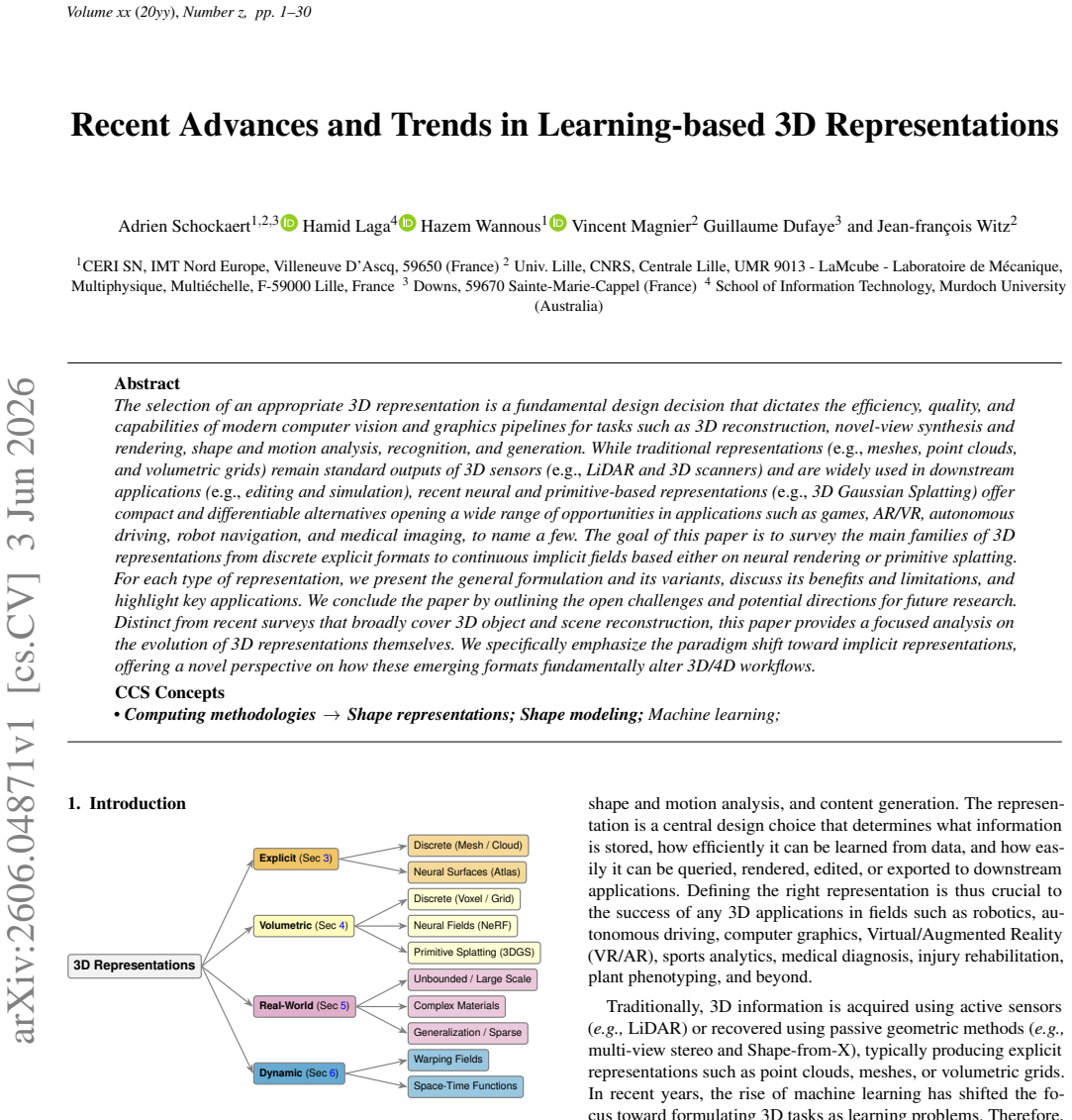
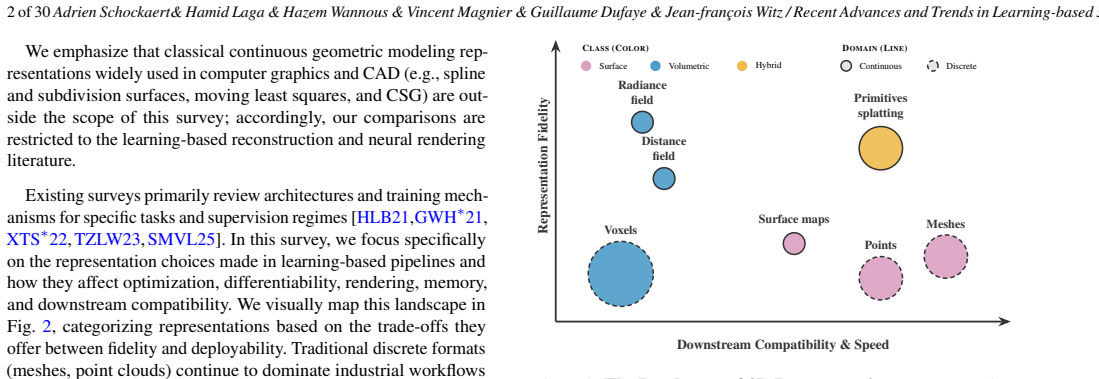
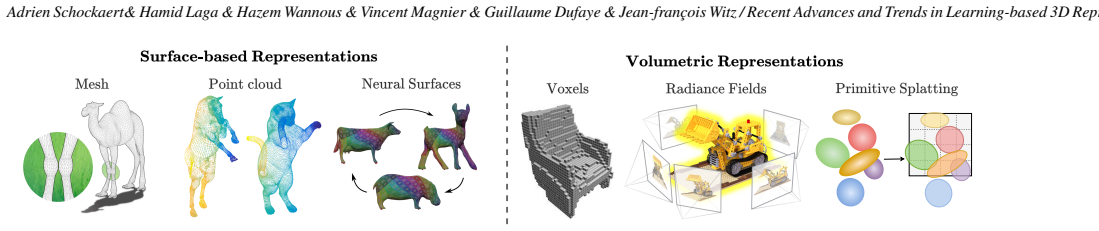
The taxonomy of representation families, ranging from explicit discrete formats (meshes, point clouds, volumetric grids) to implicit continuous fields (neural rendering and primitive splatting such as 3D Gaussian Splatting), which determines efficiency, quality, and differentiability of downstream pipelines.
If this is right
- Neural and primitive-based representations supply compact differentiable outputs that support end-to-end learning for novel-view synthesis and shape generation.
- Applications expand beyond traditional sensor outputs to include interactive uses in AR/VR, autonomous driving, and medical imaging.
- Each representation family carries distinct trade-offs between memory use, editability, and rendering speed that must be weighed for any given task.
- Future work must resolve open challenges in scalability, generalization, and integration with existing explicit data sources.
Where Pith is reading between the lines
- Hybrid pipelines that convert between explicit sensor data and implicit learned fields may become necessary for practical deployment.
- The differentiability of implicit forms could enable new optimization loops in simulation and editing that were previously intractable.
- Standardization of interfaces between representation types would reduce friction when mixing legacy and new components in large systems.
Load-bearing premise
The surveyed families and cited works are assumed to capture the dominant trends and that the move toward implicit representations constitutes the main direction of the field.
What would settle it
A count of recent high-impact papers and deployed systems showing that explicit representations still dominate new production pipelines for reconstruction, novel-view synthesis, and real-time rendering would falsify the claimed paradigm shift.
Figures

read the original abstract
The selection of an appropriate 3D representation is a fundamental design decision that dictates the efficiency, quality, and capabilities of modern computer vision and graphics pipelines for tasks such as 3D reconstruction, novel-view synthesis and rendering, shape and motion analysis, recognition, and generation. While traditional representations (\eg meshes, point clouds, and volumetric grids) remain standard outputs of 3D sensors (\eg LiDAR and 3D scanners) and are widely used in downstream applications (\eg editing and simulation), recent neural and primitive-based representations (\eg 3D Gaussian Splatting) offer compact and differentiable alternatives opening a wide range of opportunities in applications such as games, AR/VR, autonomous driving, robot navigation, and medical imaging, to name a few. The goal of this paper is to survey the main families of 3D representations from discrete explicit formats to continuous implicit fields based either on neural rendering or primitive splatting. For each type of representation, we present the general formulation and its variants, discuss its benefits and limitations, and highlight key applications. We conclude the paper by outlining the open challenges and potential directions for future research. Distinct from recent surveys that broadly cover 3D object and scene reconstruction, this paper provides a focused analysis on the evolution of 3D representations themselves. We specifically emphasize the paradigm shift toward implicit representations, offering a novel perspective on how these emerging formats fundamentally alter 3D/4D workflows.
Editorial analysis
A structured set of objections, weighed in public.
Referee Report
Summary. The manuscript is a survey reviewing families of 3D representations in computer vision and graphics. It covers traditional explicit formats (meshes, point clouds, volumetric grids) that remain standard outputs of sensors and are used in editing/simulation, as well as recent implicit and primitive-based representations (neural rendering, 3D Gaussian Splatting) that offer compact, differentiable alternatives for applications including AR/VR, autonomous driving, and medical imaging. For each family the paper presents general formulations and variants, discusses benefits and limitations, and highlights key applications. It concludes by outlining open challenges and future directions, claiming to supply a focused analysis on the evolution of representations themselves (distinct from reconstruction surveys) and to emphasize a paradigm shift toward implicit fields that alters 3D/4D workflows.
Significance. If the curation of families and literature is representative and the trend analysis accurate, the survey could serve as a useful reference by organizing recent advances around representation choice and by linking implicit methods to downstream workflow changes in graphics and vision pipelines. The explicit discussion of benefits/limitations per family and the identification of open challenges would add practical value for researchers selecting representations for reconstruction, rendering, or generation tasks.
major comments (1)
- [Abstract] Abstract: The central claim that the paper supplies a 'focused analysis on the evolution of 3D representations' and 'emphasize[s] the paradigm shift toward implicit representations' as a novel perspective rests on the authors' selection of the listed families (meshes, point clouds, volumetric grids, neural rendering, primitive splatting) and the cited works. The abstract provides no selection criteria, inclusion methodology, or explicit comparison to prior surveys, which is load-bearing for assessing whether the described shift is accurately characterized as dominant.
Simulated Author's Rebuttal
We thank the referee for the positive evaluation and recommendation of minor revision. The single major comment concerns the abstract; we address it directly below and will incorporate the suggested clarifications in the revised manuscript.
read point-by-point responses
-
Referee: [Abstract] Abstract: The central claim that the paper supplies a 'focused analysis on the evolution of 3D representations' and 'emphasize[s] the paradigm shift toward implicit representations' as a novel perspective rests on the authors' selection of the listed families (meshes, point clouds, volumetric grids, neural rendering, primitive splatting) and the cited works. The abstract provides no selection criteria, inclusion methodology, or explicit comparison to prior surveys, which is load-bearing for assessing whether the described shift is accurately characterized as dominant.
Authors: We agree that the abstract would be strengthened by explicitly stating the selection criteria and providing a concise comparison to prior surveys. In the revision we will add the following elements to the abstract: (i) the families were chosen because they represent the dominant discrete-explicit and continuous-implicit/primitive paradigms that directly affect learning-based pipelines for reconstruction, novel-view synthesis, and generation; (ii) the survey deliberately narrows its scope to the representation families themselves rather than to end-to-end reconstruction pipelines (distinguishing it from recent reconstruction surveys); and (iii) the cited literature is representative of the main methodological branches within each family up to the submission date. These additions will make the claimed paradigm shift and novelty of perspective more transparent without altering the paper’s core content. revision: yes
Circularity Check
No circularity: survey with no derivations or predictions
full rationale
This is a survey paper whose claims concern curation of representation families (meshes, point clouds, grids, neural rendering, splatting) and a high-level narrative of paradigm shift. No equations, fitted parameters, predictions, or derivations appear that could reduce to inputs by construction. The distinction from other surveys is a framing choice, not a load-bearing technical result. Per rules, self-contained surveys without falsifiable technical assertions or self-referential reductions receive score 0.
Axiom & Free-Parameter Ledger
Reference graph
Works this paper leans on
-
[1]
Ben Charrada and H
T. Ben Charrada and H. Laga and H. Tabia , journal=
-
[2]
CVPR , pages=
Neuraludf: Learning unsigned distance fields for multi-view reconstruction of surfaces with arbitrary topologies , author=. CVPR , pages=
-
[3]
CVPR , pages=
Neudf: Leaning neural unsigned distance fields with volume rendering , author=. CVPR , pages=
-
[4]
arXiv preprint arXiv:2412.04459 , year=
Sparse Voxels Rasterization: Real-time High-fidelity Radiance Field Rendering , author=. arXiv preprint arXiv:2412.04459 , year=
-
[5]
CVPR , month =
Fainstein, Miguel and Siless, Viviana and Iarussi, Emmanuel , title =. CVPR , month =. 2024 , pages =
2024
-
[6]
CAP-UDF: Learning Unsigned Distance Functions Progressively From Raw Point Clouds With Consistency-Aware Field Optimization , year=
Zhou, Junsheng and Ma, Baorui and Li, Shujuan and Liu, Yu-Shen and Fang, Yi and Han, Zhizhong , journal=. CAP-UDF: Learning Unsigned Distance Functions Progressively From Raw Point Clouds With Consistency-Aware Field Optimization , year=
-
[7]
Computer Graphics Forum , pages=
4-LEGS: 4D Language Embedded Gaussian Splatting , author=. Computer Graphics Forum , pages=. 2025 , organization=
2025
-
[8]
arXiv preprint arXiv:2406.04861 , year=
Normal-guided Detail-Preserving Neural Implicit Functions for High-Fidelity 3D Surface Reconstruction , author=. arXiv preprint arXiv:2406.04861 , year=
-
[9]
CVPR , pages=
Customize your NeRF: Adaptive Source Driven 3D Scene Editing via Local-Global Iterative Training , author=. CVPR , pages=
-
[10]
CVPR , pages=
Aerial Lifting: Neural Urban Semantic and Building Instance Lifting from Aerial Imagery , author=. CVPR , pages=
-
[11]
CVPR , pages=
Gaussian-flow: 4d reconstruction with dynamic 3d gaussian particle , author=. CVPR , pages=
-
[12]
CVPR , pages=
Gaussianshader: 3d gaussian splatting with shading functions for reflective surfaces , author=. CVPR , pages=
-
[13]
SIGGRAPH 2024 Conference Papers , year =
2D Gaussian Splatting for Geometrically Accurate Radiance Fields , author=. SIGGRAPH 2024 Conference Papers , year =
2024
-
[14]
CVPR , month =
Ma, Li and Agrawal, Vasu and Turki, Haithem and Kim, Changil and Gao, Chen and Sander, Pedro and Zollh\"ofer, Michael and Richardt, Christian , title =. CVPR , month =. 2024 , pages =
2024
-
[15]
ACM Transactions on Graphics (TOG) , volume=
3d gaussian ray tracing: Fast tracing of particle scenes , author=. ACM Transactions on Graphics (TOG) , volume=. 2024 , publisher=
2024
-
[16]
CVPR , pages=
Nerf-ds: Neural radiance fields for dynamic specular objects , author=. CVPR , pages=
-
[17]
ACM Transactions on Graphics (ToG) , volume=
Gaussian opacity fields: Efficient adaptive surface reconstruction in unbounded scenes , author=. ACM Transactions on Graphics (ToG) , volume=. 2024 , publisher=
2024
-
[18]
Gao, Kyle and Gao, Yina and He, Hongjie and Lu, Denning and Xu, Linlin and Li, Jonathan , journal=
-
[19]
2016 , organization=
Sinha, Ayan and Bai, Jing and Ramani, Karthik , booktitle=. 2016 , organization=
2016
-
[20]
Williams, Francis and Schneider, Teseo and Silva, Claudio and Zorin, Denis and Bruna, Joan and Panozzo, Daniele , booktitle=
-
[21]
CVPR , pages=
Synsin: End-to-end view synthesis from a single image , author=. CVPR , pages=
-
[22]
ACM TOG , volume=
Parallel Poisson disk sampling with spectrum analysis on surfaces , author=. ACM TOG , volume=. 2010 , publisher=
2010
-
[23]
Shi, Zifan and Peng, Sida and Xu, Yinghao and Liao, Yiyi and Shen, Yujun , journal=
-
[24]
Deep Learning for 3D Point Clouds: A Survey , year=
Guo, Yulan and Wang, Hanyun and Hu, Qingyong and Liu, Hao and Liu, Li and Bennamoun, Mohammed , journal=. Deep Learning for 3D Point Clouds: A Survey , year=
-
[25]
A Survey and Benchmark of Automatic Surface Reconstruction From Point Clouds , year=
Sulzer, Raphael and Marlet, Renaud and Vallet, Bruno and Landrieu, Loic , journal=. A Survey and Benchmark of Automatic Surface Reconstruction From Point Clouds , year=
-
[26]
Lahoud, Jean and Cao, Jiale and Khan, Fahad Shahbaz and Cholakkal, Hisham and Anwer, Rao Muhammad and Khan, Salman and Yang, Ming-Hsuan , journal=
-
[27]
IEEE TPAMI , year=
Recovering 3d human mesh from monocular images: A survey , author=. IEEE TPAMI , year=
-
[28]
CGF , volume=
Advances in neural rendering , author=. CGF , volume=. 2022 , organization=
2022
-
[29]
CGF , volume=
Neural fields in visual computing and beyond , author=. CGF , volume=. 2022 , organization=
2022
-
[30]
CVPR , year =
Yu, Zehao and Chen, Anpei and Huang, Binbin and Sattler, Torsten and Geiger, Andreas , title =. CVPR , year =
-
[31]
IEEE Transactions on Visualization and Computer Graphics , year=
3d gaussian splatting as new era: A survey , author=. IEEE Transactions on Visualization and Computer Graphics , year=
-
[32]
A Survey on 3D Gaussian Splatting
A survey on 3d gaussian splatting , author=. arXiv preprint arXiv:2401.03890 , year=
work page internal anchor Pith review Pith/arXiv arXiv
-
[33]
CGF , volume=
Point-Based Neural Rendering with Per-View Optimization , author=. CGF , volume=. 2021 , organization=
2021
-
[34]
ACM TOG , volume=
Neural point catacaustics for novel-view synthesis of reflections , author=. ACM TOG , volume=. 2022 , publisher=
2022
-
[35]
SIGGRAPH Asia 2022 Conference Papers , pages=
Differentiable point-based radiance fields for efficient view synthesis , author=. SIGGRAPH Asia 2022 Conference Papers , pages=
2022
-
[36]
ACM Transactions on Graphics , volume=
3D gaussian splatting for real-time radiance field rendering , author=. ACM Transactions on Graphics , volume=. 2023 , publisher=
2023
-
[37]
Proceedings of the ACM on Computer Graphics and Interactive Techniques , volume=
Reducing the Memory Footprint of 3D Gaussian Splatting , author=. Proceedings of the ACM on Computer Graphics and Interactive Techniques , volume=. 2024 , publisher=
2024
-
[38]
and Pfister, H
Zwicker, M. and Pfister, H. and van Baar, J. and Gross, M. , journal=. EWA splatting , year=
-
[39]
CVPR , pages=
Compact 3d gaussian representation for radiance field , author=. CVPR , pages=
-
[40]
ECCV , year=
Compact 3d scene representation via self-organizing gaussian grids , author=. ECCV , year=
-
[41]
CVPR , pages=
Compressed 3d gaussian splatting for accelerated novel view synthesis , author=. CVPR , pages=
-
[42]
CVPR , pages=
Sugar: Surface-aligned gaussian splatting for efficient 3d mesh reconstruction and high-quality mesh rendering , author=. CVPR , pages=
-
[43]
ACM SIGGRAPH , pages=
High-quality surface reconstruction using gaussian surfels , author=. ACM SIGGRAPH , pages=
-
[44]
CVPR , pages=
Sc-gs: Sparse-controlled gaussian splatting for editable dynamic scenes , author=. CVPR , pages=
-
[45]
Proceedings of the IEEE/CVF Conference on Computer Vision and Pattern Recognition (CVPR) , month =
Keetha, Nikhil and Karhade, Jay and Jatavallabhula, Krishna Murthy and Yang, Gengshan and Scherer, Sebastian and Ramanan, Deva and Luiten, Jonathon , title =. Proceedings of the IEEE/CVF Conference on Computer Vision and Pattern Recognition (CVPR) , month =. 2024 , pages =
2024
-
[46]
Proceedings of the IEEE/CVF international conference on computer vision , pages=
imap: Implicit mapping and positioning in real-time , author=. Proceedings of the IEEE/CVF international conference on computer vision , pages=
-
[47]
Proceedings of the IEEE/CVF conference on computer vision and pattern recognition , pages=
Nice-slam: Neural implicit scalable encoding for slam , author=. Proceedings of the IEEE/CVF conference on computer vision and pattern recognition , pages=
-
[48]
2025 International Conference on 3D Vision (3DV) , pages=
Dynomo: Online point tracking by dynamic online monocular gaussian reconstruction , author=. 2025 International Conference on 3D Vision (3DV) , pages=. 2025 , organization=
2025
-
[49]
and Davison, Andrew J
Matsuki, Hidenobu and Murai, Riku and Kelly, Paul H.J. and Davison, Andrew J. , title =. Proceedings of the IEEE/CVF Conference on Computer Vision and Pattern Recognition (CVPR) , month =. 2024 , pages =
2024
-
[50]
, title =
Matsuki, Hidenobu and Bae, Gwangbin and Davison, Andrew J. , title =. Proceedings of the IEEE/CVF Conference on Computer Vision and Pattern Recognition (CVPR) , month =. 2025 , pages =
2025
-
[51]
Proceedings of the IEEE/CVF International Conference on Computer Vision (ICCV) , month =
Huang, Shengyu and Gojcic, Zan and Wang, Zian and Williams, Francis and Kasten, Yoni and Fidler, Sanja and Schindler, Konrad and Litany, Or , title =. Proceedings of the IEEE/CVF International Conference on Computer Vision (ICCV) , month =. 2023 , pages =
2023
-
[52]
Proceedings of the 32nd ACM International Conference on Multimedia , pages=
Lidar-nerf: Novel lidar view synthesis via neural radiance fields , author=. Proceedings of the 32nd ACM International Conference on Multimedia , pages=
-
[53]
Proceedings of the AAAI Conference on Artificial Intelligence , volume=
Nerf-lidar: Generating realistic lidar point clouds with neural radiance fields , author=. Proceedings of the AAAI Conference on Artificial Intelligence , volume=
-
[54]
Proceedings of the IEEE/CVF Conference on Computer Vision and Pattern Recognition (CVPR) , month =
Yura, Toshiya and Mirzaei, Ashkan and Gilitschenski, Igor , title =. Proceedings of the IEEE/CVF Conference on Computer Vision and Pattern Recognition (CVPR) , month =. 2025 , pages =
2025
-
[55]
IEEE Robotics and Automation Letters , year=
A Probabilistic Formulation of LiDAR Mapping with Neural Radiance Fields , author=. IEEE Robotics and Automation Letters , year=
-
[56]
Computer Graphics Forum , volume =
Bouzidi, Abelaziz and Laga, Hamid and Wannous, Hazem and Sohel, Ferdous , title =. Computer Graphics Forum , volume =. doi:https://doi.org/10.1111/cgf.70232 , url =. https://onlinelibrary.wiley.com/doi/pdf/10.1111/cgf.70232 , abstract =
-
[57]
CVPR , pages=
Fregs: 3d gaussian splatting with progressive frequency regularization , author=. CVPR , pages=
-
[58]
CVPR , pages=
Gs-ir: 3d gaussian splatting for inverse rendering , author=. CVPR , pages=
-
[59]
ACM SIGGRAPH , pages=
3D Gaussian Splatting with Deferred Reflection , author=. ACM SIGGRAPH , pages=
-
[60]
3DV , pages=
Dynamic 3d gaussians: Tracking by persistent dynamic view synthesis , author=. 3DV , pages=. 2024 , organization=
2024
-
[61]
Zhang et al
RIConv++: Effective Rotation Invariant Convolutions for 3D Point Clouds Deep Learning: Z. Zhang et al. , author=. International Journal of Computer Vision , volume=. 2022 , publisher=
2022
-
[62]
Proceedings of the IEEE/CVF International Conference on Computer Vision , pages=
Point transformer , author=. Proceedings of the IEEE/CVF International Conference on Computer Vision , pages=
-
[63]
NeurIPS , year =
Point transformer V2: Grouped Vector Attention and Partition-based Pooling , author =. NeurIPS , year =
-
[64]
Proceedings of the IEEE/CVF conference on computer vision and pattern recognition , pages=
Point transformer v3: Simpler faster stronger , author=. Proceedings of the IEEE/CVF conference on computer vision and pattern recognition , pages=
-
[65]
ACM Transactions on Graphics (TOG) , volume=
Octformer: Octree-based transformers for 3d point clouds , author=. ACM Transactions on Graphics (TOG) , volume=. 2023 , publisher=
2023
-
[66]
Advances in neural information processing systems , volume=
Pointmamba: A simple state space model for point cloud analysis , author=. Advances in neural information processing systems , volume=
-
[67]
Proceedings of the Computer Vision and Pattern Recognition Conference , pages=
Pma: Towards parameter-efficient point cloud understanding via point mamba adapter , author=. Proceedings of the Computer Vision and Pattern Recognition Conference , pages=
-
[68]
Proceedings of the AAAI Conference on Artificial Intelligence , volume=
DAPointMamba: Domain Adaptive Point Mamba for Point Cloud Completion , author=. Proceedings of the AAAI Conference on Artificial Intelligence , volume=
-
[69]
European Conference on Computer Vision , pages=
Risurconv: Rotation invariant surface attention-augmented convolutions for 3d point cloud classification and segmentation , author=. European Conference on Computer Vision , pages=. 2024 , organization=
2024
-
[70]
Proceedings of the AAAI conference on artificial intelligence , volume=
Point cloud mamba: Point cloud learning via state space model , author=. Proceedings of the AAAI conference on artificial intelligence , volume=
-
[71]
Proceedings of the IEEE/CVF conference on computer vision and pattern recognition , pages=
Meshgpt: Generating triangle meshes with decoder-only transformers , author=. Proceedings of the IEEE/CVF conference on computer vision and pattern recognition , pages=
-
[72]
Proceedings of the IEEE/CVF International Conference on Computer Vision , pages=
Meshmamba: State space models for articulated 3d mesh generation and reconstruction , author=. Proceedings of the IEEE/CVF International Conference on Computer Vision , pages=
-
[73]
Proceedings of the Computer Vision and Pattern Recognition Conference , pages=
Mesh Mamba: A unified state space model for saliency prediction in non-textured and textured meshes , author=. Proceedings of the Computer Vision and Pattern Recognition Conference , pages=
-
[74]
ACM Transactions on Graphics, (Proc
Embodied Hands: Modeling and Capturing Hands and Bodies Together , author =. ACM Transactions on Graphics, (Proc. SIGGRAPH Asia) , volume =. 2017 , month_numeric =
2017
-
[75]
CVPR , pages=
A 3d morphable model learnt from 10,000 faces , author=. CVPR , pages=
-
[76]
CVPR , pages=
Deformable 3d gaussians for high-fidelity monocular dynamic scene reconstruction , author=. CVPR , pages=
-
[77]
CVPR , pages=
4d gaussian splatting for real-time dynamic scene rendering , author=. CVPR , pages=
-
[78]
ICCV , pages=
Forward flow for novel view synthesis of dynamic scenes , author=. ICCV , pages=
-
[79]
ECCV , month = oct, year =
EgoBody: Human Body Shape and Motion of Interacting People from Head-Mounted Devices , author =. ECCV , month = oct, year =
-
[80]
ACM SIGGRAPH , pages=
Predicting loose-fitting garment deformations using bone-driven motion networks , author=. ACM SIGGRAPH , pages=
discussion (0)
Sign in with ORCID, Apple, or X to comment. Anyone can read and Pith papers without signing in.