Non-linear evolution of five-dimensional black strings in effective field theory
Pith reviewed 2026-06-28 04:50 UTC · model grok-4.3
The pith
For positive Gauss-Bonnet coupling, curvature growth during five-dimensional black string instability stays within effective field theory validity.
A machine-rendered reading of the paper's core claim, the machinery that carries it, and where it could break.
Core claim
In Einstein-Gauss-Bonnet gravity, five-dimensional black strings undergo a non-linear instability that fragments them into a chain of black holes connected by string-like segments. For positive Gauss-Bonnet coupling the growth of curvature invariants is limited within the validity of the effective field theory, while for negative coupling the curvatures grow until the effective description breaks down.
What carries the argument
The sign of the Gauss-Bonnet coupling that controls whether curvature invariants saturate inside the effective field theory regime during black string fragmentation.
If this is right
- Positive coupling prevents curvature from exceeding the effective field theory regime during the instability.
- The bounded curvature offers a possible dynamical mechanism for preserving weak cosmic censorship.
- Negative coupling permits curvatures to grow large enough that the effective field theory description fails.
- The instability itself occurs independently of the coupling sign, but the endpoint curvature behavior depends on that sign.
Where Pith is reading between the lines
- The same sign-dependent saturation might appear in other higher-curvature corrections to Einstein gravity.
- Including next-order terms in the effective action could test whether the curvature cap survives or shifts.
- If the mechanism generalizes, it could constrain which signs of higher-curvature couplings are viable in ultraviolet completions.
Load-bearing premise
The numerical relativity simulations remain accurate without higher-order terms in the effective field theory becoming important before the reported curvature cap is reached.
What would settle it
A simulation with positive Gauss-Bonnet coupling in which a curvature invariant exceeds the effective field theory cutoff scale before the evolution reaches a steady state.
Figures
read the original abstract
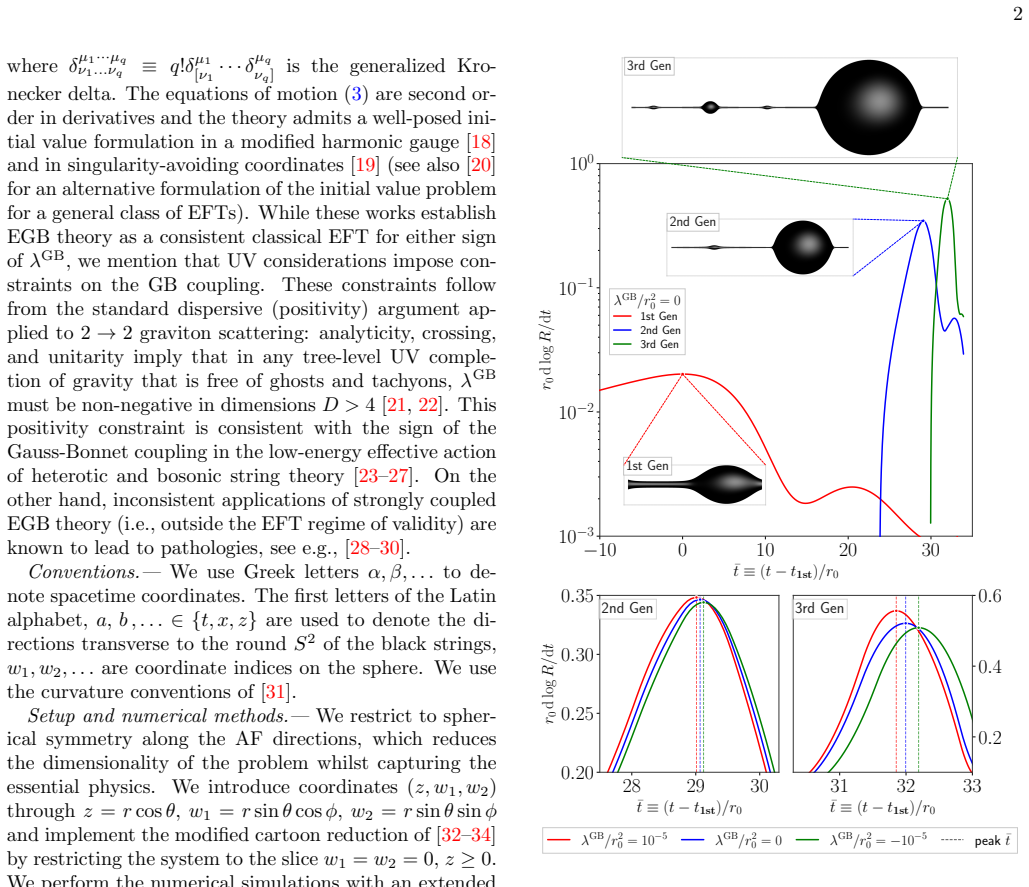
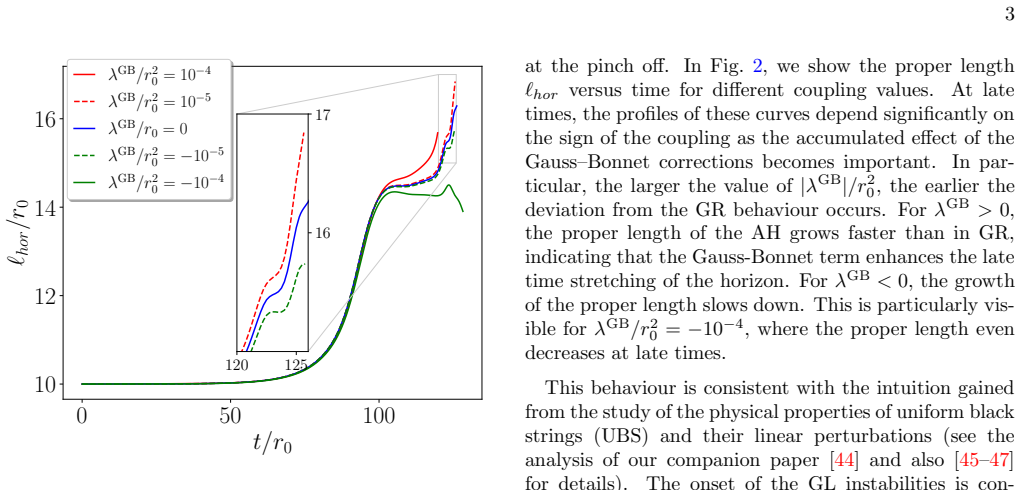
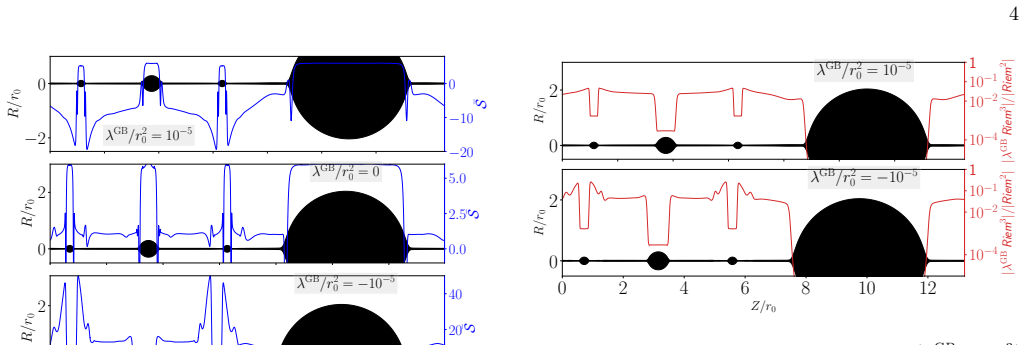
We use numerical relativity to study the non-linear instability of five-dimensional black strings in Einstein-Gauss-Bonnet gravity. Black strings evolve into a series of black holes joined by thinner string-like segments, but key features of the dynamics depend on the sign of the Gauss-Bonnet coupling. For positive coupling, favored by UV considerations, the growth of curvature invariants is limited within the validity of effective field theory (EFT), suggesting a mechanism for restoring weak cosmic censorship. For negative coupling this cap is absent and curvatures may grow until the EFT breaks down.
Editorial analysis
A structured set of objections, weighed in public.
Referee Report
Summary. The manuscript uses numerical relativity to study the non-linear instability of five-dimensional black strings in Einstein-Gauss-Bonnet gravity. The evolution produces a chain of black holes connected by thinner string segments, with dynamics that depend on the sign of the Gauss-Bonnet coupling. For positive coupling the growth of curvature invariants saturates within the validity of the effective field theory, which the authors suggest may restore weak cosmic censorship; for negative coupling the cap is absent and curvatures grow until the EFT breaks down.
Significance. If the numerical results and the claimed EFT validity can be substantiated, the work would be significant for clarifying how higher-curvature corrections regulate singularities in higher-dimensional gravity. The sign-dependent behavior is noteworthy given that positive Gauss-Bonnet coupling is favored by UV completions. The numerical exploration of the non-linear regime itself constitutes a technical contribution.
major comments (1)
- [Abstract] Abstract: the central claim that curvature invariants remain bounded within EFT validity for positive coupling rests on the numerical simulations, yet the abstract (and by extension the reported results) supplies no information on grid resolution, convergence tests, error bars, or a quantitative check that higher-order operators remain perturbatively small at the reported saturation time or scale. Without such evidence the assertion that the dynamics stay inside the truncated theory is an assumption rather than a demonstrated result.
Simulated Author's Rebuttal
We thank the referee for their careful reading and the constructive comment on the abstract. We address the concern below and will revise the manuscript to improve clarity.
read point-by-point responses
-
Referee: [Abstract] Abstract: the central claim that curvature invariants remain bounded within EFT validity for positive coupling rests on the numerical simulations, yet the abstract (and by extension the reported results) supplies no information on grid resolution, convergence tests, error bars, or a quantitative check that higher-order operators remain perturbatively small at the reported saturation time or scale. Without such evidence the assertion that the dynamics stay inside the truncated theory is an assumption rather than a demonstrated result.
Authors: We agree that the abstract lacks explicit mention of numerical validation details. The main text already reports grid resolutions, convergence tests, and checks that higher-order operators remain small up to the saturation time (see Sections 3 and 4). To address the referee's point directly, we will revise the abstract to include a concise statement on these aspects and the quantitative EFT validity check, making the central claim better supported in the summary. revision: yes
Circularity Check
Numerical evolution results independent of claimed curvature cap
full rationale
The paper performs numerical relativity simulations of the Einstein-Gauss-Bonnet system for five-dimensional black strings. The reported saturation of curvature invariants for positive Gauss-Bonnet coupling is an output of integrating the field equations forward in time, not a quantity defined in terms of itself or obtained by fitting a parameter to a subset of the same data. No self-citation chain, uniqueness theorem, or ansatz is invoked to force the outcome; the abstract and described results treat the cap as an observed dynamical feature whose location relative to the EFT cutoff is checked against the simulation data. The derivation chain therefore remains self-contained against external benchmarks.
Axiom & Free-Parameter Ledger
axioms (1)
- domain assumption The effective field theory description remains valid up to the curvatures reached in the simulation for positive Gauss-Bonnet coupling.
Reference graph
Works this paper leans on
-
[1]
R. P. Geroch and G. T. Horowitz, Global structure of spacetimes, inGeneral Relativity: An Einstein Cente- nary Survey(1979) pp. 212–293
1979
-
[2]
Christodoulou, Classical and Quantum Gravity16, A23 (1999)
D. Christodoulou, Classical and Quantum Gravity16, A23 (1999)
1999
-
[3]
R. Gregory and R. Laflamme, Phys. Rev. Lett.70, 2837 (1993), arXiv:hep-th/9301052
Pith/arXiv arXiv 1993
-
[4]
R. Gregory and R. Laflamme, Nucl. Phys. B428, 399 (1994), arXiv:hep-th/9404071
Pith/arXiv arXiv 1994
-
[5]
R. Emparan and H. S. Reall, Phys. Rev. Lett.88, 101101 (2002), arXiv:hep-th/0110260
Pith/arXiv arXiv 2002
- [6]
-
[7]
O. J. C. Dias, P. Figueras, R. Monteiro, J. E. San- tos, and R. Emparan, Phys. Rev. D80, 111701 (2009), arXiv:0907.2248 [hep-th]
Pith/arXiv arXiv 2009
-
[8]
O. J. C. Dias, P. Figueras, R. Monteiro, H. S. Reall, and J. E. Santos, JHEP05, 076, arXiv:1001.4527 [hep-th]
-
[9]
O. J. C. Dias, P. Figueras, R. Monteiro, and J. E. Santos, JHEP12, 067, arXiv:1011.0996 [hep-th]
-
[10]
J. E. Santos and B. Way, Phys. Rev. Lett.114, 221101 (2015), arXiv:1503.00721 [hep-th]
Pith/arXiv arXiv 2015
-
[11]
H. Bantilan, P. Figueras, M. Kunesch, and R. Panosso Macedo, Phys. Rev. D100, 086014 (2019), arXiv:1906.10696 [hep-th]
arXiv 2019
-
[12]
T. Andrade, P. Figueras, and U. Sperhake, JHEP03, 111, arXiv:2011.03049 [hep-th]
arXiv 2011
-
[13]
L. Lehner and F. Pretorius, Phys. Rev. Lett.105, 101102 (2010), arXiv:1006.5960 [hep-th]
Pith/arXiv arXiv 2010
-
[14]
S. W. Hawking and G. F. R. Ellis,The Large Scale Struc- ture of Space-Time, Cambridge Monographs on Mathe- matical Physics (Cambridge University Press, 2023)
2023
-
[15]
P. Figueras, T. Fran¸ ca, C. Gu, and T. Andrade, Phys. Rev. D107, 044028 (2023), arXiv:2210.13501 [hep-th]
arXiv 2023
-
[16]
P. Figueras, M. Kunesch, and S. Tunyasuvunakool, Phys. Rev. Lett.116, 071102 (2016), arXiv:1512.04532 [hep- th]
Pith/arXiv arXiv 2016
-
[17]
P. Figueras, M. Kunesch, L. Lehner, and S. Tun- yasuvunakool, Phys. Rev. Lett.118, 151103 (2017), arXiv:1702.01755 [hep-th]
Pith/arXiv arXiv 2017
-
[18]
A. D. Kov´ acs and H. S. Reall, Phys. Rev. D101, 124003 (2020), arXiv:2003.08398 [gr-qc]
arXiv 2020
-
[19]
L. Arest´ e Sal´ o, S. E. Brady, K. Clough, D. Doneva, T. Evstafyeva, P. Figueras, T. Fran¸ ca, L. Rossi, and S. Yao, J. Open Source Softw.9, 6369 (2024), arXiv:2309.06225 [gr-qc]
arXiv 2024
- [20]
-
[21]
C. Cheung and G. N. Remmen, Phys. Rev. Lett.118, 051601 (2017), arXiv:1608.02942 [hep-th]
Pith/arXiv arXiv 2017
-
[22]
B. Bellazzini, C. Cheung, and G. N. Remmen, Phys. Rev. D93, 064076 (2016), arXiv:1509.00851 [hep-th]
Pith/arXiv arXiv 2016
-
[23]
Zwiebach, Phys
B. Zwiebach, Phys. Lett. B156, 315 (1985)
1985
-
[24]
D. J. Gross and E. Witten, Nucl. Phys. B277, 1 (1986)
1986
-
[25]
D. J. Gross and J. H. Sloan, Nucl. Phys. B291, 41 (1987)
1987
-
[26]
R. R. Metsaev and A. A. Tseytlin, Nucl. Phys. B293, 385 (1987). 6
1987
-
[27]
D. G. Boulware and S. Deser, Phys. Rev. Lett.55, 2656 (1985)
1985
-
[28]
X. O. Camanho, J. D. Edelstein, J. Maldacena, and A. Zhiboedov, JHEP02, 020, arXiv:1407.5597 [hep-th]
- [29]
-
[30]
C. Y. R. Chen, C. de Rham, A. Margalit, and A. J. Tolley, JHEP03, 025, arXiv:2112.05031 [hep-th]
-
[31]
R. M. Wald,General Relativity(Chicago Univ. Pr., Chicago, USA, 1984)
1984
-
[32]
Pretorius, Class.Quant.Grav.22, 425 (2005), arXiv:gr- qc/0407110 [gr-qc]
F. Pretorius, Class.Quant.Grav.22, 425 (2005), arXiv:gr- qc/0407110 [gr-qc]
arXiv 2005
-
[33]
H. Yoshino and M. Shibata, Phys. Rev. D80, 084025 (2009), arXiv:0907.2760 [gr-qc]
Pith/arXiv arXiv 2009
-
[34]
W. G. Cook, P. Figueras, M. Kunesch, U. Sperhake, and S. Tunyasuvunakool, Int. J. Mod. Phys. D25, 1641013 (2016), arXiv:1603.00362 [gr-qc]
Pith/arXiv arXiv 2016
-
[35]
L. Arest´ e Sal´ o, K. Clough, and P. Figueras, Phys. Rev. Lett.129, 261104 (2022), arXiv:2208.14470 [gr-qc]
arXiv 2022
-
[36]
L. Arest´ e Sal´ o, K. Clough, and P. Figueras, Phys. Rev. D108, 084018 (2023), arXiv:2306.14966 [gr-qc]
arXiv 2023
-
[37]
D. D. Doneva, L. Arest´ e Sal´ o, K. Clough, P. Figueras, and S. S. Yazadjiev, Phys. Rev. D108, 084017 (2023), arXiv:2307.06474 [gr-qc]
arXiv 2023
-
[38]
D. D. Doneva, L. Arest´ e Sal´ o, and S. S. Yazadjiev, Phys. Rev. D110, 024040 (2024), arXiv:2404.15526 [gr-qc]
arXiv 2024
-
[39]
L. Arest´ e Sal´ o, D. D. Doneva, K. Clough, P. Figueras, and S. S. Yazadjiev, Phys. Rev. D112, 084022 (2025), arXiv:2507.13046 [gr-qc]
arXiv 2025
- [40]
-
[41]
Note that these initial conditions do not solve the EGB constraint equations. To minimise constraint violations, we initially setλ GB to zero and gradually switch it on as a quadratic function of time until it reaches its target value, which we keep fixed for the rest of simulations
-
[42]
Theχ= 0.1 level set lies well inside the AH [12, 15]
More specifically, we do this by replacingλ GB → λGB 1+e−100(χ−χ0 ) withχ 0 = 0.1 andχdenotes the (m)CCZ4 conformal factor. Theχ= 0.1 level set lies well inside the AH [12, 15]
-
[43]
Note that whilea(x) is generally taken to be non-zero [36], in the symmetry- reduced setting of this work the choicea(x) = 0 also leads to a strongly hyperbolic evolution system
We employ choice (i) for theλ GB/r2 0 = 0,±10 −5 sim- ulations and choice (ii) for theλ GB/r2 0 = 10 −4 simula- tions, because the run with the larger coupling generally requires a more substantial modification in the propaga- tion speeds of the unphysical modes. Note that whilea(x) is generally taken to be non-zero [36], in the symmetry- reduced setting ...
-
[44]
Figueras, ´A
P. Figueras, ´A. D. Kov´ acs, and S. Yao, (2026)
2026
-
[45]
T. Kobayashi and T. Tanaka, Phys. Rev. D71, 084005 (2005), arXiv:gr-qc/0412139
Pith/arXiv arXiv 2005
-
[46]
P. Suranyi, C. Vaz, and L. C. R. Wijewardhana, Phys. Rev. D79, 124046 (2009), arXiv:0810.0525 [hep-th]
Pith/arXiv arXiv 2009
-
[47]
Y. Brihaye, T. Delsate, and E. Radu, JHEP07, 022, arXiv:1004.2164 [hep-th]
-
[48]
H. S. Reall, Phys. Rev. D103, 084027 (2021), arXiv:2101.11623 [gr-qc]
arXiv 2021
-
[49]
F. Thaalba, N. Franchini, M. Bezares, and T. P. Sotiriou, Phys. Rev. D111, 024053 (2025), arXiv:2410.16264 [gr- qc]
arXiv 2025
-
[50]
A. H. K. R, J. L. Ripley, and N. Yunes, Phys. Rev. D 107, 044044 (2023), arXiv:2211.08477 [gr-qc]
arXiv 2023
-
[51]
The constant factor 16 3 is chosen such thatg ab effreduces to the spacetime metricg ab asλ GB →0
-
[52]
Susskind, , 118 (1993), arXiv:hep-th/9309145
L. Susskind, , 118 (1993), arXiv:hep-th/9309145
Pith/arXiv arXiv 1993
-
[53]
G. T. Horowitz and J. Polchinski, Phys. Rev. D55, 6189 (1997), arXiv:hep-th/9612146
Pith/arXiv arXiv 1997
-
[54]
G. T. Horowitz and J. Polchinski, Phys. Rev. D57, 2557 (1998), arXiv:hep-th/9707170
Pith/arXiv arXiv 1998
-
[55]
R. Emparan, M. Sanchez-Garitaonandia, and M. Tomaˇ sevi´ c, JHEP02, 104, arXiv:2411.14998 [hep-th]
-
[56]
P. Figueras and T. Fran¸ ca, Class. Quant. Grav.37, 225009 (2020), arXiv:2006.09414 [gr-qc]
arXiv 2020
-
[57]
L. Bernard, L. Lehner, and R. Luna, Phys. Rev. D100, 024011 (2019), arXiv:1904.12866 [gr-qc]
Pith/arXiv arXiv 2019
- [58]
-
[59]
7 End Matter Gen
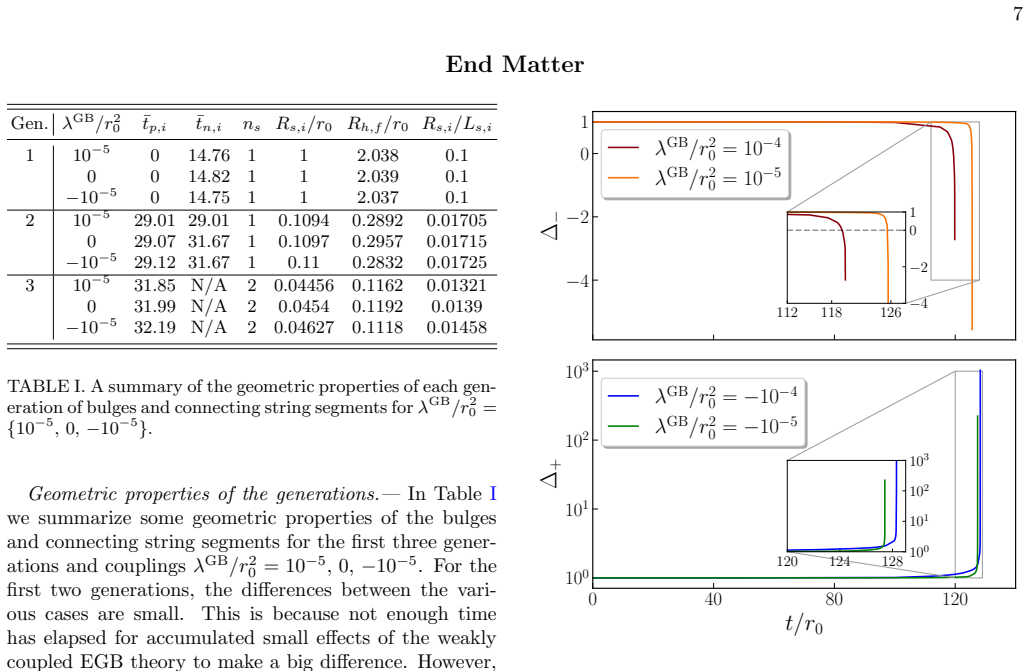
Recall that in our simulations we effectively turn off the Gauss-Bonnet term further inside the AH and hence the transition cannot occur too close to the centre of the string. 7 End Matter Gen. λGB/r2 0 ¯tp,i ¯tn,i ns Rs,i/r0 Rh,f /r0 Rs,i/Ls,i 1 10−5 0 14.76 1 1 2.038 0.1 0 0 14.82 1 1 2.039 0.1 −10−5 0 14.75 1 1 2.037 0.1 2 10−5 29.01 29.01 1 0.1094 0.2...
discussion (0)
Sign in with ORCID, Apple, or X to comment. Anyone can read and Pith papers without signing in.