UniPixie: Unified and Probabilistic 3D Physics Learning via Flow Matching
Pith reviewed 2026-06-28 06:38 UTC · model grok-4.3
The pith
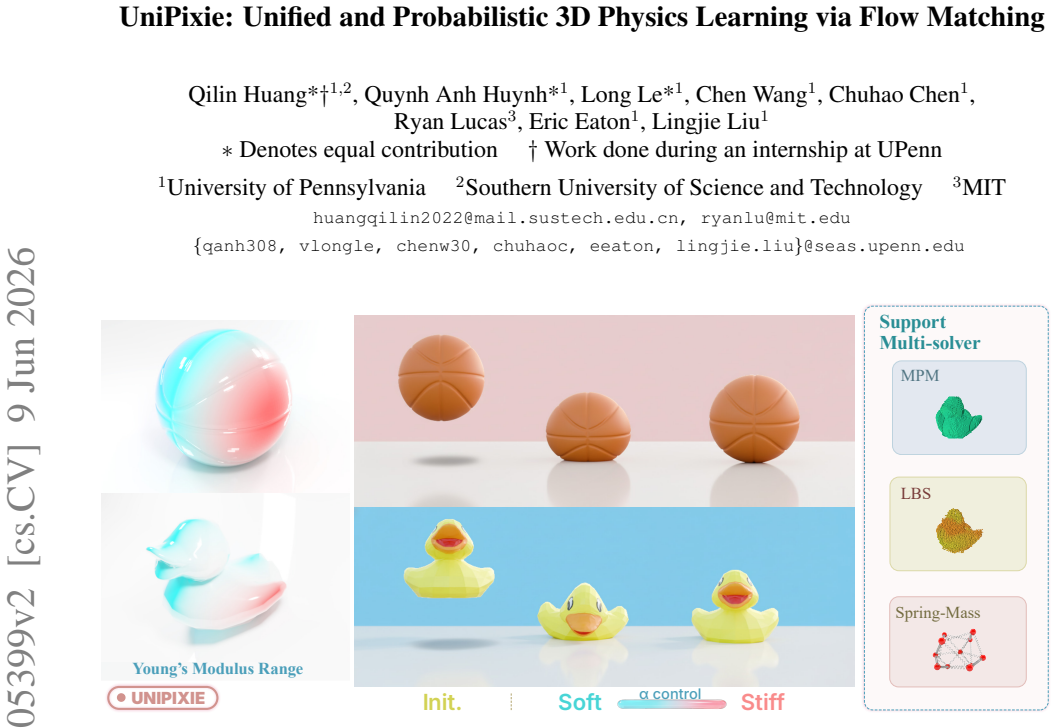
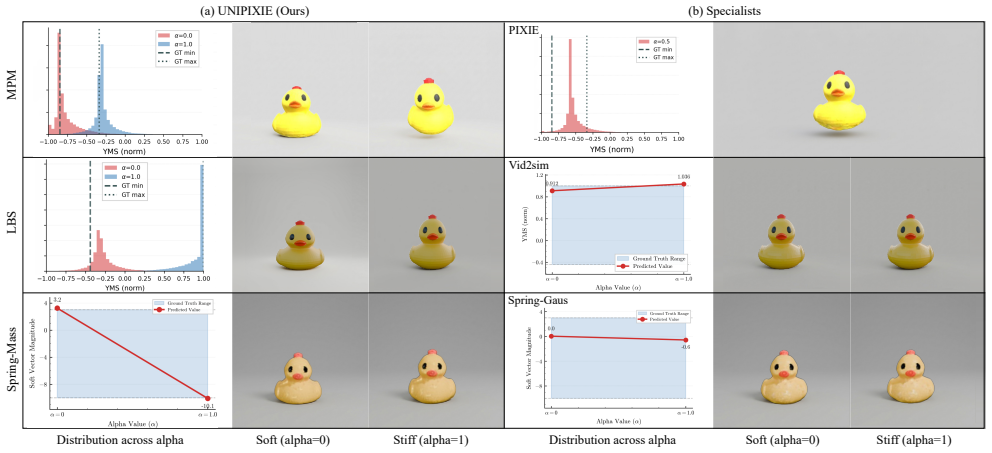
A single control parameter generates a continuous spectrum of physically valid material properties from one image across multiple solvers.
A machine-rendered reading of the paper's core claim, the machinery that carries it, and where it could break.
Core claim
By learning a direct mapping along an object's softest-to-stiffest spectrum on a dedicated multi-solver dataset, the model produces simulation-ready material parameters for continuum MPM, reduced-order LBS, and anchor-based spring-mass systems; a single scalar input selects any point along the learned path and yields physically plausible fields that reduce Young's Modulus error by over 50 percent relative to the strongest point-estimate baseline.
What carries the argument
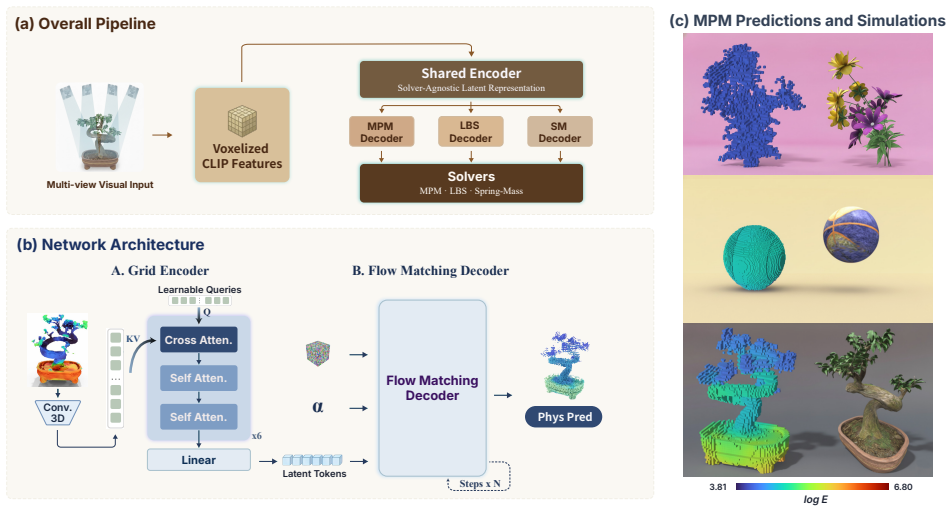
The unified architecture that maps a visual input to a parameterized soft-to-stiff path and outputs solver-ready parameters for MPM, LBS, and spring-mass systems.
If this is right
- One intuitive parameter produces a rich variety of plausible dynamics from the same visual input.
- Young's Modulus prediction error drops by more than 50 percent versus the strongest deterministic baseline.
- The same model supplies ready-to-use parameters to continuum, reduced-order, and discrete spring-mass solvers.
- Material prediction becomes a continuous, controllable process rather than a single fixed output.
Where Pith is reading between the lines
- The approach could support interactive material editing in graphics pipelines by letting users slide the control parameter in real time.
- Extending the spectrum to additional solvers would require only retraining the output heads while keeping the shared image-to-path backbone.
- If the learned path generalizes beyond the training objects, the method could serve as a prior for inverse problems that recover material distributions from sparse observations.
Load-bearing premise
A single learned scalar parameter produces material fields that remain physically valid and simulation-ready in all three solvers without any solver-specific post-processing.
What would settle it
Generate material fields for a held-out object, feed them into an MPM simulation, and check whether the resulting deformation matches ground-truth video within the same tolerance achieved on the training distribution.
Figures
read the original abstract
Existing feed-forward networks excel at predicting a single set of physical properties from visual appearance, but this point-estimate paradigm fundamentally fails to capture the real world's inherent physical ambiguity. We address this by reframing physics prediction as a task of learning a controllable, continuous distribution of material properties. We introduce UNIPIXIE, a framework trained to predict a continuous and parameterized path of physically plausible material properties from a single visual input. By learning a direct mapping along an object's softest-to-stiffest spectrum on our PIXIEMULTIVERSE dataset, UNIPIXIE allows for controllable generation of diverse, physically valid material fields via a single intuitive parameter. Crucially, UNIPIXIE introduces a novel unified architecture to produce simulation-ready parameters for diverse physics solvers, including continuum-based Material Point Method (MPM), reduced-order deformation based on Linear Blend Skinning (LBS), and anchor-based Spring-Mass systems, addressing a key portability issue in prior work. Experiments show our approach not only generates a rich variety of plausible dynamics but also reduces Young's Modulus prediction error by over 50% against the strongest deterministic baseline, bridging the gap between static point estimates and the continuous nature of physical reality. Project page: https://unipixie.github.io/
Editorial analysis
A structured set of objections, weighed in public.
Referee Report
Summary. The paper introduces UniPixie, a flow-matching framework that reframes 3D physics property prediction as learning a continuous, controllable distribution of material fields from a single visual input. Trained on the PIXIEMULTIVERSE dataset, it learns a direct mapping along the softest-to-stiffest spectrum controlled by one scalar parameter and employs a unified architecture to output simulation-ready parameters for three dissimilar solvers (MPM, LBS, spring-mass). The central empirical claims are a >50% reduction in Young's Modulus prediction error versus the strongest deterministic baseline together with generation of diverse, physically plausible dynamics.
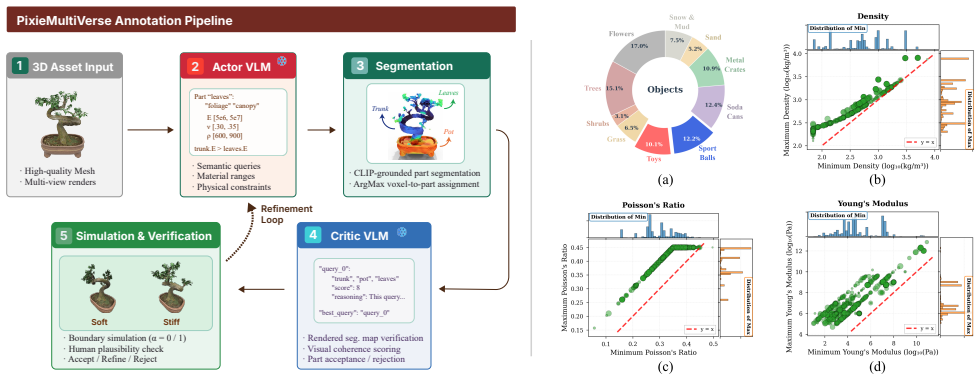
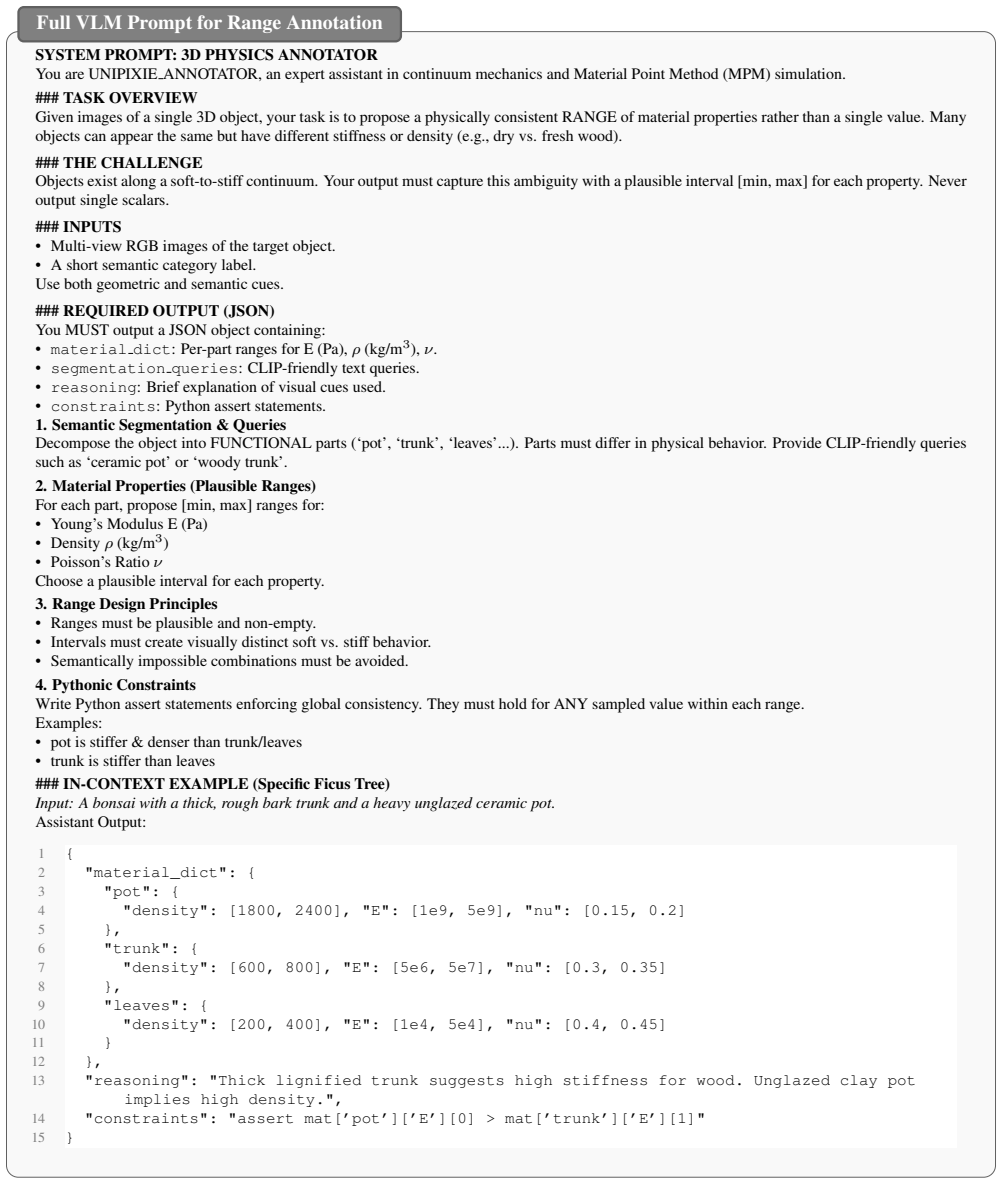
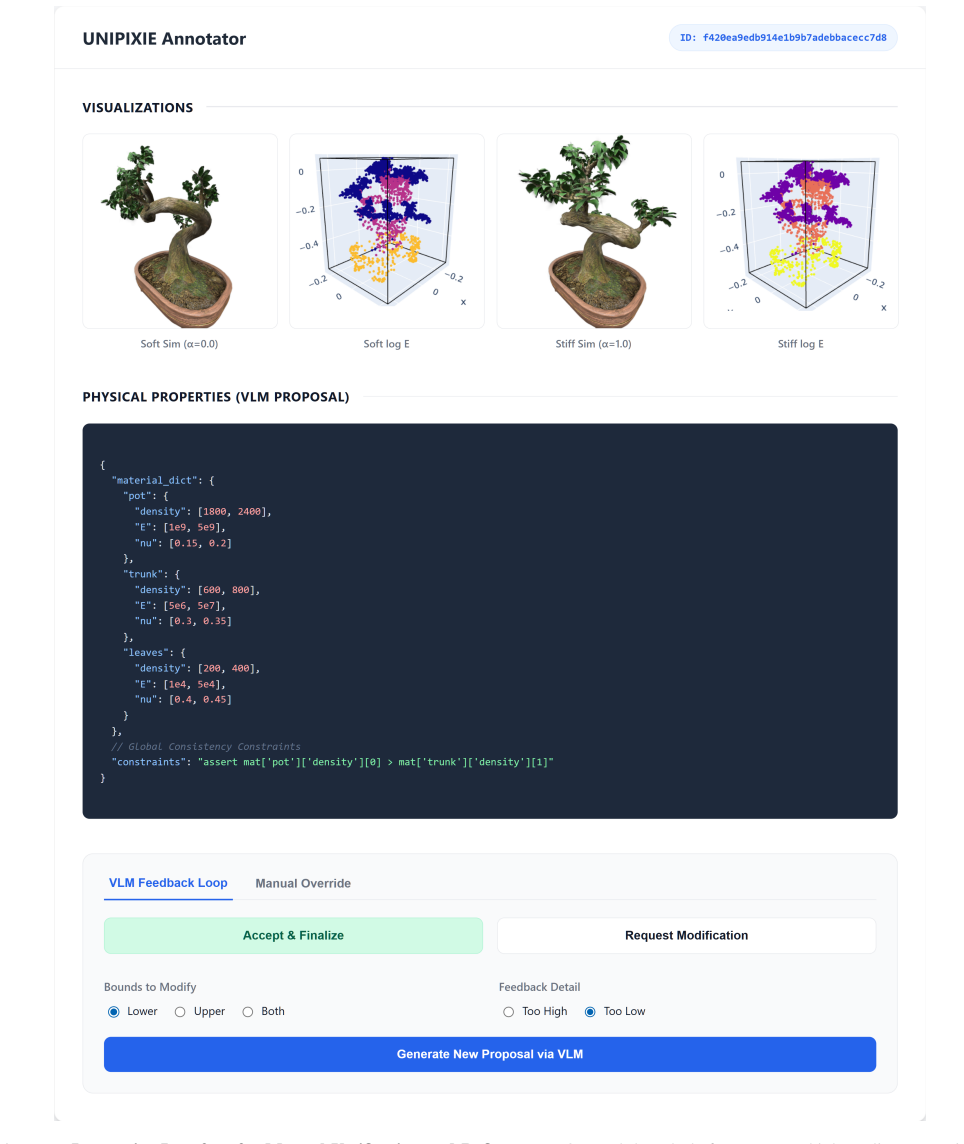
Significance. If the cross-solver portability claim holds without solver-specific post-processing, the work would meaningfully advance feed-forward physics prediction by replacing point estimates with an intuitive, continuous control interface. The unified architecture and the introduction of a multi-solver dataset constitute concrete strengths; the flow-matching formulation itself is a natural fit for the continuous-spectrum objective.
major comments (3)
- [Abstract and §4] Abstract and §4 (Experiments): the reported >50% reduction in Young's Modulus error is presented without naming the strongest deterministic baseline, the precise evaluation split of PIXIEMULTIVERSE, error bars, or exclusion criteria; because this number is the primary quantitative support for the performance claim, its reproducibility must be established.
- [§3.2 and §4.3] §3.2 (Unified Architecture) and §4.3 (Cross-solver results): the assertion that a single learned control parameter produces simulation-ready material fields for MPM, LBS, and spring-mass without solver-specific clamping or remapping is load-bearing for the portability claim, yet no quantitative cross-solver consistency metric (e.g., stability under LBS when parameters are taken from an MPM-trained field) is reported.
- [§4.2] §4.2 (Ablation on control parameter): the paper does not provide an ablation isolating whether the training objective is dominated by one solver's loss; if so, the single-parameter controllability claim for the remaining solvers would not be independently supported.
minor comments (2)
- [§3.1] Notation for the control parameter and the flow-matching time variable should be disambiguated in §3.1 to avoid reader confusion with the material spectrum parameter.
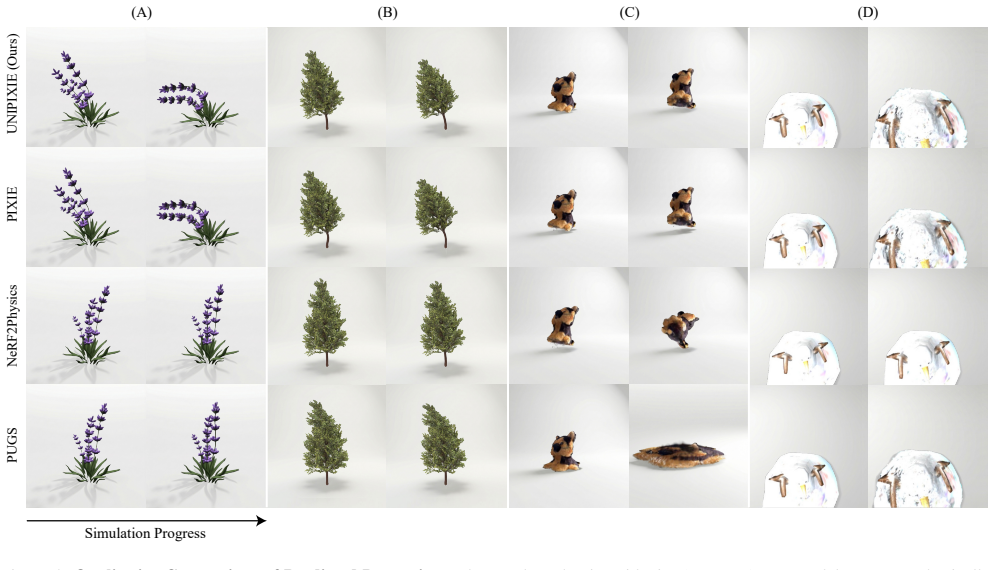
- [Figure 3] Figure 3 (qualitative dynamics) would benefit from explicit indication of which solver generated each row so that visual inspection can be tied to the cross-solver claim.
Simulated Author's Rebuttal
We thank the referee for the constructive comments that highlight opportunities to strengthen reproducibility and empirical support. We address each major comment below and will incorporate the requested clarifications and additional analyses in the revised manuscript.
read point-by-point responses
-
Referee: [Abstract and §4] Abstract and §4 (Experiments): the reported >50% reduction in Young's Modulus error is presented without naming the strongest deterministic baseline, the precise evaluation split of PIXIEMULTIVERSE, error bars, or exclusion criteria; because this number is the primary quantitative support for the performance claim, its reproducibility must be established.
Authors: We agree that these details are required for reproducibility. In the revised manuscript we will explicitly name the strongest deterministic baseline, specify the precise train/validation/test split of PIXIEMULTIVERSE, report error bars across multiple random seeds, and state the exclusion criteria applied during evaluation. These additions will appear in both the abstract and §4. revision: yes
-
Referee: [§3.2 and §4.3] §3.2 (Unified Architecture) and §4.3 (Cross-solver results): the assertion that a single learned control parameter produces simulation-ready material fields for MPM, LBS, and spring-mass without solver-specific clamping or remapping is load-bearing for the portability claim, yet no quantitative cross-solver consistency metric (e.g., stability under LBS when parameters are taken from an MPM-trained field) is reported.
Authors: We acknowledge that a quantitative cross-solver consistency metric would provide stronger evidence for the portability claim. While the unified architecture is designed to produce directly usable parameters, the original submission does not include such a metric. We will add a new experiment in the revised §4.3 that measures consistency (e.g., trajectory stability when parameters derived under one solver are used with another) to address this point. revision: yes
-
Referee: [§4.2] §4.2 (Ablation on control parameter): the paper does not provide an ablation isolating whether the training objective is dominated by one solver's loss; if so, the single-parameter controllability claim for the remaining solvers would not be independently supported.
Authors: We agree that an ablation isolating per-solver loss dominance is necessary to fully support the independent controllability claim. We will include an additional ablation study in the revised §4.2 that trains with individual solver losses and evaluates controllability on the held-out solvers, thereby demonstrating that the single-parameter interface is not dominated by any one loss term. revision: yes
Circularity Check
No circularity; claims rest on empirical training and dataset
full rationale
The abstract presents UNIPIXIE as a flow-matching model trained on the authors' PIXIEMULTIVERSE dataset to map visual inputs to a continuous soft-to-stiff spectrum of material properties, with a unified architecture producing solver-ready outputs for MPM, LBS, and spring-mass systems. No derivation equations, fitted parameters renamed as predictions, or self-citation chains appear in the provided text. Performance claims (50% error reduction) are framed as experimental results against external baselines rather than by-construction identities. The single-parameter controllability is asserted as a learned outcome on the custom data, not reduced to input definitions or prior self-citations. The derivation chain is therefore self-contained against external benchmarks.
Axiom & Free-Parameter Ledger
free parameters (1)
- control parameter along material spectrum
axioms (1)
- domain assumption Material properties admit a continuous parameterized path that remains physically valid across multiple distinct simulation solvers.
Reference graph
Works this paper leans on
-
[1]
Physx- 3d: Physical-grounded 3D asset generation.arXiv preprint arXiv:2507.12465, 2025
Ziang Cao, Zhaoxi Chen, Liang Pan, and Ziwei Liu. Physx- 3d: Physical-grounded 3D asset generation.arXiv preprint arXiv:2507.12465, 2025. 3
-
[2]
Vid2sim: Generalizable, video-based reconstruction of ap- pearance, geometry and physics for mesh-free simulation
Chuhao Chen, Zhiyang Dou, Chen Wang, Yiming Huang, Anjun Chen, Qiao Feng, Jiatao Gu, and Lingjie Liu. Vid2sim: Generalizable, video-based reconstruction of ap- pearance, geometry and physics for mesh-free simulation. In Proceedings of the IEEE/CVF Conference on Computer Vi- sion and Pattern Recognition, pages 26545–26555, 2025. 3, 4, 5, 6, 7, 13, 14, 15
2025
-
[3]
Bouman, Justin G
Abe Davis, Katherine L. Bouman, Justin G. Chen, Michael Rubinstein, Fr´edo Durand, and William T. Freeman. Visual vibrometry: Estimating material properties from small mo- tions in video. InProceedings of the IEEE/CVF Conference on Computer Vision and Pattern Recognition, pages 5335– 5343, 2015. 2
2015
-
[4]
Tianyu Huang, Haoze Zhang, Yihan Zeng, Zhilu Zhang, Hui Li, Wangmeng Zuo, and Rynson W. H. Lau. Dreamphysics: learning physics-based 3d dynamics with video diffusion pri- ors. InProceedings of the AAAI Conference on Artificial In- telligence, 2025. 2
2025
-
[5]
H ´enaff, Matthew M
Andrew Jaegle, Sebastian Borgeaud, Jean-Baptiste Alayrac, Carl Doersch, Catalin Ionescu, David Ding, Skanda Kop- pula, Daniel Zoran, Andrew Brock, Evan Shelhamer, Olivier J. H ´enaff, Matthew M. Botvinick, Andrew Zisser- man, Oriol Vinyals, and Jo˜ao Carreira. Perceiver IO: A gen- eral architecture for structured inputs & outputs. InInterna- tional Confer...
2022
-
[6]
The material point method for simulating continuum materials
Chenfanfu Jiang, Craig Schroeder, Joseph Teran, Alexey Stomakhin, and Andrew Selle. The material point method for simulating continuum materials. InACM SIGGRAPH 2016 Courses. Association for Computing Machinery, 2016. 2
2016
-
[7]
Phystwin: Physics- informed reconstruction and simulation of deformable ob- jects from videos
Hanxiao Jiang, Hao-Yu Hsu, Kaifeng Zhang, Hsin-Ni Yu, Shenlong Wang, and Yunzhu Li. Phystwin: Physics- informed reconstruction and simulation of deformable ob- jects from videos. InProceedings of the IEEE/CVF Inter- national Conference on Computer Vision, pages 7219–7230,
-
[8]
3d gaussian splatting for real-time radiance field rendering.ACM Trans
Bernhard Kerbl, Georgios Kopanas, Thomas Leimkuehler, and George Drettakis. 3d gaussian splatting for real-time radiance field rendering.ACM Trans. Graph., 42(4), 2023. 2
2023
-
[9]
Long Le, Ryan Lucas, Chen Wang, Chuhao Chen, Dinesh Ja- yaraman, Eric Eaton, and Lingjie Liu. Pixie: Fast and gener- alizable supervised learning of 3d physics from pixels.arXiv preprint arXiv:2508.17437, 2025. 2, 3, 5, 6, 7, 10, 15
-
[10]
Pac-nerf: Physics augmented continuum neural ra- diance fields for geometry-agnostic system identification
Xuan Li, Yi-Ling Qiao, Peter Yichen Chen, Krishna Murthy Jatavallabhula, Ming Lin, Chenfanfu Jiang, and Chuang Gan. Pac-nerf: Physics augmented continuum neural ra- diance fields for geometry-agnostic system identification. InInternational Conference on Learning Representations,
-
[11]
Generative image dynamics
Zhengqi Li, Richard Tucker, Noah Snavely, and Aleksander Holynski. Generative image dynamics. InProceedings of the IEEE/CVF Conference on Computer Vision and Pattern Recognition, pages 24142–24153, 2024. 3
2024
-
[12]
Wonderplay: Dy- namic 3d scene generation from a single image and actions
Zizhang Li, Hong-Xing Yu, Wei Liu, Yin Yang, Charles Her- rmann, Gordon Wetzstein, and Jiajun Wu. Wonderplay: Dy- namic 3d scene generation from a single image and actions. InProceedings of the IEEE/CVF International Conference on Computer Vision, pages 9080–9090, 2025. 3
2025
-
[13]
Omniphysgs: 3d constitutive gaussians for general physics- based dynamics generation
Yuchen Lin, Chenguo Lin, Jianjin Xu, and Yadong Mu. Omniphysgs: 3d constitutive gaussians for general physics- based dynamics generation. InInternational Conference on Learning Representations, 2025. 2
2025
-
[14]
Yaron Lipman, Ricky T. Q. Chen, Heli Ben-Hamu, Maxim- ilian Nickel, and Matthew Le. Flow matching for generative modeling. InInternational Conference on Learning Repre- sentations, 2023. 2, 4
2023
-
[15]
Vismay Modi, Nicholas Sharp, Or Perel, Shinjiro Sueda, and David I. W. Levin. Simplicits: Mesh-free, geometry-agnostic elastic simulation.ACM Trans. Graph., 43(4), 2024. 2, 5
2024
-
[16]
J. Krishna Murthy, Miles Macklin, Florian Golemo, Vikram V oleti, Linda Petrini, Martin Weiss, Breandan Considine, J´erˆome Parent-L ´evesque, Kevin Xie, Kenny Erleben, Liam Paull, Florian Shkurti, Derek Nowrouzezahrai, and Sanja Fi- dler. gradsim: Differentiable simulation for system identifi- cation and visuomotor control. InInternational Conference on ...
2021
-
[17]
Learning transferable visual models from natural language supervision
Alec Radford, Jong Wook Kim, Chris Hallacy, Aditya Ramesh, Gabriel Goh, Sandhini Agarwal, Girish Sastry, Amanda Askell, Pamela Mishkin, Jack Clark, Gretchen Krueger, and Ilya Sutskever. Learning transferable visual models from natural language supervision. InProceedings of the 38th International Conference on Machine Learning, pages 8748–8763. PMLR, 2021. 3, 5
2021
-
[18]
Pugs: Zero- shot physical understanding with gaussian splatting
Yinghao Shuai, Ran Yu, Yuantao Chen, Zijian Jiang, Xi- aowei Song, Nan Wang, Jv Zheng, Jianzhu Ma, Meng Yang, Zhicheng Wang, Wenbo Ding, and Hao Zhao. Pugs: Zero- shot physical understanding with gaussian splatting. In2025 IEEE International Conference on Robotics and Automation (ICRA), pages 4478–4485, 2025. 2, 6, 15
2025
-
[19]
Deformation capture and modeling of soft objects.ACM Trans
Bin Wang, Longhua Wu, KangKang Yin, Uri Ascher, Libin Liu, and Hui Huang. Deformation capture and modeling of soft objects.ACM Trans. Graph., 34(4), 2015. 2
2015
-
[20]
Physctrl: Generative physics for controllable and physics-grounded video genera- tion
Chen Wang, Chuhao Chen, Yiming Huang, Zhiyang Dou, Yuan Liu, Jiatao Gu, and Lingjie Liu. Physctrl: Generative physics for controllable and physics-grounded video genera- tion. InAdvances in Neural Information Processing Systems,
-
[21]
Bovik, H.R
Zhou Wang, A.C. Bovik, H.R. Sheikh, and E.P. Simoncelli. Image quality assessment: from error visibility to structural similarity.IEEE Transactions on Image Processing, 13(4): 600–612, 2004. 6
2004
-
[22]
Lim, Bill Freeman, and Joshua B
Jiajun Wu, Ilker Yildirim, Joseph J. Lim, Bill Freeman, and Joshua B. Tenenbaum. Galileo: Perceiving physical object properties by integrating a physics engine with deep learn- ing. InAdvances in neural information processing systems, pages 127–135, 2015. 2
2015
-
[23]
Structured 3d latents for scalable and versatile 3d generation
Jianfeng Xiang, Zelong Lv, Sicheng Xu, Yu Deng, Ruicheng Wang, Bowen Zhang, Dong Chen, Xin Tong, and Jiaolong Yang. Structured 3d latents for scalable and versatile 3d generation. InProceedings of the IEEE/CVF Conference on Computer Vision and Pattern Recognition, pages 21469– 21480, 2025. 3
2025
-
[24]
Physgaussian: Physics- integrated 3d gaussians for generative dynamics
Tianyi Xie, Zeshun Zong, Yuxing Qiu, Xuan Li, Yutao Feng, Yin Yang, and Chenfanfu Jiang. Physgaussian: Physics- integrated 3d gaussians for generative dynamics. InProceed- ings of the IEEE/CVF Conference on Computer Vision and Pattern Recognition, pages 4389–4398, 2024. 2, 3, 5
2024
-
[25]
Zhai, Yuan Shen, Emily Y
Albert J. Zhai, Yuan Shen, Emily Y . Chen, Gloria X. Wang, Xinlei Wang, Sheng Wang, Kaiyu Guan, and Shenlong Wang. Physical property understanding from language- embedded feature fields. InProceedings of the IEEE/CVF Conference on Computer Vision and Pattern Recognition, pages 28296–28305, 2024. 2, 6, 15
2024
-
[26]
Efros, Eli Shecht- man, and Oliver Wang
Richard Zhang, Phillip Isola, Alexei A. Efros, Eli Shecht- man, and Oliver Wang. The unreasonable effectiveness of deep features as a perceptual metric. InProceedings of the IEEE/CVF Conference on Computer Vision and Pattern Recognition, pages 586–595, 2018. 6
2018
-
[27]
Feng, Changxi Zheng, Noah Snavely, Jiajun Wu, and William T
Tianyuan Zhang, Hong-Xing Yu, Rundi Wu, Brandon Y . Feng, Changxi Zheng, Noah Snavely, Jiajun Wu, and William T. Freeman. Physdreamer: Physics-based interac- tion with 3d objects via video generation. InEuropean Con- ference on Computer Vision, pages 388–406. Springer, 2024. 2
2024
-
[28]
Reconstruction and simulation of elastic objects with spring- mass 3d gaussians
Licheng Zhong, Hong-Xing Yu, Jiajun Wu, and Yunzhu Li. Reconstruction and simulation of elastic objects with spring- mass 3d gaussians. InEuropean Conference on Computer Vision, pages 407–423. Springer, 2024. 2, 3, 5, 6, 7, 13, 14, 15 Appendix
2024
-
[29]
Lower bound is too high
Dataset Details In this section, we provide a comprehensive overview of our new dataset, PIXIEMULTIVERSE. Our work builds upon the 3D assets of the PIXIEVERSE dataset [9] but intro- duces a fundamentally new annotation paradigm to sup- port our generative and unified modeling goals. Specifi- cally, we re-annotate the entire dataset withplausible prop- ert...
-
[30]
Parts must differ in physical behavior
Semantic Segmentation & Queries Decompose the object into FUNCTIONAL parts (‘pot’, ‘trunk’, ‘leaves’...). Parts must differ in physical behavior. Provide CLIP-friendly queries such as ‘ceramic pot’ or ‘woody trunk’
-
[31]
Material Properties (Plausible Ranges) For each part, propose [min, max] ranges for: • Young’s Modulus E (Pa) • Densityρ(kg/m 3) • Poisson’s Ratioν Choose a plausible interval for each property
-
[32]
• Intervals must create visually distinct soft vs
Range Design Principles • Ranges must be plausible and non-empty. • Intervals must create visually distinct soft vs. stiff behavior. • Semantically impossible combinations must be avoided
-
[33]
material_dict
Pythonic Constraints Write Python assert statements enforcing global consistency. They must hold for ANY sampled value within each range. Examples: • pot is stiffer & denser than trunk/leaves • trunk is stiffer than leaves ### IN-CONTEXT EXAMPLE (Specific Ficus Tree) Input: A bonsai with a thick, rough bark trunk and a heavy unglazed ceramic pot. Assistan...
-
[34]
Model Architecture and Training Details In this section, we provide a comprehensive specification of the UNIPIXIEarchitecture, training objectives, hyper- parameters, and inference procedures to ensure full repro- ducibility. 7.1. Detailed Model Architectures Our framework comprises a shared Grid Encoder and a suite of specialized decoders tailored for di...
2049
-
[35]
This section details the specific implementation and training protocols for each baseline
Baseline Implementation Details To ensure a fair and comprehensive evaluation of UNIP- IXIE, we carefully adapted and re-trained all baseline meth- ods on our PIXIEMULTIVERSE. This section details the specific implementation and training protocols for each baseline. 8.1. Deterministic Baselines PIXIE [9].As PIXIE is the direct predecessor to our work, we ...
discussion (0)
Sign in with ORCID, Apple, or X to comment. Anyone can read and Pith papers without signing in.