Bitcoin After Block Rewards
Pith reviewed 2026-06-28 05:03 UTC · model grok-4.3
The pith
When Bitcoin block rewards end, honest mining stops being privately optimal even if transaction fees are only a small fraction of the total.
A machine-rendered reading of the paper's core claim, the machinery that carries it, and where it could break.
Core claim
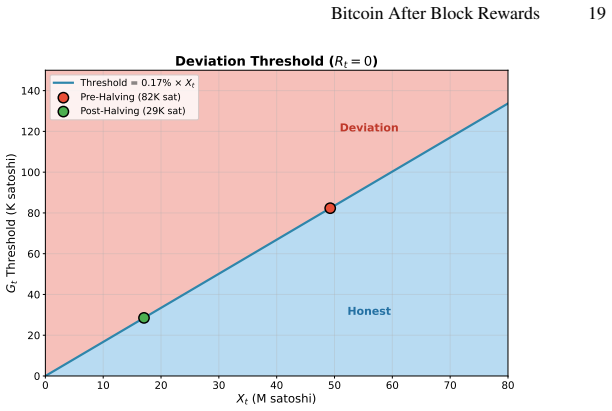
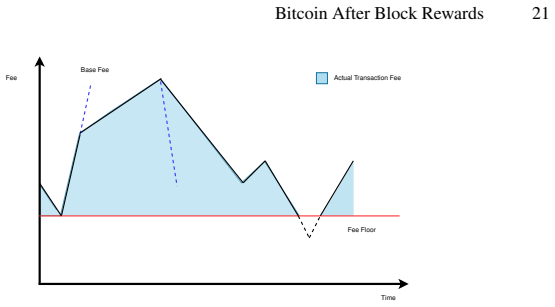
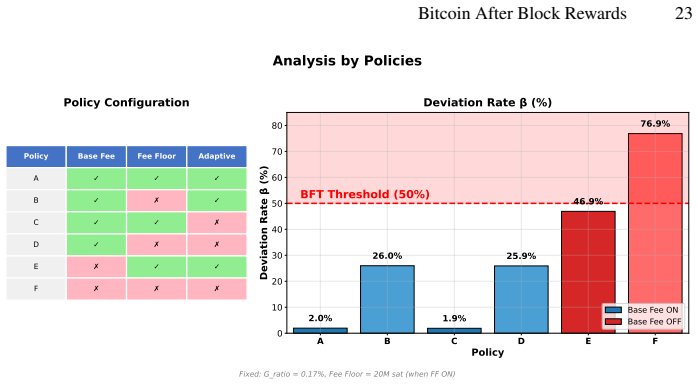
In a sequential decision model that compares the payoffs of honest and deviating miners, a deviation threshold Gt is identified at which honest mining ceases to be privately optimal. When the block reward is removed, the Gt criterion implies that deviation can arise even with a very small fraction of transaction fees. The combination of Base Fee, Fee Floor, and an adaptive maximum block size rule raises this threshold and mitigates incentive breakdown in a fee-only regime.
What carries the argument
The deviation threshold Gt, obtained by comparing honest and deviating payoffs inside the sequential decision model, marking the point at which honest mining is no longer the privately optimal strategy.
If this is right
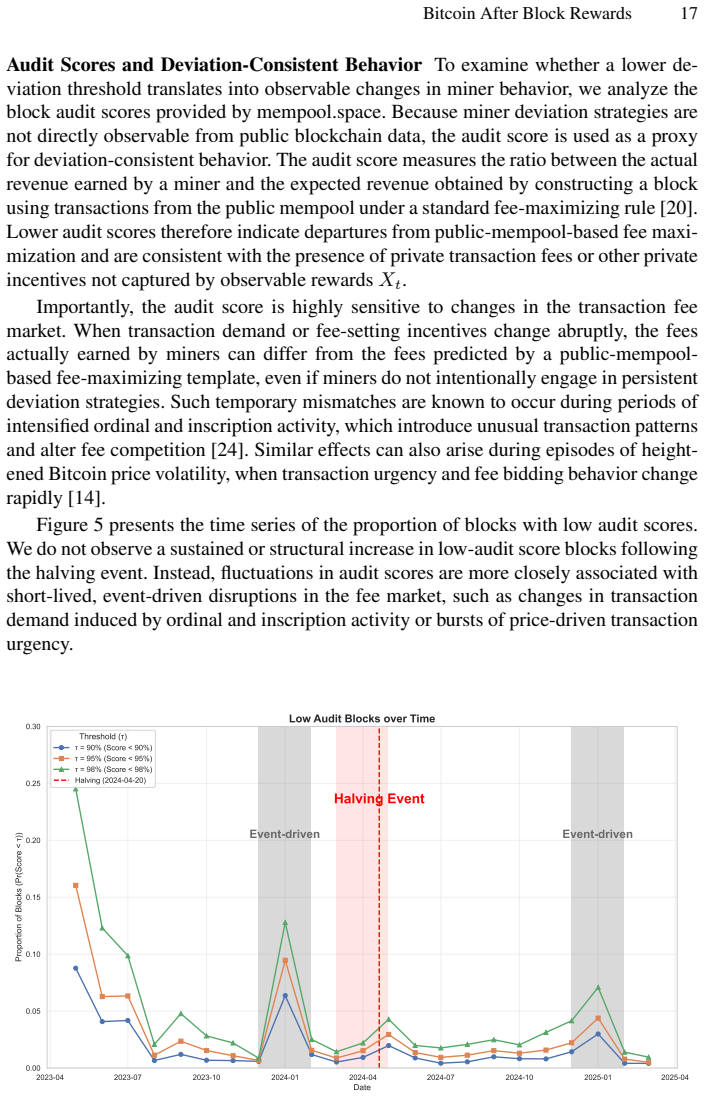
- Around the 2024 halving, observed mining behavior shows no large-scale or structural deviation from honest mining.
- After block rewards are removed, the Gt criterion predicts that deviation can occur even when transaction fees constitute only a very small fraction of revenue.
- The joint application of Base Fee, Fee Floor, and adaptive maximum block size raises Gt and reduces the risk of incentive breakdown.
Where Pith is reading between the lines
- Protocol changes of the three kinds examined would need to be deployed before the final halving to prevent the predicted shift in miner behavior.
- The Gt threshold could be recalculated under different assumptions about fee variance or hash-rate distribution to test robustness.
- Real-time monitoring of deviation signals after each future halving would provide an empirical check on the model's predictions.
Load-bearing premise
The sequential decision model and its payoff comparisons accurately capture the private incentives and information available to real miners.
What would settle it
Direct observation of whether large-scale and persistent deviation from honest mining appears in the Bitcoin network once block rewards reach zero while transaction fees remain only a small share of total miner revenue.
Figures
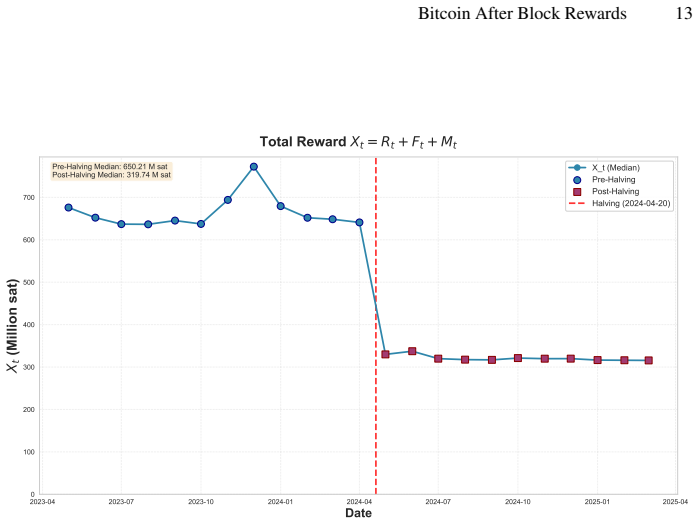
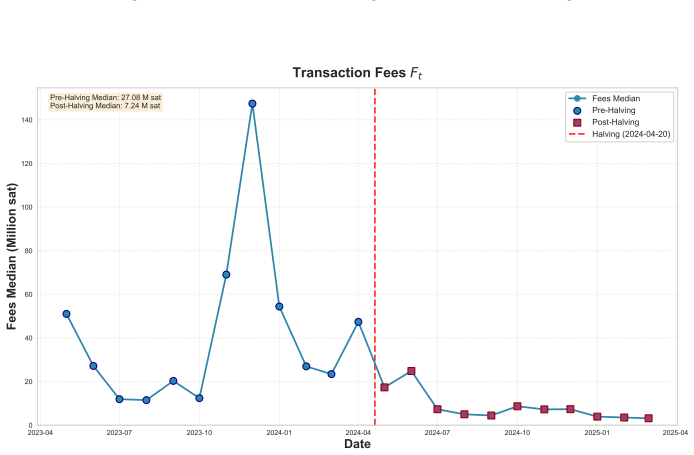
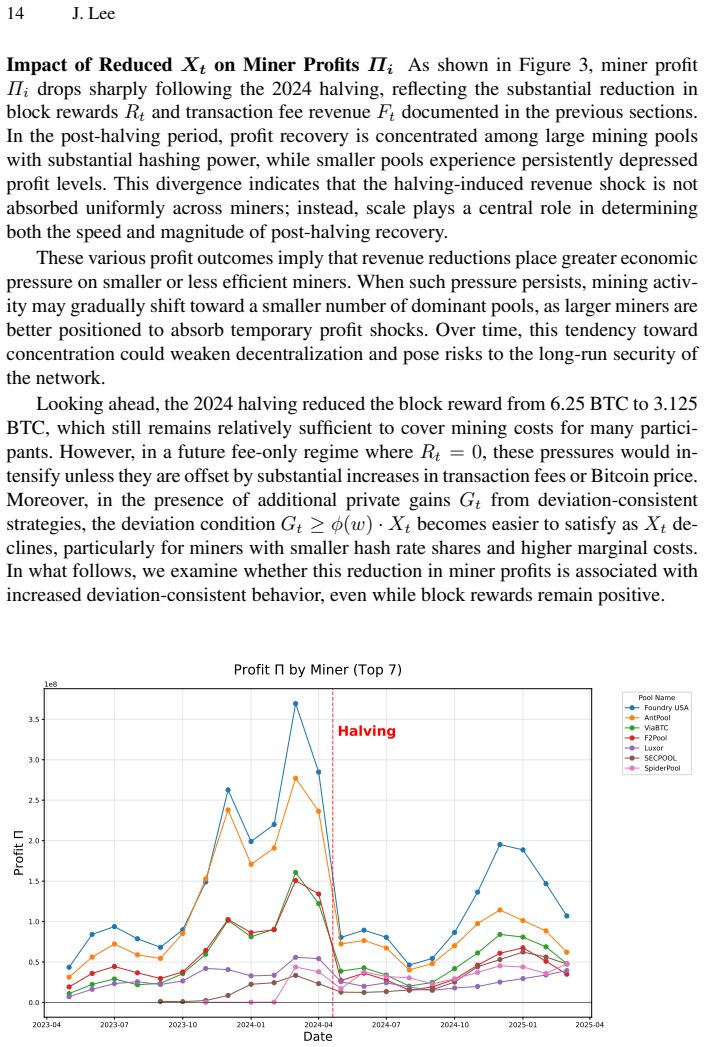
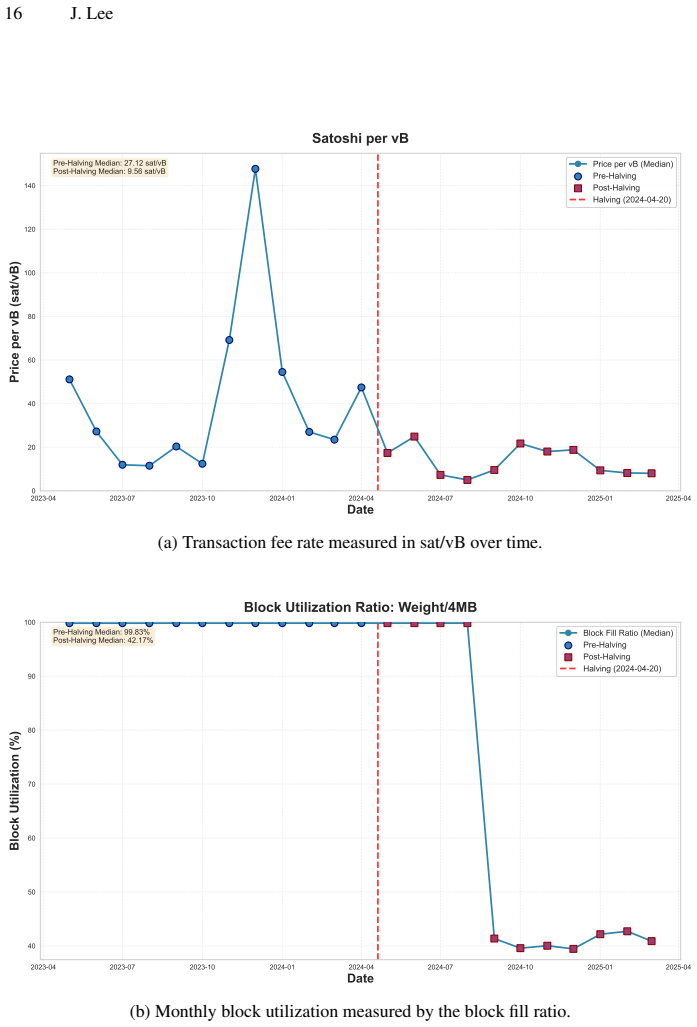
read the original abstract
Bitcoin's block reward is scheduled to decline to zero, raising concerns about whether the network can remain secure once miners rely solely on transaction fees. This paper seeks to identify the conditions under which large-scale and persistent deviation from honest mining can arise. We analyze and compare the payoffs of honest and deviating miners in a sequential decision model, and identify a deviation threshold $G_t$ at which honest mining ceases to be privately optimal. Around the 2024 Bitcoin halving, we show that current mining behavior does not exhibit large-scale or structural deviation. However, when the block reward is removed, the $G_t$ criterion implies that deviation can arise even with a very small fraction of transaction fees. Finally, we evaluate three protocol-level mechanisms: Base Fee, Fee Floor, and an adaptive maximum block size rule, and show that their combination raises the deviation threshold and mitigates incentive breakdown in a fee-only regime. These results provide a practical benchmark for assessing Bitcoin's security as block rewards disappear.
Editorial analysis
A structured set of objections, weighed in public.
Referee Report
Summary. The paper analyzes Bitcoin mining incentives using a sequential decision model to identify a deviation threshold G_t at which honest mining ceases to be privately optimal. It reports that current behavior around the 2024 halving shows no large-scale deviation, but predicts that removing the block reward allows deviation even with a very small fraction of transaction fees. It evaluates three protocol mechanisms (Base Fee, Fee Floor, and adaptive maximum block size) and claims their combination raises G_t and mitigates incentive breakdown in a fee-only regime.
Significance. If the model and G_t derivation hold, the work supplies a concrete benchmark for assessing long-term Bitcoin security once block rewards reach zero and offers specific, testable protocol adjustments. The explicit comparison of honest versus deviating payoffs and the mechanism evaluation are strengths that could inform both theory and deployment discussions.
major comments (2)
- [Abstract and deviation threshold section] Abstract and deviation threshold section: the central claim that 'deviation can arise even with a very small fraction of transaction fees' once the block reward is removed rests on G_t derived from payoff comparisons in the sequential decision model. This model assumes miners observe prior decisions and realized fee values before acting, yet real mining occurs under Poisson block arrivals, private mempool views, and propagation delays. The assumption is load-bearing for the low-fee deviation prediction and requires either explicit robustness checks or discussion of how the threshold changes under asynchronous information.
- [Mechanisms evaluation section] Mechanisms evaluation section: the claim that the combination of Base Fee, Fee Floor, and adaptive maximum block size 'raises the deviation threshold and mitigates incentive breakdown' is presented without quantitative estimates of the magnitude of the G_t increase or sensitivity analysis to the specific parameter values chosen for each mechanism. This weakens the practical benchmark value of the result.
minor comments (1)
- [Abstract] Notation for the deviation threshold alternates between G_t and Gt; adopt a single consistent form throughout the manuscript and equations.
Simulated Author's Rebuttal
We thank the referee for the constructive comments on model assumptions and the mechanisms evaluation. We address each point below with proposed revisions.
read point-by-point responses
-
Referee: [Abstract and deviation threshold section] Abstract and deviation threshold section: the central claim that 'deviation can arise even with a very small fraction of transaction fees' once the block reward is removed rests on G_t derived from payoff comparisons in the sequential decision model. This model assumes miners observe prior decisions and realized fee values before acting, yet real mining occurs under Poisson block arrivals, private mempool views, and propagation delays. The assumption is load-bearing for the low-fee deviation prediction and requires either explicit robustness checks or discussion of how the threshold changes under asynchronous information.
Authors: We agree the sequential model idealizes perfect observation to enable analytical derivation of G_t via direct payoff comparison. Real-world asynchrony from Poisson arrivals, private mempools, and delays is a valid concern that could affect coordination on deviation. In revision we will add a discussion subsection explaining that such frictions likely raise the effective threshold by impeding simultaneous observation, while noting that full stochastic robustness simulations exceed the paper's current scope. revision: partial
-
Referee: [Mechanisms evaluation section] Mechanisms evaluation section: the claim that the combination of Base Fee, Fee Floor, and adaptive maximum block size 'raises the deviation threshold and mitigates incentive breakdown' is presented without quantitative estimates of the magnitude of the G_t increase or sensitivity analysis to the specific parameter values chosen for each mechanism. This weakens the practical benchmark value of the result.
Authors: The mechanisms section currently demonstrates directional improvement in G_t qualitatively. We accept that quantitative magnitude and sensitivity would improve the result's utility. The revised manuscript will incorporate explicit numerical estimates of G_t before and after the combined mechanisms using the paper's example parameters, plus sensitivity tables varying each parameter (base fee, floor, block size adjustment) by ±20%. revision: yes
Circularity Check
No circularity: Gt derived from explicit sequential payoff comparison
full rationale
The paper constructs Gt by direct comparison of miner payoffs under honest versus deviating strategies inside a sequential decision model whose assumptions are stated independently of the target result. No parameter is fitted to data and then relabeled as a prediction, no self-citation supplies a uniqueness theorem, and no ansatz is imported. The claim that deviation becomes possible with small fee fractions once the block reward reaches zero follows algebraically from setting the block-reward term to zero inside the already-derived Gt expression. The derivation is therefore self-contained against external benchmarks.
Axiom & Free-Parameter Ledger
axioms (1)
- domain assumption Miners are rational payoff maximizers who observe the same public information when choosing honest or deviating actions.
Reference graph
Works this paper leans on
-
[1]
Andresen, G.: BIP 101: Increase maximum block size.https://bips.dev /101/(2015), accessed: 2026-02-15
2015
-
[2]
https://bips.dev/109/(2016), accessed: 2026-02-15
Andresen, G.: BIP 109: Two million byte size limit with sigop and sighash limits. https://bips.dev/109/(2016), accessed: 2026-02-15
2016
-
[3]
Block Scholes: Ethereum staking deep dive: Analysing execution layer rewards & MEV (2024), block Scholes Research Note
2024
-
[4]
BtcDrak: BIP 105: Consensus based block size retargeting algorithm.https: //bips.dev/105/(2015), accessed: 2026-02-15
2015
-
[5]
Cambridge Centre for Alternative Finance: Cambridge bitcoin electricity con- sumption index (cbeci) methodology (2025),https://ccaf.io/cbnsi/cb eci/methodology, assumption 1: Average electricity price is 0.05 USD/kWh
2025
-
[6]
Drammer: Deterministic rowhammer attacks on mobile platforms,
Carlsten, M., Kalodner, H., Weinberg, S.M., Narayanan, A.: On the instability of bitcoin without the block reward. In: Proceedings of the 2016 ACM SIGSAC Con- ference on Computer and Communications Security (CCS). pp. 154–167. ACM (2016).https://doi.org/10.1145/2976749.2978408
-
[7]
https://bips.dev/106/(2015), accessed: 2026-02-15
Chakraborty, U.: BIP 106: Dynamically controlled bitcoin block size max cap. https://bips.dev/106/(2015), accessed: 2026-02-15
2015
-
[8]
In: Financial Cryptography and Data Security Workshops (FC)
Croman, K., Decker, C., Eyal, I., Gencer, A.E., Juels, A., Kosba, A., Miller, A., Saxena, P., Shi, E., Sirer, E.G., Song, D., Wattenhofer, R.: On scaling decentral- ized blockchains. In: Financial Cryptography and Data Security Workshops (FC). Lecture Notes in Computer Science, vol. 9604, pp. 106–125. Springer (2016). https://doi.org/10.1007/978-3-662-53357-4_8
-
[9]
In: Proceedings of the IEEE Symposium on Security and Privacy (S&P)
Daian, P., Goldfeder, S., Kell, T., Li, Y ., Zhao, X., Bentov, I., Breidenbach, L., Juels, A.: Flash boys 2.0: Frontrunning, transaction reordering, and consensus in- stability. In: Proceedings of the IEEE Symposium on Security and Privacy (S&P). pp. 910–927. IEEE (2020).https://doi.org/10.1109/SP40000.20 20.00040
-
[10]
In: Proceedings of the IEEE International Conference on Peer-to-Peer Computing (P2P)
Decker, C., Wattenhofer, R.: Information propagation in the bitcoin network. In: Proceedings of the IEEE International Conference on Peer-to-Peer Computing (P2P). pp. 1–10. IEEE (2013).https://doi.org/10.1109/P2P.20 13.6688704
-
[11]
Journal of the ACM35(2), 288–323 (1988).https://doi.org/10 .1145/42282.42283
Dwork, C., Lynch, N., Stockmeyer, L.: Consensus in the presence of partial syn- chrony. Journal of the ACM35(2), 288–323 (1988).https://doi.org/10 .1145/42282.42283
arXiv 1988
-
[12]
Ethereum Improvement Proposals: Eip-1559: Fee market change for ETH 1.0 chain.https://eips.ethereum.org/EIPS/eip-1559(2021), ac- cessed: 2026-02-15
2021
-
[13]
In: International Conference on Financial Cryptography and Data Security (FC)
Eyal, I., Sirer, E.G.: Majority is not enough: Bitcoin mining is vulnerable. In: International Conference on Financial Cryptography and Data Security (FC). pp. 436–454 (2014).https://doi.org/10.1007/978-3-662-45472-5 _28 26 J. Lee
-
[14]
Flashbots: Quantifying maximal extractable value (2022), flashbots Research Note
2022
-
[15]
In: Advances in Cryptology – EUROCRYPT 2015
Garay, J.A., Kiayias, A., Leonardos, N.: The bitcoin backbone protocol: Analy- sis and applications. In: Advances in Cryptology – EUROCRYPT 2015. Lecture Notes in Computer Science, vol. 9057, pp. 281–310. Springer (2015).https: //doi.org/10.1007/978-3-662-46803-6_10
-
[16]
In: Katz, J., Shacham, H
Garay, J.A., Kiayias, A., Leonardos, N.: The bitcoin backbone protocol with chains of variable difficulty. In: Katz, J., Shacham, H. (eds.) Advances in Cryptol- ogy - CRYPTO 2017 - 37th Annual International Cryptology Conference, Santa Barbara, CA, USA, August 20-24, 2017, Proceedings, Part I. pp. 291–323. Lec- ture Notes in Computer Science, Springer (20...
2017
-
[17]
Garzik, J.: BIP 102: Block size increase to 2mb.https://bips.dev/102/ (2015), accessed: 2026-02-15
2015
-
[18]
Garzik, J., Harding, T., Johannsson, D.V .: BIP 100: Dynamic maximum block size by miner vote.https://bips.dev/100/(2015), accessed: 2026-02-15
2015
-
[19]
Khan, T.: BIP 104: Block75 – max block size like difficulty.https://bips.d ev/104/(2017), accessed: 2026-02-15
2017
-
[20]
Accessed: 2026-02-15
Mempool Open Source Project: Block audit score and mempool audit ratio.http s://mempool.space/docs/api/rest(2025), section:get-block-audit- score. Accessed: 2026-02-15
2025
-
[21]
Nakamoto, S.: Bitcoin: A peer-to-peer electronic cash system.https://bitc oin.org/bitcoin.pdf(2008), accessed: 2026-02-15
2008
-
[22]
Sanchez, W.Y .: BIP 107: Dynamic limit on the block size.https://bips.d ev/107/(2015), accessed: 2026-02-15
2015
-
[23]
MIT Press, Cambridge, MA, 2 edn
Sutton, R.S., Barto, A.G.: Reinforcement Learning: An Introduction. MIT Press, Cambridge, MA, 2 edn. (2018)
2018
-
[24]
Wiedenmann, A., Guettler, A.: Bitcoin ordinals and inscriptions: An analysis of bitcoin’s evolving network dynamics. The Journal of The British Blockchain As- sociation9(1) (2026).https://doi.org/10.31585/jbba-9-1-(1)20 26
-
[25]
We assume: –Withholding timew≥0, –Block arrival rateλ >0(Bitcoin targets one block per 600 seconds), –Hash shareh i >0
Wuille, P.: BIP 103: Block size following technological growth.https://bi ps.dev/103/(2015), accessed: 2026-02-15 Bitcoin After Block Rewards 27 A Additional Proofs on Assumptions and the Solutions A.1G t Threshold andϕ(w) In this appendix, we formally show that the successful mining probability gap(p hon i − pdev i )appearing in theG t threshold conditio...
2015
discussion (0)
Sign in with ORCID, Apple, or X to comment. Anyone can read and Pith papers without signing in.