Two Fabry-Perots and two calibration units for CARMENES
Pith reviewed 2026-06-27 23:54 UTC · model grok-4.3
The pith
Two temperature-stabilized Fabry-Pérot units supply dense line grids for CARMENES wavelength calibration and drift monitoring.
A machine-rendered reading of the paper's core claim, the machinery that carries it, and where it could break.
Core claim
The central claim is that two independently optimized Fabry-Pérot units, one with 15 GHz free spectral range for the 520-960 nm channel and one with 12.2 GHz for the 960-1710 nm channel, together with Th-Ne, U-Ar, U-Ne hollow-cathode lamps, furnish the wavelength calibration and nightly drift measurements for CARMENES, with the etalons engineered to maintain internal stability better than 10 cm/s through temperature and pressure stabilization.
What carries the argument
Temperature- and pressure-stabilized Fabry-Pérot etalons that generate ~17,900 useful lines in the visible and ~9,700 in the near-infrared for wavelength solution and drift tracking.
If this is right
- The visible Fabry-Pérot supplies approximately 17,900 emission lines across 520-960 nm.
- The near-infrared Fabry-Pérot supplies approximately 9,700 lines across 960-1710 nm.
- Hollow-cathode lamps (Th-Ne, U-Ar, U-Ne) and flat-field lamps operate alongside each Fabry-Pérot for absolute calibration.
- Separate units for each spectrograph arm allow independent optimization of line density and stabilization for the two wavelength ranges.
Where Pith is reading between the lines
- The line densities imply that interpolation between calibration lines can be kept small enough to support sub-10 cm/s radial-velocity work.
- Having independent calibration hardware for the visible and infrared channels reduces the risk that a single failure affects the entire instrument.
- The same stabilization approach could be adapted to other dual-arm high-resolution spectrographs that require nightly drift monitoring at the 10 cm/s level.
Load-bearing premise
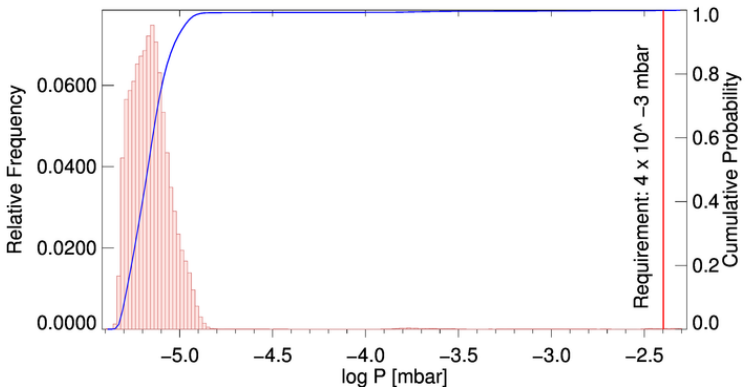
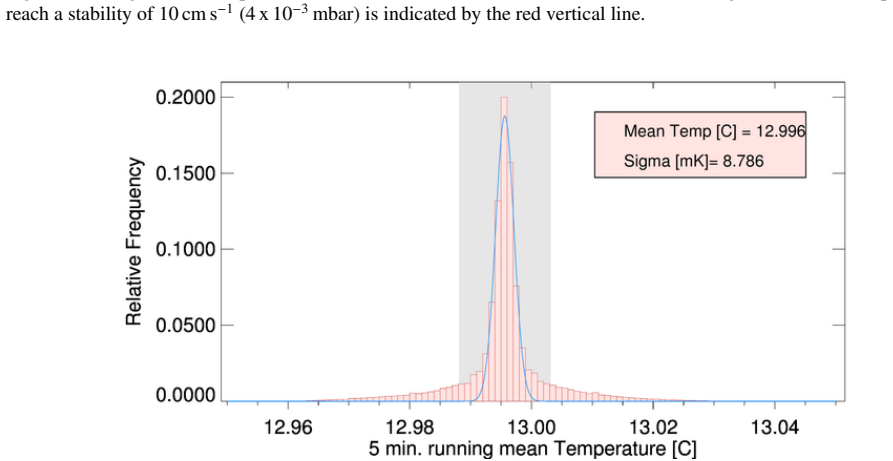
The temperature and pressure stabilization choices will in practice deliver the claimed internal stability of better than 10 cm/s per night.
What would settle it
Direct measurement of the residual nightly wavelength drift in the CARMENES spectrographs when using these Fabry-Pérot units, if the observed scatter exceeds 10 cm/s over multiple nights.
Figures
read the original abstract
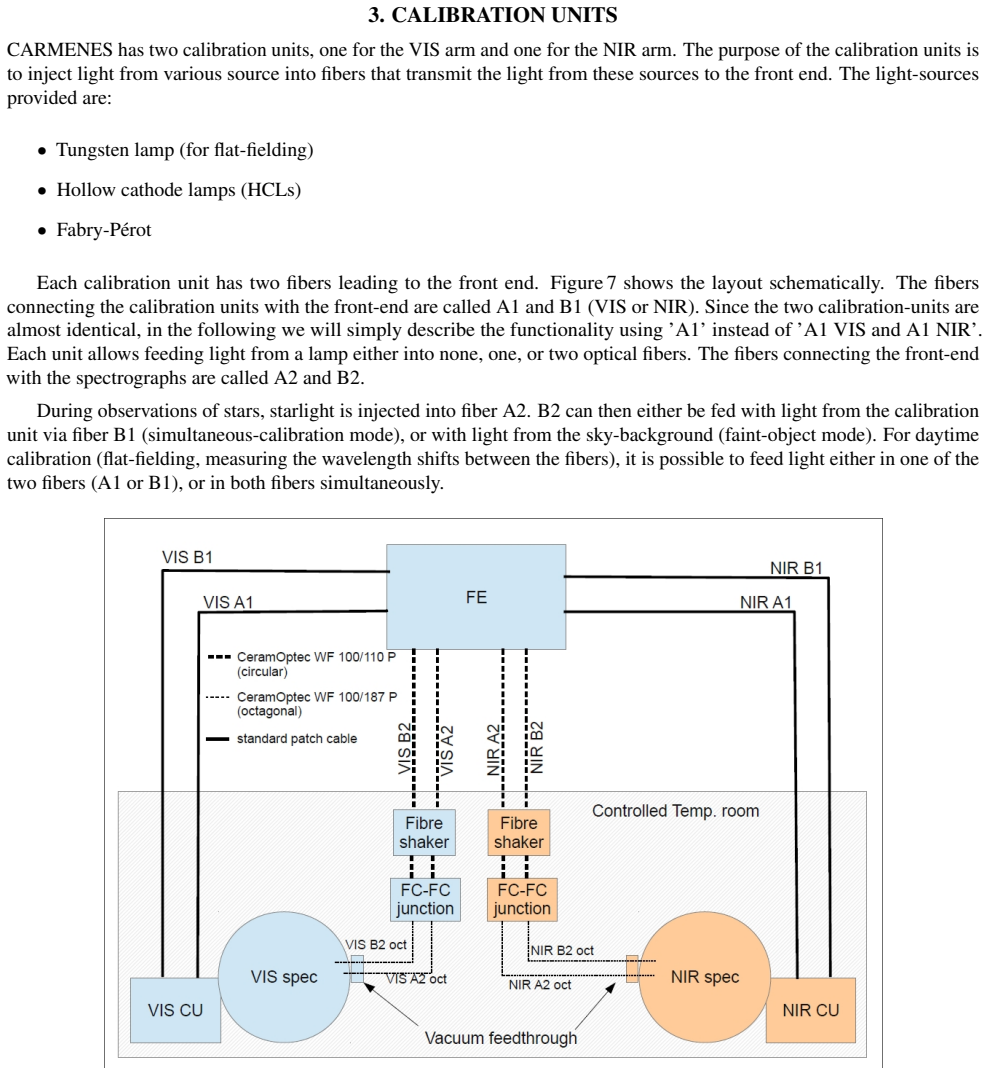
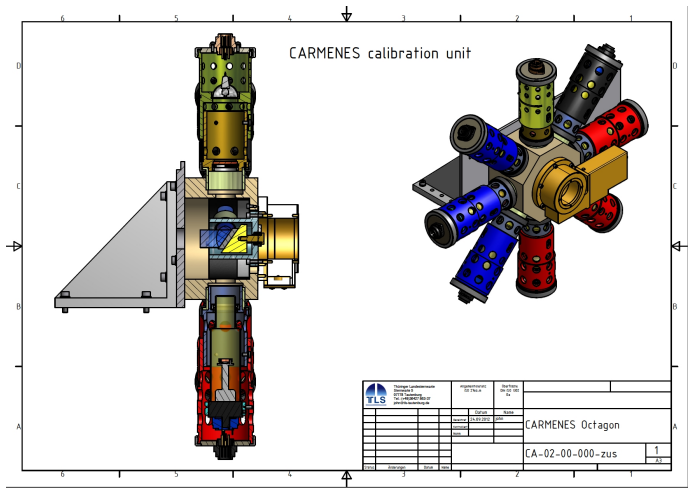
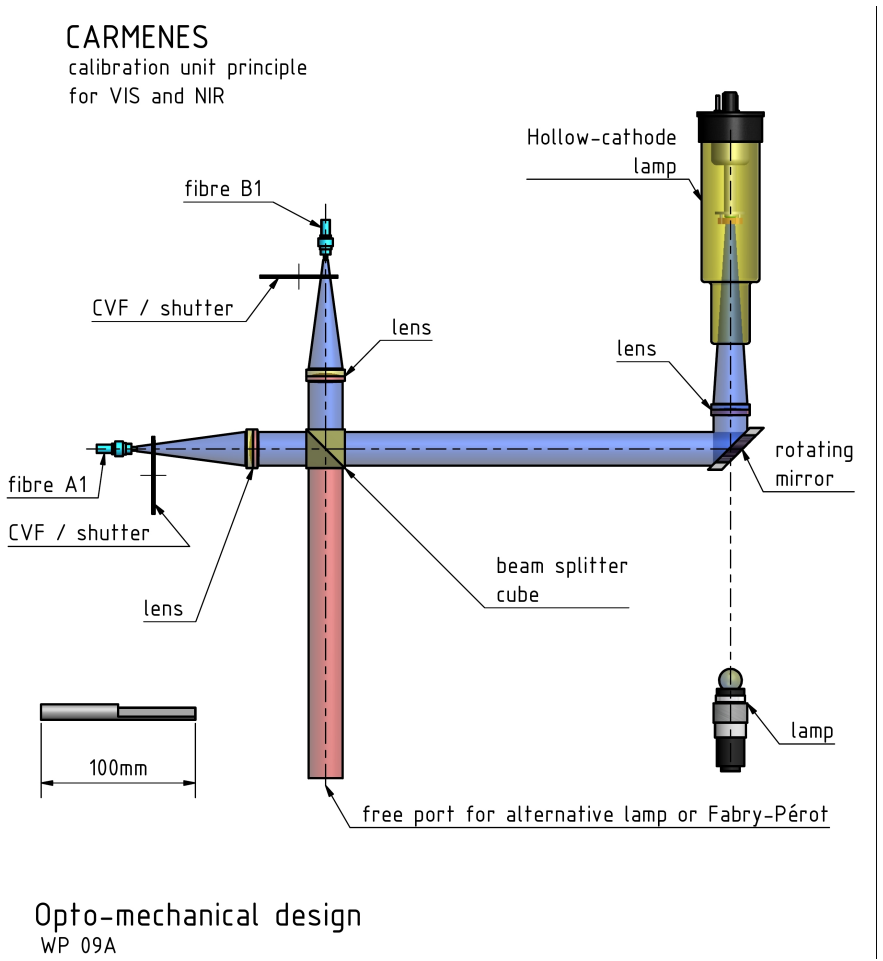
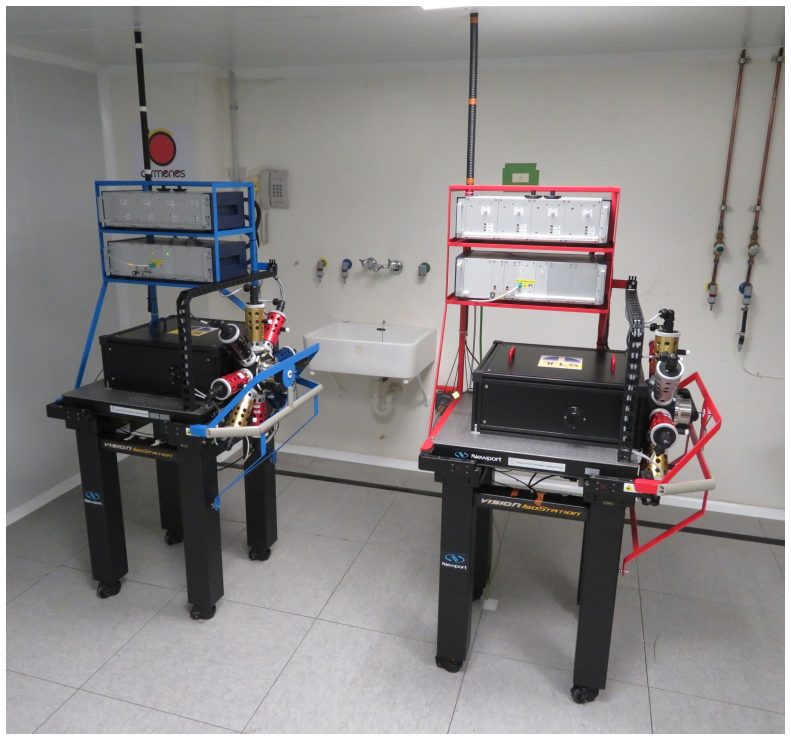
The wavelength calibration and nightly drift measurements for CARMENES (Calar Alto high-Resolution search for M dwarfs with Exoearths with Near-infrared and optical Echelle Spectrographs) are provided by a combination of hollow cathode lamps and two Fabry-P\'{e}rot units. CARMENES consists of two spectrograph, one for the visible part of the spectrum (520-960nm) and one for the near infrared (960-1710nm). Each spectrograph has its own calibration unit and its own Fabry-P\'{e}rot. The calibration units are equipped with Th-Ne, U-Ar and U-Ne hollow cathode lamps as well as a flat field lamp. The Fabry-P\'{e}rots are optimized for the wavelength ranges of the spectrographs and use halogen-tungsten lamps as light sources. The Fabry-P\'{e}rots have a free spectral range of 15GHz for the visible and 12.2GHz for the near infrared which translates to $\sim$17,900 useful emission lines for the visible spectrograph and $\sim$9,700 for the infrared. These lines are used to compute the wavelength solution, and to monitor the instrumental drift during the night. The Fabry-P\'{e}rot units are temperature and pressure stabilized and designed to reach an internal stability of better than 10\,cm/s per night. Here, we present the designs of both Fabry-P\'{e}rot units and the calibration units.
Editorial analysis
A structured set of objections, weighed in public.
Referee Report
Summary. The paper describes the design and implementation of two Fabry-Pérot etalons (one for the visible arm, one for the NIR arm) together with their dedicated calibration units for the CARMENES spectrograph. It specifies the free spectral ranges (15 GHz visible, 12.2 GHz NIR), the choice of halogen-tungsten lamps, the sets of hollow-cathode lamps (Th-Ne, U-Ar, U-Ne), and the temperature/pressure stabilization approach whose goal is an internal stability better than 10 cm/s per night for wavelength solution and drift monitoring.
Significance. If the described stabilization and optical choices deliver the stated performance, the work supplies a concrete, reusable reference for dense-line calibration systems on high-resolution echelle spectrographs. The explicit line counts (~17 900 visible, ~9 700 NIR) and the dual-arm architecture are useful benchmarks for similar instruments.
major comments (1)
- [Abstract and design sections] The central design claim is that the temperature/pressure stabilization will achieve <10 cm/s nightly internal stability, yet no quantitative thermal model, pressure-control specification, or error budget appears in the manuscript to show how the chosen hardware meets this target. This is load-bearing for the paper's purpose as a calibration-system design document.
minor comments (2)
- [Abstract] Abstract: 'two spectrograph' should read 'two spectrographs'.
- The manuscript would benefit from a short table summarizing the key parameters (FSR, line count, lamp types, stabilization method) for both arms side-by-side.
Simulated Author's Rebuttal
We thank the referee for the constructive report and for recognizing the potential utility of this work as a reference for dense-line calibration systems. We address the single major comment below.
read point-by-point responses
-
Referee: [Abstract and design sections] The central design claim is that the temperature/pressure stabilization will achieve <10 cm/s nightly internal stability, yet no quantitative thermal model, pressure-control specification, or error budget appears in the manuscript to show how the chosen hardware meets this target. This is load-bearing for the paper's purpose as a calibration-system design document.
Authors: We agree that the manuscript would be strengthened by an explicit quantitative error budget. The current text states only that the units are 'designed to reach' the target stability; it does not derive this figure from the hardware parameters. In the revised version we will insert a new subsection (in the Fabry-Pérot design section) that supplies the thermal model, pressure-control tolerances, and error budget showing how the chosen stabilization hardware is expected to deliver <10 cm/s nightly internal stability. revision: yes
Circularity Check
No significant circularity; design description only
full rationale
The manuscript is a hardware design paper documenting optical, mechanical, and stabilization choices for Fabry-Pérot and calibration units. It contains no equations, no fitted parameters, no predictions derived from data, and no load-bearing self-citations or uniqueness theorems. The stability claim is explicitly a design target rather than a derived result, so no reduction to inputs occurs. This is a self-contained descriptive document with no derivation chain to inspect.
Axiom & Free-Parameter Ledger
Reference graph
Works this paper leans on
-
[1]
ArXiv e-prints , archivePrefix = "arXiv", eprint =
A Community Science Case for E-ELT HIRES. ArXiv e-prints , archivePrefix = "arXiv", eprint =
-
[2]
Radial velocity observations of the 2015 Mar. 20 eclipse. A benchmark Rossiter-McLaughlin curve with zero free parameters. , keywords =. 2016. doi:10.1051/0004-6361/201629088 , archivePrefix =. 1609.00535 , primaryClass =
work page internal anchor Pith review Pith/arXiv arXiv doi:10.1051/0004-6361/201629088 2015
-
[3]
W. F. Meggers , title =. Analytical Chemistry , volume =. 1956 , doi =
1956
-
[4]
, year = 1901, month = may, volume = 13, pages =
On a New Form of Interferometer. , year = 1901, month = may, volume = 13, pages =. doi:10.1086/140817 , adsurl =
-
[5]
, year = 2012, month = nov, volume = 491, pages =
An Earth-mass planet orbiting Centauri B. , year = 2012, month = nov, volume = 491, pages =. doi:10.1038/nature11572 , adsurl =
-
[6]
The HARPS search for southern extra-solar planets. XVIII. An Earth-mass planet in the GJ 581 planetary system. , archivePrefix = "arXiv", eprint =. doi:10.1051/0004-6361/200912172 , adsurl =
-
[7]
Two Fabry-Perot interferometers for high precision wavelength calibration in the near-infrared. Society of Photo-Optical Instrumentation Engineers (SPIE) Conference Series , year = 2012, series =. doi:10.1117/12.926232 , adsurl =
-
[8]
A kinematic classification for early-type galaxies
High-precision wavelength calibration of astronomical spectrographs with laser frequency combs. , eprint =. doi:10.1111/j.1365-2966.2007.12147.x , adsurl =
-
[9]
, year = 2012, month = may, volume = 485, pages =
A spectrograph for exoplanet observations calibrated at the centimetre-per-second level. , year = 2012, month = may, volume = 485, pages =. doi:10.1038/nature11092 , adsurl =
-
[10]
CARMENES: Calar Alto High-Resolution Search for M Dwarfs with Exo-earths with a Near-infrared Echelle Spectrograph. Pathways Towards Habitable Planets , year = 2010, series =. arXiv:0912.0561 , primaryClass = "astro-ph.SR", editor =
Pith/arXiv arXiv 2010
-
[11]
The habitable-zone planet finder: a stabilized fiber-fed NIR spectrograph for the Hobby-Eberly Telescope. Society of Photo-Optical Instrumentation Engineers (SPIE) Conference Series , year = 2012, series =. doi:10.1117/12.926102 , adsurl =. arXiv:1209.1686 , primaryClass = "astro-ph.EP", month = sep, eid =
work page internal anchor Pith review Pith/arXiv arXiv doi:10.1117/12.926102 2012
-
[12]
Society of Photo-Optical Instrumentation Engineers (SPIE) Conference Series , year = 2012, series =
ESPRESSO: the ultimate rocky exoplanets hunter for the VLT. Society of Photo-Optical Instrumentation Engineers (SPIE) Conference Series , year = 2012, series =. doi:10.1117/12.924602 , adsurl =
-
[13]
Society of Photo-Optical Instrumentation Engineers (SPIE) Conference Series , year = 2008, series =
PEPSI: the Potsdam Echelle Polarimetric and Spectroscopic Instrument for the LBT. Society of Photo-Optical Instrumentation Engineers (SPIE) Conference Series , year = 2008, series =. doi:10.1117/12.787376 , adsurl =
-
[14]
Society of Photo-Optical Instrumentation Engineers (SPIE) Conference Series , year = 2010, series =
A Fabry-Perot calibrator of the HARPS radial velocity spectrograph: performance report. Society of Photo-Optical Instrumentation Engineers (SPIE) Conference Series , year = 2010, series =. doi:10.1117/12.857951 , adsurl =
-
[15]
16th Cambridge Workshop on Cool Stars, Stellar Systems, and the Sun , year = 2011, series =
Planet Detection, Magnetic Field of Protostars and Brown Dwarfs Meteorology with SPIRou. 16th Cambridge Workshop on Cool Stars, Stellar Systems, and the Sun , year = 2011, series =
2011
-
[16]
Advanced Optical and Mechanical Technologies in Telescopes and Instrumentation , Year =
Optical fiber scrambling and light pipes for high accuracy radial velocities measurements. Society of Photo-Optical Instrumentation Engineers (SPIE) Conference Series , year = 2008, series =. doi:10.1117/12.789509 , adsurl =
-
[17]
Society of Photo-Optical Instrumentation Engineers (SPIE) Conference Series , year = 2006, series =
Photometrical scrambling gain and focal ratio degradation in fibers for astronomical instruments. Society of Photo-Optical Instrumentation Engineers (SPIE) Conference Series , year = 2006, series =. doi:10.1117/12.671417 , adsurl =
-
[18]
Society of Photo-Optical Instrumentation Engineers (SPIE) Conference Series , year = 2010, series =
New scramblers for precision radial velocity: square and octagonal fibers. Society of Photo-Optical Instrumentation Engineers (SPIE) Conference Series , year = 2010, series =. doi:10.1117/12.856874 , adsurl =
-
[19]
History, theory, practice and applications
The Fabry-Perot interferometer. History, theory, practice and applications. The Adam Hilger Series on Optics and Optoelectronics, Bristol: Hilger, 1989 , year = 1989, adsurl =
1989
-
[20]
Astronomy & Astrophysics , Year =
Calibrating echelle spectrographs with Fabry-P \'e rot etalons. Astronomy and Astrophysics , archivePrefix = "arXiv", eprint =. doi:10.1051/0004-6361/201526462 , adsurl =
-
[21]
High-resolution optical and near-infrared spectroscopy of 324 survey stars
The CARMENES search for exoplanets around M dwarfs. High-resolution optical and near-infrared spectroscopy of 324 survey stars
discussion (0)
Sign in with ORCID, Apple, or X to comment. Anyone can read and Pith papers without signing in.