Observing the integrated and spatially resolved Sun with ultra-high spectral resolution
Pith reviewed 2026-06-27 23:47 UTC · model grok-4.3
The pith
A solar instrument suite provides frequency calibration accurate to less than 10 cm/s across 400-800 nm for precision spectroscopy.
A machine-rendered reading of the paper's core claim, the machinery that carries it, and where it could break.
Core claim
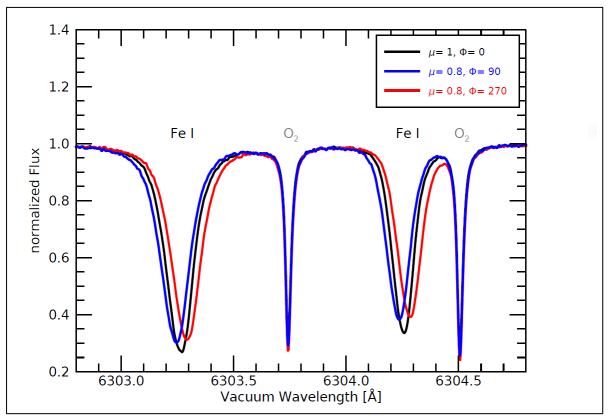
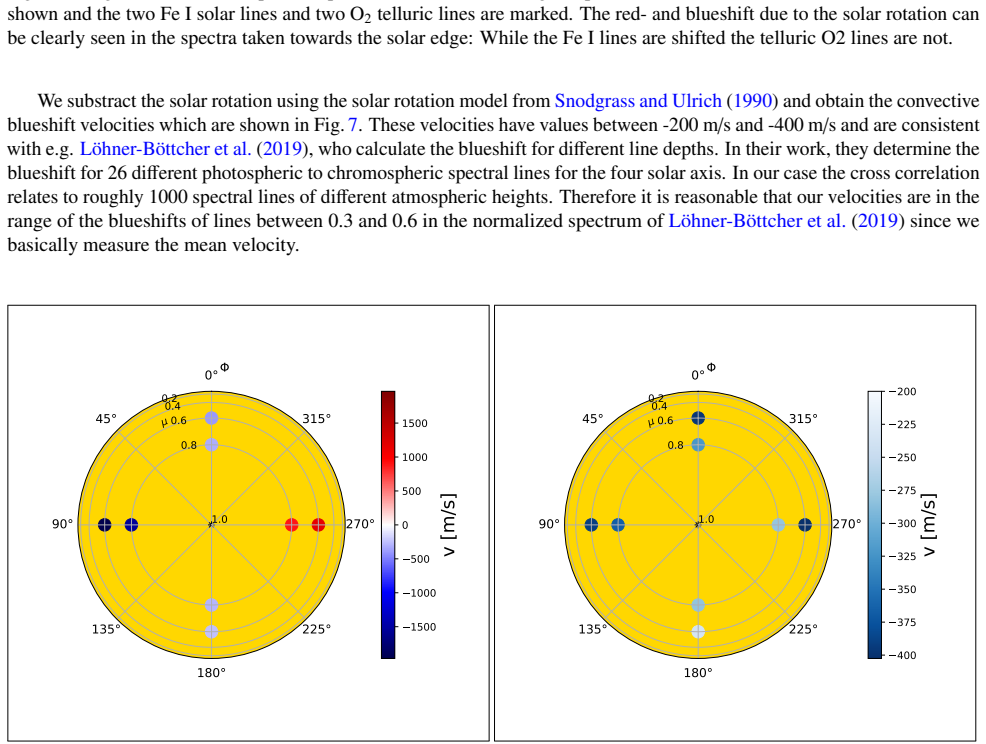
Our instrument suite can deliver spectroscopic measurements with extremely accurate frequency calibration, which is valid across very large frequency regions (approx. 400-800 nm in wavelength). This allows precision spectroscopy of individual lines in order to study the variability of spectral lines in Sun-as-a-star observations as well as determining the convective blueshift across the solar surface from many spectral lines.
What carries the argument
The laser frequency comb that achieves frequency calibration accurate to less than 10 cm/s, paired with the high-resolution Fourier transform spectrograph.
If this is right
- The calibration supports Sun-as-a-star observations to track spectral line variability.
- Many spectral lines can be used to map convective blueshift across the solar surface.
- The wide wavelength coverage enables analysis without separate calibrations for different bands.
- Spatially resolved observations are possible by injecting light from specific solar positions.
Where Pith is reading between the lines
- Similar calibration techniques could be applied to other solar observatories to improve consistency in measurements.
- The precision might allow detection of subtle changes in solar activity through line profile analysis.
- If the system proves stable, it could serve as a reference for validating models of solar convection.
Load-bearing premise
The laser frequency comb maintains its accuracy of less than 10 cm/s across the full 400-800 nm range during actual observations.
What would settle it
Observing a known spectral line with established wavelength and checking if the measured position matches within the claimed precision would test the calibration.
Figures
read the original abstract
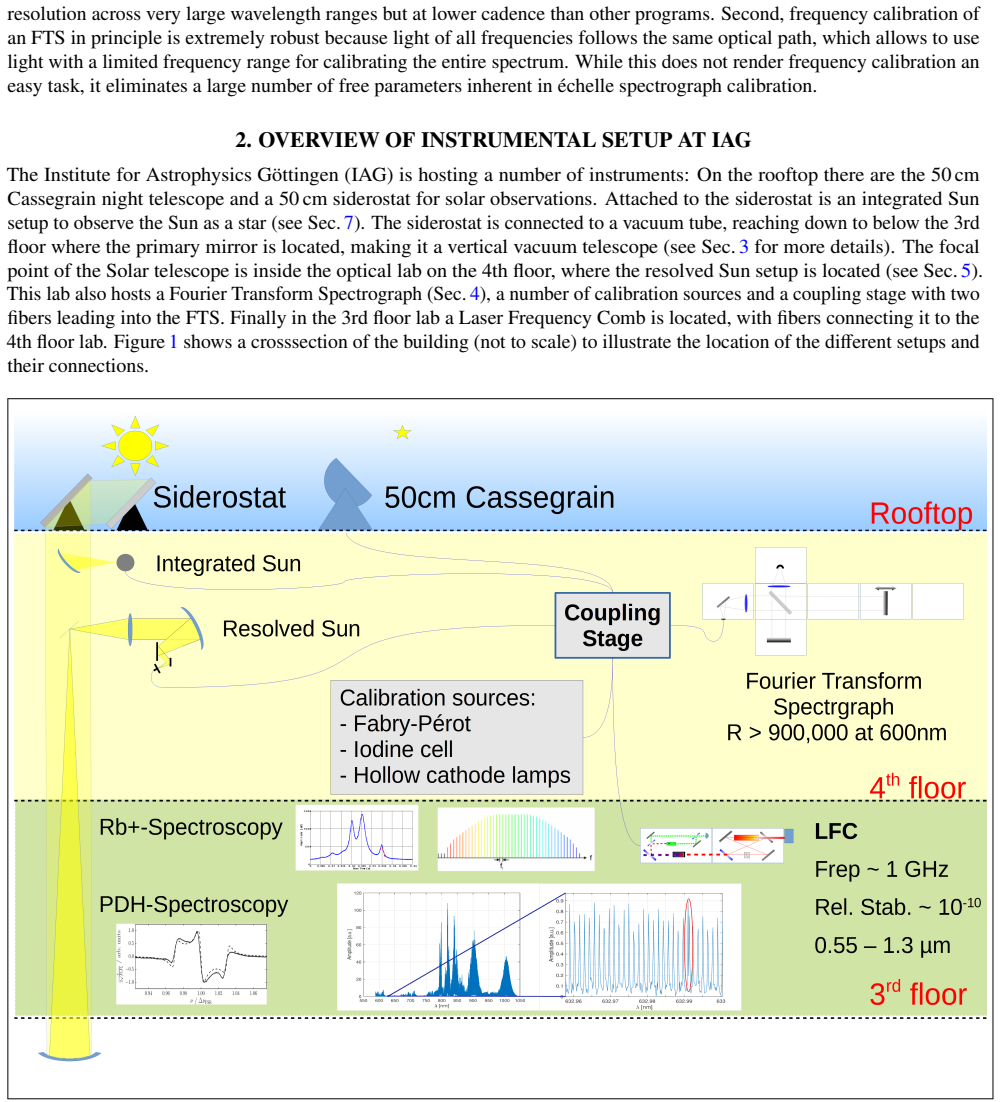
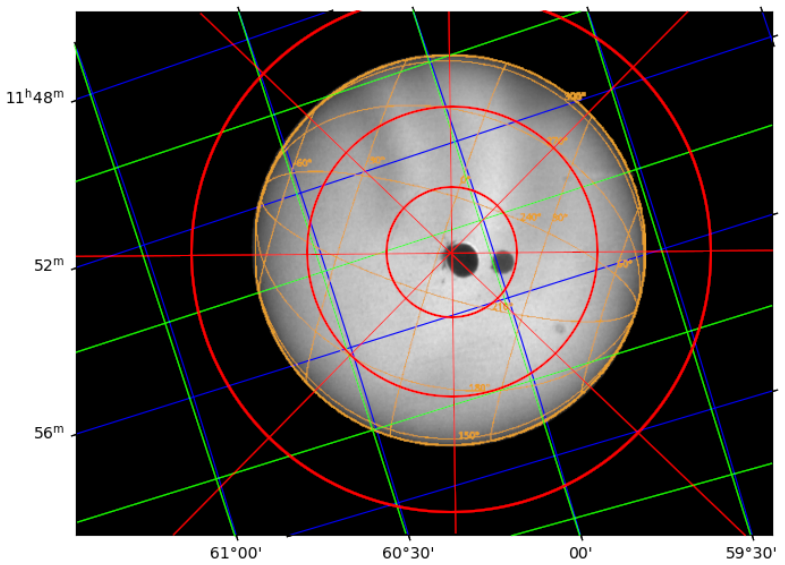
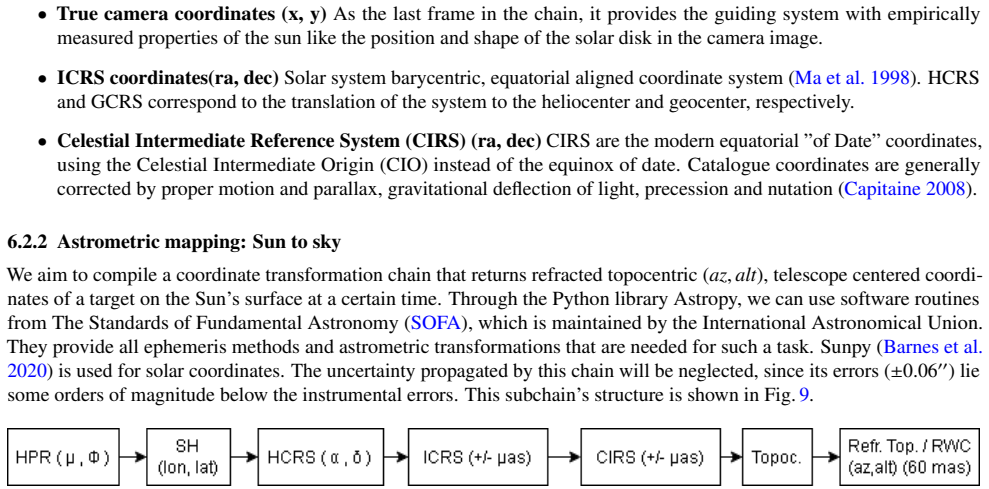
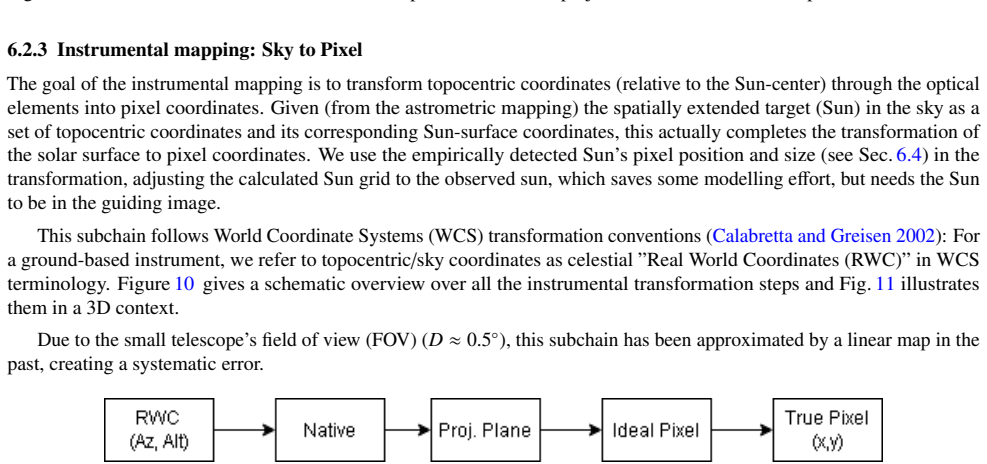
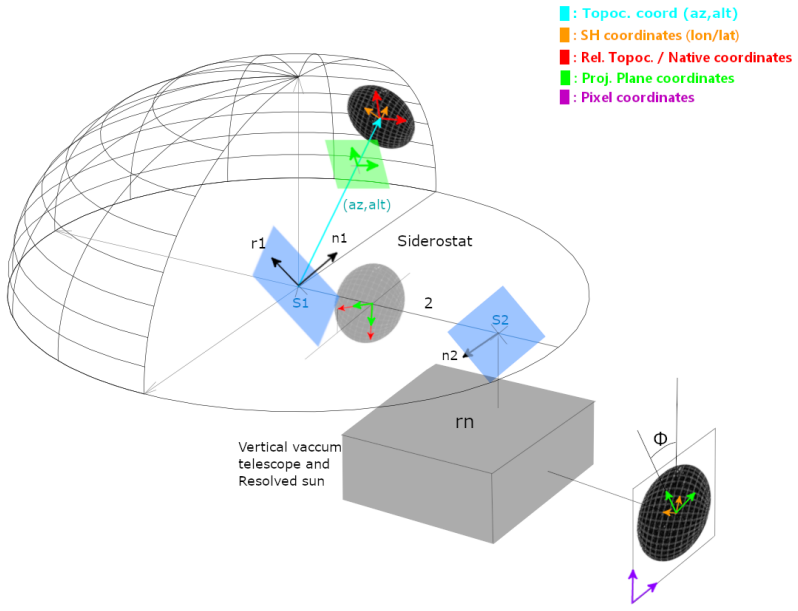
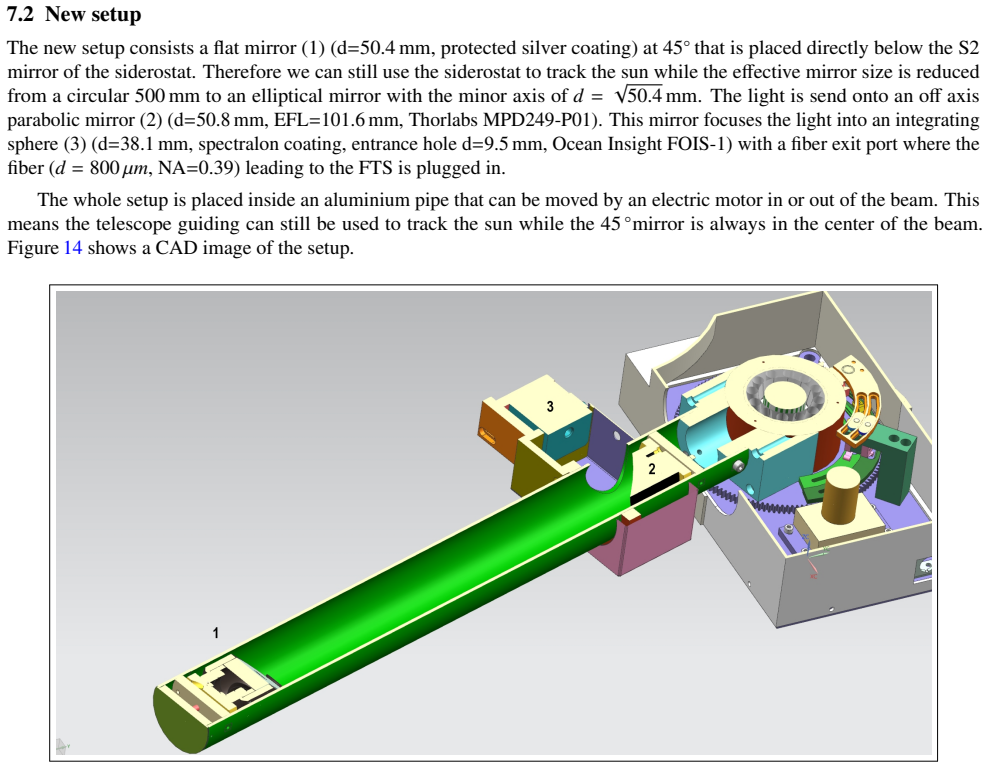
The Institute for Astrophysics G\"ottingen operates a solar observatory that combines a 50\,cm siderostat with (1) a vacuum vertical telescope, (2) a very high resolution Fourier Transform Spectrograph ($R > 900,000$ at 600\,nm), and (3) a Laser Frequency Comb for extremely precise and accurate frequency calibration ($<10\,cm/s$). We introduce our setup that feeds the spectrograph with either a 32.5" field of view of the solar surface, or with disk-integrated sunlight for Sun-as-a-star observations and explain the necessary computational steps to guide specific positions on the solar surface into the fiber. Our instrument suite can deliver spectroscopic measurements with extremely accurate frequency calibration, which is valid across very large frequency regions (approx. 400-800\,nm in wavelength). This allows precision spectroscopy of individual lines in order to study the variability of spectral lines in Sun-as-a-star observations as well as determining the convective blueshift across the solar surface from many spectral lines.
Editorial analysis
A structured set of objections, weighed in public.
Referee Report
Summary. The paper describes a solar observatory at the Institute for Astrophysics Göttingen that combines a 50 cm siderostat, vacuum vertical telescope, Fourier Transform Spectrograph (R > 900,000 at 600 nm), and Laser Frequency Comb (<10 cm/s calibration). It explains the optical feed for either a 32.5 arcsecond solar surface field or disk-integrated sunlight, plus computational guiding steps, and asserts that the suite enables precision spectroscopy of individual lines across ~400-800 nm for Sun-as-a-star line variability studies and spatially resolved convective blueshift measurements.
Significance. If the stated calibration performance is realized under operational conditions, the instrument would offer a distinctive capability for high-precision solar spectroscopy, supporting studies of spectral line variability and surface convection that are relevant to stellar activity and radial-velocity exoplanet work.
major comments (1)
- [Abstract] Abstract and main text: the assertion that the LFC delivers <10 cm/s accuracy valid across the full 400-800 nm range is presented without an error budget, on-sky validation data, or tests of fiber-injection stability, guiding residuals, or modal noise under the siderostat + vacuum-telescope feed; this accuracy is load-bearing for the two science applications claimed.
minor comments (1)
- The description of the fiber-injection and guiding system would benefit from additional quantitative detail on throughput, position repeatability, and how the 32.5 arcsecond field is maintained.
Simulated Author's Rebuttal
We thank the referee for their detailed review and constructive feedback. The major comment raises a valid point about the presentation of the LFC calibration accuracy. We address it below and will revise the manuscript accordingly to strengthen the supporting details for the claimed performance.
read point-by-point responses
-
Referee: [Abstract] Abstract and main text: the assertion that the LFC delivers <10 cm/s accuracy valid across the full 400-800 nm range is presented without an error budget, on-sky validation data, or tests of fiber-injection stability, guiding residuals, or modal noise under the siderostat + vacuum-telescope feed; this accuracy is load-bearing for the two science applications claimed.
Authors: We agree that the manuscript currently states the <10 cm/s figure without a full error budget or on-sky validation data. This value originates from the LFC design specifications and our laboratory characterizations demonstrating stability across 400-800 nm. However, the referee is correct that integration-specific factors such as fiber-injection stability, guiding residuals, and modal noise under the actual optical feed are not quantified in the present version. In revision we will add a dedicated subsection providing the available error budget from lab measurements, with explicit discussion of the known contributions and limitations. We will also clarify that comprehensive on-sky validation remains part of commissioning and is reserved for a follow-up paper. This revision directly supports the two science applications by making the basis of the accuracy claim transparent while preserving the instrument-description focus of the current work. revision: yes
Circularity Check
No significant circularity; instrument description only
full rationale
The paper is an instrument description that states performance specifications (LFC <10 cm/s calibration across 400-800 nm) and outlines setup/computational guidance steps without presenting any derivation chain, equations, or fitted quantities. No load-bearing claims reduce to self-definition, fitted inputs renamed as predictions, or self-citation chains. The central accuracy claim is presented as a design specification rather than a derived result, so no circularity patterns apply.
Axiom & Free-Parameter Ledger
Reference graph
Works this paper leans on
-
[1]
Radial velocity observations of the sun at night. , keywords =. doi:10.1086/172251 , adsurl =
-
[2]
, archivePrefix = "arXiv", eprint =
Correlations between sunspots and their moat flows. , archivePrefix = "arXiv", eprint =. doi:10.1051/0004-6361/201220543 , adsurl =
-
[3]
, archivePrefix = "arXiv", eprint =
A Magnetic Calibration of Photospheric Doppler Velocities. , archivePrefix = "arXiv", eprint =. doi:10.1088/0004-637X/765/2/98 , adsurl =
-
[4]
Wavelength Dependence of the Helioseismic and Magnetic Imager (HMI) Instrument onboard the Solar Dynamics Observatory (SDO). , keywords =. doi:10.1007/s11207-011-9723-8 , adsurl =
-
[5]
, archivePrefix = "arXiv", eprint =
The Sun as a planet-host star: proxies from SDO images for HARPS radial-velocity variations. , archivePrefix = "arXiv", eprint =. doi:10.1093/mnras/stw187 , adsurl =
-
[6]
, archivePrefix = "arXiv", eprint =
Toward Understanding Stellar Radial Velocity Jitter as a Function of Wavelength: The Sun as a Proxy. , archivePrefix = "arXiv", eprint =. doi:10.1088/0004-637X/798/1/63 , adsurl =
-
[7]
, archivePrefix = "arXiv", eprint =
SOAP 2.0: A Tool to Estimate the Photometric and Radial Velocity Variations Induced by Stellar Spots and Plages. , archivePrefix = "arXiv", eprint =. doi:10.1088/0004-637X/796/2/132 , adsurl =
-
[8]
, archivePrefix = "arXiv", eprint =
Photospheric activity, rotation, and radial velocity variations of the planet-hosting star CoRoT-7. , archivePrefix = "arXiv", eprint =. doi:10.1051/0004-6361/201014403 , adsurl =
-
[9]
, archivePrefix = "arXiv", eprint =
Reconstructing the solar integrated radial velocity using MDI/SOHO. , archivePrefix = "arXiv", eprint =. doi:10.1051/0004-6361/201014199 , adsurl =
-
[10]
Using the Sun to estimate Earth-like planets detection capabilities . II. Impact of plages. , archivePrefix = "arXiv", eprint =. doi:10.1051/0004-6361/200913551 , adsurl =
-
[11]
Using the Sun to estimate Earth-like planets detection capabilities . I. Impact of cold spots. , archivePrefix = "arXiv", eprint =. doi:10.1051/0004-6361/200913071 , adsurl =
-
[12]
Magnetic fields, convection and solar luminosity variability. , keywords =. doi:10.1038/297208a0 , adsurl =
-
[13]
, keywords =
Solar granulation - Influence of convection on spectral line asymmetries and wavelength shifts. , keywords =
-
[14]
II - The effect of granular motions
Some comments on the limb shift of solar lines. II - The effect of granular motions. , keywords =. doi:10.1007/BF00157270 , adsurl =
-
[15]
The G \"o ttingen Solar Radial Velocity Project: Sub-m s ^ -1 Doppler Precision from FTS Observations of the Sun as a Star. , archivePrefix = "arXiv", eprint =. doi:10.1088/1538-3873/128/967/095002 , adsurl =
-
[16]
, archivePrefix = "arXiv", eprint =
HARPS-N Observes the Sun as a Star. , archivePrefix = "arXiv", eprint =. doi:10.1088/2041-8205/814/2/L21 , adsurl =
-
[17]
On the apparent velocity of integrated sunlight. I - 1983-1985. , keywords =. doi:10.1086/165242 , adsurl =
-
[18]
2: 1983-1992 and comparisons with magnetograms
On the apparent velocity of integrated sunlight. 2: 1983-1992 and comparisons with magnetograms. , keywords =. doi:10.1086/174074 , adsurl =
-
[19]
Advances in Space Research , keywords =
The radial velocity of the sun as a star and the solar cycle. Advances in Space Research , keywords =. doi:10.1016/0273-1177(86)90415-1 , adsurl =
-
[20]
Three years of Sun-as-a-star radial-velocity observations on the approach to solar minimum
Three years of Sun-as-a-star radial-velocity observations on the approach to solar minimum. , keywords =. doi:10.1093/mnras/stz1215 , archivePrefix =. 1904.12186 , primaryClass =
work page internal anchor Pith review Pith/arXiv arXiv doi:10.1093/mnras/stz1215 1904
-
[21]
arXiv e-prints , keywords =
Three Years of HARPS-N High-Resolution Spectroscopy and Precise Radial Velocity Data for the Sun. arXiv e-prints , keywords =
-
[22]
Reiners, A. and Mrotzek, N. and Lemke, U. and Hinrichs, J. and Reinsch, K. , year=. The IAG solar flux atlas: Accurate wavelengths and absolute convective blueshift in standard solar spectra , volume=. doi:10.1051/0004-6361/201527530 , journal=
-
[23]
Solar flux atlas from 296 to 1300 nm
-
[24]
An Optical and Near-infrared (2958-9250 A ) Solar Flux Atlas. , keywords =. doi:10.1088/0067-0049/195/1/6 , adsurl =
-
[25]
A frequency comb calibrated solar atlas , DOI= "10.1051/0004-6361/201322324", url= "https://doi.org/10.1051/0004-6361/201322324", journal =
-
[26]
Coordinate systems for solar image data. , keywords =. doi:10.1051/0004-6361:20054262 , adsurl =
-
[27]
Celestial Mechanics and Dynamical Astronomy , keywords =
Report of the IAU/IAG Working Group on cartographic coordinates and rotational elements: 2006. Celestial Mechanics and Dynamical Astronomy , keywords =. doi:10.1007/s10569-007-9072-y , adsurl =
-
[28]
The International Celestial Reference Frame as Realized by Very Long Baseline Interferometry. , keywords =. doi:10.1086/300408 , adsurl =
-
[29]
A Giant Step: from Milli- to Micro-arcsecond Astrometry , year = 2008, editor =
Definition and realization of the celestial intermediate reference system. A Giant Step: from Milli- to Micro-arcsecond Astrometry , year = 2008, editor =. doi:10.1017/S1743921308019583 , adsurl =
-
[30]
Representations of celestial coordinates in FITS
Representations of celestial coordinates in FITS. , keywords =. doi:10.1051/0004-6361:20021327 , archivePrefix =. astro-ph/0207413 , primaryClass =
work page internal anchor Pith review Pith/arXiv arXiv doi:10.1051/0004-6361:20021327
-
[31]
P. Huke and M. Debus and M. Zechmeister and A. Reiners , journal =. Characterization and calibration of a Fourier-transform spectrometer using a laser frequency comb , volume =. 2019 , url =. doi:10.1364/JOSAB.36.001899 , abstract =
-
[32]
Phase-correction algorithm for Fourier transform spectroscopy of a laser frequency comb , volume =
Philipp Huke and Michael Debus and Ansgar Reiners , journal =. Phase-correction algorithm for Fourier transform spectroscopy of a laser frequency comb , volume =. 2019 , url =. doi:10.1364/JOSAB.36.001260 , abstract =
-
[33]
Advances in Optical and Mechanical Technologies for Telescopes and Instrumentation III , editor =
Michael Debus and Philipp Huke and Grzegorz Kowzan and Piotr Masłowski and Ansgar Reiners , title =. Advances in Optical and Mechanical Technologies for Telescopes and Instrumentation III , editor =. 2018 , doi =
2018
-
[34]
Radial velocity observations of the 2015 Mar. 20 eclipse - A benchmark Rossiter-McLaughlin curve with zero free parameters , DOI= "10.1051/0004-6361/201629088", url= "https://doi.org/10.1051/0004-6361/201629088", journal =
-
[35]
Advances in Optical and Mechanical Technologies for Telescopes and Instrumentation II , editor =
Philipp Huke and Lev Tal-Or and Luis Fernando Sarmiento and Ansgar Reiners , title =. Advances in Optical and Mechanical Technologies for Telescopes and Instrumentation II , editor =. 2016 , doi =
2016
-
[36]
I: instrument and survey overview
CARMENES. I: instrument and survey overview. Ground-based and Airborne Instrumentation for Astronomy IV , year = 2012, editor =. doi:10.1117/12.925164 , adsurl =
-
[37]
The Messenger , year = 2003, month = dec, volume =
Setting New Standards with HARPS. The Messenger , year = 2003, month = dec, volume =
2003
-
[38]
Numerically stable direct least squares fitting of ellipses , author=. Proc. 6th International Conference in Central Europe on Computer Graphics and Visualization. WSCG , volume=. 1998 , organization=
1998
-
[39]
IEEE Transactions on Pattern Analysis and Machine Intelligence , title=
J. IEEE Transactions on Pattern Analysis and Machine Intelligence , title=. 1986 , volume=
1986
-
[40]
Charles R. Harris and K. Jarrod Millman and St. Array programming with. 2020 , month = sep, journal =. doi:10.1038/s41586-020-2649-2 , publisher =
-
[41]
, citeulike-article-id =
Bradski, G. , citeulike-article-id =. Dr. Dobb's Journal of Software Tools , keywords =
-
[42]
2010 , volume=
2010 International Conference on Computer Application and System Modeling (ICCASM 2010) , title=. 2010 , volume=
2010
-
[43]
Convective blueshifts in the solar atmosphere. III. High-accuracy observations of spectral lines in the visible. , keywords =. doi:10.1051/0004-6361/201834925 , archivePrefix =. 1901.07606 , primaryClass =
work page internal anchor Pith review Pith/arXiv arXiv doi:10.1051/0004-6361/201834925 1901
-
[44]
Precision spectroscopy with a frequency-comb-calibrated solar spectrograph
-
[45]
, year = 1996, month = jan, volume =
Ancillary data services of NASA's Navigation and Ancillary Information Facility. , year = 1996, month = jan, volume =. doi:10.1016/0032-0633(95)00107-7 , adsurl =
-
[46]
Rotation of Doppler Features in the Solar Photosphere. , keywords =. doi:10.1086/168467 , adsurl =
-
[47]
Fiber-coupling of Fourier Transform Spectrographs , booktitle =
-
[48]
IAU SOFA Software Collection
SOFA. IAU SOFA Software Collection
-
[49]
The Astrophysical Journal , volume=
The sunpy project: Open source development and status of the version 1.0 core package , author=. The Astrophysical Journal , volume=. 2020 , publisher=
2020
-
[50]
Astropy: A Community Python Package for Astronomy
doi:10.1051/0004-6361/201322068 , Eid =. arXiv , Author =:1307.6212 , Journal =
work page internal anchor Pith review Pith/arXiv arXiv doi:10.1051/0004-6361/201322068
-
[51]
The Astropy Project: Building an inclusive, open-science project and status of the v2.0 core package
The Astropy Project: Building an Open-science Project and Status of the v2.0 Core Package. aj , keywords =. doi:10.3847/1538-3881/aabc4f , archivePrefix =. 1801.02634 , primaryClass =
work page internal anchor Pith review Pith/arXiv arXiv doi:10.3847/1538-3881/aabc4f
-
[52]
Mumford and Nabil Freij and Steven Christe and Jack Ireland and Florian Mayer and V
Stuart J. Mumford and Nabil Freij and Steven Christe and Jack Ireland and Florian Mayer and V. Keith Hughitt and Albert Y. Shih and Daniel F. Ryan and Simon Liedtke and David Stansby and David Pérez-Suárez and Vishnunarayan K I. and Pritish Chakraborty and Andrew Inglis and Punyaslok Pattnaik and Brigitta Sipőcz and Laura Hayes and Rishabh Sharma and Andr...
-
[53]
David E. Smith and Maria T. Zuber and Gregory A. Neumann and Erwan Mazarico and Frank G. Lemoine and James W. Head III and Paul G. Lucey and Oded Aharonson and Mark S. Robinson and Xiaoli Sun and Mark H. Torrence and Michael K. Barker and Juergen Oberst and Thomas C. Duxbury and Dandan Mao and Olivier S. Barnouin and Kopal Jha and David D. Rowlands and Sa...
-
[54]
Sato, H. and Robinson, M. S. and Hapke, B. and Denevi, B. W. and Boyd, A. K. , title =. Journal of Geophysical Research: Planets , volume =. doi:https://doi.org/10.1002/2013JE004580 , url =. https://agupubs.onlinelibrary.wiley.com/doi/pdf/10.1002/2013JE004580 , abstract =
discussion (0)
Sign in with ORCID, Apple, or X to comment. Anyone can read and Pith papers without signing in.