HAARES Half-Split Residual Basis Routing for Deep Transformers
Pith reviewed 2026-06-28 03:09 UTC · model grok-4.3
The pith
Adding a half-split detail basis to block residual routing improves performance in 48-layer transformers.
A machine-rendered reading of the paper's core claim, the machinery that carries it, and where it could break.
Core claim
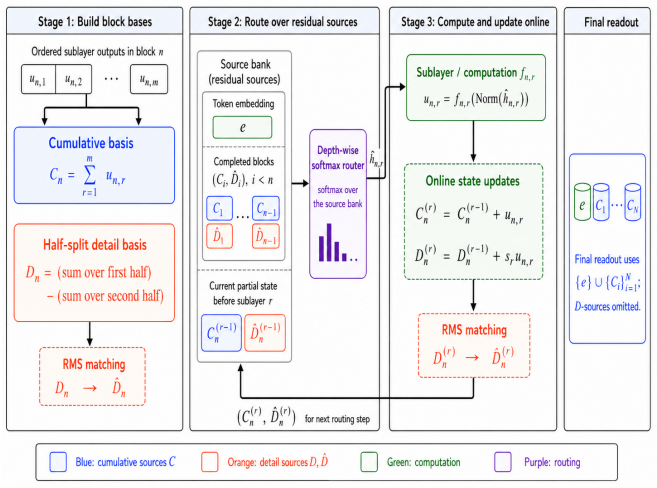
Block-level residual routing becomes more effective when the router also receives a half-split detail basis, defined as the RMS-matched difference between the first-half and second-half residual updates within each transformer block; this exposes ordered intra-block trajectory information at low extra cost and produces measurable accuracy gains that are most reliable in deep 48-layer models.
What carries the argument
The half-split detail basis, computed as the difference between first-half and second-half residual updates inside each block and kept RMS-matched to the source.
If this is right
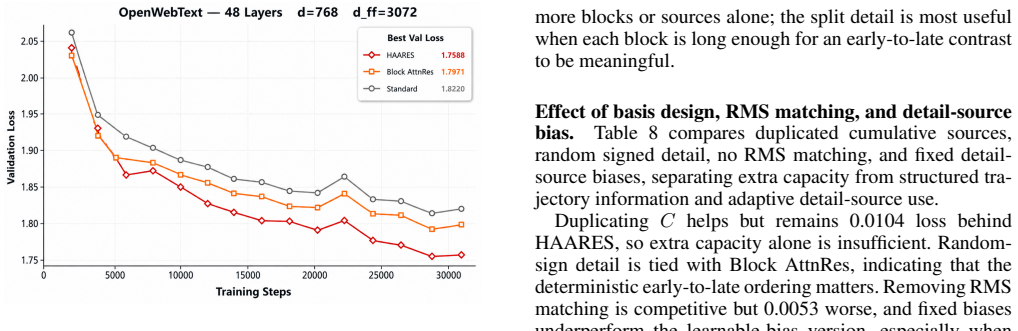
- Gains appear depth-dependent and are small or mixed at shallow depths but reliable at 48 layers.
- The added arithmetic cost is small relative to model width and can be offset by faster convergence.
- Ablations show the benefit does not arise from simply duplicating the source or using random signed vectors.
- The same directional improvement appears in a larger 453M two-seed probe.
Where Pith is reading between the lines
- The half-split construction might generalize to other residual-stream routing schemes that currently treat each block as a single vector.
- If the first-half versus second-half difference encodes genuine ordering information, similar splits could be tested at other granularities inside the block.
- The method's memory overhead suggests it may be most attractive when model width is large enough to amortize the extra state.
Load-bearing premise
The difference between first-half and second-half residual updates inside a block supplies non-redundant trajectory information that a router can actually use.
What would settle it
No consistent accuracy improvement over Block AttnRes when the same 48-layer 201M models are trained across three random seeds with HAARES versus the baseline.
Figures
read the original abstract
Block-level residual routing makes learned residual aggregation practical by routing over block summaries, but each summary compresses an ordered sequence of attention and MLP updates into one cumulative vector. We propose \method{}, a lightweight residual basis router that keeps the cumulative block source and adds one half-split detail basis, computed as the difference between first-half and second-half residual updates. The detail basis is RMS-matched and updated online, exposing coarse intra-block trajectory information without dense sublayer-level routing. Across OpenWebText, cross-domain character-level benchmarks, and BPE-tokenized OpenWebText, the empirical pattern is depth-dependent: gains are small or mixed at shallow depth and most reliable in 48-layer models. In the 201M 48-layer setting, \method{} improves over Block AttnRes across all three seeds, while a 453M two-seed probe shows the same direction. Ablations rule out source duplication, random signed details, fixed detail-source biases, or block-count changes alone. Cost analysis shows that the method is FLOP-light but not wall-clock-free: it adds memory and routing overhead, yet its relative arithmetic cost is amortized as width grows and earlier convergence can reduce time-to-target.
Editorial analysis
A structured set of objections, weighed in public.
Referee Report
Summary. The paper introduces HAARES, a lightweight residual routing method for deep transformers that augments standard block-level residual aggregation (Block AttnRes) with a single half-split detail basis. This basis is defined as the RMS-matched difference between first-half and second-half residual updates within each block and is maintained online. The central empirical claim is that the added basis yields depth-dependent gains: small or mixed at shallow depths but consistent improvement over Block AttnRes in 48-layer models (201M parameters across three seeds; same direction in a 453M two-seed probe) on OpenWebText, character-level, and BPE-tokenized benchmarks. Ablations are presented to exclude source duplication, random signed details, fixed biases, and block-count changes.
Significance. If the half-split detail basis supplies non-redundant intra-block trajectory information rather than redundant or noise-dominated signal, the approach offers a low-FLOP way to expose coarse ordering information inside blocks without the cost of dense sublayer routing. The depth-dependent pattern and the set of ablations that rule out several trivial explanations are positive features; the method is also noted to amortize its arithmetic cost at larger widths.
major comments (2)
- [Experimental results / abstract] Experimental results (abstract and implied § on 48-layer runs): the claim that HAARES “improves over Block AttnRes across all three seeds” reports only direction, with no effect sizes, standard deviations, or statistical tests. Without these quantities it is impossible to judge whether the observed direction is reliable or could be explained by seed-to-seed variance, directly weakening the central empirical claim.
- [Method / ablations] Method definition and ablations (abstract): the half-split detail basis is motivated by the assumption that the difference between first-half and second-half residual updates encodes non-redundant trajectory information. No analysis is supplied of the correlation between the two halves, the variance of the difference vector, or its signal-to-noise ratio relative to the cumulative block source; if the halves are highly correlated or the difference is noise-dominated, the added basis supplies no new routing signal and the reported gains would not be attributable to the half-split construction.
minor comments (1)
- [Cost analysis] The cost analysis states the method is “FLOP-light but not wall-clock-free”; a brief table or paragraph quantifying the added memory and routing overhead versus the baseline would improve clarity.
Simulated Author's Rebuttal
We thank the referee for the constructive comments, which help strengthen the presentation of our empirical claims and methodological justifications. We respond to each major comment below.
read point-by-point responses
-
Referee: [Experimental results / abstract] Experimental results (abstract and implied § on 48-layer runs): the claim that HAARES “improves over Block AttnRes across all three seeds” reports only direction, with no effect sizes, standard deviations, or statistical tests. Without these quantities it is impossible to judge whether the observed direction is reliable or could be explained by seed-to-seed variance, directly weakening the central empirical claim.
Authors: We agree that reporting only directional improvement without effect sizes, standard deviations, or statistical tests limits assessment of reliability relative to seed variance. The revised manuscript will add these quantities (mean differences, standard deviations across the three seeds for the 201M model, and the two-seed 453M probe) to the results section and update the abstract accordingly. revision: yes
-
Referee: [Method / ablations] Method definition and ablations (abstract): the half-split detail basis is motivated by the assumption that the difference between first-half and second-half residual updates encodes non-redundant trajectory information. No analysis is supplied of the correlation between the two halves, the variance of the difference vector, or its signal-to-noise ratio relative to the cumulative block source; if the halves are highly correlated or the difference is noise-dominated, the added basis supplies no new routing signal and the reported gains would not be attributable to the half-split construction.
Authors: The referee is correct that the manuscript does not include explicit correlation, variance, or SNR analysis of the half-split difference vector. While the existing ablations exclude several trivial sources of the gains, we will add the requested analysis (correlation between halves and variance/SNR of the detail basis relative to the block source) to the ablations section or appendix in the revision to directly substantiate the non-redundancy assumption. revision: yes
Circularity Check
No circularity: procedural definition with external empirical validation
full rationale
The paper defines HAARES procedurally as a residual router that retains the cumulative block source and augments it with a half-split detail basis (difference between first-half and second-half residual updates, RMS-matched and updated online). No equations or derivations are presented that reduce a claimed prediction or result to a fitted parameter or self-citation by construction. Performance claims rest on direct comparisons to the external baseline Block AttnRes across seeds, model sizes, and benchmarks, plus ablations that test against alternative constructions. This structure is self-contained against external benchmarks and contains no load-bearing self-referential steps.
Axiom & Free-Parameter Ledger
axioms (1)
- domain assumption The difference between first-half and second-half residual updates within a block constitutes useful coarse trajectory information.
invented entities (1)
-
half-split detail basis
no independent evidence
Reference graph
Works this paper leans on
-
[1]
Proceedings of the IEEE Conference on Computer Vision and Pattern Recognition , year=
Deep Residual Learning for Image Recognition , author=. Proceedings of the IEEE Conference on Computer Vision and Pattern Recognition , year=
-
[2]
Advances in Neural Information Processing Systems , year=
Attention Is All You Need , author=. Advances in Neural Information Processing Systems , year=
-
[3]
Proceedings of the International Conference on Machine Learning , year=
On Layer Normalization in the Transformer Architecture , author=. Proceedings of the International Conference on Machine Learning , year=
-
[4]
ReZero Is All You Need: Fast Convergence at Large Depth , author=. arXiv preprint arXiv:2003.04887 , year=
-
[5]
Proceedings of the IEEE/CVF International Conference on Computer Vision , year=
Going Deeper with Image Transformers , author=. Proceedings of the IEEE/CVF International Conference on Computer Vision , year=
-
[6]
Deepnet: Scaling transformers to 1,000 layers.arXiv preprint arXiv:2203.00555,
DeepNet: Scaling Transformers to 1,000 Layers , author=. arXiv preprint arXiv:2203.00555 , year=
-
[7]
Advances in Neural Information Processing Systems , year=
Root Mean Square Layer Normalization , author=. Advances in Neural Information Processing Systems , year=
-
[8]
Attention Residuals , author=. arXiv preprint arXiv:2603.15031 , year=
work page internal anchor Pith review Pith/arXiv arXiv
discussion (0)
Sign in with ORCID, Apple, or X to comment. Anyone can read and Pith papers without signing in.