Radial Oscillations of Viscous Stars at Finite Temperature
Pith reviewed 2026-06-27 23:48 UTC · model grok-4.3
The pith
Finite stellar size allows thermal modes in viscous relativistic stars to propagate like second sound even for the fundamental mode.
A machine-rendered reading of the paper's core claim, the machinery that carries it, and where it could break.
Core claim
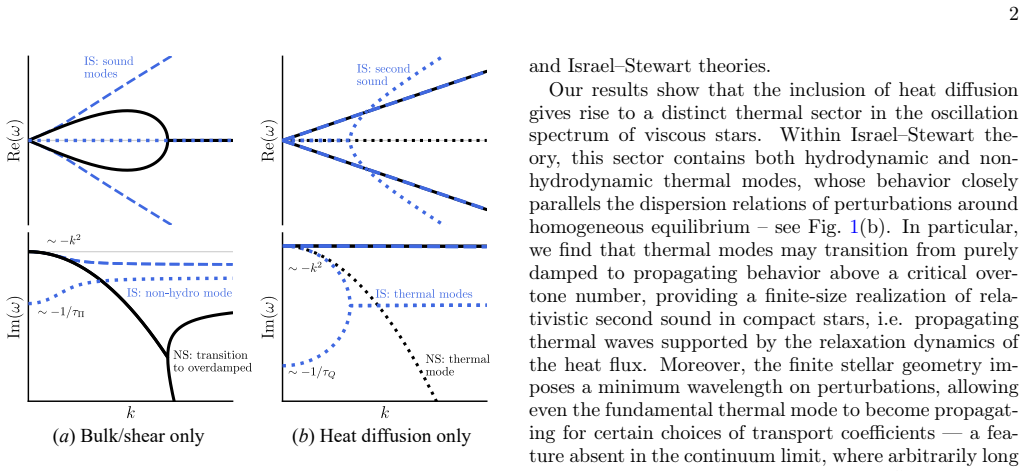
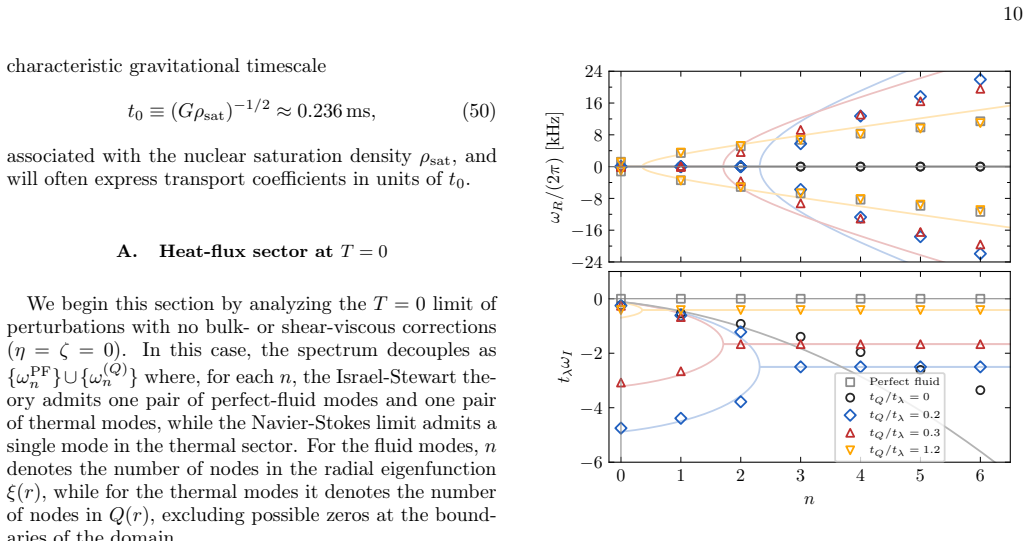
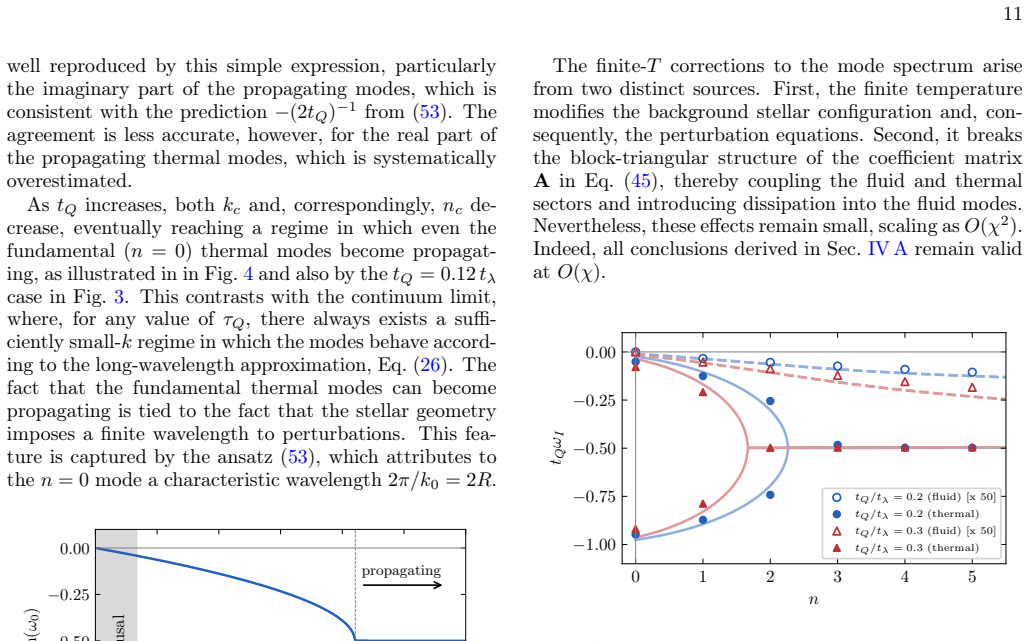
Within Israel-Stewart theory the thermal modes transition from purely damped to propagating behavior above a critical overtone number, providing a finite-size realization of relativistic second sound in compact stars. The finite stellar geometry can push even the fundamental thermal mode into the propagating regime, a feature with no continuum analogue. For the equations of state considered, where finite-temperature corrections enter as controlled Sommerfeld-type perturbations of a cold polytrope, the thermal sector couples only weakly to the ordinary fluid oscillation spectrum, with the coupling being of second order in a suitable temperature parameter. The discrete stellar spectrum is well
What carries the argument
The thermal sector generated by the heat-flux term in the Israel-Stewart evolution equations, whose modes are discretized by the stellar radius and follow the dispersion relation of an infinite dissipative fluid.
Load-bearing premise
Finite-temperature corrections enter only as small Sommerfeld-type perturbations of a cold polytrope so that the thermal sector remains weakly coupled to the fluid spectrum at second order in the temperature parameter.
What would settle it
A numerical solution of the full radial perturbation equations for a concrete finite-temperature polytropic model that shows whether the fundamental thermal mode has a real frequency component or remains purely imaginary.
Figures

read the original abstract
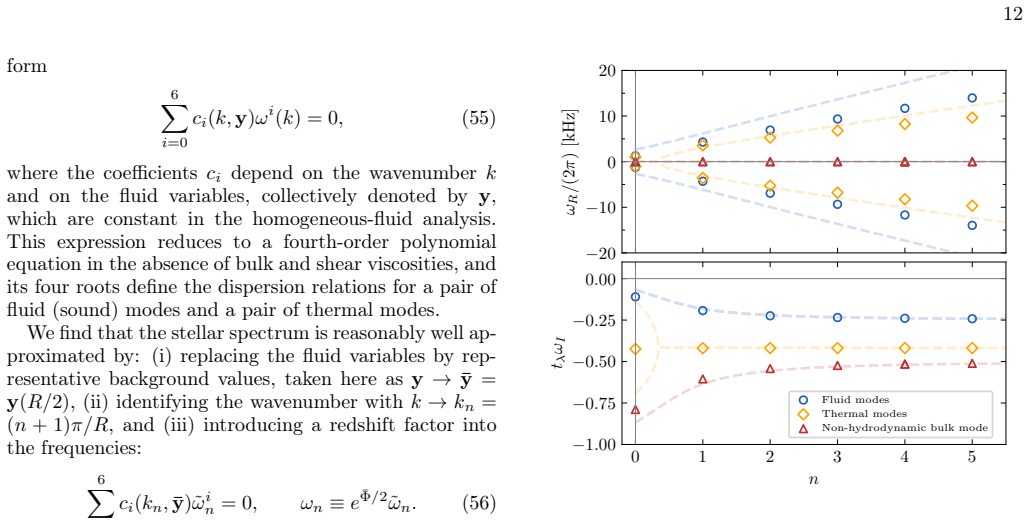
We study the radial oscillation spectrum of relativistic stars within Israel-Stewart and Navier-Stokes theories, extending previous analyses to include heat diffusion and a thermodynamically consistent finite-temperature equation of state. The inclusion of heat flux gives rise to a distinct thermal sector in the mode spectrum, whose structure closely mirrors the dispersion relations of an infinite dissipative fluid. Within Israel-Stewart theory, the thermal modes transition from purely damped to propagating behavior above a critical overtone number, providing a finite-size realization of relativistic second sound in compact stars. Remarkably, the finite stellar geometry can push even the fundamental thermal mode into the propagating regime -- a feature with no continuum analogue. For the class of equations of state considered here, where finite-temperature corrections enter as controlled, Sommerfeld-type perturbations of a cold polytrope, the thermal sector couples only weakly to the ordinary fluid oscillation spectrum, with the coupling being of second order in a suitable temperature parameter. We further show that the discrete stellar spectrum is well captured by an analytic ansatz constructed from the flat-spacetime dispersion relations, with the star's finite radius discretizing the continuous mode structure. Our results complete the analysis of radial oscillations of viscous stars by incorporating the last remaining dissipative degree of freedom within the Israel-Stewart framework.
Editorial analysis
A structured set of objections, weighed in public.
Referee Report
Summary. The manuscript extends the study of radial oscillations in relativistic stars to include heat diffusion and finite-temperature effects within the Israel-Stewart and Navier-Stokes frameworks. It identifies a distinct thermal sector whose dispersion mirrors that of an infinite dissipative fluid, with thermal modes transitioning from purely damped to propagating above a critical overtone number in Israel-Stewart theory. The finite stellar geometry is claimed to allow even the fundamental thermal mode to propagate, realizing relativistic second sound in compact stars. For the considered class of equations of state, finite-temperature corrections enter as Sommerfeld-type perturbations of a cold polytrope, resulting in only second-order coupling between the thermal and ordinary fluid sectors. An analytic ansatz built from flat-spacetime dispersion relations is stated to capture the discrete stellar spectrum.
Significance. If the decoupling and mode-transition claims hold, the work completes the dissipative radial-oscillation analysis by incorporating the heat-flux degree of freedom and supplies a concrete finite-size realization of relativistic second sound with no direct continuum analogue. The reported analytic ansatz from flat-spacetime relations constitutes a useful strength for capturing the discrete spectrum when verified.
major comments (2)
- [Abstract] Abstract: the central claim that 'the thermal sector couples only weakly to the ordinary fluid oscillation spectrum, with the coupling being of second order in a suitable temperature parameter' is load-bearing for the separation of sectors and the interpretation of the thermal modes, yet the manuscript provides no explicit first-order expansion of the linearized Israel-Stewart perturbation equations (including heat-flux and relaxation-time terms) around the background star to demonstrate the absence of first-order mixing through thermodynamic relations or dissipative currents.
- [Abstract] Abstract: the reported transition of thermal modes from damped to propagating behavior above a critical overtone, and the assertion that finite geometry can push the fundamental thermal mode into the propagating regime, rest on the analytic ansatz and numerical spectrum but are presented without derivation details, numerical methods, convergence tests, or error analysis, preventing verification of the load-bearing dispersion-relation results.
minor comments (1)
- The abstract refers to 'the class of equations of state considered here' without specifying the exact polytropic index range or the magnitude of the temperature parameter over which the second-order coupling holds.
Simulated Author's Rebuttal
We thank the referee for their careful reading of the manuscript and for highlighting these two points. We address each comment below.
read point-by-point responses
-
Referee: [Abstract] Abstract: the central claim that 'the thermal sector couples only weakly to the ordinary fluid oscillation spectrum, with the coupling being of second order in a suitable temperature parameter' is load-bearing for the separation of sectors and the interpretation of the thermal modes, yet the manuscript provides no explicit first-order expansion of the linearized Israel-Stewart perturbation equations (including heat-flux and relaxation-time terms) around the background star to demonstrate the absence of first-order mixing through thermodynamic relations or dissipative currents.
Authors: We agree that an explicit first-order expansion would make the decoupling claim more transparent. The Sommerfeld expansion of the finite-temperature EOS already implies that thermal corrections appear only at O(T^2), but we will add a new subsection (or appendix) that linearizes the full Israel-Stewart system around the background star and explicitly verifies that all first-order mixing terms between the heat-flux sector and the ordinary fluid variables vanish identically for the chosen class of EOS. revision: yes
-
Referee: [Abstract] Abstract: the reported transition of thermal modes from damped to propagating behavior above a critical overtone, and the assertion that finite geometry can push the fundamental thermal mode into the propagating regime, rest on the analytic ansatz and numerical spectrum but are presented without derivation details, numerical methods, convergence tests, or error analysis, preventing verification of the load-bearing dispersion-relation results.
Authors: The analytic ansatz is constructed in Section 3 by substituting the flat-space dispersion relation into the stellar boundary-value problem; the numerical spectrum is obtained in Section 4 via a shooting method on the radial ODE system. To improve verifiability we will (i) expand the derivation of the ansatz, (ii) document the precise numerical scheme, boundary conditions, and eigenvalue solver, and (iii) add convergence tests and error estimates in a new appendix. These additions will be included in the revised manuscript. revision: partial
Circularity Check
No circularity: derivation chain is self-contained
full rationale
The paper's central results on thermal modes, their transition to propagating behavior, and weak second-order coupling follow from the linearized Israel-Stewart equations applied to a Sommerfeld-perturbed polytropic EOS. No step reduces by construction to a fitted parameter, self-defined quantity, or load-bearing self-citation. The analytic ansatz is constructed from independent flat-spacetime dispersion relations and shown to approximate the discrete stellar spectrum; it is not presented as a derivation that forces the result. The finite-size realization of second sound is obtained directly from the boundary-value problem without circular reduction. This is the normal case of an independent theoretical calculation.
Axiom & Free-Parameter Ledger
free parameters (1)
- temperature perturbation parameter
axioms (2)
- domain assumption Israel-Stewart theory provides a causal description of viscosity and heat conduction
- domain assumption Finite-temperature EOS corrections are Sommerfeld-type perturbations of a cold polytrope
Reference graph
Works this paper leans on
-
[1]
Away from equilibrium, however, these quantities do not admit a unique definition: different choices of(T, µ, uµ)can be used to parametrize the same conserved currentsTµν and N µ
Matching conditions Relativistic hydrodynamics is formally constructed as an expansion around a state of local thermodynamic equilibrium, characterized by a temperatureT, a chem- ical potentialµ, and a time-like four-velocityu µ. Away from equilibrium, however, these quantities do not admit a unique definition: different choices of(T, µ, uµ)can be used to...
-
[2]
second sound
Israel-Stewart theory As discussed above, the conservation laws do not form a closed system and must be supplemented by additional relations specifying the form of the currents. A system- atic way to construct such relations is to impose the sec- ond law of thermodynamics at the local level [42], ∇µSµ ≥0,(6) whereS µ is the entropy 4-current. This approac...
2018
-
[3]
D. Reitzeet al., Bull. Am. Astron. Soc.51, 035 (2019), arXiv:1907.04833 [astro-ph.IM]
Pith/arXiv arXiv 2019
-
[4]
The Einstein Telescope collaboration, Journal of Cosmol- ogy and Astroparticle Physics2026(03), 081
-
[5]
K. D. Kokkotas and B. G. Schmidt, Living Rev. Rel.2, 2 (1999), arXiv:gr-qc/9909058
Pith/arXiv arXiv 1999
-
[6]
Nollert, Class
H.-P. Nollert, Class. Quant. Grav.16, R159 (1999)
1999
-
[7]
G. Pratten, P. Schmidt, and T. Hinderer, Nature Com- mun.11, 2553 (2020), arXiv:1905.00817 [gr-qc]
arXiv 2020
-
[8]
H. O. Silva, Neutron Stars as Extreme Gravity Probes (2024) arXiv:2407.17578 [gr-qc]
arXiv 2024
-
[9]
D. D. Doneva, F. M. Ramazanoğlu, H. O. Silva, T. P. Sotiriou,andS.S.Yazadjiev,Rev.Mod.Phys.96,015004 (2024), arXiv:2211.01766 [gr-qc]
arXiv 2024
-
[10]
T. Dietrich, T. Hinderer, and A. Samajdar, Gen. Rel. Grav.53, 27 (2021), arXiv:2004.02527 [gr-qc]
arXiv 2021
-
[11]
M.Shibata,Phys.Rev.Lett.94,201101(2005),arXiv:gr- qc/0504082
arXiv 2005
-
[12]
K. Hotokezaka, K. Kyutoku, H. Okawa, M. Shibata, and K. Kiuchi, Phys. Rev. D83, 124008 (2011), arXiv:1105.4370 [astro-ph.HE]
Pith/arXiv arXiv 2011
-
[13]
A. Bauswein and H. T. Janka, Phys. Rev. Lett.108, 011101 (2012), arXiv:1106.1616 [astro-ph.SR]
Pith/arXiv arXiv 2012
-
[14]
A. Bauswein, H. T. Janka, K. Hebeler, and A. Schwenk, Phys. Rev. D86, 063001 (2012), arXiv:1204.1888 [astro- ph.SR]
Pith/arXiv arXiv 2012
-
[15]
A. Bauswein, N. Stergioulas, and H. T. Janka, Phys. Rev. D90, 023002 (2014), arXiv:1403.5301 [astro-ph.SR]
Pith/arXiv arXiv 2014
-
[16]
M. G. Alford, L. Bovard, M. Hanauske, L. Rezzolla, and K. Schwenzer, Phys. Rev. Lett.120, 041101 (2018), arXiv:1707.09475 [gr-qc]
Pith/arXiv arXiv 2018
-
[17]
M. G. Alford and S. P. Harris, Phys. Rev. C98, 065806 (2018), arXiv:1803.00662 [nucl-th]
Pith/arXiv arXiv 2018
-
[18]
E. R. Most, S. P. Harris, C. Plumberg, M. G. Alford, J. Noronha, J. Noronha-Hostler, F. Pretorius, H. Witek, and N. Yunes, Mon. Not. Roy. Astron. Soc.509, 1096 (2021), arXiv:2107.05094 [astro-ph.HE]
arXiv 2021
- [19]
- [20]
- [21]
-
[22]
G. Camelio, L. Gavassino, M. Antonelli, S. Bernuzzi, and B. Haskell, Phys. Rev. D107, 103032 (2023), arXiv:2204.11810 [gr-qc]. 14
arXiv 2023
-
[23]
G. Camelio, L. Gavassino, M. Antonelli, S. Bernuzzi, and B. Haskell, Phys. Rev. D107, 103031 (2023), arXiv:2204.11809 [gr-qc]
arXiv 2023
-
[24]
M. Chabanov and L. Rezzolla, Phys. Rev. D111, 044074 (2025), arXiv:2311.13027 [gr-qc]
arXiv 2025
-
[25]
M. Chabanov and L. Rezzolla, Phys. Rev. Lett.134, 071402 (2025), arXiv:2307.10464 [gr-qc]
arXiv 2025
-
[26]
H. L. H. Shum, F. Abalos, Y. Bea, M. Bezares, P.Figueras,andC.Palenzuela,Phys.Rev.D113,084029 (2026), arXiv:2509.15303 [gr-qc]
Pith/arXiv arXiv 2026
-
[27]
N. Clarisse, E. O. Pinho, T. Patel, F. S. Bemfica, M. Hip- pert, and J. Noronha, Phys. Rev. D113, 024051 (2026), arXiv:2510.16603 [gr-qc]
arXiv 2026
-
[28]
J. Redondo-Yuste, Class. Quant. Grav.42, 075012 (2025), arXiv:2411.16841 [gr-qc]
arXiv 2025
-
[29]
D. A. Caballero and N. Yunes, Phys. Rev. D112, 063050 (2025), arXiv:2506.09149 [gr-qc]
arXiv 2025
-
[30]
L. S. Keeble and J. Redondo-Yuste, Radial Oscillations of Viscous Stars (2026), arXiv:2603.23622 [gr-qc]
Pith/arXiv arXiv 2026
-
[31]
S. Bussières, J. Redondo-Yuste, J. J. Ortega Gómez, and V. Cardoso, Axial Oscillations of Viscous Neutron Stars (2026), arXiv:2604.13208 [gr-qc]
Pith/arXiv arXiv 2026
-
[32]
R. F. P. Mendes, A. Guerrieri, J. V. M. Muniz, G. S. Rocha, and G. S. Denicol, Phys. Rev. D113, 024010 (2026), arXiv:2509.12330 [gr-qc]
arXiv 2026
-
[33]
Israel, Annals Phys.100, 310 (1976)
W. Israel, Annals Phys.100, 310 (1976)
1976
-
[34]
Israel and J
W. Israel and J. M. Stewart, Annals Phys.118, 341 (1979)
1979
-
[35]
W. A. Hiscock and L. Lindblom, Physical Review D31, 725 (1985)
1985
-
[36]
Pichon, inAnnales de l’IHP Physique théorique, Vol
G. Pichon, inAnnales de l’IHP Physique théorique, Vol. 2 (1965) pp. 21–85
1965
-
[37]
W. A. Hiscock and L. Lindblom, Annals of Physics151, 466 (1983)
1983
-
[38]
T. S. Olson, Annals of Physics199, 18 (1990)
1990
-
[39]
F. Bemfica, M. Disconzi, and J. Noronha, Phys. Rev. D 98, 104064 (2018), arXiv:1708.06255 [gr-qc]
Pith/arXiv arXiv 2018
-
[40]
F. S. Bemfica, M. M. Disconzi, and J. Noronha, Phys. Rev. D100, 104020 (2019), [Erratum: Phys.Rev.D 105, 069902 (2022)], arXiv:1907.12695 [gr-qc]
arXiv 2019
-
[41]
F. S. Bemfica, M. M. Disconzi, and J. Noronha, Phys. Rev. X12, 021044 (2022), arXiv:2009.11388 [gr-qc]
arXiv 2022
-
[42]
Kovtun, JHEP10, 034, arXiv:1907.08191 [hep-th]
P. Kovtun, JHEP10, 034, arXiv:1907.08191 [hep-th]
arXiv 1907
-
[43]
Eckart, Phys
C. Eckart, Phys. Rev.58, 919 (1940)
1940
-
[44]
Landau and E
L. Landau and E. Lifshitz,Fluid Mechanics, Course of Theoretical Physics, Vol. 6 (Addison-Wesley, 1959)
1959
-
[45]
S. R. De Groot,Relativistic Kinetic Theory. Principles and Applications, edited by W. A. Van Leeuwen and C. G. Van Weert (North-Holland, 1980)
1980
-
[46]
G. S. Denicol and D. H. Rischke,Microscopic Founda- tions of Relativistic Fluid Dynamics(Springer, 2021)
2021
-
[47]
Rezzolla and O
L. Rezzolla and O. Zanotti,Relativistic Hydrodynamics (Oxford University Press, 2013)
2013
-
[48]
G. S. Denicol, H. Niemi, E. Molnar, and D. H. Rischke, Phys. Rev. D85, 114047 (2012), [Erratum: Phys.Rev.D 91, 039902 (2015)], arXiv:1202.4551 [nucl-th]
Pith/arXiv arXiv 2012
-
[49]
G. S. Rocha, D. Wagner, G. S. Denicol, J. Noronha, and D. H. Rischke, Entropy26, 189 (2024), arXiv:2311.15063 [nucl-th]
arXiv 2024
-
[50]
Baier, P
R. Baier, P. Romatschke, D. T. Son, A. O. Starinets, and M. A. Stephanov, JHEP2008(04), 100–100
-
[51]
L. E. Reichl,A Modern Course in Statistical Physics, 4th ed. (Wiley-VCH Verlag GmbH & Co. KGaA, 2016)
2016
-
[52]
Guerrieri, G
A. Guerrieri, G. S. Rocha, G. S. Denicol, and R. F. P. Mendes, In preparation
-
[53]
C. V. Brito and G. S. Denicol, Phys. Rev. D102, 116009 (2020), arXiv:2007.16141 [nucl-th]
arXiv 2020
-
[54]
G. S. Denicol, T. Kodama, T. Koide, and P. Mota, J. Phys. G35, 115102 (2008), arXiv:0807.3120 [hep-ph]
Pith/arXiv arXiv 2008
-
[55]
S. Pu, T. Koide, and D. H. Rischke, Physical Review D 81, 10.1103/physrevd.81.114039 (2010)
- [56]
-
[57]
L. Gavassino, M. Antonelli, and B. Haskell, Phys. Rev. Lett.128, 010606 (2022), arXiv:2105.14621 [gr-qc]
arXiv 2022
- [58]
- [59]
- [60]
-
[61]
J. S. Read, B. D. Lackey, B. J. Owen, and J. L. Friedman, Phys. Rev. D79, 124032 (2009), arXiv:0812.2163 [astro- ph]
Pith/arXiv arXiv 2009
-
[62]
M. F. O’Boyle, C. Markakis, N. Stergioulas, and J. S. Read, Phys. Rev. D102, 083027 (2020), arXiv:2008.03342 [astro-ph.HE]
arXiv 2020
-
[63]
Greiner, L
W. Greiner, L. Neise, and H. Stöcker,Thermodynamics and Statistical Mechanics, Classical Theoretical Physics (Springer, New York, NY, 1995)
1995
-
[64]
I. S. Gradshteyn and I. M. Ryzhik,Table of integrals, series, and products(Academic press, 2014)
2014
-
[65]
R. F. Sawyer, Phys. Rev. D39, 3804 (1989)
1989
-
[66]
Haensel and R
P. Haensel and R. Schaeffer, Phys. Rev. D45, 4708 (1992)
1992
-
[67]
Y.Yang, M.Hippert, E.Speranza,andJ.Noronha,Phys. Rev. C109, 015805 (2024), arXiv:2309.01864 [nucl-th]
arXiv 2024
-
[68]
P. S. Shternin and D. G. Yakovlev, Phys. Rev. D78, 063006 (2008), arXiv:0808.2018 [astro-ph]
Pith/arXiv arXiv 2008
-
[69]
C. Manuel and L. Tolos, Phys. Rev. D88, 043001 (2013), arXiv:1212.2075 [astro-ph.SR]
Pith/arXiv arXiv 2013
-
[70]
P. S. Shternin and D. G. Yakovlev, Phys. Rev. D75, 103004 (2007), arXiv:0705.1963 [astro-ph]
Pith/arXiv arXiv 2007
-
[71]
B. T. Goodwin and C. J. Pethick, Astrophys. J.253, 816 (1982)
1982
-
[72]
Ng and W
B. Ng and W. Reid, Journal of Computational Physics 58, 209 (1985)
1985
-
[73]
Cattaneo, Comptes Rendus de l’Académie des Sci- ences247, 431 (1958)
C. Cattaneo, Comptes Rendus de l’Académie des Sci- ences247, 431 (1958)
1958
- [74]
discussion (0)
Sign in with ORCID, Apple, or X to comment. Anyone can read and Pith papers without signing in.