Reweighting Adversarial Networks for Unbinned Unfolding
Pith reviewed 2026-06-28 00:26 UTC · model grok-4.3
The pith
Reweighting Adversarial Networks perform unbinned unfolding without detector-level support overlap.
A machine-rendered reading of the paper's core claim, the machinery that carries it, and where it could break.
Core claim
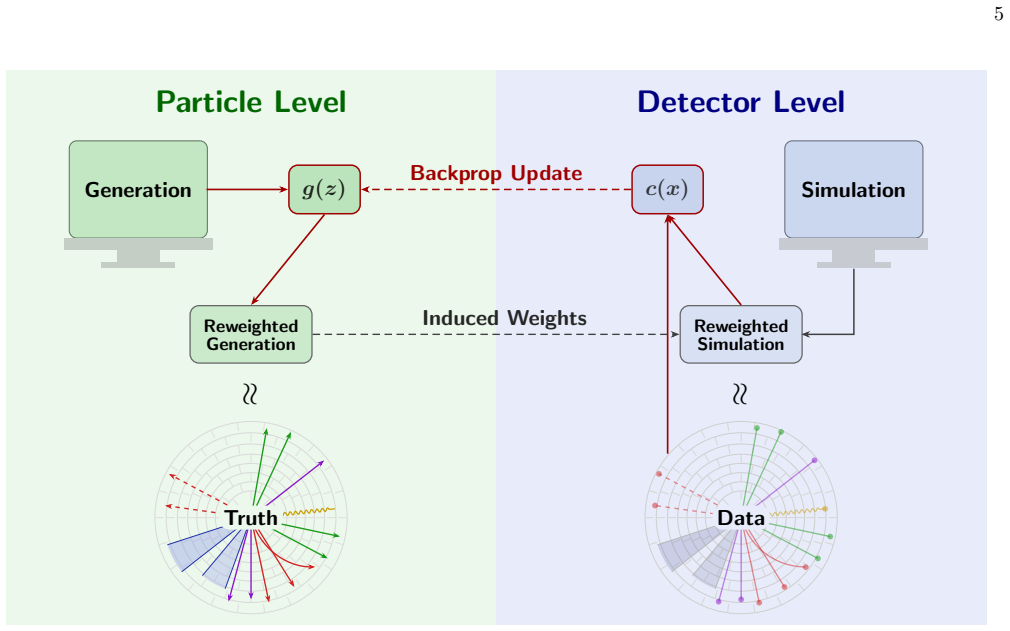
RANs address unfolding by optimizing a particle-level reweighting function whose effect is judged by a Wasserstein distance between the detector-level reweighted distribution and the observed data. The method succeeds even when the particle-level and detector-level supports have no overlap, eliminating the need for multiple iterations or support-matching assumptions.
What carries the argument
The Reweighting Adversarial Network, consisting of a particle-level reweighting function steered by a Wasserstein critic at detector level.
Load-bearing premise
The Wasserstein critic can reliably guide the particle-level reweighting to match the true distribution even without any overlapping support at the detector level.
What would settle it
A simulation where the particle-level truth is known, but the detector-level supports have zero overlap, and the unfolded result deviates from the known truth by more than statistical uncertainty.
Figures
read the original abstract
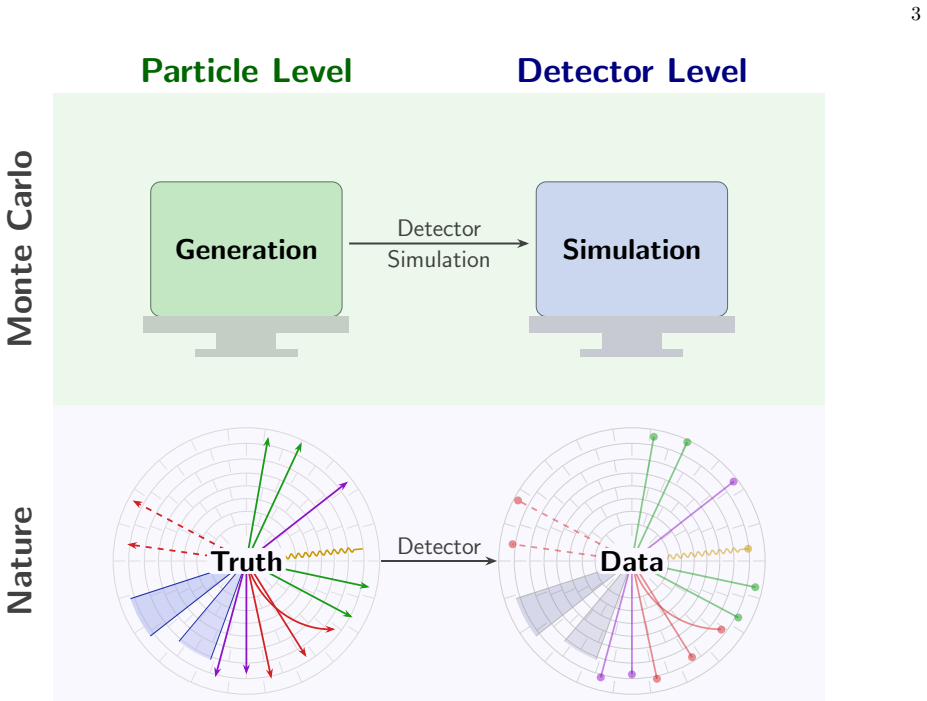
Differential cross sections are the currency of scientific exchange in particle and nuclear physics. Recently, machine learning methods have enabled unbinned and high-dimensional cross section measurements through new approaches to unfolding. A key challenge with unfolding is that it is a bi-level optimization problem where constraints are available at the detector level while the target is at the particle level, linked by a stochastic detector response. Further complications arise when the particle-level and detector-level distributions have non-overlapping or only partially overlapping support, which can destabilize training and degrade unfolding performance. In this paper, we introduce a new unbinned unfolding technique called the Reweighting Adversarial Network (RAN), which can be viewed as a generalization of the Moment Unfolding protocol to accommodate full phase-space unfolding. RANs address the bi-level optimization problem through a particle-level reweighting function steered by a Wasserstein critic at the detector level. RANs do not require overlapping support at the detector level, nor multiple iterations of training. We evaluate the performance of RANs with Gaussian data and jet substructure studies, including cases specifically designed to stress test the method under vanishing support overlap. We demonstrate that RANs outperform state-of-the-art methods in accuracy and have a lower computational overhead.
Editorial analysis
A structured set of objections, weighed in public.
Referee Report
Summary. The manuscript introduces Reweighting Adversarial Networks (RANs) for unbinned unfolding of differential cross sections in particle and nuclear physics. It frames the problem as bi-level optimization with constraints at detector level and target at particle level, linked by stochastic response. RANs generalize Moment Unfolding by using a particle-level reweighting function steered by a Wasserstein critic at detector level; the method is asserted to handle non-overlapping or partially overlapping supports without multiple iterations. Performance is evaluated on Gaussian toy data and jet substructure observables with stress tests for vanishing support overlap, claiming superior accuracy and lower computational overhead versus state-of-the-art methods.
Significance. If validated, the approach would address a practical challenge in high-dimensional unbinned unfolding where support mismatch destabilizes training. Explicit design of vanishing-overlap stress tests is a strength. The generalization from Moment Unfolding and focus on bi-level optimization without iteration are positive contributions if the central claims on critic-driven reweighting hold.
major comments (2)
- [Abstract] Abstract: the claim that RANs 'outperform state-of-the-art methods in accuracy' is stated without any quantitative metrics, error bars, tables, or specific comparison values, which is load-bearing for the central superiority assertion.
- [Abstract] Abstract and implied evaluation section: no derivation or analysis is supplied showing that the bi-level objective remains well-conditioned or that the particle-level reweighting function remains identifiable when detector-level supports have zero overlap; the Wasserstein critic can then yield near-constant scores and uninformative gradients, directly undermining the claim of reliable performance in this regime without iterations.
minor comments (2)
- The abstract would benefit from inclusion of at least one key quantitative result (e.g., a reported error or comparison metric) to support the performance claims.
- Notation for the reweighting function, critic, and bi-level objective should be introduced with explicit definitions early in the text for clarity.
Simulated Author's Rebuttal
We thank the referee for their careful reading of the manuscript and for the constructive comments. We address each major comment below.
read point-by-point responses
-
Referee: [Abstract] Abstract: the claim that RANs 'outperform state-of-the-art methods in accuracy' is stated without any quantitative metrics, error bars, tables, or specific comparison values, which is load-bearing for the central superiority assertion.
Authors: We agree that the abstract states the performance claim without accompanying numerical values. The quantitative comparisons, including accuracy metrics, error bars, and tables versus other methods, appear in the results sections of the manuscript. We will revise the abstract to either include representative quantitative results or qualify the claim to reference the detailed evaluations. revision: yes
-
Referee: [Abstract] Abstract and implied evaluation section: no derivation or analysis is supplied showing that the bi-level objective remains well-conditioned or that the particle-level reweighting function remains identifiable when detector-level supports have zero overlap; the Wasserstein critic can then yield near-constant scores and uninformative gradients, directly undermining the claim of reliable performance in this regime without iterations.
Authors: The manuscript validates performance in the vanishing-overlap regime through dedicated stress tests on Gaussian toy data, showing that RANs remain stable without iterations. While no formal derivation of well-conditioning or identifiability for the zero-overlap case is provided, the Wasserstein critic is employed because it supplies gradients based on optimal transport even with limited support overlap. We will add a short discussion paragraph in the revised manuscript relating the empirical stress-test outcomes to this point. revision: partial
Circularity Check
No circularity: new method with independent evaluations
full rationale
The provided text introduces RANs as a generalization of Moment Unfolding without any equations, fitted parameters, or self-citations that reduce the central claims to inputs by construction. Performance claims rest on explicit evaluations with Gaussian data and jet substructure studies (including vanishing overlap cases), which are external to the method definition itself. No load-bearing step matches any enumerated circularity pattern.
Axiom & Free-Parameter Ledger
axioms (1)
- domain assumption Wasserstein distance provides a stable signal for guiding particle-level reweighting in the presence of detector response.
Reference graph
Works this paper leans on
-
[1]
Wasserstein Distance and Kantorovich–Rubinstein Duality 6
-
[2]
Regularization 7
RAN Training Objective 6 C. Regularization 7
-
[3]
Enforcing the Lipschitz Constraint 7
-
[4]
Activation Function 7
-
[5]
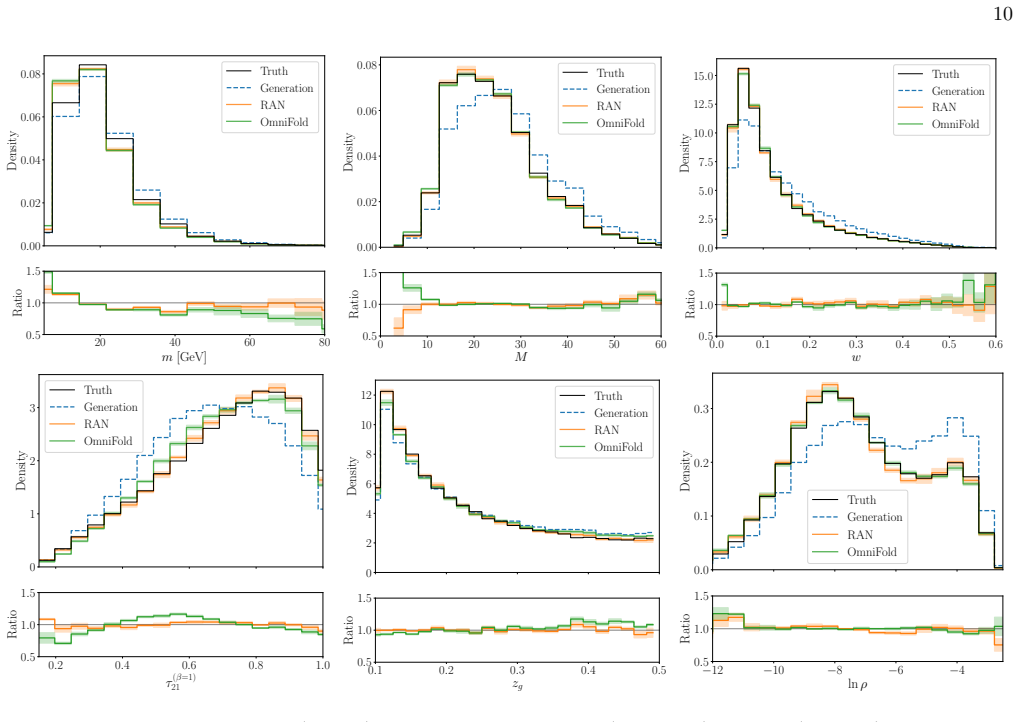
Pretraining the Generator to the Identity 7 D. Machine Learning Implementation 8 IV. Gaussian Experiment 8 V. Jet Substructure Experiments 8 A. Datasets 9 ∗ uqureshi@cern.ch; These authors contributed equally. † krish.desai@berkeley.edu; These authors contributed equally. ‡ jthaler@mit.edu § nachman@stanford.edu B. Observables and Definitions 9 C. Results...
Pith/arXiv arXiv 2026
-
[6]
Intuitively, the couplingγ(x, y) speci- fies how much probability mass is moved from locationx to locationy, andW 1 is the minimum total “work” re- quired to reshapeµintoν
Wasserstein Distance and Kantorovich–Rubinstein Duality The Wasserstein-1 distance [62, 63] (also known as the Earth Mover’s Distance [64]) between two probability measuresµandνsupported onR d is defined in terms of the solution to the Monge–Kantorovich optimal trans- port problem [65]: W1(µ, ν) = inf γ∈Π(µ,ν) Z ∥x−y∥dγ(x, y),(8) where Π(µ, ν) is the set ...
-
[7]
(6) with the KR dual formulation
RAN Training Objective We now combine the reweighting ansatz of Eq. (6) with the KR dual formulation. Letp(x) denote the Data dis- tribution andeq(x) the reweighted Simulation distribu- tion at detector level. We seek the generator parameters βthat minimizeW 1(eq, p). Substitutingµ=eqandν=p into Eq. (10) and replacing the expectation overeq(x) with a weig...
-
[8]
III B 1, the KR dual representation ofW 1 (Eq
Enforcing the Lipschitz Constraint As derived in Sec. III B 1, the KR dual representation ofW 1 (Eq. (10)) requires the criticc(x) to be 1-Lipschitz (Eq. (9)). If this constraint is violated, it is possible that the critic can assign arbitrarily different scores to nearby points in phase space, and the quantityL[g, c] in Eq. (11) no longer estimates the t...
-
[9]
(6) determines the reweighting functiong(z)
Activation Function The positive-definite functionFappearing in Eq. (6) determines the reweighting functiong(z). The expo- nential form motivated by Moment Unfolding (Eq. (4)) is a natural starting point but is numerically unstable: even moderately large outputs from NN(z;β) produce extremely large weights, leading to gradient spikes and training divergen...
-
[10]
distortion factor
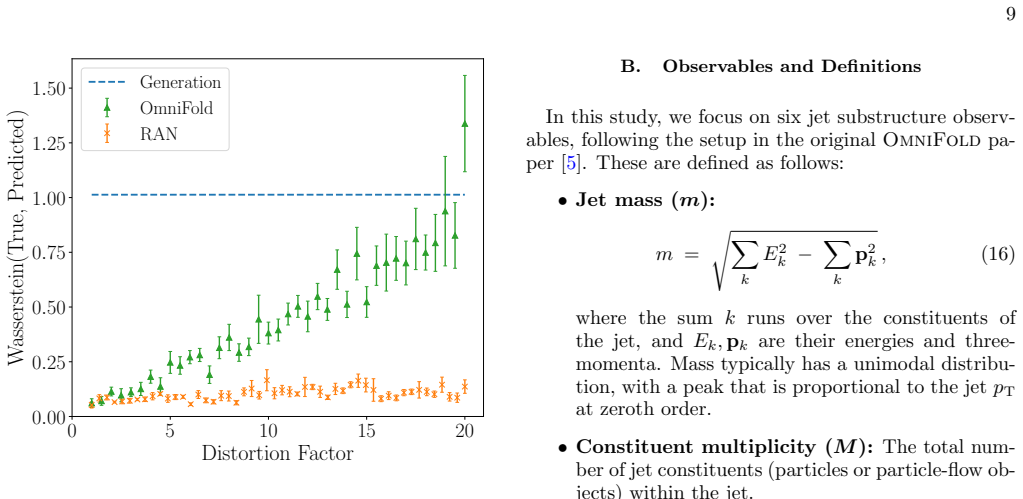
Pretraining the Generator to the Identity An additional regularization measure we employ is pre- training the generator network to approximate the iden- tity mapping prior to adversarial training. In the con- text of unfolding, the generatorg(z) is intended to pro- duce weights that reweight the Generation to be statis- tically indistinguishable from the ...
-
[11]
E. Maguire, L. Heinrich, and G. Watt, HEPData: a repository for high energy physics data, J. Phys. Conf. Ser.898, 102006 (2017), arXiv:1704.05473 [hep-ex]
Pith/arXiv arXiv 2017
-
[12]
M. Arratiaet al., Presenting Unbinned Differen- tial Cross Section Results, JINST17, P01024, arXiv:2109.13243 [hep-ph]
-
[13]
Badgeret al., Machine learning and LHC event gen- eration,2022 Snowmass Summer Study, SciPost Phys
S. Badgeret al., Machine learning and LHC event gen- eration,2022 Snowmass Summer Study, SciPost Phys. 14, 079 (2023), arXiv:2203.07460 [hep-ph]
arXiv 2022
-
[14]
N. Huetschet al., The Landscape of Unfolding with Machine Learning, SciPost Phys.18, 070 (2024), arXiv:2404.18807 [hep-ph]. 13
arXiv 2024
-
[15]
A. Andreassen, P. T. Komiske, E. M. Metodiev, B. Nachman, and J. Thaler, OmniFold: A Method to Si- multaneously Unfold All Observables, Phys. Rev. Lett. 124, 182001 (2020), arXiv:1911.09107 [hep-ph]
arXiv 2020
-
[16]
A. Andreassen, P. T. Komiske, E. M. Metodiev, B. Nachman, A. Suresh, and J. Thaler, Scaffolding Sim- ulations with Deep Learning for High-dimensional De- convolution, in9th International Conference on Learn- ing Representations(2021) arXiv:2105.04448 [stat.ML]
arXiv 2021
-
[17]
C.-C. Pan, X. Dong, Y.-C. Sun, A.-Y. Cheng, A.-B. Wang, Y.-X. Hu, and H. Cai, SwdFold:A Reweight- ing and Unfolding method based on Optimal Transport Theory, (2024), arXiv:2406.01635 [physics.data-an]
arXiv 2024
-
[18]
H. Zhu, K. Desai, M. Kuusela, V. Mikuni, B. Nach- man, and L. Wasserman, Multidimensional Deconvolu- tion with Profiling, (2024), arXiv:2409.10421 [hep-ph]
arXiv 2024
-
[19]
K. Datta, D. Kar, and D. Roy, Unfolding with Gener- ative Adversarial Networks, (2018), arXiv:1806.00433 [physics.data-an]
Pith/arXiv arXiv 2018
-
[20]
Y. Alanaziet al., AI-based Monte Carlo event generator for electron-proton scattering, Phys.Rev.D106, 096002 (2020), arXiv:2008.03151 [hep-ph]
arXiv 2020
-
[21]
J. N. Howard, S. Mandt, D. Whiteson, and Y. Yang, Foundations of a Fast, Data-Driven, Machine-Learned Simulator, Sci.Rep.12, 7567 (2021), arXiv:2101.08944 [hep-ph]
arXiv 2021
-
[22]
S. Diefenbacher, G.-H. Liu, V. Mikuni, B. Nachman, and W. Nie, Improving Generative Model-based Unfold- ing with Schr¨ odinger Bridges, Phys.Rev.D109, 076011 (2023), arXiv:2308.12351 [hep-ph]
arXiv 2023
- [23]
-
[24]
M. Bellagente, A. Butter, G. Kasieczka, T. Plehn, and R. Winterhalder, How to GAN away Detector Effects, SciPost Phys.8, 070 (2020), arXiv:1912.00477 [hep-ph]
arXiv 2020
-
[25]
M. Bellagente, A. Butter, G. Kasieczka, T. Plehn, A. Rousselot, R. Winterhalder, L. Ardizzone, and U. K¨ othe, Invertible Networks or Partons to Detec- tor and Back Again, SciPost Phys.9, 074 (2020), arXiv:2006.06685 [hep-ph]
arXiv 2020
-
[26]
M. Vandegar, M. Kagan, A. Wehenkel, and G. Louppe, Neural Empirical Bayes: Source Distribution Estima- tion and its Applications to Simulation-Based Inference, inProceedings of The 24th International Conference on Artificial Intelligence and Statistics, Proceedings of Ma- chine Learning Research, Vol. 130, edited by A. Baner- jee and K. Fukumizu (PMLR, 20...
arXiv 2021
- [27]
-
[28]
J. Ackerschott, R. K. Barman, D. Gon¸ calves, T. Heimel, and T. Plehn, Returning CP-observables to the frames they belong, SciPost Phys.17, 001 (2024), arXiv:2308.00027 [hep-ph]
arXiv 2024
-
[29]
A. Shmakov, K. Greif, M. Fenton, A. Ghosh, P. Baldi, and D. Whiteson, End-To-End Latent Variational Dif- fusion Models for Inverse Problems in High Energy Physics, (2023), arXiv:2305.10399 [hep-ex]
arXiv 2023
-
[30]
A. Shmakov, K. Greif, M. J. Fenton, A. Ghosh, P. Baldi, and D. Whiteson, Full Event Particle-Level Unfolding with Variable-Length Latent Variational Diffusion, Sci- Post Phys.18, 117 (2024), arXiv:2404.14332 [hep-ex]
arXiv 2024
- [31]
-
[32]
H1 Collaboration, Measurement of lepton-jet correla- tion in deep-inelastic scattering with the H1 detector us- ing machine learning for unfolding, Phys.Rev.Lett.128, 132002 (2021), arXiv:2108.12376 [hep-ex]
arXiv 2021
-
[33]
H1 Collaboration, Machine learning-assisted measure- ment of multi-differential lepton-jet correlations in deep- inelastic scattering with the h1 detector, H1prelim-22- 031 (2022)
2022
-
[34]
H1 Collaboration, Unbinned Deep Learning Jet Substructure Measurement in HighQ 2 ep colli- sions at HERA, Phys.Lett.B844, 138101 (2023), arXiv:2303.13620 [hep-ex]
arXiv 2023
-
[35]
H1 Collaboration, Measurement of lepton-jet correla- tions in highQ 2 neutral-current DIS with the H1 detec- tor at HERA, H1prelim-21-031 (2021)
2021
-
[36]
R. Aaijet al.(LHCb), Multidifferential study of iden- tified charged hadron distributions inZ-tagged jets in proton-proton collisions at √s=13 TeV, Phys. Rev. D 108, L031103 (2023), arXiv:2208.11691 [hep-ex]
arXiv 2023
-
[37]
ATLAS Collaboration, A simultaneous unbinned dif- ferential cross section measurement of twenty-four Z+jets kinematic observables with the ATLAS detector, Phys.Rev.Lett.133, 261803 (2024), arXiv:2405.20041 [hep-ex]
arXiv 2024
-
[38]
G. Aadet al.(ATLAS), Measurement of jet track functions in pp collisions at s=13 TeV with the AT- LAS detector, Phys. Lett. B868, 139680 (2025), arXiv:2502.02062 [hep-ex]. [29]Measurement of event shapes in minimum bias events fromppcollisions at13 TeV, Tech. Rep. (CERN, Geneva, 2024)
arXiv 2025
-
[39]
Y. Song (STAR), Measurement of CollinearDrop jet mass and its correlation with SoftDrop groomed jet sub- structure observables in √s= 200 GeVppcollisions by STAR, (2023), arXiv:2307.07718 [nucl-ex]
arXiv 2023
-
[40]
Pani (STAR), Generalized angularities measure- ments from STAR at√SNN = 200 GeV, EPJ Web Conf
T. Pani (STAR), Generalized angularities measure- ments from STAR at√SNN = 200 GeV, EPJ Web Conf. 296, 11003 (2024), arXiv:2403.13921 [nucl-ex]
arXiv 2024
-
[41]
Desai,Machine Learning Methods for Cross Section Measurements, Ph.D
K. Desai,Machine Learning Methods for Cross Section Measurements, Ph.D. thesis, University of California (2025), phD thesis
2025
- [42]
-
[43]
K. Craig, B. Faktor, and B. Nachman, Unfolding with a Wasserstein Loss, (2026), arXiv:2603.20903 [math.OC]
Pith/arXiv arXiv 2026
-
[44]
I. J. Goodfellow, J. Pouget-Abadie, M. Mirza, B. Xu, D. Warde-Farley, S. Ozair, A. Courville, and Y. Bengio, Generative Adversarial Networks, (2014), arXiv:1406.2661 [stat.ML]
Pith/arXiv arXiv 2014
-
[45]
J. Chan and B. Nachman, Unbinned Profiled Unfolding, Phys.Rev.D108, 016002 (2023), arXiv:2302.05390 [hep- ph]
arXiv 2023
-
[46]
J. Chan, X. Ju, A. Kania, B. Nachman, V. Sangli, and A. Siodmok, Fitting a Deep Generative Hadronization Model, JHEP09, 084, arXiv:2305.17169 [hep-ph]
-
[47]
C. Bierlich, P. Ilten, T. Menzo, S. Mrenna, M. Szewc, M. K. Wilkinson, A. Youssef, and J. Zupan, Towards 14 a data-driven model of hadronization using normalizing flows, SciPost Phys.17, 045 (2023), arXiv:2311.09296 [hep-ph]
arXiv 2023
- [48]
-
[49]
Erdmann, B
M. Erdmann, B. Fischer, D. Noll, Y. Alexander Rath, M. Rieger, and D. Josef Schmidt, Adversarial Neu- ral Network-based data-simulation corrections for jet- tagging at CMS, J. Phys. Conf. Ser.1525, 012094 (2020)
2020
-
[50]
M. Erdmann, L. Geiger, J. Glombitza, and D. Schmidt, Generating and refining particle detector simulations using the Wasserstein distance in adversarial networks, Comput. Softw. Big Sci.2, 4 (2018), arXiv:1802.03325 [astro-ph.IM]
Pith/arXiv arXiv 2018
-
[51]
M. Arjovsky, S. Chintala, and L. Bottou, Wasserstein gan (2017), arXiv:1701.07875 [stat.ML]
Pith/arXiv arXiv 2017
-
[52]
Cowan, A survey of unfolding methods for particle physics, Conf
G. Cowan, A survey of unfolding methods for particle physics, Conf. Proc.C0203181, 248 (2002)
2002
-
[53]
Blobel, Unfolding Methods in Particle Physics, PHY- STAT2011 Proceedings , 240 (2011)
V. Blobel, Unfolding Methods in Particle Physics, PHY- STAT2011 Proceedings , 240 (2011)
2011
-
[54]
Blobel, Unfolding, Data Analysis in High Energy Physics , 187 (2013)
V. Blobel, Unfolding, Data Analysis in High Energy Physics , 187 (2013)
2013
-
[55]
L. Brenner, R. Balasubramanian, C. Burgard, W. Verk- erke, G. Cowan, P. Verschuuren, and V. Croft, Com- parison of unfolding methods using RooFitUnfold, Int. J. Mod. Phys. A35, 2050145 (2020), arXiv:1910.14654 [physics.data-an]
arXiv 2020
-
[56]
D’Agostini, A Multidimensional unfolding method based on Bayes’ theorem, Nucl
G. D’Agostini, A Multidimensional unfolding method based on Bayes’ theorem, Nucl. Instrum. Meth.A362, 487 (1995)
1995
-
[57]
W. H. Richardson, Bayesian-based iterative method of image restoration, J. Opt. Soc. Am.62, 55 (1972)
1972
-
[58]
L. B. Lucy, An iterative technique for the rectification of observed distributions, Astronomical Journal79, 745 (1974)
1974
-
[59]
A. P. Dempster, N. M. Laird, and D. B. Rubin, Maxi- mum likelihood from incomplete data via the em algo- rithm, Journal of the Royal Statistical Society. Series B (Methodological)39, 1 (1977)
1977
-
[60]
C. F. J. Wu, On the convergence properties of the em algorithm, The Annals of Statistics11, 95 (1983)
1983
-
[61]
Y. Vardi, L. A. Shepp, and L. Kaufman, A statisti- cal model for positron emission tomography, Journal of the American Statistical Association80, 8 (1985), https://doi.org/10.1080/01621459.1985.10477119
-
[62]
Kuusela, Statistical issues in unfolding methods for high energy physics (2012)
M. Kuusela, Statistical issues in unfolding methods for high energy physics (2012)
2012
-
[63]
G. B. De Luca, B. Nachman, E. Silverstein, and H. Zheng, Optimizers for Stabilizing Likelihood- free Inference, Phys.Rev.D112, 092008 (2025), arXiv:2501.18419 [hep-ph]
arXiv 2025
-
[64]
V. Mikuni and B. Nachman, A Method to Simultane- ously Facilitate All Jet Physics Tasks, Phys.Rev.D111, 054015 (2025), arXiv:2502.14652 [hep-ph]
arXiv 2025
-
[65]
V. Mikuni and B. Nachman, OmniLearn: A Method to Simultaneously Facilitate All Jet Physics Tasks, Phys.Rev.D111, L051504 (2024), arXiv:2404.16091 [hep-ph]
arXiv 2024
-
[66]
on the relationship between the second fundamental theorem of the mechanical theory of heat and probability calculations regard- ing the conditions for thermal equilibrium
K. Sharp and F. Matschinsky, Translation of lud- wig boltzmann’s paper “on the relationship between the second fundamental theorem of the mechanical theory of heat and probability calculations regard- ing the conditions for thermal equilibrium” sitzung- berichte der kaiserlichen akademie der wissenschaften. mathematisch-naturwissen classe. abt. ii, lxxvi ...
1909
-
[67]
E. T. Jaynes, Information Theory and Statistical Me- chanics, Phys. Rev.106, 620 (1957)
1957
-
[68]
E. T. Jaynes, Information Theory and Statistical Me- chanics. II, Phys. Rev.108, 171 (1957)
1957
-
[69]
B. Assi, S. H¨ oche, K. Lee, and J. Thaler, QCD The- ory Meets Information Theory, Phys. Rev. Lett.135, 131901 (2025), arXiv:2501.17219 [hep-ph]
arXiv 2025
-
[70]
B. Assi, K. Lee, and J. Thaler, Improving parton shower predictions via precision moments of energy flow poly- nomials, (2026), arXiv:2604.00084 [hep-ph]
arXiv 2026
-
[71]
Kolouri, S
S. Kolouri, S. R. Park, M. Thorpe, D. Slepcev, and G. K. Rohde, Optimal mass transport: Signal processing and machine-learning applications, IEEE Signal Processing Magazine34, 43 (2017)
2017
-
[72]
Villani,Optimal Transport: Old and New, Grundlehren der mathematischen Wissenschaften (Springer Berlin Heidelberg, 2008)
C. Villani,Optimal Transport: Old and New, Grundlehren der mathematischen Wissenschaften (Springer Berlin Heidelberg, 2008)
2008
-
[73]
Rubner, C
Y. Rubner, C. Tomasi, and L. J. Guibas, The earth mover’s distance as a metric for image retrieval, Inter- national Journal of Computer Vision40, 99 (2000)
2000
-
[74]
Kantorovich, On the translocation of masses, Journal of Mathematical Sciences133(2006)
L. Kantorovich, On the translocation of masses, Journal of Mathematical Sciences133(2006)
2006
-
[75]
S. T. Rachev, On a class of minimal function- als on a space of probability measures, Theory of Probability & Its Applications29, 41 (1985), https://doi.org/10.1137/1129004
-
[76]
R. A. Willoughby, Solutions of ill-posed problems (a. n. tikhonov and v. y. arsenin), SIAM Review21, 266 (1979), https://doi.org/10.1137/1021044
-
[77]
C. T. Kelley,Iterative Methods for Linear and Nonlinear Equations(Society for In- dustrial and Applied Mathematics, 1995) https://epubs.siam.org/doi/pdf/10.1137/1.9781611970944
-
[78]
Blobel, Unfolding Methods in High-energy Physics Experiments, in1984 CERN School of Computing (1984)
V. Blobel, Unfolding Methods in High-energy Physics Experiments, in1984 CERN School of Computing (1984)
1984
-
[79]
Cowan,Statistical data analysis(1998)
G. Cowan,Statistical data analysis(1998)
1998
-
[80]
I. Gulrajani, F. Ahmed, M. Arjovsky, V. Dumoulin, and A. Courville, Improved training of wasserstein gans (2017), arXiv:1704.00028 [cs.LG]
Pith/arXiv arXiv 2017
discussion (0)
Sign in with ORCID, Apple, or X to comment. Anyone can read and Pith papers without signing in.