DIFFRACT: Neuralized Utility Maximization for Wireless Networks by Differentiable Programming
Pith reviewed 2026-06-27 20:31 UTC · model grok-4.3
The pith
Mapping iterative interference algorithms to neural networks via duality enables distributed utility maximization in wireless networks.
A machine-rendered reading of the paper's core claim, the machinery that carries it, and where it could break.
Core claim
By developing a duality theory for standard interference functions, iterative interference management algorithms can be mapped into differentiable neural network architectures via algorithm unrolling, enabling distributed, end-to-end gradient-based learning at the network edge for utility maximization.
What carries the argument
The duality theory for standard interference functions, which supports algorithm unrolling to create differentiable neural architectures for power control and resource management.
If this is right
- Distributed optimization becomes possible at the network edge through gradient descent on the unrolled network.
- Real-time adaptation to interference occurs in both terrestrial and non-terrestrial wireless environments.
- Scalable handling of complex channel dynamics and stochastic QoS constraints is achieved via expressive differentiable models.
- Robust utility maximization is supported by the theoretical soundness of the mapping.
Where Pith is reading between the lines
- This could extend to other iterative algorithms in networking beyond interference management.
- Integration with other machine learning techniques might further improve adaptability to unseen channel conditions.
- The framework may reduce the need for manual tuning of optimization parameters in wireless systems.
Load-bearing premise
The mathematical structure of standard interference functions admits a duality theory that allows direct mapping of iterative algorithms to differentiable neural architectures without losing key convergence properties.
What would settle it
A demonstration that the neuralized version fails to converge to the same solutions as the original iterative algorithm or violates the interference function properties under standard conditions.
Figures
read the original abstract
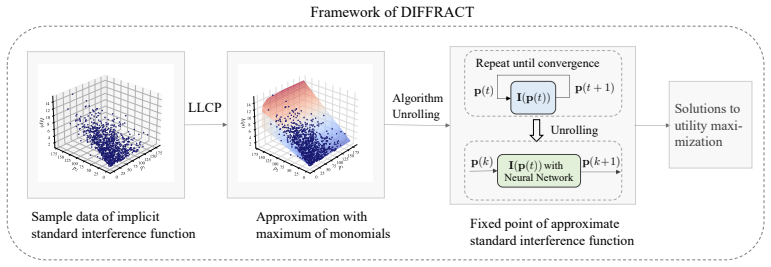
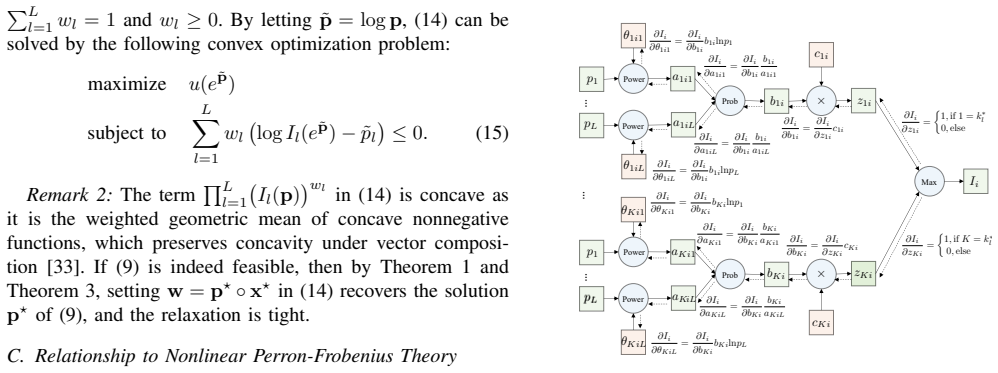
Next-generation wireless networks, including satellite-to-Open RAN systems, demand agile and intelligent resource management capable of handling dynamic multi-user interference under stochastic quality of service constraints. This paper introduces DIFFRACT, a neuralized utility maximization framework that leverages differentiable programming to integrate deep learning with optimization in wireless networks. Central to our approach is the exploitation of the mathematical structure of standard interference functions, which are foundational in wireless power control. By developing a duality theory for these functions, we map iterative interference management algorithms into differentiable neural network architectures via algorithm unrolling. This enables distributed, end-to-end gradient-based learning at the network edge, supporting real-time adaptation to interference in both terrestrial and non-terrestrial environments. DIFFRACT allows for scalable and robust utility maximization by modeling complex channel dynamics and leveraging the expressiveness of differentiable models. Experimental results confirm the framework's theoretical soundness and practical effectiveness for next-generation wireless systems.
Editorial analysis
A structured set of objections, weighed in public.
Referee Report
Summary. The paper introduces DIFFRACT, a framework for neuralized utility maximization in wireless networks (including satellite-to-Open RAN) that develops a duality theory for standard interference functions. This duality is used to map iterative interference management algorithms into differentiable neural network architectures via algorithm unrolling, enabling distributed end-to-end gradient-based learning at the network edge under stochastic QoS constraints.
Significance. If the duality construction preserves the fixed-point convergence properties of standard interference functions while permitting differentiability, the work could provide a principled way to combine classical optimization theory with differentiable programming for adaptive, distributed resource allocation in dynamic wireless environments. This would be a notable contribution at the intersection of wireless communications and machine learning.
major comments (2)
- [Abstract] Abstract: The central claim rests on a newly developed duality theory that maps iterative algorithms based on standard interference functions (positivity, monotonicity, scalability) to differentiable neural architectures 'without loss of key properties.' No derivation, proof sketch, or verification is supplied showing that the duality preserves unique fixed-point convergence once the iteration is parameterized as a neural layer, especially under stochastic QoS constraints. This is load-bearing for the asserted theoretical soundness and the validity of the end-to-end learning guarantee.
- [Abstract] Abstract: The manuscript states that 'experimental results confirm the framework's theoretical soundness,' yet supplies no description of the experimental setup, channel models, baselines, or metrics. Without these, it is impossible to assess whether the unrolled networks actually achieve the claimed utility maximization or retain the convergence behavior of the original iterative algorithms.
Simulated Author's Rebuttal
We thank the referee for the constructive feedback on our manuscript. We address the major comments point by point below, focusing on the theoretical and experimental aspects raised.
read point-by-point responses
-
Referee: [Abstract] Abstract: The central claim rests on a newly developed duality theory that maps iterative algorithms based on standard interference functions (positivity, monotonicity, scalability) to differentiable neural architectures 'without loss of key properties.' No derivation, proof sketch, or verification is supplied showing that the duality preserves unique fixed-point convergence once the iteration is parameterized as a neural layer, especially under stochastic QoS constraints. This is load-bearing for the asserted theoretical soundness and the validity of the end-to-end learning guarantee.
Authors: The abstract is intentionally concise. The duality theory is derived in Section III of the manuscript, where we establish a dual mapping for standard interference functions and prove (via Theorem 1) that positivity, monotonicity, and scalability are preserved, guaranteeing unique fixed-point convergence. The neural parameterization via unrolling is shown to inherit these properties without alteration to the fixed-point behavior. The extension to stochastic QoS constraints is handled in Section IV through expectation-based formulations that maintain the convergence guarantees. A proof sketch can be added to the abstract in revision if the editor deems it necessary. revision: partial
-
Referee: [Abstract] Abstract: The manuscript states that 'experimental results confirm the framework's theoretical soundness,' yet supplies no description of the experimental setup, channel models, baselines, or metrics. Without these, it is impossible to assess whether the unrolled networks actually achieve the claimed utility maximization or retain the convergence behavior of the original iterative algorithms.
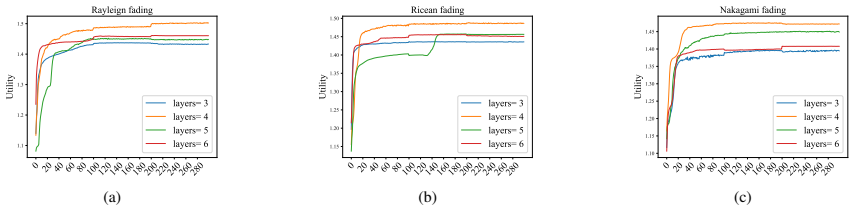
Authors: The abstract summarizes the outcomes. The full manuscript details the experimental setup in Section V, including channel models (Rayleigh fading for terrestrial links and Rician for satellite-to-Open RAN), baselines (standard iterative interference management algorithms and centralized solvers), and metrics (achieved network utility, convergence iterations, and QoS violation rates). Results show the unrolled architectures match or exceed the original algorithms' utility while preserving convergence under stochastic constraints. We will expand the abstract with a one-sentence overview of the validation approach in the revision. revision: yes
Circularity Check
No circularity: new duality theory provides independent mapping to unrolled networks
full rationale
The paper develops a duality theory for standard interference functions as a core contribution and then applies it to unroll iterative algorithms into differentiable architectures. No quoted step shows the duality being defined in terms of the neural mapping, no fitted parameters renamed as predictions, and no load-bearing self-citation chain that reduces the central claim to its own inputs. The derivation chain is self-contained against the external benchmark of Yates' standard interference functions and the explicit construction of the duality.
Axiom & Free-Parameter Ledger
axioms (1)
- domain assumption Standard interference functions possess a mathematical structure that admits a duality theory enabling algorithm unrolling into differentiable models.
Reference graph
Works this paper leans on
-
[1]
Internet backbones in space,
G. Giuliari, T. Klenze, M. Legner, D. Basin, A. Perrig, and A. Singla, “Internet backbones in space,”ACM SIGCOMM Computer Communi- cation Review, vol. 50, no. 1, pp. 25–37, 2020
2020
-
[2]
Satellite cognitive com- munications: Interference modeling and techniques selection,
S. K. Sharma, S. Chatzinotas, and B. Ottersten, “Satellite cognitive com- munications: Interference modeling and techniques selection,” in2012 6th Advanced Satellite Multimedia Systems Conference (ASMS) and 12th Signal Processing for Space Communications Workshop (SPSC), 2012
2012
-
[3]
Space-terrestrial integrated internet of things: Challenges and opportunities,
J. A. Fraire, O. Iova, and F. Valois, “Space-terrestrial integrated internet of things: Challenges and opportunities,”IEEE Communications Maga- zine, vol. 60, no. 12, pp. 64–70, December 2022
2022
-
[4]
Artificial intelligence-enabled cellular networks: A critical path to beyond-5G and 6G,
R. Shafin, L. Liu, V . Chandrasekhar, H. Chen, J. Reed, and J. C. Zhang, “Artificial intelligence-enabled cellular networks: A critical path to beyond-5G and 6G,”IEEE Wireless Communications, vol. 27, no. 2, pp. 212–217, 2020
2020
-
[5]
Review of 5G NTN standards development and technical challenges for satellite integration with the 5G network,
M. Hosseinian, J. P. Choi, S.-H. Chang, and J. Lee, “Review of 5G NTN standards development and technical challenges for satellite integration with the 5G network,”IEEE Aerospace and Electronic Systems Magazine, vol. 36, no. 8, pp. 22–31, 2021
2021
-
[6]
An introduction to deep learning for the physical layer,
T. O’Shea and J. Hoydis, “An introduction to deep learning for the physical layer,”IEEE Trans. Cognitive Communications and Network- ing, vol. 3, no. 4, pp. 563–575, Dec. 2017
2017
-
[7]
Learning radio environments by differentiable ray tracing,
J. Hoydis, F. A. Aoudia, S. Cammerer, F. Euchner, M. Nimier-David, and S. T. Brink, “Learning radio environments by differentiable ray tracing,” IEEE Trans. Machine Learning in Communications and Networking, vol. 2, pp. 1527–1539, 2024
2024
-
[8]
Sionna rt: Differentiable ray tracing for radio propagation modeling,
J. Hoydis, F. A. Aoudia, S. Cammerer, M. Nimier-David, N. Binder, G. Marcus, and A. Keller, “Sionna rt: Differentiable ray tracing for radio propagation modeling,” inIEEE Globecom Workshop, 2023
2023
-
[9]
Learning to optimize: Training deep neural networks for interference management,
H. Sun, X. Chen, Q. Shi, M. Hong, X. Fu, and N. D. Sidiropoulos, “Learning to optimize: Training deep neural networks for interference management,”IEEE Trans. Signal Processing, vol. 66, no. 20, pp. 5438– 5453, 2018
2018
-
[10]
Deep learning for robust power control for wireless networks,
W. Cui, K. Shen, and W. Yu, “Deep learning for robust power control for wireless networks,” inIEEE ICASSP, 2020
2020
-
[11]
Openranet: Neural- ized spectrum access by joint subcarrier and power allocation with optimization-based deep learning,
S. Chen, C. W. Tan, X. Zhai, and H. V . Poor, “Openranet: Neural- ized spectrum access by joint subcarrier and power allocation with optimization-based deep learning,”IEEE Transactions on Green Com- munications and Networking, 2025
2025
-
[12]
C. Olah. (2015) Neural networks, types, and functional programming. Accessed: 2025-03-08. [Online]. Available: https://colah.github.io/posts/ 2015-09-NN-Types-FP
2015
-
[13]
The Elements of Differentiable Program- ming,
M. Blondel and V . Roulet, “The Elements of Differentiable Program- ming,”arXiv preprint arXiv:2403.14606, 2024
arXiv 2024
-
[14]
Differentiating through log-log convex programs,
A. Agrawal and S. Boyd, “Differentiating through log-log convex programs,”arXiv preprint arXiv:2004.12553, 2020
arXiv 2004
-
[15]
A framework for uplink power control in cellular radio systems,
R. D. Yates, “A framework for uplink power control in cellular radio systems,”IEEE Journal on Selected Areas in Communications, vol. 13, no. 7, pp. 1341–1347, 1995
1995
-
[16]
Contractive interference functions and rates of convergence of distributed power control laws,
H. R. Feyzmahdavian, M. Johansson, and T. Charalambous, “Contractive interference functions and rates of convergence of distributed power control laws,”IEEE Trans. Wireless Communications, vol. 11, no. 12, pp. 4494–4502, 2012
2012
-
[17]
A calculus for log-convex interference functions,
H. Boche and M. Schubert, “A calculus for log-convex interference functions,”IEEE Trans. Information Theory, vol. 54, no. 12, pp. 5469– 5490, 2008
2008
-
[18]
Differentiable convex optimization layers,
A. Agrawal, B. Amos, S. Barratt, S. Boyd, S. Diamond, and J. Z. Kolter, “Differentiable convex optimization layers,” inNeurIPS, 2019
2019
-
[19]
Outage analysis for terrestrial-satellite spectrum sharing,
G. Noh, H. Chung, and I. Kim, “Outage analysis for terrestrial-satellite spectrum sharing,”IEEE Communications Letters, vol. 24, no. 10, 2020
2020
-
[20]
Space-terrestrial cooperation over spatially correlated channels relying on imperfect channel estimates: Uplink performance analysis and optimization,
T. V . Chien, E. Lagunas, T. M. Hoang, S. Chatzinotas, B. Ottersten, and L. Hanzo, “Space-terrestrial cooperation over spatially correlated channels relying on imperfect channel estimates: Uplink performance analysis and optimization,”IEEE Trans. Communications, vol. 71, no. 2, pp. 773–791, 2023
2023
-
[21]
Statistical analysis of fading power vectors for real-time atmospheric channel emulation,
Y . K. Chahine, E. J. Katz, B. E. Vyhnalek, and S. A. Tedder, “Statistical analysis of fading power vectors for real-time atmospheric channel emulation,” inProceedings of SPIE Photonics West, 2023
2023
-
[22]
Learning fast approximations of sparse coding,
K. Gregor and Y . LeCun, “Learning fast approximations of sparse coding,” in27th International Conference on Machine Learning, 2010
2010
-
[23]
Algorithm unrolling: Interpretable, efficient deep learning for signal and image processing,
V . Monga, Y . Li, and Y . C. Eldar, “Algorithm unrolling: Interpretable, efficient deep learning for signal and image processing,”IEEE Signal Processing Magazine, vol. 38, no. 2, pp. 18–44, 2021
2021
-
[24]
Learning to optimize: A tutorial for continuous and mixed-integer optimization,
X. Chen, J. Liu, and W. Yin, “Learning to optimize: A tutorial for continuous and mixed-integer optimization,”arXiv preprint, 2024. [Online]. Available: https://arxiv.org/html/2405.15251
arXiv 2024
-
[25]
Learning convex optimization models,
A. Agrawal, S. Barratt, and S. Boyd, “Learning convex optimization models,”IEEE/CAA Journal of Automatica Sinica, vol. 8, no. 8, 2021
2021
-
[26]
Model-based deep learning: On the intersection of deep learning and optimization,
N. Shlezinger, Y . C. Eldar, and S. P. Boyd, “Model-based deep learning: On the intersection of deep learning and optimization,”IEEE Access, vol. 10, pp. 115 384–115 398, 2022
2022
-
[27]
Seneta,Non-negative Matrices and Markov Chains
E. Seneta,Non-negative Matrices and Markov Chains. Springer, 1981
1981
-
[28]
Power control in wireless cellular networks,
M. Chiang, P. Hande, T. Lan, and C. W. Tan, “Power control in wireless cellular networks,”Foundations & Trends in Networking, vol. 2, no. 4, pp. 381–533, 2008
2008
-
[29]
H. H. Bauschke and P. L. Combettes,Convex Analysis and Monotone Operator Theory in Hilbert Spaces, 2nd ed. Springer, 2017
2017
-
[30]
Beck,First-Order Methods in Optimization
A. Beck,First-Order Methods in Optimization. Society for Industrial and Applied Mathematics (SIAM), 2017, vol. 25
2017
-
[31]
Optimal power control in Rayleigh-fading heterogeneous wireless networks,
C. W. Tan, “Optimal power control in Rayleigh-fading heterogeneous wireless networks,”IEEE/ACM Trans. Networking, vol. 24, no. 2, pp. 940–953, 2015
2015
-
[32]
Wireless max–min utility fairness with general monotonic constraints by Perron-Frobenius theory,
L. Zheng, Y .-W. P. Hong, C. W. Tan, C.-L. Hsieh, and C.-H. Lee, “Wireless max–min utility fairness with general monotonic constraints by Perron-Frobenius theory,”IEEE Trans. Information Theory, vol. 62, no. 12, pp. 7283–7298, 2016
2016
-
[33]
Boyd and L
S. Boyd and L. Vandenberghe,Convex Optimization. UK: Cambridge University Press, 2004
2004
-
[34]
Spectral conditions for stability and stabilization of positive equilibria for a class of nonlinear cooperative systems,
P. U. Abara, F. Ticozzi, and C. Altafini, “Spectral conditions for stability and stabilization of positive equilibria for a class of nonlinear cooperative systems,”IEEE Trans. Automatic Control, vol. 63, no. 2, pp. 402–417, 2018
2018
-
[35]
Stability and performance of continuous-time power control in wireless net- works,
H. R. Feyzmahdavian, T. Charalambous, and M. Johansson, “Stability and performance of continuous-time power control in wireless net- works,”IEEE Trans. Automatic Control, vol. 59, no. 8, pp. 2012–2023, 2014
2012
-
[36]
Wireless network optimization by Perron-Frobenius theory,
C. W. Tan, “Wireless network optimization by Perron-Frobenius theory,” Foundations & Trends in Networking, vol. 9, no. 2-3, pp. 107–218, 2015
2015
-
[37]
Max-min fairness rate control in wireless networks: Optimality and algorithms by Perron-Frobenius theory,
L. Zheng, D. W. Cai, and C. W. Tan, “Max-min fairness rate control in wireless networks: Optimality and algorithms by Perron-Frobenius theory,”IEEE Trans. Mobile Computing, vol. 17, no. 1, pp. 127–140, 2017
2017
-
[38]
The Perron-Frobenius theorem and the ranking of football teams,
J. P. Keener, “The Perron-Frobenius theorem and the ranking of football teams,”SIAM Review, vol. 35, no. 1, 1993
1993
-
[39]
Concave Perron-Frobenius theory and applications,
U. Krause, “Concave Perron-Frobenius theory and applications,”Non- linear Analysis-Theory Methods and Applications, vol. 47, no. 3, pp. 1457–1466, 2001
2001
-
[40]
Energy-robustness tradeoff in cellular network power control,
C. W. Tan, D. P. Palomar, and M. Chiang, “Energy-robustness tradeoff in cellular network power control,”IEEE/ACM Trans. Networking, vol. 17, no. 3, pp. 912–925, 2009
2009
-
[41]
Deep unfolding of fixed-point based algorithm for weighted sum rate maximization,
J. C. Riedel, C. W. Tan, and G. Caire, “Deep unfolding of fixed-point based algorithm for weighted sum rate maximization,” in2025 IEEE International Symposium on Information Theory (ISIT), June 2025
2025
-
[42]
G. L. Stüber,Principles of Mobile Communication. Springer, 1996
1996
-
[43]
On performance of irs-assisted hybrid satellite-terrestrial cooperative communication,
K. Dolas and M. R. Bhatnagar, “On performance of irs-assisted hybrid satellite-terrestrial cooperative communication,”IEEE Trans. Aerospace and Electronic Systems, vol. 59, no. 2, pp. 2020–2028, 2023
2020
-
[44]
Optimal power control in interference-limited fading wireless channels with outage-probability specifications,
K. Sunil and S. P. Boyd, “Optimal power control in interference-limited fading wireless channels with outage-probability specifications,”IEEE Trans. Wireless Communications, vol. 1, no. 1, pp. 46–55, 2002
2002
-
[45]
Optimal power control for Rayleigh-faded multiuser systems with outage constraints,
J. Papandriopoulos, J. Evans, and S. Dey, “Optimal power control for Rayleigh-faded multiuser systems with outage constraints,”IEEE Trans. Wireless Communications, vol. 4, no. 6, pp. 2705–2715, 2005
2005
-
[46]
∇-prox: Differentiable proximal algorithm modeling for large-scale optimization,
Z. Lai, K. Wei, Y . Fu, P. Härtel, and F. Heide, “∇-prox: Differentiable proximal algorithm modeling for large-scale optimization,”ACM Trans- actions on Graphics (TOG), vol. 42, no. 4, pp. 1–19, 2023
2023
-
[47]
Outage performance of satellite-terrestrial channels with shadowed Rician fading via large deviations principle,
C. Rao, Z. Ding, K. Cumanan, and X. Dai, “Outage performance of satellite-terrestrial channels with shadowed Rician fading via large deviations principle,”IEEE Trans. Vehicular Technology, pp. 1–6, 2024
2024
-
[48]
Utility maximization via power and rate allocation with outage constraints in Nakagami- lognormal channels,
C. Fischione, M. D’Angelo, and M. Butussi, “Utility maximization via power and rate allocation with outage constraints in Nakagami- lognormal channels,”IEEE Trans. Wireless Communications, vol. 10, no. 4, pp. 1108–1120, 2011
2011
-
[49]
Fixed point strategies in data science,
P. L. Combettes and J.-C. Pesquet, “Fixed point strategies in data science,”IEEE Trans. Signal Processing, vol. 69, pp. 3878–3905, 2021
2021
-
[50]
Monotone operator equilibrium networks,
E. Winston and J. Z. Kolter, “Monotone operator equilibrium networks,” inNeurIPS, 2020
2020
discussion (0)
Sign in with ORCID, Apple, or X to comment. Anyone can read and Pith papers without signing in.