Ferroelectrical Switching as a Probe of Quantum Damping in Magnetic Spin Systems
Pith reviewed 2026-06-27 21:37 UTC · model grok-4.3
The pith
Ferroelectric polarization reversal in a magnetic dimer switches exchange coupling and provides a magnetization signature for detecting quantum Gilbert damping.
A machine-rendered reading of the paper's core claim, the machinery that carries it, and where it could break.
Core claim
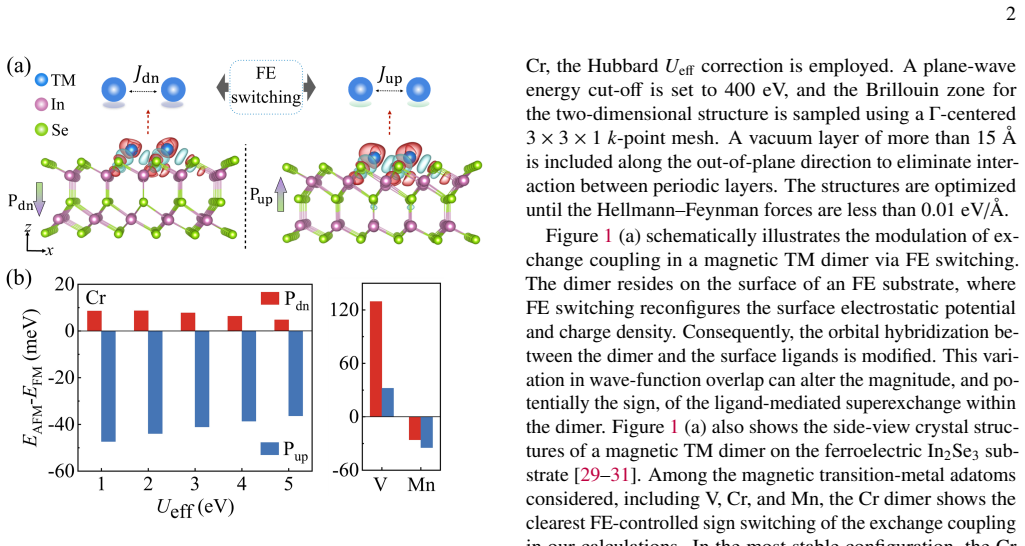
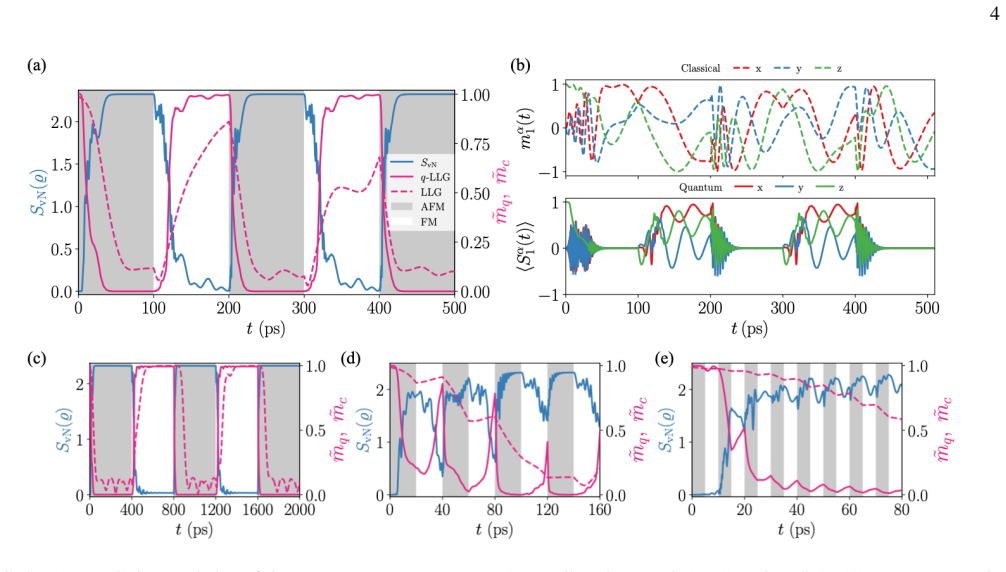
Ab initio calculations for dimers on ferroelectric substrates show that polarization reversal switches the inter-spin exchange between ferromagnetic and antiferromagnetic regimes. This setup enables formulation of a magnetization-based diagnostic that relates magnetization traces to entanglement dynamics for ferroelectrical on/off control of dimer entanglement. Quantum Landau-Lifshitz-Gilbert simulations then illustrate how the signature of magnetization dynamics can be used to infer the existence of quantum Gilbert spin damping.
What carries the argument
The magnetization-based diagnostic that relates magnetization traces to entanglement dynamics, combined with ferroelectric polarization reversal to switch exchange coupling.
If this is right
- Polarization reversal switches the exchange interaction between ferromagnetic and antiferromagnetic states.
- The diagnostic enables ferroelectrical on/off control of dimer entanglement.
- Magnetization dynamics signatures can be used to infer the existence of quantum Gilbert spin damping.
- This minimal platform connects first-principles modeling directly to experimentally accessible observables.
Where Pith is reading between the lines
- If the diagnostic isolates the quantum signatures reliably, the same ferroelectric control could be extended to larger spin networks for voltage-controlled entanglement.
- The method offers a route to test quantum damping in other spin systems by varying the substrate polarization.
- Real-device implementation would need to quantify how much substrate effects influence the observed magnetization traces.
Load-bearing premise
The magnetization-based diagnostic correctly isolates entanglement dynamics and quantum damping signatures from classical contributions and substrate effects.
What would settle it
An experiment that measures magnetization traces under polarization reversal and finds they match classical LLG predictions exactly, with no deviation matching the quantum simulation signatures, would falsify the inference of quantum damping.
Figures
read the original abstract
While damped spin dynamics is important for the understanding of magnetic materials, clear signatures of \emph{quantum corrections} to the Gilbert damping mechanism remain elusive. We propose a route to distinguish quantum and classical Gilbert spin damping using ferroelectric control of a magnetic dimer. Ab initio calculations for dimers on ferroelectric substrates show that polarization reversal switches the inter-spin exchange between ferromagnetic and antiferromagnetic regimes. We formulate a magnetization-based diagnostic that relates magnetization traces to entanglement dynamics, which enables ferroelectrical on/off control of dimer entanglement. Material-informed quantum Landau-Lifshitz-Gilbert simulations illustrate how the signature of magnetization dynamics can, in principle, be used to infer the existence of quantum Gilbert spin damping. This minimal and non-volatile platform connects first-principles modeling to experimentally accessible observables and provides a starting point for voltage-controlled quantum entanglement in magnetic spin networks.
Editorial analysis
A structured set of objections, weighed in public.
Referee Report
Summary. The paper proposes ferroelectric switching of a magnetic dimer on a ferroelectric substrate as a probe for quantum corrections to Gilbert damping. Ab initio calculations establish that polarization reversal switches the inter-spin exchange between FM and AFM regimes. A magnetization-based diagnostic is formulated that relates magnetization traces to entanglement dynamics, enabling on/off control of dimer entanglement. Material-informed quantum LLG simulations are used to illustrate that magnetization dynamics signatures can, in principle, be used to infer the existence of quantum Gilbert spin damping.
Significance. If the diagnostic is shown to isolate quantum damping signatures, the work offers a minimal, non-volatile platform linking first-principles results to experimentally accessible magnetization observables and a route toward voltage-controlled entanglement in spin networks. The 'in principle' simulation-based demonstration provides a concrete starting point, though its impact hinges on validation of the isolation claim.
major comments (2)
- [Diagnostic formulation and quantum LLG simulations] The central inference route requires that the magnetization-based diagnostic uniquely isolates quantum Gilbert damping from classical LLG contributions and substrate effects. The manuscript asserts this isolation but does not provide explicit side-by-side comparisons (classical vs. quantum LLG runs, or with the quantum damping term toggled off) demonstrating that the claimed signature vanishes in the absence of the quantum correction.
- [Diagnostic formulation] The mapping from magnetization traces to entanglement dynamics is presented as enabling ferroelectrical control, yet the derivation and validation details of this mapping (including how substrate polarization reversal is subtracted from damping parameters) are not shown to hold beyond the specific dimer parameters chosen.
minor comments (1)
- Notation for the quantum damping term in the LLG equation should be defined explicitly at first use and distinguished from the classical Gilbert term.
Simulated Author's Rebuttal
We thank the referee for the careful reading of our manuscript and the constructive comments. We address each major comment below.
read point-by-point responses
-
Referee: [Diagnostic formulation and quantum LLG simulations] The central inference route requires that the magnetization-based diagnostic uniquely isolates quantum Gilbert damping from classical LLG contributions and substrate effects. The manuscript asserts this isolation but does not provide explicit side-by-side comparisons (classical vs. quantum LLG runs, or with the quantum damping term toggled off) demonstrating that the claimed signature vanishes in the absence of the quantum correction.
Authors: We agree that explicit side-by-side comparisons are required to substantiate the isolation claim. The original manuscript presents the diagnostic via quantum LLG simulations as an in-principle illustration but does not include the requested toggled-off and classical runs. In the revision we will add these comparisons, including runs with the quantum damping term disabled and classical LLG baselines, to demonstrate that the signature vanishes without the quantum correction. Substrate effects will be addressed by explicit subtraction in the updated figures and text. revision: yes
-
Referee: [Diagnostic formulation] The mapping from magnetization traces to entanglement dynamics is presented as enabling ferroelectrical control, yet the derivation and validation details of this mapping (including how substrate polarization reversal is subtracted from damping parameters) are not shown to hold beyond the specific dimer parameters chosen.
Authors: The mapping is formulated for the specific dimer parameters obtained from the ab initio calculations, with the relation between magnetization traces and entanglement derived from the quantum LLG equations under the ferroelectric switching. We acknowledge that the derivation steps and the explicit subtraction procedure for substrate polarization effects on damping are not presented in sufficient detail. In the revision we will expand the methods section to include the full derivation of the mapping, the subtraction protocol for polarization reversal, and validation checks confirming applicability within the reported parameter regime, together with a statement of its limitations. revision: yes
Circularity Check
No circularity: derivation uses independent ab initio inputs and illustrative simulations
full rationale
The paper's chain begins with ab initio calculations establishing polarization-driven exchange switching between FM/AFM regimes, followed by formulation of a magnetization-based diagnostic relating traces to entanglement dynamics, and then material-informed quantum LLG simulations that illustrate (in principle) inference of quantum Gilbert damping. No quoted equations or steps reduce the claimed diagnostic or inference to a fitted parameter, self-definition, or self-citation chain; the central mapping and simulation outputs remain independent of the target signature by the paper's own description.
Axiom & Free-Parameter Ledger
axioms (2)
- domain assumption Density functional theory accurately predicts polarization-dependent exchange in magnetic dimers on ferroelectric substrates
- domain assumption The quantum Landau-Lifshitz-Gilbert equation is the appropriate dynamical model for including quantum damping
Reference graph
Works this paper leans on
-
[1]
Eriksson, A
O. Eriksson, A. Bergman, L. Bergqvist, and J. Hellsvik, Atom- istic Spin Dynamics: Foundations and Applications (Oxford University Press, Oxford, 2017)
2017
-
[2]
Lakshmanan, The fascinating world of the Lan- dau–Lifshitz–Gilbert equation: an overview, Philos
M. Lakshmanan, The fascinating world of the Lan- dau–Lifshitz–Gilbert equation: an overview, Philos. Trans. R. Soc. A369, 1280 (2011)
2011
-
[3]
Garcia-Gaitan and B
F. Garcia-Gaitan and B. K. Nikoli ´c, Fate of entanglement in magnetism under Lindbladian or non-Markovian dynamics and conditions for their transition to Landau-Lifshitz-Gilbert classi- cal dynamics, Phys. Rev. B109, L180408 (2024)
2024
-
[4]
G. S. Uhrig, Landau-Lifshitz damping from Lindbladian dissipa- tion in quantum magnets, New J. Phys.27, 103502 (2025)
2025
-
[5]
R. C. Verstraten, T. Ludwig, R. A. Duine, and C. Morais Smith, Fractional Landau-Lifshitz-Gilbert equation, Phys. Rev. Re- search5, 033128 (2023)
2023
-
[6]
Wieser, Comparison of quantum and classical relaxation in spin dynamics, Phys
R. Wieser, Comparison of quantum and classical relaxation in spin dynamics, Phys. Rev. Lett.110, 147201 (2013)
2013
-
[7]
Y . Liu, I. P. Miranda, L. Johnson, A. Bergman, A. Delin, D. Thonig, M. Pereiro, O. Eriksson, V . A. Mousolou, and E. Sjöqvist, Quantum Analog of Landau-Lifshitz-Gilbert Dynam- ics, Phys. Rev. Lett.133, 266704 (2024)
2024
-
[8]
H. Y . Yuan, Y . Cao, A. Kamra, R. A. Duine, and P. Yan, Quantum magnonics: When magnon spintronics meets quantum informa- tion science, Phys. Rep.965, 1 (2022)
2022
-
[9]
Kamra, W
A. Kamra, W. Belzig, and A. Brataas, Magnon-squeezing as a niche of quantum magnonics, Appl. Phys. Lett.117, 090501 (2020)
2020
-
[10]
A.-L. E. Römling, A. Vivas-Viaña, C. Sánchez Muñoz, and A. Kamra, Resolving nonclassical magnon composition of a magnetic ground state via a qubit, Phys. Rev. Lett.131, 143602 (2023)
2023
-
[11]
A.-L. E. Römling and A. Kamra, Quantum sensing of antifer- romagnetic magnon two-mode squeezed vacuum, Phys. Rev. B 109, 174410 (2024)
2024
-
[12]
H. Y . Yuan, W. P. Sterk, A. Kamra, and R. A. Duine, Pure de- phasing of magnonic quantum states, Phys. Rev. B106, L100403 (2022)
2022
-
[13]
H. Y . Yuan, W. P. Sterk, A. Kamra, and R. A. Duine, Master equation approach to magnon relaxation and dephasing, Phys. Rev. B106, 224422 (2022)
2022
-
[14]
Scheie, P
A. Scheie, P. Laurell, A. M. Samarakoon, B. Lake, S. E. Nagler, G. E. Granroth, S. Okamoto, G. Alvarez, and D. A. Tennant, Witnessing entanglement in quantum magnets using neutron scattering, Phys. Rev. B103, 224434 (2021); see also Phys. Rev. B107, 059902(E) (2023)
2021
-
[15]
Pantel, S
D. Pantel, S. Goetze, D. Hesse, and M. Alexe, Reversible electri- cal switching of spin polarization in multiferroic tunnel junctions, Nat. Mater.11, 289 (2012)
2012
-
[16]
C. Gong, E. M. Kim, Y . Wang, G. Lee, and X. Zhang, Multifer- roicity in atomic van der Waals heterostructures, Nat. Commun. 10, 2657 (2019)
2019
-
[17]
Liang, T
S. Liang, T. Xie, N. A. Blumenschein, T. Zhou, T. Ersevim, Z. Song, J. Liang, M. A. Susner, B. S. Conner, S.-J. Gong, J.-P. Wang, M. Ouyang, I. Zutic, A. L. Friedman, X. Zhang, and C. Gong, Small-voltage multiferroic control of two-dimensional magnetic insulators, Nat. Electron.6, 199 (2023)
2023
-
[18]
J. H. Lee, H. J. Kim, J. Yoon, S. Kim, J. R. Kim, W. Peng, S. Y . Park, T. W. Noh, and D. Lee, Flexoelectricity-Driven Mechanical Switching of Polarization in Metastable Ferroelectrics, Phys. Rev. Lett.129, 117601 (2022)
2022
-
[19]
Yang and S
Q. Yang and S. Meng, Light-Induced Complete Reversal of Ferroelectric Polarization in Sliding Ferroelectrics, Phys. Rev. Lett.133, 136902 (2024)
2024
-
[20]
A. Fert, R. Ramesh, V . Garcia, F. Casanova, and M. Bibes, Electrical control of magnetism by electric field and current- induced torques, Rev. Mod. Phys.96, 015005 (2024)
2024
-
[21]
Eigler and E
D. Eigler and E. Schweizer, Positioning single atoms with a scan- ning tunnelling microscope, Nature (London)344, 524 (1990)
1990
-
[22]
C. F. Hirjibehedin, C. P. Lutz, and A. J. Heinrich, Spin Coupling in Engineered Atomic Structures, Science312, 1021 (2006)
2006
-
[23]
S. Loth, S. Baumann, C. P. Lutz, D. M. Eigler, and A. J. Heinrich, Bistability in Atomic-Scale Antiferromagnets, Science335, 196 (2012). 6
2012
-
[24]
Kawai, A
S. Kawai, A. S. Foster, F. F. Canova, H. Onodera, S. Kitamura, and E. Meyer, Atom manipulation on an insulating surface at room temperature, Nat. Commun.5, 4403 (2014)
2014
-
[25]
Kresse and J
G. Kresse and J. Hafner, Ab initio molecular-dynamics simula- tion of the liquid-metal–amorphous-semiconductor transition in germanium, Phys. Rev. B49, 14251 (1994)
1994
-
[26]
Kresse and J
G. Kresse and J. Furthmüller, Efficient iterative schemes for ab initio total-energy calculations using a plane-wave basis set, Phys. Rev. B54, 11169 (1996)
1996
-
[27]
Kresse and D
G. Kresse and D. Joubert, From ultrasoft pseudopotentials to the projector augmented-wave method, Phys. Rev. B59, 1758 (1999)
1999
-
[28]
J. P. Perdew, K. Burke, and M. Ernzerhof, Generalized Gradient Approximation Made Simple, Phys. Rev. Lett.77, 3865 (1996)
1996
-
[29]
W. Ding, J. Zhu, Z. Wang, Y . Gao, D. Xiao, Y . Gu, Z. Zhang, and W. Zhu, Prediction of intrinsic two-dimensional ferroelectrics in In2Se3 and other III2-VI3 van der Waals materials, Nat. Commun. 8, 14956 (2017)
2017
-
[30]
Y . Zhou, D. Wu, Y . Zhu, Y . Cho, Q. He, X. Yang, K. Herrera, Z. Chu, Y . Han, M. C. Downer, H. Peng, and K. Lai, Out-of- Plane Piezoelectricity and Ferroelectricity in Layered α-In2Se3 Nanoflakes, Nano Lett.17, 5508 (2017)
2017
-
[31]
J. Xiao, H. Zhu, Y . Wang, W. Feng, Y . Hu, A. Dasgupta, Y . Han, Y . Wang, D. A. Muller, L. W. Martin, P. Hu, and X. Zhang, Intrinsic Two-Dimensional Ferroelectricity with Dipole Locking, Phys. Rev. Lett.120, 227601 (2018)
2018
-
[32]
Amoroso, P
D. Amoroso, P. Barone, and S. Picozzi, Spontaneous skyrmionic lattice from anisotropic symmetric exchange in a Ni-halide monolayer, Nat. Commun.11, 5784 (2020)
2020
-
[33]
Goodenough, Theory of the role of covalence in the perovskite-type manganites [La, M(II)]MnO3, Phys
B. Goodenough, Theory of the role of covalence in the perovskite-type manganites [La, M(II)]MnO3, Phys. Rev.100, 564 (1955)
1955
-
[34]
Kanamori, Superexchange interaction and symmetry proper- ties of electron orbitals, J
J. Kanamori, Superexchange interaction and symmetry proper- ties of electron orbitals, J. Phys. Chem. Solids10, 87 (1959)
1959
-
[35]
P. W. Anderson, New approach to the theory of superexchange interactions, Phys. Rev.115, 2 (1959)
1959
-
[36]
Q. Cui, J. Liang, Z. Shao, P. Cui, H. Yang, Strain-tunable fer- romagnetism and chiral spin textures in two-dimensional Janus chromium dichalcogenides, Phys. Rev. B102, 094425 (2020)
2020
-
[37]
H. Yang, J. Liang, Q. Cui, First-principles calculations for Dzyaloshinskii–Moriya interaction, Nat. Rev. Phys.5, 43 (2023)
2023
-
[38]
Edström, D
A. Edström, D. Amoroso, S. Picozzi, P. Barone , and M. Stengel, Curved Magnetism in CrI3, Phys. Rev. Lett.128, 177202 (2022)
2022
-
[39]
Q. Cui, Y . Zhu, J. Jiang, J. Liang, D. Yu, P. Cui, and H. Yang, Fer- roelectrically controlled topological magnetic phase in a Janus- magnet-based multiferroic heterostructure, Phys. Rev. Research 3, 043011 (2021)
2021
-
[40]
The von Neumann entropy is defined as S vN(ϱA)=−Tr(ϱ A lnϱ A)=− X i λi lnλ i , where ϱA = TrB |ψ⟩⟨ψ| is the reduced density matrix of subsys- tem A obtained by tracing out its complement B, and {λi} are the eigenvalues of ϱA. Because ϱA is positive semi-definite with unit trace, S (ϱA)=0 if and only if |ψ⟩ is a product state, while S (ϱA) attains its maxi...
-
[41]
For a spin-2 dimer, for which d =2 s +1=5, the von Neumann entropy cannot exceed log2 5 ≈ 2.32, the value attained by a maximally entangled state
q-LLG evolution, the von Neumann entropy serves as a faith- ful and easily computable entanglement monotone. For a spin-2 dimer, for which d =2 s +1=5, the von Neumann entropy cannot exceed log2 5 ≈ 2.32, the value attained by a maximally entangled state
-
[42]
L. Ju, X. Tan, X. Mao, Y . Gu, S. Smith, A. Du, Z. Chen, C. Chen, and L. Kou, Controllable CO2 electrocatalytic reduction via fer- roelectric switching on single atom anchored In2Se3 monolayer, Nat. Commun.12, 5128 (2021)
2021
-
[43]
D. Yu, Y . Ga, J. Liang, C. Jia , and H. Yang, V oltage-Controlled Dzyaloshinskii-Moriya Interaction Torque Switching of Perpen- dicular Magnetization, Phys. Rev. Lett.130, 056701 (2023)
2023
-
[44]
Z. Xia, O. V . Prezhdo, W. Zhu, J. Zhao, and Q. Zheng, Pi- cosecond Valley Manipulation in Two-Dimensional In2Se3 via Ferroelectric Switching, Nano Lett.25, 9084 (2025)
2025
-
[45]
F. Hartmann, V . Unikandanunni, M. Bargheer, E. E. Fullerton, S. Bonetti, and J. Anders, Intrinsic non-Markovian magnetisation dynamics, arXiv:2512.07378 (2025)
arXiv 2025
-
[46]
Reyes-Osorio and B
F. Reyes-Osorio and B. K. Nikoli ´c, Optically induced mag- netic inertia and magnons from non-markovian extension of the Landau-Lifshitz-Gilbert Equation, Phys. Rev. Lett.135, 246701 (2025)
2025
-
[47]
Kirilyuk, A
A. Kirilyuk, A. V . Kimel, and T. Rasing, Ultrafast optical ma- nipulation of magnetic order, Rev. Mod. Phys.82, 2731 (2010)
2010
-
[48]
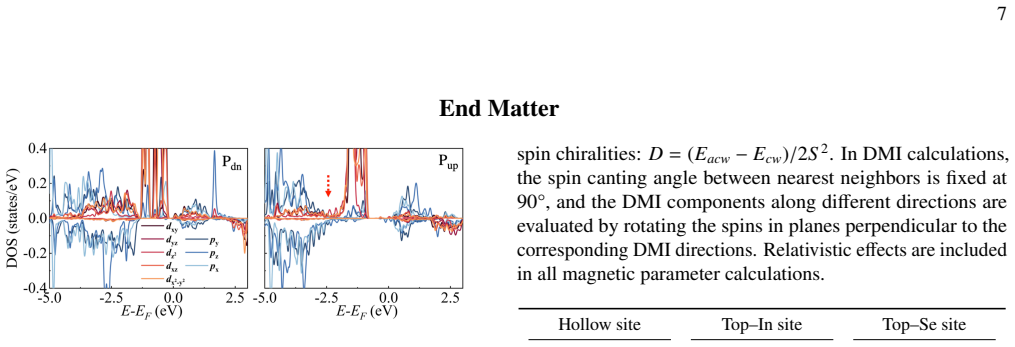
M. J. Gomez, K. Liu, J. G. Lee, and R. B. Wilson, High sen- sitivity pump–probe measurements of magnetic, thermal, and acoustic phenomena with a spectrally tunable oscillator, Rev. Sci. Instrum.91, 023905 (2020). 7 End Matter FIG. 3. The projected density of states (DOS) of Cr dimer on In2Se3. The red dotted arrow is to emphasis that thep−d orbital hybrid...
2020
discussion (0)
Sign in with ORCID, Apple, or X to comment. Anyone can read and Pith papers without signing in.