REVIEW 2 major objections 2 minor 24 references
DnD compares two object detectors by taking set intersections and differences on their shared ground-truth matches.
Reviewed by Pith at T0; open to challenge. T0 means a machine referee read the full paper against a public rubric. the ladder, T0–T4 →
T0 review · grok-4.3
2026-06-27 22:15 UTC pith:FF7DNG3N
load-bearing objection DnD is a straightforward set-difference procedure on top of standard matching that gives a direct view of shared and unique detections between two models. the 2 major comments →
Differences in Detection: Explainability Where it Matters
The pith
A machine-rendered reading of the paper's core claim, the machinery that carries it, and where it could break.
Core claim
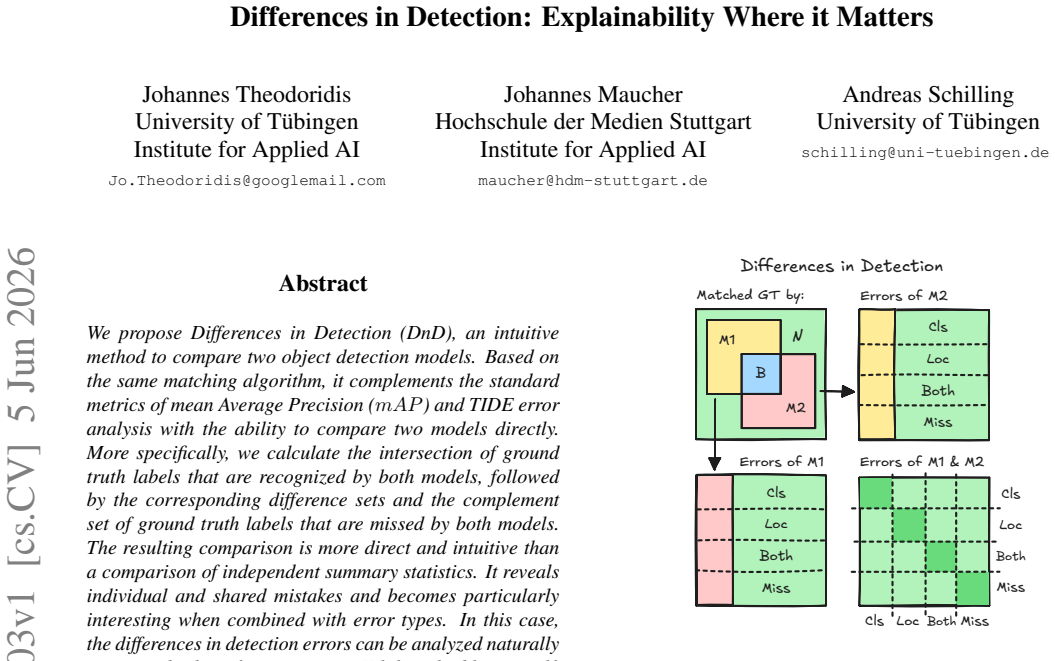
DnD calculates the intersection of ground truth labels recognized by both models, followed by the corresponding difference sets and the complement set of ground truth labels missed by both models, providing a more direct and intuitive comparison than independent summary statistics.
What carries the argument
Differences in Detection (DnD), which applies set intersection, difference, and complement operations to the ground-truth matches obtained from the same matching algorithm run on each model.
Load-bearing premise
That performing set differences on the matched ground-truth instances produces insights that are meaningfully more actionable or less misleading than comparing separate mAP and TIDE scores.
What would settle it
A controlled user study in which practitioners using only DnD outputs select or debug models faster or more accurately than practitioners given only mAP and TIDE scores.
If this is right
- Reveals which detections are shared successes, unique to one model, or shared failures.
- Allows detection errors to be analyzed in a standard confusion matrix once error types are attached.
- Supplies structured subsets of examples that explainability methods can target because they affect the metrics.
- Complements rather than replaces mAP and TIDE by adding instance-level overlap information.
Where Pith is reading between the lines
- The same set-construction logic could be applied to more than two models by computing multi-way intersections and symmetric differences.
- The resulting subsets could serve as a natural training or validation split when the goal is to improve one model relative to another.
- Because the method re-uses the existing matching step, it adds negligible computational cost while changing only the post-processing view of the results.
Editorial analysis
A structured set of objections, weighed in public.
Referee Report
Summary. The paper proposes Differences in Detection (DnD), a method to compare two object detection models by applying the same matching algorithm and then computing the intersection of ground-truth labels detected by both, the symmetric difference sets for each model, and the complement of labels missed by both. This set-algebraic view is positioned as complementary to mAP and TIDE, with natural extension to error-type confusion matrices, and is suggested as a way to select metric-relevant examples for explainability techniques such as ODAM.
Significance. If the claimed intuitiveness and actionability hold, DnD would supply a lightweight, structured reorganization of existing matching outputs that could help practitioners isolate shared versus model-specific errors without replacing summary metrics. The approach is parameter-free and directly leverages standard IoU-based assignment, which is a strength, but its practical utility remains untested.
major comments (2)
- [Abstract] Abstract: the central claim that the resulting comparison 'is more direct and intuitive than a comparison of independent summary statistics' and 'reveals individual and shared mistakes' is asserted without any quantitative evaluation, user study, ablation, or concrete example showing that DnD changes conclusions drawn from mAP/TIDE; this is load-bearing for the paper's positioning as a useful complement.
- [Method / Error-type analysis] Method description (inferred from abstract and § on error types): while the set operations are a direct reorganization of standard matching outputs, the manuscript supplies no demonstration that the intersection/difference sets yield more actionable insights for guiding ODAM or other explainability methods than simply inspecting per-model TIDE error breakdowns.
minor comments (2)
- The GitHub link is provided, supporting reproducibility; however, the manuscript does not indicate whether the released code includes the exact matching routine used in the reported comparisons.
- Notation for the intersection, difference, and complement sets is described procedurally but not formalized with equations or pseudocode, which would improve clarity.
Simulated Author's Rebuttal
We thank the referee for the detailed and constructive report. The two major comments correctly identify that the manuscript's positioning relies on claims of intuitiveness and actionability that are not yet supported by concrete examples or demonstrations. We address each point below and will revise the manuscript to incorporate the requested evidence.
read point-by-point responses
-
Referee: [Abstract] Abstract: the central claim that the resulting comparison 'is more direct and intuitive than a comparison of independent summary statistics' and 'reveals individual and shared mistakes' is asserted without any quantitative evaluation, user study, ablation, or concrete example showing that DnD changes conclusions drawn from mAP/TIDE; this is load-bearing for the paper's positioning as a useful complement.
Authors: We agree that the abstract's claims would be strengthened by at least one concrete example. The current manuscript presents DnD as a direct reorganization of standard matching outputs but does not show an instance where the intersection/symmetric-difference sets lead to different practitioner conclusions than separate mAP and TIDE scores. We will add such an example (e.g., two detectors with similar mAP but visibly different shared vs. model-specific errors) in a revised experiments or applications section and will adjust the abstract wording to reflect the addition. revision: yes
-
Referee: [Method / Error-type analysis] Method description (inferred from abstract and § on error types): while the set operations are a direct reorganization of standard matching outputs, the manuscript supplies no demonstration that the intersection/difference sets yield more actionable insights for guiding ODAM or other explainability methods than simply inspecting per-model TIDE error breakdowns.
Authors: We accept this observation. Although the set-algebraic view is parameter-free and directly reuses IoU matching, the manuscript contains no side-by-side illustration showing that the DnD subsets produce more targeted example selection for ODAM than TIDE error-type breakdowns alone. We will add a short illustrative case study in the revision that applies both approaches to the same pair of detectors and highlights any differences in the resulting explainability focus. revision: yes
Circularity Check
No significant circularity
full rationale
The paper defines DnD as a direct procedural computation of set intersections, differences, and complements on ground-truth matches obtained from any standard matching algorithm (e.g., IoU-based assignment). No equations, fitted parameters, or derived quantities are introduced; the method is explicitly complementary to mAP and TIDE rather than a replacement metric. No self-citations, uniqueness theorems, or ansatzes are invoked as load-bearing steps. The derivation is therefore self-contained and does not reduce to its own inputs by construction.
Axiom & Free-Parameter Ledger
read the original abstract
We propose Differences in Detection (DnD), an intuitive method to compare two object detection models. Based on the same matching algorithm, it complements the standard metrics of mean Average Precision ($mAP$) and TIDE error analysis with the ability to compare two models directly. More specifically, we calculate the intersection of ground truth labels that are recognized by both models, followed by the corresponding difference sets and the complement set of ground truth labels that are missed by both models. The resulting comparison is more direct and intuitive than a comparison of independent summary statistics. It reveals individual and shared mistakes and becomes particularly interesting when combined with error types. In this case, the differences in detection errors can be analyzed naturally in a standard confusion matrix. While valuable in itself, we believe that one of the best applications of DnD is to guide explainability methods such as ODAM towards metric-relevant examples, grounded in structured subsets. The code for our method is available here: https://github.com/JohannesTheo/differences-in-detection
Figures


Reference graph
Works this paper leans on
-
[1]
TIDE: A General Toolbox for Identifying Object Detection Errors
Daniel Bolya, Sean Foley, James Hays, and Judy Hoffman. TIDE: A General Toolbox for Identifying Object Detection Errors. InComputer Vision – ECCV 2020: 16th Euro- pean Conference, Glasgow, UK, August 23–28, 2020, Pro- ceedings, Part III, pages 558–573, Berlin, Heidelberg, 2020. Springer-Verlag. 1, 2
2020
-
[2]
Empirical Upper Bound in Object Detection and More, 2019
Ali Borji and Seyed Mehdi Iranmanesh. Empirical Upper Bound in Object Detection and More, 2019. arXiv:1911.12451 [cs]. 1
-
[3]
Grad-CAM++: General- ized Gradient-Based Visual Explanations for Deep Convolu- tional Networks
Aditya Chattopadhay, Anirban Sarkar, Prantik Howlader, and Vineeth N Balasubramanian. Grad-CAM++: General- ized Gradient-Based Visual Explanations for Deep Convolu- tional Networks. In2018 IEEE Winter Conference on Appli- cations of Computer Vision (WACV), pages 839–847, 2018. 2
2018
-
[4]
Berg, and Alexander Kirillov
Bowen Cheng, Ross Girshick, Piotr Dollar, Alexander C. Berg, and Alexander Kirillov. Boundary IoU: Improving Object-Centric Image Segmentation Evaluation. InProceed- ings of the IEEE/CVF Conference on Computer Vision and Pattern Recognition (CVPR), pages 15334–15342, 2021. 2
2021
-
[5]
An Image is Worth 16x16 Words: Transformers for Image Recognition at Scale
Alexey Dosovitskiy, Lucas Beyer, Alexander Kolesnikov, Dirk Weissenborn, Xiaohua Zhai, Thomas Unterthiner, Mostafa Dehghani, Matthias Minderer, Georg Heigold, Syl- vain Gelly, Jakob Uszkoreit, and Neil Houlsby. An Image is Worth 16x16 Words: Transformers for Image Recognition at Scale. InInternational Conference on Learning Representa- tions, 2021. 3
2021
-
[6]
Cubuk, Quoc V
Golnaz Ghiasi, Yin Cui, Aravind Srinivas, Rui Qian, Tsung- Yi Lin, Ekin D. Cubuk, Quoc V . Le, and Barret Zoph. Simple copy-paste is a strong data augmentation method for instance segmentation. InProceedings of the IEEE/CVF conference on computer vision and pattern recognition (CVPR), pages 2918–2928, 2021. 3
2021
-
[7]
Mask R-CNN
Kaiming He, Georgia Gkioxari, Piotr Doll ´ar, and Ross Gir- shick. Mask R-CNN. In2017 IEEE International Confer- ence on Computer Vision (ICCV), pages 2980–2988, 2017. 3
2017
-
[8]
Benchmarking Neu- ral Network Robustness to Common Corruptions and Pertur- bations
Dan Hendrycks and Thomas Dietterich. Benchmarking Neu- ral Network Robustness to Common Corruptions and Pertur- bations. InInternational Conference on Learning Represen- tations, 2019. 4
2019
-
[9]
Exploring Plain Vision Transformer Backbones for Object Detection
Yanghao Li, Hanzi Mao, Ross Girshick, and Kaiming He. Exploring Plain Vision Transformer Backbones for Object Detection. InComputer Vision – ECCV 2022, pages 280– 296, Cham, 2022. Springer Nature Switzerland. 3
2022
-
[10]
Lawrence Zitnick
Tsung-Yi Lin, Michael Maire, Serge Belongie, James Hays, Pietro Perona, Deva Ramanan, Piotr Doll´ar, and C. Lawrence Zitnick. Microsoft COCO: Common Objects in Context. InComputer Vision – ECCV 2014, pages 740–755, Cham,
2014
-
[11]
Springer International Publishing. 1, 2
-
[12]
Michaelis, B
C. Michaelis, B. Mitzkus, R. Geirhos, E. Rusak, O. Bring- mann, A. S. Ecker, M. Bethge, and W. Brendel. Bench- marking robustness in object detection: Autonomous driving when winter is coming. InMachine learning for autonomous driving workshop, NeurIPS 2019, 2019. 4
2019
-
[13]
Faster-COCO-Eval: Faster interpretation of the original COCOEval, 2024
MiXaiLL76. Faster-COCO-Eval: Faster interpretation of the original COCOEval, 2024. 1
2024
-
[14]
Morariu, Ashutosh Mehra, Vicente Ordonez, and Kate Saenko
Vitali Petsiuk, Rajiv Jain, Varun Manjunatha, Vlad I. Morariu, Ashutosh Mehra, Vicente Ordonez, and Kate Saenko. Black-box Explanation of Object Detectors via Saliency Maps. In2021 IEEE/CVF Conference on Com- puter Vision and Pattern Recognition (CVPR), pages 11438– 11447, 2021. 2
2021
-
[15]
Selvaraju, Michael Cogswell, Abhishek Das, Ramakrishna Vedantam, Devi Parikh, and Dhruv Ba- tra
Ramprasaath R. Selvaraju, Michael Cogswell, Abhishek Das, Ramakrishna Vedantam, Devi Parikh, and Dhruv Ba- tra. Grad-CAM: Visual Explanations from Deep Networks via Gradient-Based Localization. In2017 IEEE Interna- tional Conference on Computer Vision (ICCV), pages 618– 626, 2017. 2
2017
-
[16]
Benchmarking Object De- tectors with COCO: A New Path Forward
Shweta Singh, Aayan Yadav, Jitesh Jain, Humphrey Shi, Justin Johnson, and Karan Desai. Benchmarking Object De- tectors with COCO: A New Path Forward. InComputer Vi- sion – ECCV 2024, pages 279–295, Cham, 2025. Springer Nature Switzerland. 2
2024
-
[17]
Trapped in Texture Bias? A Large Scale Comparison of Deep Instance Segmentation
Johannes Theodoridis, Jessica Hofmann, Johannes Maucher, and Andreas Schilling. Trapped in Texture Bias? A Large Scale Comparison of Deep Instance Segmentation. InCom- puter Vision – ECCV 2022, pages 609–627, Cham, 2022. Springer Nature Switzerland. 4
2022
-
[18]
ConvNeXt V2: Co-Designing and Scaling ConvNets With Masked Autoencoders
Sanghyun Woo, Shoubhik Debnath, Ronghang Hu, Xin- lei Chen, Zhuang Liu, In So Kweon, and Saining Xie. ConvNeXt V2: Co-Designing and Scaling ConvNets With Masked Autoencoders. InProceedings of the IEEE/CVF Conference on Computer Vision and Pattern Recognition (CVPR), pages 16133–16142, 2023. 3
2023
-
[19]
Explaining Object Detection Through Difference Map
Shujun Xia, Chenyang Zhao, and Antoni Chan. Explaining Object Detection Through Difference Map. InProceedings of the IEEE/CVF International Conference on Computer Vi- sion (ICCV) Workshops, pages 713–722, 2025. 2
2025
-
[20]
Spatial Sensitive Grad-CAM++: Improved Visual Explanation for Object Detectors via Weighted Combination of Gradient Map
Toshinori Yamauchi. Spatial Sensitive Grad-CAM++: Improved Visual Explanation for Object Detectors via Weighted Combination of Gradient Map. InProceedings of the IEEE/CVF Conference on Computer Vision and Pattern Recognition (CVPR) Workshops, pages 8164–8168, 2024
2024
-
[21]
Spatial Sensi- tive GRAD-CAM: Visual Explanations for Object Detection by Incorporating Spatial Sensitivity
Toshinori Yamauchi and Masayoshi Ishikawa. Spatial Sensi- tive GRAD-CAM: Visual Explanations for Object Detection by Incorporating Spatial Sensitivity. In2022 IEEE Interna- tional Conference on Image Processing (ICIP), pages 256– 260, 2022
2022
-
[22]
Chenyang ZHAO and Antoni B. Chan. ODAM: Gradient- based Instance-Specific Visual Explanations for Object De- tection. InThe Eleventh International Conference on Learn- ing Representations, 2023. 2
2023
-
[23]
Daquan Zhou, Zhiding Yu, Enze Xie, Chaowei Xiao, Ani- mashree Anandkumar, Jiashi Feng, and Jose M. Alvarez. Un- derstanding The Robustness in Vision Transformers. InPro- ceedings of the 39th International Conference on Machine Learning, pages 27378–27394. PMLR, 2022. 4
2022
-
[24]
Benchmarking a Benchmark: How Reliable is MS-COCO? InICCV 2023 DataComp Workshop, 2023
Eric Zimmermann, Justin Szeto, Jerome Pasquero, and Fred- eric Ratle. Benchmarking a Benchmark: How Reliable is MS-COCO? InICCV 2023 DataComp Workshop, 2023. eprint: 2311.02709. 2 5
discussion (0)
Sign in with ORCID, Apple, or X to comment. Anyone can read and Pith papers without signing in.