MedicalRec: Medical recommender system for image classification without retraining
Pith reviewed 2026-06-30 14:16 UTC · model grok-4.3
The pith
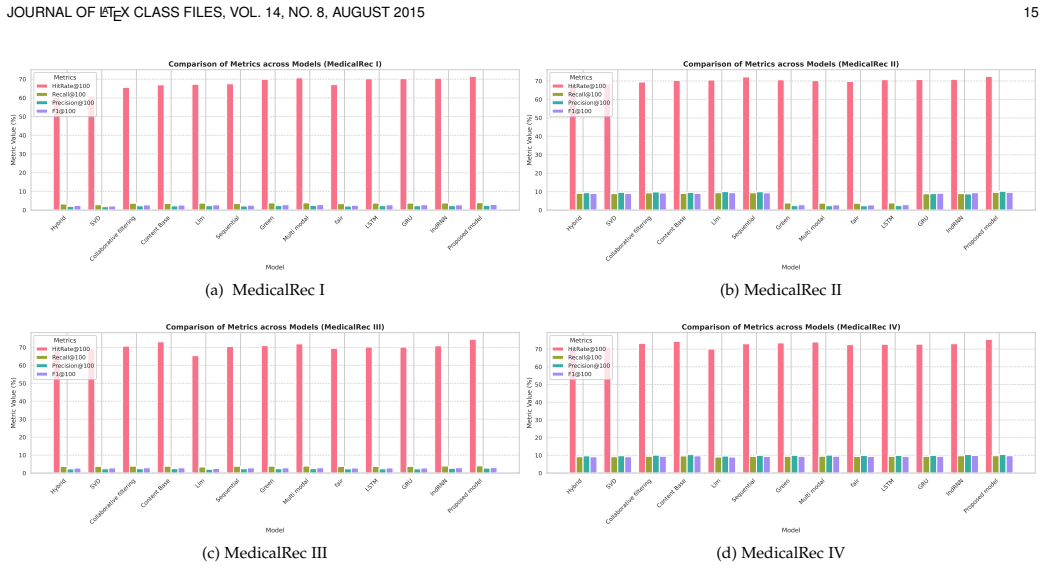
A transformer-based recommender suggests suitable pre-trained models for medical image classification tasks using records from 3000 papers and reaches 75.5 percent HitRate@100.
A machine-rendered reading of the paper's core claim, the machinery that carries it, and where it could break.
Core claim
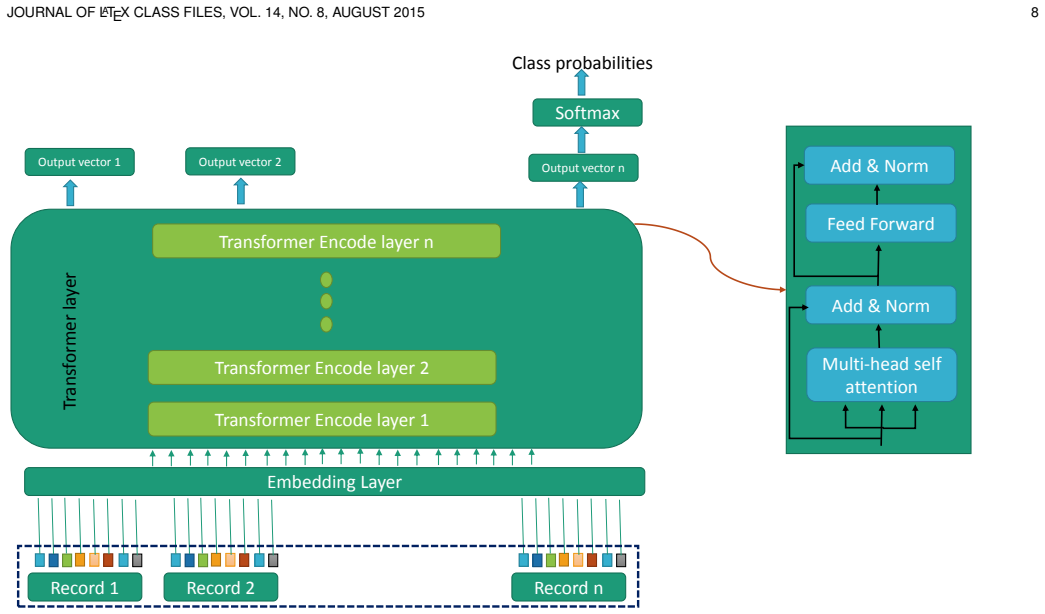
The MedicalRec transformer-based model for item recommendations, trained on the MedicalRec-Bench dataset collected from 3000 articles, recommends models for medical image classification tasks including Skin Cancer Classification, Tumour Classification, Wound Classification, Breast Cancer, and MRI classification and achieves a maximum HitRate@100 of 75.5 percent when evaluated on the dataset and with 12 base models.
What carries the argument
The MedicalRec transformer-based model for item recommendations that takes features describing model performance on medical imaging tasks.
If this is right
- MedicalRec allows selection of existing models for new medical imaging tasks without retraining or repeated experiments.
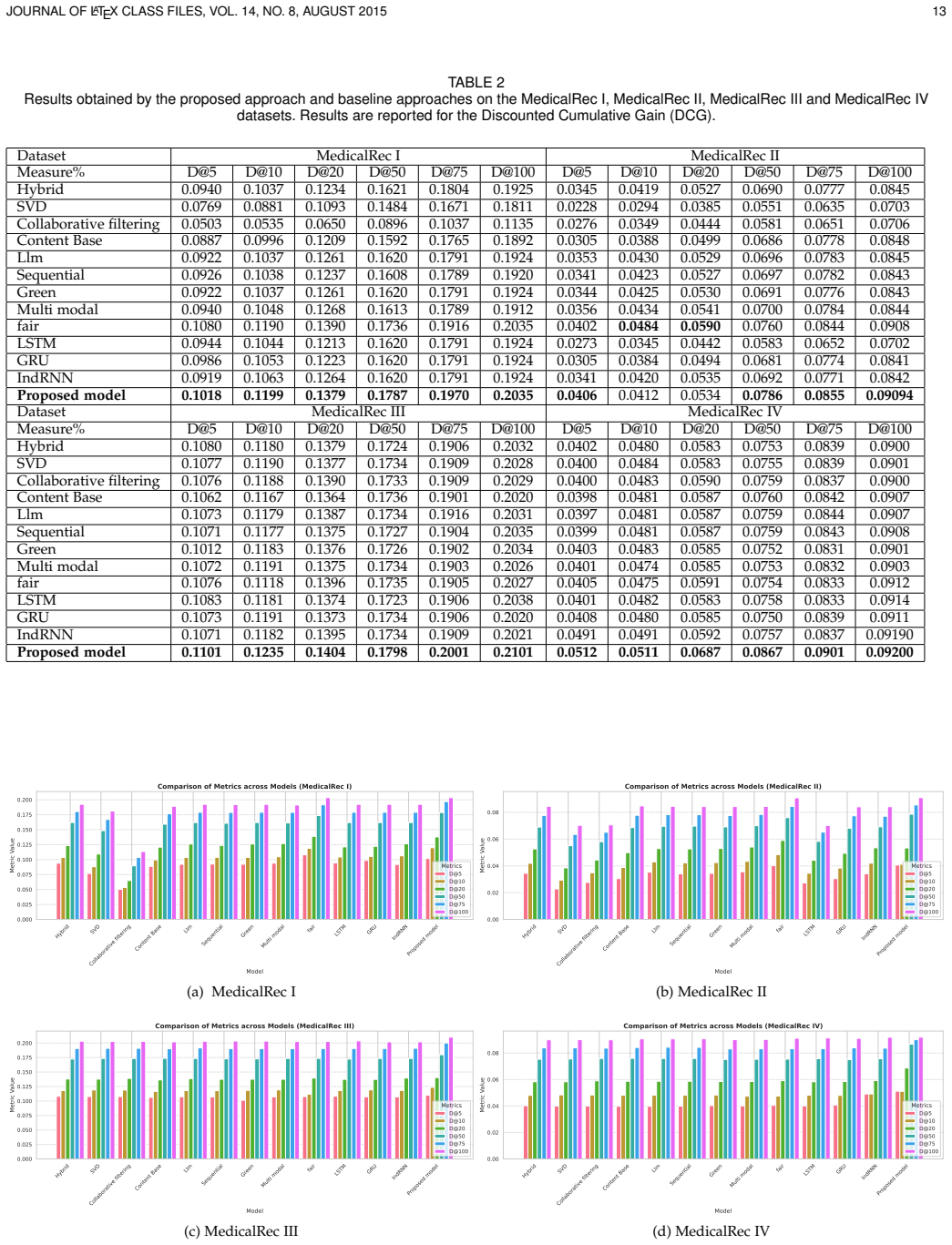
- Four evaluation modes with 5, 9, 11, and 18 features show how additional reported metrics affect recommendation quality.
- The publicly released MedicalRec-Bench dataset supports further work on literature-based model recommenders.
- Evaluation against 12 base models confirms the system can surface suitable classifiers for the covered tasks.
Where Pith is reading between the lines
- The same literature-mining approach could be applied to recommend models in non-medical computer vision domains where trial costs are also high.
- Improved imputation techniques for missing performance numbers might raise HitRate beyond the reported level.
- Embedding the recommender inside clinical pipelines would let practitioners receive model suggestions directly from new image data.
- Regular updates to the underlying dataset would be needed to incorporate newer models and tasks as the literature grows.
Load-bearing premise
The dataset scraped from 3000 articles accurately represents model performances across tasks despite significant missing values caused by non-reporting in the source papers.
What would settle it
Applying MedicalRec to a fresh collection of medical image classification papers outside the original 3000 and finding that its HitRate@100 drops substantially below 75.5 percent or matches random selection would falsify the claim.
Figures

read the original abstract
The emergence of machine learning and deep learning has revolutionized the efficiency of diagnostic, therapeutic, and administrative systems in healthcare. However, this rapid adoption has come at the cost of requiring significant computing power and energy consumption, as well as e-waste disposal and carbon emissions. One of the challenges of these models is choosing the right model for classification tasks. To this end, researchers attempt to identify the optimal model using their data through trial and error, which involves energy consumption and waste. The goal of this study is to develop a model-based recommender system for medical image classification. For this purpose, a data set was collected from 3,000 articles in the field of medical image classification. This dataset, publicly available under the name MedicalRec-Bench, contains over 5,000 records of models tested in various tasks, including Skin Cancer Classification, Tumour Classification, Wound Classification, Breast Cancer, and MRI classification. The dataset was evaluated in four different modes, depending on the number of features: MedicalRec I (5 features), MedicalRec II (9 features), MedicalRec III (11 features), and MedicalRec IV (18 features). Collecting all values for the features is challenging due to non-reporting by the authors; hence, the dataset contains significant amounts of missing values. The Medical Recommender System (MedicalRec) is a transformer-based model used for item recommendations in this study. This model achieved remarkable results in the evaluation on the dataset and in the evaluation with 12 base models. This model achieved a maximum HitRate@100 of 75.5%. The dataset and implementations are available through the GitHub link: https://github.com/Ramin1Mousa/MedicalRec
Editorial analysis
A structured set of objections, weighed in public.
Referee Report
Summary. The paper presents MedicalRec, a transformer-based recommender system for selecting models for medical image classification tasks without retraining. It describes scraping the MedicalRec-Bench dataset from 3,000 articles (over 5,000 records across tasks like skin cancer and MRI classification), evaluates the system in four feature modes (5/9/11/18 features), and reports a maximum HitRate@100 of 75.5%. The dataset and code are released publicly.
Significance. If the performance metric is shown to be robust, the work could reduce the energy and compute costs of model selection in medical imaging by enabling zero-shot recommendations. The public dataset release and code availability are explicit strengths that support reproducibility.
major comments (2)
- [Abstract] Abstract: The central claim of a maximum HitRate@100 of 75.5% is stated without any information on the evaluation protocol (train/test splits, cross-validation, baselines, or metrics computation). This directly prevents verification that the result supports the 'without retraining' recommender claim.
- [Abstract] Abstract (dataset paragraph): The text states that MedicalRec-Bench 'contains significant amounts of missing values' due to non-reporting and evaluates four modes with 5/9/11/18 features, yet supplies no description of imputation, masking, complete-case analysis, or MNAR handling. Because missingness handling affects both training and the reported hit rate, this is load-bearing for the performance claim.
minor comments (1)
- [Abstract] The GitHub link is provided, which is a positive step for reproducibility; ensure the repository includes the exact scripts used to produce the 75.5% figure.
Simulated Author's Rebuttal
We thank the referee for the constructive comments on the abstract. We address each point below and will revise the abstract accordingly.
read point-by-point responses
-
Referee: [Abstract] Abstract: The central claim of a maximum HitRate@100 of 75.5% is stated without any information on the evaluation protocol (train/test splits, cross-validation, baselines, or metrics computation). This directly prevents verification that the result supports the 'without retraining' recommender claim.
Authors: We agree that the abstract should be self-contained and include a summary of the evaluation protocol. The full manuscript details the protocol in the Experiments section, including data splits, validation strategy, baselines, and metric computation. In the revision we will condense this information into the abstract to support verification of the zero-shot recommender claim. revision: yes
-
Referee: [Abstract] Abstract (dataset paragraph): The text states that MedicalRec-Bench 'contains significant amounts of missing values' due to non-reporting and evaluates four modes with 5/9/11/18 features, yet supplies no description of imputation, masking, complete-case analysis, or MNAR handling. Because missingness handling affects both training and the reported hit rate, this is load-bearing for the performance claim.
Authors: We agree that the abstract should briefly describe the missing-value strategy, as it affects the reported results. The manuscript explains the handling approach in the dataset construction section. We will add a concise statement to the abstract covering the method used across the four feature modes. revision: yes
Circularity Check
No significant circularity; empirical performance metric on independently scraped dataset
full rationale
The paper collects model performance records from 3,000 published articles into MedicalRec-Bench, then trains a transformer recommender on that data and reports HitRate@100 = 75.5% on the same collection (evaluated in four feature modes). This is a standard supervised recommendation setup whose central claim is an empirical generalization result, not a derivation that reduces to its inputs by definition or by self-citation. No equations, uniqueness theorems, or ansatzes are invoked; the missing-value handling and train/test protocol are not described in a way that collapses the metric to a fitted quantity by construction. The result therefore remains falsifiable against external benchmarks and does not trigger any of the enumerated circularity patterns.
Axiom & Free-Parameter Ledger
Reference graph
Works this paper leans on
-
[1]
Selvan, Raghavendra, et al. ”Carbon footprint of selecting and train- ing deep learning models for medical image analysis.” International Conference on Medical Image Computing and Computer-Assisted Intervention. Cham: Springer Nature Switzerland, 2022
2022
-
[2]
(Eds.): Summary for policymakers
Masson-Delmotte, V ., Zhai, P ., Pirani, A., Connors, S., et al. (Eds.): Summary for policymakers. Climate Change 2021: The Physical Science Basis. Contribution of Working Group I to the Sixth Assess- ment Report of the Intergovernmental Panel on Climate Change (2021)
2021
-
[3]
arXiv preprint arXiv:2202.05924 (2022)
Sevilla, J., Heim, L., Ho, A., Besiroglu, T., Hobbhahn, M., Villalobos, P .: Compute trends across three eras of machine learning. arXiv preprint arXiv:2202.05924 (2022)
-
[4]
Amodei, D., Hernandez, D., Sastry, G., Clark, J., Brockman, G., Sutskever, I.: Ai and compute (2018), https://blog. openai. com/aiand-compute
2018
-
[5]
A graph neural network framework for social recommendations,
W. Fan, Y. Ma, Q. Li, J. Wang, G. Cai, J. Tang, and D. Yin, “A graph neural network framework for social recommendations,” IEEE Transactions on Knowledge and Data Engineering, 2020
2020
-
[6]
Fairly adaptive negative sampling for recommendations,
X. Chen, W. Fan, J. Chen, H. Liu, Z. Liu, Z. Zhang, and Q. Li, “Fairly adaptive negative sampling for recommendations,” in Proceedings of the ACM Web Conference 2023, 2023, pp. 3723–3733. JOURNAL OF LATEX CLASS FILES, VOL. 14, NO. 8, AUGUST 2015 16 TABLE 5 T -test(P-value) results from different approaches in 5-fold cross validation on MedicalRec IV. Mode...
2023
-
[7]
Chat-rec: Towards interactive and explainable llms-augmented recommender system,
Y. Gao, T. Sheng, Y. Xiang, Y. Xiong, H. Wang, and J. Zhang, “Chat-rec: Towards interactive and explainable llms-augmented recommender system,” arXiv preprint arXiv:2303.14524, 2023
-
[8]
J. Chen, L. Ma, X. Li, N. Thakurdesai, J. Xu, J. H. Cho, K. Nag, E. Korpeoglu, S. Kumar, and K. Achan, “Knowledge graph comple- tion models are few-shot learners: An empirical study of relation labeling in e-commerce with llms,” arXiv preprint arXiv:2305.09858, 2023
-
[9]
A comprehensive survey on trustworthy recommender systems,
W. Fan, X. Zhao, X. Chen, J. Su, J. Gao, L. Wang, Q. Liu, Y. Wang, H. Xu, L. Chen et al., “A comprehensive survey on trustworthy recommender systems,” arXiv preprint arXiv:2209.10117, 2022
-
[10]
A Review of the Role of Artificial In- telligence in Healthcare,
A. Al Kuwaiti et al., “A Review of the Role of Artificial In- telligence in Healthcare,” J Pers Med, vol. 13, no. 6, 2023, doi: 10.3390/jpm13060951
-
[11]
D. Ueda et al., “Climate change and artificial intelligence in healthcare: Review and recommendations towards a sustainable future,” Diagn Interv Imaging, vol. 105, no. 11, pp. 453–459, 2024, doi: 10.1016/j.diii.2024.06.002
-
[12]
Energy and Policy Considerations for Deep Learning in NLP
E. Strubell, A. Ganesh, A. McCallum, A. Korhonen, D. Traum, and L. M`arquez, “Energy and Policy Considerations for Deep Learning in NLP ,” Florence, Italy: Association for Computational Linguistics, 2019, pp. 3645–3650. doi: 10.18653/v1/P19-1355
work page internal anchor Pith review doi:10.18653/v1/p19-1355 2019
-
[13]
R. Schwartz, J. Dodge, N. A. Smith, and O. Etzioni, “Green AI,” Commun. ACM, vol. 63, no. 12, pp. 54–63, 2020, doi: 10.1145/3381831
-
[14]
Counting Carbon: A Survey of Factors Influencing the Emissions of Machine Learning,
A. Sasha Luccioni and A. Hernandez-Garcia, “Counting Carbon: A Survey of Factors Influencing the Emissions of Machine Learning,”
-
[15]
doi: 10.48550/arXiv.2302.08476
-
[16]
Carbon Footprint of Selecting and Training Deep Learning Models for Medical Image Analysis,
R. Selvan, N. Bhagwat, L. F. Wolff Anthony, B. Kanding, and E. B. Dam, “Carbon Footprint of Selecting and Training Deep Learning Models for Medical Image Analysis,” 2022. doi: 10.48550/arXiv.2203.02202
-
[17]
Towards the systematic reporting of the energy and carbon footprints of machine learning,
P . Henderson, J. Hu, J. Romoff, E. Brunskill, D. Jurafsky, and J. Pineau, “Towards the systematic reporting of the energy and carbon footprints of machine learning,” J. Mach. Learn. Res., vol. 21, no. 1, p. Article 248, 2020
2020
-
[18]
Carbon Emission Quantification of Machine Learning: A Review,
S. M. Hasan, T. Islam, M. Saifuzzaman, K. R. Ahmed, C.-H. Huang, and A. R. Shahid, “Carbon Emission Quantification of Machine Learning: A Review,” IEEE Transactions on Sustainable Computing, no. 01, pp. 1–19, 5555, doi: 10.1109/tsusc.2025.3578834
-
[19]
Carbontracker: Tracking and Predicting the Carbon Footprint of Training Deep Learning Models,
L. F. Wolff Anthony, B. Kanding, and R. Selvan, “Carbontracker: Tracking and Predicting the Carbon Footprint of Training Deep Learning Models,” 2020. doi: 10.48550/arXiv.2007.03051
-
[20]
S. A. Budennyy et al., “eco2AI: Carbon Emissions Tracking of Machine Learning Models as the First Step Towards Sustainable AI,” Doklady Mathematics, vol. 106, no. 1, pp. S118–S128, 2022, doi: 10.1134/S1064562422060230
-
[21]
Carlini, N., Chien, S., Nasr, M., Song, S., Terzis, A., and Tramer, F
A. Verma, S. K. Singh, R. K. Sah, R. Misra, and T. N. Singh, “Performance Comparison of Deep Learning Models for CO2 Pre- diction: Analyzing Carbon Footprint with Advanced Trackers,” in 2024 IEEE International Conference on Big Data (BigData), 2024, pp. 4429–4437. doi: 10.1109/BigData62323.2024.10825767
-
[22]
Evaluating the carbon footprint of NLP methods: a survey and analysis of existing tools,
N. Bannour et al., “Evaluating the carbon footprint of NLP methods: a survey and analysis of existing tools,” Virtual: As- sociation for Computational Linguistics, 2021, pp. 11–21. doi: 10.18653/v1/2021.sustainlp-1.2
-
[23]
Quantifying the Carbon Emissions of Machine Learning
A. Lacoste, A. Luccioni, V . Schmidt, and T. Dandres, “Quan- tifying the Carbon Emissions of Machine Learning,” 2019. doi: 10.48550/arXiv.1910.09700
work page internal anchor Pith review Pith/arXiv arXiv doi:10.48550/arxiv.1910.09700 2019
-
[24]
J. Dodge et al., “Measuring the Carbon Intensity of AI in Cloud Instances,” 2022, Association for Computing Machinery, Seoul, Republic of Korea. doi: 10.1145/3531146.3533234
-
[25]
Mitigating carbon footprint for knowledge distil- lation based deep learning model compression,
K. Rafat et al., “Mitigating carbon footprint for knowledge distil- lation based deep learning model compression,” PLoS One, vol. 18, no. 5, p. e0285668, 2023, doi: 10.1371/journal.pone.0285668
-
[26]
A first look into the carbon footprint of federated learning,
X. Qiu et al., “A first look into the carbon footprint of federated learning,” J. Mach. Learn. Res., vol. 24, no. 1, p. Article 129, 2023
2023
-
[27]
The Carbon Footprint of Machine Learning Training Will Plateau, Then Shrink,
D. Patterson et al., “The Carbon Footprint of Machine Learning Training Will Plateau, Then Shrink,” Computer (Long Beach Calif), vol. 55, no. 7, pp. 18–28, 2022, doi: 10.1109/MC.2022.3148714
-
[28]
A. Sasha Luccioni, E. Strubell, and K. Crawford, “From Ef- ficiency Gains to Rebound Effects: The Problem of Jevons’ Paradox in AI’s Polarized Environmental Debate,” 2025. doi: 10.48550/arXiv.2501.16548
-
[29]
”Recommender system using trans former model: A systematic literature review.” 2022 1st Interna- tional Conference on Information System Information Technology (ICISIT)
Pohan, Husni Iskandar, et al. ”Recommender system using trans former model: A systematic literature review.” 2022 1st Interna- tional Conference on Information System Information Technology (ICISIT). IEEE, 2022
2022
-
[31]
Deldjoo, Yashar, et al. ”Toward Holistic Evaluation of Recom mender Systems Powered by Generative Models.” Proceedings of the 48th International ACM SIGIR Conference on Research and Development in Information Retrieval. 2025
2025
-
[32]
Sun, Fei, et al. ”BERT4Rec: Sequential recommendation with bidi rectional encoder representations from transformer.” Proceedings of the 28th ACM international conference on information and knowledge management. 2019
2019
-
[33]
Yadav, Naina, and Anil Kumar Singh. ”Bi-directional encoder representation of transformer model for sequential music recom mender system.” Proceedings of the 12th Annual Meeting of the Forum for Information Retrieval Evaluation. 2020
2020
-
[34]
”Multiview fusion using transformer model for recommender systems: Inte grating the utility matrix and textual sources.” Applied Sciences 13.10 (2023): 6324
Ho, Thi-Linh, Anh-Cuong Le, and Dinh-Hong Vu. ”Multiview fusion using transformer model for recommender systems: Inte grating the utility matrix and textual sources.” Applied Sciences 13.10 (2023): 6324
2023
-
[35]
”Federated recommender system based on diffusion augmentation and guided denoising.” ACM Transactions on Information Systems 43.2 (2025): 1-36
] Di, Yicheng, et al. ”Federated recommender system based on diffusion augmentation and guided denoising.” ACM Transactions on Information Systems 43.2 (2025): 1-36
2025
-
[36]
”Transformer based federated learning models for recommendation systems.” IEEE Access (2024)
Reddy, M.Sujaykumar, Hemanth Karnati, and L.Mohana Sundari. ”Transformer based federated learning models for recommendation systems.” IEEE Access (2024)
2024
-
[37]
”LDPMF: Local differential privacy enhanced matrix factorization for advanced recommendation.” Knowledge Based Systems 309 (2025): 112892
Li, Xiang, et al. ”LDPMF: Local differential privacy enhanced matrix factorization for advanced recommendation.” Knowledge Based Systems 309 (2025): 112892
2025
-
[41]
”Causal Inference for Recommendation: Foun- dations, Methods, and Applications.” ACM Transactions on Intelli- gent Systems and Technology 16.3 (2025): 1-51
Xu, Shuyuan, et al. ”Causal Inference for Recommendation: Foun- dations, Methods, and Applications.” ACM Transactions on Intelli- gent Systems and Technology 16.3 (2025): 1-51. JOURNAL OF LATEX CLASS FILES, VOL. 14, NO. 8, AUGUST 2015 17
2025
-
[43]
Mason Lilly, and Karen M
Srivastava, Divya, J. Mason Lilly, and Karen M. Feigh. ”Exploring the role of judgement and shared situation awareness when work ing with AI recommender systems.” Cognition, Technology Work 27.1 (2025): 1-18
2025
-
[45]
”Transformer based tool recommendation system in Galaxy.” BMC bioinformatics 24.1 (2023): 446
Kumar, Anup, Bj¨orn Gr¨uning, and Rolf Backofen. ”Transformer based tool recommendation system in Galaxy.” BMC bioinformatics 24.1 (2023): 446
2023
-
[46]
”Diffusion Models in Recommenda- tion Systems: A Survey.” arXiv preprint arXiv:2501.10548 (2025)
Wei, Ting-Ruen, and Yi Fang. ”Diffusion Models in Recommenda- tion Systems: A Survey.” arXiv preprint arXiv:2501.10548 (2025)
-
[47]
”Recommender systems meet large language model agents: A survey.” Foundations and Trends® in Privacy and Secu- rity 7.4 (2025): 247-396
Zhu, Xi, et al. ”Recommender systems meet large language model agents: A survey.” Foundations and Trends® in Privacy and Secu- rity 7.4 (2025): 247-396
2025
-
[48]
Deldjoo, Yashar, et al. ”Toward Holistic Evaluation of Recom- mender Systems Powered by Generative Models.” Proceedings of the 48th International ACM SIGIR Conference on Research and Development in Information Retrieval. 2025
2025
-
[49]
”Cfairllm: Consumer fairness evaluation in large-language model recommender system.” ACM Transactions on Intelligent Systems and Technology (2025)
Deldjoo, Yashar, and Tommaso Di Noia. ”Cfairllm: Consumer fairness evaluation in large-language model recommender system.” ACM Transactions on Intelligent Systems and Technology (2025)
2025
-
[50]
”Generalizable recommender system during temporal popularity distribution shifts.” Proceedings of the 31st ACM SIGKDD Conference on Knowledge Discovery and Data Mining
Yoo, Hyunsik, et al. ”Generalizable recommender system during temporal popularity distribution shifts.” Proceedings of the 31st ACM SIGKDD Conference on Knowledge Discovery and Data Mining. 2025
2025
-
[51]
”Federated recommender system based on diffusion augmentation and guided denoising.” ACM Transactions on Information Systems 43.2 (2025): 1-36
Di, Yicheng, et al. ”Federated recommender system based on diffusion augmentation and guided denoising.” ACM Transactions on Information Systems 43.2 (2025): 1-36
2025
-
[52]
”A llm-based con- trollable, scalable, human-involved user simulator framework for conversational recommender systems.” Proceedings of the ACM on Web Conference 2025
Zhu, Lixi, Xiaowen Huang, and Jitao Sang. ”A llm-based con- trollable, scalable, human-involved user simulator framework for conversational recommender systems.” Proceedings of the ACM on Web Conference 2025. 2025
2025
-
[53]
Mason Lilly, and Karen M
Srivastava, Divya, J. Mason Lilly, and Karen M. Feigh. ”Exploring the role of judgement and shared situation awareness when work- ing with AI recommender systems.” Cognition, Technology & Work 27.1 (2025): 1-18
2025
-
[54]
Liu, Weizi, and Yanyun Wang. ”Evaluating trust in recommender systems: A user study on the impacts of explanations, agency attribution, and product types.” International Journal of Hu- man–Computer Interaction 41.2 (2025): 1280-1292
2025
-
[55]
Zhang, Sheng, et al. ”Glint-ru: Gated lightweight intelligent recur- rent units for sequential recommender systems.” Proceedings of the 31st ACM SIGKDD Conference on Knowledge Discovery and Data Mining V . 1. 2025
2025
-
[56]
”Causal Inference for Recommendation: Foun- dations, Methods, and Applications.” ACM Transactions on Intelli- gent Systems and Technology 16.3 (2025): 1-51
Xu, Shuyuan, et al. ”Causal Inference for Recommendation: Foun- dations, Methods, and Applications.” ACM Transactions on Intelli- gent Systems and Technology 16.3 (2025): 1-51
2025
-
[57]
”Massive open online course recommenda- tion system based on a reinforcement learning algorithm.” Neural Computing and Applications 37.18 (2025): 11607-11618
Tzeng, Jian-Wei, et al. ”Massive open online course recommenda- tion system based on a reinforcement learning algorithm.” Neural Computing and Applications 37.18 (2025): 11607-11618
2025
-
[58]
”LDPMF: Local differential privacy enhanced matrix factorization for advanced recommendation.” Knowledge- Based Systems 309 (2025): 112892
Li, Xiang, et al. ”LDPMF: Local differential privacy enhanced matrix factorization for advanced recommendation.” Knowledge- Based Systems 309 (2025): 112892
2025
-
[59]
Zou, Jie, et al. ”Improving conversational recommender systems via transformer-based sequential modelling.” Proceedings of the 45th international ACM SIGIR conference on research and devel- opment in information retrieval. 2022
2022
-
[60]
”Recommender system using trans- former model: A systematic literature review.” 2022 1st Interna- tional Conference on Information System & Information Technol- ogy (ICISIT)
Pohan, Husni Iskandar, et al. ”Recommender system using trans- former model: A systematic literature review.” 2022 1st Interna- tional Conference on Information System & Information Technol- ogy (ICISIT). IEEE, 2022
2022
-
[61]
”Financial product recommendation system based on transformer.” 2020 IEEE 4th Information Technol- ogy, Networking, Electronic and Automation Control Conference (ITNEC)
Lian, Meng, and Juan Li. ”Financial product recommendation system based on transformer.” 2020 IEEE 4th Information Technol- ogy, Networking, Electronic and Automation Control Conference (ITNEC). Vol. 1. IEEE, 2020
2020
-
[62]
Sun, Fei, et al. ”BERT4Rec: Sequential recommendation with bidi- rectional encoder representations from transformer.” Proceedings of the 28th ACM international conference on information and knowledge management. 2019
2019
-
[63]
”Multiview fusion using transformer model for recommender systems: Inte- grating the utility matrix and textual sources.” Applied Sciences 13.10 (2023): 6324
Ho, Thi-Linh, Anh-Cuong Le, and Dinh-Hong Vu. ”Multiview fusion using transformer model for recommender systems: Inte- grating the utility matrix and textual sources.” Applied Sciences 13.10 (2023): 6324
2023
-
[64]
Sujaykumar, Hemanth Karnati, and L
Reddy, M. Sujaykumar, Hemanth Karnati, and L. Mohana Sundari. ”Transformer based federated learning models for recommendation systems.” IEEE Access (2024)
2024
-
[65]
Yadav, Naina, and Anil Kumar Singh. ”Bi-directional encoder representation of transformer model for sequential music recom- mender system.” Proceedings of the 12th Annual Meeting of the Forum for Information Retrieval Evaluation. 2020
2020
-
[66]
”Transformer- based tool recommendation system in Galaxy.” BMC bioinformatics 24.1 (2023): 446
Kumar, Anup, Bj ¨orn Gr ¨uning, and Rolf Backofen. ”Transformer- based tool recommendation system in Galaxy.” BMC bioinformatics 24.1 (2023): 446
2023
-
[67]
”Multi-behavior sequential transformer rec- ommender.” Proceedings of the 45th international ACM SIGIR conference on research and development in information retrieval
Yuan, Enming, et al. ”Multi-behavior sequential transformer rec- ommender.” Proceedings of the 45th international ACM SIGIR conference on research and development in information retrieval. 2022
2022
-
[68]
Jacob Devlin, Ming-Wei Chang, Kenton Lee, and Kristina Toutanova. 2018. BERT: Pre-training of Deep Bidirectional Trans- formers for Language Understanding. CoRR abs/1810.04805 (2018)
work page internal anchor Pith review Pith/arXiv arXiv 2018
-
[69]
Gomez, Łukasz Kaiser, and Illia Polosukhin
Ashish Vaswani, Noam Shazeer, Niki Parmar, Jakob Uszkoreit, Llion Jones, Aidan N. Gomez, Łukasz Kaiser, and Illia Polosukhin
-
[70]
Attention is All you Need. In NIPS. Curran Associates, Inc., 5998–6008
-
[71]
Geoffrey Hinton, Oriol Vinyals, and Jeff Dean. 2015. Distilling the knowledge in a neural network. In Deep Learning and Representa- tion Learning Workshop
2015
-
[72]
Dan Hendrycks and Kevin Gimpel. 2016. Bridging Nonlinearities and Stochastic Regularizers with Gaussian Error Linear Units. CoRR abs/1606.08415 (2016)
work page internal anchor Pith review Pith/arXiv arXiv 2016
-
[73]
Kaiming He, Xiangyu Zhang, Shaoqing Ren, and Jian Sun. 2016. Deep Residual Learning for Image Recognition. In Proceedings of CVPR. 770–778
2016
-
[74]
Lei Jimmy Ba, Ryan Kiros, and Geoffrey E. Hinton. 2016. Layer Normalization. CoRR abs/1607.06450 (2016)
work page internal anchor Pith review Pith/arXiv arXiv 2016
-
[75]
Nitish Srivastava, Geoffrey Hinton, Alex Krizhevsky, Ilya Sutskever, and Ruslan Salakhutdinov. 2014. Dropout: A Simple Way to Prevent Neural Networks from Overfitting. J. Mach. Learn. Res. 15, 1 (Jan. 2014), 1929–1958
2014
-
[76]
”A hybrid approach using collaborative filtering and content based filtering for recommender system.” Journal of physics: conference series
Geetha, G., et al. ”A hybrid approach using collaborative filtering and content based filtering for recommender system.” Journal of physics: conference series. Vol. 1000. IOP Publishing, 2018
2018
-
[77]
”SVD-based incremental approaches for recom- mender systems.” Journal of Computer and System Sciences 81.4 (2015): 717-733
Zhou, Xun, et al. ”SVD-based incremental approaches for recom- mender systems.” Journal of Computer and System Sciences 81.4 (2015): 717-733
2015
-
[78]
”An efficient deep learning approach for collaborative filtering recommender system.” Procedia Computer Science 171 (2020): 829-836
Aljunid, Mohammed Fadhel, and Manjaiah Dh. ”An efficient deep learning approach for collaborative filtering recommender system.” Procedia Computer Science 171 (2020): 829-836
2020
-
[79]
”Content-based recommender systems.” Rec- ommender systems: The textbook
Aggarwal, Charu C. ”Content-based recommender systems.” Rec- ommender systems: The textbook. Cham: Springer International Publishing, 2016. 139-166
2016
-
[80]
Kim, Sein, et al. ”Large language models meet collaborative filtering: An efficient all-round llm-based recommender system.” Proceedings of the 30th ACM SIGKDD Conference on Knowledge Discovery and Data Mining. 2024
2024
-
[81]
”A reproducible analysis of sequential recommender systems.” IEEE Access (2024)
Betello, Filippo, et al. ”A reproducible analysis of sequential recommender systems.” IEEE Access (2024)
2024
-
[82]
Spillo, Giuseppe, et al. ”Towards green recommender systems: Investigating the impact of data reduction on carbon footprint and algorithm performances.” Proceedings of the 18th ACM Conference on Recommender Systems. 2024
2024
-
[83]
Xv, Guipeng, et al. ”Improving multi-modal recommender sys- tems by denoising and aligning multi-modal content and user feedback.” Proceedings of the 30th ACM SIGKDD Conference on Knowledge Discovery and Data Mining. 2024
2024
-
[84]
”Comprehensive fair meta-learned recommender system.” Proceedings of the 28th ACM SIGKDD conference on knowledge discovery and data mining
Wei, Tianxin, and Jingrui He. ”Comprehensive fair meta-learned recommender system.” Proceedings of the 28th ACM SIGKDD conference on knowledge discovery and data mining. 2022
2022
-
[85]
”Hashtag recom- mender system based on LSTM neural reccurent network.” 2019 Third International Conference on Intelligent Computing in Data Sciences (ICDS)
Ben-Lhachemi, Nada, and Jaouad Boumhidi. ”Hashtag recom- mender system based on LSTM neural reccurent network.” 2019 Third International Conference on Intelligent Computing in Data Sciences (ICDS). IEEE, 2019
2019
-
[86]
”Attention neural collabo- ration filtering based on GRU for recommender systems.” Complex & Intelligent Systems 7.3 (2021): 1367-1379
Xia, Hongbin, Yang Luo, and Yuan Liu. ”Attention neural collabo- ration filtering based on GRU for recommender systems.” Complex & Intelligent Systems 7.3 (2021): 1367-1379
2021
discussion (0)
Sign in with ORCID, Apple, or X to comment. Anyone can read and Pith papers without signing in.