Detecting Exciton Condensation through Charge Transport in Semiconductor Heterostructures
Pith reviewed 2026-06-27 20:56 UTC · model grok-4.3
The pith
Exciton condensation reduces resistivity by limiting carrier scattering and reverses Hall resistivity sign near resonance in heterostructures
A machine-rendered reading of the paper's core claim, the machinery that carries it, and where it could break.
Core claim
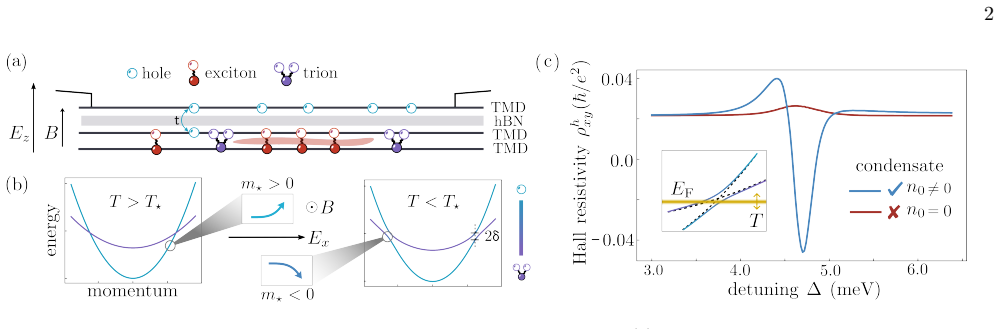
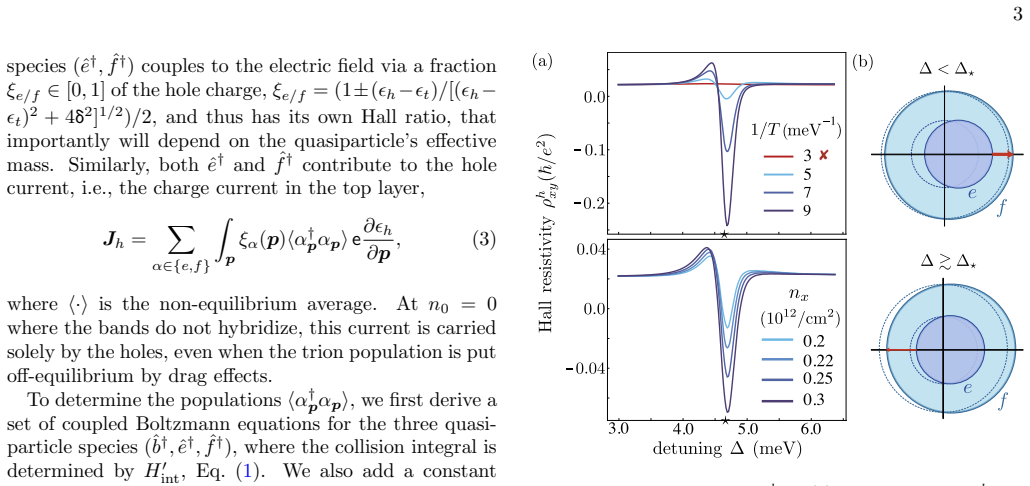
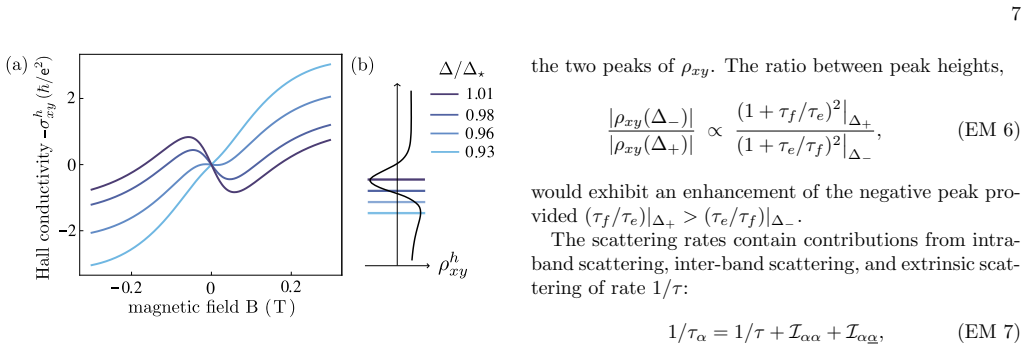
Condensation suppresses the phase space for carrier scattering and thereby reduces resistivity. Near resonance, condensate-induced hybridization between doped carriers and trion bound states produces a negative effective mass for the carriers and a corresponding sign reversal of the Hall resistivity.
What carries the argument
Suppression of scattering phase space by the condensate together with hybridization to trion states at a tunable solid-state Feshbach resonance
Load-bearing premise
A tunable solid-state Feshbach resonance exists in the heterostructure so that condensate-induced hybridization with trion states produces a negative effective mass for the doped carriers.
What would settle it
Resistivity that fails to drop or Hall resistivity that fails to reverse sign when condensation is expected and the resonance is tuned would falsify the proposed signatures.
Figures
read the original abstract
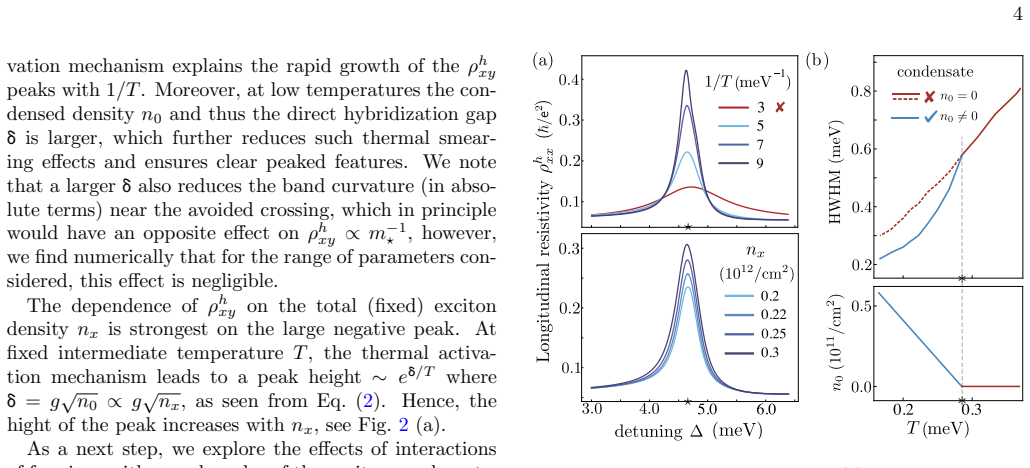
Direct evidence of exciton condensation in semiconductor heterostructures remains elusive. Here we propose charge transport of doped carriers as a probe of exciton condensation in transition-metal dichalcogenide heterostructures and identify distinct experimental signatures. First, condensation suppresses the phase space for carrier scattering, leading to a reduction in resistivity, that provides a general diagnostic of exciton condensation. Second, in heterostructures with a tunable solid-state Feshbach resonance, condensate-induced hybridization between doped carriers and trion bound states qualitatively modifies transport. In particular, near resonance, this hybridization yields a negative effective mass and a corresponding sign reversal of the Hall resistivity. These results establish charge transport as a promising route for detecting and characterizing exciton condensation in semiconductor heterostructures.
Editorial analysis
A structured set of objections, weighed in public.
Referee Report
Summary. The paper proposes charge transport of doped carriers as a probe for exciton condensation in TMD heterostructures. It identifies two signatures: condensation suppresses scattering phase space leading to reduced resistivity as a general diagnostic, and near a tunable solid-state Feshbach resonance, condensate-induced hybridization with trion states produces negative effective mass and Hall resistivity sign reversal.
Significance. If the proposed signatures are quantitatively validated, the work would offer a promising transport-based route to detect and characterize exciton condensation, complementing optical methods in semiconductor heterostructures. The resistivity reduction is conceptually general, while the Hall reversal would require the resonance mechanism to be realized.
major comments (2)
- [Abstract (second paragraph)] Abstract, second paragraph: the claim that hybridization near resonance yields negative effective mass (and thus Hall sign reversal) is presented without a microscopic Hamiltonian, resonance condition, effective-mass derivation, or gate-tunability analysis in TMD bilayers; this assumption is load-bearing for the second signature.
- [Abstract] Abstract: the resistivity reduction is argued from phase-space suppression but no explicit scattering-rate calculation, numerical resistivity values, or error estimates are shown to quantify the effect or its dependence on condensate density.
Simulated Author's Rebuttal
We thank the referee for their careful reading of the manuscript and for highlighting the need for greater clarity on the two proposed signatures. We address each major comment below.
read point-by-point responses
-
Referee: [Abstract (second paragraph)] Abstract, second paragraph: the claim that hybridization near resonance yields negative effective mass (and thus Hall sign reversal) is presented without a microscopic Hamiltonian, resonance condition, effective-mass derivation, or gate-tunability analysis in TMD bilayers; this assumption is load-bearing for the second signature.
Authors: The abstract is intentionally concise. The full manuscript presents the microscopic Hamiltonian for the tunable solid-state Feshbach resonance in TMD bilayers (Section III), derives the resonance condition from interlayer bias and doping, obtains the negative effective mass from the resulting hybridization between doped carriers and trion states, and analyzes gate tunability. To improve accessibility, we will revise the abstract to include a brief reference to the resonance mechanism and its consequences. revision: partial
-
Referee: [Abstract] Abstract: the resistivity reduction is argued from phase-space suppression but no explicit scattering-rate calculation, numerical resistivity values, or error estimates are shown to quantify the effect or its dependence on condensate density.
Authors: The resistivity reduction is presented as a general, qualitative consequence of phase-space suppression, which is standard in the literature on condensates. We agree that quantitative support strengthens the claim; in revision we will add an explicit estimate of the scattering-rate reduction (using Fermi's golden rule with the condensate-modified density of states) together with order-of-magnitude numerical values and their dependence on condensate density. revision: yes
Circularity Check
No circularity: signatures proposed from stated physical assumptions without self-referential reduction
full rationale
The manuscript proposes two transport signatures (resistivity drop from suppressed scattering phase space; Hall sign reversal from hybridization near a tunable Feshbach resonance) as diagnostics for exciton condensation. These follow directly from the modeling assumptions stated in the abstract and introduction; no equations, fitted parameters, or self-citations are shown that would render the predicted quantities equivalent to the inputs by construction. The derivation chain is therefore self-contained as a forward proposal rather than a closed loop.
Axiom & Free-Parameter Ledger
axioms (2)
- domain assumption Exciton condensation occurs and suppresses scattering phase space for doped carriers
- domain assumption A tunable solid-state Feshbach resonance exists that enables condensate-induced hybridization with trion states
Reference graph
Works this paper leans on
-
[1]
L. V. Keldysh and Y. V. Kopaev, Possible instability of the semimetallic state toward coulomb interaction, Soviet Physics Solid State6, 2219 (1965)
1965
-
[2]
X. Zhu, P. B. Littlewood, M. S. Hybertsen, and T. M. Rice, Exciton condensate in semiconductor quantum well structures, Phys. Rev. Lett.74, 1633 (1995)
1995
-
[3]
M. M. Fogler, L. V. Butov, and K. S. Novoselov, High- temperature superfluidity with indirect excitons in van der Waals heterostructures, Nat. Commun.5, 1 (2014)
2014
-
[4]
F.-C. Wu, F. Xue, and A. H. MacDonald, Theory of two- dimensional spatially indirect equilibrium exciton con- densates, Phys. Rev. B92, 165121 (2015)
2015
-
[5]
Fern´ andez-Rossier and C
J. Fern´ andez-Rossier and C. Tejedor, Spin degree of free- dom in two dimensional exciton condensates, Phys. Rev. Lett.78, 4809 (1997)
1997
-
[6]
L. Ma, P. X. Nguyen, Z. Wang, Y. Zeng, K. Watanabe, T. Taniguchi, A. H. MacDonald, K. F. Mak, and J. Shan, Strongly correlated excitonic insulator in atomic double layers, Nature598, 585–589 (2021)
2021
-
[7]
H. Park, J. Zhu, X. Wang, Y. Wang, W. Holtzmann, T. Taniguchi, K. Watanabe, J. Yan, L. Fu, T. Cao, D. Xiao, D. R. Gamelin, H. Yu, W. Yao, and X. Xu, Dipole ladders with large Hubbard interaction in a moir´ e exciton lattice, Nat. Phys.19, 1286 (2023)
2023
-
[8]
Xiong, J
R. Xiong, J. H. Nie, S. L. Brantly, P. Hays, R. Sailus, K. Watanabe, T. Taniguchi, S. Tongay, and C. Jin, Cor- related insulator of excitons in WSe2/WS2 moir´ e super- lattices, Science380, 860 (2023)
2023
-
[9]
R. Qi, A. Y. Joe, Z. Zhang, Y. Zeng, T. Zheng, Q. Feng, J. Xie, E. Regan, Z. Lu, T. Taniguchi, K. Watan- abe, S. Tongay, M. F. Crommie, A. H. MacDonald, and F. Wang, Thermodynamic behavior of correlated electron-hole fluids in van der waals heterostructures, Nature Communications14, 10.1038/s41467-023-43799- 7 (2023)
-
[10]
B. Gao, D. G. Su´ arez-Forero, S. Sarkar, T.-S. Huang, D. Session, M. J. Mehrabad, R. Ni, M. Xie, P. Upad- hyay, J. Vannucci, S. Mittal, K. Watanabe, T. Taniguchi, A. Imamoglu, Y. Zhou, and M. Hafezi, Excitonic Mott insulator in a Bose-Fermi-Hubbard system of moir´ e WS2/WSe2 heterobilayer, Nat. Commun.15, 1 (2024)
2024
-
[11]
Z. Lian, Y. Meng, L. Ma, I. Maity, L. Yan, Q. Wu, X. Huang, D. Chen, X. Chen, X. Chen, M. Blei, T. Taniguchi, K. Watanabe, S. Tongay, J. Lischner, Y.-T. Cui, and S.-F. Shi, Valley-polarized excitonic Mott insu- lator in WS2/WSe2 moir´ e superlattice, Nat. Phys.20, 34 (2024)
2024
-
[12]
R. Qi, Q. Li, Z. Zhang, S. Chen, J. Xie, Y. Ou, Z. Cui, D. D. Dai, A. Y. Joe, T. Taniguchi, K. Watanabe, S. Ton- gay, A. Zettl, L. Fu, and F. Wang, Electrically controlled interlayer trion fluid in electron-hole bilayers, Science 390, 299–303 (2025)
2025
-
[13]
P. X. Nguyen, R. Chaturvedi, L. Ma, P. Knuppel, K. Watanabe, T. Taniguchi, K. F. Mak, and J. Shan, An equilibrium trion liquid in atomic double layers, Science 390, 304–307 (2025)
2025
-
[14]
A. B. Mhenni, W. Kadow, M. J. Metelski, A. O. Paulus, A. Dijkstra, K. Watanabe, T. Taniguchi, S. A. Tongay, M. Barbone, J. J. Finley, M. Knap, and N. P. Wilson, Gate-tunable bose-fermi mixture in a strongly correlated moir´ e bilayer electron system (2024), arXiv:2410.07308 [cond-mat.str-el]
-
[15]
Upadhyay, D
P. Upadhyay, D. G. Su´ arez-Forero, T.-S. Huang, M. J. Mehrabad, B. Gao, S. Sarkar, D. Session, K. Watanabe, T. Taniguchi, Y. Zhou, M. Knap, and M. Hafezi, Giant enhancement of exciton diffusion near an electronic mott insulator, Science391, 394–398 (2026)
2026
-
[16]
R. Qi, A. Y. Joe, Z. Zhang, J. Xie, Q. Feng, Z. Lu, Z. Wang, T. Taniguchi, K. Watanabe, S. Tongay, and F. Wang, Perfect coulomb drag and exciton transport in an excitonic insulator, Science388, 278–283 (2025)
2025
- [17]
-
[18]
Eisenstein, Exciton condensation in bilayer quan- tum hall systems, Annual Review of Condensed Matter Physics5, 159 (2014)
J. Eisenstein, Exciton condensation in bilayer quan- tum hall systems, Annual Review of Condensed Matter Physics5, 159 (2014)
2014
-
[19]
Kuhlenkamp, M
C. Kuhlenkamp, M. Knap, M. Wagner, R. Schmidt, and A. Imamo˘ glu, Tunable feshbach resonances and their spectral signatures in bilayer semiconductors, Phys. Rev. Lett.129, 037401 (2022)
2022
-
[20]
Schwartz, Y
I. Schwartz, Y. Shimazaki, C. Kuhlenkamp, K. Watan- abe, T. Taniguchi, M. Kroner, and A. Imamo˘ glu, Electri- cally tunable feshbach resonances in twisted bilayer semi- conductors, Science374, 336–340 (2021)
2021
-
[21]
Zerba, C
C. Zerba, C. Kuhlenkamp, A. m. c. Imamo˘ glu, and M. Knap, Realizing topological superconductivity in tun- able bose-fermi mixtures with transition metal dichalco- genide heterostructures, Phys. Rev. Lett.133, 056902 6 (2024)
2024
-
[23]
C. Chin, R. Grimm, P. Julienne, and E. Tiesinga, Fesh- bach resonances in ultracold gases, Rev. Mod. Phys.82, 1225 (2010)
2010
-
[24]
See Supplemental Material
-
[27]
A. Y. Joe, K. Pistunova, K. Kaasbjerg, K. Wang, B. Kim, D. A. Rhodes, T. Taniguchi, K. Watanabe, J. Hone, T. Low, L. A. Jauregui, and P. Kim, Transport study of charge-carrier scattering in monolayer wse 2, Phys. Rev. Lett.132, 056303 (2024)
2024
-
[28]
J. Pack, Y. Guo, Z. Liu, B. S. Jessen, L. Holtz- man, S. Liu, M. Cothrine, K. Watanabe, T. Taniguchi, D. G. Mandrus, K. Barmak, J. Hone, and C. R. Dean, Charge-transfer contacts for the measurement of corre- lated states in high-mobility WSe2, Nat. Nanotechnol. 19, 948 (2024)
2024
- [29]
-
[30]
Xiao, G.-B
D. Xiao, G.-B. Liu, W. Feng, X. Xu, and W. Yao, Cou- pled spin and valley physics in monolayers of mos 2 and other group-vi dichalcogenides, Phys. Rev. Lett.108, 196802 (2012)
2012
-
[31]
X. Xu, W. Yao, D. Xiao, and T. F. Heinz, Spin and pseudospins in layered transition metal dichalcogenides, Nature Physics10, 343–350 (2014)
2014
-
[32]
Cr´ epel, D
V. Cr´ epel, D. Guerci, J. Cano, J. H. Pixley, and A. Millis, Topological superconductivity in doped magnetic moir´ e semiconductors, Phys. Rev. Lett.131, 056001 (2023)
2023
-
[33]
von Milczewski, X
J. von Milczewski, X. Chen, A. Imamoglu, and R. Schmidt, Superconductivity induced by strong electron-exciton coupling in doped atomically thin semi- conductor heterostructures, Phys. Rev. Lett.133, 226903 (2024)
2024
-
[34]
Kumar, A
A. Kumar, A. S. Patri, and T. Senthil, Unconventional superconductivity mediated by exciton density wave fluc- tuations, Phys. Rev. Lett.135, 266501 (2025)
2025
-
[35]
R” corresponds to +i0 and “A
C. Zerba, L. Mangeolle, and M. Knap, Detecting Exciton Condensation through Charge Transport in Semiconduc- tor Heterostructures (2026). END MATTER A. Magnetoresistive effects We evaluate the Hall conductivityσ h xy as a function of the magnetic fieldB; see Fig. 4. We find that the negative peak near resonance, signaling exciton conden- sation, is robust ...
2026
-
[36]
D. S. Fisher and P. C. Hohenberg, Dilute bose gas in two dimensions, Phys. Rev. B37, 4936 (1988)
1988
-
[37]
Prokof’ev, O
N. Prokof’ev, O. Ruebenacker, and B. Svistunov, Critical point of a weakly interacting two-dimensional bose gas, Phys. Rev. Lett.87, 270402 (2001)
2001
-
[38]
Zerba, C
C. Zerba, C. Kuhlenkamp, L. Mangeolle, and M. Knap, Tuning transport in solid-state bose-fermi mixtures by feshbach resonances, Phys. Rev. Lett.134, 126502 (2025)
2025
discussion (0)
Sign in with ORCID, Apple, or X to comment. Anyone can read and Pith papers without signing in.