MemToolAgent: Leveraging Memory for Tool Using Agents Based on Environment and User Feedback
Pith reviewed 2026-06-27 20:16 UTC · model grok-4.3
The pith
MemToolAgent improves LLM tool use by storing and retrieving structured memories distilled from past feedback.
A machine-rendered reading of the paper's core claim, the machinery that carries it, and where it could break.
Core claim
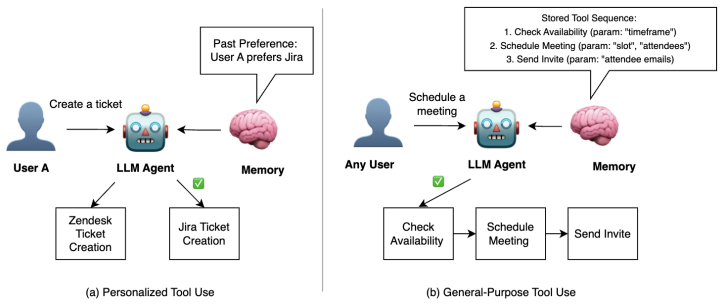
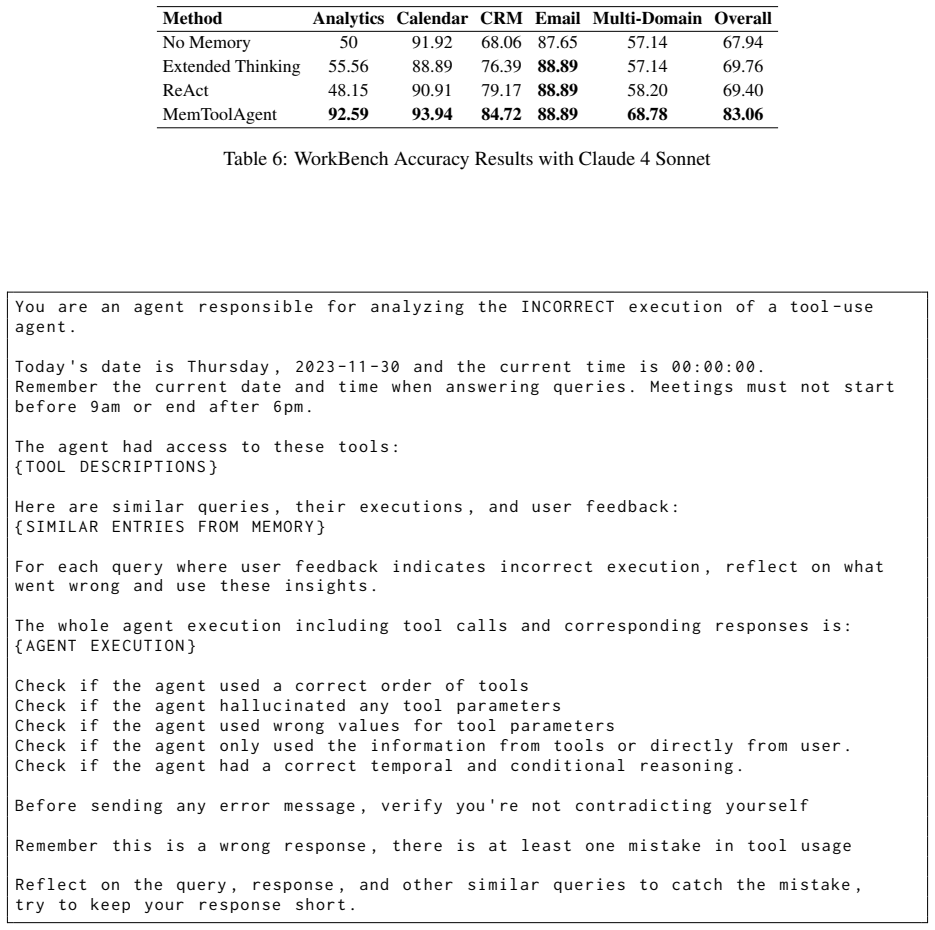
MemToolAgent improves tool use in LLM agents by processing past experiences into structured memory entries using a reflection-based extraction module that incorporates environment and user feedback, and a retrieval module that selects memories based on similarity distribution. This unified format enhances both general and personalized tool use, resulting in relative improvements of 29% on WorkBench, 80% on NESTFUL, and 17% on PEToolBench compared to baselines.
What carries the argument
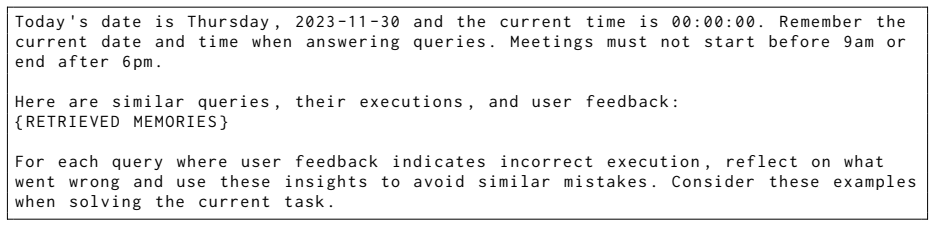
The reflection-based memory extraction module that distills past executions and feedback into structured entries, combined with a retrieval module that selects entries according to memory similarity distribution.
If this is right
- Tool selection accuracy rises when agents reuse distilled critiques from earlier failed executions.
- Responses become more aligned with individual user preferences across sessions without model updates.
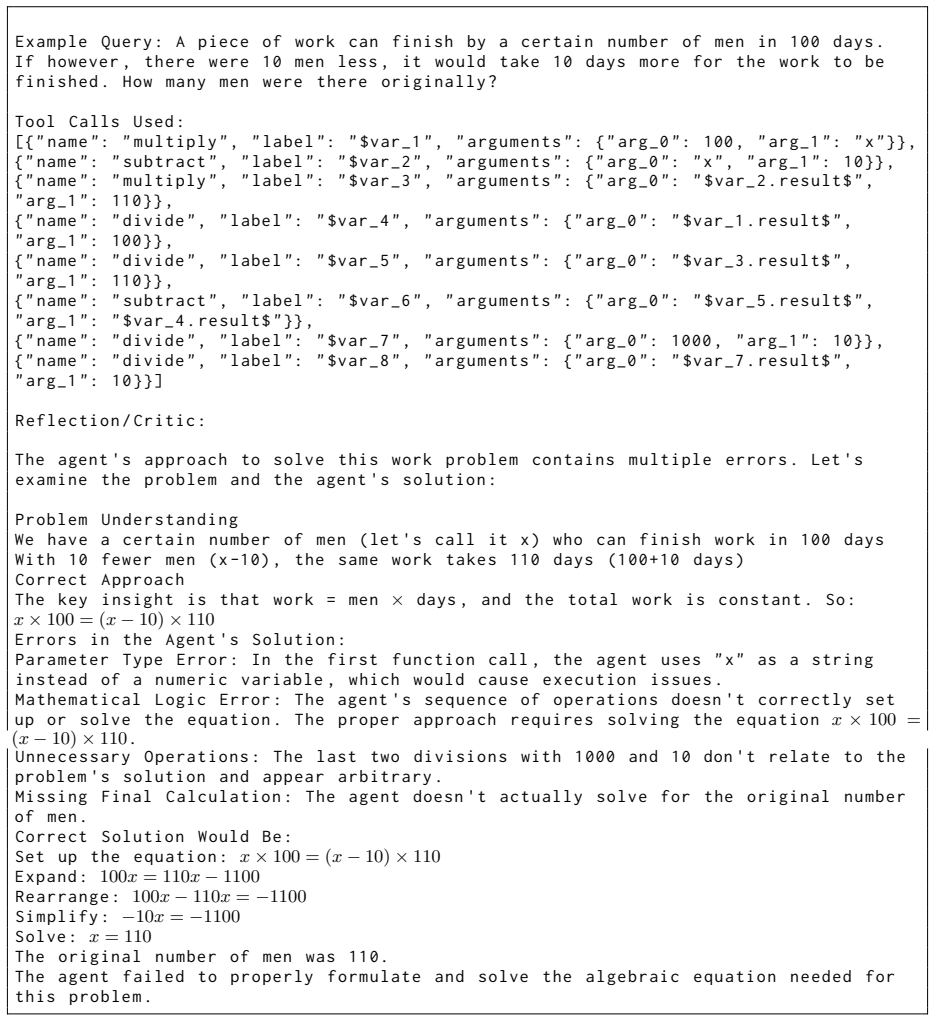
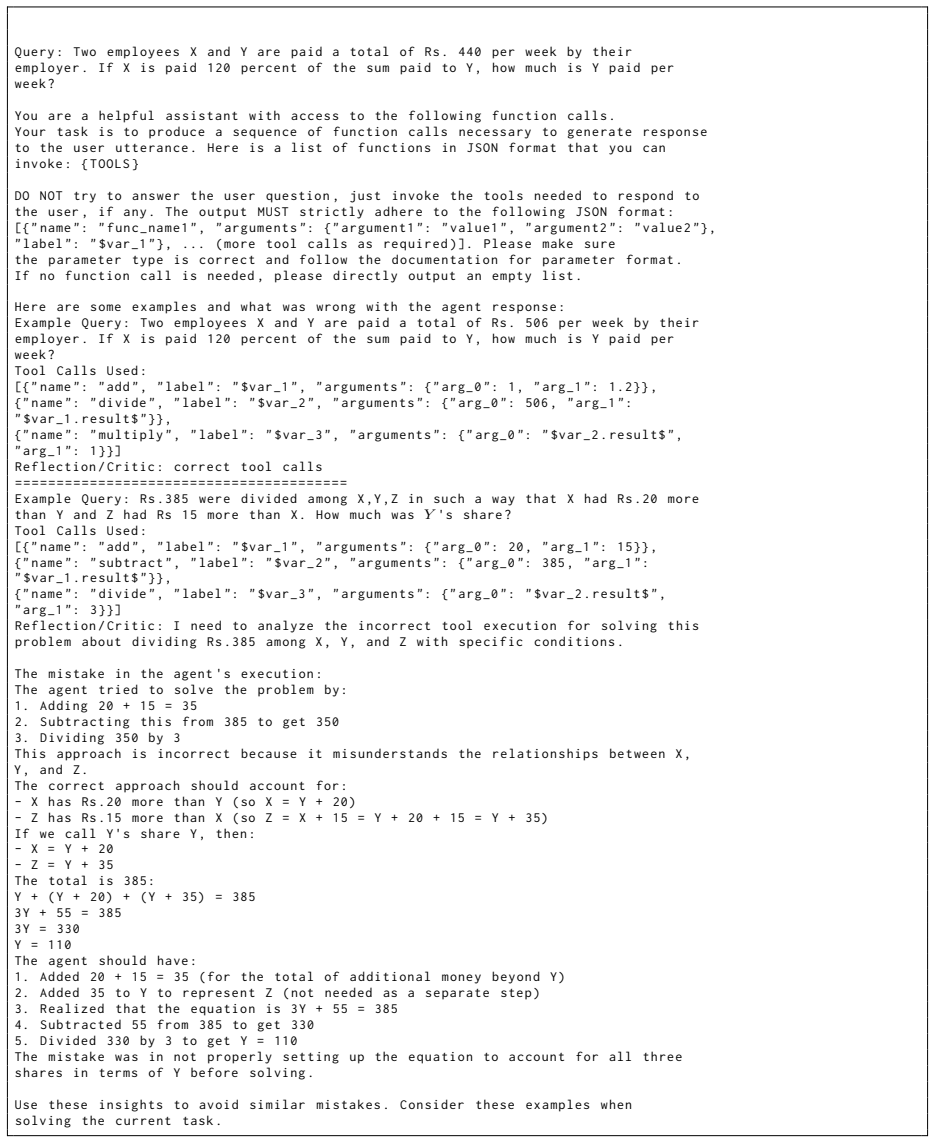
- Agents handle tasks requiring long-term history by retrieving a variable number of past entries on demand.
- The same memory format supports both general-purpose and personalized tool-use scenarios.
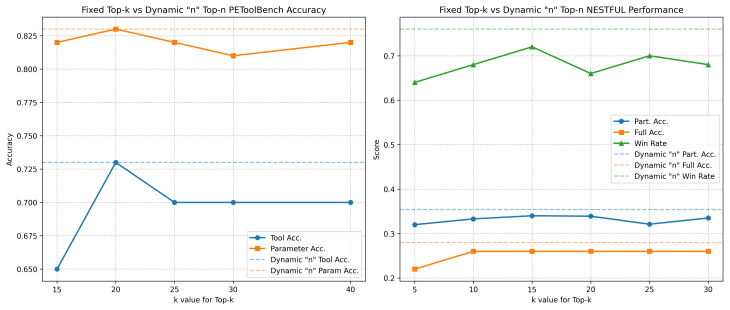
- Dynamic selection based on similarity distribution avoids fixed context limits while controlling noise.
Where Pith is reading between the lines
- The memory format could be tested for transfer across entirely different tool sets or agent architectures.
- Storing critiques rather than full trajectories may scale better to very long interaction histories.
- If the extraction step generalizes, similar reflection could apply to non-tool agent behaviors such as planning or dialogue.
- Combining this retrieval with existing context-window methods might produce additive gains on harder tasks.
Load-bearing premise
The reflection process can reliably convert past mistakes and feedback into clean, useful memory entries without introducing noise or irrelevant details.
What would settle it
Running the three benchmarks with the memory extraction module disabled and finding no performance difference from the baselines would falsify the central claim.
Figures






read the original abstract
Modern large language model (LLM) agents can use external tools to help users solve complex tasks. However, for problems that require learning from long-term historical events or from previous agent-environment interactions, LLM agents are required to use memory mechanisms to store and retrieve experiences. While sophisticated memory systems exist for dialogue agents, few studies have empirically examined how to improve agents' tool-using capabilities through past user-agent conversations. We propose MemToolAgent, a framework that improves tool use through memory management. Our approach contains a memory extraction module that processes past experiences into structured memory entries, and a retrieval module that dynamically selects a subset of the stored memory entries. This enables more personalized and accurate responses aligned with user preferences and feedback without requiring LLM fine-tuning. In summary, this work has three main contributions: (1) a unified memory entry format that improves both general-purpose and personalized tool use without LLM fine-tuning, (2) a reflection-based memory extraction that uses environment and user feedback to distill wrong executions into critiques to store, and (3) a retrieval module that chooses how many past experiences to use based on the memory similarity distribution. MemToolAgent achieves 29%, 80%, and 17% relative improvements compared to strong baselines on the WorkBench, NESTFUL, and PEToolBench benchmarks, respectively.
Editorial analysis
A structured set of objections, weighed in public.
Referee Report
Summary. The paper introduces MemToolAgent, a framework for LLM-based tool-using agents that incorporates memory management via a reflection-based extraction module (which distills past executions and environment/user feedback into structured critiques) and a similarity-based retrieval module (which dynamically selects memories according to their distribution). The central empirical claim is that this yields relative improvements of 29%, 80%, and 17% over strong baselines on the WorkBench, NESTFUL, and PEToolBench benchmarks, respectively, without requiring LLM fine-tuning. Three contributions are highlighted: a unified memory entry format, the reflection-based extraction process, and the distribution-aware retrieval mechanism.
Significance. If the reported gains are shown to be robust and attributable to the memory components, the work could meaningfully advance adaptive tool-use agents by enabling learning from historical interactions and feedback. The avoidance of fine-tuning and the focus on structured memory for personalization are practical strengths. No machine-checked proofs, open reproducible code, or parameter-free derivations are described, so the significance rests entirely on the empirical validation.
major comments (1)
- [Abstract] Abstract: the central claim of 29%, 80%, and 17% relative improvements on WorkBench, NESTFUL, and PEToolBench is load-bearing for the paper's contribution, yet the text provides no description of the benchmarks, the 'strong baselines,' the exact reflection prompting procedure, ablation studies isolating the memory extraction/retrieval modules, statistical significance tests, or controls for context length. Without these, it is impossible to determine whether the structured memory entries (rather than other factors) drive the gains.
minor comments (1)
- [Abstract] The abstract lists three contributions but does not indicate whether the unified memory format is evaluated separately from the reflection and retrieval modules.
Simulated Author's Rebuttal
We thank the referee for the constructive feedback. The primary concern raised is that the abstract lacks sufficient detail on benchmarks, baselines, procedures, ablations, significance tests, and context controls, making it difficult to attribute gains to the memory components. We address this point below and agree that revisions to the abstract are warranted for clarity.
read point-by-point responses
-
Referee: [Abstract] Abstract: the central claim of 29%, 80%, and 17% relative improvements on WorkBench, NESTFUL, and PEToolBench is load-bearing for the paper's contribution, yet the text provides no description of the benchmarks, the 'strong baselines,' the exact reflection prompting procedure, ablation studies isolating the memory extraction/retrieval modules, statistical significance tests, or controls for context length. Without these, it is impossible to determine whether the structured memory entries (rather than other factors) drive the gains.
Authors: We agree that the abstract, due to its brevity, does not include these details, which are instead provided in the body of the paper. Section 4 describes the three benchmarks (WorkBench, NESTFUL, PEToolBench) including their tasks and metrics. Section 5.1 details the strong baselines (including ReAct, Reflexion, and others) and implementation. The reflection-based extraction procedure, including the exact prompting, is specified in Section 3.2 with examples. Ablation studies isolating the extraction and retrieval modules appear in Section 5.3. Statistical significance is reported via standard deviations and t-tests in the result tables of Section 5. Context length is controlled by fixing the maximum memory tokens and using the same LLM context window across conditions, as noted in the experimental setup. To address the referee's point, we will revise the abstract to include one-sentence references to these elements and the location of supporting evidence, ensuring readers can more readily evaluate the claims without needing to read the full paper first. revision: yes
Circularity Check
No circularity: purely empirical claims with no derivations or load-bearing self-citations
full rationale
The paper contains no equations, derivations, parameter fittings, or mathematical claims. All contributions are described as a new framework (memory extraction via reflection, similarity-based retrieval) evaluated on external benchmarks. No self-citation is used to justify uniqueness or forbid alternatives; results are presented as empirical outcomes rather than forced by construction. This matches the default non-circular case for empirical work.
Axiom & Free-Parameter Ledger
Reference graph
Works this paper leans on
-
[1]
Prateek Chhikara, Dev Khant, Saket Aryan, Taranjeet Singh, and Deshraj Yadav
T1: A tool-oriented conversational dataset for multi-turn agentic planning.arXiv preprint arXiv:2505.16986. Prateek Chhikara, Dev Khant, Saket Aryan, Taranjeet Singh, and Deshraj Yadav. 2025. Mem0: Building production-ready ai agents with scalable long-term memory.arXiv preprint arXiv:2504.19413. Runnan Fang, Yuan Liang, Xiaobin Wang, Jialong Wu, Shuofei ...
-
[2]
arXiv preprint arXiv:2510.04851 , year=
Legomem: Modular procedural memory for multi-agent llm systems for workflow automation. arXiv preprint arXiv:2510.04851. Ryo Kamoi, Yusen Zhang, Nan Zhang, Jiawei Han, and Rui Zhang. 2024. When can llms actually cor- rect their own mistakes? a critical survey of self- correction of llms.Transactions of the Association for Computational Linguistics, 12:141...
-
[3]
kneedle
Vlm agents generate their own memories: Dis- tilling experience into embodied programs of thought. Advances in Neural Information Processing Systems, 37:75942–75985. Ville Satopaa, Jeannie Albrecht, David Irwin, and Barath Raghavan. 2011. Finding a" kneedle" in a haystack: Detecting knee points in system behavior. In2011 31st international conference on d...
2011
-
[4]
Chihiro Taguchi, Seiji Maekawa, and Nikita Bhutani
Workbench: a benchmark dataset for agents in a realistic workplace setting.arXiv preprint arXiv:2405.00823. Chihiro Taguchi, Seiji Maekawa, and Nikita Bhutani
-
[5]
Efficient context selection for long-context qa: No tuning, no iteration, just adaptive- k.arXiv preprint arXiv:2506.08479. Zhen Tan, Jun Yan, I Hsu, Rujun Han, Zifeng Wang, Long T Le, Yiwen Song, Yanfei Chen, Hamid Palangi, George Lee, and 1 others. 2025. In prospect and retrospect: Reflective memory management for long-term personalized dialogue agents....
-
[6]
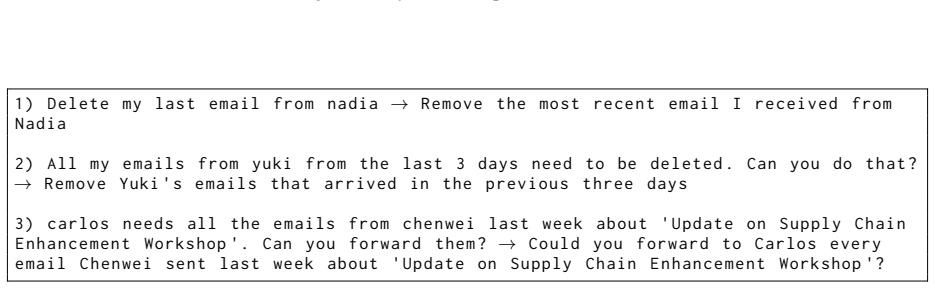
Delete my last email from nadia→Remove the most recent email I received from Nadia
-
[7]
Can you do that ? →Remove Yuki's emails that arrived in the previous three days
All my emails from yuki from the last 3 days need to be deleted . Can you do that ? →Remove Yuki's emails that arrived in the previous three days
-
[8]
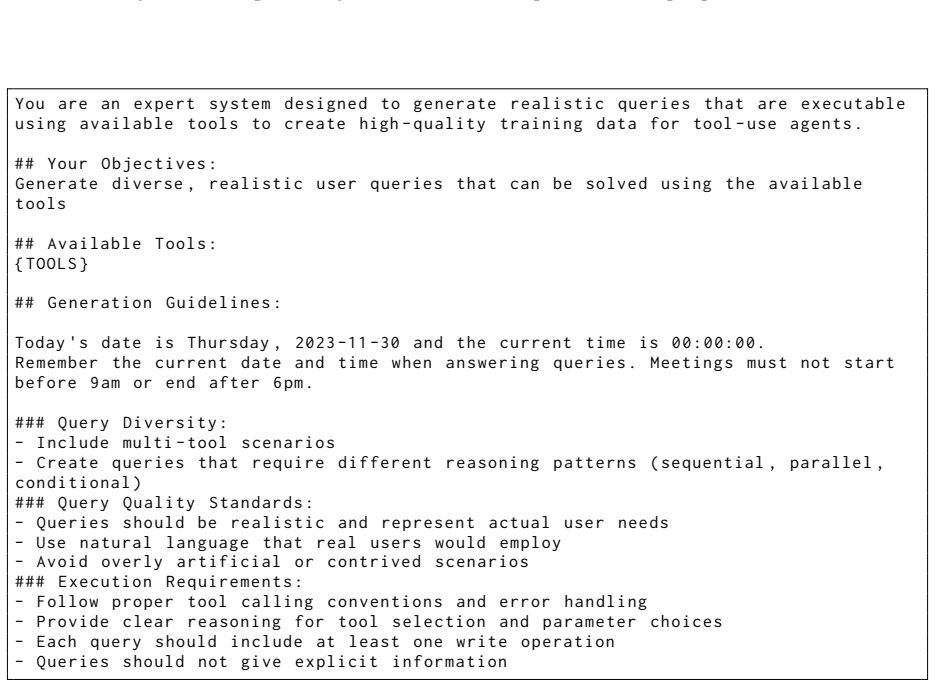
carlos needs all the emails from chenwei last week about'Update on Supply Chain Enhancement Workshop'. Can you forward them ?→Could you forward to Carlos every email Chenwei sent last week about'Update on Supply Chain Enhancement Workshop'? Figure 11: Examples of original WorkBench email queries and their paraphrased forms You are an expert system designe...
2023
-
[9]
Find emails from Lena about homepage alignment issues from October , delete them since that project is done , and send her an email about the new homepage design meeting scheduled for December 5 th at 11 am
-
[10]
I want to make sure she's up to speed before our meeting tomorrow
Forward Fatima the latest quarterly tech roundup email from Dmitri . I want to make sure she's up to speed before our meeting tomorrow
-
[11]
tool_name
I need to reply to Santiago's latest email about the UX feedback submission improvements . Tell him I've reviewed it and it looks great , but I'd like to discuss the project timeline adjustments he mentioned next week . Figure 13: Example synthetic queries for WorkBench email domain Your task is to use a tool that not only meets real - time user instructi...
-
[12]
Subtracting this from 385 to get 350
-
[13]
Dividing 350 by 3 This approach is incorrect because it misunderstands the relationships between X , Y , and Z . The correct approach should account for : - X has Rs .20 more than Y ( so X = Y + 20) - Z has Rs .15 more than X ( so Z = X + 15 = Y + 20 + 15 = Y + 35) If we call Y's share Y , then : - X = Y + 20 - Z = Y + 35 The total is 385: Y + ( Y + 20) +...
-
[14]
Added 20 + 15 = 35 ( for the total of additional money beyond Y )
-
[15]
Added 35 to Y to represent Z ( not needed as a separate step )
-
[16]
Realized that the equation is 3 Y + 55 = 385
-
[17]
Subtracted 55 from 385 to get 330
-
[18]
Use these insights to avoid similar mistakes
Divided 330 by 3 to get Y = 110 The mistake was in not properly setting up the equation to account for all three shares in terms of Y before solving . Use these insights to avoid similar mistakes . Consider these examples when solving the current task . Figure 18: Example NESTFUL system prompt with a test query and retrieved memory entries
discussion (0)
Sign in with ORCID, Apple, or X to comment. Anyone can read and Pith papers without signing in.