Property-Informed Diffusion-Based Text-to-Microstructure Generation
Pith reviewed 2026-06-27 19:46 UTC · model grok-4.3
The pith
Text prompts describing material properties guide a diffusion model to generate 3D microstructures.
A machine-rendered reading of the paper's core claim, the machinery that carries it, and where it could break.
Core claim
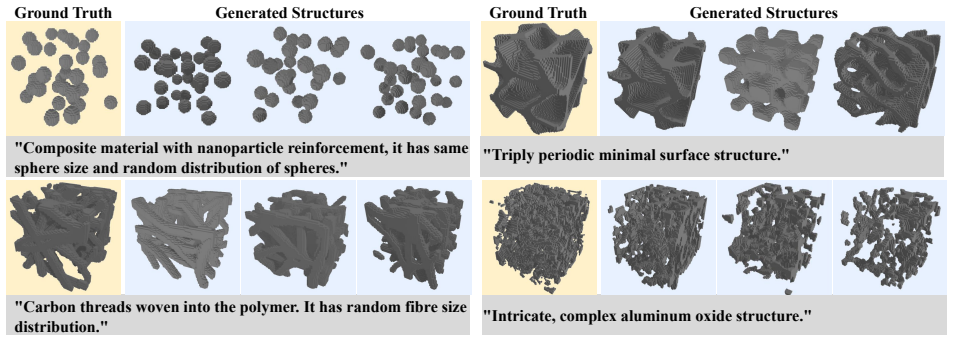
The property-informed diffusion-based network generates 3D microstructures directly from textual descriptions by leveraging rich semantic and physical-property guidance contained in the text input, with consistency enforced by a dual alignment strategy that includes contrastive text-structure alignment and test-time reward-guided alignment, yielding structures that are semantically meaningful and physically plausible across a wide range of material categories.
What carries the argument
Property-informed diffusion-based network using dual alignment of text prompts with generated structures
If this is right
- Structures can be produced across a wide range of material categories.
- Interactive microstructure design becomes possible through language interfaces.
- Language-based methods can be combined with inverse material discovery.
- Diverse outputs arise without requiring additional explicit physics constraints.
Where Pith is reading between the lines
- Non-experts could explore metamaterial ideas by writing ordinary descriptions of desired behavior.
- The same text interface might later connect to real-time simulators that refine outputs on the fly.
- Prompt engineering could target entirely new material classes beyond those seen during training.
Load-bearing premise
Textual prompts supply enough semantic and physical-property detail to produce diverse, feasible 3D microstructures without added explicit physics rules or post-generation checks.
What would settle it
Generate a structure from a prompt that specifies a target mechanical property such as high stiffness, then run finite-element simulation on the output and observe whether the measured stiffness matches the described target.
Figures
read the original abstract
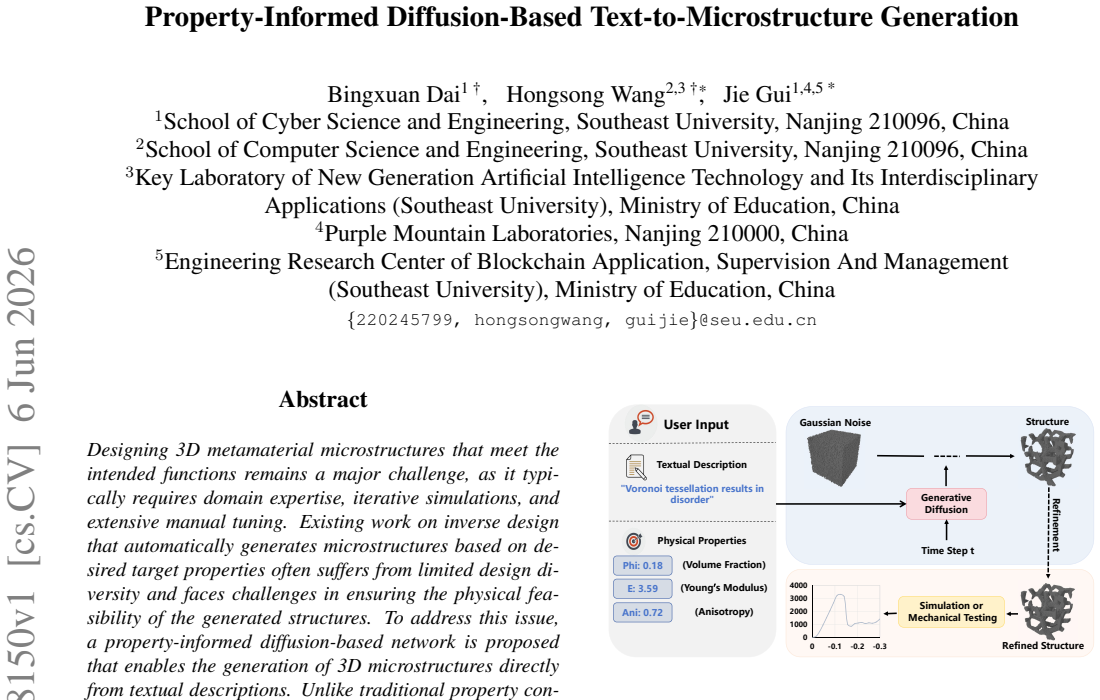
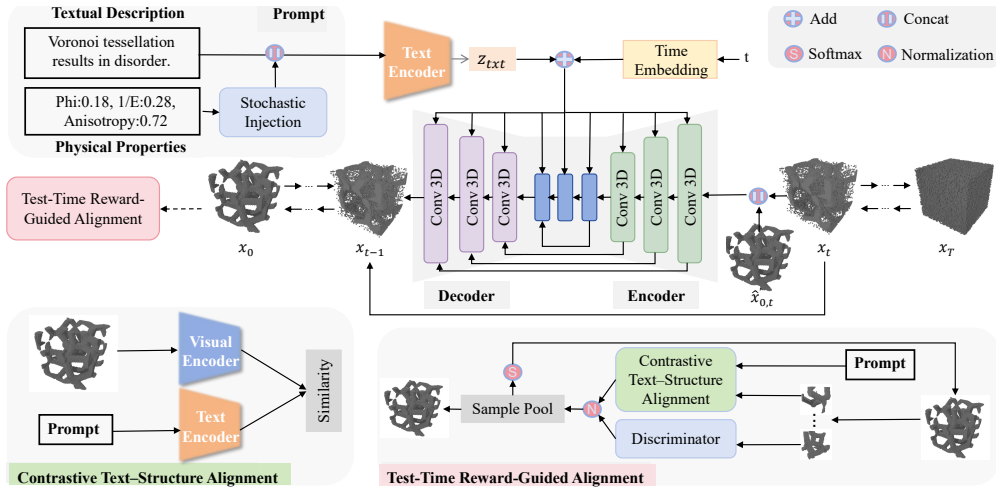
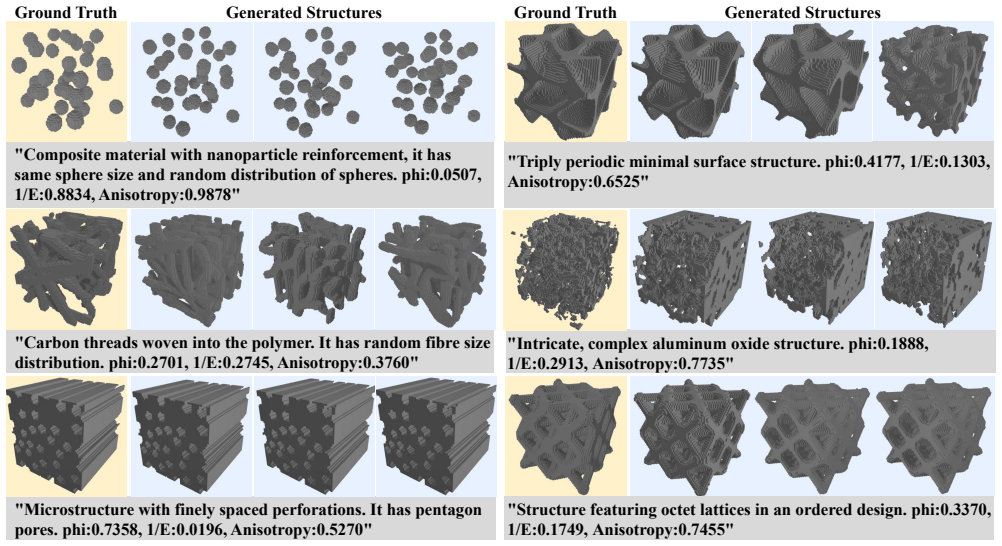
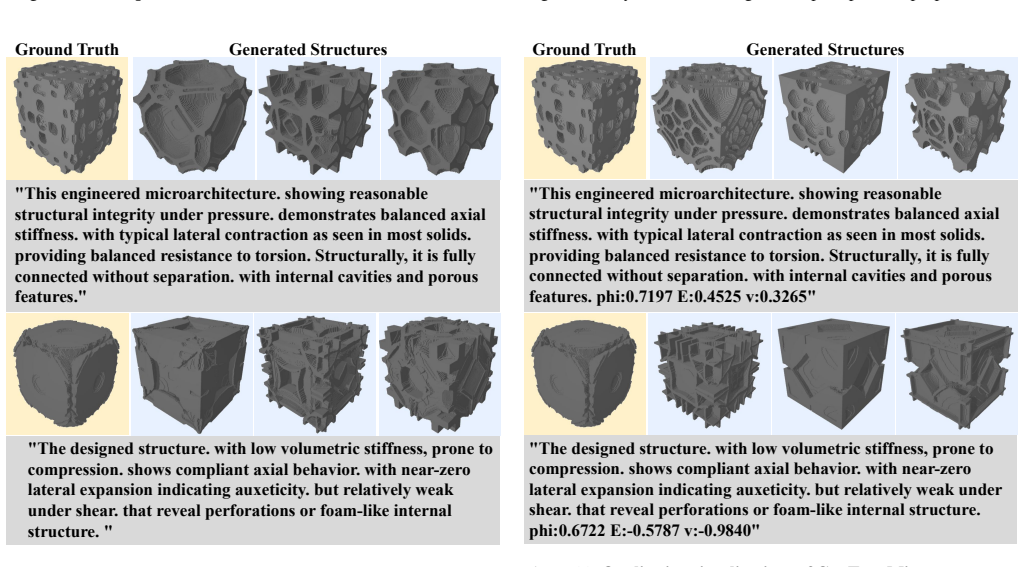
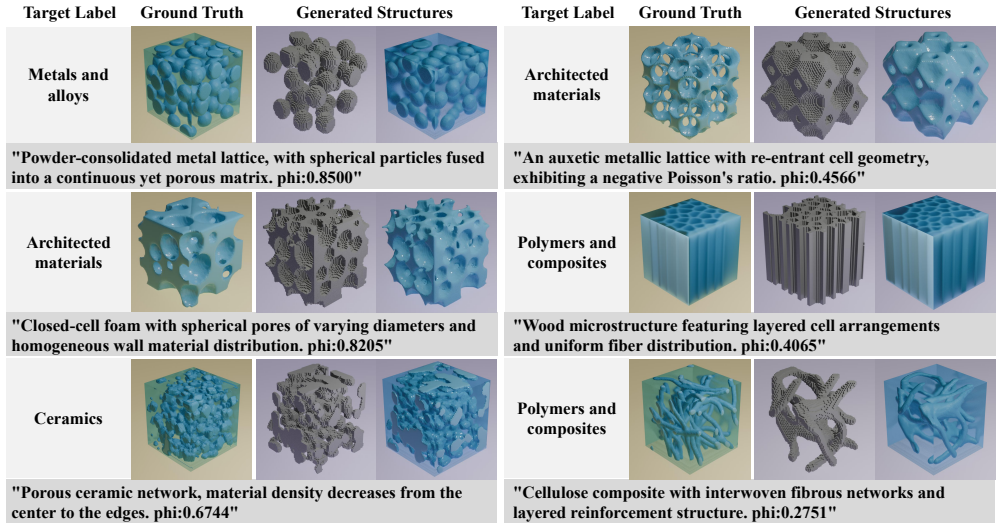
Designing 3D metamaterial microstructures that meet the intended functions remains a major challenge, as it typically requires domain expertise, iterative simulations, and extensive manual tuning. Existing work on inverse design that automatically generates microstructures based on desired target properties often suffers from limited design diversity and faces challenges in ensuring the physical feasibility of the generated structures. To address this issue, a property-informed diffusion-based network is proposed that enables the generation of 3D microstructures directly from textual descriptions. Unlike traditional property conditioning methods, our approach leverages rich guidance in terms of semantics and physical properties in the text input to support diverse structure synthesis. To enforce consistency between the generated structures and the target textual prompts, a dual alignment strategy is adopted, including contrastive text-structure alignment and test-time reward-guided alignment. Experimental results show that the model is capable of generating semantically meaningful and physically plausible structures across a wide range of material categories. Our approach has good potential for interactive microstructure design and opens up new directions for combining language-based interfaces with inverse material discovery. Code is available at: https://github.com/hongsong-wang/PropDiff-TMG
Editorial analysis
A structured set of objections, weighed in public.
Referee Report
Summary. The paper proposes a property-informed diffusion model for text-to-3D-microstructure generation that conditions on textual prompts encoding both semantics and physical properties. It introduces a dual alignment strategy (contrastive text-structure alignment during training plus test-time reward-guided alignment) to enforce prompt consistency without explicit physics constraints in the diffusion process. The central claim is that the resulting structures are both semantically meaningful and physically plausible across material categories, supported by experimental results, with code released at the provided GitHub link.
Significance. If the physical-plausibility claim is substantiated with quantitative validation, the work would offer a language-based interface for inverse microstructure design that improves diversity over property-vector conditioning methods. The public code release is a clear strength for reproducibility. The approach sits at the intersection of conditional diffusion models and materials inverse design but requires stronger evidence on property fidelity to realize its stated potential.
major comments (2)
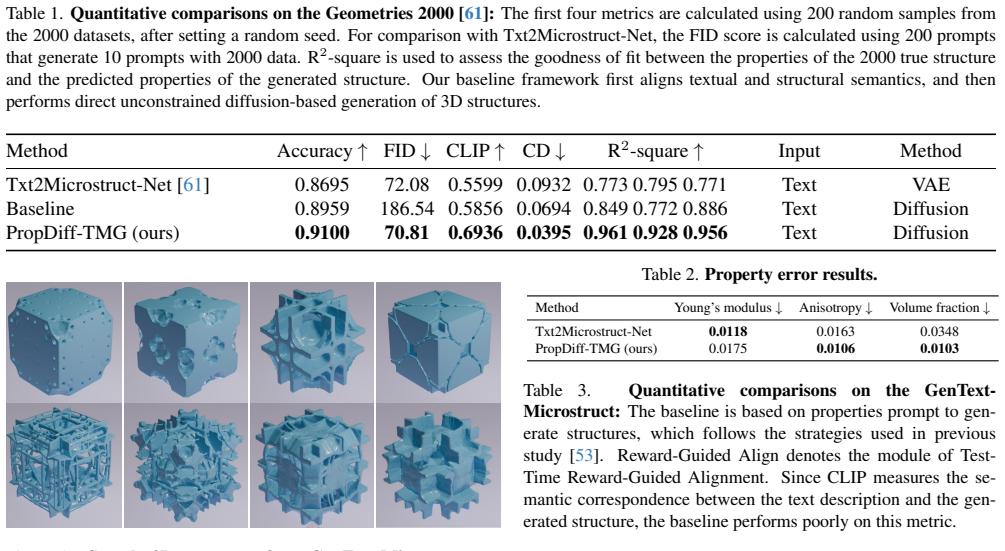
- [Experimental Results] Experimental Results section: the claim that generated structures are 'physically plausible' is unsupported by any reported quantitative metrics (e.g., effective stiffness, thermal conductivity, or porosity obtained via homogenization or finite-element simulation), baseline comparisons, or error bars. Plausibility appears to rest solely on visual inspection and semantic similarity, which is load-bearing for the central claim given the absence of hard physics constraints or post-generation validation.
- [Methods] Methods, dual alignment strategy: the reward function used in test-time alignment is defined via learned text embeddings rather than direct property simulation; no ablation or sensitivity analysis is provided to show that this reward reliably encodes quantitative physical targets (e.g., target Young's modulus) rather than merely semantic similarity.
minor comments (2)
- [Abstract] The abstract states 'experimental results show' success but supplies no numerical values; adding a concise quantitative summary table in the abstract or introduction would improve clarity.
- [Methods] Notation for the alignment losses (contrastive and reward-guided) should be introduced with explicit equations and hyper-parameter values in the main text rather than only in supplementary material.
Simulated Author's Rebuttal
We thank the referee for the constructive feedback. We address the two major comments point by point below. Where the comments identify gaps in quantitative validation, we agree that revisions are needed to strengthen the manuscript.
read point-by-point responses
-
Referee: [Experimental Results] Experimental Results section: the claim that generated structures are 'physically plausible' is unsupported by any reported quantitative metrics (e.g., effective stiffness, thermal conductivity, or porosity obtained via homogenization or finite-element simulation), baseline comparisons, or error bars. Plausibility appears to rest solely on visual inspection and semantic similarity, which is load-bearing for the central claim given the absence of hard physics constraints or post-generation validation.
Authors: We agree that the physical-plausibility claim would be substantially strengthened by quantitative metrics. The current experiments rely on visual inspection and semantic similarity scores, which do not directly measure physical properties. In the revised manuscript we will add homogenization-based simulations (finite-element analysis) reporting effective stiffness, thermal conductivity, and porosity for generated samples across material categories, together with baseline comparisons and error bars. These additions will be placed in an expanded Experimental Results section. revision: yes
-
Referee: [Methods] Methods, dual alignment strategy: the reward function used in test-time alignment is defined via learned text embeddings rather than direct property simulation; no ablation or sensitivity analysis is provided to show that this reward reliably encodes quantitative physical targets (e.g., target Young's modulus) rather than merely semantic similarity.
Authors: We acknowledge that an explicit demonstration of the reward function's correlation with quantitative physical targets is missing. The reward is currently derived from the contrastively trained text-structure embedding space. In the revision we will include an ablation study and sensitivity analysis that compares reward values against ground-truth property values (e.g., Young's modulus obtained from simulation) to quantify how well the reward encodes physical targets beyond semantic similarity alone. revision: yes
Circularity Check
No circularity; standard conditional diffusion training with independent alignment losses
full rationale
The paper presents a property-informed diffusion model for text-to-microstructure generation using contrastive text-structure alignment during training and reward-guided alignment at test time. No equations or central claims reduce to fitted quantities defined by the target result itself, nor do they rely on self-citation chains, uniqueness theorems imported from prior author work, or ansatzes smuggled via citation. The derivation follows the standard conditional diffusion framework (forward noising, reverse denoising conditioned on text embeddings) with added alignment objectives that are independently optimized. Experimental claims of physical plausibility rest on visual and semantic evaluation rather than tautological re-derivation of inputs. This is the most common honest non-finding for modern generative modeling papers.
Axiom & Free-Parameter Ledger
free parameters (1)
- alignment loss weights
axioms (1)
- domain assumption Text embeddings can jointly encode semantic intent and quantitative physical targets sufficiently well to guide microstructure synthesis.
Reference graph
Works this paper leans on
-
[1]
Ren- derdiffusion: Image diffusion for 3d reconstruction, inpaint- ing and generation
Titas Anciukevi ˇcius, Zexiang Xu, Matthew Fisher, Paul Hen- derson, Hakan Bilen, Niloy J Mitra, and Paul Guerrero. Ren- derdiffusion: Image diffusion for 3d reconstruction, inpaint- ing and generation. InProceedings of the IEEE/CVF Con- ference on Computer Vision and Pattern Recognition, pages 12608–12618, 2023. 3
2023
-
[2]
Inverse de- sign of nonlinear mechanical metamaterials via video de- noising diffusion models.Nature Machine Intelligence, 5 (12):1466–1475, 2023
Jan-Hendrik Bastek and Dennis M Kochmann. Inverse de- sign of nonlinear mechanical metamaterials via video de- noising diffusion models.Nature Machine Intelligence, 5 (12):1466–1475, 2023. 2
2023
-
[3]
Lan- guage models are few-shot learners.Advances in Neural In- formation Processing Systems, 33:1877–1901, 2020
Tom Brown, Benjamin Mann, Nick Ryder, Melanie Sub- biah, Jared D Kaplan, Prafulla Dhariwal, Arvind Neelakan- tan, Pranav Shyam, Girish Sastry, Amanda Askell, et al. Lan- guage models are few-shot learners.Advances in Neural In- formation Processing Systems, 33:1877–1901, 2020. 2
1901
-
[4]
Generating 3d architectured nature- inspired materials and granular media using diffusion models based on language cues.Oxford Open Materials Science, 2 (1):itac010, 2022
Markus J Buehler. Generating 3d architectured nature- inspired materials and granular media using diffusion models based on language cues.Oxford Open Materials Science, 2 (1):itac010, 2022. 2
2022
-
[5]
Clip-driven open-vocabulary 3d scene graph generation via cross-modality contrastive learning
Lianggangxu Chen, Xuejiao Wang, Jiale Lu, Shaohui Lin, Changbo Wang, and Gaoqi He. Clip-driven open-vocabulary 3d scene graph generation via cross-modality contrastive learning. InProceedings of the IEEE/CVF Conference on Computer Vision and Pattern Recognition, pages 27863– 27873, 2024. 5
2024
-
[6]
Simultaneously enhancing the ulti- mate strength and ductility of high-entropy alloys via short- range ordering.Nature Communications, 12(1):4953, 2021
Shuai Chen, Zachary H Aitken, Subrahmanyam Pattamatta, Zhaoxuan Wu, Zhi Gen Yu, David J Srolovitz, Peter K Liaw, and Yong-Wei Zhang. Simultaneously enhancing the ulti- mate strength and ductility of high-entropy alloys via short- range ordering.Nature Communications, 12(1):4953, 2021. 1
2021
-
[7]
Diffusiondet: Diffusion model for object detection
Ting Chen, Ruixiang Zhang, and Geoffrey Hinton. Analog bits: Generating discrete data using diffusion models with self-conditioning.arXiv preprint arXiv:2208.04202, 2022. 3
-
[8]
3dtopia-xl: Scaling high- quality 3d asset generation via primitive diffusion
Zhaoxi Chen, Jiaxiang Tang, Yuhao Dong, Ziang Cao, Fangzhou Hong, Yushi Lan, Tengfei Wang, Haozhe Xie, Tong Wu, Shunsuke Saito, et al. 3dtopia-xl: Scaling high- quality 3d asset generation via primitive diffusion. InPro- ceedings of the Computer Vision and Pattern Recognition Conference, pages 26576–26586, 2025. 3
2025
-
[9]
Recent advances and applications of deep learning methods in ma- terials science.npj Computational Materials, 8(1):59, 2022
Kamal Choudhary, Brian DeCost, Chi Chen, Anubhav Jain, Francesca Tavazza, Ryan Cohn, Cheol Woo Park, Alok Choudhary, Ankit Agrawal, Simon JL Billinge, et al. Recent advances and applications of deep learning methods in ma- terials science.npj Computational Materials, 8(1):59, 2022. 2
2022
-
[10]
Kishalay Das, Subhojyoti Khastagir, Pawan Goyal, Seung- Cheol Lee, Satadeep Bhattacharjee, and Niloy Ganguly. Pe- riodic materials generation using text-guided joint diffusion model.arXiv preprint arXiv:2503.00522, 2025. 3
-
[11]
Bert: Pre-training of deep bidirectional trans- formers for language understanding
Jacob Devlin, Ming-Wei Chang, Kenton Lee, and Kristina Toutanova. Bert: Pre-training of deep bidirectional trans- formers for language understanding. InProceedings of the Conference of the North American Chapter of the Associa- tion for Computational Linguistics: Human Language Tech- nologies, pages 4171–4186, 2019. 5, 10
2019
-
[12]
Disordered enthalpy–entropy descriptor for high-entropy ceramics dis- covery.Nature, 625(7993):66–73, 2024
Simon Divilov, Hagen Eckert, David Hicks, Corey Oses, Cormac Toher, Rico Friedrich, Marco Esters, Michael J Mehl, Adam C Zettel, Yoav Lederer, et al. Disordered enthalpy–entropy descriptor for high-entropy ceramics dis- covery.Nature, 625(7993):66–73, 2024. 1
2024
-
[13]
Connecting microstructures for multiscale topology optimization with connectivity index constraints.Journal of Mechanical Design, 140(11):111417, 2018
Zongliang Du, Xiao-Yi Zhou, Renato Picelli, and H Alicia Kim. Connecting microstructures for multiscale topology optimization with connectivity index constraints.Journal of Mechanical Design, 140(11):111417, 2018. 2
2018
-
[14]
Svim3d: Stable video material diffusion for single image 3d generation
Andreas Engelhardt, Mark Boss, Vikram V oleti, Chun-Han Yao, Hendrik Lensch, and Varun Jampani. Svim3d: Stable video material diffusion for single image 3d generation. In Proceedings of the IEEE/CVF International Conference on Computer Vision, pages 28428–28439, 2025. 3
2025
-
[15]
A comprehen- sive review of isogeometric topology optimization: methods, applications and prospects.Chinese Journal of Mechanical Engineering, 33:1–14, 2020
Jie Gao, Mi Xiao, Yan Zhang, and Liang Gao. A comprehen- sive review of isogeometric topology optimization: methods, applications and prospects.Chinese Journal of Mechanical Engineering, 33:1–14, 2020. 2
2020
-
[16]
CAT3D: Create Anything in 3D with Multi-View Diffusion Models
Ruiqi Gao, Aleksander Holynski, Philipp Henzler, Arthur Brussee, Ricardo Martin-Brualla, Pratul Srinivasan, Jonathan T Barron, and Ben Poole. Cat3d: Create anything in 3d with multi-view diffusion models.arXiv preprint arXiv:2405.10314, 2024. 3
work page internal anchor Pith review Pith/arXiv arXiv 2024
-
[17]
Polymer-inspired mechanical metamaterials
Zhenyang Gao, Pengyuan Ren, Yifeng Dong, Gengchen Zheng, Min-Son Pham, Xiao Shang, Shaojia Wang, Shuo Yang, Zijue Tang, Yongbing Li, et al. Polymer-inspired me- chanical metamaterials.arXiv preprint arXiv:2512.16732,
work page internal anchor Pith review Pith/arXiv arXiv
-
[18]
Generative meta- materials based on large language models.arXiv preprint arXiv:2601.17997, 2026
Zhenyang Gao, Gengchen Zheng, Pengyuan Ren, Hongsong Wang, Kun Zhou, Minh-Son Pham, Yi Wu, Yu Zou, Chu Lun Alex Leung, Yuanyuan Tian, et al. Generative meta- materials based on large language models.arXiv preprint arXiv:2601.17997, 2026. 1, 2
-
[19]
Compatibility in microstructural op- timization for additive manufacturing.Additive Manufactur- ing, 26:65–75, 2019
Eric Garner, Helena MA Kolken, Charlie CL Wang, Amir A Zadpoor, and Jun Wu. Compatibility in microstructural op- timization for additive manufacturing.Additive Manufactur- ing, 26:65–75, 2019. 2
2019
-
[20]
Inverse-designed 3d sequential meta- materials achieving extreme stiffness.Materials & Design, 247:113350, 2024
Jiacheng Han, Xiaoya Zhai, Lili Wang, Di Zhang, Junhao Ding, Winston Wai Shing Ma, Xu Song, Wei-Hsin Liao, Lig- ang Liu, Jun Wu, et al. Inverse-designed 3d sequential meta- materials achieving extreme stiffness.Materials & Design, 247:113350, 2024. 2
2024
-
[21]
Materialmvp: Illumination- invariant material generation via multi-view pbr diffusion
Zebin He, Mingxin Yang, Shuhui Yang, Yixuan Tang, Tao Wang, Kaihao Zhang, Guanying Chen, Yuhong Liu, Jie Jiang, Chunchao Guo, et al. Materialmvp: Illumination- invariant material generation via multi-view pbr diffusion. arXiv preprint arXiv:2503.10289, 2025. 3
-
[22]
Denoising diffu- sion probabilistic models.Advances in Neural Information Processing Systems, 33:6840–6851, 2020
Jonathan Ho, Ajay Jain, and Pieter Abbeel. Denoising diffu- sion probabilistic models.Advances in Neural Information Processing Systems, 33:6840–6851, 2020. 3
2020
-
[23]
Gener- ative design, manufacturing, and molecular modeling of 3d architected materials based on natural language input.APL Materials, 10(4), 2022
Yu-Chuan Hsu, Zhenze Yang, and Markus J Buehler. Gener- ative design, manufacturing, and molecular modeling of 3d architected materials based on natural language input.APL Materials, 10(4), 2022. 2
2022
-
[24]
Ma- terial anything: Generating materials for any 3d object via diffusion
Xin Huang, Tengfei Wang, Ziwei Liu, and Qing Wang. Ma- terial anything: Generating materials for any 3d object via diffusion. InProceedings of the Computer Vision and Pat- tern Recognition Conference, pages 26556–26565, 2025. 3
2025
-
[25]
Artificial intelligence- enabled smart mechanical metamaterials: advent and fu- ture trends.International Materials Reviews, 66(6):365–393,
Pengcheng Jiao and Amir H Alavi. Artificial intelligence- enabled smart mechanical metamaterials: advent and fu- ture trends.International Materials Reviews, 66(6):365–393,
-
[26]
Deep learning for topology optimization of 2d metamaterials.Materials & Design, 196: 109098, 2020
Hunter T Kollmann, Diab W Abueidda, Seid Koric, Erman Guleryuz, and Nahil A Sobh. Deep learning for topology optimization of 2d metamaterials.Materials & Design, 196: 109098, 2020. 2
2020
-
[27]
Inverse-designed spinodoid metamaterials.npj Computational Materials, 6(1):73, 2020
Siddhant Kumar, Stephanie Tan, Li Zheng, and Dennis M Kochmann. Inverse-designed spinodoid metamaterials.npj Computational Materials, 6(1):73, 2020. 2
2020
-
[28]
Data-driven design for metamaterials and mul- tiscale systems: a review.Advanced Materials, 36(8): 2305254, 2024
Doksoo Lee, Wei Chen, Liwei Wang, Yu-Chin Chan, and Wei Chen. Data-driven design for metamaterials and mul- tiscale systems: a review.Advanced Materials, 36(8): 2305254, 2024. 2
2024
-
[29]
Junhyeong Lee, Donggeun Park, Mingyu Lee, Hugon Lee, Kundo Park, Ikjin Lee, and Seunghwa Ryu. Machine learning-based inverse design methods considering data characteristics and design space size in materials design and manufacturing: a review.Materials horizons, 10(12):5436– 5456, 2023. 2
2023
-
[30]
Diffusion renderer: Neural inverse and forward rendering with video diffusion models
Ruofan Liang, Zan Gojcic, Huan Ling, Jacob Munkberg, Jon Hasselgren, Chih-Hao Lin, Jun Gao, Alexander Keller, Nandita Vijaykumar, Sanja Fidler, et al. Diffusion renderer: Neural inverse and forward rendering with video diffusion models. InProceedings of the Computer Vision and Pattern Recognition Conference, pages 26069–26080, 2025. 3
2025
-
[31]
In- verse design of 2d-mechanical metamaterials with spinodal topologies under uncertainty
Kiara L McMillan, Do ˘gacan S ¨Ozt¨urk, and Pinar Acar. In- verse design of 2d-mechanical metamaterials with spinodal topologies under uncertainty. InAIAA SCITECH 2022 Fo- rum, page 0811, 2022. 1
2022
-
[32]
Additively- manufactured lightweight metamaterials for energy absorp- tion.Materials & Design, 139:521–530, 2018
Mehrdad Mohsenizadeh, Federico Gasbarri, Michael Munther, Ali Beheshti, and Keivan Davami. Additively- manufactured lightweight metamaterials for energy absorp- tion.Materials & Design, 139:521–530, 2018. 1
2018
-
[33]
Clip-guided vision-language pre-training for question answering in 3d scenes
Maria Parelli, Alexandros Delitzas, Nikolas Hars, Geor- gios Vlassis, Sotirios Anagnostidis, Gregor Bachmann, and Thomas Hofmann. Clip-guided vision-language pre-training for question answering in 3d scenes. InProceedings of the IEEE/CVF Conference on Computer Vision and Pattern Recognition, pages 5607–5612, 2023. 5
2023
-
[34]
Film: Visual reasoning with a general conditioning layer
Ethan Perez, Florian Strub, Harm de Vries, Vincent Du- moulin, and Aaron Courville. Film: Visual reasoning with a general conditioning layer. InProceedings of the AAAI Con- ference on Artificial Intelligence, 2018. 2, 4
2018
-
[35]
Richdreamer: A generalizable normal-depth diffusion model for detail richness in text-to- 3d
Lingteng Qiu, Guanying Chen, Xiaodong Gu, Qi Zuo, Mu- tian Xu, Yushuang Wu, Weihao Yuan, Zilong Dong, Liefeng Bo, and Xiaoguang Han. Richdreamer: A generalizable normal-depth diffusion model for detail richness in text-to- 3d. InProceedings of the IEEE/CVF conference on computer vision and pattern recognition, pages 9914–9925, 2024. 3
2024
-
[36]
Improving language understanding by gen- erative pre-training
Alec Radford, Karthik Narasimhan, Tim Salimans, Ilya Sutskever, et al. Improving language understanding by gen- erative pre-training. 2018. 2
2018
-
[37]
Learn- ing transferable visual models from natural language super- vision
Alec Radford, Jong Wook Kim, Chris Hallacy, Aditya Ramesh, Gabriel Goh, Sandhini Agarwal, Girish Sastry, Amanda Askell, Pamela Mishkin, Jack Clark, et al. Learn- ing transferable visual models from natural language super- vision. InInternational Conference on Machine Learning, pages 8748–8763. PmLR, 2021. 5
2021
-
[38]
Dl-msto+: A deep learning- based multi-scale topology optimization framework via pos- itive definiteness ensured material representation network
Minsik Seo and Seungjae Min. Dl-msto+: A deep learning- based multi-scale topology optimization framework via pos- itive definiteness ensured material representation network. Computer Methods in Applied Mechanics and Engineering, 415:116276, 2023. 2
2023
-
[39]
Topology optimization methods for thermal metamaterials: A review.International Journal of Heat and Mass Transfer, 227:125588, 2024
Wei Sha, Mi Xiao, Yihui Wang, Mingzhe Huang, Qishi Li, and Liang Gao. Topology optimization methods for thermal metamaterials: A review.International Journal of Heat and Mass Transfer, 227:125588, 2024. 1
2024
-
[40]
Alchemist: Parametric control of material proper- ties with diffusion models
Prafull Sharma, Varun Jampani, Yuanzhen Li, Xuhui Jia, Dmitry Lagun, Fredo Durand, Bill Freeman, and Mark Matthews. Alchemist: Parametric control of material proper- ties with diffusion models. InProceedings of the IEEE/CVF Conference on Computer Vision and Pattern Recognition, pages 24130–24141, 2024. 3
2024
-
[41]
Systematic design of metamaterials by topol- ogy optimization
Ole Sigmund. Systematic design of metamaterials by topol- ogy optimization. InIUTAM Symposium on Modelling Nanomaterials and Nanosystems: Proceedings of the IU- TAM Symposium held in Aalborg, Denmark, 19–22 May 2008, pages 151–159. Springer, 2009. 2
2008
-
[42]
Artificial intelligence in the design of innovative meta- materials: A comprehensive review.International Journal of Precision Engineering and Manufacturing, 25(1):225–244,
JunHo Song, JaeHoon Lee, Namjung Kim, and Kyoungmin Min. Artificial intelligence in the design of innovative meta- materials: A comprehensive review.International Journal of Precision Engineering and Manufacturing, 25(1):225–244,
-
[43]
A review of mechanical metamaterials and addi- tively manufacturing techniques for biomedical applications
P Suhas, Jaimon Dennis Quadros, Yakub Iqbal Mogul, Ma Mohin, Abdul Aabid, Muneer Baig, and Omar Shabbir Ahmed. A review of mechanical metamaterials and addi- tively manufacturing techniques for biomedical applications. Materials Advances, 2025. 1
2025
-
[44]
A closer look at spatiotemporal convolutions for action recognition
Du Tran, Heng Wang, Lorenzo Torresani, Jamie Ray, Yann LeCun, and Manohar Paluri. A closer look at spatiotemporal convolutions for action recognition. InProceedings of the IEEE conference on Computer Vision and Pattern Recogni- tion, pages 6450–6459, 2018. 5, 10
2018
-
[45]
Lion: Latent point dif- fusion models for 3d shape generation.Advances in Neural Information Processing Systems, 35:10021–10039, 2022
Arash Vahdat, Francis Williams, Zan Gojcic, Or Litany, Sanja Fidler, Karsten Kreis, et al. Lion: Latent point dif- fusion models for 3d shape generation.Advances in Neural Information Processing Systems, 35:10021–10039, 2022. 2
2022
-
[46]
Matfuse: controllable material gen- eration with diffusion models
Giuseppe Vecchio, Renato Sortino, Simone Palazzo, and Concetto Spampinato. Matfuse: controllable material gen- eration with diffusion models. InProceedings of the IEEE/CVF Conference on Computer Vision and Pattern Recognition, pages 4429–4438, 2024. 3
2024
-
[47]
Diffusion models for 3d generation: A survey
Chen Wang, Hao-Yang Peng, Ying-Tian Liu, Jiatao Gu, and Shi-Min Hu. Diffusion models for 3d generation: A survey. Computational Visual Media, 11(1):1–28, 2025. 3
2025
-
[48]
Design of a metamaterial film with excellent conformability and adhesion for bandage substrates.Jour- nal of the mechanical behavior of biomedical materials, 124: 104799, 2021
Haotian Wang, Chen Pan, Haiyuan Zhao, Tingyu Wang, and Yafeng Han. Design of a metamaterial film with excellent conformability and adhesion for bandage substrates.Jour- nal of the mechanical behavior of biomedical materials, 124: 104799, 2021. 2
2021
-
[49]
Inverse design of materials by machine learning.Materials, 15(5):1811, 2022
Jia Wang, Yingxue Wang, and Yanan Chen. Inverse design of materials by machine learning.Materials, 15(5):1811, 2022. 1
2022
-
[50]
Taps3d: Text-guided 3d textured shape generation from pseudo supervision
Jiacheng Wei, Hao Wang, Jiashi Feng, Guosheng Lin, and Kim-Hui Yap. Taps3d: Text-guided 3d textured shape generation from pseudo supervision. InProceedings of the IEEE/CVF conference on computer vision and pattern recognition, pages 16805–16815, 2023. 2
2023
-
[51]
Topology opti- mization of multi-scale structures: a review.Structural and Multidisciplinary Optimization, 63(3):1455–1480, 2021
Jun Wu, Ole Sigmund, and Jeroen P Groen. Topology opti- mization of multi-scale structures: a review.Structural and Multidisciplinary Optimization, 63(3):1455–1480, 2021. 1
2021
-
[52]
A review of shape memory polymers and com- posites: mechanisms, materials, and applications.Advanced Materials, 33(6):2000713, 2021
Yuliang Xia, Yang He, Fenghua Zhang, Yanju Liu, and Jin- song Leng. A review of shape memory polymers and com- posites: mechanisms, materials, and applications.Advanced Materials, 33(6):2000713, 2021. 1
2021
-
[53]
Yanyan Yang, Lili Wang, Xiaoya Zhai, Kai Chen, Wenming Wu, Yunkai Zhao, Ligang Liu, and Xiao-Ming Fu. Guided diffusion for fast inverse design of density-based mechanical metamaterials.arXiv preprint arXiv:2401.13570, 2024. 2, 5, 6, 10
-
[54]
Words to matter: De novo architected materials design using transformer neural networks.Frontiers in Materials, 8:740754, 2021
Zhenze Yang and Markus J Buehler. Words to matter: De novo architected materials design using transformer neural networks.Frontiers in Materials, 8:740754, 2021. 2
2021
-
[55]
Mechanics of re-entrant anti-trichiral honeycombs with nature-inspired gradient distributions.International Journal of Mechanical Sciences, 259:108597, 2023
Ee Teng Zhang, Hu Liu, and Bing Feng Ng. Mechanics of re-entrant anti-trichiral honeycombs with nature-inspired gradient distributions.International Journal of Mechanical Sciences, 259:108597, 2023. 2
2023
-
[56]
Development of phase-field modeling in materials science in china: a review.Acta Metallurgica Sinica (En- glish Letters), 36(11):1749–1775, 2023
Yuhong Zhao, Hui Xing, Lijun Zhang, Houbing Huang, Dongke Sun, Xianglei Dong, Yongxing Shen, and Jincheng Wang. Development of phase-field modeling in materials science in china: a review.Acta Metallurgica Sinica (En- glish Letters), 36(11):1749–1775, 2023. 1
2023
-
[57]
Michelangelo: Conditional 3d shape generation based on shape-image-text aligned latent representation.Advances in neural information processing systems, 36:73969–73982,
Zibo Zhao, Wen Liu, Xin Chen, Xianfang Zeng, Rui Wang, Pei Cheng, Bin Fu, Tao Chen, Gang Yu, and Shenghua Gao. Michelangelo: Conditional 3d shape generation based on shape-image-text aligned latent representation.Advances in neural information processing systems, 36:73969–73982,
-
[58]
Algebraic Language Models for Inverse Design of Metamaterials via Diffusion Transformers
Li Zheng, Siddhant Kumar, and Dennis M Kochmann. Dif- fumeta: Algebraic language models for inverse design of metamaterials via diffusion transformers.arXiv preprint arXiv:2507.15753, 2025. 3
work page internal anchor Pith review Pith/arXiv arXiv 2025
-
[59]
A mathematically defined 3d auxetic metamaterial with tunable mechanical and conduction properties.Materials & Design, 198:109313, 2021
Xiaoyang Zheng, Xiaofeng Guo, and Ikumu Watanabe. A mathematically defined 3d auxetic metamaterial with tunable mechanical and conduction properties.Materials & Design, 198:109313, 2021. 2
2021
-
[60]
Xiaoyang Zheng, Ta-Te Chen, Xiaoyu Jiang, Masanobu Naito, and Ikumu Watanabe. Deep-learning-based inverse design of three-dimensional architected cellular materials with the target porosity and stiffness using voxelized voronoi lattices.Advanced Materials, 24(1):2157682, 2023. 1, 2
2023
-
[61]
Text-to-microstructure generation using generative deep learning.Small, 20(37): 2402685, 2024
Xiaoyang Zheng, Ikumu Watanabe, Jamie Paik, Jingjing Li, Xiaofeng Guo, and Masanobu Naito. Text-to-microstructure generation using generative deep learning.Small, 20(37): 2402685, 2024. 2, 5, 6, 12
2024
-
[62]
Com- putational morphology design of duplex structure consider- ing interface debonding.Composite Structures, 302:116200,
Jiaxin Zhou, Ikumu Watanabe, and Takayuki Yamada. Com- putational morphology design of duplex structure consider- ing interface debonding.Composite Structures, 302:116200,
discussion (0)
Sign in with ORCID, Apple, or X to comment. Anyone can read and Pith papers without signing in.