TimpaTeks: Automatic In-place Text Sequence Modification via Diffusion Language Model Steering
Pith reviewed 2026-06-27 18:55 UTC · model grok-4.3
The pith
TimpaTeks extends activation steering to diffusion language models to enable automatic in-place text modification that changes concepts while keeping structure and lowering perplexity.
A machine-rendered reading of the paper's core claim, the machinery that carries it, and where it could break.
Core claim
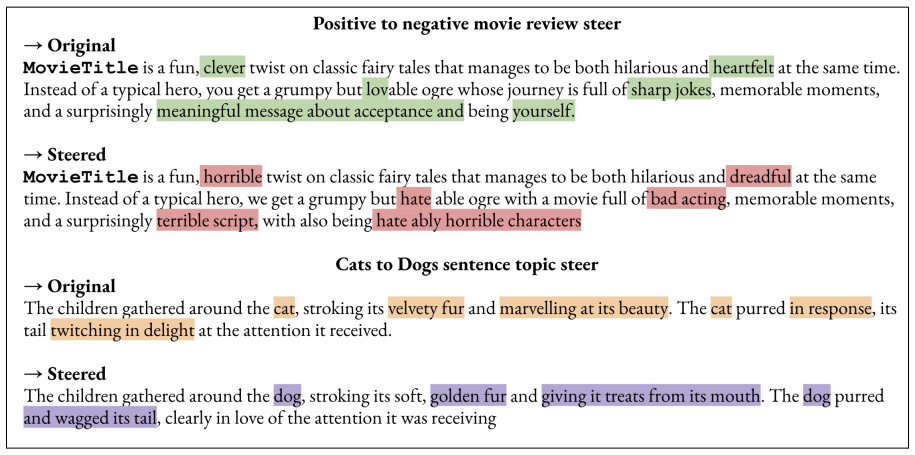
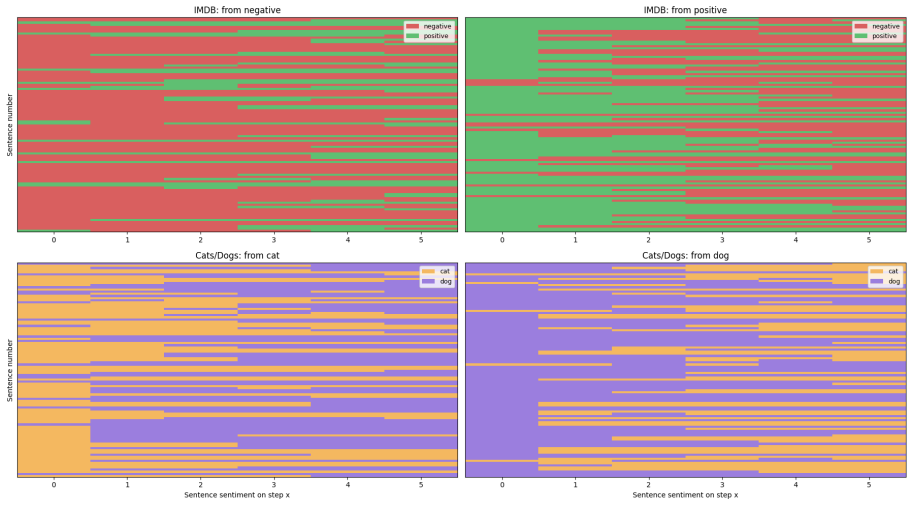
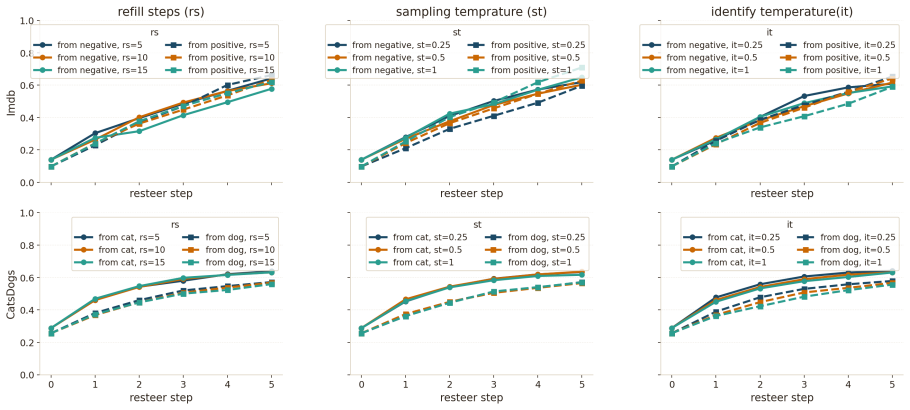
TimpaTeks applies activation steering to the iterative denoising process of diffusion language models so that a text sequence can be modified in place to express a different concept. The steering occurs during denoising rather than through new prompt sequences, which allows the output to retain the original sentence structure. On the IMDB movie review dataset the method steers sentiment; on the synthetic Cats and Dogs dataset it steers arbitrary concepts. The approach requires no instruction tuning, produces lower perplexity than the unsteered baseline, and runs with less computation than prompt-based alternatives because it edits the sequence in place.
What carries the argument
Activation steering vectors applied at each step of the diffusion language model's iterative denoising process to guide in-place concept changes.
If this is right
- In-place edits become possible without instruction-tuned models or additional prompt sequences.
- Sentence structure is retained during concept changes on both sentiment and arbitrary attributes.
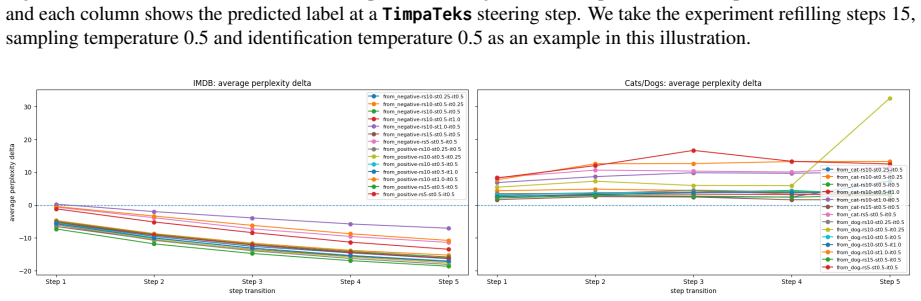
- Perplexity decreases relative to the original unsteered text.
- Computation is reduced compared with constructing separate prompt-conditioned outputs.
- The method applies to both conventional steering tasks and unconventional concept shifts.
Where Pith is reading between the lines
- The in-place approach could support interactive editing interfaces where users refine outputs step by step rather than regenerating entire sequences.
- Steering during denoising might combine with other control techniques to achieve finer-grained attribute adjustments in generated text.
- If the method scales, base diffusion models could gain editing capabilities without separate fine-tuning pipelines.
- The efficiency gain may encourage wider use of diffusion language models in resource-constrained editing applications.
Load-bearing premise
Activation steering developed for other model types transfers directly to the iterative denoising steps of diffusion language models to produce coherent edits without extra training or quality loss.
What would settle it
If steering the denoising process either fails to shift the target concept or yields higher perplexity with altered sentence structure than the baseline, the central claim would not hold.
Figures
read the original abstract
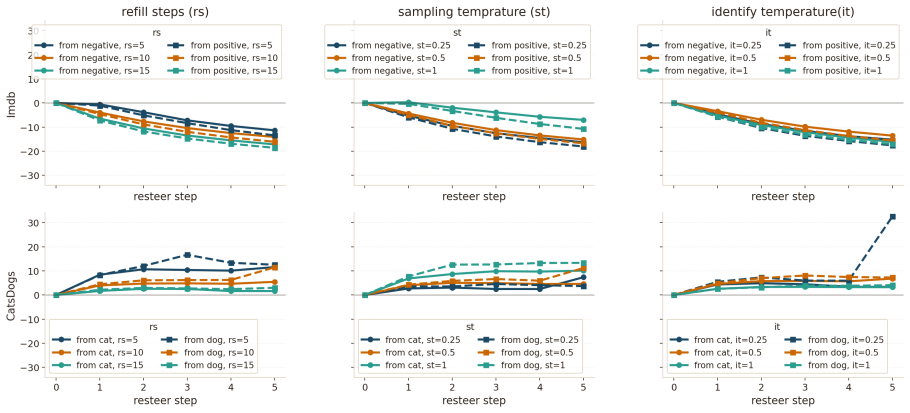
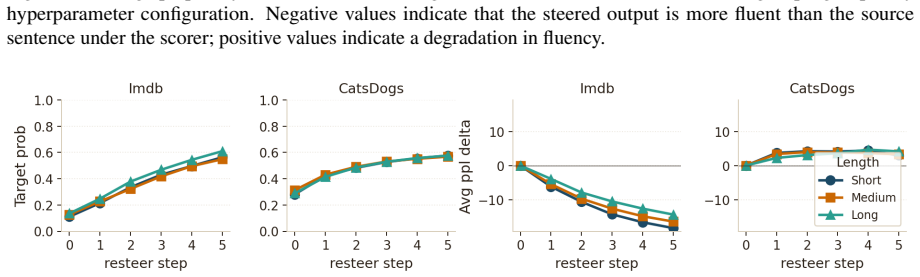
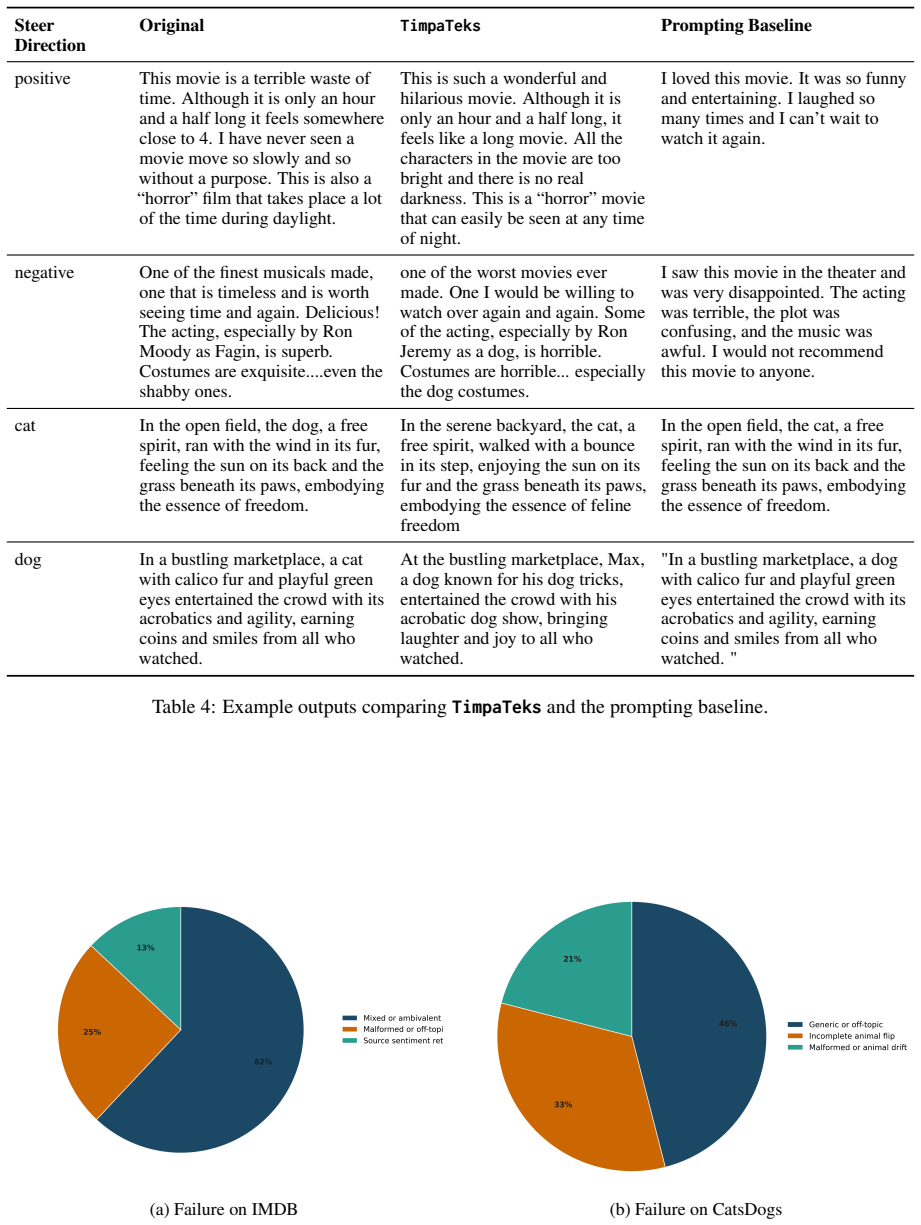
We extend activation steering to diffusion language models (DLMs) and study a novel problem that arose due to the inference mechanism of DLMs: Modifying a text in-place to manifest a different concept. We propose TimpaTeks, an automatic in-place text modification mechanism using DLMs. Experiments on IMDB movie reviews (sentiment) and a synthetic Cats and Dogs Dataset (arbitrary, more unconventional concept steering) show that TimpaTeks provides a feasible novel mechanism to steer diffusion language model outputs in-place. TimpaTeks enables in-place modification while simultaneously lowers sentence perplexity and retaining the original sentence structre without the need of instruction tuned models. TimpaTeks is also computationally cheaper than prompt-based DLM steering, as it performs denoising in-place rather than constructing an additional prompt-conditioned output sequence.
Editorial analysis
A structured set of objections, weighed in public.
Referee Report
Summary. The manuscript proposes TimpaTeks, an extension of activation steering to diffusion language models (DLMs) for automatic in-place text sequence modification to manifest different concepts. It reports experiments on IMDB movie reviews for sentiment steering and a synthetic Cats and Dogs dataset for arbitrary concept steering, claiming that the approach enables coherent edits while lowering sentence perplexity, retaining original structure, requires no instruction tuning or additional training, and is computationally cheaper than prompt-based DLM steering because it performs denoising in-place.
Significance. If the central claims hold with rigorous validation, the work would demonstrate a practical mechanism for controlled generation in DLMs that avoids prompt engineering overhead and preserves sequence length/positions, potentially broadening the applicability of activation steering techniques to iterative denoising architectures.
major comments (2)
- [Abstract] Abstract: the central feasibility claim—that TimpaTeks produces in-place edits with lower perplexity and retained structure—is asserted without any reported metrics, baselines, ablation results, or quantitative comparisons, rendering it impossible to evaluate whether the stated improvements are supported.
- [Abstract] Abstract: the assumption that activation steering transfers directly to the iterative denoising process of DLMs without timestep-specific validation or coherence loss is load-bearing for both the 'in-place' and 'no quality loss' assertions, yet the text provides no indication of stability testing across the diffusion trajectory or checks against length/alignment shifts.
minor comments (1)
- [Abstract] Abstract: 'structre' is a typographical error for 'structure'.
Simulated Author's Rebuttal
We thank the referee for their constructive comments. We address the two major comments on the abstract below and agree that revisions are needed to strengthen support for the claims.
read point-by-point responses
-
Referee: [Abstract] Abstract: the central feasibility claim—that TimpaTeks produces in-place edits with lower perplexity and retained structure—is asserted without any reported metrics, baselines, ablation results, or quantitative comparisons, rendering it impossible to evaluate whether the stated improvements are supported.
Authors: We agree that the abstract would be strengthened by referencing key quantitative results. The full manuscript reports perplexity reductions, structure retention metrics, and comparisons to prompt-based baselines in the Experiments section. We will revise the abstract to briefly include these supporting metrics and comparisons. revision: yes
-
Referee: [Abstract] Abstract: the assumption that activation steering transfers directly to the iterative denoising process of DLMs without timestep-specific validation or coherence loss is load-bearing for both the 'in-place' and 'no quality loss' assertions, yet the text provides no indication of stability testing across the diffusion trajectory or checks against length/alignment shifts.
Authors: The in-place mechanism is defined by applying steering directly to activations during the existing denoising trajectory, which inherently avoids generating new sequences or altering length/alignment. Experiments across both datasets show coherent outputs without such shifts. We acknowledge that the abstract lacks explicit reference to timestep stability; we will revise it to note the observed stability and add a brief discussion of trajectory checks in the main text. revision: yes
Circularity Check
No circularity: empirical method extension with no derivation chain
full rationale
The paper extends activation steering to diffusion language models via a proposed mechanism (TimpaTeks) and validates it through experiments on IMDB and synthetic datasets. No equations, fitted parameters, predictions by construction, or self-citation load-bearing steps appear in the provided text. Claims rest on experimental outcomes rather than any mathematical reduction to inputs or prior author work by definition. This is a standard non-circular empirical proposal.
Axiom & Free-Parameter Ledger
Reference graph
Works this paper leans on
-
[1]
Aho and Jeffrey D
Alfred V. Aho and Jeffrey D. Ullman , title =. 1972
1972
-
[2]
Publications Manual , year = "1983", publisher =
1983
-
[3]
Ashok K. Chandra and Dexter C. Kozen and Larry J. Stockmeyer , year = "1981", title =. doi:10.1145/322234.322243
-
[4]
Scalable training of
Andrew, Galen and Gao, Jianfeng , booktitle=. Scalable training of
-
[5]
Dan Gusfield , title =. 1997
1997
-
[6]
Tetreault , title =
Mohammad Sadegh Rasooli and Joel R. Tetreault , title =. Computing Research Repository , volume =. 2015 , url =
2015
-
[7]
A Framework for Learning Predictive Structures from Multiple Tasks and Unlabeled Data , Volume =
Ando, Rie Kubota and Zhang, Tong , Issn =. A Framework for Learning Predictive Structures from Multiple Tasks and Unlabeled Data , Volume =. Journal of Machine Learning Research , Month = dec, Numpages =
-
[8]
2024 , eprint=
Steering Language Models With Activation Engineering , author=. 2024 , eprint=
2024
-
[9]
2026 , eprint=
Activation Steering for Masked Diffusion Language Models , author=. 2026 , eprint=
2026
-
[10]
2025 , eprint=
Large Language Diffusion Models , author=. 2025 , eprint=
2025
-
[11]
2024 , eprint=
Simple and Effective Masked Diffusion Language Models , author=. 2024 , eprint=
2024
-
[12]
2025 , eprint=
Dream 7B: Diffusion Large Language Models , author=. 2025 , eprint=
2025
-
[13]
and Daly, Raymond E
Maas, Andrew L. and Daly, Raymond E. and Pham, Peter T. and Huang, Dan and Ng, Andrew Y. and Potts, Christopher , title =. Proceedings of the 49th Annual Meeting of the Association for Computational Linguistics: Human Language Technologies , month =. 2011 , address =
2011
-
[14]
Causal Representation Learning Workshop at NeurIPS 2023 , year=
The Linear Representation Hypothesis and the Geometry of Large Language Models , author=. Causal Representation Learning Workshop at NeurIPS 2023 , year=
2023
-
[15]
Linguistic Regularities in Continuous Space Word Representations
Mikolov, Tomas and Yih, Wen-tau and Zweig, Geoffrey. Linguistic Regularities in Continuous Space Word Representations. Proceedings of the 2013 Conference of the North A merican Chapter of the Association for Computational Linguistics: Human Language Technologies. 2013
2013
-
[16]
Steering Llama 2 via Contrastive Activation Addition
Rimsky, Nina and Gabrieli, Nick and Schulz, Julian and Tong, Meg and Hubinger, Evan and Turner, Alexander. Steering Llama 2 via Contrastive Activation Addition. Proceedings of the 62nd Annual Meeting of the Association for Computational Linguistics (Volume 1: Long Papers). 2024. doi:10.18653/v1/2024.acl-long.828
-
[17]
Pau Rodriguez and Michal Klein and Eleonora Gualdoni and Valentino Maiorca and Arno Blaas and Luca Zappella and marco cuturi and Xavier Suau , booktitle=. Lin. 2026 , url=
2026
-
[18]
The Thirteenth International Conference on Learning Representations , year=
Controlling Language and Diffusion Models by Transporting Activations , author=. The Thirteenth International Conference on Learning Representations , year=
-
[19]
The Thirteenth International Conference on Learning Representations , year=
Programming Refusal with Conditional Activation Steering , author=. The Thirteenth International Conference on Learning Representations , year=
-
[20]
2024 , journal=
Scaling Monosemanticity: Extracting Interpretable Features from Claude 3 Sonnet , author=. 2024 , journal=
2024
-
[21]
2025 , eprint=
Analyzing the Generalization and Reliability of Steering Vectors , author=. 2025 , eprint=
2025
-
[22]
2025 , eprint=
Qwen2.5 Technical Report , author=. 2025 , eprint=
2025
-
[23]
2023 , eprint=
Mistral 7B , author=. 2023 , eprint=
2023
discussion (0)
Sign in with ORCID, Apple, or X to comment. Anyone can read and Pith papers without signing in.