Natural Selection in the Wake of Catastrophe
Pith reviewed 2026-06-27 14:20 UTC · model grok-4.3
The pith
Natural selection after catastrophe drives mean fitness to relax inversely with time, scaled by the number of coupled traits.
A machine-rendered reading of the paper's core claim, the machinery that carries it, and where it could break.
Core claim
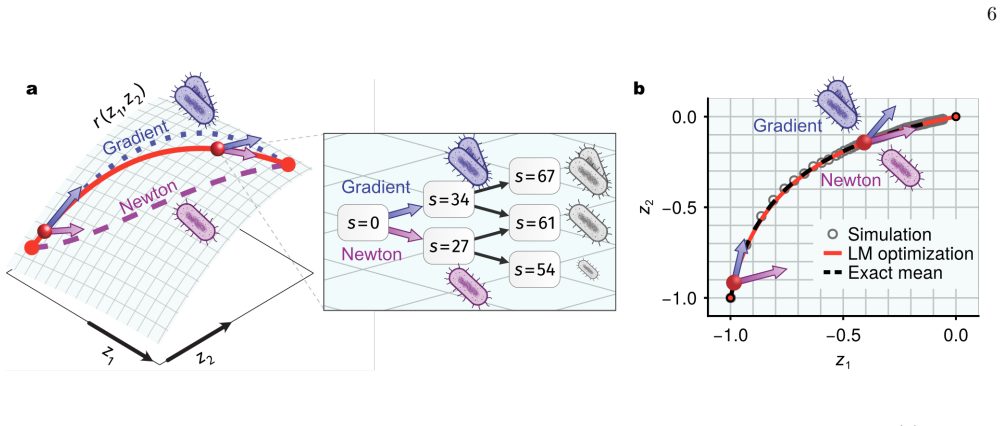
In the wake of catastrophe, natural selection causes the mean fitness of the population to relax inversely with time, with a prefactor proportional to the number of traits coupled to the post-catastrophe environment. The mean trait adaptation follows Levenberg-Marquardt optimization rather than gradient ascent on the fitness landscape. Near fitness peaks, evolutionary trajectories are biased against greediness, making post-catastrophic selection optimistic from an optimization perspective.
What carries the argument
The inverse-time relaxation law for mean fitness together with the Levenberg-Marquardt optimization rule that governs how mean traits change.
Load-bearing premise
That fitness landscapes measured in E. coli after antibiotic exposure represent general post-catastrophe recovery and that the trajectories match Levenberg-Marquardt optimization rather than some other process.
What would settle it
A post-catastrophe experiment in which mean fitness is tracked over time and fails to show inverse scaling with time, or in which fitted trajectories on comparable landscapes match gradient ascent instead of Levenberg-Marquardt steps.
Figures
read the original abstract
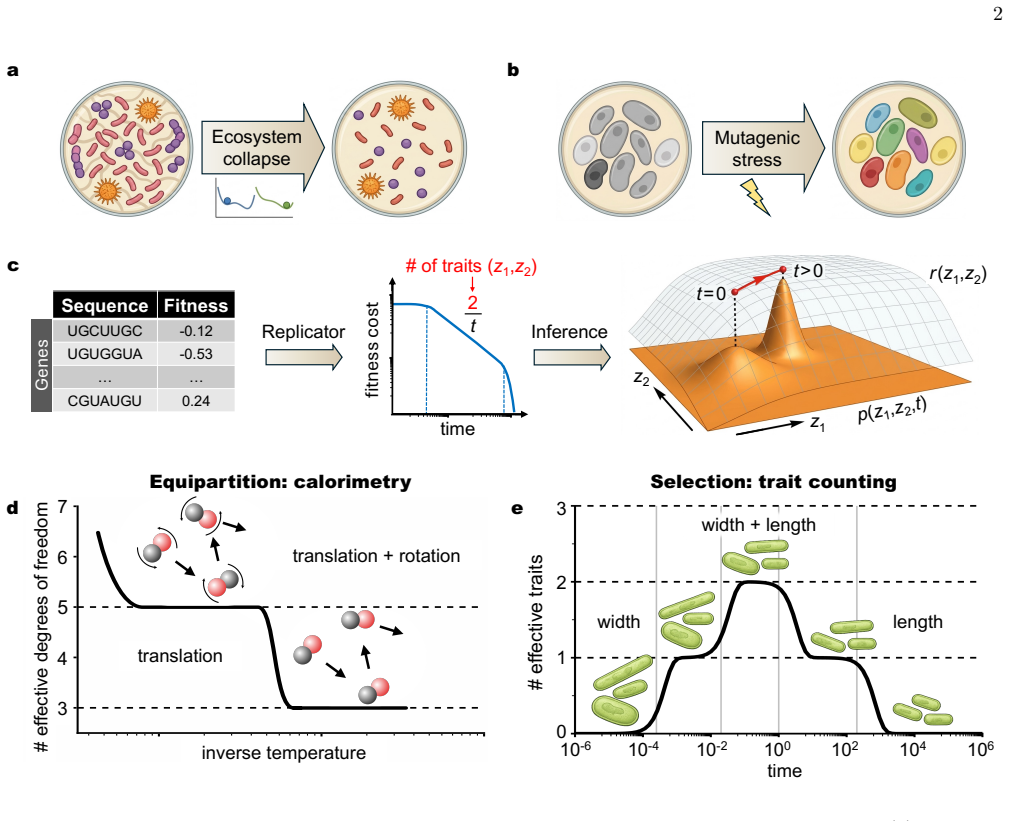
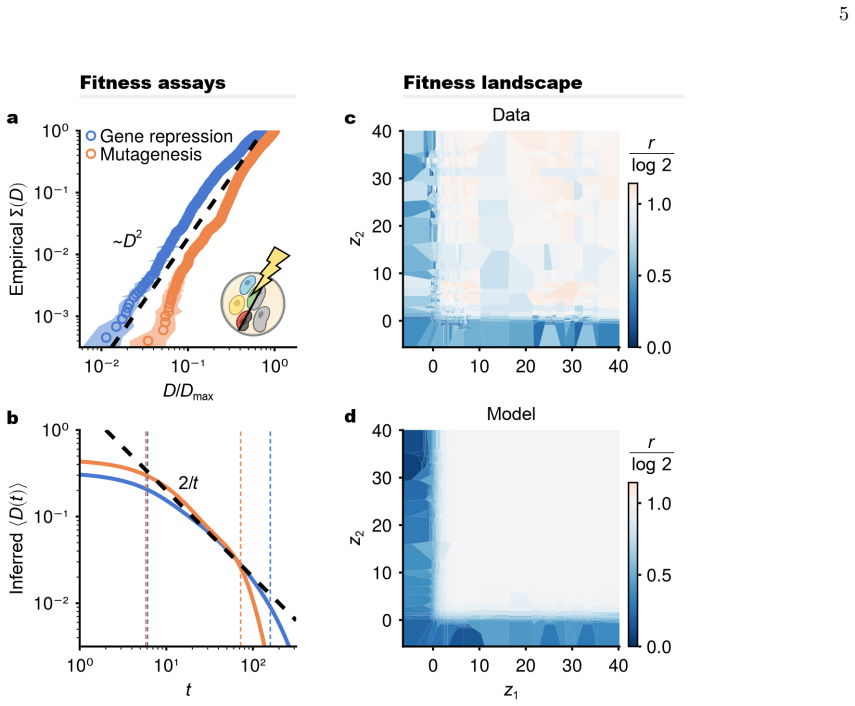
Living organisms, from bacteria to humans, are more likely to survive if their traits enhance fitness. In populations well adapted to their environmental niches, natural selection proceeds via rarely beneficial mutations. But when a catastrophe wipes out niche diversity, sudden adaptation often follows. Here, we present a data-validated theory of natural selection in the wake of catastrophe and unveil a simple law that emerges during recovery: the mean fitness relaxes inversely with time, with a prefactor proportional to the number of traits coupled to the post-catastrophe environment. We put our approach to test using experimental fitness landscapes measured following antibiotic administration to E. coli. The resulting mean trait adaptation is not described by gradient ascent on a fitness landscape, instead it follows an algorithm known as Levenberg-Marquardt optimization. Near fitness peaks, evolutionary trajectories are biased against greediness - from an optimization perspective, post-catastrophic selection is optimistic.
Editorial analysis
A structured set of objections, weighed in public.
Referee Report
Summary. The paper presents a theory of natural selection following catastrophe, deriving that mean fitness relaxes inversely with time (prefactor proportional to the number of traits coupled to the post-catastrophe environment). It tests this on experimental fitness landscapes from antibiotic-treated E. coli and claims that mean trait adaptation follows Levenberg-Marquardt optimization rather than gradient ascent, with trajectories biased against greediness near peaks.
Significance. If the inverse-time relaxation law and the specific mapping to Levenberg-Marquardt optimization are substantiated, the work would supply a simple, potentially parameter-free prediction for post-catastrophe recovery dynamics and a concrete link between evolutionary trajectories and a damped least-squares algorithm, which could be tested in other systems and inform optimization theory.
major comments (3)
- [Abstract] Abstract: the claim of a 'data-validated theory' is not accompanied by any derivation steps for the inverse-time law, data details, exclusion criteria, or error analysis, preventing evaluation of the central claims from the given information.
- [Abstract] Abstract: the assertion that trajectories follow Levenberg-Marquardt optimization (rather than gradient ascent or other damped methods) requires a quantitative metric or error comparison on the E. coli data demonstrating superiority; qualitative similarity alone does not secure the distinction.
- [Abstract] Abstract: the proportionality of the prefactor to the number of coupled traits is presented as emerging from the model, but without the explicit assumptions or derivation shown, it is unclear whether this is a genuine prediction or inherits post-hoc choices.
Simulated Author's Rebuttal
We thank the referee for their careful reading and constructive comments on our manuscript. We respond point-by-point to the major comments below. Revisions have been made to the abstract and supporting analyses to improve clarity and provide the requested details.
read point-by-point responses
-
Referee: [Abstract] Abstract: the claim of a 'data-validated theory' is not accompanied by any derivation steps for the inverse-time law, data details, exclusion criteria, or error analysis, preventing evaluation of the central claims from the given information.
Authors: The abstract is a high-level summary; the full derivation of the inverse-time relaxation (from the multi-trait dynamical equations) appears in Section 2 of the main text. The E. coli fitness landscape data source, trajectory exclusion criteria, and error analysis are described in the Methods and Supplementary Information. To address the concern, we have revised the abstract to briefly note the key modeling assumptions and data origin. revision: yes
-
Referee: [Abstract] Abstract: the assertion that trajectories follow Levenberg-Marquardt optimization (rather than gradient ascent or other damped methods) requires a quantitative metric or error comparison on the E. coli data demonstrating superiority; qualitative similarity alone does not secure the distinction.
Authors: The original manuscript presents trajectory comparisons but relies primarily on visual and qualitative agreement. We agree a quantitative metric strengthens the distinction. The revised manuscript adds a root-mean-square deviation metric between observed mean trait paths and those predicted by Levenberg-Marquardt versus gradient ascent (and other damped methods), with statistical tests confirming superior fit for Levenberg-Marquardt on the experimental data. revision: yes
-
Referee: [Abstract] Abstract: the proportionality of the prefactor to the number of coupled traits is presented as emerging from the model, but without the explicit assumptions or derivation shown, it is unclear whether this is a genuine prediction or inherits post-hoc choices.
Authors: The proportionality follows directly from integrating the multi-trait response equations under the assumption of linear trait-environment coupling (see Eq. 3 and derivation in Section 2). It is a model prediction, not a post-hoc fit. We have revised the abstract to state this assumption explicitly and reference the derivation. revision: yes
Circularity Check
No circularity: derivation self-contained against external data
full rationale
The paper derives the inverse-time mean-fitness relaxation from explicit model assumptions on trait coupling to the post-catastrophe environment and then compares resulting trajectories to experimental E. coli fitness landscapes. No quoted equation or step reduces a claimed prediction to a fitted parameter or self-citation by construction; the LM-optimization identification is presented as an empirical match rather than a definitional renaming. The central claims remain independently falsifiable on the external dataset.
Axiom & Free-Parameter Ledger
Reference graph
Works this paper leans on
-
[1]
Cox and D
D. Cox and D. Oakes,Analysis of Survival Data(Chap- man and Hall/CRC, 1984)
1984
-
[2]
P. K. Andersen, Ø. Borgan, R. D. Gill, and N. Keiding, Statistical Models Based on Counting Processes, Springer Series in Statistics (Springer US, New York, NY, 1993)
1993
-
[3]
Narteau, P
C. Narteau, P. Shebalin, and M. Holschneider, Journal of Geophysical Research: Solid Earth107, 2359 (2002)
2002
-
[4]
J. W. Vaupel, K. G. Manton, and E. Stallard, Demogra- phy16, 439 (1979)
1979
-
[5]
O. O. Aalen, Statistics in Medicine7, 1121 (1988)
1988
-
[6]
Hougaard, Lifetime Data Analysis1, 255 (1995)
P. Hougaard, Lifetime Data Analysis1, 255 (1995)
1995
-
[7]
T. I. Missov and M. Finkelstein, Theoretical Population Biology80, 64 (2011)
2011
-
[8]
T.A.BalanandH.Putter,StatisticalMethodsinMedical Research29, 3424 (2020)
2020
-
[9]
Holmlund, The Scandinavian Journal of Economics 100, 113 (1998)
B. Holmlund, The Scandinavian Journal of Economics 100, 113 (1998)
1998
-
[10]
N. M. Kiefer, Journal of Economic Literature26, 646 (1988)
1988
-
[11]
Rogerson, R
R. Rogerson, R. Shimer, and R. Wright, Journal of Eco- nomic Literature43, 959 (2005)
2005
-
[12]
Lancaster,The Econometric Analysis of Transition Data(Cambridge University Press, Cambridge, 1990)
T. Lancaster,The Econometric Analysis of Transition Data(Cambridge University Press, Cambridge, 1990)
1990
-
[13]
J. W. Vaupel and A. I. Yashin, The American Statistician 39, 176 (1985)
1985
-
[14]
T. A. Balan and H. Putter, Statistics in Medicine38, 3405 (2019)
2019
-
[15]
B. H. Good and O. Hallatschek, Current Opinion in Microbiology45, 203 (2018)
2018
-
[16]
M. T. Wortel, D. Agashe, S. F. Bailey, C. Bank, K. Biss- chop, T. Blankers, J. Cairns, E. S. Colizzi, D. Cusseddu, 10 M. M. Desai, B. van Dijk, M. Egas, J. Ellers, A. T. Groot, D. G. Heckel, M. L. Johnson, K. Kraaijeveld, J. Krug, L. Laan, M. Lässig, P. A. Lind, J. Meijer, L. M. Noble, S. Okasha, P. B. Rainey, D. E. Rozen, S. Shitut, S. J. Tans, O. Tenail...
2023
-
[17]
J.A.AscensaoandM.M.Desai,NatureReviewsGenetics 27, 81 (2026)
2026
-
[18]
D. J. Hernandez, A. S. David, E. S. Menges, C. A. Searcy, and M. E. Afkhami, The ISME Journal15, 1722 (2021)
2021
-
[19]
O. F. A. Larsen and L. H. M. van de Burgwal, Frontiers in Microbiology12, 784797 (2021)
2021
-
[20]
O. F. A. Larsen and R. J. M. Brummer, Frontiers in Microbiology15, 1449133 (2024)
2024
-
[21]
Y. Hong, H. Li, L. Chen, H. Su, B. Zhang, Y. Luo, C. Li, Z. Zhao, Y. Shao, and L. Guo, Microbiome12, 80 (2024)
2024
-
[22]
Patnaik and G
S. Patnaik and G. Baruah, Theoretical Ecology18, 10 (2025)
2025
-
[23]
C. C. Xu, V. Fugère, N. Barbosa da Costa, B. E. Beisner, G. Bell, M. E. Cristescu, G. F. Fussmann, A. Gonzalez, B. J. Shapiro, and R. D. Barrett, Current Biology35, 1061 (2025)
2025
-
[24]
Hildebrand, L
F. Hildebrand, L. Moitinho-Silva, S. Blasche, M. T. Jahn, T. I. Gossmann, J. Huerta-Cepas, R. Hercog, M. Luetge, M. Bahram, A. Pryszlak, R. J. Alves, S. M. Waszak, A. Zhu, L. Ye, P. I. Costea, S. Aalvink, C. Belzer, S. K. Forslund, S. Sunagawa, U. Hentschel, C. Merten, K. R. Patil, V. Benes, and P. Bork, Gut68, 1781 (2019)
2019
-
[25]
M. P. Thakur, W. H. van der Putten, F. Apon, E. An- gelini, B. Vreš, and S. Geisen, Functional Ecology35, 216 (2021)
2021
-
[26]
L. Dai, D. Vorselen, K. S. Korolev, and J. Gore, Science 336, 1175 (2012)
2012
-
[27]
Dakos, B
V. Dakos, B. Matthews, A. P. Hendry, J. Levine, N. Loeuille, J. Norberg, P. Nosil, M. Scheffer, and L. De Meester, Nature Ecology & Evolution3, 355 (2019)
2019
-
[28]
Alcantara-Diaz, Mutagenesis19, 349 (2004)
D. Alcantara-Diaz, Mutagenesis19, 349 (2004)
2004
-
[29]
Javed, M
S. Javed, M. Asgher, M. A. Sheikh, and H. Nawaz, Food Biotechnology24, 165 (2010)
2010
-
[30]
Shibai, Y
A. Shibai, Y. Takahashi, Y. Ishizawa, D. Motooka, S. Nakamura, B.-W. Ying, and S. Tsuru, Scientific Re- ports7, 14531 (2017)
2017
-
[31]
F. K. Richtmyer and E. H. Kennard,Introduction to Modern Physics, 4th ed., International Series in Pure and Applied Physics (McGraw-Hill Book Company, New York, 1947)
1947
-
[32]
M. A. Nowak,Evolutionary Dynamics: Exploring the Equations of Life(Harvard University Press, 2006)
2006
-
[33]
Without loss of generality, we considern non-neutral phenotypic axes in the post-catastrophe environment
-
[34]
W. H. Fleming and M. Viot, Indiana University Mathe- matics Journal28, 817 (1979)
1979
-
[35]
A. S. Bhat, Theoretical Population Biology161, 1 (2025)
2025
-
[36]
Kimura, Proceedings of the National Academy of Sciences54, 731 (1965)
M. Kimura, Proceedings of the National Academy of Sciences54, 731 (1965)
1965
-
[37]
L. S. Tsimring, H. Levine, and D. A. Kessler, Physical Review Letters76, 4440 (1996)
1996
-
[38]
P. J. Gerrish, A. Colato, A. S. Perelson, and P. D. Sniegowski, Proceedings of the National Academy of Sciences104, 6266 (2007)
2007
-
[39]
P. D. Sniegowski and P. J. Gerrish, Philosophical Trans- actions of the Royal Society B: Biological Sciences365, 1255 (2010)
2010
-
[40]
M. M. Desai and D. S. Fisher, Genetics188, 997 (2011)
2011
-
[41]
Alfaro and R
M. Alfaro and R. Carles, Proceedings of the American Mathematical Society145, 5315 (2017)
2017
-
[42]
Hamel, F
F. Hamel, F. Lavigne, G. Martin, and L. Roques, Non- linear Analysis: Real World Applications54, 103107 (2020)
2020
-
[43]
Mahdisoltani, P
S. Mahdisoltani, P. Murugan, A. K. Chakraborty, and M. Kardar, Physical Review E110, 064137 (2024)
2024
-
[44]
Tenaillon, Annual Review of Ecology, Evolution, and Systematics45, 179 (2014)
O. Tenaillon, Annual Review of Ecology, Evolution, and Systematics45, 179 (2014)
2014
-
[45]
Huang,Statistical Mechanics, 2nd ed
K. Huang,Statistical Mechanics, 2nd ed. (J. Wiley & Sons, New York, 1987)
1987
-
[46]
G. I. Barenblatt,Scaling, self-similarity, and intermediate asymptotics, Cambridge Texts in Applied Mathematics No. 14 (Cambridge University Press, Cambridge, 1996)
1996
-
[47]
Lande and S
R. Lande and S. J. Arnold, Evolution37, 1210 (1983)
1983
-
[48]
R. M. Otto, A. Turska-Nowak, P. M. Brown, and K. A. Reynolds, Cell Systems15, 134 (2024)
2024
-
[49]
Papkou, L
A. Papkou, L. Garcia-Pastor, J. A. Escudero, and A. Wag- ner, Science382, eadh3860 (2023)
2023
-
[50]
Clauset, C
A. Clauset, C. R. Shalizi, and M. E. J. Newman, SIAM Review51, 661 (2009)
2009
-
[51]
J.-P. Côté, S. French, S. S. Gehrke, C. R. MacNair, C. S. Mangat, A. Bharat, and E. D. Brown, mBio7, e01714-16 (2016)
2016
-
[52]
Kacser and J
H. Kacser and J. A. Burns, Genetics97, 639 (1981)
1981
-
[53]
A. M. Dean, D. E. Dykhuizen, and D. L. Hartl, Genetical Research48, 1 (1986)
1986
-
[54]
D. E. Dykhuizen and A. M. Dean, Trends in Ecology & Evolution5, 257 (1990)
1990
-
[55]
M. S. Newton, V. L. Arcus, M. L. Gerth, and W. M. Patrick, Current Opinion in Structural Biology48, 110 (2018)
2018
-
[56]
Bar-Even, E
A. Bar-Even, E. Noor, Y. Savir, W. Liebermeister, D. Da- vidi, D. S. Tawfik, and R. Milo, Biochemistry50, 4402 (2011)
2011
-
[57]
Y. T. Tamer, I. K. Gaszek, H. Abdizadeh, T. A. Batur, K. A. Reynolds, A. R. Atilgan, C. Atilgan, and E. Toprak, Molecular Biology and Evolution36, 1533 (2019)
2019
-
[58]
Krucinska, M
J. Krucinska, M. N. Lombardo, H. Erlandsen, A. Estrada, D. Si, K. Viswanathan, and D. L. Wright, Communica- tions Biology5, 459 (2022)
2022
-
[59]
J. V. Rodrigues, S. Bershtein, A. Li, E. R. Lozovsky, D. L. Hartl, and E. I. Shakhnovich, Proceedings of the National Academy of Sciences113, E1470 (2016)
2016
-
[60]
T. N. Nguyen, C. Ingle, S. Thompson, and K. A. Reynolds, Nature Communications15, 3351 (2024)
2024
-
[61]
S. G. Das, S. O. Direito, B. Waclaw, R. J. Allen, and J. Krug, eLife9, e55155 (2020)
2020
-
[62]
S. G. Das, J. Krug, and M. Mungan, Physical Review X 12, 031040 (2022)
2022
-
[63]
S. G. Das, M. Mungan, and J. Krug, Proceedings of the National Academy of Sciences122, e2422520122 (2025)
2025
-
[64]
R. R. Regoes, C. Wiuff, R. M. Zappala, K. N. Garner, F. Baquero, and B. R. Levin, Antimicrobial Agents and Chemotherapy48, 3670 (2004)
2004
-
[65]
Ziegler, J
C. Ziegler, J. Martin, C. Sinner, and F. Morcos, Nature Communications14, 2222 (2023)
2023
-
[66]
I. K. Gaszek, M. S. Yildiz, D. Meng, J. A. de la Paz, S. M. Alvarez, F. Morcos, M. Lin, and E. Toprak, (2025), bioRxiv:2025.07.08.663783
2025
-
[67]
C. L. David, E. E. Howell, M. F. Farnum, J. E. Vil- lafranca, S. J. Oatley, and J. Kraut, Biochemistry31, 9813 (1992). 11
1992
-
[68]
Le Nagard and O
H. Le Nagard and O. Tenaillon, inAdvances in Network Complexity, Vol. 4 (Wiley, 2013) pp. 41–61
2013
-
[69]
Schneemann, B
H. Schneemann, B. De Sanctis, and J. J. Welch, Cold Spring Harbor Perspectives in Biology16, a041442 (2024)
2024
-
[70]
Blanquart, G
F. Blanquart, G. Achaz, T. Bataillon, and O. Tenaillon, Evolution68, 3537 (2014)
2014
-
[71]
Blanquart and T
F. Blanquart and T. Bataillon, Genetics203, 847 (2016)
2016
-
[72]
Hwang, S.-C
S. Hwang, S.-C. Park, and J. Krug, Genetics206, 1049 (2017)
2017
-
[73]
T. D. Schneider, Nucleic Acids Research28, 2794 (2000)
2000
-
[74]
F. W. Stearns, Genetics186, 767 (2010)
2010
-
[75]
Levenberg, Quarterly of Applied Mathematics2, 164 (1944)
K. Levenberg, Quarterly of Applied Mathematics2, 164 (1944)
1944
-
[76]
D. W. Marquardt, Journal of the Society for Industrial and Applied Mathematics11, 431 (1963)
1963
-
[77]
Attouch and B
H. Attouch and B. F. Svaiter, SIAM Journal on Control and Optimization49, 574 (2011)
2011
-
[78]
M. K. Transtrum and J. P. Sethna, (2012), arXiv:1201.5885 [physics.data-an]
work page internal anchor Pith review Pith/arXiv arXiv 2012
-
[79]
Nesterov,Lectures on Convex Optimization, Springer Optimization and Its Applications, Vol
Y. Nesterov,Lectures on Convex Optimization, Springer Optimization and Its Applications, Vol. 137 (Springer International Publishing, Cham, Switzerland, 2018)
2018
-
[80]
D. P. Bertsekas,Reinforcement Learning and Opti- mal Control, 2nd ed. (Athena Scientific, Belmont, Mas- sachusetts, 2019)
2019
discussion (0)
Sign in with ORCID, Apple, or X to comment. Anyone can read and Pith papers without signing in.