IB-HFN: Information Bottleneck-Driven SAR-Optical Fusion Network for High-Fidelity Cloud Removal
Pith reviewed 2026-06-27 16:57 UTC · model grok-4.3
The pith
An information bottleneck in SAR-optical fusion suppresses speckle noise while routing clear optical details for cloud removal.
A machine-rendered reading of the paper's core claim, the machinery that carries it, and where it could break.
Core claim
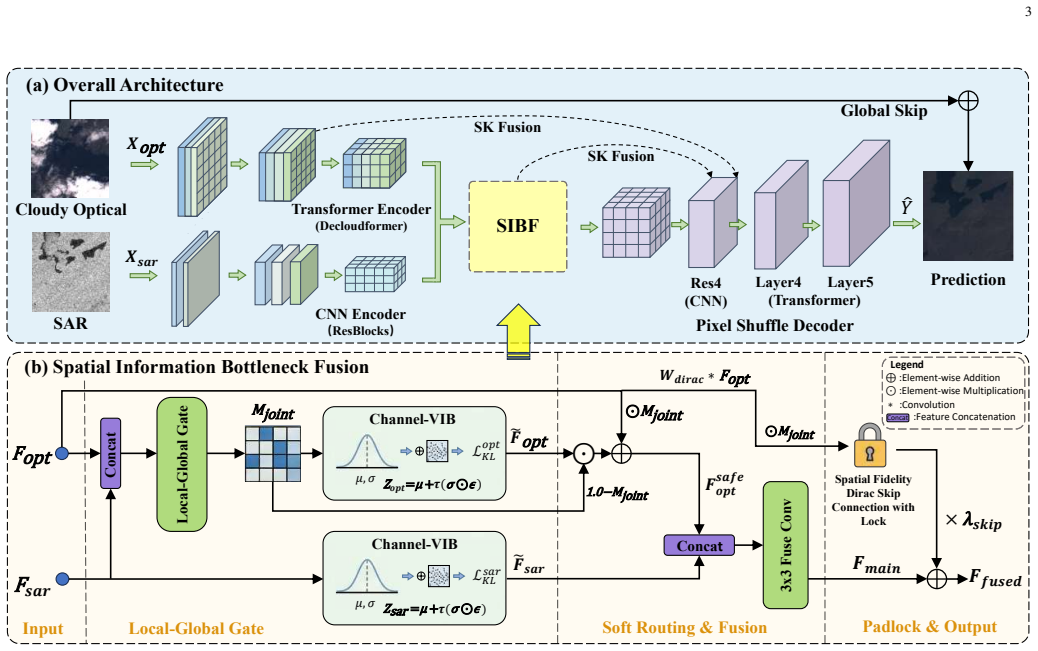
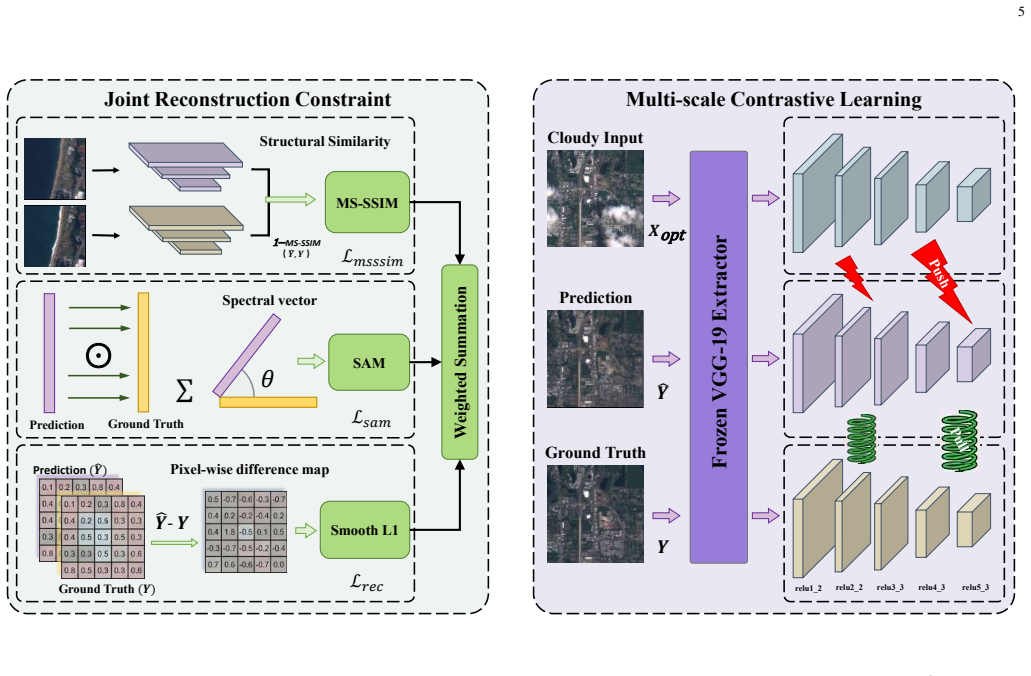
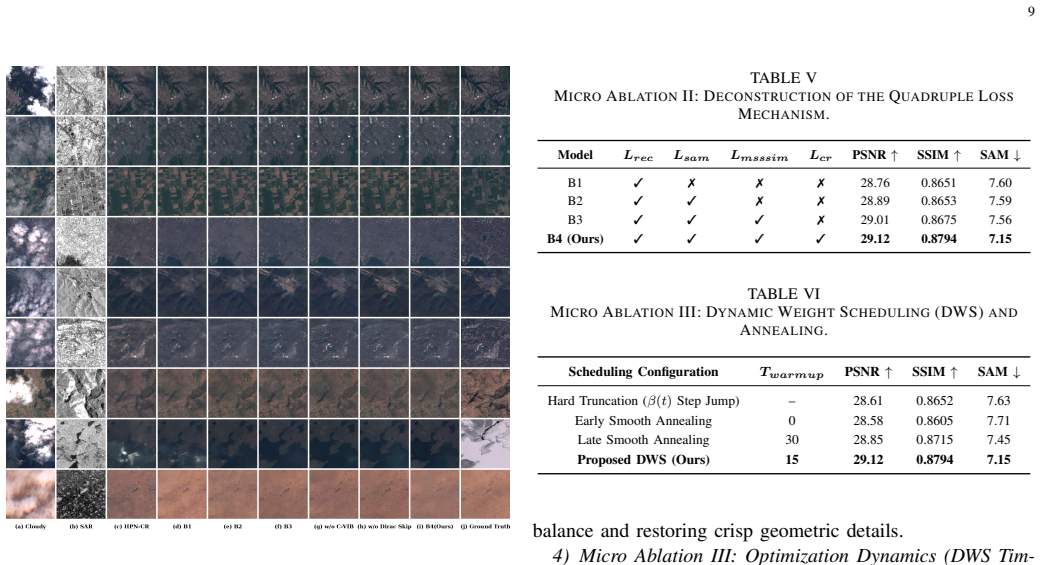
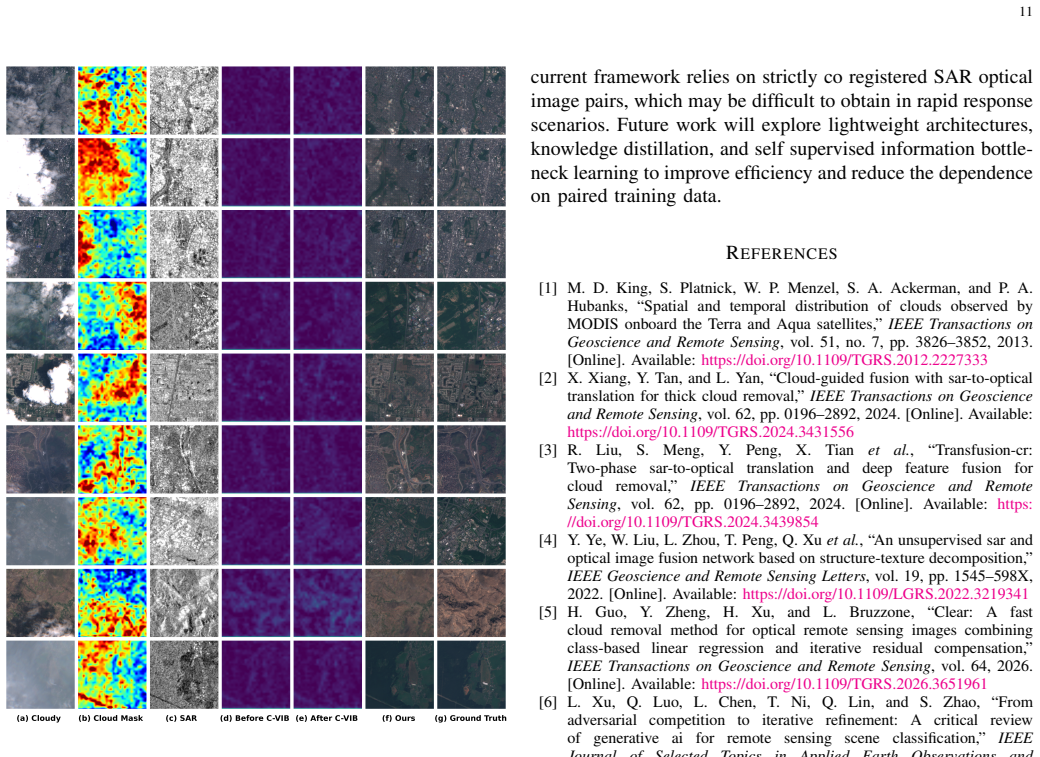
IB-HFN achieves superior structural preservation and spectral fidelity by using a dual-stream backbone to maintain modality-specific representations, a Spatial Information Bottleneck Fusion module that compresses SAR features through a channel-wise variational information bottleneck to suppress unstructured speckle noise, and a parallel local-global gating mechanism that predicts clear-sky regions and routes optical details via a Dirac-initialized skip connection, all trained with feature-level bottleneck regularization plus image-level constraints on reconstruction accuracy, structural consistency, spectral fidelity, and contrastive sharpness under a dynamic weighting schedule.
What carries the argument
Spatial Information Bottleneck Fusion module that compresses SAR features via channel-wise variational information bottleneck while a local-global gating mechanism routes optical details through Dirac-initialized skip connections.
If this is right
- SAR speckle noise is prevented from propagating into the final optical reconstruction.
- Noise suppression and texture preservation are handled by separate mechanisms rather than a single pixel-wise loss.
- Structural consistency and spectral fidelity improve on datasets with challenging spatio-temporal distribution shifts.
- Dynamic weighting of multiple loss terms reduces hazy artifacts during training.
Where Pith is reading between the lines
- The same separation of compression and gating could be tested on other noisy multimodal pairs such as LiDAR and optical data.
- If the gating predictions prove reliable, the architecture might support incremental updates when new clear-sky optical patches become available.
- The joint optimization schedule may generalize to any remote-sensing fusion task that must trade off fidelity against artifact suppression.
Load-bearing premise
The channel-wise variational information bottleneck will reliably suppress SAR speckle noise while the local-global gating mechanism will accurately identify clear-sky regions and route optical details without introducing new artifacts or losing fine texture.
What would settle it
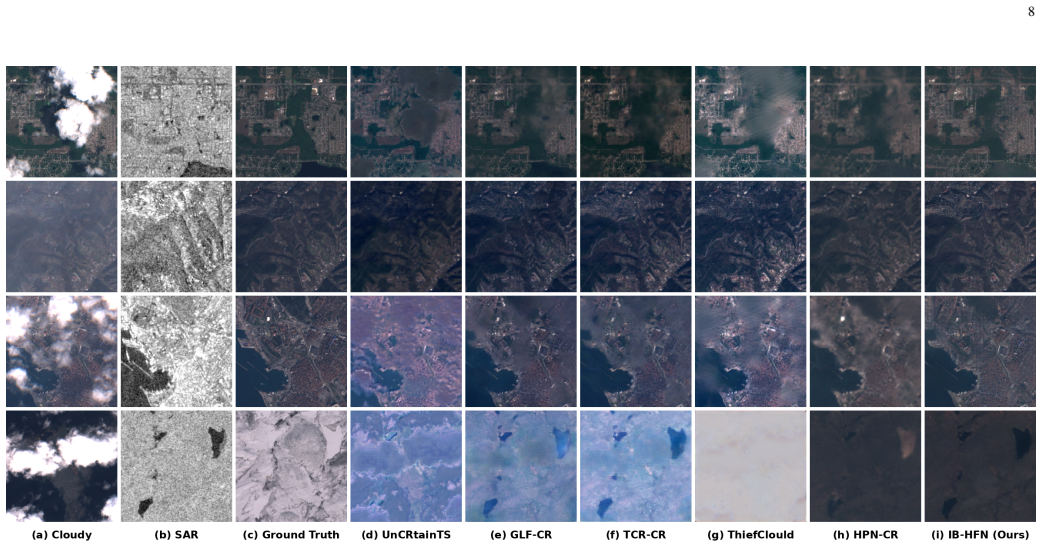
Compare output images on SEN12MS-CR test cases containing heavy cloud cover and strong SAR speckle against ground truth; if the method produces more visible noise patterns, blurring, or spectral shifts than the best baseline, the central claim does not hold.
Figures
read the original abstract
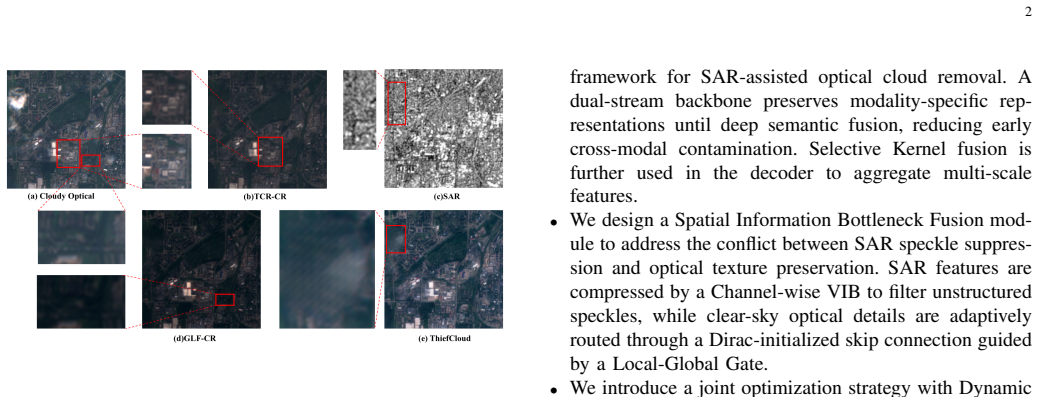
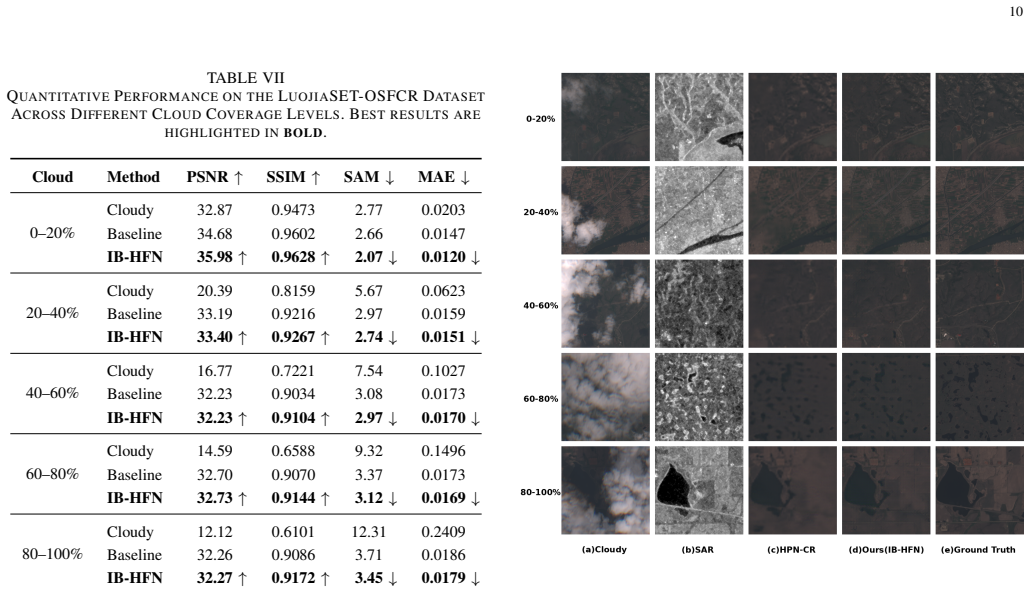
Synthetic aperture radar (SAR)-assisted optical cloud removal aims to recover surface information obscured by clouds in optical remote sensing images by exploiting complementary SAR observations. Existing multimodal fusion methods typically rely on direct spatial concatenation and pixel-wise supervision, which can propagate SAR speckle noise into optical reconstruction and lead to over-smoothed results. To address these limitations, we propose an Information Bottleneck-driven High-Fidelity Network (IB-HFN) for SAR-assisted optical cloud removal. IB-HFN employs a dual-stream backbone to preserve modality-specific representations before deep semantic fusion, thereby mitigating premature cross-modal contamination. At the fusion stage, we introduce a Spatial Information Bottleneck Fusion module that compresses SAR features through a channel-wise variational information bottleneck to suppress unstructured speckle noise. In parallel, a local-global gating mechanism predicts clear-sky regions and routes reliable optical details through a Dirac-initialized skip connection, decoupling noise suppression from texture preservation. We further develop a joint optimization strategy that integrates feature-level bottleneck regularization with image-level constraints on reconstruction accuracy, structural consistency, spectral fidelity, and contrastive sharpness. A dynamic weighting schedule balances these objectives to stabilize training and reduce hazy artifacts. Experiments on the SEN12MS-CR dataset under challenging spatio-temporal splits demonstrate that IB-HFN achieves superior structural preservation and spectral fidelity over existing methods.
Editorial analysis
A structured set of objections, weighed in public.
Referee Report
Summary. The manuscript proposes the Information Bottleneck-driven High-Fidelity Network (IB-HFN) for SAR-assisted optical cloud removal. It employs a dual-stream backbone to preserve modality-specific representations, a Spatial Information Bottleneck Fusion module that applies a channel-wise variational information bottleneck to compress SAR features and suppress speckle, a local-global gating mechanism with Dirac-initialized skip connections to route reliable optical texture, and a joint optimization combining feature-level bottleneck regularization with image-level losses on reconstruction accuracy, structural consistency, spectral fidelity, and contrastive sharpness. Experiments on the SEN12MS-CR dataset under spatio-temporal splits are stated to demonstrate superior structural preservation and spectral fidelity relative to existing methods.
Significance. If the empirical superiority holds under detailed quantitative scrutiny, the approach offers a principled way to decouple speckle suppression from texture preservation in multimodal remote-sensing fusion, potentially improving upon direct concatenation methods that propagate noise or cause over-smoothing.
major comments (1)
- [Spatial Information Bottleneck Fusion module (abstract and §3)] Spatial Information Bottleneck Fusion module (abstract and §3): the central claim that the channel-wise variational information bottleneck suppresses unstructured speckle noise while enabling superior structural preservation rests on an assumption that may not hold. SAR speckle is multiplicative and spatially correlated; a channel-wise operation on per-channel statistics cannot explicitly model or remove these spatially structured components, raising the possibility that residual noise propagates or forces over-smoothing and directly undermining the reported gains on the spatio-temporal splits.
minor comments (1)
- [Abstract] The abstract asserts quantitative superiority but supplies no metrics, baselines, or error bars; including at least the key PSNR/SSIM values and comparison table references would strengthen the summary.
Simulated Author's Rebuttal
We thank the referee for the careful reading and the substantive comment on the Spatial Information Bottleneck Fusion module. Below we respond directly to the concern raised.
read point-by-point responses
-
Referee: [Spatial Information Bottleneck Fusion module (abstract and §3)] Spatial Information Bottleneck Fusion module (abstract and §3): the central claim that the channel-wise variational information bottleneck suppresses unstructured speckle noise while enabling superior structural preservation rests on an assumption that may not hold. SAR speckle is multiplicative and spatially correlated; a channel-wise operation on per-channel statistics cannot explicitly model or remove these spatially structured components, raising the possibility that residual noise propagates or forces over-smoothing and directly undermining the reported gains on the spatio-temporal splits.
Authors: We agree that SAR speckle is multiplicative and spatially correlated, and that a purely channel-wise variational information bottleneck does not contain an explicit spatial noise model. The convolutional feature extractors preceding the bottleneck do, however, operate on spatially local receptive fields, so the per-channel statistics are computed on representations that already encode local spatial context. The information-bottleneck objective then regularizes these features toward task-relevant content, which in practice reduces the transmission of speckle-related variance. This is consistent with the observed improvements in structural (SSIM, edge metrics) and spectral (SAM) fidelity on the spatio-temporal splits of SEN12MS-CR. We do not claim an explicit spatial speckle filter; rather, the module provides a principled compression regularizer whose empirical effect is noise suppression without the over-smoothing seen in direct-concatenation baselines. We will add a short clarifying paragraph in §3.2 acknowledging the multiplicative/spatial nature of speckle and the reliance on convolutional context plus empirical validation. revision: partial
Circularity Check
No circularity: empirical network proposal without derivation chain
full rationale
The paper describes an empirical deep learning architecture (IB-HFN) for SAR-optical cloud removal, relying on a dual-stream backbone, Spatial Information Bottleneck Fusion module with channel-wise variational information bottleneck, local-global gating, and joint optimization with dynamic weighting. No mathematical derivations, first-principles predictions, or equations are presented that could reduce to inputs by construction. Claims rest on experimental results on SEN12MS-CR under spatio-temporal splits, with no self-citation load-bearing steps or fitted parameters renamed as predictions. The method is self-contained as a proposed architecture validated empirically.
Axiom & Free-Parameter Ledger
Reference graph
Works this paper leans on
-
[1]
Spatial and temporal distribution of clouds observed by MODIS onboard the Terra and Aqua satellites,
M. D. King, S. Platnick, W. P. Menzel, S. A. Ackerman, and P. A. Hubanks, “Spatial and temporal distribution of clouds observed by MODIS onboard the Terra and Aqua satellites,”IEEE Transactions on Geoscience and Remote Sensing, vol. 51, no. 7, pp. 3826–3852, 2013. [Online]. Available: https://doi.org/10.1109/TGRS.2012.2227333
-
[2]
Cloud-guided fusion with sar-to-optical translation for thick cloud removal,
X. Xiang, Y . Tan, and L. Yan, “Cloud-guided fusion with sar-to-optical translation for thick cloud removal,”IEEE Transactions on Geoscience and Remote Sensing, vol. 62, pp. 0196–2892, 2024. [Online]. Available: https://doi.org/10.1109/TGRS.2024.3431556
-
[3]
Transfusion-cr: Two-phase sar-to-optical translation and deep feature fusion for cloud removal,
R. Liu, S. Meng, Y . Peng, X. Tianet al., “Transfusion-cr: Two-phase sar-to-optical translation and deep feature fusion for cloud removal,”IEEE Transactions on Geoscience and Remote Sensing, vol. 62, pp. 0196–2892, 2024. [Online]. Available: https: //doi.org/10.1109/TGRS.2024.3439854
-
[4]
An unsupervised sar and optical image fusion network based on structure-texture decomposition,
Y . Ye, W. Liu, L. Zhou, T. Peng, Q. Xuet al., “An unsupervised sar and optical image fusion network based on structure-texture decomposition,” IEEE Geoscience and Remote Sensing Letters, vol. 19, pp. 1545–598X,
-
[5]
Available: https://doi.org/10.1109/LGRS.2022.3219341
[Online]. Available: https://doi.org/10.1109/LGRS.2022.3219341
-
[6]
H. Guo, Y . Zheng, H. Xu, and L. Bruzzone, “Clear: A fast cloud removal method for optical remote sensing images combining class-based linear regression and iterative residual compensation,” IEEE Transactions on Geoscience and Remote Sensing, vol. 64, 2026. [Online]. Available: https://doi.org/10.1109/TGRS.2026.3651961
-
[7]
L. Xu, Q. Luo, L. Chen, T. Ni, Q. Lin, and S. Zhao, “From adversarial competition to iterative refinement: A critical review of generative ai for remote sensing scene classification,”IEEE Journal of Selected Topics in Applied Earth Observations and Remote Sensing, pp. 10 573–10 634, 2026. [Online]. Available: https://doi.org/10.1109/JSTARS.2026.3670966
-
[8]
Thick cloud removal using cloud mask-guided sar-optical fusion network,
S. Meng, S. Li, X. Wang, J. Yang, G. Song, and Y . Ding, “Thick cloud removal using cloud mask-guided sar-optical fusion network,”IEEE Journal of Selected Topics in Applied Earth Observations and Remote Sensing, 2026. [Online]. Available: https: //doi.org/10.1109/JSTARS.2026.3651496
-
[9]
Idf-cr: Iterative diffusion process for divide-and- conquer cloud removal in remote-sensing images,
M. Wanget al., “Idf-cr: Iterative diffusion process for divide-and- conquer cloud removal in remote-sensing images,”IEEE Transactions on Geoscience and Remote Sensing, vol. 62, pp. 0196–2892, 2024. [Online]. Available: https://doi.org/10.1109/TGRS.2024.3378720
-
[10]
M. Wang, J. Yao, B. Zhang, and J. Zhou, “Adaptive fusion-based two-flow spectral–spatial transformer network for sar-based optical cloud removal,”IEEE Journal of Selected Topics in Applied Earth Observations and Remote Sensing, vol. 62, 2025. [Online]. Available: https://doi.org/10.1109/JSTARS.2025.3629856
-
[11]
Task-Driven Prompt Learning: A Joint Framework for Multi-modal Cloud Removal and Segmentation
Z. Zhang, J. Li, S. Shi, and Q. Yuan, “Task-driven prompt learning: A joint framework for multi-modal cloud removal and segmentation,”arXiv preprint arXiv:2601.12052, 2026. [Online]. Available: https://doi.org/10.48550/arXiv.2601.12052
work page internal anchor Pith review Pith/arXiv arXiv doi:10.48550/arxiv.2601.12052 2026
-
[12]
Diffcr: A fast conditional diffusion framework for cloud removal from optical satellite images,
X. Zou, K. Li, J. Xing, Y . Zhang, S. Wang, and L. Jin, “Diffcr: A fast conditional diffusion framework for cloud removal from optical satellite images,”IEEE Transactions on Geoscience and Remote Sensing, vol. 62, pp. 0196–2892, 2024. [Online]. Available: https://doi.org/10.1109/TGRS.2024.3365806
-
[13]
Y . Zhang, Q. Chen, Y . Liu, W. Li, and J. Guan, “Sader: Structure-aware diffusion framework with deterministic resampling for multi-temporal remote sensing cloud removal,”arXiv preprint arXiv:2602.00536, 2026. [Online]. Available: https://doi.org/10.48550/arXiv.2602.00536
-
[14]
Uncrtaints: Uncertainty quantification for cloud removal in optical satellite time series,
P. Ebel, V . S. F. Garnot, M. Schmitt, J. D. Wegner, and X. X. Zhu, “Uncrtaints: Uncertainty quantification for cloud removal in optical satellite time series,” inCVF Conference on Computer Vision and Pattern Recognition Workshops (CVPRW). IEEE, 2023, pp. 2160–7508. [Online]. Available: https://doi.org/10.1109/CVPRW59228.2023.00202
-
[15]
Enhancing cloud-removed regions in multispectral optical images using sar edge features,
M. Wang, X. Zhao, and L. Ren, “Enhancing cloud-removed regions in multispectral optical images using sar edge features,”IEEE Geoscience and Remote Sensing Letters, vol. 22, 2025. [Online]. Available: https://doi.org/10.1109/LGRS.2025.3574323 12
-
[16]
Glf-cr: Sar-enhanced cloud removal with global-local fusion,
F. Xu, Y . Shi, P. Ebel, L. Yu, G.-S. Xia, W. Yang, and X. X. Zhu, “Glf-cr: Sar-enhanced cloud removal with global-local fusion,”ISPRS Journal of Photogrammetry and Remote Sensing, vol. 192, pp. 268–278,
-
[17]
Available: https://doi.org/10.48550/arXiv.2206.02850
[Online]. Available: https://doi.org/10.48550/arXiv.2206.02850
-
[18]
A. Zhao, R. Feng, and X. Li, “Thiefcloud: A thickness fused thin cloud removal network for optical remote sensing image with self-supervised learnable cloud prior,”IEEE Transactions on Circuits and Systems for Video Technology, 2025. [Online]. Available: https://doi.org/10.1109/TCSVT.2025.3585720
-
[19]
H. Wu, Y . Qu, S. Lin, J. Zhou, R. Qiao, Z. Zhang, Y . Xie, and L. Ma, “Contrastive learning for compact single image dehazing,” in Proceedings of the IEEE/CVF Conference on Computer Vision and Pattern Recognition, 2021, pp. 10 551–10 560. [Online]. Available: https://doi.org/10.1109/CVPR46437.2021.00033
-
[20]
Contrastive learning via variational information bottleneck,
J. Li, Y . Wang, X. Zhang, D. Jiang, W. Dai, and C. Li, “Contrastive learning via variational information bottleneck,”IEEE Transactions on Pattern Analysis and Machine Intelligence, 2025. [Online]. Available: https://doi.org/10.1109/TPAMI.2025.3571990
-
[21]
Deep variational information bottleneck,
A. A. Alemi, I. Fischer, J. V . Dillon, and K. Murphy, “Deep variational information bottleneck,”arXiv preprint arXiv:1612.00410,
-
[22]
Deep Variational Information Bottleneck
[Online]. Available: https://doi.org/10.48550/arXiv.1612.00410
work page internal anchor Pith review Pith/arXiv arXiv doi:10.48550/arxiv.1612.00410
-
[24]
Y . Zhou, J. Suo, Y . Wang, J. Su, W. Xiao, and Z. Hong, “Mmcanet: A multimodal and cross-attention network for cloud removal and exploration of progressive remote sensing images restoration algorithm,” IEEE Transactions on Geoscience and Remote Sensing, vol. 63, 2025. [Online]. Available: https://doi.org/10.1109/TGRS.2025.3556560
-
[25]
Transformer- based sar-optical fusion network for cloud removal in satellite imagery,
T.-T. Le, T.-A. Bui, H. Tran, Y .-L. Chang, and P.-J. Lee, “Transformer- based sar-optical fusion network for cloud removal in satellite imagery,” in2025 IEEE International Conference on Consumer Electronics - Taiwan (ICCE-Taiwan), 2025. [Online]. Available: https://doi.org/10.1109/ICCE-Taiwan66881.2025.11207770
-
[26]
Graph-based robust cloud removal via optical-sar image fusion,
R. Isono, S. Ono, and A. Ortega, “Graph-based robust cloud removal via optical-sar image fusion,” inIGARSS 2025 - 2025 IEEE International Geoscience and Remote Sensing Symposium, 2025. [Online]. Available: https://doi.org/10.1109/IGARSS.2025.11243640
-
[27]
Cloud-aware sar fusion for enhanced optical sensing in space missions,
T.-A. Bui and T.-T. Le, “Cloud-aware sar fusion for enhanced optical sensing in space missions,”2025 IEEE Radar Conference (RadarConf25), 2025. [Online]. Available: https://doi.org/10.1109/ RadarConf2559087.2025.11205145
arXiv 2025
-
[28]
Att-cr: Adaptive triangular transformer for cloud removal,
Y . Wu, Y . Deng, P. Li, W. Huang, K. Wu, and X. Xin, “Att-cr: Adaptive triangular transformer for cloud removal,”IEEE Journal of Selected Topics in Applied Earth Observations and Remote Sensing, 2025. [Online]. Available: https://doi.org/10.1109/JSTARS.2025.3596856
-
[29]
Dual-view prompting for cloud removal,
Y . Deng, W. Huang, Z. Tang, and J. Duan, “Dual-view prompting for cloud removal,”IEEE Transactions on Geoscience and Remote Sensing,
-
[30]
Available: https://doi.org/10.1109/TGRS.2025.3614865
[Online]. Available: https://doi.org/10.1109/TGRS.2025.3614865
-
[31]
Advancing pose-guided image synthesis with progressive conditional diffusion models,
F. Shen, H. Ye, J. Zhang, C. Wang, X. Han, and Y . Wei, “Advancing pose-guided image synthesis with progressive conditional diffusion models,” inThe Twelfth International Conference on Learning Representations, 2024. [Online]. Available: https://openreview.net/ forum?id=rHzapPnCgT
2024
-
[32]
Imagpose: A unified conditional framework for pose-guided person generation,
F. Shen and J. Tang, “Imagpose: A unified conditional framework for pose-guided person generation,”Advances in neural information processing systems, vol. 37, pp. 6246–6266, 2024
2024
-
[33]
Long-term talkingface generation via motion-prior conditional diffusion model,
F. Shen, C. Wang, J. Gao, Q. Guo, J. Dang, J. Tang, and T.-S. Chua, “Long-term talkingface generation via motion-prior conditional diffusion model,” inForty-second International Conference on Machine Learning, 2025
2025
-
[34]
Boost- ing consistency in story visualization with rich-contextual conditional diffusion models,
F. Shen, H. Ye, S. Liu, J. Zhang, C. Wang, X. Han, and Y . Wei, “Boost- ing consistency in story visualization with rich-contextual conditional diffusion models,” inProceedings of the AAAI Conference on Artificial Intelligence, vol. 39, no. 7, 2025, pp. 6785–6794
2025
-
[35]
Imagedit: Let any subject transform,
F. Shen, W. Xu, R. Yan, D. Zhang, X. Shu, and J. Tang, “Imagedit: Let any subject transform,”arXiv preprint arXiv:2510.01186, 2025
Pith/arXiv arXiv 2025
-
[36]
Imaghar- mony: Controllable image editing with consistent object quantity and layout,
F. Shen, X. Du, Y . Gao, J. Yu, Y . Cao, X. Lei, and J. Tang, “Imaghar- mony: Controllable image editing with consistent object quantity and layout,”arXiv preprint arXiv:2506.01949, 2025
arXiv 2025
-
[37]
Imagdressing-v1: Customizable virtual dressing,
F. Shen, X. Jiang, X. He, H. Ye, C. Wang, X. Du, Z. Li, and J. Tang, “Imagdressing-v1: Customizable virtual dressing,” inProceedings of the AAAI Conference on Artificial Intelligence, vol. 39, no. 7, 2025, pp. 6795–6804
2025
-
[38]
Imaggarment-1: Fine-grained garment generation for controllable fashion design,
F. Shen, J. Yu, C. Wang, X. Jiang, X. Du, and J. Tang, “Imaggarment-1: Fine-grained garment generation for controllable fashion design,”arXiv preprint arXiv:2504.13176, 2025
arXiv 2025
-
[39]
Multimodal diffusion bridge with attention-based sar fusion for satellite image cloud removal,
Y . Hu, S. Lohit, U. S. Kamilov, and T. K. Marks, “Multimodal diffusion bridge with attention-based sar fusion for satellite image cloud removal,” IEEE Transactions on Geoscience and Remote Sensing, vol. 63, 2025. [Online]. Available: https://doi.org/10.1109/TGRS.2025.3604654
-
[40]
A local anomaly detection method for occluded targets with multispectral point clouds,
J. Xu, X. Yu, J. Panet al., “Efficient diffusion model for sar-assisted optical remote sensing image cloud removal,”IEEE International Geoscience and Remote Sensing Symposium, 2025. [Online]. Available: https://doi.org/10.1109/IGARSS55030.2025.11243696
-
[41]
J. Chen, X. Tong, Y . Sun, and Z. Xiao, “Cloud removal method for remote sensing images based on sar-guided conditional diffusion model and style adaptation,”IEEE Journal of Selected Topics in Applied Earth Observations and Remote Sensing, pp. 22 770–22 783, 2025. [Online]. Available: https://doi.org/10.1109/JSTARS.2025.3599162
-
[42]
CBEN -- A Multimodal Machine Learning Dataset for Cloud Robust Remote Sensing Image Understanding
M. Stricker, M. Iwamura, and K. Kise, “Cben: A multimodal machine learning dataset for cloud robust remote sensing image understanding,”arXiv preprint arXiv:2602.12652, 2026. [Online]. Available: https://doi.org/10.48550/arXiv.2602.12652
work page internal anchor Pith review Pith/arXiv arXiv doi:10.48550/arxiv.2602.12652 2026
-
[43]
L. Wang, C. Wang, R. Li, J. Yu, H. Sun, and W. Wang, “Mdfanet: Multidimensional feature alignment network for self- supervised pretraining in remote sensing change detection,”IEEE Journal of Selected Topics in Applied Earth Observations and Remote Sensing, 2025. [Online]. Available: https://doi.org/10.1109/JSTARS. 2025.3644606
-
[44]
Deep learning and the information bottleneck principle,
N. Tishby and N. Zaslavsky, “Deep learning and the information bottleneck principle,” inIEEE Information Theory Workshop (ITW). IEEE, 2015, pp. 1–5
2015
-
[45]
Projection head is secretly an information bottleneck,
Z. Ouyang, K. Hu, Q. Zhang, Y . Wang, Y . Wanget al., “Projection head is secretly an information bottleneck,” inInternational Conference on Learning Representations, 2025. [Online]. Available: https://doi.org/10.48550/arXiv.2503.00507
-
[46]
Video-bench: Human-aligned video generation benchmark
J.-H. Hong, H.-J. Kim, K.-S. Jeon, and S.-W. Lee, “Comprehensive information bottleneck for unveiling universal attribution to interpret vision transformers,” in2025 IEEE/CVF Conference on Computer Vision and Pattern Recognition (CVPR), 2025. [Online]. Available: https://doi.org/10.1109/CVPR52734.2025.02343
-
[47]
Ibcs: Learning information bottleneck-constrained denoised causal subgraph for graph classification,
R. Yuan, Y . Tang, Y . Xiao, and W. Zhang, “Ibcs: Learning information bottleneck-constrained denoised causal subgraph for graph classification,”IEEE Transactions on Pattern Analysis and Machine Intelligence (TPAMI), 2024. [Online]. Available: https: //doi.org/10.1109/TPAMI.2024.3508766
-
[48]
Graph information bottleneck for remote sensing segmentation,
Y . Shou, W. Ai, T. Meng, and N. Yin, “Graph information bottleneck for remote sensing segmentation,”Neurocomputing, 2024. [Online]. Available: https://doi.org/10.48550/arXiv.2312.02545
-
[49]
Information-bottleneck driven binary neural network for change detection,
K. Yin, Z. Zhang, S. Kong, T. Gao, C. Xu, H. Konget al., “Information-bottleneck driven binary neural network for change detection,” inProceedings of the IEEE/CVF International Conference on Computer Vision (ICCV), 2025. [Online]. Available: https: //doi.org/10.48550/arXiv.2507.03504
-
[50]
Refining the information bottleneck via adversarial information separation,
S. Ning, Z. Wang, L. Wang, B. Chen, S. Liu, X. Wu, J. Zhou, and B. Yang, “Refining the information bottleneck via adversarial information separation,”arXiv preprint arXiv:2602.06549, 2026. [Online]. Available: https://doi.org/10.48550/arXiv.2602.06549
-
[51]
F. Zhang, Y . Wu, Z. Wang, X. Wang, C. Lv, X. Huang, and X. Zheng, “Vib-probe: Detecting and mitigating hallucinations in vision-language models via variational information bottleneck,” arXiv preprint arXiv:2601.05547, 2026. [Online]. Available: https: //doi.org/10.48550/arXiv.2601.05547
work page internal anchor Pith review Pith/arXiv arXiv doi:10.48550/arxiv.2601.05547 2026
-
[52]
Hpn-cr: Heterogeneous parallel network for sar-optical data fusion cloud removal,
P. Gu, W. Liu, S. Feng, T. Wei, J. Wang, H. Chenet al., “Hpn-cr: Heterogeneous parallel network for sar-optical data fusion cloud removal,”IEEE Transactions on Geoscience and Remote Sensing, vol. 63, pp. 0196–2892, 2025. [Online]. Available: https: //doi.org/10.1109/TGRS.2025.3546489
-
[53]
Sen12ms- cr-ts: A remote-sensing data set for multimodal multitemporal cloud removal,
P. Ebel, Y . Xu, M. Schmitt, X. X. Zhuet al., “Sen12ms- cr-ts: A remote-sensing data set for multimodal multitemporal cloud removal,”IEEE Transactions on Geoscience and Remote Sensing, vol. 60, pp. 0196–2892, 2022. [Online]. Available: https: //doi.org/10.1109/TGRS.2022.3146246
-
[54]
Hdrsa-net: Hybrid dynamic residual self-attention network for sar-assisted optical image cloud and shadow removal,
J. Pan, J. Xu, X. Yu, G. Ye, M. Wang, Y . Chen, and J. Ma, “Hdrsa-net: Hybrid dynamic residual self-attention network for sar-assisted optical image cloud and shadow removal,”ISPRS Journal of Photogrammetry and Remote Sensing, vol. 218, pp. 258–275, 2024. [Online]. Available: https://www.sciencedirect.com/science/article/pii/S0924271624004039
2024
discussion (0)
Sign in with ORCID, Apple, or X to comment. Anyone can read and Pith papers without signing in.