A Meta-Learning Framework for Multitask Reverberation Mapping in Active Galactic Nuclei
Pith reviewed 2026-06-27 16:21 UTC · model grok-4.3
The pith
A meta-learning framework using attentive latent neural processes reconstructs AGN light curves 60-70 percent better than baseline regressors and generalizes from simulations to real data.
A machine-rendered reading of the paper's core claim, the machinery that carries it, and where it could break.
Core claim
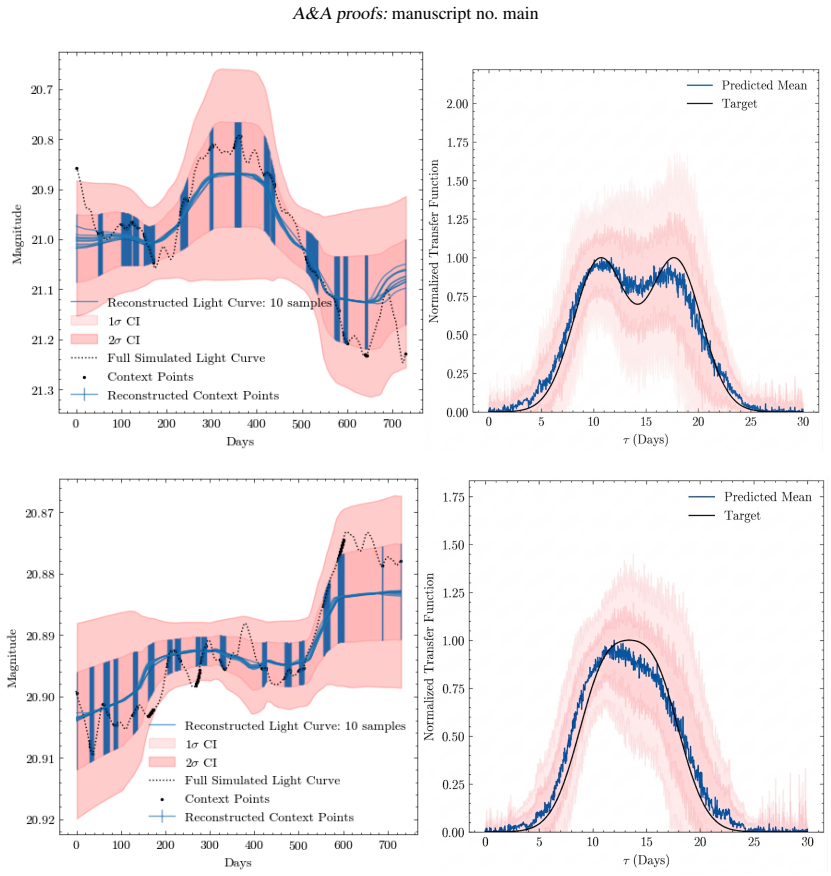
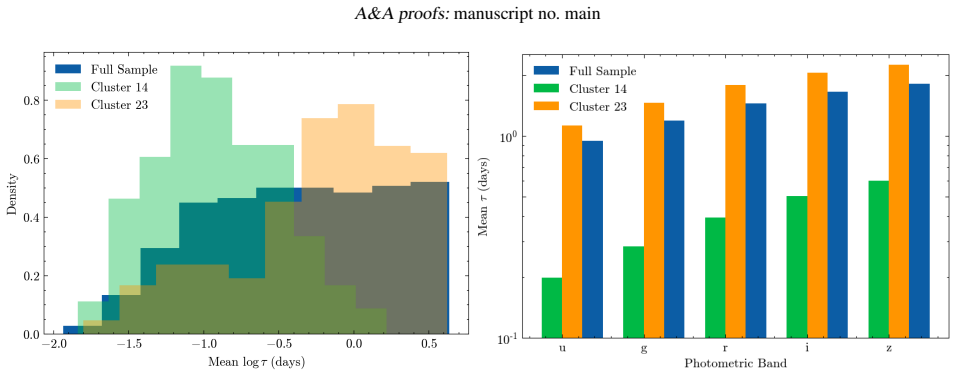
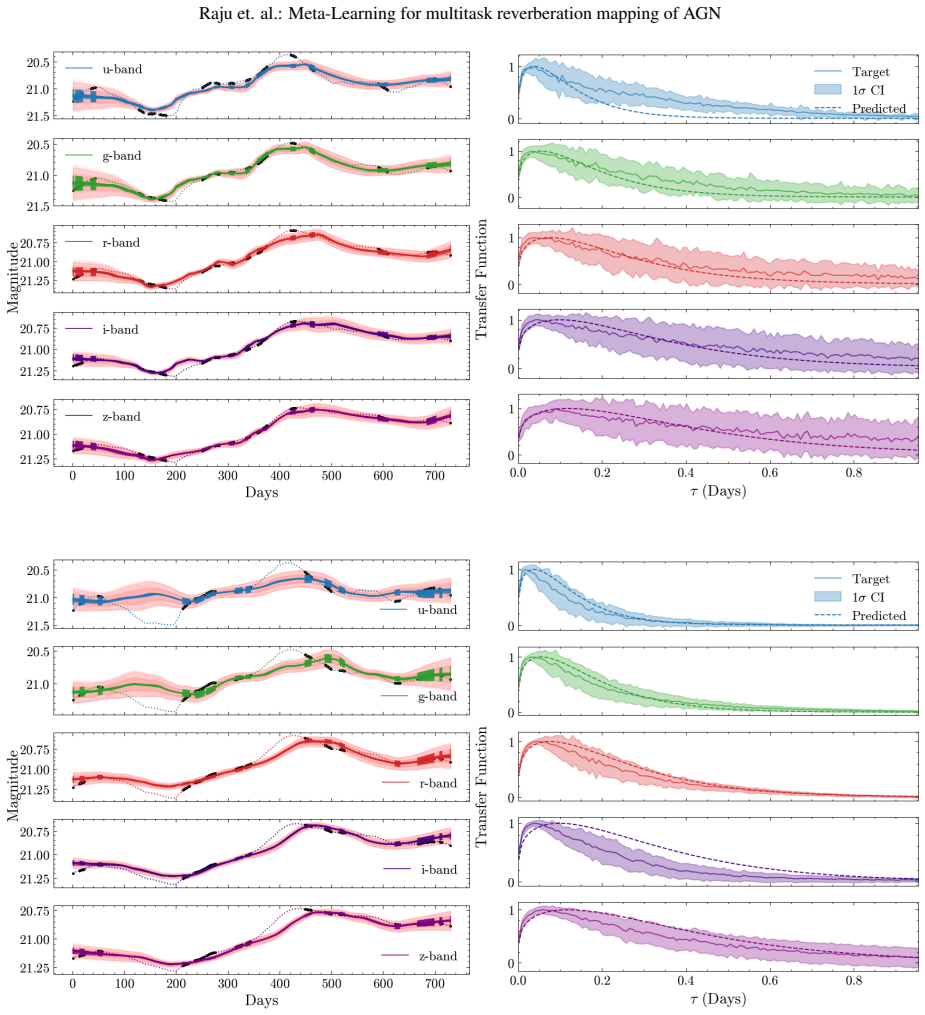
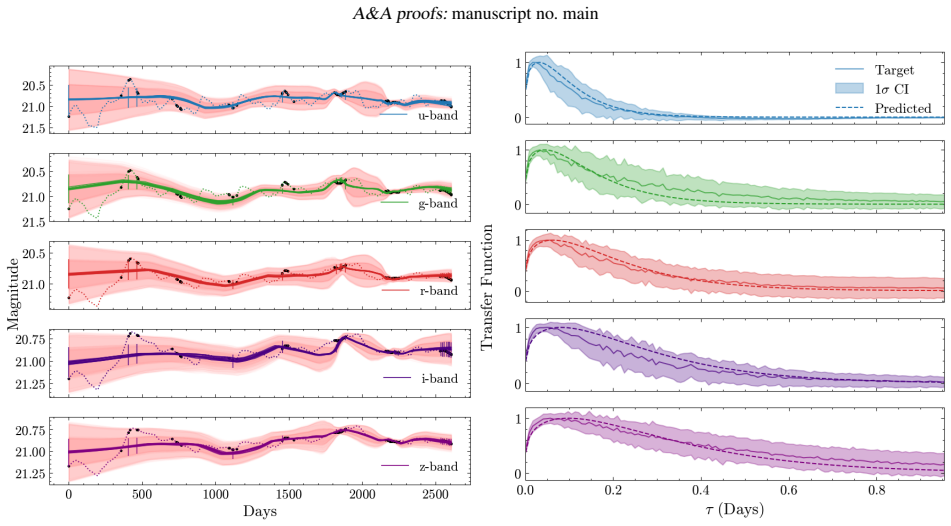
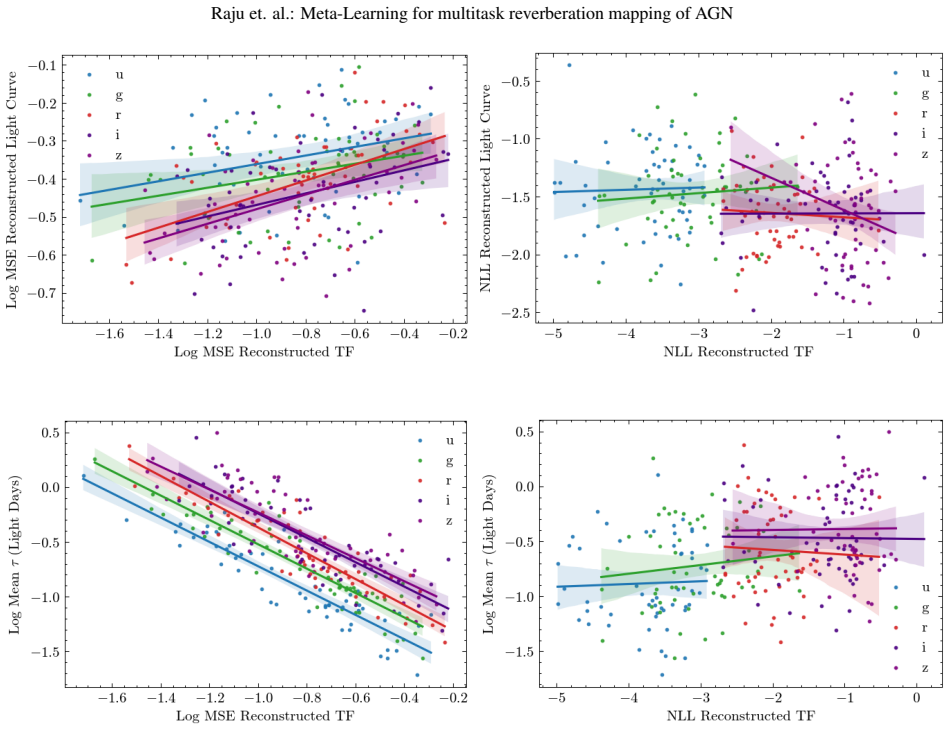
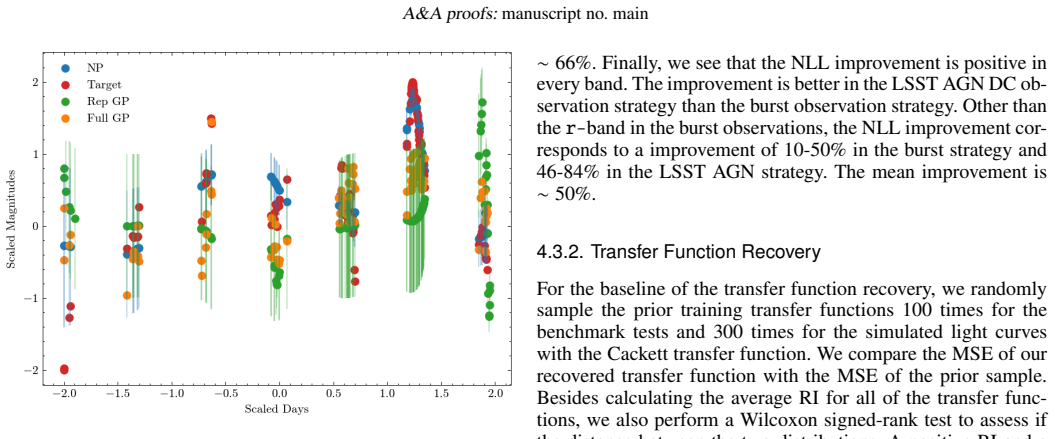
The attentive latent neural process framework learns latent representations that simultaneously encode transfer functions and supermassive black hole parameters; when the representations are obtained after self-organizing-map clustering and decoded with mixture density models, light-curve reconstruction improves 60-70 percent over ensemble baselines, transfer-function recovery improves approximately 35 percent relative to the training prior in low-variability clusters, and recovery of intrinsic supermassive black hole and red-noise parameters improves approximately 34 percent, with the same models transferring from simulated to real Zwicky Transient Facility light curves.
What carries the argument
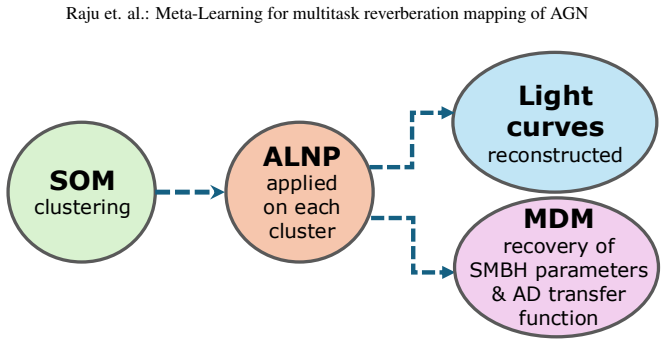
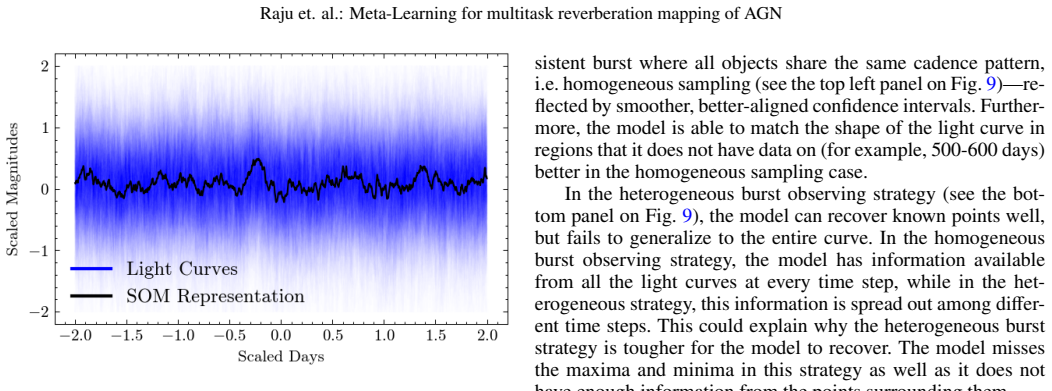
Attentive Latent Neural Processes combined with Self-Organizing Maps and Mixture Density Models that perform unsupervised clustering of light-curve topologies and joint recovery of transfer functions and black-hole parameters.
If this is right
- The method supplies a scalable route to photometric reverberation mapping for the thousands of AGN per square degree expected from wide-field time-domain surveys.
- Latent representations produced by the framework can be used for joint inference on both transfer functions and black-hole properties without requiring labeled real data.
- Unsupervised training on simulations followed by direct application to observations removes the need for large annotated training sets drawn from the target survey.
- The clustering step groups AGN by light-curve topology, which may support population-level studies of variability classes across large samples.
Where Pith is reading between the lines
- The same architecture could be tested on other irregularly sampled time-series problems in astronomy that require recovery of underlying response functions.
- If the latent space separates transfer-function shape from black-hole mass, it might enable rapid pre-selection of targets for spectroscopic follow-up.
- Extending the mixture-density output to produce full posterior distributions over transfer functions would allow direct propagation of uncertainty into black-hole mass estimates.
- The reported gains rest on the particular choice of simulation prior; retraining the same architecture on a different prior could reveal how sensitive the improvements are to simulation realism.
Load-bearing premise
Light-curve topologies and transfer functions generated in the simulated training set match the statistical properties of real AGN light curves observed by current and future surveys closely enough for the unsupervised models to generalize.
What would settle it
A controlled test in which the framework is applied to a large set of real AGN light curves and its reconstruction error exceeds that of the Gaussian-process baseline regressors would falsify the generalization claim.
Figures
read the original abstract
The Vera C. Rubin Observatory Legacy Survey of Space and Time (LSST) is expected to observe active galactic nuclei (AGN) at sky densities of approximately 1000-4000 per sq. deg, enabling photometric reverberation mapping on an unprecedented scale. We present a meta-learning framework for AGN photometric reverberation mapping based on Attentive Latent Neural Processes (ALNP), developed by the SER-SAG-S1 directable software in-kind team for LSST. The framework clusters AGN light curves with similar topologies using Self-Organizing Maps and combines ALNPs with Mixture Density Models to learn light-curve structure, supermassive black hole (SMBH) properties, and accretion-disk transfer functions in an unsupervised manner. We evaluate the framework on simulated AGN light curves spanning a range of cadences and transfer functions, as well as on real data from the Zwicky Transient Facility. The learned latent representations encode information on both transfer functions and SMBH parameters. Relative to ensemble-trained baseline regressors, including Gaussian-process models, the framework improves light-curve reconstruction by 60-70%. The transfer function recovery improves by approximately 35% relative to the training prior in a low-variability cluster, while recovery of intrinsic SMBH and red-noise parameters improves by approximately 34%. We further demonstrate that models trained on simulated data can be applied to real AGN light curves. These results indicate that ALNP-based representations provide a flexible and scalable approach to photometric reverberation mapping and are well suited to the diverse AGN population expected from LSST and future time-domain surveys.
Editorial analysis
A structured set of objections, weighed in public.
Referee Report
Summary. The manuscript presents a meta-learning framework for photometric reverberation mapping of AGN that combines Attentive Latent Neural Processes (ALNP), Self-Organizing Maps (SOM) to cluster light curves by topology, and Mixture Density Models (MDM). The approach is trained unsupervised on simulated AGN light curves spanning varied cadences and transfer functions, then evaluated on both simulations and real ZTF observations. It reports 60-70% gains in light-curve reconstruction relative to ensemble baselines (including Gaussian processes), ~35% improvement in transfer-function recovery (relative to training prior) within a low-variability cluster, and ~34% improvement in recovery of intrinsic SMBH and red-noise parameters. The work claims that models trained exclusively on simulations can be applied directly to real AGN light curves and positions the method as scalable for LSST-scale surveys.
Significance. If the reported performance gains and sim-to-real generalization are substantiated, the framework would supply a practical unsupervised route to photometric reverberation mapping at the volume expected from LSST (1000-4000 AGN per square degree). The multitask latent representations that jointly encode transfer functions and SMBH parameters, together with the SOM-based clustering, represent a potentially valuable technical advance over single-task regressors for handling heterogeneous AGN populations.
major comments (3)
- [Abstract] Abstract: the quantitative claims of 60-70% reconstruction improvement, ~35% transfer-function recovery, and ~34% SMBH/red-noise parameter recovery are stated without specifying the exact metric(s) used, the precise construction of the ensemble-trained baseline regressors (including GP hyperparameter settings and training protocol), error bars, or any statistical significance tests. These omissions are load-bearing because the central claim rests on the magnitude of the reported gains.
- [Abstract] Abstract / Results: no quantitative domain-shift diagnostics are supplied between the simulated training distribution and real ZTF light curves (e.g., MMD, KS tests on PSDs or ACFs, or reconstruction error on a real-data hold-out set). Because the framework is trained exclusively on simulations yet applied to real observations, the absence of such checks directly undermines the asserted applicability and the parameter-recovery numbers on real data.
- [Evaluation / Methods] Evaluation / Methods: the manuscript does not describe how the ALNP latent encodings are mapped to physical transfer functions and SMBH parameters, nor how the MDM component produces the reported recoveries; without this mapping and without ablation of the SOM clustering step, it is unclear whether the quoted improvements are independent of the simulation priors or simply reflect better interpolation within the training distribution.
minor comments (1)
- [Abstract] The abstract would be clearer if it stated the total number of simulated light curves, the exact cadence ranges, and the distribution of transfer-function parameters used in training.
Simulated Author's Rebuttal
We thank the referee for their careful reading and constructive comments. We address each major comment point by point below, indicating the revisions that will be made to the manuscript.
read point-by-point responses
-
Referee: [Abstract] Abstract: the quantitative claims of 60-70% reconstruction improvement, ~35% transfer-function recovery, and ~34% SMBH/red-noise parameter recovery are stated without specifying the exact metric(s) used, the precise construction of the ensemble-trained baseline regressors (including GP hyperparameter settings and training protocol), error bars, or any statistical significance tests. These omissions are load-bearing because the central claim rests on the magnitude of the reported gains.
Authors: We agree that the abstract requires greater specificity to substantiate the quantitative claims. In the revised manuscript we will explicitly state the metrics used for each reported improvement, describe the construction and hyperparameter settings of the ensemble baselines (including Gaussian processes), and report error bars together with the results of statistical significance tests. revision: yes
-
Referee: [Abstract] Abstract / Results: no quantitative domain-shift diagnostics are supplied between the simulated training distribution and real ZTF light curves (e.g., MMD, KS tests on PSDs or ACFs, or reconstruction error on a real-data hold-out set). Because the framework is trained exclusively on simulations yet applied to real observations, the absence of such checks directly undermines the asserted applicability and the parameter-recovery numbers on real data.
Authors: We acknowledge that quantitative domain-shift diagnostics are necessary to support the sim-to-real claims. The revised manuscript will include such diagnostics, for example MMD or KS tests on PSDs and ACFs between the simulated and ZTF distributions, as well as reconstruction performance on any available real-data hold-out sets. revision: yes
-
Referee: [Evaluation / Methods] Evaluation / Methods: the manuscript does not describe how the ALNP latent encodings are mapped to physical transfer functions and SMBH parameters, nor how the MDM component produces the reported recoveries; without this mapping and without ablation of the SOM clustering step, it is unclear whether the quoted improvements are independent of the simulation priors or simply reflect better interpolation within the training distribution.
Authors: We thank the referee for identifying this omission. The revised Methods and Evaluation sections will describe the mapping from ALNP latent encodings to physical transfer functions and SMBH parameters via the MDM, and will include an ablation study of the SOM clustering step to clarify the origin of the reported gains. revision: yes
Circularity Check
No significant circularity; framework evaluated on held-out simulated and separate real data
full rationale
The paper describes a meta-learning framework (ALNP + SOM + MDM) trained on simulated AGN light curves and applied to both held-out simulations and independent real ZTF observations. Performance gains (60-70% reconstruction, 34-35% parameter recovery) are reported relative to external ensemble baselines including Gaussian processes. No equations or steps reduce a claimed prediction to a fitted input by construction, and no load-bearing self-citation chain is invoked to justify uniqueness or ansatz choices. The derivation remains self-contained against the stated external benchmarks.
Axiom & Free-Parameter Ledger
Reference graph
Works this paper leans on
-
[1]
2015, Information Systems, 53, 16 Arévalo, P., Churazov, E., Lira, P., et al
Aghabozorgi, S., Seyed Shirkhorshidi, A., & Ying Wah, T. 2015, Information Systems, 53, 16 Arévalo, P., Churazov, E., Lira, P., et al. 2024, A&A, 684, A133 Arévalo, P., Churazov, E., Zhuravleva, I., Hernández-Monteagudo, C., &
2015
-
[2]
2012, MNRAS, 426, 1793 Arévalo, P., Lira, P., Sánchez-Sáez, P., et al
Revnivtsev, M. 2012, MNRAS, 426, 1793 Arévalo, P., Lira, P., Sánchez-Sáez, P., et al. 2023, MNRAS, 526, 6078
2012
-
[3]
J., Temple, M., Richards, G., Yu, W., & Bauer, F
Assef, R. J., Temple, M., Richards, G., Yu, W., & Bauer, F. 2021, LSST AGN SC Cadence Note: Quasar Counts, accessed: 2025-02-18
2021
-
[4]
2017, in 2017 IEEE International Conference on Computer Vision (ICCV), 3306–3314
Bahat, Y ., Efrat, N., & Irani, M. 2017, in 2017 IEEE International Conference on Computer Vision (ICCV), 3306–3314
2017
-
[5]
Bardeen, J. M. & Petterson, J. A. 1975, ApJ, 195, L65
1975
-
[6]
& Kowalski, M
Bartos, I. & Kowalski, M. 2017, Multimessenger Astronomy
2017
-
[7]
2009, ApJ, 696, 1241
Bauer, A., Baltay, C., Coppi, P., et al. 2009, ApJ, 696, 1241
2009
-
[8]
Bellm, E. C. e. a. 2019, PASP, 131, 018002
2019
-
[9]
B., Ivezi´c, Ž., Jones, R
Bianco, F. B., Ivezi´c, Ž., Jones, R. L., et al. 2022, ApJS, 258, 1
2022
-
[10]
Bishop, C. M. 2006, Pattern Recognition and Machine Learning, Information Science and Statistics (Berlin: Springer)
2006
-
[11]
Blandford, R. D. & McKee, C. F. 1982, ApJ, 255, 419
1982
-
[12]
2023, The Astrophysical Journal Sup- plement Series, 265, 27
Bonito, R., Venuti, L., Ustamujic, S., et al. 2023, The Astrophysical Journal Sup- plement Series, 265, 27
2023
-
[13]
Breivik, K., Connolly, A. J., Ford, K. E. S., et al. 2022, arXiv e-prints, arXiv:2208.02781
-
[14]
R., West, R
Brett, D. R., West, R. G., & Wheatley, P. J. 2004, Monthly Notices of the Royal Astronomical Society, 353, 369
2004
-
[15]
J., Shen, Y ., Blaes, O., et al
Burke, C. J., Shen, Y ., Blaes, O., et al. 2021, Science, 373, 789
2021
-
[16]
M., Bentz, M
Cackett, E. M., Bentz, M. C., & Kara, E. 2021, iScience, 24, 102557
2021
-
[17]
M., Horne, K., & Winkler, H
Cackett, E. M., Horne, K., & Winkler, H. 2007, MNRAS, 380, 669
2007
-
[18]
2017, ApJ, 834, 111
Caplar, N., Lilly, S., & Trakhtenbrot, B. 2017, ApJ, 834, 111
2017
-
[19]
Chan, J. H. H., Millon, M., Bonvin, V ., & Courbin, F. 2020, A&A, 636, A52
2020
-
[20]
2022, Monthly Notices of the Royal As- tronomical Society: Letters, 511, 13
Chand, K., Omar, A., Chand, H., et al. 2022, Monthly Notices of the Royal As- tronomical Society: Letters, 511, 13
2022
-
[21]
& Daniel, E
Chelouche, D. & Daniel, E. 2012, ApJ, 747, 62
2012
-
[22]
& Wang, J
Chen, X. & Wang, J. 2015, ApJ, 805, 80 De Cicco, D., Bauer, F. E., Paolillo, M., et al. 2021, A&A, 645, A103 De Cicco, D., Paolillo, M., Falocco, S., et al. 2019, A&A, 627, A33 de Vries, W. H., Becker, R. H., White, R. L., & Loomis, C. 2005, AJ, 129, 615
2015
-
[23]
2025, ApJ, 980, 257
Deesamutara, S., Chainakun, P., Worrakitpoonpon, T., et al. 2025, ApJ, 980, 257
2025
-
[24]
G., Drake, A
Djorgovski, S. G., Drake, A. J., Mahabal, A. A., et al. 2016, in American Astro- nomical Society Meeting Abstracts, V ol. 227, American Astronomical Soci- ety Meeting Abstracts #227, 349.14
2016
-
[25]
2023, A&A, 670, A54
Donoso-Oliva, C., Becker, I., Protopapas, P., et al. 2023, A&A, 670, A54
2023
-
[26]
J., Djorgovski, S
Drake, A. J., Djorgovski, S. G., Catelan, M., et al. 2017, Monthly Notices of the Royal Astronomical Society, 469, 3688
2017
-
[27]
Dubois, Y ., Gordon, J., & Foong, A. Y . K. 2020, Neural Process Family,http: //yanndubs.github.io/Neural-Process-Family/
2020
-
[28]
C., & Trump, J
Elitzur, M., Ho, L. C., & Trump, J. R. 2014, MNRAS, 438, 3340 Event Horizon Telescope Collaboration, Akiyama, K., Alberdi, A., et al. 2022, ApJ, 930, L12 Event Horizon Telescope Collaboration, Akiyama, K., Alberdi, A., et al. 2019, ApJ, 875, L4
2014
-
[29]
2024a, arXiv e-prints, arXiv:2410.18423
Fagin, J., Hung-Hsu Chan, J., Best, H., et al. 2024a, arXiv e-prints, arXiv:2410.18423
-
[30]
D., Bianco, F
Feigelson, E. D., Bianco, F. B., & Bonito, R. 2023, The Astrophysical Journal Supplement Series, 268, 11
2023
-
[31]
Foong, A. Y . K., Bruinsma, W. P., Gordon, J., et al. 2020, in Proceedings of the 34th International Conference on Neural Information Processing Systems, NIPS ’20 (Red Hook, NY , USA: Curran Associates Inc.)
2020
-
[32]
2018, in Proceedings of Ma- chine Learning Research, V ol
Garnelo, M., Rosenbaum, D., Maddison, C., et al. 2018, in Proceedings of Ma- chine Learning Research, V ol. 80, Proceedings of the 35th International Con- ference on Machine Learning, ed. J. Dy & A. Krause (PMLR), 1704–1713
2018
-
[33]
Garnelo, M., Schwarz, J., Rosenbaum, D., et al. 2018, arXiv e-prints, arXiv:1807.01622
work page internal anchor Pith review Pith/arXiv arXiv 2018
-
[34]
1999, MNRAS, 306, 637
Giveon, U., Maoz, D., Kaspi, S., Netzer, H., & Smith, P. 1999, MNRAS, 306, 637
1999
-
[35]
2016, Deep Learning (MIT Press)
Goodfellow, I., Bengio, Y ., & Courville, A. 2016, Deep Learning (MIT Press)
2016
-
[36]
2019, Publications of the Astronomi- cal Society of the Pacific, 131, 078001
Graham, M., Kulkarni, S., Bellm, E., et al. 2019, Publications of the Astronomi- cal Society of the Pacific, 131, 078001
2019
-
[37]
J., Djorgovski, S
Graham, M. J., Djorgovski, S. G., Stern, D., et al. 2015, MNRAS, 453, 1562
2015
- [38]
-
[39]
2002, Monthly Notices of the Royal Astronomical Society, 329, 76
Hawkins, M. 2002, Monthly Notices of the Royal Astronomical Society, 329, 76
2002
-
[40]
F., Coughlin, M
Healy, B. F., Coughlin, M. W., Mahabal, A. A., et al. 2024, ApJS, 272, 14
2024
-
[41]
I., Harrison, T
Hoffman, D. I., Harrison, T. E., & McNamara, B. J. 2009, The Astronomical Journal, 138, 466
2009
-
[42]
R., Grier, C
Homayouni, Y ., Trump, J. R., Grier, C. J., et al. 2019, ApJ, 880, 126 Hönig, S. F. 2014, ApJ, 784, L4
2019
-
[43]
M., Collier, S
Horne, K., Peterson, B. M., Collier, S. J., & Netzer, H. 2004, PASP, 116, 465
2004
-
[44]
2022, IEEE Transac- tions on Pattern Analysis and Machine Intelligence, 44, 5149
Hospedales, T., Antoniou, A., Micaelli, P., & Storkey, A. 2022, IEEE Transac- tions on Pattern Analysis and Machine Intelligence, 44, 5149
2022
-
[45]
2019, MNRAS, 488, 324 Ivezi´c, Ž., Kahn, S
Ingram, A., Mastroserio, G., Dauser, T., et al. 2019, MNRAS, 488, 324 Ivezi´c, Ž., Kahn, S. M., Tyson, J. A., et al. 2019, ApJ, 873, 111
2019
-
[46]
K., Joshi, R., Chand, H., et al
Jha, V . K., Joshi, R., Chand, H., et al. 2022, Monthly Notices of the Royal As- tronomical Society, 511, 3005
2022
-
[47]
P., V ogeley, M
Kasliwal, V . P., V ogeley, M. S., & Richards, G. T. 2017, MNRAS, 470, 3027
2017
-
[48]
P., V ogeley, M
Kasliwal, V . P., V ogeley, M. S., Richards, G. T., Williams, J., & Carini, M. T. 2015, MNRAS, 453, 2075
2015
-
[49]
C., Bechtold, J., & Siemiginowska, A
Kelly, B. C., Bechtold, J., & Siemiginowska, A. 2009, ApJ, 698, 895
2009
-
[50]
C., Becker, A
Kelly, B. C., Becker, A. C., Sobolewska, M., Siemiginowska, A., & Uttley, P. 2014, ApJ, 788, 33
2014
-
[51]
2019, in International Conference on Learning Representations
Kim, H., Mnih, A., Schwarz, J., et al. 2019, in International Conference on Learning Representations
2019
-
[52]
Kingma, D. P. & Ba, J. 2014, arXiv e-prints, arXiv:1412.6980
work page internal anchor Pith review Pith/arXiv arXiv 2014
-
[53]
S., Shappee, B
Kochanek, C. S., Shappee, B. J., Stanek, K. Z., et al. 2017, Publications of the Astronomical Society of the Pacific, 129, 104502
2017
-
[54]
1990, Proceedings of the IEEE, 78, 1464
Kohonen, T. 1990, Proceedings of the IEEE, 78, 1464
1990
-
[55]
F., Blanc, G
Kollmeier, J., Anderson, S. F., Blanc, G. A., et al. 2019, in Bulletin of the Amer- ican Astronomical Society, V ol. 51, 274
2019
-
[56]
S., Sijacki, D., et al
Koudmani, S., Somerville, R. S., Sijacki, D., et al. 2024, Monthly Notices of the Royal Astronomical Society, 532, 60 Kovaˇcevi´c, A. B., Ili ´c, D., Popovi ´c, L. ˇC., et al. 2021, Monthly Notices of the Royal Astronomical Society, 505, 5012 Kovaˇcevi´c, A. B., Ili´c, D., Popovi´c, L., et al. 2023, Universe, 9, 287 Kovaˇcevi´c, A. B., Radovi´c, V ., Ili´...
2024
-
[57]
2020, MNRAS, 499, 6053
Laurenti, M., Vagnetti, F., Middei, R., & Paolillo, M. 2020, MNRAS, 499, 6053
2020
-
[58]
M., Kulkarni, S
Law, N. M., Kulkarni, S. R., Dekany, R. G., et al. 2009, Publications of the Astronomical Society of the Pacific, 121, 1395
2009
-
[59]
I., & Bianco, F
Li, X., Ragosta, F., Clarkson, W. I., & Bianco, F. B. 2021, The Astrophysical Journal Supplement Series, 258, 2
2021
-
[60]
2016, ApJ, 831, 206
Li, Y .-R., Wang, J.-M., & Bai, J.-M. 2016, ApJ, 831, 206
2016
-
[61]
2016, The Astrophysical Journal, 831, 206
Li, Y .-R., Wang, J.-M., & Bai, J.-M. 2016, The Astrophysical Journal, 831, 206
2016
-
[62]
2018, ApJ, 861, 6
Li, Z., McGreer, I., Wu, X., Fan, X., & Yang, Q. 2018, ApJ, 861, 6
2018
-
[63]
Y .-Y ., Pandya, S., Pratap, D., et al
Lin, J. Y .-Y ., Pandya, S., Pratap, D., et al. 2022, Monthly Notices of the Royal Astronomical Society, 518, 4921
2022
-
[64]
2020, MNRAS, 494, 3686
Luo, Y ., Shen, Y ., & Yang, Q. 2020, MNRAS, 494, 3686
2020
-
[65]
2012, ApJ, 753, 106
MacLeod, C., Ivezi´c, Ž., Sesar, B., et al. 2012, ApJ, 753, 106
2012
-
[66]
L., Ivezi´c, Ž., Kochanek, C
MacLeod, C. L., Ivezi´c, Ž., Kochanek, C. S., et al. 2010, ApJ, 721, 1014
2010
-
[67]
2019, Publications of the As- tronomical Society of the Pacific, 131, 038002
Mahabal, A., Rebbapragada, U., Walters, R., et al. 2019, Publications of the As- tronomical Society of the Pacific, 131, 038002
2019
-
[68]
J., Laher, R
Masci, F. J., Laher, R. R., Rusholme, B., et al. 2019, PASP, 131, 018003
2019
-
[69]
& Basford, K
Mclachlan, G. & Basford, K. 1988, Mixture Models: Inference and Applications to Clustering, V ol. 38 Article number, page 23 of 34 A&A proofs:manuscript no. main
1988
-
[70]
J., Xiang, Z., & Kesidis, G
Miller, D. J., Xiang, Z., & Kesidis, G. 2023, Adversarial Learning and Secure AI (Cambridge University Press)
2023
-
[71]
S., Richards, G
Moreno, J., V ogeley, M. S., Richards, G. T., & Yu, W. 2019, PASP, 131, 063001
2019
-
[72]
W., Hyer, G
Morgan, C. W., Hyer, G. E., Bonvin, V ., et al. 2018, ApJ, 869, 106
2018
-
[73]
W., Kochanek, C
Morgan, C. W., Kochanek, C. S., Morgan, N. D., & Falco, E. E. 2010, The As- trophysical Journal, 712, 1129
2010
-
[74]
S., Chambers, K
Morganson, E., Burgett, W. S., Chambers, K. C., et al. 2014, ApJ, 784, 92
2014
-
[75]
F., Edelson, R., Baumgartner, W., & Gandhi, P
Mushotzky, R. F., Edelson, R., Baumgartner, W., & Gandhi, P. 2011, ApJ, 743, L12
2011
-
[76]
K., Chand, H., & Singh, V
Ojha, V ., Jha, V . K., Chand, H., & Singh, V . 2022, Monthly Notices of the Royal Astronomical Society, 514, 5607
2022
-
[77]
M., Assef, R
Padovani, P., Alexander, D. M., Assef, R. J., et al. 2017, A&A Rev., 25, 2
2017
-
[78]
Panaretos, V . M. & Zemel, Y . 2019, Annual Review of Statistics and Its Appli- cation, 6, 405
2019
-
[79]
W., Villar, A., Li, Y ., et al
Park, J. W., Villar, A., Li, Y ., et al. 2021, arXiv e-prints, arXiv:2106.01450
-
[80]
Peterson, B. M. & Horne, K. 2004, Astronomische Nachrichten, 325, 248
2004
discussion (0)
Sign in with ORCID, Apple, or X to comment. Anyone can read and Pith papers without signing in.