ALMA measurements of mass loss and wind clumping in the massive stars of the Arches cluster
Pith reviewed 2026-06-27 14:48 UTC · model grok-4.3
The pith
ALMA data show wind clumping in Arches cluster stars decreases with radius.
A machine-rendered reading of the paper's core claim, the machinery that carries it, and where it could break.
Core claim
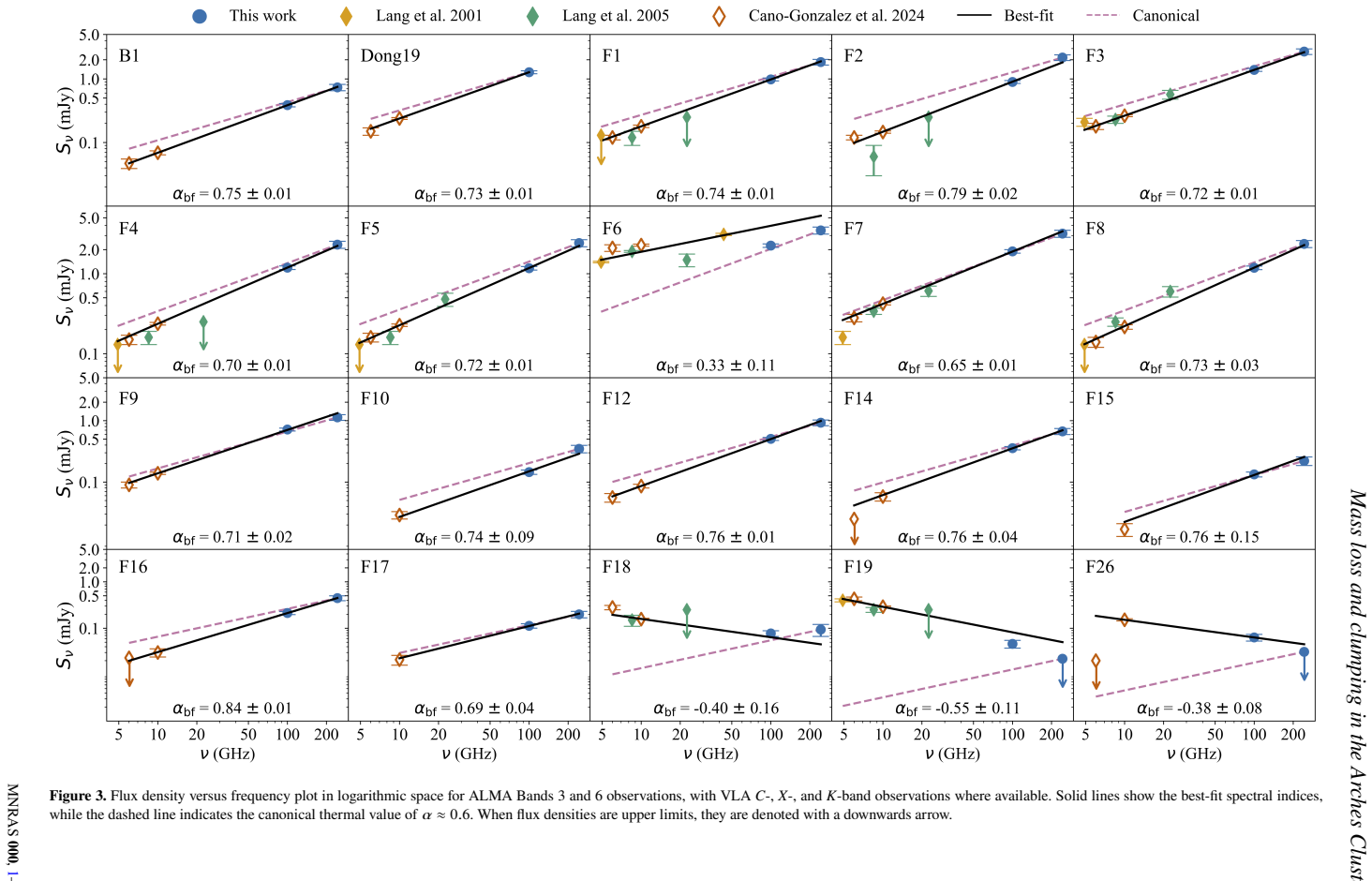
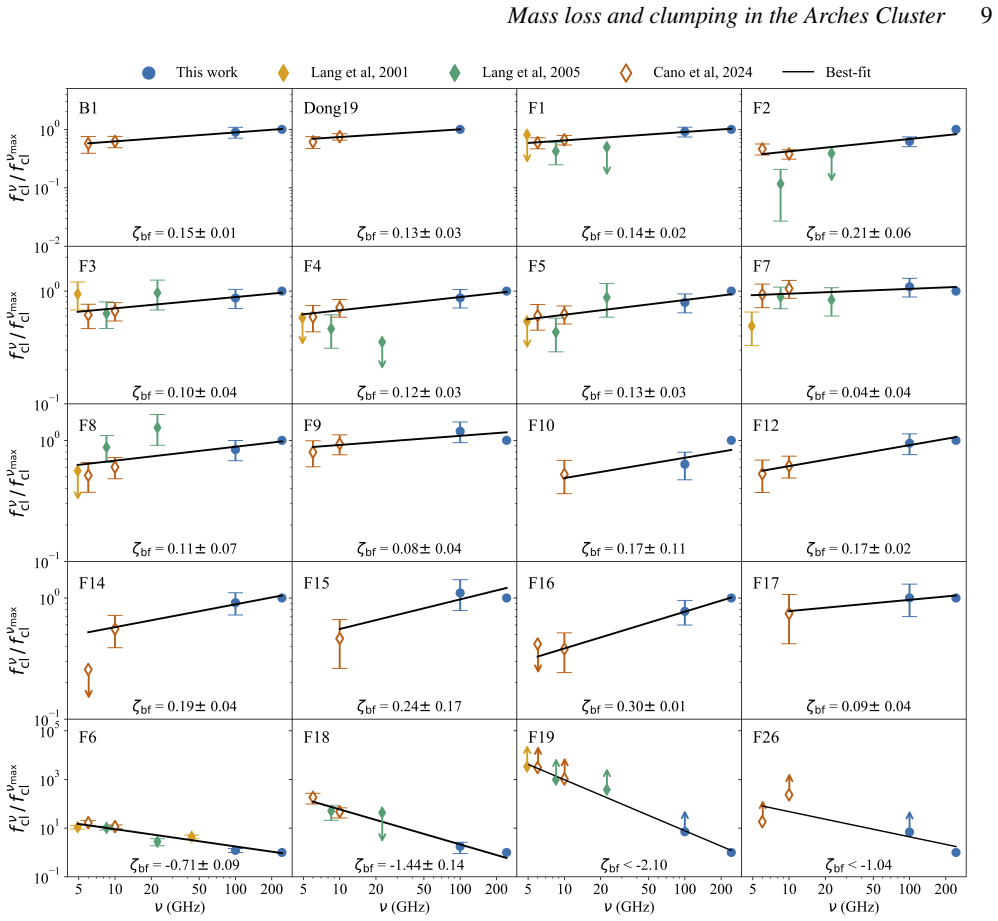
The majority of Wolf-Rayet stars exhibit spectral indices clustered around α ≈ 0.7-0.8, consistent with predominantly thermal free-free emission from dense, partially optically thick winds. We find significant evidence of structured wind clumping at millimetre wavelengths that generally decreases with increasing radius, supporting structured wind models with strong inner-wind inhomogeneities.
What carries the argument
Broadband spectral indices spanning radio to millimetre frequencies, used as frequency-dependent diagnostics of wind clumping.
If this is right
- Mass-loss rates for the WN stars fall between log(Mdot) ≈ -4.1 and -4.9 solar masses per year.
- O-type supergiants and hypergiants show lower rates between log(Mdot) ≈ -4.9 and -5.4.
- Wind models must incorporate stronger density inhomogeneities in the inner wind than in the outer wind.
- Radio-millimetre data provide an independent route to mass-loss rates that is less affected by line-driving uncertainties than ultraviolet diagnostics.
- Stellar feedback calculations for dense clusters can now incorporate radially varying clumping when estimating total momentum and energy input.
Where Pith is reading between the lines
- The same ALMA plus VLA approach could be repeated on other young massive clusters to test whether the inner-wind clumping pattern is common.
- If the radial decline in clumping holds, integrated mass-loss over a star's lifetime may be lower than estimates that assume constant clumping factors.
- Non-thermal indices seen in several O stars already flag likely colliding-wind binaries, which future monitoring could confirm directly.
Load-bearing premise
Spectral indices can be read directly as thermal free-free versus non-thermal synchrotron without major contamination from other emission processes or binary interactions.
What would settle it
A high-resolution map or multi-epoch data set showing that clumping strength stays constant or increases with radius in a well-studied WN star would contradict the reported radial decline.
Figures
read the original abstract
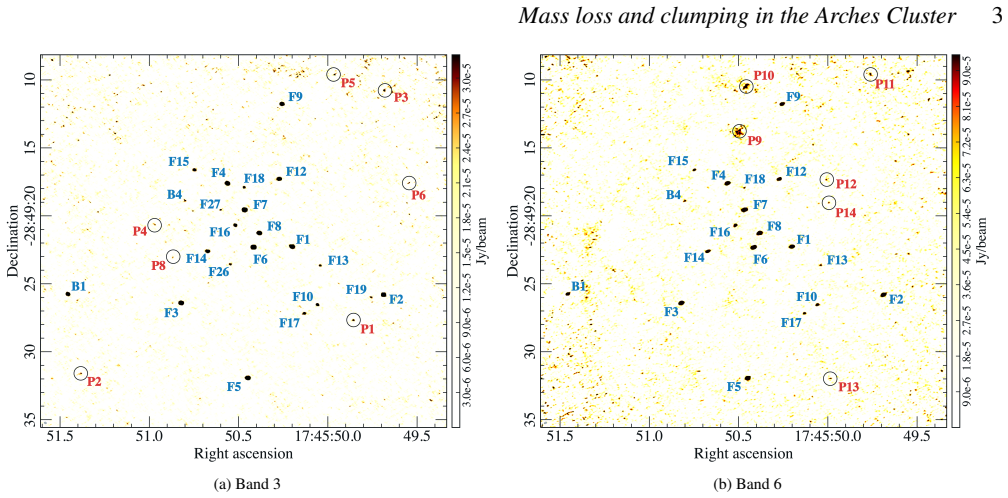
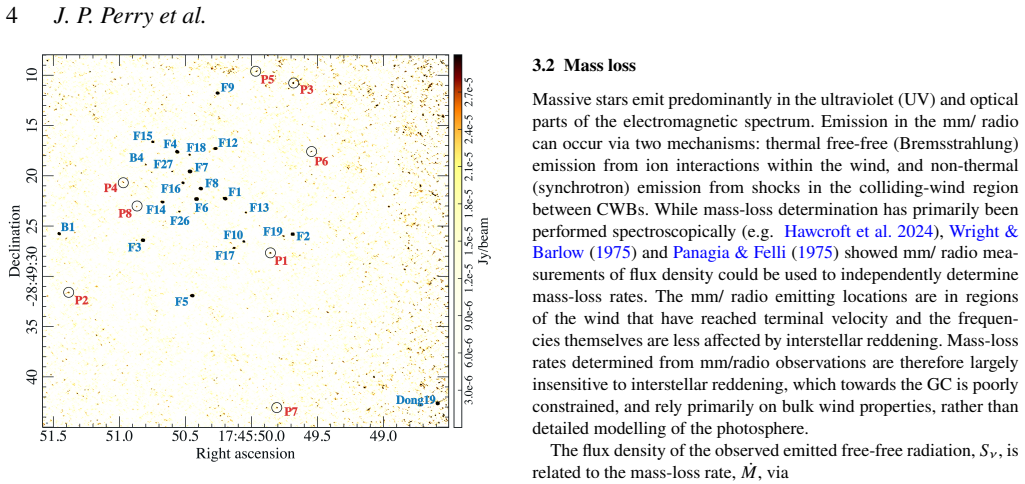
We present the first Atacama Large Millimeter/submillimeter Array (ALMA) Band 3 (100 GHz) and Band 6 (243 GHz) continuum observations of the Arches cluster, one of the youngest and most massive stellar clusters in the Milky Way. We detect and characterise millimetre emission from 23 massive stars, including WN7-9h Wolf-Rayet stars, O-type supergiants and hypergiants. By combining our ALMA measurements with archival Very Large Array data spanning 5-22.5 GHz, we derive broadband radio-millimetre spectral indices and investigate the radial structure of stellar winds through frequency-dependent clumping diagnostics. The majority of Wolf-Rayet stars exhibit spectral indices clustered around $\alpha \approx 0.7-0.8$, consistent with predominantly thermal free-free emission from dense, partially optically thick winds. In contrast, several O-type stars show flat or negative broadband spectral indices, indicative of non-thermal synchrotron emission likely associated with colliding-wind binaries. Using millimetre flux densities, we derive clumping-scaled mass-loss rates spanning $\log(\dot{M}/\mathrm{M}_{\odot}\,\text{yr}^{-1})\approx-4.1$ to $-4.9$ for the WN stars and $-4.9$ to $-5.4$ for the O super-/hypergiants, consistent with expectations for luminous massive stars in the Galactic Centre environment. We find significant evidence of structured wind clumping at millimetre wavelengths that generally decreases with increasing radius, supporting structured wind models with strong inner-wind inhomogeneities. These results demonstrate the power of combined radio-millimetre observations for constraining mass-loss and wind structure in massive stars, and provide new insight into stellar feedback in extreme cluster environments.
Editorial analysis
A structured set of objections, weighed in public.
Referee Report
Summary. The manuscript presents the first ALMA Band 3 (100 GHz) and Band 6 (243 GHz) continuum observations of the Arches cluster, detecting millimetre emission from 23 massive stars (WN7-9h Wolf-Rayet stars, O-type supergiants and hypergiants). Combining these data with archival VLA observations (5-22.5 GHz) yields broadband spectral indices, from which clumping-scaled mass-loss rates are derived (log Ṁ ≈ -4.1 to -4.9 for WN stars; -4.9 to -5.4 for O stars). The central result is significant evidence for structured wind clumping at millimetre wavelengths that decreases with increasing radius, supporting models with strong inner-wind inhomogeneities.
Significance. If the radial clumping trend holds under the adopted assumptions, the work supplies new multi-frequency constraints on mass loss and wind structure for luminous stars in a high-density Galactic Centre environment. The combined radio-mm approach to frequency-dependent clumping diagnostics is a methodological strength that could inform stellar feedback models.
major comments (2)
- [§5] The central claim of a radial decrease in clumping (abstract and §5) rests on broadband spectral indices mapping directly to thermal free-free emission modified by clumping factors for the WN sample. This requires that standard wind velocity laws, ionization structures, and optical-depth scaling hold without substantial non-thermal synchrotron or binary-wind contributions; the manuscript applies the thermal interpretation to WN stars while attributing flat/negative indices to binaries only for O stars, but provides no quantitative test of the assumption for WN stars.
- [Table 2] Table 2 (or equivalent data table): the reported mass-loss rates and clumping factors lack an explicit error budget or statement of exclusion criteria for sources; without this, it is not possible to assess whether post-hoc choices in source selection or model assumptions affect the reported trends or the claimed decrease of clumping with radius.
minor comments (2)
- The abstract states spectral indices clustered around α ≈ 0.7-0.8 but does not specify how many WN versus O stars fall in each category; adding these counts would improve clarity.
- [§2] Ensure all VLA archival data references are explicitly cited in the methods section rather than only in the abstract.
Simulated Author's Rebuttal
We thank the referee for their constructive and detailed review. We address each major comment below and have revised the manuscript to improve clarity and transparency where possible.
read point-by-point responses
-
Referee: [§5] The central claim of a radial decrease in clumping (abstract and §5) rests on broadband spectral indices mapping directly to thermal free-free emission modified by clumping factors for the WN sample. This requires that standard wind velocity laws, ionization structures, and optical-depth scaling hold without substantial non-thermal synchrotron or binary-wind contributions; the manuscript applies the thermal interpretation to WN stars while attributing flat/negative indices to binaries only for O stars, but provides no quantitative test of the assumption for WN stars.
Authors: We acknowledge the referee's point that a more explicit quantitative test of the thermal assumption for WN stars would strengthen the analysis. The WN stars show spectral indices tightly clustered at α ≈ 0.7–0.8, consistent with the canonical range for thermal free-free emission in partially optically thick winds (0.6 < α < 1.0). We attributed deviations only for O stars because those sources exhibit flat/negative indices and have independent evidence of binarity in the literature. While a full Monte Carlo exploration of possible non-thermal contributions was beyond the scope of the present data set, we have added a dedicated paragraph in §5 that (i) quantifies how large a non-thermal fraction would be required to shift the observed indices outside the thermal range and (ii) notes the absence of known binary signatures or variability in the WN sample. This addition directly addresses the concern while preserving the original conclusions. revision: partial
-
Referee: [Table 2] Table 2 (or equivalent data table): the reported mass-loss rates and clumping factors lack an explicit error budget or statement of exclusion criteria for sources; without this, it is not possible to assess whether post-hoc choices in source selection or model assumptions affect the reported trends or the claimed decrease of clumping with radius.
Authors: We agree that an explicit error budget and clear exclusion criteria are necessary for assessing robustness. In the revised manuscript we have (i) expanded Table 2 to report 1σ uncertainties on each mass-loss rate and clumping factor, propagated from the measured flux densities, distance, terminal velocity, and adopted ionization fractions, and (ii) added a new methods subsection that lists the detection threshold, confusion criteria, and any sources excluded from the final sample together with the rationale. These changes allow readers to evaluate whether the reported radial clumping trend is sensitive to selection or modeling choices. revision: yes
Circularity Check
Observational derivation from measured fluxes shows no circularity
full rationale
The paper reports direct ALMA Band 3/6 and archival VLA continuum measurements of 23 stars, computes broadband spectral indices from the observed flux densities across 5-243 GHz, and applies standard free-free emission formulas to derive clumping-scaled mass-loss rates. No equations reduce the reported clumping trend or mass-loss values to self-referential fitted parameters, self-citation chains, or inputs that presuppose the output. The radial decrease in clumping is inferred from frequency-dependent diagnostics on independent data products rather than being defined into the result. External benchmarks (standard wind models) are used only for interpretation, not to force the measurements.
Axiom & Free-Parameter Ledger
Reference graph
Works this paper leans on
-
[1]
Abbott D. C., Bieging J. H., Churchwell E., 1981, @doi [ ] 10.1086/159412 , https://ui.adsabs.harvard.edu/abs/1981ApJ...250..645A 250, 645
-
[2]
Becker R. H., White R. L., Helfand D. J., 1995, @doi [ ] 10.1086/176166 , https://ui.adsabs.harvard.edu/abs/1995ApJ...450..559B 450, 559
-
[3]
Bj \"o rklund R., Sundqvist J. O., Singh S. M., Puls J., Najarro F., 2023, @doi [ ] 10.1051/0004-6361/202141948 , https://ui.adsabs.harvard.edu/abs/2023A&A...676A.109B 676, A109
-
[4]
Blomme R., Volpi D., 2014, @doi [ ] 10.1051/0004-6361/201322679 , https://ui.adsabs.harvard.edu/abs/2014A&A...561A..18B 561, A18
-
[5]
Blomme R., Rauw G., Volpi D., Naz \'e Y., Abdul-Masih M., 2024, @doi [ ] 10.1051/0004-6361/202450227 , https://ui.adsabs.harvard.edu/abs/2024A&A...687A.106B 687, A106
-
[6]
D., Schaerer D., Pasquali A., Heydari-Malayeri M., Conti P
Blum R. D., Schaerer D., Pasquali A., Heydari-Malayeri M., Conti P. S., Schmutz W., 2001, @doi [ ] 10.1086/323096 , https://ui.adsabs.harvard.edu/abs/2001AJ....122.1875B 122, 1875
-
[7]
Bonaldi A., Zwaan M., Best P., Broderick J., Goedhart S., Mahony E., 2024, @doi [The Messenger] 10.18727/0722-6691/5361 , https://ui.adsabs.harvard.edu/abs/2024Msngr.193....5B 193, 5
-
[8]
CASA Team et al., 2022, @doi [ ] 10.1088/1538-3873/ac9642 , https://ui.adsabs.harvard.edu/abs/2022PASP..134k4501C 134, 114501
work page internal anchor Pith review doi:10.1088/1538-3873/ac9642 2022
-
[9]
Cano-Gonz \'a lez M., Sch \"o del R., Nogueras-Lara F., 2021, @doi [ ] 10.1051/0004-6361/202140982 , https://ui.adsabs.harvard.edu/abs/2021A&A...653A..37C 653, A37
-
[10]
Cano-Gonz \'a lez M., Sch \"o del R., Alberdi A., Mold \'o n J., P \'e rez-Torres M., Najarro F., Gallego-Calvente A. T., 2024, @doi [ ] 10.1051/0004-6361/202451771 , https://ui.adsabs.harvard.edu/abs/2024A&A...692A..23C 692, A23
-
[11]
Capelli R., Warwick R. S., Cappelluti N., Gillessen S., Predehl P., Porquet D., Czesla S., 2011, @doi [ ] 10.1051/0004-6361/201015758 , https://ui.adsabs.harvard.edu/abs/2011A&A...525L...2C 525, L2
-
[12]
Cappa C., Goss W. M., van der Hucht K. A., 2004, @doi [ ] 10.1086/383286 , https://ui.adsabs.harvard.edu/abs/2004AJ....127.2885C 127, 2885
-
[13]
Chen \'e A.-N., St-Louis N., Moffat A. F. J., Gayley K. G., 2020, @doi [ ] 10.3847/1538-4357/abba24 , https://ui.adsabs.harvard.edu/abs/2020ApJ...903..113C 903, 113
-
[14]
Clark J. S., Lohr M. E., Najarro F., Dong H., Martins F., 2018, @doi [ ] 10.1051/0004-6361/201832826 , https://ui.adsabs.harvard.edu/abs/2018A&A...617A..65C 617, A65
-
[15]
Clark J. S., Lohr M. E., Patrick L. R., Najarro F., 2019, @doi [ ] 10.1051/0004-6361/201834529 , https://ui.adsabs.harvard.edu/abs/2019A&A...623A..84C 623, A84
-
[16]
Observational constraints on the binary properties of very massive stars
Clark J. S., Lohr M. E., Najarro F., Patrick L. R., Ritchie B. W., 2023, @doi [ ] 10.1093/mnras/stad449 , https://ui.adsabs.harvard.edu/abs/2023MNRAS.521.4473C 521, 4473
-
[17]
Clarkson W. I., Ghez A. M., Morris M. R., Lu J. R., Stolte A., McCrady N., Do T., Yelda S., 2012, @doi [ ] 10.1088/0004-637X/751/2/132 , https://ui.adsabs.harvard.edu/abs/2012ApJ...751..132C 751, 132
-
[18]
Condon J. J., Cotton W. D., Greisen E. W., Yin Q. F., Perley R. A., Taylor G. B., Broderick J. J., 1998, @doi [ ] 10.1086/300337 , https://ui.adsabs.harvard.edu/abs/1998AJ....115.1693C 115, 1693
-
[19]
Cotera A. S., Erickson E. F., Colgan S. W. J., Simpson J. P., Allen D. A., Burton M. G., 1996, @doi [ ] 10.1086/177099 , https://ui.adsabs.harvard.edu/abs/1996ApJ...461..750C 461, 750
-
[20]
A gas-giant planet transiting a rapidly rotating A5 star
Crowther P. A., Schnurr O., Hirschi R., Yusof N., Parker R. J., Goodwin S. P., Kassim H. A., 2010, @doi [ ] 10.1111/j.1365-2966.2010.17167.x , https://ui.adsabs.harvard.edu/abs/2010MNRAS.408..731C 408, 731
-
[21]
Davies B., Vink J. S., Oudmaijer R. D., 2007, @doi [ ] 10.1051/0004-6361:20077193 , https://ui.adsabs.harvard.edu/abs/2007A&A...469.1045D 469, 1045
-
[22]
De Becker M., 2007, @doi [ ] 10.1007/s00159-007-0005-2 , https://ui.adsabs.harvard.edu/abs/2007A&ARv..14..171D 14, 171
-
[23]
Dong H., et al., 2011, @doi [ ] 10.1111/j.1365-2966.2011.19013.x , https://ui.adsabs.harvard.edu/abs/2011MNRAS.417..114D 417, 114
-
[24]
Dougherty S. M., Williams P. M., 2000, @doi [ ] 10.1046/j.1365-8711.2000.03837.x , https://ui.adsabs.harvard.edu/abs/2000MNRAS.319.1005D 319, 1005
-
[25]
Dougherty S. M., Clark J. S., Negueruela I., Johnson T., Chapman J. M., 2010, @doi [ ] 10.1051/0004-6361/200913505 , https://ui.adsabs.harvard.edu/abs/2010A&A...511A..58D 511, A58
-
[26]
E., 1989, @doi [ ] 10.1086/191374 , https://ui.adsabs.harvard.edu/abs/1989ApJS...71..267D 71, 267
Drew J. E., 1989, @doi [ ] 10.1086/191374 , https://ui.adsabs.harvard.edu/abs/1989ApJS...71..267D 71, 267
-
[27]
Ekstr \"o m S., et al., 2012, @doi [ ] 10.1051/0004-6361/201117751 , https://ui.adsabs.harvard.edu/abs/2012A&A...537A.146E 537, A146
-
[28]
Eversberg T., L \'e pine S., Moffat A. F. J., 1998, @doi [ ] 10.1086/305218 , https://ui.adsabs.harvard.edu/abs/1998ApJ...494..799E 494, 799
-
[29]
Fenech D. M., et al., 2018, @doi [ ] 10.1051/0004-6361/201832754 , https://ui.adsabs.harvard.edu/abs/2018A&A...617A.137F 617, A137
-
[30]
Figer D. F., Kim S. S., Morris M., Serabyn E., Rich R. M., McLean I. S., 1999, @doi [ ] 10.1086/307937 , https://ui.adsabs.harvard.edu/abs/1999ApJ...525..750F 525, 750
-
[31]
Figer D. F., et al., 2002, @doi [ ] 10.1086/344154 , https://ui.adsabs.harvard.edu/abs/2002ApJ...581..258F 581, 258
-
[32]
Fullerton A. W., Massa D. L., Prinja R. K., 2006, @doi [ ] 10.1086/498560 , https://ui.adsabs.harvard.edu/abs/2006ApJ...637.1025F 637, 1025
-
[33]
GRAVITY Collaboration et al., 2019, @doi [ ] 10.1051/0004-6361/201935656 , https://ui.adsabs.harvard.edu/abs/2019A&A...625L..10G 625, L10
-
[34]
Gallego-Calvente A. T., et al., 2021, @doi [ ] 10.1051/0004-6361/202039172 , https://ui.adsabs.harvard.edu/abs/2021A&A...647A.110G 647, A110
-
[35]
Gr \"a fener G., Hamann W.-R., 2008, @doi [ ] 10.1051/0004-6361:20066176 , https://ui.adsabs.harvard.edu/abs/2008A&A...482..945G 482, 945
-
[36]
Groh J. H., Meynet G., Georgy C., Ekstr \"o m S., 2013, @doi [ ] 10.1051/0004-6361/201321906 , https://ui.adsabs.harvard.edu/abs/2013A&A...558A.131G 558, A131
-
[37]
Hamann W.-R., Koesterke L., 1998, , https://ui.adsabs.harvard.edu/abs/1998A&A...335.1003H 335, 1003
1998
-
[38]
Hamann W.-R., Gr \"a fener G., Liermann A., 2006, @doi [ ] 10.1051/0004-6361:20065052 , https://ui.adsabs.harvard.edu/abs/2006A&A...457.1015H 457, 1015
-
[39]
Hamann W.-R., et al., 2019, @doi [ ] 10.1051/0004-6361/201834850 , https://ui.adsabs.harvard.edu/abs/2019A&A...625A..57H 625, A57
-
[40]
Hawcroft C., et al., 2024, @doi [ ] 10.1051/0004-6361/202348478 , https://ui.adsabs.harvard.edu/abs/2024A&A...690A.126H 690, A126
-
[41]
Hillier D. J., Miller D. L., 1999, @doi [ ] 10.1086/307339 , https://ui.adsabs.harvard.edu/abs/1999ApJ...519..354H 519, 354
-
[42]
Hoare M. G., et al., 2012, @doi [ ] 10.1086/668058 , https://ui.adsabs.harvard.edu/abs/2012PASP..124..939H 124, 939
-
[43]
Josiek J., Ekstr \"o m S., Sander A. A. C., 2024, @doi [ ] 10.1051/0004-6361/202449281 , https://ui.adsabs.harvard.edu/abs/2024A&A...688A..71J 688, A71
-
[44]
Kim S. S., Figer D. F., Lee H. M., Morris M., 2000, @doi [ ] 10.1086/317807 , https://ui.adsabs.harvard.edu/abs/2000ApJ...545..301K 545, 301
-
[45]
Krti c ka J., Kub \'a t J., Krti c kov \'a I., 2024, @doi [ ] 10.1051/0004-6361/202347916 , https://ui.adsabs.harvard.edu/abs/2024A&A...681A..29K 681, A29
-
[46]
Lacy M., et al., 2020, @doi [ ] 10.1088/1538-3873/ab63eb , https://ui.adsabs.harvard.edu/abs/2020PASP..132c5001L 132, 035001
-
[47]
Lamers H. J. G. L. M., Leitherer C., 1993, @doi [ ] 10.1086/172960 , https://ui.adsabs.harvard.edu/abs/1993ApJ...412..771L 412, 771
-
[48]
Lang C. C., Goss W. M., Rodr \' guez L. F., 2001, @doi [ ] 10.1086/320032 , https://ui.adsabs.harvard.edu/abs/2001ApJ...551L.143L 551, L143
-
[49]
Lang C. C., Johnson K. E., Goss W. M., Rodr \' guez L. F., 2005, @doi [ ] 10.1086/496976 , https://ui.adsabs.harvard.edu/abs/2005AJ....130.2185L 130, 2185
-
[50]
Leitherer C., Robert C., 1991, @doi [ ] 10.1086/170390 , https://ui.adsabs.harvard.edu/abs/1991ApJ...377..629L 377, 629
-
[51]
Leitherer C., Chapman J. M., Koribalski B., 1997, @doi [ ] 10.1086/304096 , https://ui.adsabs.harvard.edu/abs/1997ApJ...481..898L 481, 898
-
[52]
L \'e pine S., Moffat A. F. J., 1999, @doi [ ] 10.1086/306958 , https://ui.adsabs.harvard.edu/abs/1999ApJ...514..909L 514, 909
-
[53]
Lohr M. E., Clark J. S., Najarro F., Patrick L. R., Crowther P. A., Evans C. J., 2018, @doi [ ] 10.1051/0004-6361/201832670 , https://ui.adsabs.harvard.edu/abs/2018A&A...617A..66L 617, A66
-
[54]
Martins F., Hillier D. J., Paumard T., Eisenhauer F., Ott T., Genzel R., 2008, @doi [ ] 10.1051/0004-6361:20078469 , https://ui.adsabs.harvard.edu/abs/2008A&A...478..219M 478, 219
-
[55]
Massa D., Fullerton A. W., Sonneborn G., Hutchings J. B., 2003, @doi [ ] 10.1086/367786 , https://ui.adsabs.harvard.edu/abs/2003ApJ...586..996M 586, 996
-
[56]
Minniti D., et al., 2010, @doi [ ] 10.1016/j.newast.2009.12.002 , https://ui.adsabs.harvard.edu/abs/2010NewA...15..433M 15, 433
-
[57]
Mohan N., Rafferty D., 2015, PyBDSF: Python Blob Detection and Source Finder , Astrophysics Source Code Library, record ascl:1502.007
2015
-
[58]
Muno M. P., et al., 2009, @doi [ ] 10.1088/0067-0049/181/1/110 , https://ui.adsabs.harvard.edu/abs/2009ApJS..181..110M 181, 110
-
[59]
Nagata T., Woodward C. E., Shure M., Kobayashi N., 1995, @doi [ ] 10.1086/117395 , https://ui.adsabs.harvard.edu/abs/1995AJ....109.1676N 109, 1676
-
[60]
Najarro F., Figer D. F., Hillier D. J., Kudritzki R. P., 2004, @doi [ ] 10.1086/423955 , https://ui.adsabs.harvard.edu/abs/2004ApJ...611L.105N 611, L105
-
[61]
Najarro F., Hanson M. M., Puls J., 2011, @doi [ ] 10.1051/0004-6361/201016003 , https://ui.adsabs.harvard.edu/abs/2011A&A...535A..32N 535, A32
-
[62]
Najarro F., Clark J. S., Lohr M., Patrick L. R., Garc \' a M., Castellanos R., Mu \ n oz-S \'a nchez G., de la Fuente D., 2024, in Mackey J., Vink J. S., St-Louis N., eds, IAU Symposium Vol. 361, Massive Stars Near and Far. pp 114--115, @doi 10.1017/S1743921322003052
-
[63]
Nugis T., Lamers H. J. G. L. M., 2000, , https://ui.adsabs.harvard.edu/abs/2000A&A...360..227N 360, 227
2000
-
[64]
Ochsenbein F., Bauer P., Marcout J., 2000, @doi [ ] 10.1051/aas:2000169 , https://ui.adsabs.harvard.edu/abs/2000A&AS..143...23O 143, 23
-
[65]
Oskinova L. M., Hamann W.-R., Feldmeier A., 2007, @doi [ ] 10.1051/0004-6361:20066377 , https://ui.adsabs.harvard.edu/abs/2007A&A...476.1331O 476, 1331
-
[66]
Owocki S. P., Castor J. I., Rybicki G. B., 1988, @doi [ ] 10.1086/166977 , https://ui.adsabs.harvard.edu/abs/1988ApJ...335..914O 335, 914
-
[67]
Panagia N., Felli M., 1975, , https://ui.adsabs.harvard.edu/abs/1975A&A....39....1P 39, 1
1975
-
[68]
Prinja R. K., Hodges S. E., Urbaneja M. A., Massa D. L., 2010, @doi [ ] 10.1111/j.1365-2966.2009.15928.x , https://ui.adsabs.harvard.edu/abs/2010MNRAS.402..641P 402, 641
-
[69]
Puls J., Markova N., Scuderi S., Stanghellini C., Taranova O. G., Burnley A. W., Howarth I. D., 2006, @doi [ ] 10.1051/0004-6361:20065073 , https://ui.adsabs.harvard.edu/abs/2006A&A...454..625P 454, 625
-
[70]
Rau U., Cornwell T. J., 2011, @doi [ ] 10.1051/0004-6361/201117104 , https://ui.adsabs.harvard.edu/abs/2011A&A...532A..71R 532, A71
-
[71]
Rubio-D \' ez M. M., Sundqvist J. O., Najarro F., Traficante A., Puls J., Calzoletti L., Figer D., 2022, @doi [ ] 10.1051/0004-6361/202040116 , https://ui.adsabs.harvard.edu/abs/2022A&A...658A..61R 658, A61
-
[72]
Runacres M. C., Owocki S. P., 2002, @doi [ ] 10.1051/0004-6361:20011526 , https://ui.adsabs.harvard.edu/abs/2002A&A...381.1015R 381, 1015
-
[73]
Runacres M. C., Owocki S. P., 2005, @doi [ ] 10.1051/0004-6361:20041281 , https://ui.adsabs.harvard.edu/abs/2005A&A...429..323R 429, 323
-
[74]
Sander A., Shenar T., Hainich R., G \' menez-Garc \' a A., Todt H., Hamann W.-R., 2015, @doi [ ] 10.1051/0004-6361/201425356 , https://ui.adsabs.harvard.edu/abs/2015A&A...577A..13S 577, A13
-
[75]
Schneider F. R. N., et al., 2014, @doi [ ] 10.1088/0004-637X/780/2/117 , https://ui.adsabs.harvard.edu/abs/2014ApJ...780..117S 780, 117
-
[76]
Schuller F., et al., 2009, @doi [ ] 10.1051/0004-6361/200811568 , https://ui.adsabs.harvard.edu/abs/2009A&A...504..415S 504, 415
-
[77]
Smith N., 2014, @doi [ ] 10.1146/annurev-astro-081913-040025 , https://ui.adsabs.harvard.edu/abs/2014ARA&A..52..487S 52, 487
-
[78]
St-Louis N., Chen \'e A.-N., Schnurr O., Nicol M.-H., 2009, @doi [ ] 10.1088/0004-637X/698/2/1951 , https://ui.adsabs.harvard.edu/abs/2009ApJ...698.1951S 698, 1951
-
[79]
Sundqvist J. O., Puls J., Feldmeier A., 2010, @doi [ ] 10.1051/0004-6361/200912842 , https://ui.adsabs.harvard.edu/abs/2010A&A...510A..11S 510, A11
-
[80]
O., Puls J., Feldmeier A., Owocki S
Sundqvist J. O., Puls J., Feldmeier A., Owocki S. P., 2011, @doi [ ] 10.1051/0004-6361/201015771 , https://ui.adsabs.harvard.edu/abs/2011A&A...528A..64S 528, A64
discussion (0)
Sign in with ORCID, Apple, or X to comment. Anyone can read and Pith papers without signing in.