Thermodynamic versus Dynamical Description of the Neutron-Star Crust-Core Instability: Implications for Crustal Observables
Pith reviewed 2026-06-27 14:35 UTC · model grok-4.3
The pith
Dynamical RPA treatment of the neutron-star crust-core instability yields lower transition densities and pressures than the thermodynamic approach, producing thinner crusts and smaller crustal moment-of-inertia fractions.
A machine-rendered reading of the paper's core claim, the machinery that carries it, and where it could break.
Core claim
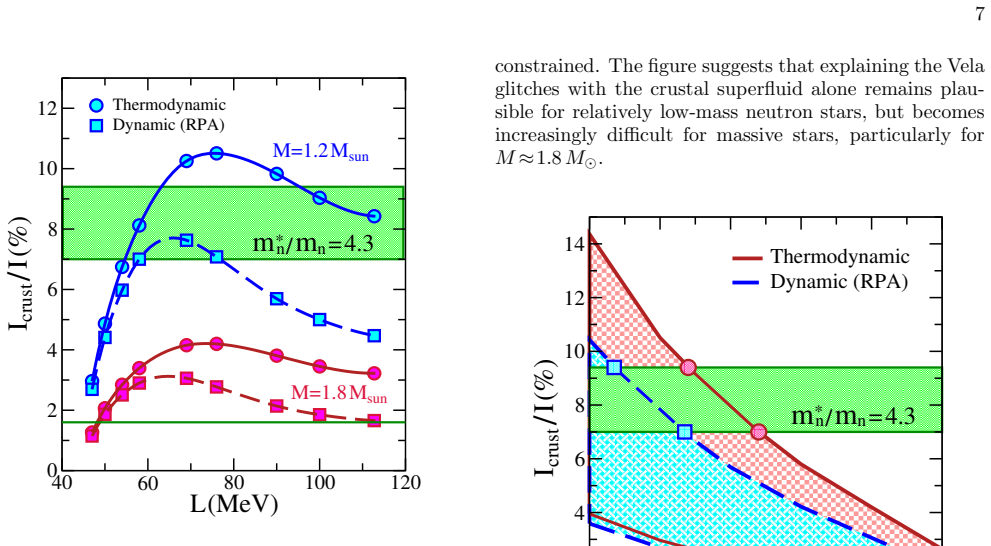
Using covariant energy density functionals that vary the slope of the symmetry energy, the relativistic random-phase approximation shows that Coulomb and surface contributions move the crust-core transition to lower densities and pressures than the point where the thermodynamic incompressibility vanishes. The thermodynamic treatment therefore overestimates both the crust thickness and the crustal fraction of the stellar moment of inertia.
What carries the argument
The relativistic random-phase approximation that locates the instability wavelength through the competition of bulk, Coulomb, and surface contributions.
If this is right
- The dynamical approach produces thinner crusts than the thermodynamic approach for the same equation of state.
- Crustal fractions of the stellar moment of inertia are systematically smaller in the dynamical-RPA framework.
- Differences in transition pressure propagate into predictions for glitch rise times and recurrence intervals.
- Other crust-sensitive quantities, such as heat capacity and transport coefficients near the base of the crust, will also differ between the two treatments.
Where Pith is reading between the lines
- Re-analysis of existing glitch data with dynamical transition densities could tighten bounds on the symmetry-energy slope.
- The same shift in transition pressure may alter estimates of the maximum mass that can be supported by a given crust equation of state.
- Future radius measurements from gravitational-wave events could be combined with glitch statistics to test which instability criterion is realized in nature.
Load-bearing premise
The relativistic random-phase approximation with Coulomb screening and finite-size effects correctly identifies the wavelength at which the instability first appears.
What would settle it
A measured pulsar glitch whose size demands a crustal moment-of-inertia fraction larger than the maximum value obtained from the dynamical-RPA calculation for any realistic equation of state.
Figures
read the original abstract
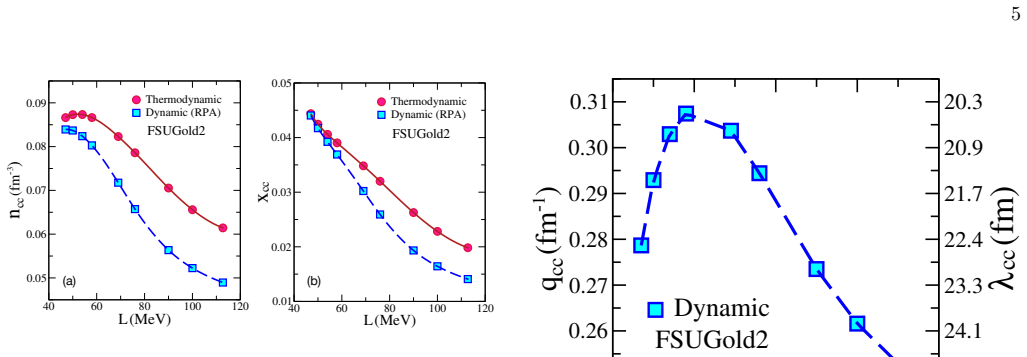
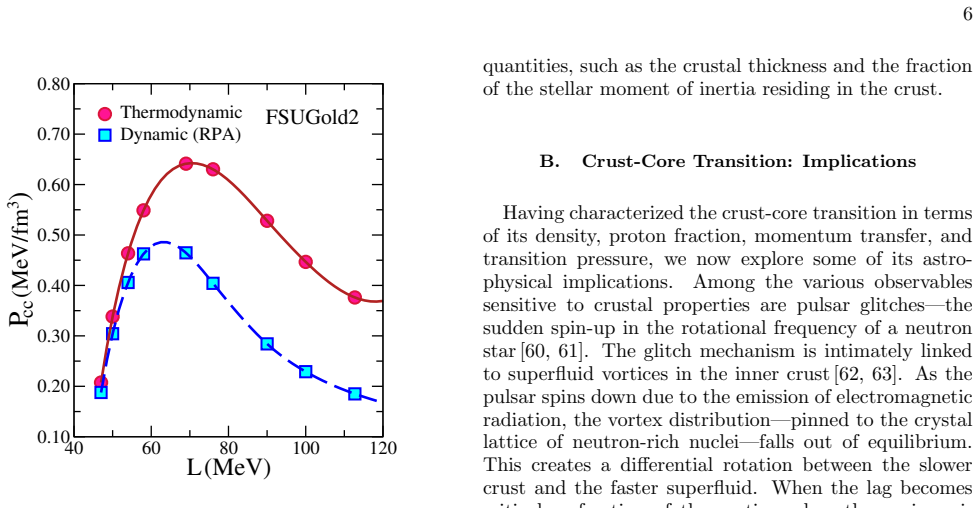
We investigate the crust-core transition in neutron stars using both thermodynamic and dynamical descriptions of the instability. In the thermodynamic approach, the transition is identified through the vanishing of a generalized incompressibility coefficient signaling the onset of a bulk spinodal instability. In contrast, the dynamical approach based on the relativistic random-phase approximation (RPA) incorporates Coulomb screening and finite-size effects that determine the instability at finite wavelength. Using a family of covariant energy density functionals spanning a broad range of symmetry-energy slopes, we show that the dynamical treatment systematically predicts lower transition densities and pressures compared to the thermodynamic approach. We further demonstrate that the RPA instability develops at a characteristic length scale set by the competition among bulk, Coulomb, and surface effects. Most importantly, we show that these differences propagate directly into neutron-star observables. Because the thermodynamic approach predicts larger transition pressures, it generates thicker crusts and significantly larger crustal fractions of the stellar moment of inertia than the dynamical-RPA framework -- with important implications for the interpretation of pulsar glitches and other crust-sensitive neutron-star observables.
Editorial analysis
A structured set of objections, weighed in public.
Referee Report
Summary. The paper compares thermodynamic (bulk spinodal via generalized incompressibility) and dynamical (relativistic RPA with Coulomb screening and finite-size effects) treatments of the crust-core transition in neutron stars across a family of covariant energy-density functionals. It claims the RPA approach systematically yields lower transition densities and pressures than the thermodynamic method, producing thinner crusts and smaller crustal fractions of the moment of inertia, with direct implications for pulsar glitches and other observables.
Significance. If the central claim holds, the work would affect modeling of crust-sensitive neutron-star observables by showing that the choice of instability criterion propagates quantitatively into crustal thickness and ΔI/I. The use of multiple functionals to demonstrate systematic differences is a positive feature; however, the absence of non-perturbative benchmarks for the RPA leaves the magnitude of the reported shift unverified.
major comments (1)
- [dynamical approach (RPA description)] The central claim that the relativistic RPA dispersion relation (including Coulomb screening and surface terms) correctly locates the finite-wavelength instability and produces a systematic downward shift in transition pressure rests on an unbenchmarked approximation. No comparison is reported against time-dependent Hartree-Fock, quantum molecular dynamics, or exact methods at the relevant densities, which is load-bearing for the assertion that the dynamical correction is physical rather than an artifact of the RPA truncation.
Simulated Author's Rebuttal
We thank the referee for their careful reading of the manuscript and for highlighting the need to address the validation of the RPA approach. We respond to the major comment below and indicate the revisions we will make.
read point-by-point responses
-
Referee: [dynamical approach (RPA description)] The central claim that the relativistic RPA dispersion relation (including Coulomb screening and surface terms) correctly locates the finite-wavelength instability and produces a systematic downward shift in transition pressure rests on an unbenchmarked approximation. No comparison is reported against time-dependent Hartree-Fock, quantum molecular dynamics, or exact methods at the relevant densities, which is load-bearing for the assertion that the dynamical correction is physical rather than an artifact of the RPA truncation.
Authors: We agree that the absence of direct comparisons to non-perturbative methods such as time-dependent Hartree-Fock or quantum molecular dynamics at the relevant densities constitutes a genuine limitation for quantifying the absolute accuracy of the RPA shift. The RPA is a linear-response approximation whose results could in principle be modified by higher-order correlations. Nevertheless, the qualitative reduction in transition density and pressure relative to the thermodynamic limit follows directly from the inclusion of finite-wavelength Coulomb and surface contributions, which are absent in the bulk spinodal analysis; this directional effect has been seen in multiple non-relativistic studies using similar frameworks. We will revise the manuscript to add an explicit discussion of the RPA truncation, its expected range of validity, and citations to existing benchmark comparisons in the literature for related nuclear systems. revision: partial
Circularity Check
No circularity: explicit computations across functionals yield the reported differences
full rationale
The paper computes crust-core transition densities and pressures via two independent routes (thermodynamic spinodal from vanishing incompressibility; dynamical RPA dispersion relation including Coulomb and surface terms) for a family of covariant EDFs with varying symmetry-energy slopes. The lower transition values under RPA and the consequent thinner crusts / smaller ΔI/I are direct numerical outputs of these calculations, not reductions of fitted parameters or self-referential definitions. No load-bearing self-citation, ansatz smuggling, or renaming of known results is present; the central claim rests on the explicit comparison itself.
Axiom & Free-Parameter Ledger
axioms (1)
- domain assumption Covariant energy density functionals with varying symmetry-energy slopes adequately span the relevant nuclear physics for the crust-core transition.
Reference graph
Works this paper leans on
-
[1]
Page and S
D. Page and S. Reddy, Ann. Rev. Nucl. Part. Sci.56, 327 (2006)
2006
-
[2]
D. Page, J. M. Lattimer, M. Prakash, and A. W. Steiner, Astrophys. J.707, 1131 (2009)
2009
-
[3]
Nuclear Science Advisory Committee,Reaching for the Horizon: The 2015 Long Range Plan for Nuclear Science, Tech. Rep. (U.S. Department of Energy and National Science Foundation, 2015)
2015
-
[4]
Nuclear Science Advisory Committee,A New Era of Dis- covery: The 2023 Long Range Plan for Nuclear Science, Tech. Rep. (U.S. Department of Energy and National Sci- ence Foundation, 2023)
2023
-
[5]
G. Baym, C. Pethick, and P. Sutherland, Astrophys. J. 170, 299 (1971)
1971
-
[6]
D. G. Ravenhall, C. J. Pethick, and J. R. Wilson, Phys. Rev. Lett.50, 2066 (1983)
2066
-
[7]
C. P. Lorenz, D. G. Ravenhall, and C. J. Pethick, Phys. Rev. Lett.70, 379 (1993)
1993
-
[8]
Douchin and P
F. Douchin and P. Haensel, Phys. Lett.B485, 107 (2000)
2000
-
[9]
Douchin and P
F. Douchin and P. Haensel, Astron. Astrophys.380, 151 (2001)
2001
-
[10]
Magierski and P.-H
P. Magierski and P.-H. Heenen, Phys. Rev.C65, 045804 (2002)
2002
-
[11]
S. B. Ruester, M. Hempel, and J. Schaffner-Bielich, Phys. Rev.C73, 035804 (2006)
2006
-
[12]
The symmetry energy at subnuclear densities and nuclei in neutron star crusts
K. Oyamatsu and K. Iida, Phys. Rev.C75, 015801 (2007), arXiv:nucl-th/0609040
work page internal anchor Pith review Pith/arXiv arXiv 2007
-
[13]
A. W. Steiner, Phys. Rev.C77, 035805 (2008), arXiv:0711.1812 [nucl-th]
work page internal anchor Pith review Pith/arXiv arXiv 2008
-
[14]
Roca-Maza and J
X. Roca-Maza and J. Piekarewicz, Phys. Rev.C78, 025807 (2008)
2008
-
[15]
Chamel and P
N. Chamel and P. Haensel, Living Rev. Rel.11, 10 (2008)
2008
-
[16]
Nuclear constraints on properties of neutron star crusts
J. Xu, L.-W. Chen, B.-A. Li, and H.-R. Ma, Astrophys. J.697, 1549 (2009), arXiv:0901.2309 [astro-ph.SR]
work page internal anchor Pith review Pith/arXiv arXiv 2009
-
[17]
Ducoin, J
C. Ducoin, J. Margueron, and C. Providencia, Europhys. Lett.91, 32001 (2010)
2010
-
[18]
C. Moustakidis, T. Niksic, G. Lalazissis, D. Vretenar, and P. Ring, Phys. Rev.C81, 065803 (2010), arXiv:1004.3882 [nucl-th]
work page internal anchor Pith review Pith/arXiv arXiv 2010
-
[19]
Pearson, S
J. Pearson, S. Goriely, and N. Chamel, Phys. Rev.C83, 065810 (2011)
2011
-
[20]
Bertulani and J
C. Bertulani and J. Piekarewicz, Neutron star crust. (Nova Science Publishers, Hauppauge New York, 2012)
2012
-
[21]
Utama, J
R. Utama, J. Piekarewicz, and H. B. Prosper, Phys. Rev. C93, 014311 (2016)
2016
-
[22]
Watanabe, T
G. Watanabe, T. Maruyama, K. Sato, K. Yasuoka, and T. Ebisuzaki, Phys. Rev. Lett.94, 031101 (2005)
2005
-
[23]
C. J. Horowitz, M. A. Perez-Garcia, and J. Piekarewicz, Phys. Rev.C69, 045804 (2004)
2004
-
[24]
Dynamical Simulation of Nuclear "Pasta": Soft Condensed Matter in Dense Stars
G. Watanabe and H. Sonoda, (2005), and references therein, cond-mat/0502515
work page internal anchor Pith review Pith/arXiv arXiv 2005
-
[25]
C. J. Horowitz, M. A. Perez-Garcia, D. K. Berry, and J. Piekarewicz, Phys. Rev.C72, 035801 (2005)
2005
-
[26]
Maruyama, T
T. Maruyama, T. Tatsumi, D. N. Voskresensky, T. Tani- gawa, and S. Chiba, Phys. Rev.C72, 015802 (2005)
2005
-
[27]
Avancini, D
S. Avancini, D. Menezes, M. Alloy, J. Marinelli, M. Moraes,et al., Phys. Rev.C78, 015802 (2008)
2008
-
[28]
Avancini, L
S. Avancini, L. Brito, J. Marinelli, D. Menezes, M. de Moraes,et al., Phys. Rev.C79, 035804 (2009)
2009
-
[29]
Newton and J
W. Newton and J. Stone, Phys. Rev.C79, 055801 (2009)
2009
-
[30]
Grygorov, P
P. Grygorov, P. Gogelein, and H. Muther, J.Phys.GG37, 075203 (2010)
2010
-
[31]
A. S. Schneider, C. J. Horowitz, J. Hughto, and D. K. Berry, Phys. Rev.C88, 065807 (2013)
2013
-
[32]
C. J. Horowitz, D. K. Berry, C. M. Briggs, M. E. Caplan, A. Cumming, and A. S. Schneider, Phys. Rev. Lett.114, 031102 (2015)
2015
-
[33]
M. E. Caplan, A. S. Schneider, C. J. Horowitz, and D. K. Berry, Phys. Rev.C91, 065802 (2015)
2015
-
[34]
Schuetrumpf and W
B. Schuetrumpf and W. Nazarewicz, Phys. Rev.C92, 045806 (2015)
2015
-
[35]
Fattoyev, C
F. Fattoyev, C. Horowitz, and B. Schuetrumpf, Phys. Rev. C95, 055804 (2017)
2017
-
[36]
R. A. Kycia, S. Kubis, and W. W´ ojcik, Phys. Rev. C96, 025803 (2017)
2017
-
[37]
Nandi and S
R. Nandi and S. Schramm, Astrophys. J.852, 135 (2018)
2018
-
[38]
da Silva Schneider, M
A. da Silva Schneider, M. E. Caplan, D. K. Berry, and C. J. Horowitz, Phys. Rev. C98, 055801 (2018)
2018
-
[39]
Z. Lin, M. E. Caplan, C. J. Horowitz, and C. Lunardini, Phys. Rev. C102, 045801 (2020)
2020
-
[40]
W. G. Newton, M. A. Kaltenborn, S. Cantu, S. Wang, A. Stinson, and J. Rikovska Stone, Phys. Rev. C105, 025806 (2022)
2022
-
[41]
Kubis, Phys
S. Kubis, Phys. Rev. C76, 025801 (2007)
2007
-
[42]
C. J. Horowitz and J. Piekarewicz, Phys. Rev. Lett.86, 5647 (2001)
2001
-
[43]
Carriere, C
J. Carriere, C. J. Horowitz, and J. Piekarewicz, Astro- phys. J.593, 463 (2003)
2003
-
[44]
J. D. Walecka, Annals Phys.83, 491 (1974)
1974
-
[45]
B. D. Serot and J. D. Walecka, Adv. Nucl. Phys.16, 1 (1986)
1986
-
[46]
B. D. Serot and J. D. Walecka, Int. J. Mod. Phys.E6, 515 (1997)
1997
-
[47]
Boguta and A
J. Boguta and A. R. Bodmer, Nucl. Phys.A292, 413 (1977)
1977
-
[48]
Mueller and B
H. Mueller and B. D. Serot, Nucl. Phys.A606, 508 (1996)
1996
-
[49]
G. A. Lalazissis, J. Konig, and P. Ring, Phys. Rev.C55, 540 (1997)
1997
-
[50]
B. G. Todd-Rutel and J. Piekarewicz, Phys. Rev. Lett 95, 122501 (2005)
2005
-
[51]
Chen and J
W.-C. Chen and J. Piekarewicz, Phys. Rev.C90, 044305 (2014)
2014
-
[52]
Chen and J
W.-C. Chen and J. Piekarewicz, Phys. Lett.B748, 284 (2015)
2015
-
[53]
Salinas and J
M. Salinas and J. Piekarewicz, Phys. Rev. C109, 045807 (2024)
2024
-
[54]
C. J. Horowitz and K. Wehrberger, Nucl. Phys. A531, 665 (1991)
1991
-
[55]
B. T. Reed, F. J. Fattoyev, C. J. Horowitz, and J. Piekarewicz, Phys. Rev. Lett.126, 172503 (2021)
2021
-
[56]
B. Link, R. I. Epstein, and J. M. Lattimer, Phys. Rev. Lett.83, 3362 (1999), arXiv:astro-ph/9909146
work page internal anchor Pith review Pith/arXiv arXiv 1999
-
[57]
J. M. Lattimer and M. Prakash, Astrophys. J.550, 426 (2001), astro-ph/0002232
work page internal anchor Pith review Pith/arXiv arXiv 2001
-
[58]
J. M. Lattimer and M. Prakash, Phys. Rept.442, 109 (2007)
2007
-
[59]
F. J. Fattoyev and J. Piekarewicz, Phys. Rev.C82, 025810 (2010)
2010
-
[60]
Jodrell Bank Centre for Astrophysics (glitch catalogue) http://www.jb.man.ac.uk/pulsar/glitches.html. 11
-
[61]
A study of 315 glitches in the rotation of 102 pulsars
C.M. Espinoza, A.G. Lyne, B.W. Stappers, and M. Kramer, Mon. Not. Roy. Astron. Soc.414, 1679 (2011), arXiv:1102.1743 [astro-ph.HE]
work page internal anchor Pith review Pith/arXiv arXiv 2011
-
[62]
Anderson and N
P. Anderson and N. Itoh, Nature256, 25 (1975)
1975
-
[63]
Alpar, S
M. Alpar, S. Langer, and J. Sauls, Astrophys. J.282, 533 (1984)
1984
-
[64]
Hooker, W
J. Hooker, W. G. Newton, and B.-A. Li, Mon. Not. Roy. Astron. Soc.449, 3559 (2015)
2015
-
[65]
Chamel, Phys
N. Chamel, Phys. Rev. Lett.110, 011101 (2013)
2013
-
[66]
Andersson, K
N. Andersson, K. Glampedakis, W. Ho, and C. Espinoza, Phys. Rev. Lett.109, 241103 (2012)
2012
-
[67]
Piekarewicz, F
J. Piekarewicz, F. J. Fattoyev, and C. J. Horowitz, Phys. Rev.C90, 015803 (2014)
2014
-
[68]
Chamel, Phys
N. Chamel, Phys. Rev.C85, 035801 (2012)
2012
-
[69]
Samuelsson and N
L. Samuelsson and N. Andersson, Mon. Not. Roy. Astron. Soc.374, 256 (2007)
2007
-
[70]
Sotani, K
H. Sotani, K. D. Kokkotas, and N. Stergioulas, Mon. Not. Roy. Astron. Soc.375, 261 (2007)
2007
-
[71]
A. W. Steiner and A. L. Watts, Phys. Rev. Lett.103, 181101 (2009)
2009
-
[72]
E. F. Brown and A. Cumming, Astrophys. J.698, 1020 (2009)
2009
-
[73]
D. Page, M. Prakash, J. M. Lattimer, and A. W. Steiner, Phys. Rev. Lett.106, 081101 (2011)
2011
-
[74]
Tsang, J
D. Tsang, J. S. Read, T. Hinderer, A. L. Piro, and R. Bondarescu, Phys. Rev. Lett.108, 011102 (2012). ACKNOWLEDGMENTS This material is based upon work supported by the U.S. Department of Energy Office of Science, Office of Nuclear Physics under Award Numbers DE-FG02- 92ER40750
2012
discussion (0)
Sign in with ORCID, Apple, or X to comment. Anyone can read and Pith papers without signing in.