Routing-Aware Expert Calibration for Machine Unlearning in Mixture-of-Experts Language Models
Pith reviewed 2026-06-27 13:19 UTC · model grok-4.3
The pith
Reweighting retain losses to match forget-side expert activations improves the forget-utility trade-off in MoE unlearning.
A machine-rendered reading of the paper's core claim, the machinery that carries it, and where it could break.
Core claim
TRACE first detects forget-critical experts from offline activation statistics, and then calibrates retain regularization by reweighting token-level retain losses so that each selected expert's retain-side activation frequency better matches its forget-side counterpart.
What carries the argument
Targeted Routing-Aware Calibration of Experts (TRACE), which reweights token-level retain losses to align per-expert activation frequencies between forget and retain data.
If this is right
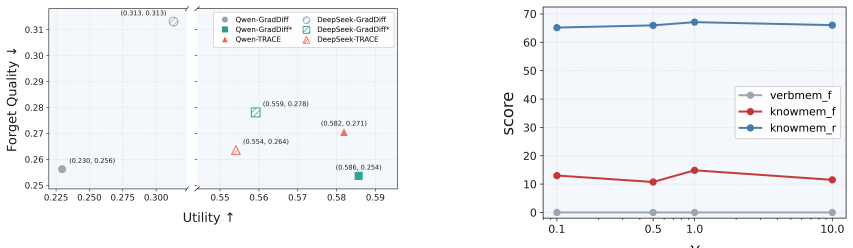
- TRACE yields a 9% relative utility improvement over the strongest baseline under comparable forgetting quality.
- TRACE achieves the best performance on three out of four MUSE-BOOKS metrics.
- The method produces consistent gains across multiple MoE LLMs on both WMDP and MUSE-BOOKS.
- The routing mismatch between forget and retain data is the primary source of under-regularization in standard MoE unlearning.
Where Pith is reading between the lines
- The same activation-frequency matching idea could be applied to other sparse routing mechanisms such as those in Switch Transformers or other conditional computation layers.
- If the mismatch is the dominant issue, then offline expert profiling might become a standard preprocessing step for any unlearning pipeline on routed models.
- Extending the calibration to also adjust expert-level learning rates rather than only token weights could further tighten the forget-retain balance.
Load-bearing premise
Reweighting token-level retain losses to match activation frequencies will correct under-regularization of forget-critical experts without introducing new side effects or degrading overall model behavior.
What would settle it
Running TRACE on the WMDP or MUSE-BOOKS benchmarks and finding no improvement in the forget-utility trade-off or degradation on retain metrics compared with the strongest baseline.
Figures


read the original abstract
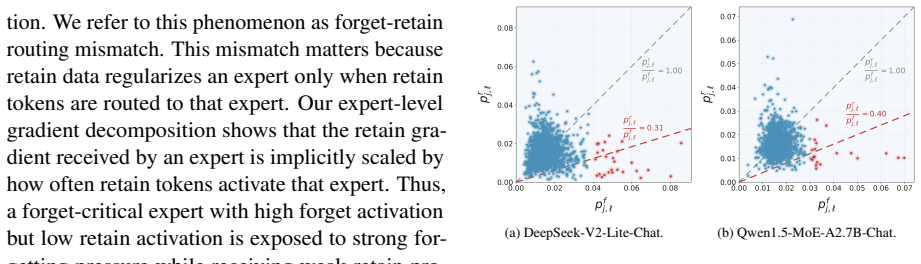
Machine unlearning is increasingly important for large language models, yet unlearning in Mixture-of-Experts (MoE) architectures remains underexplored. Unlike dense models, MoE architectures employ a router at each layer to assign each token to a sparse subset of experts. In this work, we observe that forget data often activates a small subset of experts disproportionately, while these experts may receive much weaker activation from retain data. This forget--retain routing mismatch can leave forget-critical experts under-regularized during unlearning. To address this, we propose \textbf{TRACE}, Targeted Routing-Aware Calibration of Experts, for MoE unlearning. TRACE first detects forget-critical experts from offline activation statistics, and then calibrates retain regularization by reweighting token-level retain losses so that each selected expert's retain-side activation frequency better matches its forget-side counterpart. Experiments on WMDP and MUSE-BOOKS across multiple MoE LLMs show that TRACE consistently improves the forget-utility trade-off, yielding a 9\% relative utility improvement over the strongest baseline under comparable forgetting quality and the best performance on three out of four MUSE-BOOKS metrics.
Editorial analysis
A structured set of objections, weighed in public.
Referee Report
Summary. The manuscript proposes TRACE (Targeted Routing-Aware Calibration of Experts) for machine unlearning in Mixture-of-Experts language models. It identifies forget-critical experts using offline activation statistics on forget data and then reweights token-level retain losses to better match the activation frequencies of these experts on retain data, aiming to address routing mismatch. Experiments on WMDP and MUSE-BOOKS benchmarks across multiple MoE LLMs report a 9% relative utility improvement over the strongest baseline with comparable forgetting quality.
Significance. If the empirical improvements hold under the proposed mechanism, this work addresses an underexplored area of unlearning for MoE architectures that are increasingly deployed in large-scale LLMs. The targeted reweighting idea could provide a practical regularization adjustment for sparse models.
major comments (1)
- [Method (as described in abstract and §3)] The calibration relies on static offline activation frequencies computed once before unlearning. Since the method jointly optimizes the router and experts, router updates during training can alter token-to-expert assignments for retain data, potentially invalidating the initial frequency-matching factors. No analysis, monitoring of mid-training activations, or ablation on router drift is provided to confirm the reweighting remains effective.
minor comments (2)
- [Abstract] The abstract states 'best performance on three out of four MUSE-BOOKS metrics' without naming the metrics or reporting the actual values or baseline comparisons.
- [Method] No equations, loss formulations, or pseudocode for the reweighting procedure are referenced, making it difficult to assess whether the calibration introduces new hyperparameters or side effects.
Simulated Author's Rebuttal
We thank the referee for the constructive comment on the static calibration in TRACE. We address the concern below and will revise the manuscript to incorporate additional analysis.
read point-by-point responses
-
Referee: [Method (as described in abstract and §3)] The calibration relies on static offline activation frequencies computed once before unlearning. Since the method jointly optimizes the router and experts, router updates during training can alter token-to-expert assignments for retain data, potentially invalidating the initial frequency-matching factors. No analysis, monitoring of mid-training activations, or ablation on router drift is provided to confirm the reweighting remains effective.
Authors: We agree that the reweighting factors are computed statically from offline activation statistics prior to unlearning, and that joint optimization of the router and experts during training could in principle alter token-to-expert assignments on retain data. The calibration is designed as an initial regularization adjustment to address the observed forget-retain mismatch at the outset. To directly address the concern, we will add an ablation in the revised manuscript that tracks activation frequencies at multiple training checkpoints and evaluates the stability of the reweighting factors, thereby confirming whether the initial calibration remains effective throughout optimization. revision: yes
Circularity Check
Empirical calibration from offline statistics with no definitional reduction
full rationale
The paper presents TRACE as an empirical procedure: offline activation statistics on forget data identify critical experts, after which fixed reweighting factors are applied to retain-token losses during unlearning. No equations, derivations, or self-citations are shown that reduce the reported utility gains to a fitted quantity or to the input statistics by construction. The central claim therefore rests on observable mismatch statistics and standard gradient updates rather than on any self-referential loop.
Axiom & Free-Parameter Ledger
axioms (1)
- standard math Standard machine learning assumptions on loss minimization and gradient-based optimization
Reference graph
Works this paper leans on
-
[1]
2025 , eprint=
Qwen3 Technical Report , author=. 2025 , eprint=
2025
-
[2]
2025 , eprint=
DeepSeek-V3 Technical Report , author=. 2025 , eprint=
2025
-
[3]
2024 , eprint=
GPT-4 Technical Report , author=. 2024 , eprint=
2024
-
[4]
2024 , eprint=
The WMDP Benchmark: Measuring and Reducing Malicious Use With Unlearning , author=. 2024 , eprint=
2024
-
[5]
2023 , eprint=
Who's Harry Potter? Approximate Unlearning in LLMs , author=. 2023 , eprint=
2023
-
[6]
2024 , eprint=
RWKU: Benchmarking Real-World Knowledge Unlearning for Large Language Models , author=. 2024 , eprint=
2024
-
[7]
2024 , url=
Pratyush Maini and Zhili Feng and Avi Schwarzschild and Zachary Chase Lipton and J Zico Kolter , booktitle=. 2024 , url=
2024
-
[8]
2024 , eprint=
Rethinking Machine Unlearning for Large Language Models , author=. 2024 , eprint=
2024
-
[9]
2025 , eprint=
A Comprehensive Survey of Machine Unlearning Techniques for Large Language Models , author=. 2025 , eprint=
2025
-
[10]
A practical guide, 1st ed., Cham: Springer International Publishing , volume=
The eu general data protection regulation (gdpr) , author=. A practical guide, 1st ed., Cham: Springer International Publishing , volume=. 2017 , publisher=
2017
-
[11]
2019 , publisher=
The california consumer privacy act (ccpa): An implementation guide , author=. 2019 , publisher=
2019
-
[12]
2026 , eprint=
A Comprehensive Survey of Mixture-of-Experts: Algorithms, Theory, and Applications , author=. 2026 , eprint=
2026
-
[13]
SEUF : Is Unlearning One Expert Enough for Mixture-of-Experts LLM s?
Zhuang, Haomin and Zhang, Yihua and Guo, Kehan and Jia, Jinghan and Liu, Gaowen and Liu, Sijia and Zhang, Xiangliang. SEUF : Is Unlearning One Expert Enough for Mixture-of-Experts LLM s?. Proceedings of the 63rd Annual Meeting of the Association for Computational Linguistics (Volume 1: Long Papers). 2025. doi:10.18653/v1/2025.acl-long.424
-
[14]
2026 , eprint=
GRIP: Algorithm-Agnostic Machine Unlearning for Mixture-of-Experts via Geometric Router Constraints , author=. 2026 , eprint=
2026
-
[15]
2024 , eprint=
Merge, Then Compress: Demystify Efficient SMoE with Hints from Its Routing Policy , author=. 2024 , eprint=
2024
-
[16]
BMC medical research methodology , volume=
Estimating the sample mean and standard deviation from the sample size, median, range and/or interquartile range , author=. BMC medical research methodology , volume=. 2014 , publisher=
2014
-
[17]
2024 , eprint=
Let the Expert Stick to His Last: Expert-Specialized Fine-Tuning for Sparse Architectural Large Language Models , author=. 2024 , eprint=
2024
-
[18]
2024 , eprint=
MUSE: Machine Unlearning Six-Way Evaluation for Language Models , author=. 2024 , eprint=
2024
-
[19]
2022 , eprint=
ST-MoE: Designing Stable and Transferable Sparse Expert Models , author=. 2022 , eprint=
2022
-
[20]
2024 , eprint=
Mixtral of Experts , author=. 2024 , eprint=
2024
-
[21]
Qwen3 Technical Report , author=. arXiv preprint arXiv:2505.09388 , year=
work page internal anchor Pith review Pith/arXiv arXiv
-
[22]
Qwen2 Technical Report , author =. arXiv preprint arXiv:2407.10671 , year =
work page internal anchor Pith review Pith/arXiv arXiv
-
[23]
2024 , eprint=
DeepSeek-V2: A Strong, Economical, and Efficient Mixture-of-Experts Language Model , author=. 2024 , eprint=
2024
-
[24]
2024 , eprint=
Negative Preference Optimization: From Catastrophic Collapse to Effective Unlearning , author=. 2024 , eprint=
2024
-
[25]
2024 , eprint=
Large Language Model Unlearning , author=. 2024 , eprint=
2024
-
[26]
2022 , eprint=
Continual Learning and Private Unlearning , author=. 2022 , eprint=
2022
-
[27]
2021 , eprint=
Measuring Massive Multitask Language Understanding , author=. 2021 , eprint=
2021
-
[28]
2016 , eprint=
Pointer Sentinel Mixture Models , author=. 2016 , eprint=
2016
-
[29]
2022 , eprint=
Switch Transformers: Scaling to Trillion Parameter Models with Simple and Efficient Sparsity , author=. 2022 , eprint=
2022
-
[30]
2022 , eprint=
GLaM: Efficient Scaling of Language Models with Mixture-of-Experts , author=. 2022 , eprint=
2022
-
[31]
2020 , eprint=
GShard: Scaling Giant Models with Conditional Computation and Automatic Sharding , author=. 2020 , eprint=
2020
-
[32]
2025 , eprint=
Simplicity Prevails: Rethinking Negative Preference Optimization for LLM Unlearning , author=. 2025 , eprint=
2025
-
[33]
2025 , eprint=
WAGLE: Strategic Weight Attribution for Effective and Modular Unlearning in Large Language Models , author=. 2025 , eprint=
2025
-
[34]
2022 , eprint=
Quark: Controllable Text Generation with Reinforced Unlearning , author=. 2022 , eprint=
2022
-
[35]
2024 , eprint=
Large Language Model Unlearning via Embedding-Corrupted Prompts , author=. 2024 , eprint=
2024
-
[36]
2023 , eprint=
KGA: A General Machine Unlearning Framework Based on Knowledge Gap Alignment , author=. 2023 , eprint=
2023
-
[37]
2026 , eprint=
KUDA: Knowledge Unlearning by Deviating Representation for Large Language Models , author=. 2026 , eprint=
2026
-
[38]
2024 , eprint=
To Each (Textual Sequence) Its Own: Improving Memorized-Data Unlearning in Large Language Models , author=. 2024 , eprint=
2024
-
[39]
2023 , eprint=
Unlearn What You Want to Forget: Efficient Unlearning for LLMs , author=. 2023 , eprint=
2023
-
[40]
Unlearning Bias in Language Models by Partitioning Gradients
Yu, Charles and Jeoung, Sullam and Kasi, Anish and Yu, Pengfei and Ji, Heng. Unlearning Bias in Language Models by Partitioning Gradients. Findings of the Association for Computational Linguistics: ACL 2023. 2023. doi:10.18653/v1/2023.findings-acl.375
-
[41]
2023 , eprint=
Composing Parameter-Efficient Modules with Arithmetic Operations , author=. 2023 , eprint=
2023
-
[42]
2024 , eprint=
Direct Preference Optimization: Your Language Model is Secretly a Reward Model , author=. 2024 , eprint=
2024
-
[43]
2023 , eprint=
Locating and Editing Factual Associations in GPT , author=. 2023 , eprint=
2023
-
[44]
2023 , eprint=
DEPN: Detecting and Editing Privacy Neurons in Pretrained Language Models , author=. 2023 , eprint=
2023
-
[45]
2023 , eprint=
Can Sensitive Information Be Deleted From LLMs? Objectives for Defending Against Extraction Attacks , author=. 2023 , eprint=
2023
-
[46]
2023 , eprint=
Memory-assisted prompt editing to improve GPT-3 after deployment , author=. 2023 , eprint=
2023
-
[47]
2024 , eprint=
In-Context Unlearning: Language Models as Few Shot Unlearners , author=. 2024 , eprint=
2024
-
[48]
2025 , eprint=
Fast Exact Unlearning for In-Context Learning Data for LLMs , author=. 2025 , eprint=
2025
-
[49]
2017 , eprint=
Attention Is All You Need , author=. 2017 , eprint=
2017
discussion (0)
Sign in with ORCID, Apple, or X to comment. Anyone can read and Pith papers without signing in.