Transformer Based Model for Spatiotemporal Feature Learning in EEG Emotion Recognition
Pith reviewed 2026-06-27 14:08 UTC · model grok-4.3
The pith
EEG-TransNet uses local self-attention and a fuzzy-attention transformer to capture regional and spatiotemporal EEG features for emotion recognition.
A machine-rendered reading of the paper's core claim, the machinery that carries it, and where it could break.
Core claim
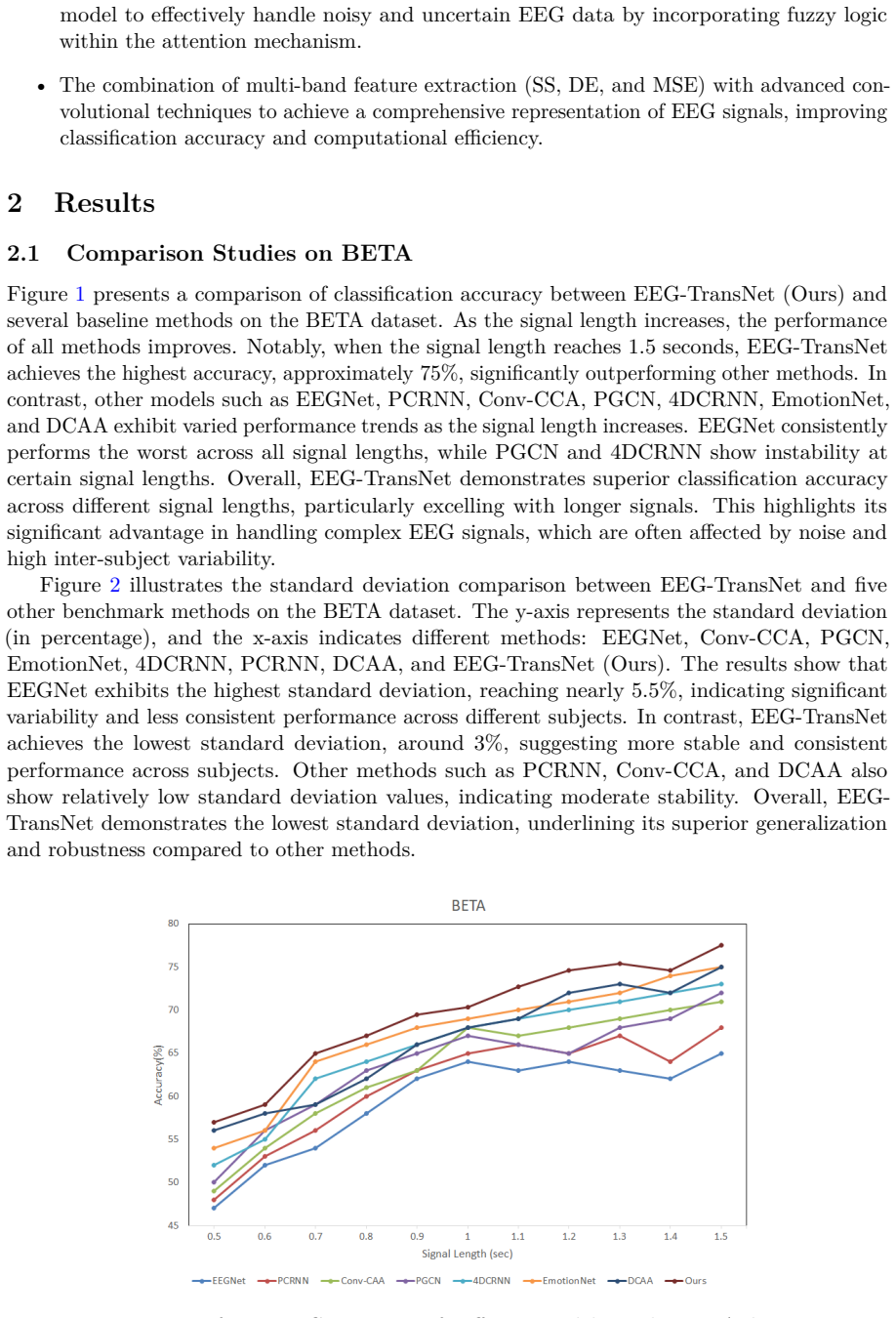
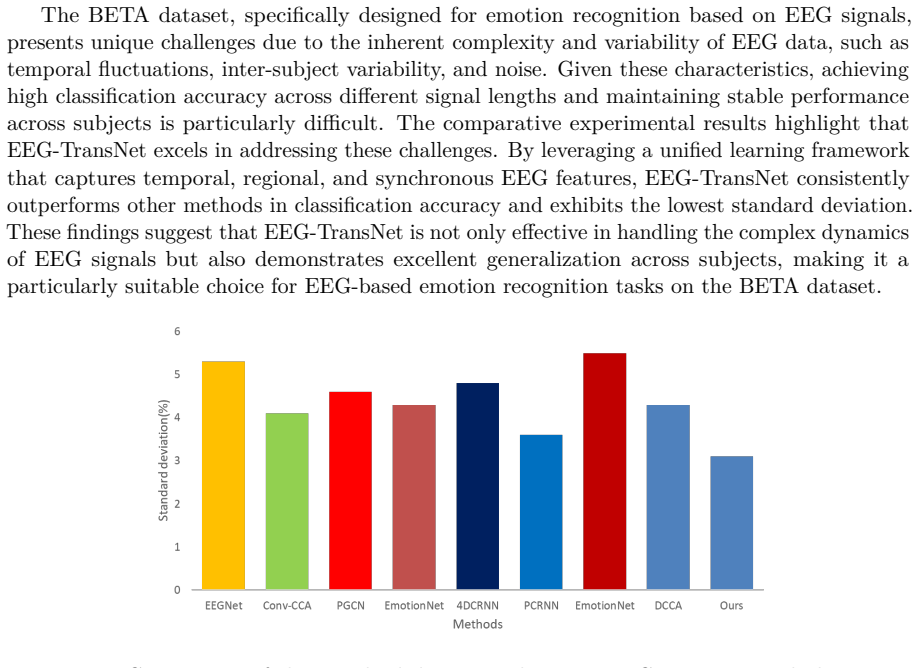
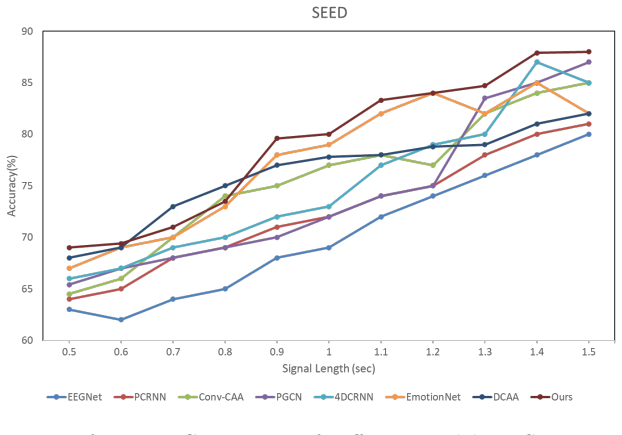
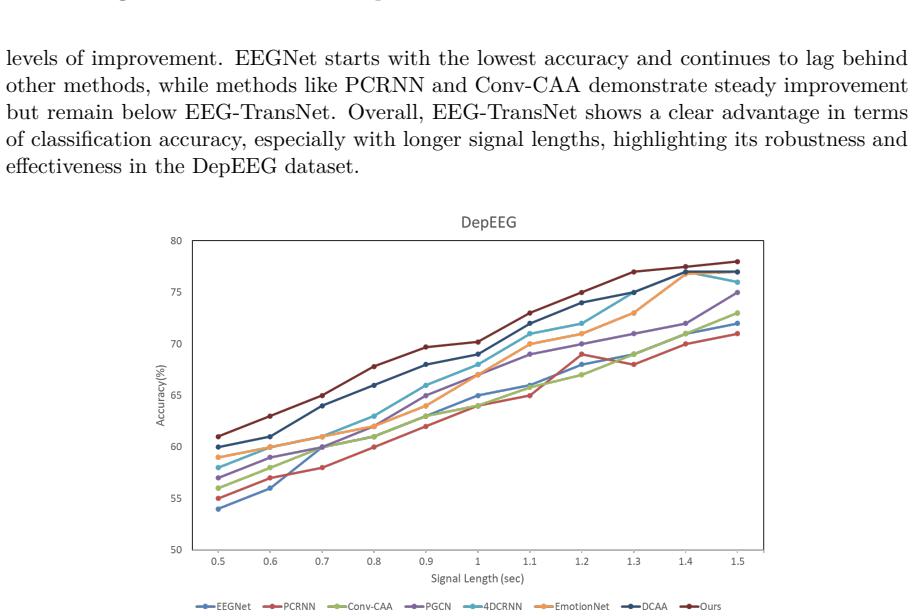
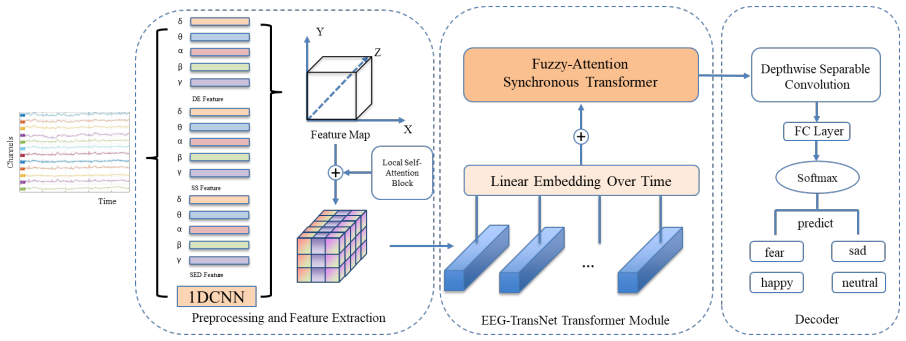
EEG-TransNet captures temporal, regional, and synchronous features of EEG signals through a preprocessing and feature extraction module leveraging ResNet and wavelet-based denoising, a Local Self-Attention Block for regional feature learning, and a Fuzzy-Attention Synchronous Transformer to model spatiotemporal dependencies, resulting in consistent outperformance of other methods on three EEG datasets in classification accuracy and robustness across varying signal lengths.
What carries the argument
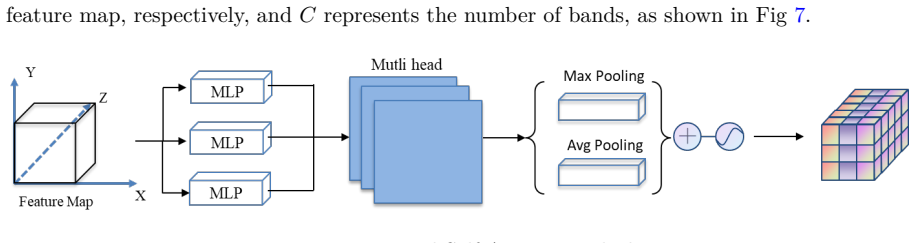
The Local Self-Attention Block combined with the Fuzzy-Attention Synchronous Transformer (FAST) module, which together extract regional and spatiotemporal dependencies from EEG signals after initial feature extraction.
If this is right
- Classification accuracy improves over existing methods on BETA, SEED, and DepEEG datasets.
- Performance holds steady when EEG signal lengths vary.
- Depthwise separable convolutions in the decoder cut computational cost while preserving accuracy.
- Cross-subject generalization occurs with only small drops in performance.
Where Pith is reading between the lines
- The same modular attention design could transfer to other EEG tasks such as motor imagery or sleep staging.
- Real-time brain-computer interface systems might adopt the architecture once decoder efficiency is verified at scale.
- Combining the model with additional sensors could extend it to multimodal affective computing without major redesign.
Load-bearing premise
The Local Self-Attention Block and Fuzzy-Attention Synchronous Transformer modules capture genuine regional and spatiotemporal dependencies in EEG signals rather than fitting to dataset-specific noise or benefiting from hidden tuning choices.
What would settle it
Testing EEG-TransNet on a fourth independent EEG emotion dataset without any retraining or hyperparameter adjustment and checking whether accuracy gains over baselines remain.
Figures
read the original abstract
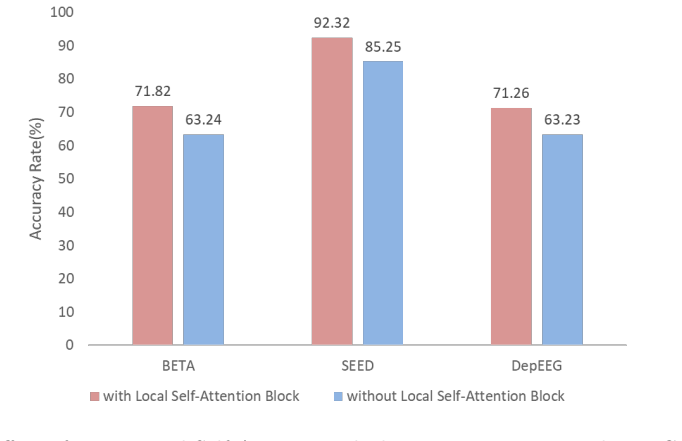
Electroencephalography (EEG) is a widely adopted technique for monitoring brain activity, offering valuable insights into neurological states due to its high temporal resolution and cost-effectiveness. To enhance the analysis of complex EEG data, we propose EEG-TransNet, an architecture designed to capture temporal, regional, and synchronous features of EEG signals. EEG-TransNet introduces three key modules: 1) a preprocessing and feature extraction module leveraging ResNet and wavelet-based denoising, 2) a Local Self-Attention Block for regional feature learning, and 3) a Fuzzy-Attention Synchronous Transformer (FAST) to model spatiotemporal dependencies. Through extensive experiments on three EEG datasets (BETA, SEED, and DepEEG), the proposed model consistently outperforms other methods in terms of classification accuracy and robustness across varying signal lengths. Ablation studies confirm the contribution of the Local Self-Attention Block in improving performance, and the inclusion of depthwise separable convolutions in the decoder reduces computational complexity while maintaining high accuracy. EEG-TransNet's ability to generalize across subjects with minimal performance variation highlights its potential as a robust tool for EEG-based brain activity classification and emotion recognition tasks.
Editorial analysis
A structured set of objections, weighed in public.
Referee Report
Summary. The manuscript proposes EEG-TransNet, a transformer architecture for EEG emotion recognition comprising a preprocessing module (ResNet + wavelet denoising), a Local Self-Attention Block for regional features, and a Fuzzy-Attention Synchronous Transformer (FAST) for spatiotemporal dependencies. It reports that the model consistently outperforms baselines in classification accuracy and robustness to varying signal lengths on the BETA, SEED, and DepEEG datasets, with ablation studies confirming module contributions and strong cross-subject generalization.
Significance. If the reported accuracy gains and robustness hold under standard statistical scrutiny, the work would offer a practical contribution to EEG analysis by demonstrating how local self-attention and fuzzy synchronous attention can jointly address regional and temporal structure. The explicit use of depthwise separable convolutions to control decoder complexity is a positive engineering detail that could aid deployment.
minor comments (3)
- [Abstract] Abstract: the claim of 'consistent outperformance' and 'robustness across varying signal lengths' is stated without any numerical accuracies, baseline names, or indication of statistical testing; while the full text reportedly contains accuracy tables, the abstract should still convey the magnitude of improvement to allow readers to assess the central claim at a glance.
- The description of how signal-length variation was controlled (e.g., fixed-length padding, truncation strategy, or length-specific training) is not detailed in the provided abstract and should be clarified in the methods or experimental protocol section to support the robustness claim.
- Ablation results are mentioned but the manuscript should explicitly state whether the reported improvements include error bars or significance tests (e.g., paired t-tests across subjects) to substantiate that the Local Self-Attention Block and FAST module contributions are not attributable to hyperparameter variation alone.
Simulated Author's Rebuttal
We thank the referee for the positive summary, significance assessment, and recommendation of minor revision. No specific major comments were listed in the report.
Circularity Check
No significant circularity
full rationale
The paper is an empirical ML architecture paper with no derivation chain, mathematical predictions, or self-citation load-bearing steps. Claims rest on reported accuracy tables and ablations on BETA/SEED/DepEEG; these are external benchmarks, not reductions to fitted inputs or prior self-work by construction. No equations or uniqueness theorems are invoked that collapse to the model's own definitions.
Axiom & Free-Parameter Ledger
Reference graph
Works this paper leans on
-
[1]
Nasir, Bifta Sama Bari, and Sabira Khatun
Mamunur Rashid, Norizam Sulaiman, Anwar PP Abdul Majeed, Rabiu Muazu Musa, Ahmad Fakhri Ab. Nasir, Bifta Sama Bari, and Sabira Khatun. Current status, challenges, and possible solutions of eeg-based brain-computer interface: a comprehensive review. Frontiers in neurorobotics, 14:25, 2020
2020
-
[2]
Electroencephalogram based brain-computer interface: Ap- plications, challenges, and opportunities.Multimedia Tools and Applications, 82(30):47003– 47047, 2023
Hitesh Yadav and Surita Maini. Electroencephalogram based brain-computer interface: Ap- plications, challenges, and opportunities.Multimedia Tools and Applications, 82(30):47003– 47047, 2023
2023
-
[3]
A comprehensive review of deep learning power in steady-state visual evoked potentials.Neural Computing and Applications, pages 1–24, 2024
ZT Al-Qaysi, AS Albahri, MA Ahmed, Rula A Hamid, MA Alsalem, OS Albahri, AH Alam- oodi, Raad Z Homod, Ghadeer Ghazi Shayea, and Ali M Duhaim. A comprehensive review of deep learning power in steady-state visual evoked potentials.Neural Computing and Applications, pages 1–24, 2024
2024
-
[4]
Beautydiffusion: Generative latent decomposition for makeup transfer via diffusion models.Information Fusion, page 103241, 2025
Feng He, Hanlin Li, Xin Ning, and Qiankun Li. Beautydiffusion: Generative latent decomposition for makeup transfer via diffusion models.Information Fusion, page 103241, 2025
2025
-
[5]
Transfer learning for motor imagery based brain–computer interfaces: A tutorial.Neural Networks, 153:235–253, 2022
Dongrui Wu, Xue Jiang, and Ruimin Peng. Transfer learning for motor imagery based brain–computer interfaces: A tutorial.Neural Networks, 153:235–253, 2022. 20
2022
-
[6]
The functional significance of delta oscillations in cognitive processing
Thalía Harmony. The functional significance of delta oscillations in cognitive processing. Frontiers in integrative neuroscience, 7:83, 2013
2013
-
[7]
Eeg-based sleep staging analysis with functional connectivity.Sensors, 21(6):1988, 2021
Hui Huang, Jianhai Zhang, Li Zhu, Jiajia Tang, Guang Lin, Wanzeng Kong, Xu Lei, and Lei Zhu. Eeg-based sleep staging analysis with functional connectivity.Sensors, 21(6):1988, 2021
1988
-
[8]
Cerebral correlates of delta waves during non-rem sleep revisited.Neuroimage, 28(1):14–21, 2005
Thien Thanh Dang-Vu, Martin Desseilles, Steven Laureys, Christian Degueldre, Fabien Perrin, Christophe Phillips, Pierre Maquet, and Philippe Peigneux. Cerebral correlates of delta waves during non-rem sleep revisited.Neuroimage, 28(1):14–21, 2005
2005
-
[9]
DK Thara, BG Premasudha, TV Murthy, et al. Eeg forecasting with univariate and multivariate time series using windowing and baseline method.International Journal of E-Health and Medical Communications (IJEHMC), 13(5):1–13, 2022
2022
-
[10]
Eeg alpha and theta oscillations reflect cognitive and memory perfor- mance: a review and analysis.Brain research reviews, 29(2-3):169–195, 1999
Wolfgang Klimesch. Eeg alpha and theta oscillations reflect cognitive and memory perfor- mance: a review and analysis.Brain research reviews, 29(2-3):169–195, 1999
1999
-
[11]
Functional integration between brain regions at rest occurs in multiple-frequency bands.Brain connectivity, 5(1):23–34, 2015
Suril R Gohel and Bharat B Biswal. Functional integration between brain regions at rest occurs in multiple-frequency bands.Brain connectivity, 5(1):23–34, 2015
2015
-
[12]
Integration of eeg and eye tracking technology: a systematic review.SoutheastCon 2023, pages 209–216, 2023
Suhaima Jamal, Meenalosini Vimal Cruz, Sibi Chakravarthy, Camden Wahl, and Hayden Wimmer. Integration of eeg and eye tracking technology: a systematic review.SoutheastCon 2023, pages 209–216, 2023
2023
-
[13]
Multi-modal integration of eeg-fnirs for character- ization of brain activity evoked by preferred music.Frontiers in Neurorobotics, 16:823435, 2022
Lina Qiu, Yongshi Zhong, Qiuyou Xie, Zhipeng He, Xiaoyun Wang, Yingyue Chen, Chang’an A Zhan, and Jiahui Pan. Multi-modal integration of eeg-fnirs for character- ization of brain activity evoked by preferred music.Frontiers in Neurorobotics, 16:823435, 2022
2022
-
[14]
Epileptic disorder detection of seizures using eeg signals.Sensors, 22(17):6592, 2022
Mariam K Alharthi, Kawthar M Moria, Daniyal M Alghazzawi, and Haythum O Tayeb. Epileptic disorder detection of seizures using eeg signals.Sensors, 22(17):6592, 2022
2022
-
[15]
Ai-driven integrated hardware and software solution for eeg-based detection of depression and anxiety.International Journal for Multidisciplinary Research, 6(3):1–24, 2024
Ghaith Alomari, Ali Husnain, and Ayesha Saeed. Ai-driven integrated hardware and software solution for eeg-based detection of depression and anxiety.International Journal for Multidisciplinary Research, 6(3):1–24, 2024
2024
-
[16]
Eegformer: Transformer-based epilepsy detection on raw eeg traces for low-channel-count wearable continuous monitoring devices
Paola Busia, Andrea Cossettini, Thorir Mar Ingolfsson, Simone Benatti, Alessio Burrello, Moritz Scherer, Matteo Antonio Scrugli, Paolo Meloni, and Luca Benini. Eegformer: Transformer-based epilepsy detection on raw eeg traces for low-channel-count wearable continuous monitoring devices. In2022 IEEE Biomedical Circuits and Systems Conference (BioCAS), page...
2022
-
[17]
Eeg-transformer: Self-attention from transformer architecture for decoding eeg of imagined speech
Young-Eun Lee and Seo-Hyun Lee. Eeg-transformer: Self-attention from transformer architecture for decoding eeg of imagined speech. In2022 10th International winter conference on brain-computer interface (BCI), pages 1–4. IEEE, 2022
2022
-
[18]
A transformer-based spatial-temporal sleep staging model through raw eeg
Guang Shi, Zheng Chen, and Renyuan Zhang. A transformer-based spatial-temporal sleep staging model through raw eeg. In2021 International Conference on High Performance Big Data and Intelligent Systems (HPBD&IS), pages 110–115. IEEE, 2021
2021
-
[19]
A cnn-transformer deep learning model for real-time sleep stage classification in an energy-constrained wireless device
Zongyan Yao and Xilin Liu. A cnn-transformer deep learning model for real-time sleep stage classification in an energy-constrained wireless device. In2023 11th International IEEE/EMBS Conference on Neural Engineering (NER), pages 1–4. IEEE, 2023. 21
2023
-
[20]
Motor imagery eeg classification algorithm based on cnn-lstm feature fusion network.Biomedical signal processing and control, 72:103342, 2022
Hongli Li, Man Ding, Ronghua Zhang, and Chunbo Xiu. Motor imagery eeg classification algorithm based on cnn-lstm feature fusion network.Biomedical signal processing and control, 72:103342, 2022
2022
-
[21]
A retro-azimuthal equidistant projection of the whole sphere.The Geographical Journal, 73(3):245–247, 1929
Arthur R Hinks. A retro-azimuthal equidistant projection of the whole sphere.The Geographical Journal, 73(3):245–247, 1929
1929
-
[22]
Yang Li, Yu Liu, Wei-Gang Cui, Yu-Zhu Guo, Hui Huang, and Zhong-Yi Hu. Epileptic seizure detection in eeg signals using a unified temporal-spectral squeeze-and-excitation network.IEEE Transactions on Neural Systems and Rehabilitation Engineering, 28(4):782– 794, 2020
2020
-
[23]
Iden- tification of epileptic eeg signals using convolutional neural networks.Applied sciences, 10(12):4089, 2020
Rahib Abiyev, Murat Arslan, John Bush Idoko, Boran Sekeroglu, and Ahmet Ilhan. Iden- tification of epileptic eeg signals using convolutional neural networks.Applied sciences, 10(12):4089, 2020
2020
-
[24]
MS Sannidhan, Jason Elroy Martis, Ramesh Sunder Nayak, Sunil Kumar Aithal, and KB Sudeepa. Detection of antibiotic constituent in aspergillus flavus using quantum convo- lutional neural network.International Journal of E-Health and Medical Communications (IJEHMC), 14(1):1–26, 2023
2023
-
[25]
A comprehensive survey on quantum machine learning and possible applications.International Journal of E-Health and Medical Communications (IJEHMC), 13(5):1–17, 2022
Muhammad Junaid Umer and Muhammad Imran Sharif. A comprehensive survey on quantum machine learning and possible applications.International Journal of E-Health and Medical Communications (IJEHMC), 13(5):1–17, 2022
2022
-
[26]
Ashwini Kodipalli, Steven L Fernandes, Santosh K Dasar, and Taha Ismail. Computational framework of inverted fuzzy c-means and quantum convolutional neural network towards accurate detection of ovarian tumors.International Journal of E-Health and Medical Communications (IJEHMC), 14(1):1–16, 2023
2023
-
[27]
A deep transfer convolutional neural network framework for eeg signal classification.IEEE Access, 7:112767–112776, 2019
Gaowei Xu, Xiaoang Shen, Sirui Chen, Yongshuo Zong, Canyang Zhang, Hongyang Yue, Min Liu, Fei Chen, and Wenliang Che. A deep transfer convolutional neural network framework for eeg signal classification.IEEE Access, 7:112767–112776, 2019
2019
-
[28]
Cross-modal knowledge transfer for 3d point clouds via graph offset prediction.Pattern Recognition, 162:111351, 2025
Huang Zhang, Long Yu, Guoqi Wang, Shengwei Tian, Zaiyang Yu, Weijun Li, and Xin Ning. Cross-modal knowledge transfer for 3d point clouds via graph offset prediction.Pattern Recognition, 162:111351, 2025
2025
-
[29]
Oral multi-pathology segmentation with lead-assisting backbone attention network and synthetic data generation.Information Fusion, 118:102892, 2025
Qiankun Li, Huabao Chen, Xiaolong Huang, Mengting He, Xin Ning, Gang Wang, and Feng He. Oral multi-pathology segmentation with lead-assisting backbone attention network and synthetic data generation.Information Fusion, 118:102892, 2025
2025
-
[30]
Bo Peng, Yongqing Zhang, Manqing Wang, Jun Chen, and Dongrui Gao. Ta-mffnet: Multi-feature fusion network for eeg analysis and driving fatigue detection based on time domain network and attention network.Computational Biology and Chemistry, 104:107863, 2023
2023
-
[31]
Multi-band network fusion for alzheimer’s disease identification with functional mri.Frontiers in Psychiatry, 13:1070198, 2022
Lingyun Guo, Yangyang Zhang, Qinghua Liu, Kaiyu Guo, and Zhengxia Wang. Multi-band network fusion for alzheimer’s disease identification with functional mri.Frontiers in Psychiatry, 13:1070198, 2022
2022
-
[32]
Short-term od flow prediction for urban rail transit control: A multi-graph spatiotemporal fusion approach
Xue Xing, Bing Wang, Xin Ning, Gang Wang, and Prayag Tiwari. Short-term od flow prediction for urban rail transit control: A multi-graph spatiotemporal fusion approach. Information Fusion, 118:102950, 2025. 22
2025
-
[33]
Hs-cnn: a cnn with hybrid convolution scale for eeg motor imagery classification.Journal of neural engineering, 17(1):016025, 2020
Guanghai Dai, Jun Zhou, Jiahui Huang, and Ning Wang. Hs-cnn: a cnn with hybrid convolution scale for eeg motor imagery classification.Journal of neural engineering, 17(1):016025, 2020
2020
-
[34]
Cnn and lstm based ensemble learning for human emotion recognition using eeg recordings
Abhishek Iyer, Srimit Sritik Das, Reva Teotia, Shishir Maheshwari, and Rishi Raj Sharma. Cnn and lstm based ensemble learning for human emotion recognition using eeg recordings. Multimedia Tools and Applications, 82(4):4883–4896, 2023
2023
-
[35]
Arunabha M Roy. An efficient multi-scale cnn model with intrinsic feature integration for motor imagery eeg subject classification in brain-machine interfaces.Biomedical Signal Processing and Control, 74:103496, 2022
2022
-
[36]
Eeg-based emotion recognition using hybrid cnn and lstm classification.Frontiers in Computational Neuroscience, 16:1019776, 2022
Bhuvaneshwari Chakravarthi, Sin-Chun Ng, MR Ezilarasan, and Man-Fai Leung. Eeg-based emotion recognition using hybrid cnn and lstm classification.Frontiers in Computational Neuroscience, 16:1019776, 2022
2022
-
[37]
A transfer learning-based cnn and lstm hybrid deep learning model to classify motor imagery eeg signals.Computers in biology and medicine, 143:105288, 2022
Zahra Khademi, Farideh Ebrahimi, and Hussain Montazery Kordy. A transfer learning-based cnn and lstm hybrid deep learning model to classify motor imagery eeg signals.Computers in biology and medicine, 143:105288, 2022
2022
-
[38]
Exploiting pretrained cnn models for the development of an eeg-based robust bci framework.Computers in Biology and Medicine, 143:105242, 2022
Muhammad Tariq Sadiq, Muhammad Zulkifal Aziz, Ahmad Almogren, Adnan Yousaf, Siuly Siuly, and Ateeq Ur Rehman. Exploiting pretrained cnn models for the development of an eeg-based robust bci framework.Computers in Biology and Medicine, 143:105242, 2022
2022
-
[39]
Eeg-based seizure prediction via transformer guided cnn.Measurement, 203:111948, 2022
Chang Li, Xiaoyang Huang, Rencheng Song, Ruobing Qian, Xiang Liu, and Xun Chen. Eeg-based seizure prediction via transformer guided cnn.Measurement, 203:111948, 2022
2022
-
[40]
A 1d cnn for high accuracy classification and transfer learning in motor imagery eeg-based brain-computer interface.Journal of Neural Engineering, 18(6):066053, jan 2022
F Mattioli, C Porcaro, and G Baldassarre. A 1d cnn for high accuracy classification and transfer learning in motor imagery eeg-based brain-computer interface.Journal of Neural Engineering, 18(6):066053, jan 2022
2022
-
[41]
Eeg conformer: Convolutional transformer for eeg decoding and visualization.IEEE Transactions on Neural Systems and Rehabilitation Engineering, 31:710–719, 2022
Yonghao Song, Qingqing Zheng, Bingchuan Liu, and Xiaorong Gao. Eeg conformer: Convolutional transformer for eeg decoding and visualization.IEEE Transactions on Neural Systems and Rehabilitation Engineering, 31:710–719, 2022
2022
-
[42]
Eeg classification with transformer-based models
Jiayao Sun, Jin Xie, and Huihui Zhou. Eeg classification with transformer-based models. In2021 ieee 3rd global conference on life sciences and technologies (lifetech), pages 92–93. IEEE, 2021
2021
-
[43]
Transformers for eeg-based emotion recognition: A hierarchical spatial information learning model.IEEE Sensors Journal, 22(5):4359–4368, 2022
Zhe Wang, Yongxiong Wang, Chuanfei Hu, Zhong Yin, and Yu Song. Transformers for eeg-based emotion recognition: A hierarchical spatial information learning model.IEEE Sensors Journal, 22(5):4359–4368, 2022
2022
-
[44]
Deep learning in eeg- based bcis: a comprehensive review of transformer models, advantages, challenges, and applications.IEEE Access, 2023
Berdakh Abibullaev, Aigerim Keutayeva, and Amin Zollanvari. Deep learning in eeg- based bcis: a comprehensive review of transformer models, advantages, challenges, and applications.IEEE Access, 2023
2023
-
[45]
Yonghao Song, Xueyu Jia, Lie Yang, and Longhan Xie. Transformer-based spatial-temporal feature learning for eeg decoding.arXiv preprint arXiv:2106.11170, 2021
-
[46]
Jin Xie, Jie Zhang, Jiayao Sun, Zheng Ma, Liuni Qin, Guanglin Li, Huihui Zhou, and Yang Zhan. A transformer-based approach combining deep learning network and spatial- temporal information for raw eeg classification.IEEE Transactions on Neural Systems and Rehabilitation Engineering, 30:2126–2136, 2022
2022
-
[47]
Eeg temporal–spatial transformer for person identification.Scientific Reports, 12(1):14378, 2022
Yang Du, Yongling Xu, Xiaoan Wang, Li Liu, and Pengcheng Ma. Eeg temporal–spatial transformer for person identification.Scientific Reports, 12(1):14378, 2022. 23
2022
-
[48]
Efficacy of transformer networks for classification of eeg data.Biomedical Signal Processing and Control, 87:105488, 2024
Gourav Siddhad, Anmol Gupta, Debi Prosad Dogra, and Partha Pratim Roy. Efficacy of transformer networks for classification of eeg data.Biomedical Signal Processing and Control, 87:105488, 2024. 24
2024
discussion (0)
Sign in with ORCID, Apple, or X to comment. Anyone can read and Pith papers without signing in.