Interplay between photon condensation and electron-electron interactions in molecular systems
Pith reviewed 2026-06-27 11:49 UTC · model grok-4.3
The pith
Electron-electron interactions can turn photon condensation into a first-order transition for most fillings in molecular plaquettes.
A machine-rendered reading of the paper's core claim, the machinery that carries it, and where it could break.
Core claim
Except for the special cases of half-filling and single electron, where the transition, if it occurs, is necessarily a second order phase transition, the global system may also undergo a first order transition because of the action of the electron-electron interaction. The polaritonic excitation energies are analyzed, providing clear spectroscopic signatures of the magnetostatic instability and of its order.
What carries the argument
Minimal model of Hubbard-interacting electrons on square planar plaquettes coupled to a spatially nonuniform cavity mode, where the Van Vleck paramagnetic mechanism produces the magnetostatic instability whose order depends on filling factor.
If this is right
- Photon condensation occurs via the Van Vleck paramagnetic mechanism in the cavity-coupled molecular system.
- The order of the transition is controlled by the electronic filling factor through the Hubbard repulsion term.
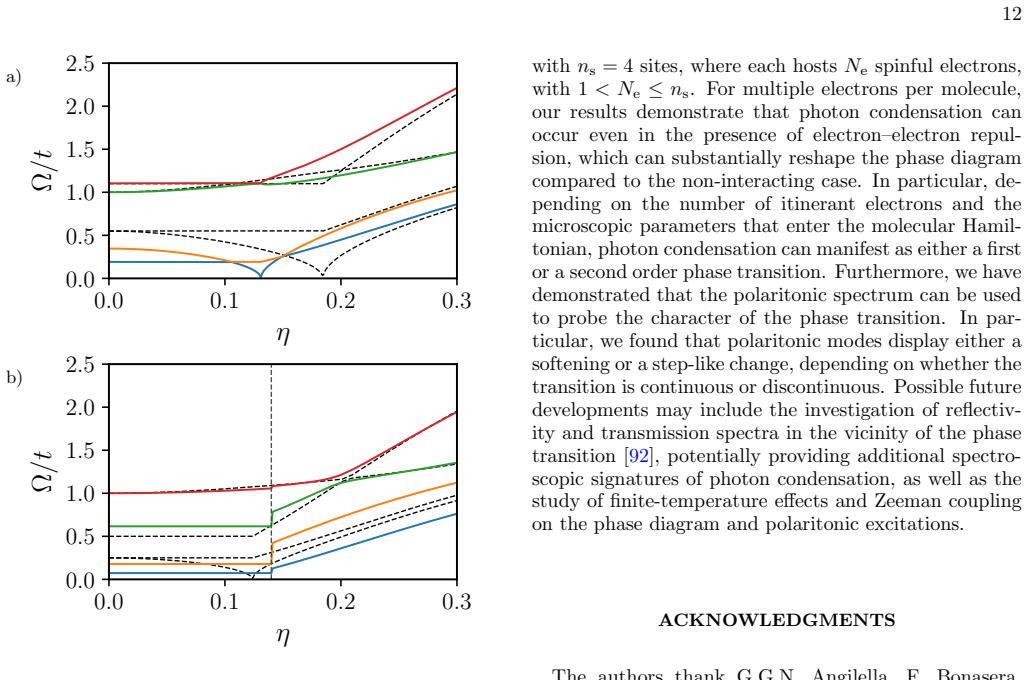
- Polaritonic excitation energies exhibit distinct signatures that reveal both the presence and the order of the magnetostatic instability.
Where Pith is reading between the lines
- Cavity-modified molecular devices could exploit abrupt first-order switches in optical response at generic fillings.
- Similar filling-dependent transition orders may appear in other lattice geometries under nonuniform cavity coupling.
- Spectroscopic detection of polariton mode softening could serve as a practical diagnostic in cavity QED experiments.
Load-bearing premise
The magnetostatic instability originates from the paramagnetic Van Vleck mechanism when the system couples to a spatially nonuniform cavity mode.
What would settle it
A discontinuous jump versus a continuous change in the lowest polaritonic energy or order parameter versus cavity coupling strength, observed at non-special fillings, would confirm first-order character.
Figures
read the original abstract
We investigate a minimal molecular model consisting of square planar plaquettes hosting multiple electrons, whose dynamics is governed by a tight-binding Hamiltonian supplemented by on-site Hubbard repulsion. By coupling this system to a spatially nonuniform cavity mode, we analyze the emergence of a magnetostatic instability, namely photon condensation, originating from the paramagnetic Van Vleck mechanism. The global behavior of the system is analyzed for different electronic filling factors, and we find that, except for the special cases of half-filling and single electron, where the transition, if it occurs, is necessarily a second order phase transition, the global system may also undergo a first order transition because of the action of the electron-electron interaction. The polaritonic excitation energies are analyzed, providing clear spectroscopic signatures of the magnetostatic instability and of its order.
Editorial analysis
A structured set of objections, weighed in public.
Referee Report
Summary. The manuscript investigates a minimal model of square planar plaquettes with tight-binding hopping and on-site Hubbard repulsion U, coupled to a spatially nonuniform cavity mode. It claims that a magnetostatic instability (photon condensation) arises via the paramagnetic Van Vleck mechanism, that the transition is second-order at half-filling and single-electron cases but can become first-order for other fillings due to electron-electron interactions, and that polaritonic excitation energies furnish spectroscopic signatures of the instability and its order.
Significance. If the central derivation of the instability is robust, the work would clarify how cavity-induced paramagnetic contributions compete with Hubbard correlations to control the order of photon condensation transitions in molecular systems, with potential relevance to cavity QED materials and spectroscopic diagnostics.
major comments (3)
- [§3] §3 (or equivalent section deriving the effective photon Hamiltonian): the emergence of a negative photon mass or instability from the Van Vleck paramagnetic term alone must be shown explicitly to survive the inclusion of the diamagnetic A² contribution; standard light-matter treatments indicate the latter can cancel or reverse the paramagnetic effect, and the nonuniform mode introduces additional gauge considerations that require explicit verification.
- [§4] §4 (analysis of filling factors and transition order): the claim that electron-electron interactions drive a first-order transition for generic fillings rests on the prior existence of the instability; if the diamagnetic cancellation occurs, the first-order regime and its spectroscopic signatures would need re-derivation.
- [Eq. (cavity mode definition)] Eq. (defining the cavity mode or effective mass term): the modeling of the spatially nonuniform mode must be shown to avoid unphysical gauge artifacts while still yielding a net paramagnetic instability; the manuscript should provide the explicit form of the vector potential and the resulting matrix elements.
minor comments (2)
- Notation for the polaritonic modes and filling factors should be unified across figures and text to avoid ambiguity in the phase diagrams.
- The abstract states the transition 'may also undergo a first order transition'; the main text should clarify the precise parameter window (U, filling) where this occurs versus where it remains second-order.
Simulated Author's Rebuttal
We thank the referee for the careful reading and constructive comments. We address each major point below. We agree that explicit verification of the diamagnetic term and gauge properties is required for robustness and will revise the manuscript to include these calculations.
read point-by-point responses
-
Referee: [§3] §3 (or equivalent section deriving the effective photon Hamiltonian): the emergence of a negative photon mass or instability from the Van Vleck paramagnetic term alone must be shown explicitly to survive the inclusion of the diamagnetic A² contribution; standard light-matter treatments indicate the latter can cancel or reverse the paramagnetic effect, and the nonuniform mode introduces additional gauge considerations that require explicit verification.
Authors: We agree that the diamagnetic A² term must be treated explicitly. Our §3 derivation isolates the paramagnetic Van Vleck contribution as the source of the instability for the chosen nonuniform mode, but we acknowledge that a complete effective Hamiltonian requires both terms. In the revision we will add an explicit calculation of the full photon mass (paramagnetic plus diamagnetic) and demonstrate that the negative mass survives for the model parameters and mode profile. We will also include the gauge-fixing procedure and verify that no unphysical artifacts arise from the spatial nonuniformity. revision: yes
-
Referee: [§4] §4 (analysis of filling factors and transition order): the claim that electron-electron interactions drive a first-order transition for generic fillings rests on the prior existence of the instability; if the diamagnetic cancellation occurs, the first-order regime and its spectroscopic signatures would need re-derivation.
Authors: The filling-dependent analysis in §4 is conditional on the instability derived in §3. Once the revised §3 confirms (or modifies) the conditions under which the instability persists after inclusion of the diamagnetic term, we will re-examine the first-order regime and the associated polaritonic signatures for the affected fillings. If the instability survives, the reported distinction between half-filling/single-electron cases and generic fillings remains; otherwise the relevant sections will be updated accordingly. revision: partial
-
Referee: [Eq. (cavity mode definition)] Eq. (defining the cavity mode or effective mass term): the modeling of the spatially nonuniform mode must be shown to avoid unphysical gauge artifacts while still yielding a net paramagnetic instability; the manuscript should provide the explicit form of the vector potential and the resulting matrix elements.
Authors: We will add the explicit expression for the vector potential of the nonuniform cavity mode together with the computed paramagnetic and diamagnetic matrix elements. This addition will make transparent that the chosen mode profile produces a net paramagnetic instability without introducing gauge artifacts, consistent with the minimal molecular model employed. revision: yes
Circularity Check
No circularity: derivation is model-driven and self-contained.
full rationale
The paper constructs a minimal tight-binding plus Hubbard model for square plaquettes, couples it to a nonuniform cavity mode, and derives the magnetostatic instability and its order (first vs second) directly from the resulting Hamiltonian for varying fillings. No parameters are fitted to data and then relabeled as predictions; no load-bearing uniqueness theorem or ansatz is imported via self-citation; the polaritonic spectra are computed from the same microscopic model. The derivation chain therefore remains independent of its own outputs.
Axiom & Free-Parameter Ledger
free parameters (2)
- Hubbard repulsion strength U
- electron filling factor
axioms (3)
- standard math Tight-binding Hamiltonian governs electron dynamics
- domain assumption On-site Hubbard repulsion supplements the Hamiltonian
- domain assumption Coupling to spatially nonuniform cavity mode induces Van Vleck instability
Reference graph
Works this paper leans on
-
[1]
Schlawin, D
F. Schlawin, D. M. Kennes, and M. A. Sentef, Cavity quantum materials, Applied Physics Reviews9, 011312 (2022)
2022
-
[2]
Mivehvar, F
F. Mivehvar, F. Piazza, T. Donner, and H. Ritsch, Cavity QED with quantum gases: new paradigms in many-body physics, Advances in Physics70, 1 (2021). 20
2021
-
[3]
Bloch, A
J. Bloch, A. Cavalleri, V. Galitski, M. Hafezi, and A. Ru- bio, Strongly correlated electron–photon systems, Nature 606, 41–48 (2022)
2022
-
[4]
and Ciuti, Cristiano and Ebbesen, Thomas W., Manipulating matter by strong coupling to vacuum fields, Science373, eabd0336 (2021)
Garc´ ıa-Vidal, Francisco J. and Ciuti, Cristiano and Ebbesen, Thomas W., Manipulating matter by strong coupling to vacuum fields, Science373, eabd0336 (2021)
2021
-
[5]
Frisk Kockum, A
A. Frisk Kockum, A. Miranowicz, S. De Liberato, S. Savasta, and F. Nori, Ultrastrong coupling between light and matter, Nature Reviews Physics1, 19 (2019)
2019
-
[6]
G. L. Paravicini-Bagliani, F. Appugliese, E. Richter, F. Valmorra, J. Keller, M. Beck, N. Bartolo, C. R¨ ossler, T. Ihn, K. Ensslin, C. Ciuti, G. Scalari, and J. Faist, Magneto-transport controlled by Landau polariton states, Nature Physics15, 186 (2019)
2019
-
[7]
Appugliese, J
F. Appugliese, J. Enkner, G. L. Paravicini-Bagliani, M. Beck, C. Reichl, W. Wegscheider, G. Scalari, C. Ciuti, and J. Faist, Breakdown of topological protection by cav- ity vacuum fields in the integer quantum Hall effect, Sci- ence375, 1030 (2022)
2022
-
[8]
G. Jarc, S. Y. Mathengattil, A. Montanaro, F. Giusti, E. M. Rigoni, R. Sergo, F. Fassioli, S. Winnerl, S. Dal Zilio, D. Mihailovic, P. Prelovˇ sek, M. Eckstein, and D. Fausti, Cavity-mediated thermal control of metal-to- insulator transition in 1T-TaS2, Nature622, 487 (2023)
2023
-
[9]
Chiriac` o, Thermal Purcell effect and cavity-induced renormalization of dissipations, Phys
G. Chiriac` o, Thermal Purcell effect and cavity-induced renormalization of dissipations, Phys. Rev. B110, L161107 (2024)
2024
-
[10]
M. A. Sentef, M. Ruggenthaler, and A. Rubio, Cav- ity quantum-electrodynamical polaritonically enhanced electron-phonon coupling and its influence on supercon- ductivity, Science Advances4, eaau6969 (2018)
2018
-
[11]
J. B. Curtis, Z. M. Raines, A. A. Allocca, M. Hafezi, and V. M. Galitski, Cavity Quantum Eliashberg Enhance- ment of Superconductivity, Phys. Rev. Lett.122, 167002 (2019)
2019
-
[12]
Schlawin, A
F. Schlawin, A. Cavalleri, and D. Jaksch, Cavity- Mediated Electron-Photon Superconductivity, Phys. Rev. Lett.122, 133602 (2019)
2019
-
[13]
G. M. Andolina, A. De Pasquale, F. M. D. Pellegrino, I. Torre, F. H. L. Koppens, and M. Polini, Amperean superconductivity cannot be induced by deep subwave- length cavities in a two-dimensional material, Phys. Rev. B109, 104513 (2024)
2024
-
[14]
Latini, D
S. Latini, D. Shin, S. A. Sato, C. Sch¨ afer, U. de Giovan- nini, H. H¨ ubener, and A. Rubio, The ferroelectric photo ground state of SrTiO 3: Cavity materials engineering, Proceedings of the National Academy of Sciences of the United States of America118, e2105618118 (2021)
2021
-
[15]
Ashida, A
Y. Ashida, A. m. c. ˙Imamo˘ glu, J. Faist, D. Jaksch, A. Cavalleri, and E. Demler, Quantum Electrodynamic Control of Matter: Cavity-Enhanced Ferroelectric Phase Transition, Phys. Rev. X10, 041027 (2020)
2020
-
[16]
Ciuti, Cavity-mediated electron hopping in disordered quantum Hall systems, Phys
C. Ciuti, Cavity-mediated electron hopping in disordered quantum Hall systems, Phys. Rev. B104, 155307 (2021)
2021
-
[17]
Chiocchetta, D
A. Chiocchetta, D. Kiese, C. P. Zelle, F. Piazza, and S. Diehl, Cavity-induced quantum spin liquids, Nature Communications12, 5901 (2021)
2021
-
[18]
Dmytruk and M
O. Dmytruk and M. Schir` o, Controlling topological phases of matter with quantum light, Communications Physics5, 271 (2022)
2022
-
[19]
Bacciconi, G
Z. Bacciconi, G. M. Andolina, and C. Mora, Topological protection of Majorana polaritons in a cavity, Phys. Rev. B109, 165434 (2024)
2024
-
[20]
Winter and O
L. Winter and O. Zilberberg, Fractional quantum Hall edge polaritons, Phys. Rev. B112, L241105 (2025)
2025
-
[21]
Kirton, M
P. Kirton, M. M. Roses, J. Keeling, and E. G. Dalla Torre, Introduction to the Dicke Model: From Equilibrium to Nonequilibrium, and Vice Versa, Ad- vanced Quantum Technologies2(2018)
2018
-
[22]
Baumann, Kristian and Guerlin, Christine and Bren- necke, Ferdinand and Esslinger, Tilman, Dicke quantum phase transition with a superfluid gas in an optical cavity, Nature464, 1301 (2010)
2010
-
[23]
R. H. Dicke, Coherence in Spontaneous Radiation Pro- cesses, Phys. Rev.93, 99 (1954)
1954
-
[24]
Gross and S
M. Gross and S. Haroche, Superradiance: An essay on the theory of collective spontaneous emission, Physics Reports93, 301 (1982)
1982
-
[25]
G. M. Andolina, F. M. D. Pellegrino, V. Giovannetti, A. H. MacDonald, and M. Polini, Cavity quantum elec- trodynamics of strongly correlated electron systems: A no-go theorem for photon condensation, Phys. Rev. B 100, 121109 (2019)
2019
-
[26]
Hepp and E
K. Hepp and E. H. Lieb, On the superradiant phase tran- sition for molecules in a quantized radiation field: the dicke maser model, Annals of Physics76, 360–404 (1973)
1973
-
[27]
Y. K. Wang and F. T. Hioe, Phase Transition in the Dicke Model of Superradiance, Physical Review A7, 831–836 (1973)
1973
-
[28]
Jaako, Z.-L
T. Jaako, Z.-L. Xiang, J. J. Garc´ ıa-Ripoll, and P. Rabl, Ultrastrong-coupling phenomena beyond the Dicke model, Phys. Rev. A94, 033850 (2016)
2016
-
[29]
Hagenm¨ uller and C
D. Hagenm¨ uller and C. Ciuti, Cavity QED of the Graphene Cyclotron Transition, Phys. Rev. Lett.109, 267403 (2012)
2012
-
[30]
F. M. D. Pellegrino, L. Chirolli, R. Fazio, V. Giovannetti, and M. Polini, Theory of integer quantum Hall polaritons in graphene, Phys. Rev. B89, 165406 (2014)
2014
-
[31]
Chirolli, M
L. Chirolli, M. Polini, V. Giovannetti, and A. H. Mac- Donald, Drude Weight, Cyclotron Resonance, and the Dicke Model of Graphene Cavity QED, Phys. Rev. Lett. 109, 267404 (2012)
2012
-
[32]
Bamba, K
M. Bamba, K. Inomata, and Y. Nakamura, Superradiant Phase Transition in a Superconducting Circuit in Ther- mal Equilibrium, Phys. Rev. Lett.117, 173601 (2016)
2016
-
[33]
G. C. Duncan, Effect of antiresonant atom-field interac- tions on phase transitions in the Dicke model, Phys. Rev. A9, 418 (1974)
1974
-
[34]
Rza˙ zewski, K
K. Rza˙ zewski, K. W´ odkiewicz, and W.˙Zakowicz, Phase transitions, two-level atoms, and theA 2 term, Phys. Rev. Lett.35, 432 (1975)
1975
-
[35]
Bialynicki-Birula and K
I. Bialynicki-Birula and K. Rza ¸ ˙ zewski, No-go theorem concerning the superradiant phase transition in atomic systems, Phys. Rev. A19, 301 (1979)
1979
-
[36]
Gaw¸ edzki and K
K. Gaw¸ edzki and K. Rza ¸ ´ zewski, No-go theorem for the superradiant phase transition without dipole approxima- tion, Phys. Rev. A23, 2134 (1981)
1981
-
[37]
G. M. Andolina, F. M. D. Pellegrino, V. Giovannetti, A. H. MacDonald, and M. Polini, Theory of photon con- densation in a spatially varying electromagnetic field, Physical Review B102(2020)
2020
-
[38]
Nataf, T
P. Nataf, T. Champel, G. Blatter, and D. M. Basko, Rashba Cavity QED: A Route Towards the Superradi- ant Quantum Phase Transition, Physical Review Letters 123(2019)
2019
-
[39]
Guerci, P
D. Guerci, P. Simon, and C. Mora, Superradiant Phase 21 Transition in Electronic Systems and Emergent Topolog- ical Phases, Phys. Rev. Lett.125, 257604 (2020)
2020
-
[40]
Guerci, P
D. Guerci, P. Simon, and C. Mora, Moir´ e lattice effects on the orbital magnetic response of twisted bilayer graphene and Condon instability, Phys. Rev. B103, 224436 (2021)
2021
-
[41]
Rom´ an-Roche, F
J. Rom´ an-Roche, F. Luis, and D. Zueco, Photon Conden- sation and Enhanced Magnetism in Cavity QED, Phys. Rev. Lett.127, 167201 (2021)
2021
-
[42]
Manzanares, T
G. Manzanares, T. Champel, D. M. Basko, and P. Nataf, Superradiant quantum phase transition for Landau po- laritons with Rashba and Zeeman couplings, Phys. Rev. B105, 245304 (2022)
2022
-
[43]
J. H. Condon, Nonlinear de Haas-van Alphen Effect and Magnetic Domains in Beryllium, Phys. Rev.145, 526 (1966)
1966
-
[44]
C. J. Eckhardt, G. Passetti, M. Othman, C. Karrasch, F. Cavaliere, M. A. Sentef, and D. M. Kennes, Quan- tum Floquet engineering with an exactly solvable tight- binding chain in a cavity, Commun. Phys.5, 122 (2022)
2022
-
[45]
Bacciconi, G
Z. Bacciconi, G. M. Andolina, T. Chanda, G. Chiriac` o, M. Schir` o, and M. Dalmonte, First-order photon conden- sation in magnetic cavities: A two-leg ladder model, Sci- Post Phys.15, 113 (2023)
2023
-
[46]
De Bernardis, P
D. De Bernardis, P. Pilar, T. Jaako, S. De Liberato, and P. Rabl, Breakdown of gauge invariance in ultrastrong- coupling cavity QED, Physical Review A98(2018)
2018
-
[47]
Di Stefano, A
O. Di Stefano, A. Settineri, V. Macr` ı, L. Garziano, R. Stassi, S. Savasta, and F. Nori, Resolution of gauge ambiguities in ultrastrong-coupling cavity quantum elec- trodynamics, Nature Physics15, 803–808 (2019)
2019
-
[48]
Savasta, O
S. Savasta, O. Di Stefano, A. Settineri, D. Zueco, S. Hughes, and F. Nori, Gauge principle and gauge in- variance in two-level systems, Physical Review A103 (2021)
2021
-
[49]
G. M. Andolina, F. M. D. Pellegrino, A. Mercurio, O. Di Stefano, M. Polini, and S. Savasta, A non- perturbative no-go theorem for photon condensation in approximate models, The European Physical Journal Plus137(2022)
2022
-
[50]
J. Li, D. Golez, G. Mazza, A. J. Millis, A. Georges, and M. Eckstein, Electromagnetic coupling in tight-binding models for strongly correlated light and matter, Phys. Rev. B101, 205140 (2020)
2020
-
[51]
Dmytruk and M
O. Dmytruk and M. Schir´ o, Gauge fixing for strongly correlated electrons coupled to quantum light, Phys. Rev. B103, 075131 (2021)
2021
-
[52]
J. M. Luttinger, The Effect of a Magnetic Field on Elec- trons in a Periodic Potential, Phys. Rev.84, 814 (1951)
1951
-
[53]
Kohn, Theory of Bloch Electrons in a Magnetic Field: The Effective Hamiltonian, Phys
W. Kohn, Theory of Bloch Electrons in a Magnetic Field: The Effective Hamiltonian, Phys. Rev.115, 1460 (1959)
1959
-
[54]
A. S. Alexandrov and H. Capellmann, Orbital diamag- netism of two-dimensional electrons, Phys. Rev. Lett.66, 365 (1991)
1991
-
[55]
Graf and P
M. Graf and P. Vogl, Electromagnetic fields and dielectric response in empirical tight-binding theory, Phys. Rev. B 51, 4940 (1995)
1995
-
[56]
T. B. Boykin, Tight-binding-like expressions for the continuous-space electromagnetic coupling Hamiltonian, American Journal of Physics69, 793 (2001)
2001
-
[57]
Iba˜ nez Azpiroz, A
J. Iba˜ nez Azpiroz, A. Eiguren, A. Bergara, G. Pettini, and M. Modugno, Breakdown of the Peierls substitution for the Haldane model with ultracold atoms, Phys. Rev. A90, 033609 (2014)
2014
-
[58]
E. C. S., The Theory of Electric and Magnetic Suscepti- bilities, Nature130, 490–491 (1932)
1932
-
[59]
Grosso and G
G. Grosso and G. Pastori Parravicini,Solid State Physics (Elsevier, United States, 2014)
2014
-
[60]
Mercurio, G
A. Mercurio, G. M. Andolina, F. M. D. Pellegrino, O. Di Stefano, P. Jarillo-Herrero, C. Felser, F. H. L. Kop- pens, S. Savasta, and M. Polini, Photon condensation, Van Vleck paramagnetism, and chiral cavities, Physical Review Research6(2024)
2024
-
[61]
Bruus and K
H. Bruus and K. Flensberg,Many–Body Quantum The- ory in Condensed Matter Physics: An Introduction(Ox- ford University PressOxford, 2004)
2004
-
[62]
Nataf and C
P. Nataf and C. Ciuti, No-go theorem for superradiant quantum phase transitions in cavity QED and counter- example in circuit QED, Nature Communications1, 72 (2010)
2010
-
[63]
Altland and B
A. Altland and B. D. Simons,Condensed Matter Field Theory, 2nd ed. (Cambridge University Press, Cam- bridge, 2010)
2010
-
[64]
C. P. Koch, J. P. Palao, R. Kosloff, and F. m. c. Masnou- Seeuws, Stabilization of ultracold molecules using opti- mal control theory, Phys. Rev. A70, 013402 (2004)
2004
-
[65]
Klein, Y
A. Klein, Y. Shagam, W. Skomorowski, P. S. ˙Zuchowski, M. Pawlak, L. M. C. Janssen, N. Moiseyev, S. Y. T. van de Meerakker, A. van der Avoird, C. P. Koch, and E. Narevicius, Directly probing anisotropy in atom–molecule collisions through quantum scattering resonances, Nature Physics13, 35–38 (2016)
2016
-
[66]
D. N. Basov, A. Asenjo-Garc´ ıa, P. J. Schuck, X. Zhu, and A. Rubio, Polariton panorama, Nanophotonics10, 549–577 (2020)
2020
-
[67]
Fregoni, F
J. Fregoni, F. J. Garc´ ıa-Vidal, and J. Feist, Theoretical Challenges in Polaritonic Chemistry, ACS Photonics9, 1096–1107 (2022)
2022
-
[68]
T. W. Ebbesen, A. Rubio, and G. D. Scholes, Intro- duction: Polaritonic Chemistry, Chemical Reviews123, 12037–12038 (2023)
2023
-
[69]
Gonzalez-Ballestero, J
C. Gonzalez-Ballestero, J. Feist, E. Gonzalo Bad´ ıa, E. Moreno, and F. J. Garc´ ıa-Vidal, Uncoupled Dark States Can Inherit Polaritonic Properties, Phys. Rev. Lett.117, 156402 (2016)
2016
-
[70]
Mandal, M
A. Mandal, M. A. Taylor, B. M. Weight, E. R. Koessler, X. Li, and P. Huo, Theoretical Advances in Polariton Chemistry and Molecular Cavity Quantum Electrody- namics, Chemical Reviews123, 9786–9879 (2023)
2023
-
[71]
Hirai, J
K. Hirai, J. A. Hutchison, and H. Uji-i, Molecular Chem- istry in Cavity Strong Coupling, Chemical Reviews123, 8099–8126 (2023)
2023
-
[72]
B. Gu, Y. Gu, V. Y. Chernyak, and S. Mukamel, Cav- ity Control of Molecular Spectroscopy and Photophysics, Accounts of Chemical Research56, 2753–2762 (2023)
2023
-
[73]
Xiang and W
B. Xiang and W. Xiong, Molecular Polaritons for Chem- istry, Photonics and Quantum Technologies, Chemical Reviews124, 2512–2552 (2024)
2024
-
[74]
R. F. Ribeiro, L. A. Mart´ ınez-Mart´ ınez, M. Du, J. Campos-Gonzalez-Angulo, and J. Yuen-Zhou, Polari- ton chemistry: controlling molecular dynamics with op- tical cavities, Chemical Science9, 6325–6339 (2018)
2018
-
[75]
T. T. Heikkil¨ a,The Physics of Nanoelectronics: Trans- port and Fluctuation Phenomena at Low Temperatures (Oxford University Press, Oxford, 2013)
2013
-
[76]
H. Lin, J. Gubernatis, H. Gould, and J. Tobochnik, Exact Diagonalization Methods for Quantum Systems, Com- puters in Physics7, 400–407 (1993). 22
1993
-
[77]
Honet, L
A. Honet, L. Henrard, and V. Meunier, Exact and many- body perturbation solutions of the Hubbard model ap- plied to linear chains, AIP Advances12(2022)
2022
-
[78]
Sharma and M
M. Sharma and M. Ahsan, Organization of the Hilbert space for exact diagonalization of Hubbard model, Com- puter Physics Communications193, 19–29 (2015)
2015
-
[79]
D. P. Arovas, E. Berg, S. A. Kivelson, and S. Raghu, The Hubbard Model, Annual Review of Condensed Matter Physics13, 239–274 (2022)
2022
-
[80]
Tasaki, The Hubbard model - an introduction and selected rigorous results, Journal of Physics: Condensed Matter10, 4353–4378 (1998)
H. Tasaki, The Hubbard model - an introduction and selected rigorous results, Journal of Physics: Condensed Matter10, 4353–4378 (1998)
1998
discussion (0)
Sign in with ORCID, Apple, or X to comment. Anyone can read and Pith papers without signing in.