Application of the Skyrme Hartree-Fock-Bogoliubov Theory to WIMP-Nucleus Interactions in 40Ar
Pith reviewed 2026-06-27 08:24 UTC · model grok-4.3
The pith
Skyrme HFB calculations for argon-40 agree with shell models on spin-independent WIMP responses but differ on spin-orbit channels.
A machine-rendered reading of the paper's core claim, the machinery that carries it, and where it could break.
Core claim
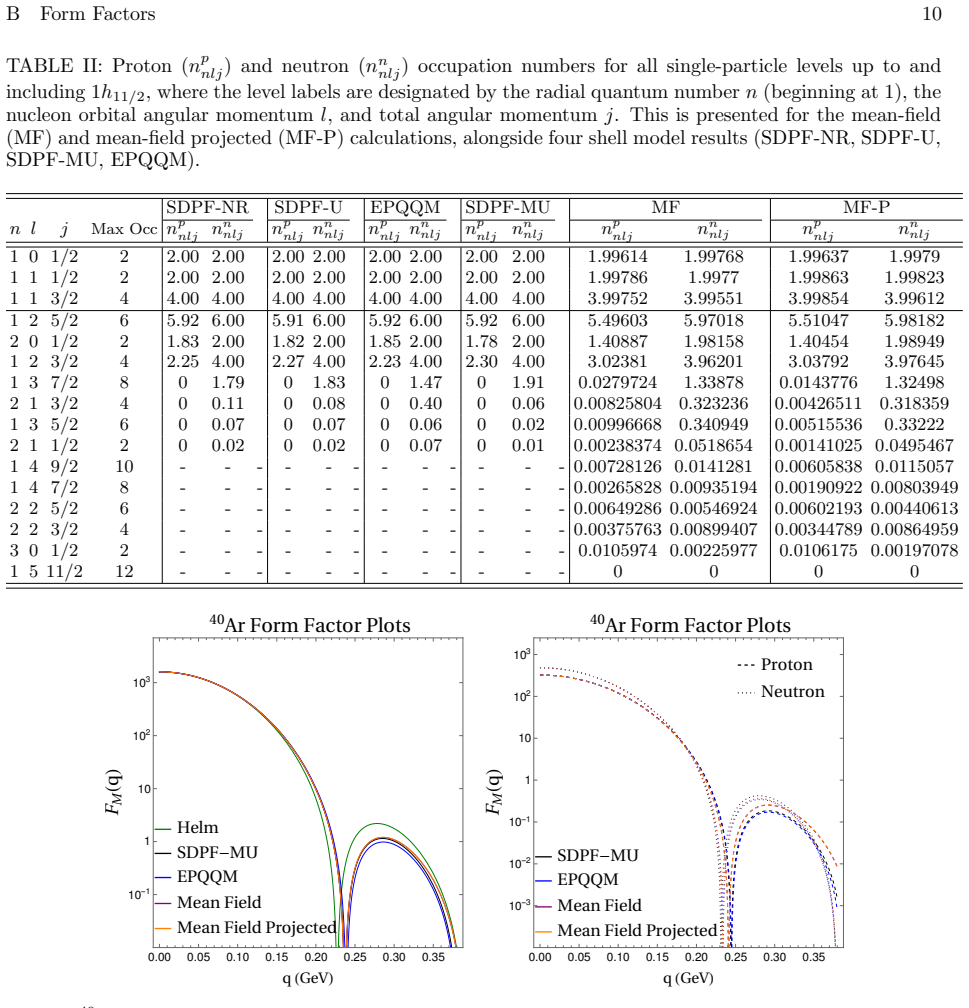
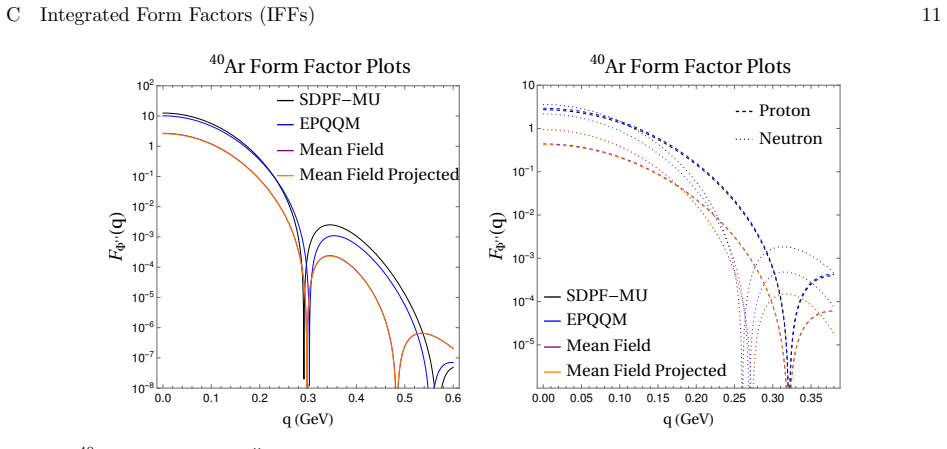
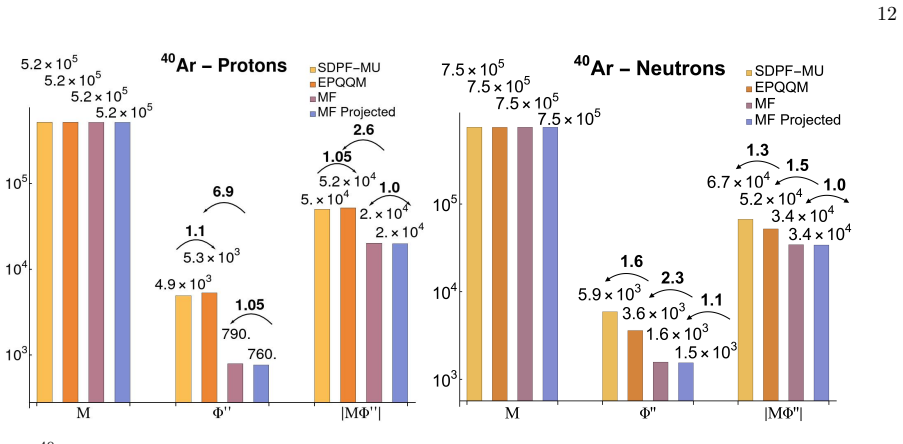
A self-consistent Skyrme Hartree-Fock-Bogoliubov calculation supplies the one-body density matrix elements needed to evaluate nuclear form factors for WIMP-nucleus scattering in 40Ar. These form factors agree closely with shell-model predictions for the spin-independent response yet differ substantially for the spin-orbit response because of changes in single-particle occupancies. Particle-number projection corrections are shown to be minor. The comparison establishes the sensitivity of selected dark matter response channels to the underlying nuclear model and supplies a practical route for extending mean-field methods to nuclei outside the reach of large-scale shell-model studies.
What carries the argument
One-body density matrix elements generated by the self-consistent Skyrme Hartree-Fock-Bogoliubov calculation, which determine the nuclear form factors for each dark matter response channel.
If this is right
- Spin-independent responses remain stable when the nuclear model is changed.
- Spin-orbit responses must be recomputed whenever single-particle occupancies shift.
- Mean-field techniques become usable for WIMP studies on nuclei heavier than those reachable by shell-model methods.
- Particle-number projection can be omitted for 40Ar without large loss of accuracy.
Where Pith is reading between the lines
- The same HFB pipeline could be run on xenon or other detector nuclei to check consistency of spin-orbit contributions.
- Updated spin-orbit form factors would alter the interpretation of any direct-detection signal that couples to angular momentum.
- Comparison with ab-initio methods on 40Ar would test whether the occupancy differences are model-specific or more general.
Load-bearing premise
The Skyrme Hartree-Fock-Bogoliubov approach correctly determines the single-particle occupancies that govern the spin-orbit response.
What would settle it
A new shell-model calculation of the spin-orbit form factor for 40Ar that uses a different effective interaction and yields occupancies matching the HFB values would remove the reported difference.
Figures
read the original abstract
WIMP scattering from 40Ar is investigated using a self-consistent Skyrme Hartree-Fock-Bogoliubov (HFB) approach. Nuclear form factors relevant to dark matter direct detection are calculated from the resulting one-body density matrix elements and compared with shell-model predictions. Good agreement is found for the spin-independent response, while significant differences are observed for the spin-orbit response due to variations in single-particle occupancies. The effects of particle-number projection are shown to be small for 40Ar. These results demonstrate the sensitivity of certain dark matter response channels to the underlying nuclear structure model and establish a framework for extending mean-field calculations to nuclei beyond the reach of large-scale shell-model studies.
Editorial analysis
A structured set of objections, weighed in public.
Referee Report
Summary. The manuscript applies a self-consistent Skyrme Hartree-Fock-Bogoliubov (HFB) calculation to 40Ar to obtain one-body density matrix elements and the associated nuclear form factors for WIMP scattering. It compares the resulting spin-independent and spin-orbit responses against shell-model benchmarks, reports good agreement in the spin-independent channel, attributes differences in the spin-orbit channel to variations in single-particle occupancies, demonstrates that particle-number projection effects are small, and presents the HFB approach as a scalable framework for nuclei beyond the reach of large-scale shell-model studies.
Significance. If the numerical comparisons hold, the work provides concrete evidence that certain dark-matter response functions are sensitive to the choice of nuclear-structure method and supplies a computationally tractable mean-field route to form factors for medium-mass and heavier nuclei. This is a useful addition to the toolkit for direct-detection phenomenology, where shell-model calculations become prohibitive.
minor comments (2)
- [Abstract] The abstract states that 'significant differences' appear in the spin-orbit response but does not quantify the size of the discrepancy (e.g., relative deviation at a representative momentum transfer). Adding a brief numerical measure would strengthen the claim without lengthening the text.
- The manuscript would benefit from an explicit statement of the Skyrme parametrization(s) employed and a short discussion of any sensitivity to the choice of functional, even if the central results are robust.
Simulated Author's Rebuttal
We thank the referee for the positive summary, significance assessment, and recommendation of minor revision. No specific major comments were raised in the report.
Circularity Check
No significant circularity in derivation chain
full rationale
The paper applies the standard Skyrme HFB method to compute one-body density matrix elements for 40Ar and compares the resulting form factors to shell-model predictions. The central results are numerical comparisons showing agreement in spin-independent response and differences in spin-orbit due to occupancies. No step reduces a prediction to a fitted parameter by construction, nor relies on self-citation for uniqueness or ansatz. The derivation is self-contained against external benchmarks like shell-model calculations.
Axiom & Free-Parameter Ledger
axioms (1)
- domain assumption The Skyrme effective interaction accurately describes the ground-state one-body densities of 40Ar relevant to WIMP scattering.
Reference graph
Works this paper leans on
-
[1]
Form factors from unprojected states 15
-
[2]
Form factors from particle number projected states 15 References 16 ∗ navneet.krishnan@anu.edu.au † raghda.abdelkhaleq@anu.edu.au ‡ cedric.simenel@anu.edu.au I. Introduction The Weakly Interacting Massive Particle (WIMP) remains an attractive candidate for dark matter (DM). While the original supersymmetric realisa- tion of the WIMP has not shown any expe...
Pith/arXiv arXiv 2026
-
[3]
interactions
and SABRE [13]) are only a few nucleons away from the doubly magic 132 50 Sn nucleus, the valence spaces require important restrictions that may have significant impact on the resulting nuclear form factors [14]. To remedy this issue, we instead consider self- consistent mean-field approaches, such as the Hartree-Fock-Bogoliubov (HFB) theory, to com- pute...
-
[4]
1 + 1 2 x0 ρ2 − 1 2 +x 0 X 1 ρ2 q # + 1 2 t1
to compute the nuclear ground state, though we note thathfbthoalso includes the option for a finite-range Gogny EDF [33] as a possible area for future investigation. As the ground-state of an even-even nucleus like 40Ar is invariant under time-reversal symmetry, all time-odd densities vanish. In this case, the Skyrme EDF is a function of the particle loca...
-
[5]
F orm factors from unprojected states F (p,p) M (MF) = e−2y(323.987−626.166y + 421.622y 2 −115.958y 3 + 11.8819y4 −0.24238y 5 + 0.0156401y6 − 0.000112196y7 + 5.16207×10 −6y8) F (p,p) Φ′′ (MF) = e −2y(0.422025−0.347225y + 0.0755131y 2 −0.00192935y 3 + 0.000111031y4 −1.19171× 10⁻⁶y5 + 3.57853×10 −8y6) F (p,p) MΦ ′′(MF) = e −2y(−11.6932 + 16.11y−6.85396y 2 +...
-
[6]
F orm factors from particle number projected states F (p,p) M (MF−P) = e −2y(323.987−626.166y+421.622y 2 −115.958y3+11.8819y4 −0.24238y5+0.0156401y6 − 0.000112196y7 + 5.16207×10 −6y8) F (p,p) Φ′′ (MF−P) = e −2y(0.422025−0.347225y + 0.0755131y 2 −0.00192935y 3 + 0.000111031y4 −1.19171× 10⁻⁶y5 + 3.57853×10 −8y6) F (p,p) MΦ ′′(MF−P) = e −2y(−11.6932 + 16.11y...
-
[7]
Bertone and T
G. Bertone and T. M. P. Tait, A new era in the search for dark matter, Nature562, 51–56 (2018)
2018
-
[8]
A. L. Fitzpatrick, W. Haxton, E. Katz, N. Lubbers, and Y. Xu, The effective field theory of dark matter direct detection, JCAP2013(02), 004
-
[9]
Abdel Khaleq, G
R. Abdel Khaleq, G. Busoni, C. Simenel, and A. E. Stuchbery, Impact of shell model interactions on nu- clear responses to WIMP elastic scattering, Phys. Rev. D109, 075036 (2024)
2024
-
[10]
Hoferichter, P
M. Hoferichter, P. Klos, J. Men´ endez, and A. Schwenk, Nuclear structure factors for general spin-independent wimp-nucleus scattering, Phys. Rev. D99, 055031 (2019)
2019
-
[11]
B. S. Hu, J. Padua-Arg¨ uelles, S. Leutheusser, T. Miyagi, S. R. Stroberg, and J. D. Holt, Ab initio structure factors for spin-dependent dark matter di- rect detection, Phys. Rev. Lett.128, 072502 (2022)
2022
-
[12]
SuperCDMS Collaboration, Results from the Super Cryogenic Dark Matter Search (SuperCDMS) ex- periment at Soudan, Phys. Rev. Lett.120, 061802 (2018)
2018
-
[13]
EDELWEISS Collaboration, A Dark Matter Search with an EDELWEISS-II Heat-and-Ionization Detec- tor, Phys. Rev. D86, 051701 (2012)
2012
-
[14]
CDEX Collaboration, Limits on Light Weakly In- teracting Massive Particles from the CDEX-1 Ex- periment with a p-type Point-Contact Germanium Detector at the China Jinping Underground Labo- ratory, Phys. Rev. Lett.113, 221301 (2014)
2014
-
[15]
Aprileet al.(XENON), First Dark Matter Search with Nuclear Recoils from the XENONnT Experi- ment, Phys
E. Aprileet al.(XENON), First Dark Matter Search with Nuclear Recoils from the XENONnT Experi- ment, Phys. Rev. Lett.131, 041003 (2023)
2023
-
[16]
Aalberset al., A next-generation liquid xenon ob- servatory for dark matter and neutrino physics, J
J. Aalberset al., A next-generation liquid xenon ob- servatory for dark matter and neutrino physics, J. Phys. G50, 013001 (2022)
2022
-
[17]
Amareet al., Annual modulation results from three-year exposure of ANAIS-112, Phys
J. Amareet al., Annual modulation results from three-year exposure of ANAIS-112, Phys. Rev. D 103, 102005 (2021)
2021
-
[18]
Adhikariet al.(COSINE-100), Three-year an- nual modulation search with COSINE-100, Phys
G. Adhikariet al.(COSINE-100), Three-year an- nual modulation search with COSINE-100, Phys. Rev. D106, 052005 (2022)
2022
-
[19]
SABRE Collaboration, SABRE: A New NaI(Tl) Dark Matter Direct Detection Experiment, Eur. Phys. J. C79, 363 (2019)
2019
-
[20]
Abdel Khaleq, J
R. Abdel Khaleq, J. L. Newstead, C. Simenel, and A. E. Stuchbery, Detailed nuclear structure calcu- lations for coherent elastic neutrino-nucleus scatter- ing, Phys. Rev. D111, 033003 (2025)
2025
-
[21]
J. A. Sheikh, J. Dobaczewski, P. Ring, L. M. Robledo, and C. Yannouleas, Symmetry restoration in mean-field approaches, J. Phys. G48, 123001 (2021)
2021
-
[22]
Cesca and C
J. Cesca and C. Simenel, Symmetry breaking and restoration on a fermionic quantum ring, Phys. Rev. C108, 054307 (2023)
2023
-
[23]
Marevi´ c, N
P. Marevi´ c, N. Schunck, E. Ney, R. Navarro P´ erez, M. Verriere, and J. O’Neal, Axially-deformed so- lution of the skyrme-hartree-fock-bogoliubov equa- tions using the transformed harmonic oscillator ba- sis (iv) hfbtho (v4.0): A new version of the program, 2 Form factors from particle number projected states 17 Comput. Phys. Commun.276, 108367 (2022)
2022
-
[24]
Agneset al.(DarkSide-50), Search for low-mass dark matter WIMPs with 12 ton-day exposure of DarkSide-50, Phys
P. Agneset al.(DarkSide-50), Search for low-mass dark matter WIMPs with 12 ton-day exposure of DarkSide-50, Phys. Rev. D107, 063001 (2023)
2023
-
[25]
Ajajet al.(DEAP), Search for dark matter with a 231-day exposure of liquid argon using DEAP-3600 at SNOLAB, Phys
R. Ajajet al.(DEAP), Search for dark matter with a 231-day exposure of liquid argon using DEAP-3600 at SNOLAB, Phys. Rev. D100, 022004 (2019)
2019
-
[26]
Anand, A
N. Anand, A. L. Fitzpatrick, and W. C. Haxton, Weakly interacting massive particle-nucleus elastic scattering response, Phys. Rev. C89, 065501 (2014)
2014
-
[27]
T. M. Undagoitia and L. Rauch, Dark matter direct-detection experiments, J. Phys. G43, 013001 (2015)
2015
-
[28]
A. E. Stuchbery and J. L. Wood, To shell model, or not to shell model, that is the question, Physics4, 697 (2022)
2022
-
[29]
B. A. Brown and W. D. M. Rae, The Shell-Model Code NuShellX@MSU, Nucl. Data Sheets120, 115 (2014)
2014
-
[30]
Nummelaet al., Spectroscopy of Si-34,35 by beta decay: sd-fp shell gap and single particle states, Phys
S. Nummelaet al., Spectroscopy of Si-34,35 by beta decay: sd-fp shell gap and single particle states, Phys. Rev. C63, 044316 (2001)
2001
-
[31]
Nowacki and A
F. Nowacki and A. Poves, A New effective interac- tion for 0 - h-bar - omega shell model calculations in the sdpf valence space, Phys. Rev. C79, 014310 (2009)
2009
-
[32]
Kaneko, Y
K. Kaneko, Y. Sun, T. Mizusaki, and M. Hasegawa, Shell model study for neutron-rich sd-shell nuclei, Phys. Rev. C83, 014320 (2011)
2011
-
[33]
Utsuno, T
Y. Utsuno, T. Otsuka, B. A. Brown, M. Honma, T. Mizusaki, and N. Shimizu, Shape transitions in exotic Si and S isotopes and tensor-force-driven Jahn-Teller effect, Phys. Rev. C86, 051301 (2012)
2012
-
[34]
Ring and P
P. Ring and P. Schuck,Table of Isotopes, Eigth Edi- tion, 1864-5879 (Springer Berlin, Heidelberg, 1980)
1980
-
[35]
Stoitsov, J
M. Stoitsov, J. Dobaczewski, W. Nazarewicz, and P. Ring, Axially deformed solution of the skyrme–hartree–fock–bogolyubov equations using the transformed harmonic oscillator basis. the pro- gram hfbtho (v1.66p), Comput. Phys. Commun. 167, 43–63 (2005)
2005
-
[36]
Stoitsov, N
M. Stoitsov, N. Schunck, M. Kortelainen, N. Michel, H. Nam, E. Olsen, J. Sarich, and S. Wild, Axially deformed solution of the skyrme- hartree–fock–bogoliubov equations using the transformed harmonic oscillator basis (ii) hfbtho v2.00d: A new version of the program, Comput. Phys. Commun.184, 1592–1604 (2013)
2013
-
[37]
R. N. Perez, N. Schunck, R.-D. Lasseri, C. Zhang, and J. Sarich, Axially deformed solution of the skyrme–hartree–fock–bogolyubov equations using the transformed harmonic oscillator basis (iii) hf- btho (v3.00): A new version of the program, Com- put. Phys. Commun.220, 363–375 (2017)
2017
-
[38]
T. H. R. Skyrme, The nuclear surface, Phil. Mag.1, 1043 (1956)
1956
-
[39]
Decharg´ e and D
J. Decharg´ e and D. Gogny, Hartree-fock-bogolyubov calculations with the d1 effective interaction on spherical nuclei, Phys. Rev. C21, 1568 (1980)
1980
-
[40]
Chabanat, P
E. Chabanat, P. Bonche, P. Haensel, J. Meyer, and R. Schaeffer, A skyrme parametrization from sub- nuclear to neutron star densities part ii. nuclei far from stabilities, Nucl. Phys. A635, 231 (1998)
1998
-
[41]
W. J. Chen, C. A. Bertulani, F. R. Xu, and Y. N. Zhang, Odd-even mass staggering with skyrme- hartree-fock-bogoliubov theory, Phys. Rev. C91, 047303 (2015)
2015
-
[42]
Firestone, V
R. Firestone, V. Shirley, C. Baglin, S. Chu, and J. Zipkin,The 8th edition of the Table of Isotopes (Springer., 1997) p. p. 647–651
1997
-
[43]
V. N. Fomenko, Projection in the occupation- number space and the canonical transformation, J. Phys. A3, 8 (1970)
1970
-
[44]
Bally and M
B. Bally and M. Bender, Projection on particle num- ber and angular momentum: Example of triaxial bogoliubov quasiparticle states, Phys. Rev. C103, 024315 (2021)
2021
-
[45]
J. A. Sheikh and P. Ring, Symmetry-projected hartree–fock–bogoliubov equations, Nucl. Phys. A 665, 71 (2000)
2000
-
[46]
R. H. Helm, Inelastic and elastic scattering of 187- mev electrons from selected even-even nuclei, Phys. Rev.104, 1466 (1956)
1956
discussion (0)
Sign in with ORCID, Apple, or X to comment. Anyone can read and Pith papers without signing in.