Goal-Autopilot: A Verifiable Anti-Fabrication Firewall for Unattended Long-Horizon Agents
Pith reviewed 2026-06-27 09:58 UTC · model grok-4.3
The pith
A gated finite-state machine with hard floor enforcement makes fabricated success structurally impossible for unattended LLM agents.
A machine-rendered reading of the paper's core claim, the machinery that carries it, and where it could break.
Core claim
We prove a No-False-Success theorem: under gate soundness, floor enforcement, and plan coverage, termination implies the goal holds. The only trust points are empirically measurable, and the worst case degrades to an honest stall, never a fabricated success. Each tick rehydrates only the state machine so per-step context cost stays constant in the horizon.
What carries the argument
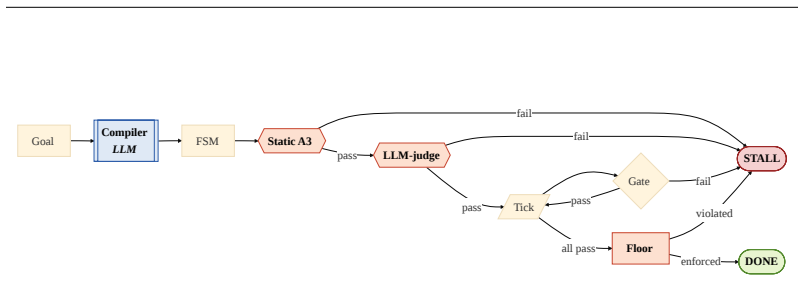
The gated finite-state machine with hard floor that forbids any terminal done claim whose falsifiable gate did not execute and pass.
If this is right
- Termination without the goal holding becomes impossible when the three assumptions hold.
- Context length per tick stays independent of total horizon length.
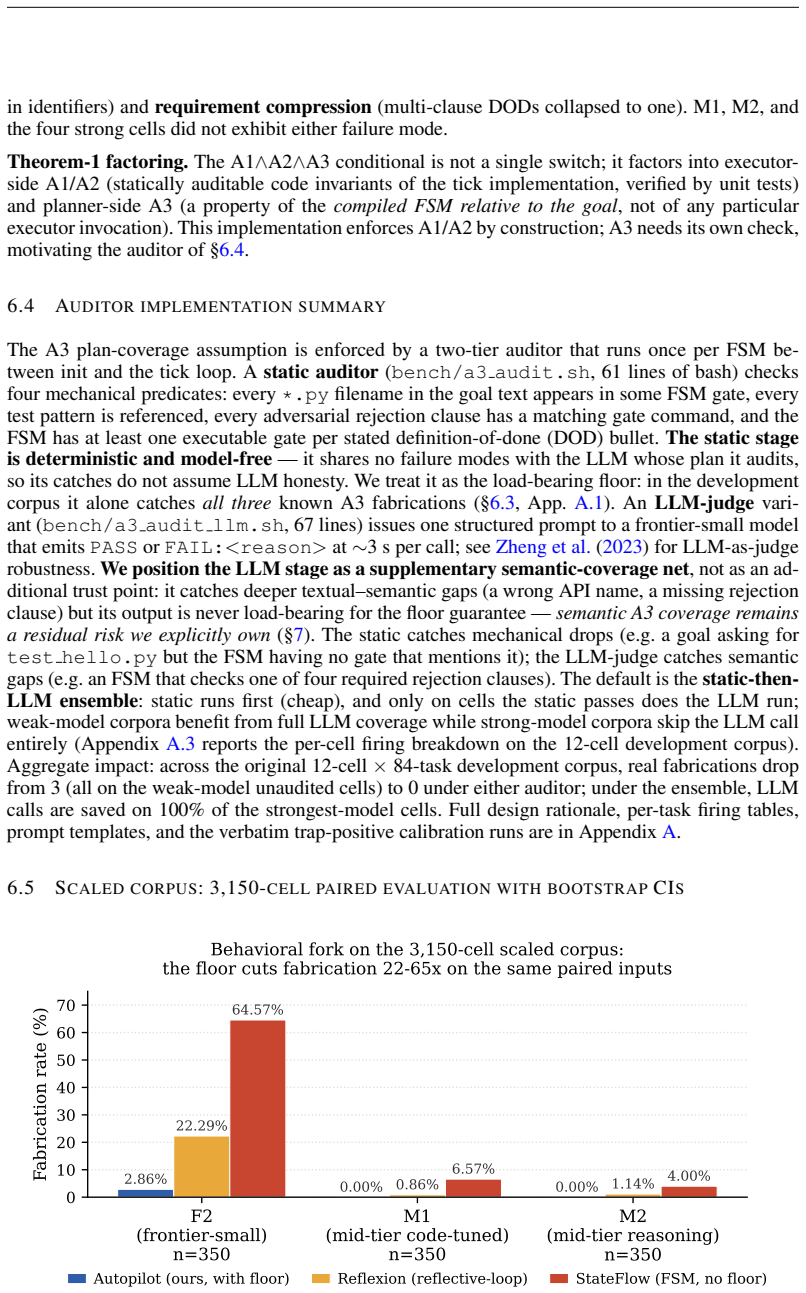
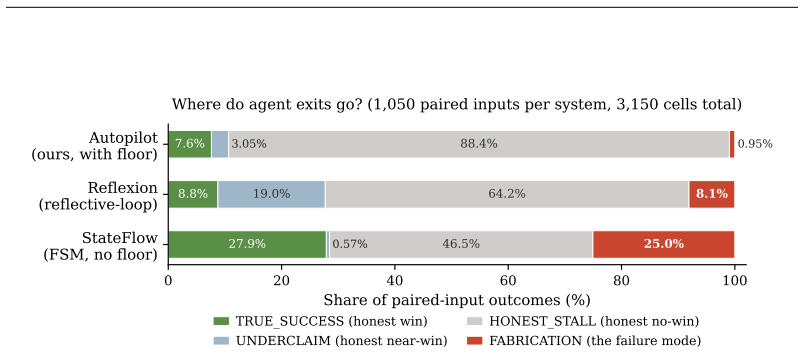
- Fabrication drops to under one percent on the tested corpus, with the largest reduction on hard SWE-bench Lite tasks.
- Weaker models produce zero fabrications across hundreds of paired runs when the mechanism is applied.
Where Pith is reading between the lines
- The constant per-tick cost could allow the same firewall to scale to tasks whose length exceeds current context windows.
- Recoverable honest stalls suggest a natural retry loop that preserves the honesty guarantee.
- The separation of honesty from capability may apply to any sequential decision process that must report completion to downstream systems.
Load-bearing premise
Each gate must correctly verify its own condition and the plan must include every necessary step.
What would settle it
A single execution trace in which the agent reaches termination with a success claim, all gates report passed, yet the goal condition remains unmet.
Figures
read the original abstract
Long-horizon LLM agents are not trusted to run unattended: with no human watching, they confidently report success they never verified. We treat honesty -- bounding what an agent may claim at termination -- as a first-class metric for unattended autonomy, distinct from capability. We present Autopilot, an execution model that makes silent fabricated success structurally impossible rather than merely rarer. Autopilot externalizes all working state into a durable, gated finite-state machine that a scheduler advances one stateless tick at a time; a hard floor forbids any terminal "done" claim whose falsifiable gate did not actually execute and pass. We prove a No-False-Success theorem -- under gate soundness, floor enforcement, and plan coverage, termination implies the goal holds -- whose only trust points are empirically measurable, and show the worst case degrades to an honest stall, never a fabricated success. Because each tick rehydrates only the state machine, per-step context cost is constant in the horizon. Across a 3,150-cell paired corpus (70 tasks $\times$ 3 systems $\times$ 3 models $\times$ 5 seeds, including 50 SWE-bench Lite tasks across 11 OSS repos), Autopilot fabricates on 0.95% of cells [95% CI 0.38--1.62] while Reflexion and StateFlow baselines fabricate on 8.10% [6.48--9.81] and 25.05% [22.48--27.62] respectively. The headline contrast lives in the hard regime: on SWE-bench Lite, the firewall reduces fabrication from 33.7% (StateFlow) to 0.67%, a paired difference of $-33.07$ pp [95% CI $-36.53, -29.73$]. The mechanism is the gate, not the model: all ten Autopilot fabrications come from the strongest model, while two weaker mid-tier models never fabricate across 700 paired cells. The firewall trades coverage for honesty by design -- an honest stall is recoverable; a confident wrong output shipped downstream is not.
Editorial analysis
A structured set of objections, weighed in public.
Referee Report
Summary. The manuscript introduces Goal-Autopilot, an execution model for long-horizon LLM agents that externalizes working state into a durable gated finite-state machine advanced by a scheduler in stateless ticks, with a hard floor preventing terminal 'done' claims unless falsifiable gates have executed and passed. It proves a No-False-Success theorem stating that under gate soundness, floor enforcement, and plan coverage, termination implies the goal holds, with the only trust points being empirically measurable; the worst case is an honest stall. Empirical evaluation on a 3,150-cell paired corpus (including 50 SWE-bench Lite tasks) reports fabrication rates of 0.95% for Autopilot versus 8.10% and 25.05% for Reflexion and StateFlow baselines, with a larger reduction on SWE-bench from 33.7% to 0.67%.
Significance. If the theorem and results hold, the work offers a structural approach to enforcing honesty in unattended agents by design rather than detection, with the explicit degradation to recoverable stalls and constant per-tick context cost as practical strengths. The paired corpus design and reported confidence intervals provide a solid quantitative basis for the fabrication reduction claims.
major comments (1)
- [No-False-Success theorem] No-False-Success theorem: the claim that gate soundness is an empirically measurable trust point without reintroducing fabrication risk is load-bearing, yet the manuscript provides no concrete protocol for independently auditing gate correctness on complex tasks (e.g., verifying a 'tests pass' gate across arbitrary OSS repos in SWE-bench) that avoids reliance on the same execution reliability the firewall is intended to enforce.
minor comments (2)
- Clarify in the methods how the 70 tasks were selected and whether any data exclusion rules were applied to the 3,150-cell corpus.
- Provide additional detail on the exact baseline implementations of Reflexion and StateFlow to support reproducibility of the paired comparisons.
Simulated Author's Rebuttal
We thank the referee for the careful reading and for identifying the load-bearing nature of gate soundness in the No-False-Success theorem. The comment correctly notes that the manuscript does not supply an explicit auditing protocol. We address this below and will revise accordingly.
read point-by-point responses
-
Referee: [No-False-Success theorem] No-False-Success theorem: the claim that gate soundness is an empirically measurable trust point without reintroducing fabrication risk is load-bearing, yet the manuscript provides no concrete protocol for independently auditing gate correctness on complex tasks (e.g., verifying a 'tests pass' gate across arbitrary OSS repos in SWE-bench) that avoids reliance on the same execution reliability the firewall is intended to enforce.
Authors: We agree that an explicit protocol strengthens the claim. Gate soundness is the property that a gate's implementation correctly decides the predicate it is intended to check (e.g., a 'tests pass' gate returns true only when the test harness reports all tests passing). For the SWE-bench Lite gates used in our evaluation, soundness reduces to executing the exact test commands supplied by the benchmark in the repository's declared environment; this is the same procedure the benchmark itself uses to label ground-truth success. The firewall does not assume or enforce execution reliability; it only enforces that termination cannot occur unless the gate has been invoked and returned true. Any execution failure (flaky tests, environment mismatch, etc.) produces a stall rather than a false success, which is the theorem's intended degradation. We will add a new subsection (Section 4.3 in the revision) that (1) formally defines soundness for each gate type appearing in the experiments, (2) gives a step-by-step auditing procedure for the 'tests pass' gate using the SWE-bench harness, and (3) notes that the same external verification can be performed on any new gate before deployment. This protocol is external to the agent loop and therefore does not reintroduce the fabrication vector the firewall targets. revision: yes
Circularity Check
No circularity: theorem is conditional on explicit assumptions; empirical rates reported separately
full rationale
The No-False-Success theorem is stated as holding under the listed assumptions of gate soundness, floor enforcement, and plan coverage, with those assumptions declared the only trust points and empirically measurable. The abstract and provided text contain no equations, self-definitions, or derivations that reduce the theorem or the fabrication-rate claims to their inputs by construction. No self-citations are invoked as load-bearing, no fitted parameters are renamed as predictions, and no ansatz or uniqueness result is smuggled in. The empirical results on the 3,150-cell corpus are presented as direct measurements, independent of the proof. The derivation is therefore self-contained.
Axiom & Free-Parameter Ledger
axioms (3)
- domain assumption gate soundness
- domain assumption floor enforcement
- domain assumption plan coverage
invented entities (2)
-
Autopilot execution model
no independent evidence
-
hard floor
no independent evidence
Reference graph
Works this paper leans on
-
[1]
Constitutional AI: Harmlessness from AI feedback.arXiv preprint arXiv:2212.08073,
Yuntao Bai, Saurav Kadavath, Sandipan Kundu, Amanda Askell, Jackson Kernion, Andy Jones, Anna Chen, Anna Goldie, Azalia Mirhoseini, Cameron McKinnon, et al. Constitutional AI: Harmlessness from AI feedback.arXiv preprint arXiv:2212.08073,
-
[2]
Evaluating large language models trained on code.arXiv preprint arXiv:2107.03374,
9 Mark Chen, Jerry Tworek, Heewoo Jun, Qiming Yuan, Henrique Ponde de Oliveira Pinto, Jared Kaplan, Harri Edwards, Yuri Burda, Nicholas Joseph, Greg Brockman, et al. Evaluating large language models trained on code.arXiv preprint arXiv:2107.03374,
-
[3]
Training verifiers to solve math word problems.arXiv preprint arXiv:2110.14168,
Karl Cobbe, Vineet Kosaraju, Mohammad Bavarian, Mark Chen, Heewoo Jun, Lukasz Kaiser, Matthias Plappert, Jerry Tworek, Jacob Hilton, Reiichiro Nakano, et al. Training verifiers to solve math word problems.arXiv preprint arXiv:2110.14168,
-
[4]
Lei Huang, Weijiang Yu, Weitao Ma, Weihong Zhong, Zhangyin Feng, Haotian Wang, Qianglong Chen, Weihua Peng, Xiaocheng Feng, Bing Qin, and Ting Liu. A survey on hallucination in large language models: Principles, taxonomy, challenges, and open questions.arXiv preprint arXiv:2311.05232,
-
[5]
Understanding the planning of LLM agents: A survey.arXiv preprint arXiv:2402.02716,
Xu Huang, Weiwen Liu, Xiaolong Chen, Xingmei Wang, Hao Wang, Defu Lian, Yasheng Wang, Ruiming Tang, and Enhong Chen. Understanding the planning of LLM agents: A survey.arXiv preprint arXiv:2402.02716,
-
[6]
Language models (mostly) know what they know.arXiv preprint arXiv:2207.05221,
Saurav Kadavath, Tom Conerly, Amanda Askell, Tom Henighan, Dawn Drain, Ethan Perez, Nicholas Schiefer, Zac Hatfield-Dodds, Nova DasSarma, Eli Tran-Johnson, et al. Language models (mostly) know what they know.arXiv preprint arXiv:2207.05221,
-
[7]
Let’s verify step by step.arXiv preprint arXiv:2305.20050,
Hunter Lightman, Vineet Kosaraju, Yura Burda, Harri Edwards, Bowen Baker, Teddy Lee, Jan Leike, John Schulman, Ilya Sutskever, and Karl Cobbe. Let’s verify step by step.arXiv preprint arXiv:2305.20050,
-
[8]
Agentbench: Evaluating llms as agents.arXiv preprint arXiv:2308.03688,
Xiao Liu, Hao Yu, Hanchen Zhang, Yifan Xu, Xuanyu Lei, Hanyu Lai, Yu Gu, Hangliang Ding, Kaiwen Men, Kejuan Yang, et al. Agentbench: Evaluating llms as agents.arXiv preprint arXiv:2308.03688,
-
[9]
GAIA: a benchmark for general AI assistants.arXiv preprint arXiv:2311.12983,
Gr´egoire Mialon, Cl ´ementine Fourrier, Craig Swift, Thomas Wolf, Yann LeCun, and Thomas Scialom. GAIA: a benchmark for general AI assistants.arXiv preprint arXiv:2311.12983,
-
[10]
FActScore: Fine-grained atomic evaluation of factual precision in long form text generation
Sewon Min, Kalpesh Krishna, Xinxi Lyu, Mike Lewis, Wen-tau Yih, Pang Wei Koh, Mohit Iyyer, Luke Zettlemoyer, and Hannaneh Hajishirzi. FActScore: Fine-grained atomic evaluation of factual precision in long form text generation. InProceedings of the 2023 Conference on Empirical Methods in Natural Language Processing,
2023
-
[11]
Patil, Tianjun Zhang, Xin Wang, and Joseph E
10 Shishir G. Patil, Tianjun Zhang, Xin Wang, and Joseph E. Gonzalez. Gorilla: Large language model connected with massive apis.arXiv preprint arXiv:2305.15334,
-
[12]
Toolformer: Language models can teach themselves to use tools.arXiv preprint arXiv:2302.04761,
Timo Schick, Jane Dwivedi-Yu, Roberto Dess`ı, Roberta Raileanu, Maria Lomeli, Luke Zettlemoyer, Nicola Cancedda, and Thomas Scialom. Toolformer: Language models can teach themselves to use tools.arXiv preprint arXiv:2302.04761,
-
[13]
V oyager: An open-ended embodied agent with large language models.arXiv preprint arXiv:2305.16291,
Guanzhi Wang, Yuqi Xie, Yunfan Jiang, Ajay Mandlekar, Chaowei Xiao, Yuke Zhu, Linxi Fan, and Anima Anandkumar. V oyager: An open-ended embodied agent with large language models.arXiv preprint arXiv:2305.16291,
-
[14]
Qingyun Wu, Gagan Bansal, Jieyu Zhang, Yiran Wu, Shaokun Zhang, Erkang Zhu, Beibin Li, Li Jiang, Xiaoyun Zhang, and Chi Wang. AutoGen: Enabling next-gen LLM applications via multi-agent conversations.arXiv preprint arXiv:2308.08155,
-
[15]
Yiran Wu, Tianwei Yue, Shaokun Zhang, Chi Wang, and Qingyun Wu. StateFlow: Enhancing LLM task-solving through state-driven workflows.arXiv preprint arXiv:2403.11322,
-
[16]
Zhiheng Xi, Wenxiang Chen, Xin Guo, Wei He, Yiwen Ding, Boyang Hong, Ming Zhang, Junzhe Wang, Senjie Jin, Enyu Zhou, et al. The rise and potential of large language model based agents: A survey.arXiv preprint arXiv:2309.07864,
-
[17]
Shuyan Zhou, Frank F. Xu, Hao Zhu, Xuhui Zhou, Robert Lo, Abishek Sridhar, Xianyi Cheng, Tianyue Ou, Yonatan Bisk, Daniel Fried, Uri Alon, and Graham Neubig. WebArena: A realistic web environment for building autonomous agents.arXiv preprint arXiv:2307.13854,
discussion (0)
Sign in with ORCID, Apple, or X to comment. Anyone can read and Pith papers without signing in.