Spin-Orbit Torque and Magnetization Switching in 2D Ferromagnetic Devices
Pith reviewed 2026-06-27 08:37 UTC · model grok-4.3
The pith
In 2D FM/NM bilayers local Rashba-Edelstein spin induction inside the ferromagnet generates the fieldlike torque that sets switching current for strong in-plane anisotropy.
A machine-rendered reading of the paper's core claim, the machinery that carries it, and where it could break.
Core claim
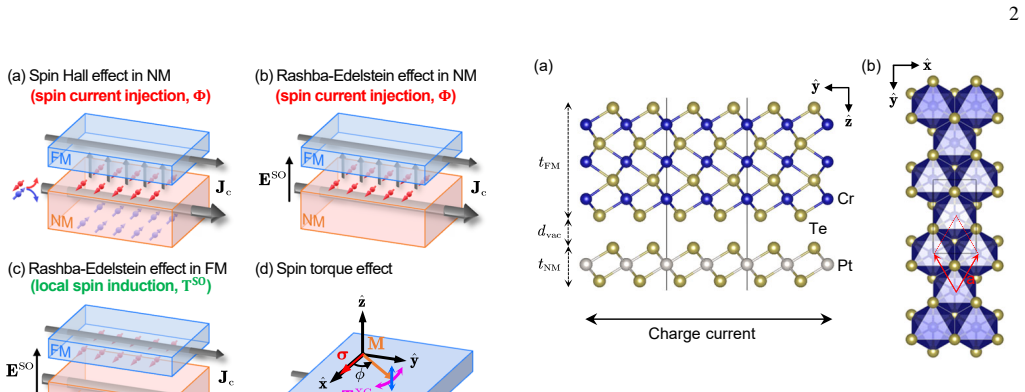
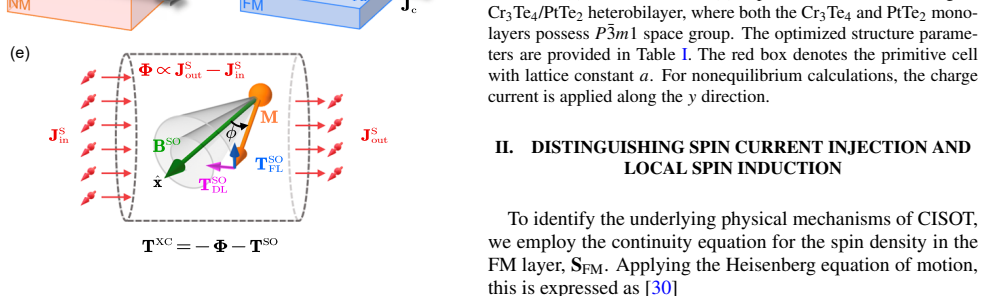
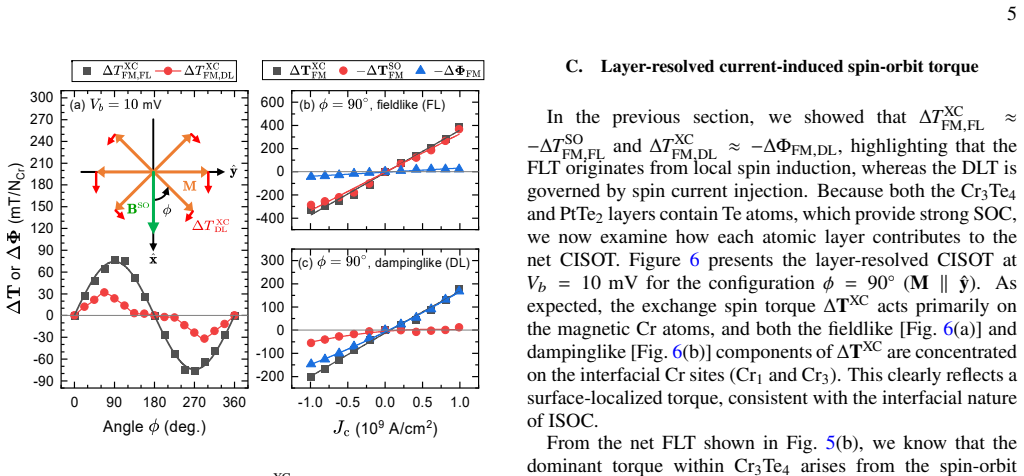
First-principles quantum transport calculations applied to the trigonal Cr3Te4/PtTe2 heterobilayer show that local spin induction resulting from the Rashba-Edelstein effect in the FM layer significantly generates the fieldlike torque, which primarily governs the switching current in systems with strong in-plane magnetic anisotropy. The same calculations indicate that optimization of the spin Hall effect in the NM layer is required for perpendicular magnetic anisotropy based switching.
What carries the argument
First-principles quantum transport calculations that quantify and separate the local Rashba-Edelstein spin induction inside the FM layer from spin-Hall injection from the NM layer, thereby isolating the source of the dominant fieldlike torque.
If this is right
- Maximizing the Rashba effect inside the FM layer reduces the switching current for in-plane anisotropy devices.
- Optimizing the spin Hall effect inside the NM layer is required to lower the switching current for perpendicular anisotropy devices.
- Fieldlike torque generated by local spin induction inside the FM layer sets the switching threshold when in-plane anisotropy is strong.
- The two torque sources can be addressed independently by choice of layer materials and interface quality.
Where Pith is reading between the lines
- Interface engineering focused on the FM layer could improve efficiency specifically for in-plane 2D memory cells.
- Repeating the same transport calculations on other van der Waals pairs would test whether local induction dominance is general or limited to this material combination.
- Thickness-dependent measurements of torque components could isolate the local contribution without changing the heterobilayer composition.
Load-bearing premise
The first-principles calculations correctly separate and quantify the local Rashba-Edelstein contribution versus spin Hall injection without dominant approximations or material-specific fitting that would alter the reported dominance.
What would settle it
An experiment that varies the Rashba strength at the Cr3Te4 interface while keeping the PtTe2 layer fixed and finds that the switching current for in-plane anisotropy devices does not change in proportion to the local induction strength.
Figures
read the original abstract
Current-induced spin-orbit torque has emerged as a powerful technique for manipulating magnetization switching of ferromagnet/nonmagnet (FM/NM) based memory cell. By investigating nonequilibrium spin torque effect in a van der Waals heterobilayer, trigonal $\text{Cr}_{3}\text{Te}_{4}/\text{PtTe}_{2}$, the first-principles quantum transport calculations are applied to determine both local spin induction, resulting from Rashba-Edelstein effect in the FM layer, and spin current injection, flowing from the NM to the FM layer. Our work reveals that local spin induction significantly generates the fieldlike torque, which primarily governs the switching current in systems with strong in-plane magnetic anisotropy. Our work emphasizes the importance of optimizing spin Hall effect in the NM layer for perpendicular magnetic anisotropy (PMA)-based magnetization switching and maximizing the Rashba effect in the FM layer for in-plane magnetic anisotropy (IMA)-based switching.
Editorial analysis
A structured set of objections, weighed in public.
Referee Report
Summary. The manuscript applies first-principles nonequilibrium quantum transport calculations to a trigonal Cr3Te4/PtTe2 van der Waals heterobilayer to separate local spin induction arising from the Rashba-Edelstein effect inside the FM layer from spin-current injection generated by the spin Hall effect in the NM layer. It concludes that the local contribution dominates the fieldlike torque and therefore controls the switching current in devices with strong in-plane magnetic anisotropy, while the NM-layer spin Hall effect should be optimized for perpendicular-anisotropy switching.
Significance. If the reported partitioning of torque channels proves robust, the work would supply concrete design rules for 2D spin-orbit-torque devices, indicating that interfacial Rashba engineering in the ferromagnet is the priority for IMA cells and spin-Hall optimization in the nonmagnet is the priority for PMA cells. No machine-checked proofs, open code, or parameter-free derivations are presented.
major comments (1)
- [Abstract] Abstract and methods (implied): the headline claim that local Rashba-Edelstein induction supplies the dominant fieldlike torque for IMA switching rests on the quantum-transport code cleanly isolating this local channel from the injected spin current. No convergence tests with respect to k-point sampling, exchange-correlation functional, or artificial suppression of the interfacial Rashba term are described, nor is any validation against known limits of the partitioning scheme (layer-resolved spin density or torque operators) provided. This absence directly undermines in the reported dominance.
minor comments (1)
- The abstract states that the heterobilayer is trigonal but supplies no information on the specific stacking registry or interface termination used in the transport calculations.
Simulated Author's Rebuttal
We thank the referee for their careful reading of our manuscript and for highlighting the need for explicit convergence and validation details. We address the major comment below and will strengthen the revised version accordingly.
read point-by-point responses
-
Referee: [Abstract] Abstract and methods (implied): the headline claim that local Rashba-Edelstein induction supplies the dominant fieldlike torque for IMA switching rests on the quantum-transport code cleanly isolating this local channel from the injected spin current. No convergence tests with respect to k-point sampling, exchange-correlation functional, or artificial suppression of the interfacial Rashba term are described, nor is any validation against known limits of the partitioning scheme (layer-resolved spin density or torque operators) provided. This absence directly undermines in the reported dominance.
Authors: We agree that the original manuscript did not explicitly describe convergence tests or additional validation steps for the torque partitioning. In the revised version we will add (i) k-point sampling and exchange-correlation functional convergence data for the nonequilibrium spin densities and torques, (ii) results obtained by artificially suppressing the interfacial Rashba term (via structural or potential modifications), and (iii) layer-resolved spin-density and torque-operator profiles that directly demonstrate the separation between local Rashba-Edelstein induction and injected spin current. These additions will provide the requested support for the reported dominance of the local channel in IMA switching. revision: yes
Circularity Check
First-principles transport calculations yield independent torque partitioning with no circular reduction.
full rationale
The manuscript applies nonequilibrium quantum transport to compute layer-resolved spin densities and torques directly from the heterostructure Hamiltonian. No parameter is fitted to a target observable and then re-used as a prediction; no self-citation supplies a uniqueness theorem or ansatz that the present results depend upon; and the separation of local Rashba-Edelstein versus injected spin-Hall channels is performed by the transport formalism itself rather than by definition. The reported dominance of field-like torque for IMA switching therefore follows from the computed matrix elements, not from any input-output equivalence.
Axiom & Free-Parameter Ledger
Reference graph
Works this paper leans on
-
[1]
𝑑𝑡 𝜃1 𝑑𝑡 𝜙1 # =𝛾 ′ 𝜇0𝐻k
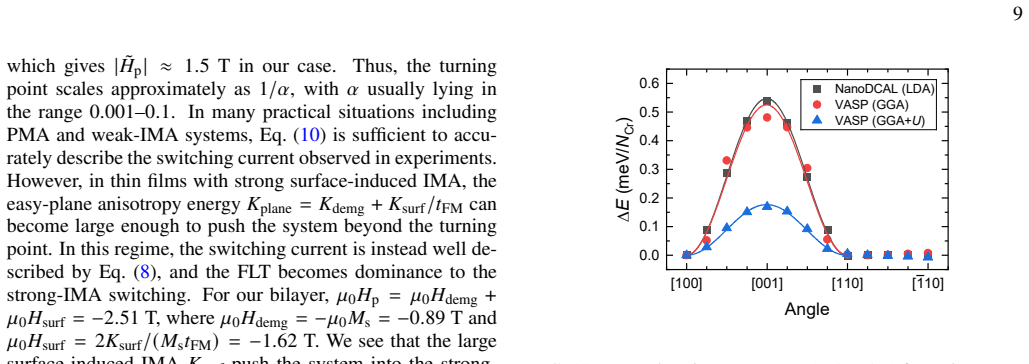
[001] [110] [110] 0.0 0.1 0.2 0.3 0.4 0.5 0.6∆E (meV/NCr) Angle NanoDCAL (LDA) VASP (GGA) VASP (GGA+U) FIG. 11. Magnetic anisotropy energy (MAE,Δ𝐸) for various mag- netization angles in the Cr 3Te4/PtTe2 bilayer. The solid curves are fitted by usingsin 2 𝜃function. For V ASP calculations with GGA+𝑈, 𝑈=4.0eV for Cr atoms is included. ACKNOWLEDGMENT Y .-H.T...
-
[2]
Ramaswamy, J
R. Ramaswamy, J. M. Lee, K. Cai, and H. Yang, Recent ad- vances in spin-orbit torques: Moving towards device applica- tions, Applied Physics Reviews5, 031107 (2018)
2018
-
[3]
Manchon, J
A. Manchon, J. ˇZelezn´y, I. M. Miron, T. Jungwirth, J. Sinova, A. Thiaville, K. Garello, and P. Gambardella, Current-induced spin-orbit torques in ferromagnetic and antiferromagnetic sys- tems, Reviews of Modern Physics91, 035004 (2019)
2019
-
[4]
Sinova, D
J. Sinova, D. Culcer, Q. Niu, N. A. Sinitsyn, T. Jungwirth, and A. H. MacDonald, Universal Intrinsic Spin Hall Effect, Physi- cal Review Letters92, 126603 (2004)
2004
-
[5]
Sinova, S
J. Sinova, S. O. Valenzuela, J. Wunderlich, C. Back, and T. Jungwirth, Spin hall effects, Reviews of Modern Physics87, 1213–1260 (2015)
2015
-
[6]
Liu, C.-F
L. Liu, C.-F. Pai, Y . Li, H. W. Tseng, D. C. Ralph, and R. A. Buhrman, Spin-torque switching with the giant spin hall effect of tantalum, Science336, 555–558 (2012)
2012
-
[7]
L. Liu, O. J. Lee, T. J. Gudmundsen, D. C. Ralph, and R. A. Buhrman, Current-Induced Switching of Perpendicularly Mag- netized Magnetic Layers Using Spin Torque from the Spin Hall Effect, Physical Review Letters109, 096602 (2012)
2012
-
[8]
Garello, I
K. Garello, I. M. Miron, C. O. Avci, F. Freimuth, Y . Mokrousov, S. Bl ¨ugel, S. Auffret, O. Boulle, G. Gaudin, and P. Gam- bardella, Symmetry and magnitude of spin–orbit torques in ferromagnetic heterostructures, Nature Nanotechnology8, 587–593 (2013)
2013
-
[9]
Edelstein, Spin polarization of conduction electrons induced by electric current in two-dimensional asymmetric electron sys- tems, Solid State Communications73, 233–235 (1990)
V . Edelstein, Spin polarization of conduction electrons induced by electric current in two-dimensional asymmetric electron sys- tems, Solid State Communications73, 233–235 (1990)
1990
-
[10]
I. M. Miron, K. Garello, G. Gaudin, P.-J. Zermatten, M. V . Costache, S. Auffret, S. Bandiera, B. Rodmacq, A. Schuhl, and P. Gambardella, Perpendicular switching of a single ferromag- netic layer induced by in-plane current injection, Nature476, 189 (2011)
2011
-
[11]
K.-S. Lee, D. Go, A. Manchon, P. M. Haney, M. D. Stiles, H.- W. Lee, and K.-J. Lee, Angular dependence of spin-orbit spin- transfer torques, Physical Review B91, 144401 (2015)
2015
-
[12]
Nakayama, Y
H. Nakayama, Y . Kanno, H. An, T. Tashiro, S. Haku, A. Nomura, and K. Ando, Rashba-Edelstein Magnetoresis- tance in Metallic Heterostructures, Physical Review Letters 117, 116602 (2016)
2016
-
[13]
V . P. Amin, P. M. Haney, and M. D. Stiles, Interfacial spin–orbit torques, Journal of Applied Physics128, 151101 (2020)
2020
-
[14]
Huang, G
B. Huang, G. Clark, E. Navarro-Moratalla, D. R. Klein, R. Cheng, K. L. Seyler, D. Zhong, E. Schmidgall, M. A. McGuire, D. H. Cobden, W. Yao, D. Xiao, P. Jarillo-Herrero, and X. Xu, Layer-dependent ferromagnetism in a van der waals crystal down to the monolayer limit, Nature546, 270–273 (2017)
2017
-
[15]
Y . Deng, Y . Yu, Y . Song, J. Zhang, N. Z. Wang, Z. Sun, Y . Yi, Y . Z. Wu, S. Wu, J. Zhu, J. Wang, X. H. Chen, and Y . Zhang, Gate-tunable room-temperature ferromagnetism in two-dimensional Fe3GeTe2, Nature563, 94–99 (2018)
2018
-
[16]
Z. Fei, B. Huang, P. Malinowski, W. Wang, T. Song, J. Sanchez, W. Yao, D. Xiao, X. Zhu, A. F. May, W. Wu, D. H. Cob- den, J.-H. Chu, and X. Xu, Two-dimensional itinerant ferro- magnetism in atomically thin Fe 3GeTe2, Nature Materials17, 778–782 (2018)
2018
-
[17]
Alghamdi, M
M. Alghamdi, M. Lohmann, J. Li, P. R. Jothi, Q. Shao, M. Aldosary, T. Su, B. P. T. Fokwa, and J. Shi, Highly effi- cient spin–orbit torque and switching of layered ferromagnet Fe3GeTe2, Nano Letters19, 4400–4405 (2019)
2019
-
[18]
H. Li, L. Wang, J. Chen, T. Yu, L. Zhou, Y . Qiu, H. He, F. Ye, I. K. Sou, and G. Wang, Molecular beam epitaxy grown Cr2Te3 thin films with tunable curie temperatures for spintronic de- vices, ACS Applied Nano Materials2, 6809–6817 (2019)
2019
-
[19]
Yamaguchi and T
M. Yamaguchi and T. Hashimoto, Magnetic properties of Cr3Te4 in ferromagnetic region, Journal of the Physical Soci- ety of Japan32, 635–638 (1972)
1972
-
[20]
R. Chua, J. Zhou, X. Yu, W. Yu, J. Gou, R. Zhu, L. Zhang, M. Liu, M. B. H. Breese, W. Chen, K. P. Loh, Y . P. Feng, M. Yang, Y . L. Huang, and A. T. S. Wee, Room temperature ferromagnetism of monolayer chromium telluride with perpen- dicular magnetic anisotropy, Advanced Materials33, 2103360 (2021)
2021
-
[21]
Goswami, N
A. Goswami, N. Ng, E. Yakubu, A. M. Abeykoon, and S. Guch- hait, Critical behavior in monoclinic Cr 3Te4, Physical Review B109, 054413 (2024)
2024
-
[22]
Matsuoka, S
H. Matsuoka, S. Kajihara, T. Nomoto, Y . Wang, M. Hirayama, R. Arita, Y . Iwasa, and M. Nakano, Band-driven switching of magnetism in a van der waals magnetic semimetal, Science Ad- vances10, eadk1415 (2024)
2024
-
[23]
Dolui, M
K. Dolui, M. D. Petrovi ´c, K. Zollner, P. Plech ´aˇc, J. Fabian, 13 and B. K. Nikoli ´c, Proximity spin–orbit torque on a two- dimensional magnet within van der Waals heterostruc- ture: Current-driven antiferromagnet-to-ferromagnet reversible nonequilibrium phase transition in bilayer CrI 3, Nano Letters 20, 2288–2295 (2020)
2020
-
[24]
I. Shin, W. J. Cho, E. An, S. Park, H. Jeong, S. Jang, W. J. Baek, S. Y . Park, D. Yang, J. H. Seo, G. Kim, M. N. Ali, S. Choi, H. Lee, J. S. Kim, S. D. Kim, and G. Lee, Spin–orbit torque switching in an all-van der Waals heterostructure, Advanced Materials34, 2101730 (2022)
2022
-
[25]
P. M. Haney, H.-W. Lee, K.-J. Lee, A. Manchon, and M. D. Stiles, Current-induced torques and interfacial spin-orbit cou- pling, Physical Review B88, 214417 (2013)
2013
-
[26]
Mahfouzi, R
F. Mahfouzi, R. Mishra, P.-H. Chang, H. Yang, and N. Kioussis, Microscopic origin of spin-orbit torque in ferromagnetic het- erostructures: A first-principles approach, Physical Review B 101, 060405 (2020)
2020
-
[27]
H. Xu, J. Wei, H. Zhou, J. Feng, T. Xu, H. Du, C. He, Y . Huang, J. Zhang, Y . Liu, H. Wu, C. Guo, X. Wang, Y . Guang, H. Wei, Y . Peng, W. Jiang, G. Yu, and X. Han, High spin Hall conductiv- ity in large-area type-II Dirac semimetal PtTe2, Advanced Ma- terials32, 2000513 (2020)
2020
-
[28]
W. Lv, Z. Jia, B. Wang, Y . Lu, X. Luo, B. Zhang, Z. Zeng, and Z. Liu, Electric-field control of spin–orbit torques in WS2/permalloy bilayers, ACS Applied Materials Interfaces10, 2843–2849 (2018)
2018
-
[29]
Kim, K.-J
K.-W. Kim, K.-J. Lee, J. Sinova, H.-W. Lee, and M. D. Stiles, Spin-orbit torques from interfacial spin-orbit coupling for vari- ous interfaces, Physical Review B96, 104438 (2017)
2017
-
[30]
Y . Zhu, X. Kong, T. D. Rhone, and H. Guo, Systematic search for two-dimensional ferromagnetic materials, Physical Review Materials2, 081001 (2018)
2018
-
[31]
Huang, Y .-H
B.-H. Huang, Y .-H. Fu, C.-C. Kaun, and Y .-H. Tang, Determin- ing perpendicular magnetic anisotropy in Fe/MgO/Fe magnetic tunnel junction: A DFT-based spin–orbit torque method, Jour- nal of Magnetism and Magnetic Materials585, 171098 (2023)
2023
-
[32]
D. Go, F. Freimuth, J.-P. Hanke, F. Xue, O. Gomonay, K.-J. Lee, S. Bl ¨ugel, P. M. Haney, H.-W. Lee, and Y . Mokrousov, Theory of current-induced angular momentum transfer dynam- ics in spin-orbit coupled systems, Physical Review Research2, 033401 (2020)
2020
-
[33]
Freimuth, S
F. Freimuth, S. Bl¨ugel, and Y . Mokrousov, Spin-orbit torques in co/pt(111) and mn/w(001) magnetic bilayers from first princi- ples, Physical Review B90, 174423 (2014)
2014
-
[34]
Kresse and J
G. Kresse and J. Furthm ¨uller, Efficient iterative schemes for ab initiototal-energy calculations using a plane-wave basis set, Physical Review B54, 11169 (1996)
1996
-
[35]
Kresse and D
G. Kresse and D. Joubert, From ultrasoft pseudopotentials to the projector augmented-wave method, Physical Review B59, 1758 (1999)
1999
-
[36]
J. P. Perdew, K. Burke, and M. Ernzerhof, Generalized gradi- ent approximation made simple, Physical Review Letters77, 3865–3868 (1996)
1996
-
[37]
Cococcioni and S
M. Cococcioni and S. de Gironcoli, Linear response approach to the calculation of the effective interaction parameters in the LDA+Umethod, Physical Review B71, 035105 (2005)
2005
-
[38]
J. c. v. Klimeˇs, D. R. Bowler, and A. Michaelides, Van der waals density functionals applied to solids, Physical Review B83, 195131 (2011)
2011
-
[39]
Taylor, H
J. Taylor, H. Guo, and J. Wang,Ab initiomodeling of quantum transport properties of molecular electronic devices, Physical Review B63, 245407 (2001)
2001
-
[40]
Waldron, L
D. Waldron, L. Liu, and H. Guo,Ab initiosimulation of mag- netic tunnel junctions, Nanotechnology18, 424026 (2007)
2007
-
[41]
Y . Ke, K. Xia, and H. Guo, Disorder scattering in magnetic tunnel junctions: Theory of nonequilibrium vertex correction, Physical Review Letters100, 166805 (2008)
2008
-
[42]
J. P. Perdew and A. Zunger, Self-interaction correction to density-functional approximations for many-electron systems, Physical Review B23, 5048 (1981)
1981
-
[43]
Huang, Y .-F
B.-H. Huang, Y .-F. Lai, and Y .-H. Tang, Validity of DFT- based spin-orbit torque calculation for perpendicular magnetic anisotropy in iron thin films, AIP Advances13, 015034 (2023)
2023
-
[44]
S. Datta,Electronic Transport in Mesoscopic Systems, Cam- bridge Studies in Semiconductor Physics and Microelectronic Engineering (Cambridge University Press, Cambridge, United Kingdom, 1995)
1995
-
[45]
J. Z. Sun, Spin-current interaction with a monodomain mag- netic body: A model study, Physical Review B62, 570 (2000)
2000
-
[46]
J. Xiao, A. Zangwill, and M. D. Stiles, Macrospin models of spin transfer dynamics, Physical Review B72, 014446 (2005)
2005
-
[47]
M. Tian, Y . Zhu, M. Jalali, W. Jiang, J. Liang, Z. Huang, Q. Chen, Z. Zeng, and Y . Zhai, Two-dimensional van der waals materials for spin-orbit torque applications, Frontiers in Nan- otechnology3, 1 (2021)
2021
-
[48]
A. A. Timopheev, R. Sousa, M. Chshiev, L. D. Buda-Prejbeanu, and B. Dieny, Respective influence of in-plane and out-of-plane spin-transfer torques in magnetization switching of perpendic- ular magnetic tunnel junctions, Physical Review B92, 104430 (2015)
2015
-
[49]
Fukami, T
S. Fukami, T. Anekawa, C. Zhang, and H. Ohno, A spin–orbit torque switching scheme with collinear magnetic easy axis and current configuration, Nature Nanotechnology11, 621–625 (2016)
2016
-
[50]
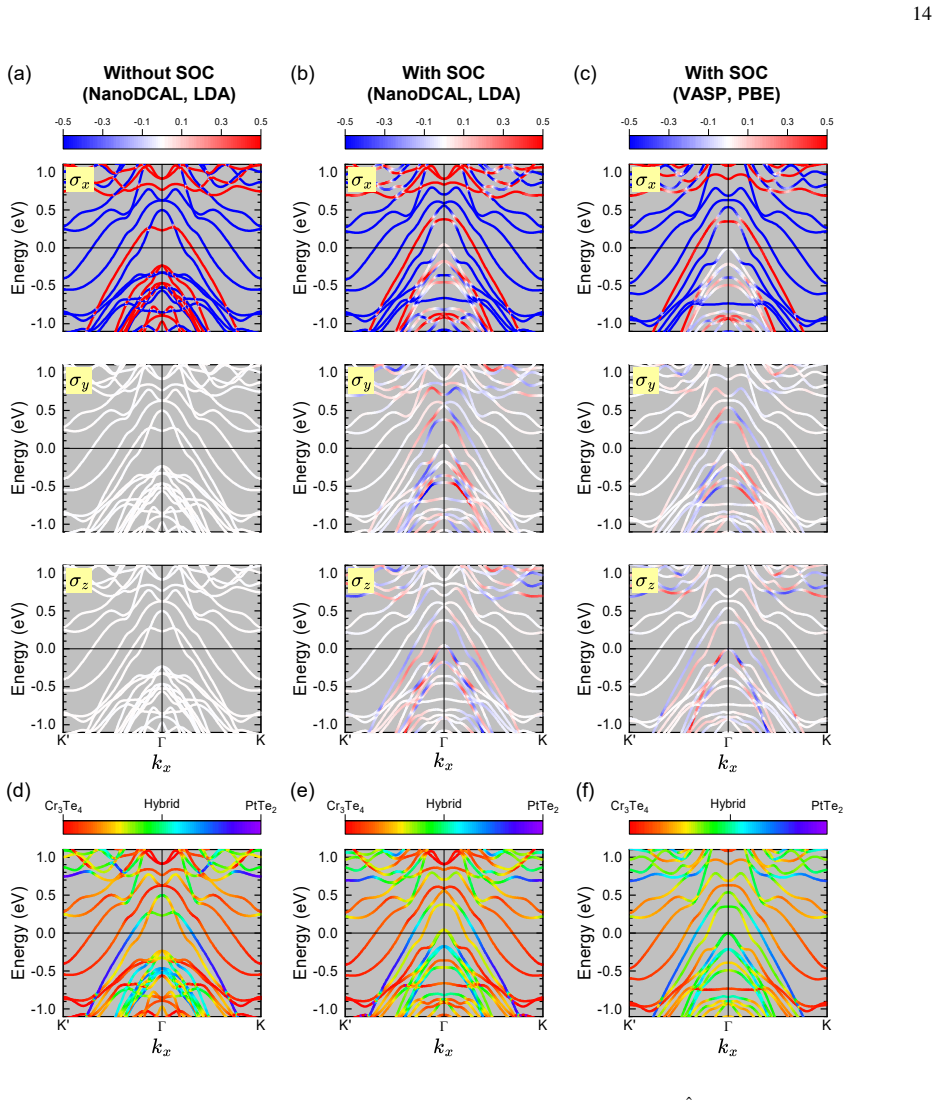
Y . B. Bazaliy, B. A. Jones, and S.-C. Zhang, Current- induced magnetization switching in small domains of different anisotropies, Physical Review B69, 094421 (2004). 14 Without SOC (NanoDCAL, LDA) With SOC (NanoDCAL, LDA) (a) (b) (d) (e) (c) With SOC (VASP, PBE) (f) -1.0 -0.5 0.0 0.5 1.0 -1.0 -0.5 0.0 0.5 1.0 -1.0 -0.5 0.0 0.5 1.0 -1.0 -0.5 0.0 0.5 1.0 E...
2004
discussion (0)
Sign in with ORCID, Apple, or X to comment. Anyone can read and Pith papers without signing in.