Perspective: The Physics of Active Solids -- From Hamiltonians to Active Matter Models
Pith reviewed 2026-06-27 08:04 UTC · model grok-4.3
The pith
Active Hamiltonian models serve as equilibrium references to map pathways into non-equilibrium dense active solids.
A machine-rendered reading of the paper's core claim, the machinery that carries it, and where it could break.
Core claim
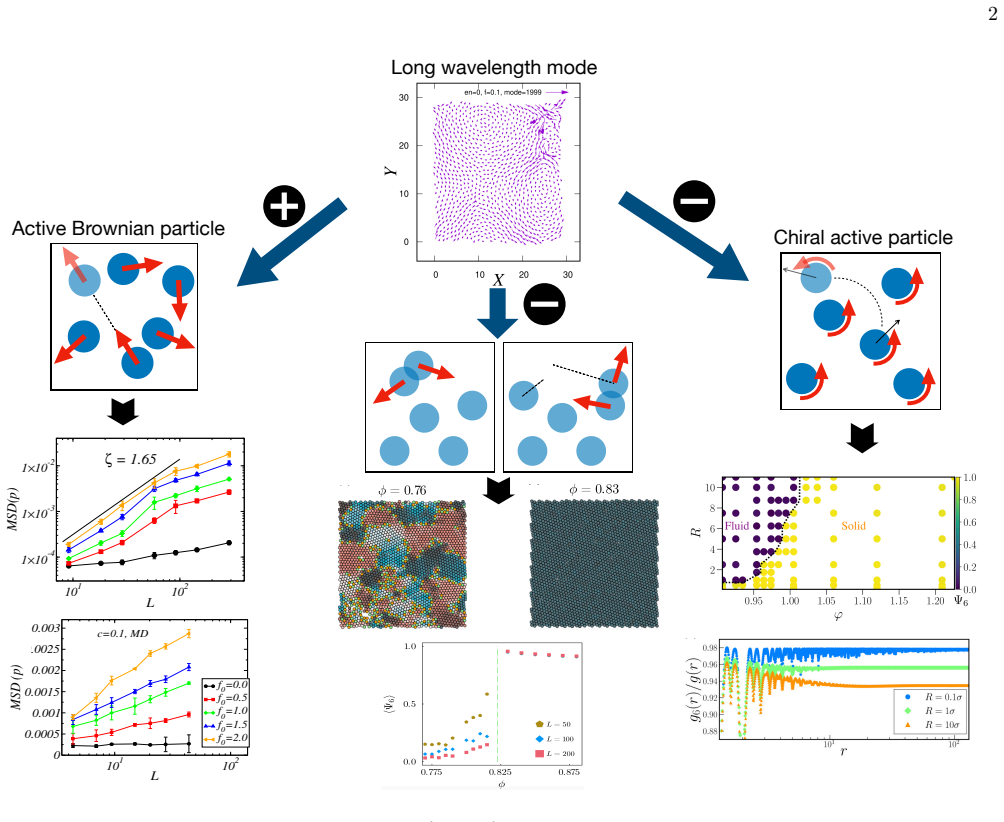
By developing active Hamiltonian models as equilibrium reference frameworks, pathways can be mapped toward non-equilibrium active systems. This strategy elucidates both the correspondence between activity-induced annealing and annealing via oscillatory shear and the enhanced Mermin-Wagner-Hohenberg fluctuations, which likely arise from strong coupling between spatially random active forces and long-wavelength density (phonon) modes.
What carries the argument
The active Hamiltonian formalism, which supplies equilibrium reference frameworks for systematic mapping to non-equilibrium active systems.
If this is right
- The activity-oscillatory shear correspondence must be checked across many different systems to establish whether it is universal.
- The enhanced fluctuations should be traceable to the coupling of spatially random active forces with long-wavelength density modes.
- Comparative studies of oscillatory shear applied to both active and passive solids will expose the large-scale emergent physics.
- Work on chiral active matter will help place the overall mapping hypothesis on firmer ground.
Where Pith is reading between the lines
- If the mapping works, it could supply a template for building effective models of other dense non-equilibrium systems that start from equilibrium Hamiltonians.
- Confirmation of the force-mode coupling mechanism would allow predictions of fluctuation spectra in new active materials before experiments are run.
- The proposed roadmap implies that failures of the correspondence in specific systems would point to which approximations in the Hamiltonian construction need revision.
Load-bearing premise
Active Hamiltonian models built as equilibrium references can be extended or mapped to capture the essential non-equilibrium physics of dense active solids without uncontrolled approximations that would invalidate the fluctuation and correspondence claims.
What would settle it
A simulation or calculation in a controlled active solid that finds no correspondence between activity-driven annealing and oscillatory-shear annealing, or that shows the enhanced long-wavelength fluctuations are unrelated to coupling between random active forces and phonon modes.
Figures
read the original abstract
The physics of active matter, wherein constituent particles consume energy to generate autonomous motion, has revolutionized non-equilibrium statistical mechanics. While a large body of work has successfully elucidated the behavior of dilute active systems, the dense regime -- characterized by ``active glasses and active solids'' -- presents profound challenges that defy conventional theoretical frameworks. Recent observations reveal two striking features in these dense systems: an apparent enhancement of Mermin-Wagner-Hohenberg (MWH) fluctuations leading to anomalous long-wavelength density fluctuations, and a remarkable correspondence between activity-induced annealing and annealing via oscillatory shear. In this perspective article, we propose a novel approach toward a deeper understanding of dense active matter: by developing active Hamiltonian models as equilibrium reference frameworks, we map out pathways toward non-equilibrium active systems. This strategy allows us to elucidate both the correspondence between driven and active systems and the enhanced MWH fluctuations, which likely arise from a strong coupling between spatially random active forces and long-wavelength density (phonon) modes. We outline a comprehensive roadmap employing complementary approaches, including the active Hamiltonian formalism, comparative studies of oscillatory shear in active and passive solids, and investigations of chiral active matter. Establishing this activity-oscillatory shear correspondence across diverse systems is essential to demonstrate its universality, reveal the underlying large-scale emergent physics, and place our hypothesis on a firmer theoretical ground.
Editorial analysis
A structured set of objections, weighed in public.
Referee Report
Summary. This perspective article proposes developing active Hamiltonian models as equilibrium reference frameworks to map pathways toward understanding non-equilibrium dense active solids. It focuses on explaining two observed features: an apparent enhancement of Mermin-Wagner-Hohenberg fluctuations and a correspondence between activity-induced annealing and annealing via oscillatory shear. The authors suggest these arise from coupling between random active forces and phonon modes, and outline a roadmap using the active Hamiltonian approach, comparative oscillatory shear studies, and chiral active matter to establish universality.
Significance. If the proposed mappings can be constructed without uncontrolled approximations, the framework could provide a systematic bridge between equilibrium statistical mechanics and active matter, offering a route to explain anomalous long-wavelength fluctuations and driven-active correspondences in dense systems. The emphasis on complementary approaches and universality testing is a constructive contribution to the field, though the perspective presents hypotheses rather than completed derivations or data.
major comments (2)
- [Abstract] Abstract (paragraph beginning 'In this perspective article'): The assertion that the active Hamiltonian strategy 'allows us to elucidate both the correspondence between driven and active systems and the enhanced MWH fluctuations' is load-bearing for the central proposal but is not supported by any explicit model, mapping, or even schematic Hamiltonian in the manuscript, leaving the claim programmatic rather than demonstrable.
- [Abstract] Abstract: The hypothesis that enhanced MWH fluctuations 'likely arise from a strong coupling between spatially random active forces and long-wavelength density (phonon) modes' is presented without reference to a specific active Hamiltonian or perturbative calculation, making it impossible to assess whether the proposed reference framework can capture this mechanism without additional uncontrolled approximations.
Simulated Author's Rebuttal
We thank the referee for the careful reading and constructive comments. We agree that the abstract overstates the current status of the proposed framework and will revise it to better reflect the perspective and roadmap character of the manuscript.
read point-by-point responses
-
Referee: [Abstract] Abstract (paragraph beginning 'In this perspective article'): The assertion that the active Hamiltonian strategy 'allows us to elucidate both the correspondence between driven and active systems and the enhanced MWH fluctuations' is load-bearing for the central proposal but is not supported by any explicit model, mapping, or even schematic Hamiltonian in the manuscript, leaving the claim programmatic rather than demonstrable.
Authors: We accept this criticism. The manuscript is a perspective outlining a proposed strategy and research roadmap rather than a completed derivation. We will revise the abstract to replace 'allows us to elucidate' with phrasing such as 'we propose that this strategy can provide a pathway toward elucidating', making explicit that the mappings remain to be constructed. revision: yes
-
Referee: [Abstract] Abstract: The hypothesis that enhanced MWH fluctuations 'likely arise from a strong coupling between spatially random active forces and long-wavelength density (phonon) modes' is presented without reference to a specific active Hamiltonian or perturbative calculation, making it impossible to assess whether the proposed reference framework can capture this mechanism without additional uncontrolled approximations.
Authors: We agree that the hypothesis is stated without an explicit model or calculation. In revision we will qualify the statement to read 'we hypothesize that these fluctuations may arise from...' and note that testing this mechanism within active Hamiltonian models is one of the open questions the roadmap is intended to address. No new calculation will be added, as the article remains a perspective. revision: yes
Circularity Check
No significant circularity in perspective proposal
full rationale
The manuscript is a perspective article outlining a proposed research program (active Hamiltonian models as equilibrium references, comparative shear studies, chiral extensions) rather than presenting a completed derivation, quantitative mapping, or set of equations. The abstract and text describe a hypothesis about future utility for explaining driven-active correspondence and MWH fluctuations but contain no equations, fitted parameters, self-citations used to justify uniqueness, or reductions of predictions to inputs by construction. The central claim remains a forward-looking suggestion without internal circular steps.
Axiom & Free-Parameter Ledger
Reference graph
Works this paper leans on
-
[1]
(Fig. 1, middle panel). Chiral active particles offer a versatile platform where this coupling can be contin- 3 Yield point /uni03B3y=0.078 Random activity driving Oscillatory shear driving Memory formation Memory formation Long wavelength mode Nature Physics | Volume 21 | February 2025 | 253–261 254 Article https:/ /doi.org/10.1038/s41567-024-02724-5 tim...
-
[2]
Ramaswamy, Annu
S. Ramaswamy, Annu. Rev. Condens. Matter Phys.1, 323 (2010)
2010
-
[3]
M. C. Marchetti, J.-F. Joanny, S. Ramaswamy, T. B. Liverpool, J. Prost, M. Rao, and R. A. Simha, Reviews of modern physics85, 1143 (2013)
2013
-
[4]
Palacci, S
J. Palacci, S. Sacanna, A. P. Steinberg, D. J. Pine, and P. M. Chaikin, Science339, 936 (2013)
2013
-
[5]
Vicsek, A
T. Vicsek, A. Czir´ ok, E. Ben-Jacob, I. Cohen, and O. Shochet, Physical review letters75, 1226 (1995)
1995
-
[6]
Ballerini, N
M. Ballerini, N. Cabibbo, R. Candelier, A. Cavagna, E. Cisbani, I. Giardina, V. Lecomte, A. Orlandi, G. Parisi, A. Procaccini,et al., Proceedings of the na- tional academy of sciences105, 1232 (2008)
2008
-
[7]
Toner and Y
J. Toner and Y. Tu, Physical review E58, 4828 (1998)
1998
-
[8]
B. R. Parry, I. V. Surovtsev, M. T. Cabeen, C. S. O’hern, E. R. Dufresne, and C. Jacobs-Wagner, Cell156, 183 (2014)
2014
-
[9]
Gravish, G
N. Gravish, G. Gold, A. Zangwill, M. A. Goodisman, and D. I. Goldman, Soft matter11, 6552 (2015)
2015
-
[10]
T. E. Angelini, E. Hannezo, X. Trepat, M. Marquez, J. J. Fredberg, and D. A. Weitz, Proceedings of the National Academy of Sciences108, 4714 (2011)
2011
-
[11]
Dauchot, G
O. Dauchot, G. Marty, and G. Biroli, Physical review letters95, 265701 (2005)
2005
-
[12]
Dreyfus, J
R. Dreyfus, J. Baudry, M. L. Roper, M. Fermigier, H. A. Stone, and J. Bibette, Nature437, 862 (2005)
2005
-
[13]
S. C. Takatori and K. K. Mandadapu, arXiv preprint arXiv:2003.05618 (2020)
arXiv 2003
-
[14]
Mandal, P
R. Mandal, P. J. Bhuyan, M. Rao, and C. Dasgupta, Soft Matter12, 6268 (2016)
2016
-
[15]
E. Zhou, X. Trepat, C. Park, G. Lenormand, M. Oliver, S. Mijailovich, C. Hardin, D. Weitz, J. Butler, and J. Fredberg, Proceedings of the National Academy of Sci- ences106, 10632 (2009)
2009
-
[16]
Berthier and J
L. Berthier and J. Kurchan, Nature Physics9, 310 (2013)
2013
-
[17]
Berthier, Physical review letters112, 220602 (2014)
L. Berthier, Physical review letters112, 220602 (2014)
2014
-
[18]
Fodor, C
´E. Fodor, C. Nardini, M. E. Cates, J. Tailleur, P. Visco, and F. Van Wijland, Physical review letters117, 038103 (2016)
2016
-
[19]
D. Loi, S. Mossa, and L. F. Cugliandolo, Physical Review E—Statistical, Nonlinear, and Soft Matter Physics77, 051111 (2008)
2008
-
[20]
S. K. Nandi, R. Mandal, P. J. Bhuyan, C. Dasgupta, M. Rao, and N. S. Gov, Proceedings of the National Academy of Sciences115, 7688 (2018)
2018
-
[21]
R. Ni, M. A. C. Stuart, and M. Dijkstra, Nature com- munications4, 2704 (2013)
2013
-
[22]
Berthier, E
L. Berthier, E. Flenner, and G. Szamel, The Journal of chemical physics150(2019)
2019
-
[23]
K. Paul, A. Mutneja, S. K. Nandi, and S. Karmakar, Proceedings of the National Academy of Sciences120, e2217073120 (2023)
2023
-
[24]
Chatterjee, M
R. Chatterjee, M. Adhikari, and S. Karmakar, Nature Communications17, 4506 (2026)
2026
-
[25]
P. C. Hohenberg, Physical Review158, 383 (1967)
1967
-
[26]
N. D. Mermin and H. Wagner, Physical review letters17, 1133 (1966)
1966
-
[27]
N. D. Mermin, Physical review176, 250 (1968)
1968
-
[28]
Jancovici, Physical Review Letters19, 20 (1967)
B. Jancovici, Physical Review Letters19, 20 (1967)
1967
-
[29]
S. Dey, A. Bhattacharya, and S. Karmakar, Nature Com- munications16, 5498 (2025)
2025
-
[30]
Galliano, M
L. Galliano, M. E. Cates, and L. Berthier, Physical Re- view Letters131, 047101 (2023)
2023
-
[31]
Kuroda, T
Y. Kuroda, T. Kawasaki, and K. Miyazaki, Physical Review Research7, L012048 (2025)
2025
-
[32]
Sharma and S
R. Sharma and S. Karmakar, Nature Physics21, 253 (2025)
2025
-
[33]
Goswami, G
Y. Goswami, G. Shivashankar, and S. Sastry, Nature Physics21, 817 (2025)
2025
-
[34]
Løland Bore, M
S. Løland Bore, M. Schindler, K.-D. Nguyen Thu Lam, E. Bertin, and O. Dauchot, Journal of Statistical Me- chanics: Theory and Experiment2016, 033305 (2016)
2016
-
[35]
Casiulis, M
M. Casiulis, M. Tarzia, L. F. Cugliandolo, and O. Dau- chot, Physical Review Letters124, 198001 (2020)
2020
-
[36]
Cavagna, A
A. Cavagna, A. Cimarelli, I. Giardina, G. Parisi, R. San- tagati, F. Stefanini, and M. Viale, Proceedings of the National Academy of Sciences107, 11865 (2010)
2010
- [37]
-
[38]
M. Casiulis, M. Tarzia, L. F. Cugliandolo, and O. Dau- chot, arXiv preprint arXiv:1912.09202 (2019)
arXiv 1912
-
[39]
Leimkuhler and S
B. Leimkuhler and S. Reich,Simulating hamiltonian dy- namics, 14 (Cambridge university press, 2004)
2004
-
[40]
Bhattacharya, J
A. Bhattacharya, J. Horbach, and S. Karmakar, Physical Review E111, 015429 (2025)
2025
-
[41]
T. H. Tan, A. Mietke, J. Li, Y. Chen, H. Higinbotham, P. J. Foster, S. Gokhale, J. Dunkel, and N. Fakhri, Na- ture607, 287 (2022)
2022
-
[42]
Mallikarjun and A
R. Mallikarjun and A. Pal, Physica A: Statistical Me- chanics and its Applications622, 128821 (2023)
2023
-
[43]
Karmakar, E
S. Karmakar, E. Lerner, and I. Procaccia, Physical Re- view E—Statistical, Nonlinear, and Soft Matter Physics 82, 026105 (2010)
2010
-
[44]
Mungan, D
M. Mungan, D. Kumar, S. Patinet, and D. Vandem- broucq, Physical Review Letters134, 178203 (2025)
2025
-
[45]
Chatterjee, S
R. Chatterjee, S. Karamkar, M. Mungan, and D. Van- dembroucq, New Journal of Physics28, 044401 (2026)
2026
-
[46]
Mungan, E
M. Mungan, E. Cl´ ement, D. Vandembroucq, and S. Sas- try, Annual Review of Condensed Matter Physics17, 207 (2026)
2026
- [47]
-
[48]
M. Wei, M. Y. Ben Zion, and O. Dauchot, Physical Review Letters131, 018301 (2023)
2023
discussion (0)
Sign in with ORCID, Apple, or X to comment. Anyone can read and Pith papers without signing in.