A post-selected quantum model of cosmic acceleration
Pith reviewed 2026-06-27 09:02 UTC · model grok-4.3
The pith
Cosmic acceleration emerges from quantum post-selection without dark energy or modified gravity.
A machine-rendered reading of the paper's core claim, the machinery that carries it, and where it could break.
Core claim
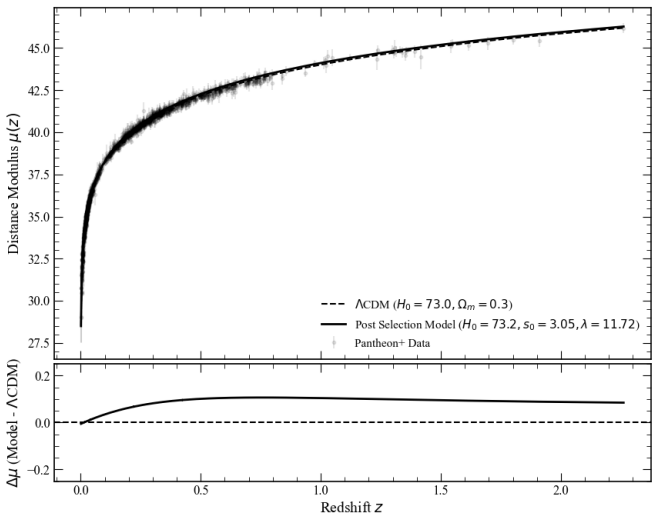
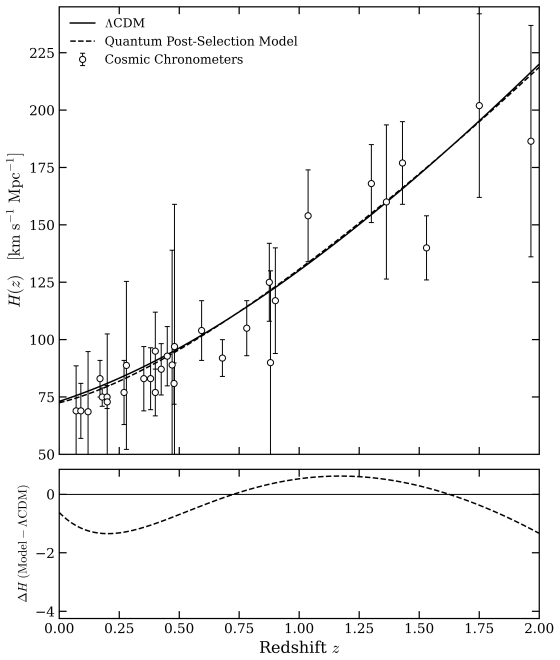
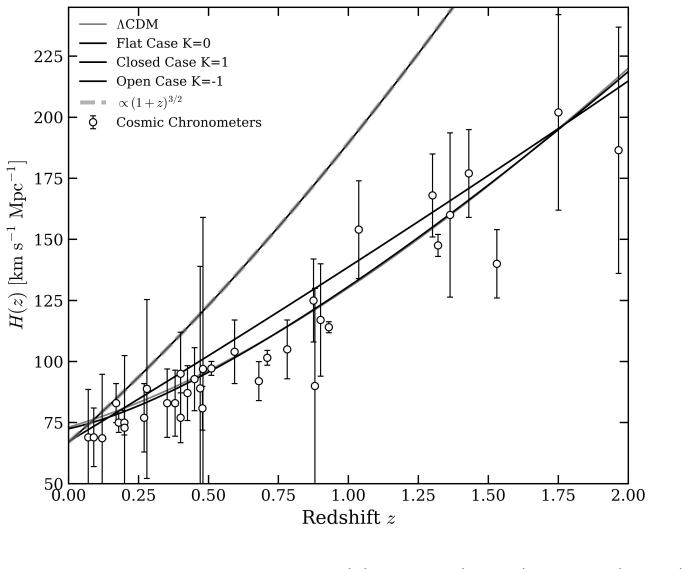
Post-selection and coarse-graining in a quantum cosmological model generate effective late-time acceleration. The resulting expansion history depends on at most two parameters beyond standard Friedmann evolution, reproduces radiation- and matter-dominated behavior at early times, and yields statistically competitive fits to type Ia supernova and cosmic chronometer data while predicting a jerk parameter different from that in the LambdaCDM model.
What carries the argument
Post-selected quasiclassical dynamics with coarse-graining applied to the global cosmological scale factor evolution.
If this is right
- The model matches observed early universe expansion without modification.
- It avoids the coincidence problem of why acceleration starts now.
- The present-day jerk parameter is predicted to differ significantly from LambdaCDM.
- Fits to current data are statistically competitive with the standard model.
- Acceleration is produced without a cosmological constant or dark energy.
Where Pith is reading between the lines
- If the model holds, future precise measurements of the jerk could distinguish it from LambdaCDM.
- The framework might extend to other cosmological observables like the CMB power spectrum.
- Similar post-selection effects could appear in other quantum gravitational contexts.
- Testing would require checking if the two-parameter model continues to fit new data sets.
Load-bearing premise
Post-selection and coarse-graining can be applied consistently to the entire cosmological history to produce acceleration while keeping early times unchanged.
What would settle it
A precise measurement showing the jerk parameter matches the LambdaCDM value exactly would falsify the prediction of a significantly different jerk.
Figures
read the original abstract
The origin of cosmic acceleration remains a central problem in cosmology, commonly attributed to a cosmological constant within the $\Lambda$CDM model or to dynamical dark energy. Here, we develop an alternative approach in which acceleration emerges from quantum post-selection, a standard feature of quantum theory that is not usually incorporated into cosmological modelling. While quantum theory admits both pre-selected and post-selected ensembles, quantum cosmological models are almost exclusively formulated in terms of initial conditions. Building on previous work on post-selected quasiclassical dynamics, we construct a minimal predictive cosmological model in which post-selection and coarse-graining generate effective late-time acceleration without introducing a cosmological constant, dark energy, or modifications of general relativity. The resulting expansion history is highly constrained theoretically and depends on at most two parameters beyond standard Friedmann evolution. Confrontation with type Ia supernova and cosmic chronometer data yields statistically competitive fits while naturally avoiding the coincidence problem. The model also reproduces the standard radiation- and matter-dominated behaviour at early times and predicts a present-day jerk parameter significantly different from the $\Lambda$CDM value. These results suggest that cosmic acceleration may arise as a macroscopic quantum cosmological effect rather than from additional cosmological fluids or modified gravitational dynamics.
Editorial analysis
A structured set of objections, weighed in public.
Referee Report
Summary. The manuscript develops a cosmological model in which late-time acceleration emerges from quantum post-selection and coarse-graining applied to quasiclassical trajectories, without a cosmological constant, dark energy, or modifications to general relativity. The expansion history is asserted to be highly constrained, depending on at most two parameters beyond standard Friedmann evolution, to recover radiation- and matter-dominated behavior at early times, to yield statistically competitive fits to type Ia supernova and cosmic chronometer data, and to predict a present-day jerk parameter distinct from the LambdaCDM value.
Significance. If the construction is valid, the result would offer a novel quantum-cosmological origin for acceleration that is theoretically constrained and avoids the coincidence problem while making a falsifiable prediction for the jerk parameter. Credit is due for building explicitly on prior post-selected quasiclassical dynamics and for emphasizing the limited parameter count.
major comments (2)
- [Model construction (effective scale-factor dynamics)] The central claim that the post-selected ensemble recovers the standard radiation- and matter-dominated Friedmann solutions exactly when a(t) is small requires an explicit derivation demonstrating that the post-selection projector and coarse-graining operators introduce no residual corrections to the early-time Hamiltonian; the abstract asserts this occurs but provides no such calculation, which is load-bearing for the assertion of unmodified early-time evolution.
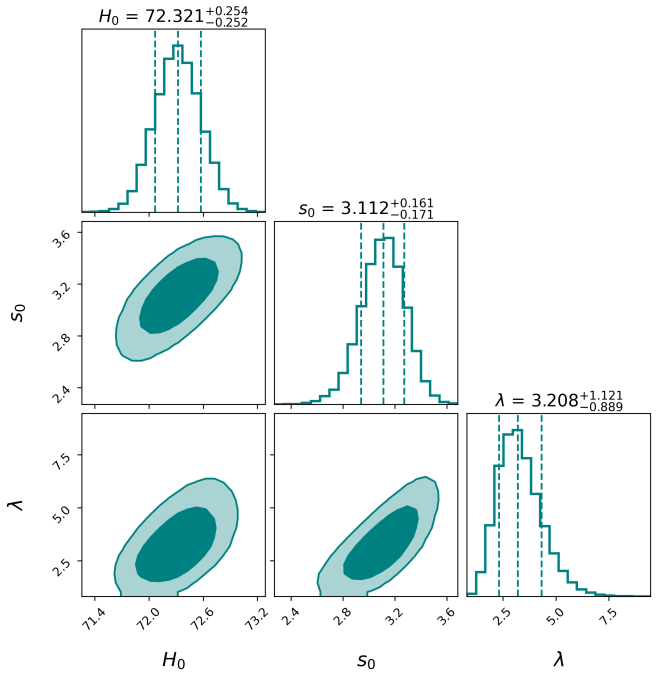
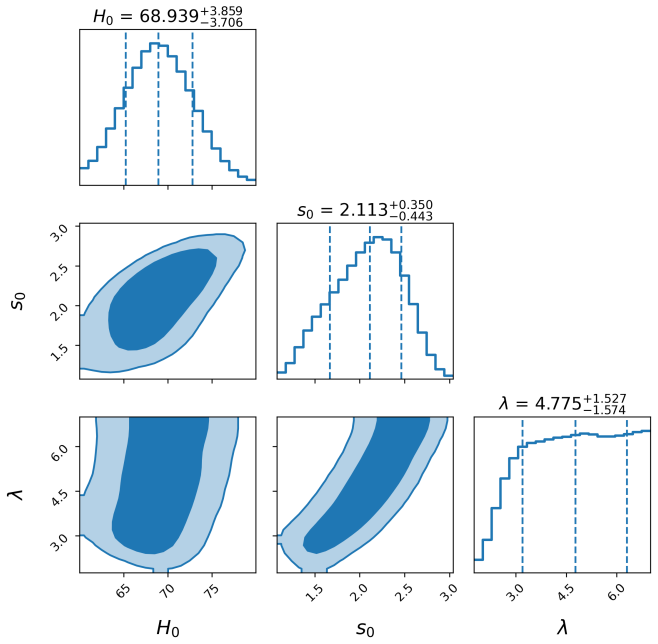
- [Data confrontation and parameter counting] The statement that the model depends on at most two parameters beyond standard Friedmann evolution and produces 'statistically competitive fits' must be supported by the explicit effective Friedmann equation, the numerical values of the best-fit parameters (including the post-selection scale and coarse-graining parameters), and quantitative fit statistics (chi-squared, Delta chi^2 relative to LambdaCDM) to establish that acceleration is not simply fitted rather than independently generated.
minor comments (1)
- [Abstract] The abstract would benefit from naming the two additional parameters explicitly rather than referring to them only generically.
Simulated Author's Rebuttal
We thank the referee for their careful review and constructive comments, which help clarify key aspects of the model. We address each major point below and will incorporate revisions to strengthen the manuscript.
read point-by-point responses
-
Referee: [Model construction (effective scale-factor dynamics)] The central claim that the post-selected ensemble recovers the standard radiation- and matter-dominated Friedmann solutions exactly when a(t) is small requires an explicit derivation demonstrating that the post-selection projector and coarse-graining operators introduce no residual corrections to the early-time Hamiltonian; the abstract asserts this occurs but provides no such calculation, which is load-bearing for the assertion of unmodified early-time evolution.
Authors: We agree that an explicit derivation is needed to rigorously support the early-time recovery claim. In the revised manuscript we will add a dedicated calculation (new subsection in Section 3) expanding the post-selection projector and coarse-graining operators for a(t) ≪ 1 and showing that all correction terms vanish identically, recovering the unmodified Friedmann Hamiltonian. This follows directly from the structure of the operators already defined in the paper. revision: yes
-
Referee: [Data confrontation and parameter counting] The statement that the model depends on at most two parameters beyond standard Friedmann evolution and produces 'statistically competitive fits' must be supported by the explicit effective Friedmann equation, the numerical values of the best-fit parameters (including the post-selection scale and coarse-graining parameters), and quantitative fit statistics (chi-squared, Delta chi^2 relative to LambdaCDM) to establish that acceleration is not simply fitted rather than independently generated.
Authors: We will revise the data-confrontation section to include the explicit effective Friedmann equation obtained after post-selection and coarse-graining, the numerical best-fit values of the two additional parameters, and a table reporting χ², Δχ² relative to ΛCDM, and other fit metrics. These additions will make transparent that the acceleration is generated by the quantum construction rather than by unconstrained fitting. revision: yes
Circularity Check
No significant circularity detected
full rationale
The paper builds a cosmological model from post-selection and coarse-graining applied to quasiclassical dynamics, asserts recovery of standard early-time Friedmann evolution, and introduces at most two additional parameters whose values are confronted with supernova and chronometer data. No equations or derivation steps in the provided text reduce the claimed acceleration or early-time recovery to a fitted input by construction, a self-definitional loop, or a load-bearing self-citation whose content is itself unverified. The two parameters are presented as theoretically constrained extensions rather than free fits that force the target result; the jerk prediction is offered as an independent testable output. The derivation chain therefore remains self-contained against external data benchmarks.
Axiom & Free-Parameter Ledger
free parameters (2)
- post-selection scale parameter
- coarse-graining parameter
axioms (1)
- domain assumption Post-selection and coarse-graining generate effective late-time acceleration when applied to cosmological dynamics
Reference graph
Works this paper leans on
-
[1]
A. G. Riess et al,Observational Evidence from Supernovae for an Accelerating Universe and a Cosmological Constant, Astron. J. 116, 1009 (1998)
1998
-
[2]
Perlmutter et al,Measurements ofΩandΛfrom 42 High-Redshift Supernovae, Astro- phys
S. Perlmutter et al,Measurements ofΩandΛfrom 42 High-Redshift Supernovae, Astro- phys. J. 517, 565 (1999)
1999
-
[3]
Aharonov, P
Y. Aharonov, P. Bergmann, and J. Lebowitz,Time Symmetry in the Quantum Process of Measurement, Phys. Rev. 134, B1410 (1964)
1964
-
[4]
Anastopoulos,Final States in Quantum Cosmology: Cosmic Acceleration as a Quan- tum Post-Selection Effect, Phys
C. Anastopoulos,Final States in Quantum Cosmology: Cosmic Acceleration as a Quan- tum Post-Selection Effect, Phys. Rev. D104, 064045 (2025)
2025
-
[5]
Aharonov and L
Y. Aharonov and L. Vaidman,The Two-State Vector Formalism of Quantum Mechanics: an Updated Review, in ‘Time in Quantum Mechanics”, edited by J. G. Muga, R. Sala Mayato and I. L. Egusquiza (Springer, 2008)
2008
-
[6]
Silva, Y
R. Silva, Y. Guryanova, N. Brunner, N. Linden, A. J. Short, and S. Popescu,Pre- and Postselected Quantum States: Density Matrices, Tomography, and Kraus Operators, Phys. Rev. A89, 012121 (2014). 18
2014
-
[7]
Omn´ es,Logical Reformulation of Quantum Mechanics
R. Omn´ es,Logical Reformulation of Quantum Mechanics. IV. Projectors in Semiclassical Physics, J. Stat. Phys. 59, 223 (1989)
1989
-
[8]
Gell-Mann and J
M. Gell-Mann and J. B. Hartle,Classical Equations for Quantum Systems, Phys. Rev. D47, 3345 (1993)
1993
-
[9]
Anastopoulos,Quantum Theory: A Foundational Approach(Cambridge: Cambridge University Press 2023)
C. Anastopoulos,Quantum Theory: A Foundational Approach(Cambridge: Cambridge University Press 2023)
2023
-
[10]
C. J. Isham and A. C. Kakas,A Group Theoretical Approach to the Canonical Quanti- sation of Gravity. I. Construction of the Canonical Group, Class. Quantum Grav. 1 621 (1984)
1984
-
[11]
Les Houches, Session XL: Relativity, Groups and Topology II
C. J. Isham,Topological and global aspects of quantum theory, in: DeWitt, B. S., and Stora, R. (eds), “Les Houches, Session XL: Relativity, Groups and Topology II” (Amster- dam: North Holland, 1983)
1983
-
[12]
Foreman-Mackey, D
D. Foreman-Mackey, D. W. Hogg, D. Lang, and J. Goodman,emcee: The MCMC Hammer, Publ. Astron. Soc. Pac.125, 306 (2013)
2013
-
[13]
Scolnic, D
D. Scolnic, D. Brout, A. Carr, A. G. Riess, T. M. Davis, et al.,The Pantheon+ Analysis: The Full Data Set and Light-curve Release, Astrophys. J.938, 113 (2022)
2022
-
[14]
Akaike,A New Look at the Statistical Model Identification, IEEE Trans
H. Akaike,A New Look at the Statistical Model Identification, IEEE Trans. Autom. Control19, 716 (1974)
1974
-
[15]
Schwarz,Estimating the Dimension of a Model, Ann
G. Schwarz,Estimating the Dimension of a Model, Ann. Statist.6, 461 (1978)
1978
-
[16]
A. R. Liddle,Information Criteria for Astrophysical Model Selection, Mon. Not. R. Astron. Soc. Lett. 377, L74 (2007)
2007
-
[17]
H. Yu, B. Ratra, and F.-Y. Wang,Hubble Parameter and Baryon Acoustic Oscillation Measurement Constraints on the Hubble Constant, the Deviation from the Spatially Flat ΛCDM Model, the Deceleration–Acceleration Transition Redshift, and Spatial Curvature, Astrophys. J.856, 3 (2018)
2018
-
[18]
P. C. W. Davies and J. Magueijo,Teleocosmology and Quantum Post-selection, arXiv:2606.02514
-
[19]
Zlatev, L.-M, Wang, and P
I. Zlatev, L.-M, Wang, and P. J. Steinhardt,Quintessence, Cosmic Coincidence, and the Cosmological Constant, Phys. Rev. Lett. 82, 896 (1999)
1999
-
[20]
Visser,Jerk, Snap and the Cosmological Equation of State, Class
M. Visser,Jerk, Snap and the Cosmological Equation of State, Class. Quantum Grav. 21, 2603 (2004)
2004
-
[21]
Omn´ es,The Interpretation of Quantum Mechanics(Princeton: Princeton University Press 1994)
R. Omn´ es,The Interpretation of Quantum Mechanics(Princeton: Princeton University Press 1994)
1994
-
[22]
R. E. Kass and A. E. Raftery,Bayes Factors, J. Amer. Statist. Assoc. 90, 773 (1995). 19
1995
discussion (0)
Sign in with ORCID, Apple, or X to comment. Anyone can read and Pith papers without signing in.