Influence-solvability: a systematic theory of (1+1)D solvability and its application to brickwork circuits
Pith reviewed 2026-06-27 07:53 UTC · model grok-4.3
The pith
Influence-solvable circuits unify known solvable dynamics by representing their generated bath as a uniform matrix product state with finite bond dimension and supply local conditions plus new examples in brickwork circuits.
A machine-rendered reading of the paper's core claim, the machinery that carries it, and where it could break.
Core claim
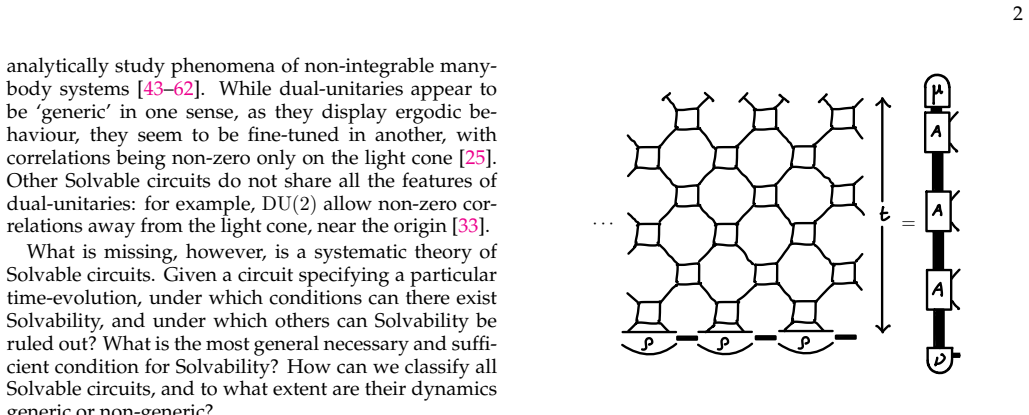
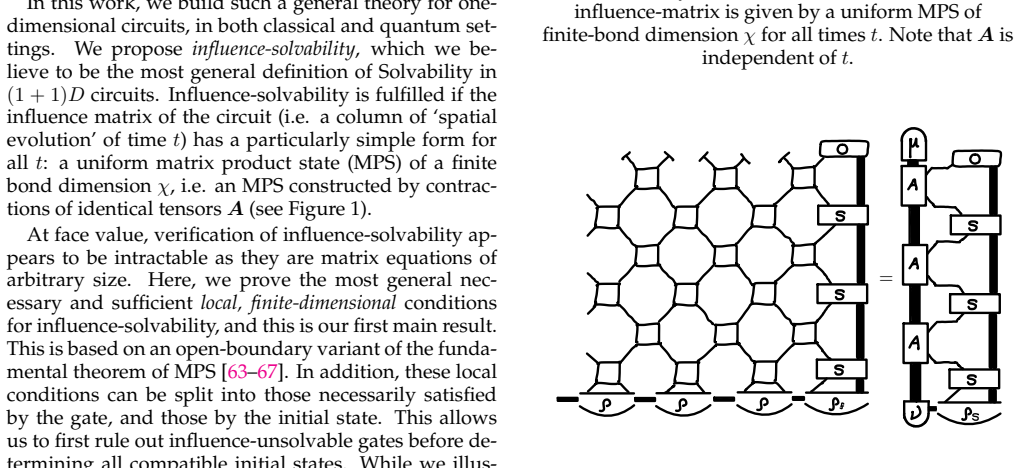
Influence-solvable circuits are those whose influence matrix, representing the bath generated by the circuit evolution, is given by a uniform MPS with finite bond-dimension χ. This property allows for efficient computation of subsystem dynamics and essentially contains all known examples of solvable circuits. Using a version of the fundamental theorem of MPS for open boundary conditions, the paper derives a set of necessary and sufficient local conditions for influence-solvability. When applied to brickwork circuits, this yields a systematic classification of classical brickwork circuits with local dimension up to d=3 and quantum brickwork circuits with d=2, revealing new solvable circuits n
What carries the argument
The influence matrix represented as a uniform matrix product state with finite bond dimension χ, which encodes the bath generated by the circuit and permits application of the fundamental theorem of MPS to obtain local solvability conditions.
If this is right
- Subsystem dynamics become efficiently computable once the influence matrix has finite bond dimension.
- All previously known solvable circuits, including dual-unitary ones, satisfy the influence-solvability condition.
- Necessary and sufficient local gate conditions replace collections of merely sufficient criteria.
- New solvable brickwork circuits exist beyond those found by earlier methods, for classical local dimensions up to 3 and quantum local dimension 2.
- A complete classification is obtained for the listed small local dimensions in the brickwork geometry.
Where Pith is reading between the lines
- The same influence-matrix construction could be applied to circuit geometries other than brickwork to search for additional solvable families.
- The newly identified circuits may display distinctive correlation or entanglement patterns that can be checked by direct simulation or experiment.
- Solvability appears linked to the existence of a time-independent low-dimensional effective description of the environment produced by the circuit itself.
Load-bearing premise
Representing the bath generated by the circuit evolution as a uniform MPS with finite bond dimension χ provides the correct and complete characterization of solvability.
What would settle it
A circuit whose dynamics satisfy an independent solvability criterion yet whose influence matrix cannot be represented by any finite-χ uniform MPS, or conversely an influence-solvable circuit whose subsystem evolution is not efficiently computable.
Figures
read the original abstract
`Solvable' circuits, such as dual unitaries and its generalisations, have arisen as paradigmatic examples of tractable chaotic non-equilibrium dynamics, both in classical and quantum systems. However, while increasingly more complicated sufficient conditions have been proposed, a systematic theory classifying and understanding general features of solvable circuits is missing. We develop such a theory by introducing influence-solvable circuits, a class of $(1+1)D$ circuits whose influence matrix, which represents the `bath' generated by its own evolution, is given by a uniform MPS with finite bond-dimension $\chi$. This property allows for efficient computation of subsystem dynamics and essentially contains all known examples of solvable circuits. We derive a set of necessary and sufficient local conditions by using a version of the fundamental theorem of MPS for open boundary conditions. Next we apply our theory to brickwork circuits with $\chi=1$ influence-solvability and perform a systematic classification of classical brickwork circuits with local dimension up to $d=3$ and quantum brickwork circuits with $d=2$. Our search reveals new solvable circuits that are not captured by known solvability conditions.
Editorial analysis
A structured set of objections, weighed in public.
Referee Report
Summary. The paper introduces influence-solvable circuits in (1+1)D systems, defined via the influence matrix (representing the bath generated by circuit evolution) being a uniform MPS with finite bond dimension χ. It claims this class contains essentially all known solvable circuits (e.g., dual unitaries), derives necessary and sufficient local conditions from the fundamental theorem of MPS under open boundary conditions, and applies the framework to exhaustively classify brickwork circuits, finding new solvable examples for classical d≤3 and quantum d=2 that evade prior conditions.
Significance. If the central claims hold, the work supplies a unifying, MPS-based classification scheme for solvable circuits that enables efficient subsystem dynamics and systematic discovery beyond ad-hoc constructions. The explicit use of the MPS fundamental theorem to obtain local conditions, together with the concrete classification results for small d, would constitute a substantive advance in understanding tractable chaotic dynamics.
major comments (2)
- [derivation of local conditions] The weakest assumption—that a uniform finite-χ MPS representation of the influence matrix yields necessary and sufficient local conditions via the OBC fundamental theorem—requires explicit justification that non-uniform or infinite-χ representations cannot produce additional solvable circuits; without this, the necessity direction of the derived conditions remains open (abstract and § on derivation of local conditions).
- [introduction and comparison to prior work] The claim that influence-solvability 'essentially contains all known examples' is asserted but the manuscript provides no explicit mapping or exhaustive cross-check against the full literature list of dual-unitary generalizations; this is load-bearing for the 'systematic theory' framing (abstract).
minor comments (2)
- [definition of influence matrix] Notation for the influence matrix and its MPS tensors should be introduced with an explicit diagram or equation reference in the main text to aid readability.
- [classification results] The search procedure for the classification (enumeration method, symmetry reductions, verification that new circuits satisfy the local conditions) is only sketched; a supplementary section or appendix with pseudocode or explicit parameter counts would strengthen reproducibility.
Simulated Author's Rebuttal
We thank the referee for their careful reading of the manuscript and for the constructive comments, which help clarify the scope and presentation of our results. We address each major comment below.
read point-by-point responses
-
Referee: [derivation of local conditions] The weakest assumption—that a uniform finite-χ MPS representation of the influence matrix yields necessary and sufficient local conditions via the OBC fundamental theorem—requires explicit justification that non-uniform or infinite-χ representations cannot produce additional solvable circuits; without this, the necessity direction of the derived conditions remains open (abstract and § on derivation of local conditions).
Authors: The derived local conditions are necessary and sufficient for the influence matrix to admit a uniform finite-χ MPS representation (under the open-boundary-conditions version of the fundamental theorem). By definition, influence-solvability is the class of circuits whose influence matrix possesses exactly this representation, which guarantees efficient subsystem dynamics. We agree that the manuscript would benefit from an explicit discussion of why we restrict attention to uniform finite-χ representations rather than allowing non-uniform or infinite-χ forms. In the revision we will add a clarifying paragraph in the section on the derivation of local conditions, explaining that non-uniform or infinite-χ representations fall outside the present definition because they would not in general permit the same efficient contraction or the same local algebraic conditions. revision: yes
-
Referee: [introduction and comparison to prior work] The claim that influence-solvability 'essentially contains all known examples' is asserted but the manuscript provides no explicit mapping or exhaustive cross-check against the full literature list of dual-unitary generalizations; this is load-bearing for the 'systematic theory' framing (abstract).
Authors: We accept that the current manuscript asserts the containment without supplying explicit mappings or a systematic cross-check against the literature on dual-unitary generalizations. In the revised version we will add a dedicated subsection (or an appendix table) that explicitly maps the principal known families—dual-unitary gates, their higher-dimensional and non-unitary generalizations, and the classical solvable circuits reported in the literature—to influence-solvable circuits, thereby making the claim concrete and supporting the “systematic theory” framing. revision: yes
Circularity Check
No significant circularity; derivation is self-contained
full rationale
The paper defines influence-solvability directly as the property that the influence matrix is a uniform finite-χ MPS. Local conditions are obtained by applying the standard fundamental theorem of MPS (OBC version), an external result from tensor-network literature rather than a self-citation or fitted input. Exhaustive classification for small d proceeds by direct enumeration under these conditions. The claim that the class contains known solvable circuits is presented as externally verifiable against prior literature and does not reduce any prediction to the definition by construction. No step equates a derived quantity to its input via renaming, fitting, or self-referential closure.
Axiom & Free-Parameter Ledger
axioms (1)
- standard math Fundamental theorem of MPS for open boundary conditions yields necessary and sufficient local conditions
invented entities (2)
-
influence-solvable circuits
no independent evidence
-
influence matrix
no independent evidence
Forward citations
Cited by 1 Pith paper
-
Exact subsystem dynamics in the deterministic Floquet-PXP model
Rule 201 in the deterministic Floquet-PXP model admits exact finite-dimensional MPO influence matrices for subsystem dynamics that solve algebraic conditions.
Reference graph
Works this paper leans on
-
[1]
partitioning protocol/domain wall
to describe steady states of Lindblad dynamics). In this case one can efficiently compute finite time dynam- ics, however it may hard to obtain analytic predictions on asymptotic behaviour. However, note that the above argument implies the absence of solvability for certain initial states, but not necessarily for all initial states. In particular, let us ...
-
[2]
Altland and B
A. Altland and B. D. Simons,Condensed matter field theory (Cambridge university press, 2010)
2010
-
[3]
S. W. Kim, G. De Tomasi, and M. Heyl, Real-time dynam- ics of one-dimensional and two-dimensional bosonic quantum matter deep in the many-body localized phase, Physical Review B104, 144205 (2021)
2021
-
[4]
Coleman,Introduction to many-body physics(Cam- bridge University Press, 2015)
P . Coleman,Introduction to many-body physics(Cam- bridge University Press, 2015)
2015
-
[5]
Kardar,Statistical physics of fields(Cambridge Univer- sity Press, 2007)
M. Kardar,Statistical physics of fields(Cambridge Univer- sity Press, 2007)
2007
-
[6]
Mézard, G
M. Mézard, G. Parisi, M. A. Virasoro, and D. J. Thouless, Spin glass theory and beyond (1988)
1988
-
[7]
Doyon, Lecture notes on generalised hydrodynamics, SciPost Physics Lecture Notes , 018 (2020)
B. Doyon, Lecture notes on generalised hydrodynamics, SciPost Physics Lecture Notes , 018 (2020)
2020
-
[8]
S. W. P . Kim, F. Hübner, J. P . Garrahan, and B. Doyon, Circuits as a simple platform for the emergence of hy- drodynamics in deterministic chaotic many-body sys- tems, arXiv preprint arXiv:2503.08788 (2025)
arXiv 2025
-
[9]
S. Sachdev and J. Ye, Gapless spin-fluid ground state in a random quantum heisenberg magnet, arXiv preprint cond-mat/9212030 (1992)
Pith/arXiv arXiv 1992
-
[10]
R. J. Baxter, Exactly solved models in statistical mechan- ics, inIntegrable systems in statistical mechanics(World Sci- entific, 1985) pp. 5–63
1985
-
[11]
S. W. P . Kim and A. Lamacraft, Planted directed poly- mer: Inferring a random walk from noisy images, Phys- ical Review E111, 024135 (2025)
2025
-
[12]
Derrida and E
B. Derrida and E. Gardner, Solution of the generalised random energy model, Journal of Physics C: Solid State Physics19, 2253 (1986)
1986
-
[13]
Kitaev, Anyons in an exactly solved model and be- yond, Annals of Physics321, 2 (2006)
A. Kitaev, Anyons in an exactly solved model and be- yond, Annals of Physics321, 2 (2006)
2006
-
[14]
M. A. Levin and X.-G. Wen, String-net condensation: A physical mechanism for topological phases, Physical Re- view B—Condensed Matter and Materials Physics71, 045110 (2005)
2005
-
[15]
Affleck, T
I. Affleck, T. Kennedy, E. H. Lieb, and H. Tasaki, Valence bond ground states in isotropic quantum antiferromag- nets, Communications in Mathematical Physics115, 477 (1988)
1988
-
[16]
Caux, The bethe ansatz (2024)
J.-S. Caux, The bethe ansatz (2024)
2024
-
[17]
Caux and J
J.-S. Caux and J. Mossel, Remarks on the notion of quan- tum integrability, Journal of Statistical Mechanics: The- ory and Experiment2011, P02023 (2011)
2011
-
[18]
Arutyunov,Elements of Classical and Quantum Inte- grable Systems, UNITEXT for Physics (Springer Interna- tional Publishing, 2020)
G. Arutyunov,Elements of Classical and Quantum Inte- grable Systems, UNITEXT for Physics (Springer Interna- tional Publishing, 2020)
2020
-
[19]
Babelon, D
O. Babelon, D. Bernard, and M. Talon,Introduction to Classical Integrable Systems, Cambridge Monographs on Mathematical Physics (Cambridge University Press, 2003)
2003
-
[20]
V . E. Korepin, N. M. Bogoliubov, and A. G. Izergin, Quantum Inverse Scattering Method and Correlation Func- tions, Cambridge Monographs on Mathematical Physics (Cambridge University Press, 1993)
1993
-
[21]
E. Lieb, T. Schultz, and D. Mattis, Two soluble models of an antiferromagnetic chain, Annals of Physics16, 407 (1961)
1961
-
[22]
A. Y. Kitaev, Unpaired majorana fermions in quantum wires, Physics-uspekhi44, 131 (2001)
2001
-
[23]
Peschel and V
I. Peschel and V . Eisler, Reduced density matrices and entanglement entropy in free lattice models, Journal of physics a: mathematical and theoretical42, 504003 (2009). 34
2009
-
[24]
Vidmar and M
L. Vidmar and M. Rigol, Generalized gibbs ensemble in integrable lattice models, Journal of Statistical Mechan- ics: Theory and Experiment2016, 064007 (2016)
2016
-
[25]
Gopalakrishnan and A
S. Gopalakrishnan and A. Lamacraft, Unitary circuits of finite depth and infinite width from quantum channels, Physical Review B100, 064309 (2019)
2019
-
[26]
Bertini, P
B. Bertini, P . Kos, and T. Prosen, Exact correlation func- tions for dual-unitary lattice models in 1+ 1 dimensions, Physical review letters123, 210601 (2019)
2019
-
[27]
Bertini, P
B. Bertini, P . W. Claeys, and T. c. v. Prosen, Exactly solv- able quantum many-body dynamics from space-time duality, Rev. Mod. Phys.98, 025001 (2026)
2026
-
[28]
Paeckel, T
S. Paeckel, T. Köhler, A. Swoboda, S. R. Manmana, U. Schollwöck, and C. Hubig, Time-evolution methods for matrix-product states, Annals of Physics411, 167998 (2019)
2019
-
[29]
M. C. Bañuls, Tensor network algorithms: A route map, Annual Review of Condensed Matter Physics14, 173 (2023)
2023
-
[30]
I. M. Georgescu, S. Ashhab, and F. Nori, Quantum sim- ulation, Rev. Mod. Phys.86, 153 (2014)
2014
-
[31]
Keenan, N
N. Keenan, N. F. Robertson, T. Murphy, S. Zhuk, and J. Goold, Evidence of kardar-parisi-zhang scaling on a digital quantum simulator, npj Quantum Information9, 72 (2023)
2023
-
[32]
L. E. Fischer, M. Leahy, A. Eddins, N. Keenan, D. Fer- racin, M. A. C. Rossi, Y. Kim, A. He, F. Pietracap- rina, B. Sokolov, S. Dooley, Z. Zimborás, F. Tacchino, S. Maniscalco, J. Goold, G. García-Pérez, I. Tavernelli, A. Kandala, and S. N. Filippov, Dynamical simulations of many-body quantum chaos on a quantum computer, Nature Physics22, 302 (2026)
2026
-
[33]
Baccari, P
F. Baccari, P . Kos, and G. Styliaris, Average-computation benchmarking for local expectation values in digital quantum devices, Phys. Rev. Res.8, L012065 (2026)
2026
-
[34]
X.-H. Yu, Z. Wang, and P . Kos, Hierarchical generaliza- tion of dual unitarity, Quantum8, 1260 (2024)
2024
-
[35]
Klobas, B
K. Klobas, B. Bertini, and L. Piroli, Exact thermalization dynamics in the “rule 54” quantum cellular automaton, Phys. Rev. Lett.126, 160602 (2021)
2021
-
[36]
Klobas and B
K. Klobas and B. Bertini, Exact relaxation to Gibbs and non-equilibrium steady states in the quantum cellular automaton Rule 54, SciPost Phys.11, 106 (2021)
2021
-
[37]
Klobas and B
K. Klobas and B. Bertini, Entanglement dynamics in Rule 54: Exact results and quasiparticle picture, SciPost Phys. 11, 107 (2021)
2021
-
[38]
Wang, X.-Y
H.-R. Wang, X.-Y. Yang, and Z. Wang, Exact hidden markovian dynamics in quantum circuits, Phys. Rev. Lett.133, 170402 (2024)
2024
-
[39]
Liu and W
C. Liu and W. W. Ho, Solvable entanglement dynamics in quantum circuits with generalized space-time duality, Phys. Rev. Res.7, L012011 (2025)
2025
-
[40]
Kos and G
P . Kos and G. Styliaris, Circuits of space and time quan- tum channels, Quantum7, 1020 (2023)
2023
-
[41]
P . W. Claeys and A. Lamacraft, Ergodic and noner- godic dual-unitary quantum circuits with arbitrary lo- cal hilbert space dimension, Phys. Rev. Lett.126, 100603 (2021)
2021
-
[42]
P . W. Claeys and A. Lamacraft, Operator dynamics and entanglement in space-time dual hadamard lattices, Journal of Physics A: Mathematical and Theoretical57, 405301 (2024)
2024
-
[43]
M. A. Rampp, S. A. Rather, and P . W. Claeys, Solv- able quantum circuits from spacetime lattices (2025), arXiv:2512.15871 [quant-ph]
arXiv 2025
-
[44]
Bertini, P
B. Bertini, P . Kos, and T. Prosen, Random matrix spectral form factor of dual-unitary quantum circuits, Commu- nications in Mathematical Physics387, 597 (2021)
2021
-
[45]
P . W. Claeys and A. Lamacraft, Emergent quantum state designs and biunitarity in dual-unitary circuit dynamics, Quantum6, 738 (2022)
2022
-
[46]
J. A. Montañà López and P . Kos, Exact solution of long- range stabilizer rényi entropy in the dual-unitary xxz model*, Journal of Physics A: Mathematical and Theo- retical57, 475301 (2024)
2024
-
[47]
Foligno, P
A. Foligno, P . Calabrese, and B. Bertini, Nonequilibrium dynamics of charged dual-unitary circuits, PRX Quan- tum6, 010324 (2025)
2025
-
[48]
Reid and B
I. Reid and B. Bertini, Entanglement barriers in dual- unitary circuits, Phys. Rev. B104, 014301 (2021)
2021
-
[49]
P . Kos, T. c. v. Prosen, and B. Bertini, Thermalization dynamics and spectral statistics of extended systems with thermalizing boundaries, Phys. Rev. B104, 214303 (2021)
2021
-
[50]
Foligno and B
A. Foligno and B. Bertini, Growth of entanglement of generic states under dual-unitary dynamics, Phys. Rev. B107, 174311 (2023)
2023
-
[51]
Fritzsch and T
F. Fritzsch and T. c. v. Prosen, Eigenstate thermalization in dual-unitary quantum circuits: Asymptotics of spec- tral functions, Phys. Rev. E103, 062133 (2021)
2021
-
[52]
Bertini, P
B. Bertini, P . Kos, and T. c. v. Prosen, Exact spectral form factor in a minimal model of many-body quantum chaos, Phys. Rev. Lett.121, 264101 (2018)
2018
-
[53]
M. A. Rampp, R. Moessner, and P . W. Claeys, From dual unitarity to generic quantum operator spreading, Phys. Rev. Lett.130, 130402 (2023)
2023
-
[54]
Dowling, P
N. Dowling, P . Kos, and K. Modi, Scrambling is neces- sary but not sufficient for chaos, Phys. Rev. Lett.131, 180403 (2023)
2023
-
[55]
P . W. Claeys and G. De Tomasi, Fock-space delocaliza- tion and the emergence of the porter-thomas distribu- tion from dual-unitary dynamics, Phys. Rev. Lett.134, 050405 (2025)
2025
-
[56]
Flack, B
A. Flack, B. Bertini, and T. c. v. Prosen, Statistics of the spectral form factor in the self-dual kicked ising model, Phys. Rev. Res.2, 043403 (2020)
2020
-
[57]
P . W. Claeys, M. Henry, J. Vicary, and A. Lamacraft, Exact dynamics in dual-unitary quantum circuits with projec- tive measurements, Phys. Rev. Res.4, 043212 (2022)
2022
-
[58]
M. A. Rampp, S. A. Rather, and P . W. Claeys, Entangle- ment membrane in exactly solvable lattice models, Phys. Rev. Res.6, 033271 (2024)
2024
-
[59]
Yao and P
J. Yao and P . W. Claeys, Temporal entanglement barri- ers in dual-unitary clifford circuits with measurements, Phys. Rev. Res.6, 043077 (2024)
2024
-
[60]
Bertini, K
B. Bertini, K. Klobas, V . Alba, G. Lagnese, and P . Cal- abrese, Growth of rényi entropies in interacting inte- grable models and the breakdown of the quasiparticle picture, Phys. Rev. X12, 031016 (2022)
2022
-
[61]
P . Kos, B. Bertini, and T. Prosen, Vanishing cor- relations in (bi)stochastic controlled circuits (2026), arXiv:2601.14379 [quant-ph]
arXiv 2026
-
[62]
M. T. Tan and T. Prosen, Logarithmic growth of opera- tor entanglement in a clean non-integrable circuit (2026), arXiv:2603.19363 [cond-mat.stat-mech]
arXiv 2026
-
[63]
X.-H. Yu, W. W. Ho, and P . Kos, Mixed state deep ther- malization, Phys. Rev. Lett.135, 260402 (2025)
2025
-
[64]
Fannes, B
M. Fannes, B. Nachtergaele, and R. F. Werner, Finitely 35 correlated states on quantum spin chains, Communica- tions in Mathematical Physics144, 443 (1992)
1992
-
[65]
Haegeman and F
J. Haegeman and F. Verstraete, Diagonalizing transfer matrices and matrix product operators: A medley of ex- act and computational methods, Annual Review of Con- densed Matter Physics8, 355 (2017)
2017
-
[66]
G. De las Cuevas, J. I. Cirac, N. Schuch, and D. Perez-Garcia, Irreducible forms of ma- trix product states: Theory and applications, Journal of Mathematical Physics58, 121901 (2017), https://pubs.aip.org/aip/jmp/article- pdf/doi/10.1063/1.5000784/15854062/121901_1_online.pdf
work page doi:10.1063/1.5000784/15854062/121901_1_online.pdf 2017
-
[67]
J. I. Cirac, D. Pérez-García, N. Schuch, and F. Ver- straete, Matrix product states and projected entangled pair states: Concepts, symmetries, theorems, Rev. Mod. Phys.93, 045003 (2021)
2021
-
[68]
M. Florido-Llinàs, Álvaro M. Alhambra, D. Pérez- García, and J. I. Cirac, Uniform matrix product states with a boundary (2025), arXiv:2512.11968 [quant-ph]
arXiv 2025
-
[69]
Bertini, C
B. Bertini, C. De Fazio, J. P . Garrahan, and K. Klobas, Ex- act quench dynamics of the floquet quantum east model at the deterministic point, Phys. Rev. Lett.132, 120402 (2024)
2024
-
[70]
Klobas, C
K. Klobas, C. De Fazio, and J. P . Garrahan, Exact pretran- sition effects in kinetically constrained circuits: Dynam- ical fluctuations in the floquet-east model, Phys. Rev. E 110, L022101 (2024)
2024
-
[71]
De Fazio, J
C. De Fazio, J. P . Garrahan, and K. Klobas, Exact results on the dynamics of the stochastic floquet-east model, Journal of Physics A: Mathematical and Theoretical57, 505002 (2024)
2024
-
[72]
Caldeira and A
A. Caldeira and A. Leggett, Path integral approach to quantum brownian motion, Physica A: Statistical Me- chanics and its Applications121, 587 (1983)
1983
-
[73]
Vanicat, L
M. Vanicat, L. Zadnik, and T. c. v. Prosen, Integrable trot- terization: Local conservation laws and boundary driv- ing, Phys. Rev. Lett.121, 030606 (2018)
2018
-
[74]
Vernier, B
E. Vernier, B. Bertini, G. Giudici, and L. Piroli, Integrable digital quantum simulation: Generalized gibbs ensem- bles and trotter transitions, Phys. Rev. Lett.130, 260401 (2023)
2023
-
[75]
Y. Miao, V . Gritsev, and D. V . Kurlov, The Floquet Bax- terisation, SciPost Phys.16, 078 (2024)
2024
-
[76]
Gombor and B
T. Gombor and B. Pozsgay, Integrable deformations of superintegrable quantum circuits, SciPost Phys.16, 114 (2024)
2024
-
[77]
B. Pozsgay, Quantum quenches and generalized gibbs ensemble in a bethe ansatz solvable lattice model of in- teracting bosons, Journal of Statistical Mechanics: The- ory and Experiment2014, P10045 (2014)
2014
-
[78]
Pozsgay and V
B. Pozsgay and V . Eisler, Real-time dynamics in a strongly interacting bosonic hopping model: global quenches and mapping to the xx chain, Journal of Sta- tistical Mechanics: Theory and Experiment2016, 053107 (2016)
2016
-
[79]
Piroli, E
L. Piroli, E. Vernier, P . Calabrese, and B. Pozsgay, Inte- grable quenches in nested spin chains i: the exact steady states, Journal of Statistical Mechanics: Theory and Ex- periment2019, 063103 (2019)
2019
-
[80]
R. Jozsa and A. Miyake, Matchgates and classi- cal simulation of quantum circuits, Proceedings of the Royal Society A: Mathematical, Physi- cal and Engineering Sciences464, 3089 (2008), https://royalsocietypublishing.org/rspa/article- pdf/464/2100/3089/742753/rspa.2008.0189.pdf
arXiv 2008
discussion (0)
Sign in with ORCID, Apple, or X to comment. Anyone can read and Pith papers without signing in.