Ultraviolet Imaging of SR 12 c with HST/WFC3: Accretion and Variability of a Giant Planet at the End Stages of Growth
Pith reviewed 2026-06-27 06:06 UTC · model grok-4.3
The pith
HST ultraviolet imaging shows SR 12 c accreting too slowly to grow much further and has reached the end stages of giant planet assembly.
A machine-rendered reading of the paper's core claim, the machinery that carries it, and where it could break.
Core claim
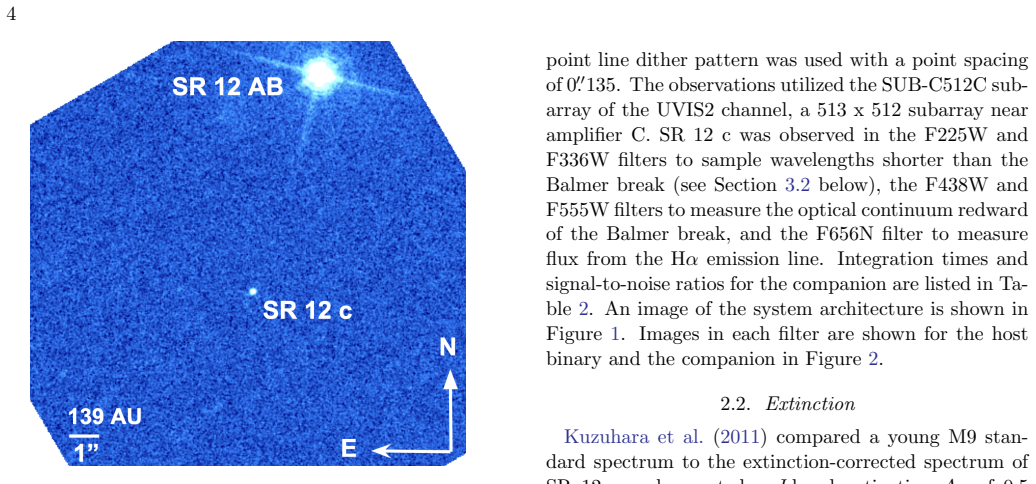
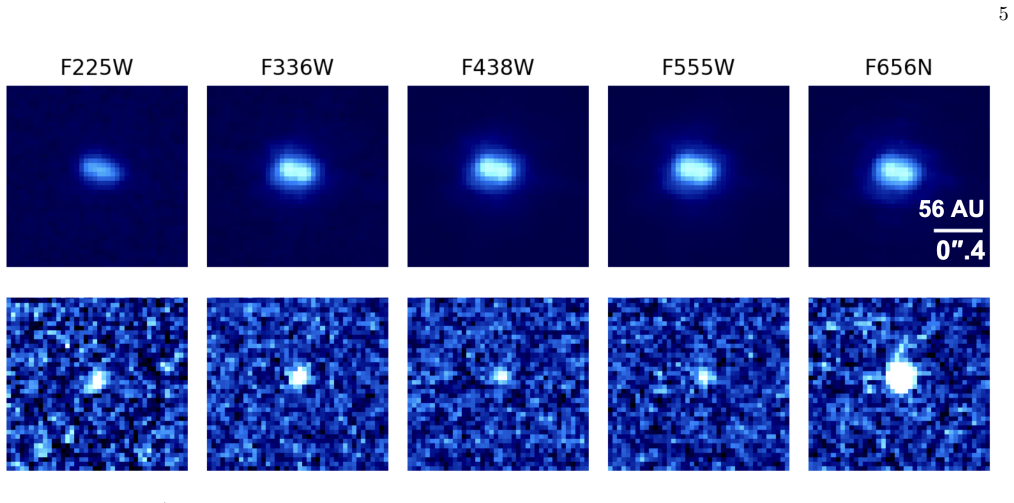
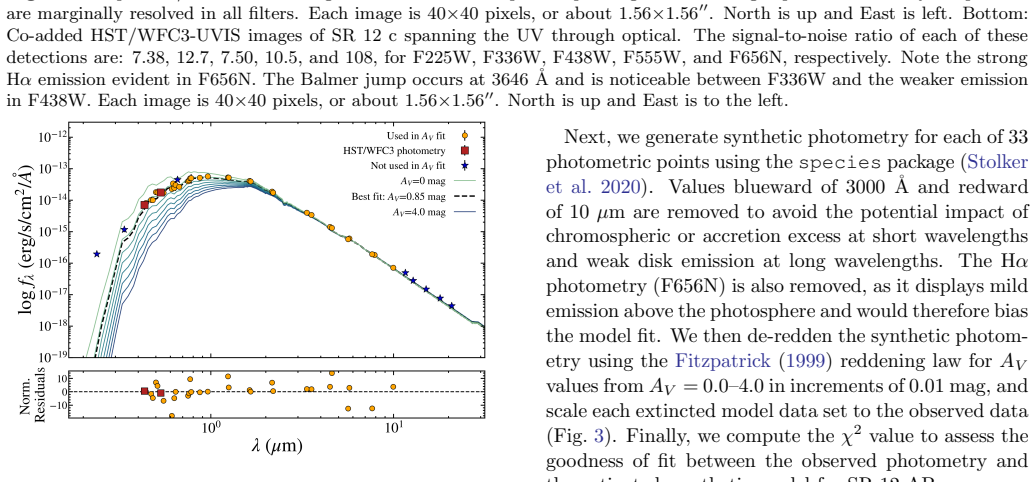
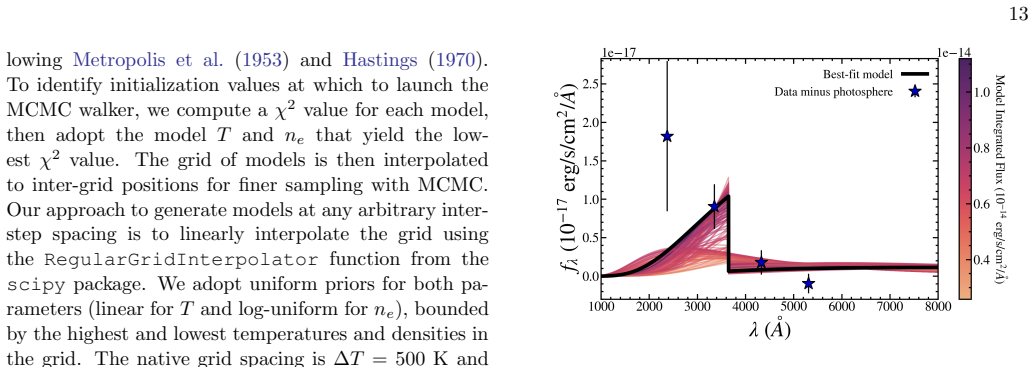
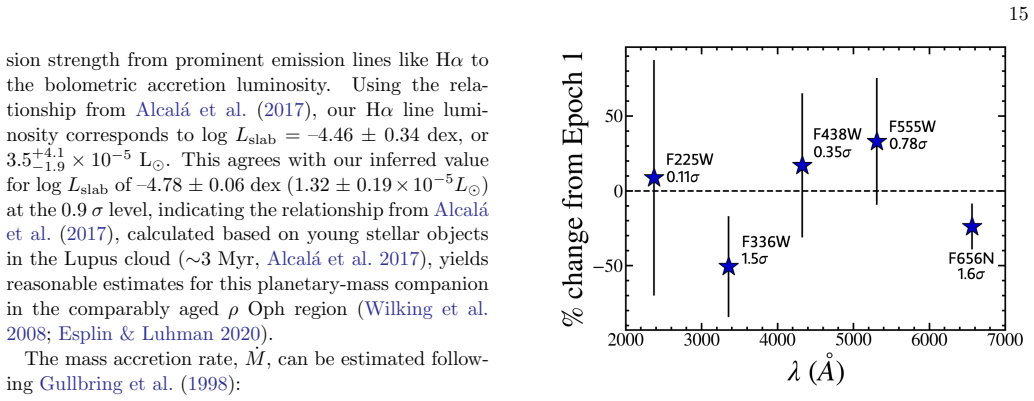
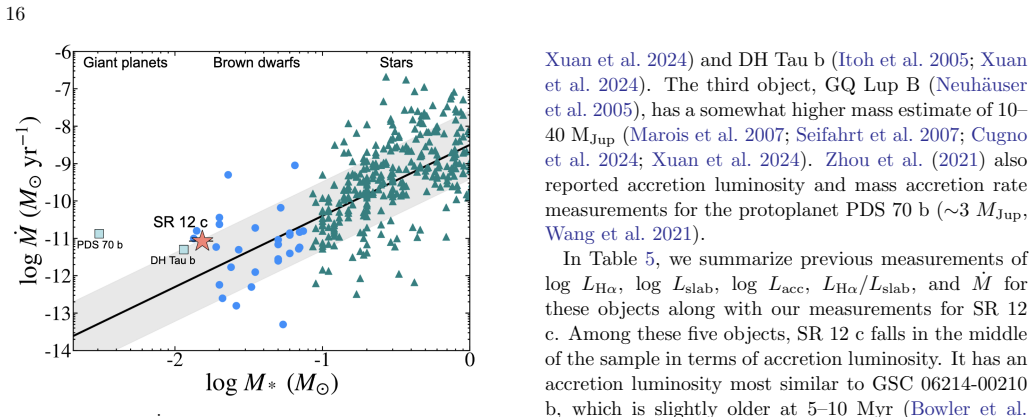
SR 12 c exhibits strong accretion-related continuum excess blueward of ∼5000 Å and clear signs of the Balmer jump at 3646 Å. We derive a total accretion luminosity of 1.65 ± 0.19 × 10^{-5} L_⊙ and a mass accretion rate of 8 ± 2× 10^{-12} M_⊙ yr^{-1}. Based on its mass and age, SR 12 c will not grow by an appreciable amount at its current accretion rate; it is at the end stages of assembly. No accretion variability is evident between the two epochs of the WFC3 observations spanning a month-long baseline, but the Hα emission line strength decreases by 90% compared to the reported flux from five years earlier.
What carries the argument
HST/WFC3 ultraviolet-through-red imaging that captures the accretion-driven continuum excess and Balmer discontinuity to calculate accretion luminosity and mass accretion rate.
If this is right
- SR 12 c will not grow by an appreciable amount at its current accretion rate.
- Accretion shows no variability over a one-month baseline but the H-alpha line has dropped 90 percent in five years.
- SR 12 c joins the small sample of young giant planets with both accretion and disk constraints from ultraviolet to submillimeter wavelengths.
- These data help map the range of timescales and physical processes that finish giant planet formation.
Where Pith is reading between the lines
- The low rate may mark the point where a gap or disk dispersal begins to starve the companion of further material.
- Repeating the ultraviolet imaging on other wide-orbit companions would test whether late-stage low accretion is common.
- The assembled spectral energy distribution could be modeled to place limits on any remaining circumplanetary disk mass.
Load-bearing premise
The mass and age of SR 12 c determined in prior work are accurate enough that the measured accretion rate means no appreciable further growth will occur.
What would settle it
An independent mass or age determination for SR 12 c that is substantially different from current values, or future monitoring that shows the accretion rate rising enough to allow significant mass gain before disk dispersal.
Figures
read the original abstract
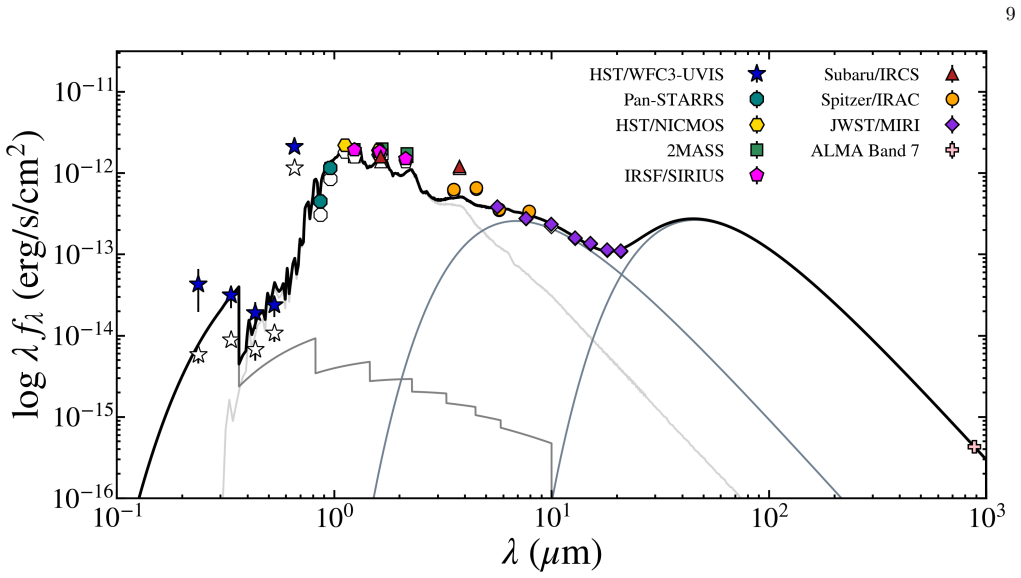
Many details of the gas accretion phase during giant planet formation remain untested. We present new 0.2$\unicode{x2013}$0.7 $\mu$m UV-through-red optical imaging of the young, wide-orbit planetary-mass companion SR 12 c from the Wide Field Camera 3 (WFC3) instrument on board the Hubble Space Telescope. SR 12 c exhibits strong accretion-related continuum excess blueward of $\sim$5000 $\unicode{x212B}$ and clear signs of the Balmer jump at 3646 $\unicode{x212B}$. We derive a total accretion luminosity of 1.65 $\pm$ $0.19 \times 10^{-5} L_{\odot}$ and a mass accretion rate of 8 $\pm$ $2\times 10^{-12}$ M$_{\odot}$ yr$^{-1}$. Based on its mass and age, SR 12 c will not grow by an appreciable amount at its current accretion rate; it is at the end stages of assembly. No accretion variability is evident between the two epochs of the WFC3 observations spanning a month-long baseline, but the H$\alpha$ emission line strength decreases by 90% compared to the reported flux from five years earlier. Combined with previous observations of SR 12 c, we assemble one of the most complete spectral energy distributions of a young giant planet to date, spanning the UV through sub-mm wavelengths (0.2$\unicode{x2013}$880 $\mu$m). This adds SR 12 c to the small yet growing sample of planets with detailed accretion and disk constraints, which together are beginning to establish the diversity of timescales and physical processes governing the formation of giant planets.
Editorial analysis
A structured set of objections, weighed in public.
Referee Report
Summary. The manuscript reports new HST/WFC3 0.2–0.7 μm imaging of the wide-orbit planetary-mass companion SR 12 c. The data show strong continuum excess blueward of ∼5000 Å and a clear Balmer jump at 3646 Å. From these observations the authors derive an accretion luminosity L_acc = 1.65 ± 0.19 × 10^{-5} L_⊙ and mass accretion rate Ṁ = 8 ± 2 × 10^{-12} M_⊙ yr^{-1}. They conclude that, given the companion’s mass and age, SR 12 c will experience negligible further growth and is therefore at the end stages of assembly. No variability is detected between the two WFC3 epochs separated by one month, although Hα has declined 90 % relative to a measurement five years earlier. The work also compiles a UV-to-sub-mm SED for the object.
Significance. The UV detection of accretion signatures and the resulting L_acc and Ṁ values constitute a direct, observationally grounded constraint on late-stage gas accretion onto a giant planet. The assembled multi-wavelength SED adds a well-characterized object to the small sample of young planets with both accretion and disk diagnostics. These measurements are independent of the interpretive claim about growth stage and therefore remain valuable even if the end-stage conclusion is qualified.
major comments (1)
- [Abstract and growth-stage discussion] Abstract (and the paragraph discussing growth stage): the statement that SR 12 c “will not grow by an appreciable amount at its current accretion rate” and “is at the end stages of assembly” rests on external mass and radius values adopted from prior studies. Because Ṁ = L_acc R / (G M), uncertainties in M and R propagate directly into both the quoted accretion rate and the integrated mass that could be accreted over the remaining lifetime. No error propagation or sensitivity test of these priors is presented, so the quantitative strength of the “end stages” claim cannot be assessed from the manuscript alone.
minor comments (2)
- [Abstract] The abstract states the new imaging covers 0.2–0.7 μm while the assembled SED extends to 880 μm; explicitly distinguish the wavelength range of the WFC3 data from the compiled SED in the abstract and §1.
- Table or text listing the exact mass, radius, and age values (with references) used to convert L_acc to Ṁ and to evaluate total growth would improve transparency and allow readers to reproduce the end-stage assessment.
Simulated Author's Rebuttal
We thank the referee for their positive assessment of the UV detection, accretion measurements, and SED compilation, and for the recommendation of minor revision. We address the single major comment below.
read point-by-point responses
-
Referee: [Abstract and growth-stage discussion] Abstract (and the paragraph discussing growth stage): the statement that SR 12 c “will not grow by an appreciable amount at its current accretion rate” and “is at the end stages of assembly” rests on external mass and radius values adopted from prior studies. Because Ṁ = L_acc R / (G M), uncertainties in M and R propagate directly into both the quoted accretion rate and the integrated mass that could be accreted over the remaining lifetime. No error propagation or sensitivity test of these priors is presented, so the quantitative strength of the “end stages” claim cannot be assessed from the manuscript alone.
Authors: We agree that the growth-stage conclusion depends on the adopted mass and radius, and that the lack of propagated uncertainties or sensitivity tests limits the ability to assess the robustness of the 'end stages' statement. In the revised manuscript we will (1) explicitly propagate the literature uncertainties on M and R through the Ṁ calculation and the integrated mass estimate over the remaining disk lifetime, and (2) add a short sensitivity table or figure showing how the accreted mass changes across the plausible mass range (approximately 5–15 M_Jup) reported in the discovery and follow-up papers. These additions will be placed in the discussion section and referenced from the abstract. revision: yes
Circularity Check
No significant circularity; new UV measurements independent of growth-stage conclusion
full rationale
The paper's core derivation consists of new HST/WFC3 photometry yielding an observed UV continuum excess and Balmer jump, from which L_acc and Ṁ are computed via standard relations. The interpretive statement that SR 12 c 'will not grow by an appreciable amount' and 'is at the end stages of assembly' invokes external prior mass and age values; these are independent inputs rather than quantities defined or fitted within the present work. No self-definitional loops, fitted inputs renamed as predictions, load-bearing self-citations, or ansatz smuggling occur. The derivation chain remains self-contained against external benchmarks.
Axiom & Free-Parameter Ledger
axioms (1)
- domain assumption The observed UV continuum excess and Balmer jump are caused by gas accretion onto the planet
Reference graph
Works this paper leans on
-
[1]
Adams, F. C., & Batygin, K. 2025, PASP, 137, 054401, doi: 10.1088/1538-3873/adcf57
-
[2]
Adams, F. C., Taylor, A. G., & Meyer, M. R. 2025, PASP, 137, 084404, doi: 10.1088/1538-3873/adfa44 Alcal´ a, J. M., Natta, A., Manara, C. F., et al. 2014, A&A, 561, A2, doi: 10.1051/0004-6361/201322254 Alcal´ a, J. M., Manara, C. F., Natta, A., et al. 2017, A&A, 600, A20, doi: 10.1051/0004-6361/201629929
-
[3]
2004, A&A, 417, L25, doi: 10.1051/0004-6361:20040053
Alibert, Y., Mordasini, C., & Benz, W. 2004, A&A, 417, L25, doi: 10.1051/0004-6361:20040053
-
[4]
2005, A&A, 434, 343, doi: 10.1051/0004-6361:20042032
Alibert, Y., Mordasini, C., Benz, W., & Winisdoerffer, C. 2005, A&A, 434, 343, doi: 10.1051/0004-6361:20042032
-
[5]
Exploring the Formation and Evolution of Planetary Systems , year = 2014, editor =
Allard, F. 2014, in IAU Symposium, Vol. 299, Exploring the Formation and Evolution of Planetary Systems, ed. M. Booth, B. C. Matthews, & J. R. Graham, 271–272, doi: 10.1017/S1743921313008545
-
[6]
Allard, F., Homeier, D., & Freytag, B. 2012, Philosophical Transactions of the Royal Society of London Series A, 370, 2765, doi: 10.1098/rsta.2011.0269
-
[7]
Allen, L. E., Myers, P. C., Di Francesco, J., et al. 2002, ApJ, 566, 993, doi: 10.1086/338128
-
[8]
M., Elder, W., Zhang, S., et al
Andrews, S. M., Elder, W., Zhang, S., et al. 2021, ApJ, 916, 51, doi: 10.3847/1538-4357/ac00b9
-
[9]
Aoyama, Y., Ikoma, M., & Tanigawa, T. 2018, ApJ, 866, 84, doi: 10.3847/1538-4357/aadc11
-
[10]
2020, arXiv e-prints, arXiv:2011.06608, doi: 10.48550/arXiv.2011.06608
Aoyama, Y., Marleau, G.-D., Mordasini, C., & Ikoma, M. 2020, arXiv e-prints, arXiv:2011.06608, doi: 10.48550/arXiv.2011.06608
-
[11]
Ardila, D. R., Herczeg, G. J., Gregory, S. G., et al. 2013, ApJS, 207, 1, doi: 10.1088/0067-0049/207/1/1
-
[12]
Bailey, V., Hinz, P. M., Currie, T., et al. 2013, ApJ, 767, 31, doi: 10.1088/0004-637X/767/1/31
-
[13]
Baraffe, I., Chabrier, G., Allard, F., & Hauschildt, P. H. 1998, A&A, 337, 403, doi: 10.48550/arXiv.astro-ph/9805009
work page internal anchor Pith review Pith/arXiv arXiv doi:10.48550/arxiv.astro-ph/9805009 1998
-
[14]
Baraffe, I., Homeier, D., Allard, F., & Chabrier, G. 2015, A&A, 577, A42, doi: 10.1051/0004-6361/201425481
work page internal anchor Pith review doi:10.1051/0004-6361/201425481 2015
-
[15]
2016, extinction v0.3.0, Zenodo, doi: 10.5281/zenodo.804967
Barbary, K. 2016, extinction v0.3.0, Zenodo, doi: 10.5281/zenodo.804967
-
[16]
Bate, M. R. 2009, MNRAS, 392, 590, doi: 10.1111/j.1365-2966.2008.14106.x
-
[17]
2021, ApJL, 916, L2, doi: 10.3847/2041-8213/ac0f83
Benisty, M., Bae, J., Facchini, S., et al. 2021, ApJL, 916, L2, doi: 10.3847/2041-8213/ac0f83
-
[18]
2023, in Astronomical Society of the Pacific Conference Series, Vol
Benisty, M., Dominik, C., Follette, K., et al. 2023, in Astronomical Society of the Pacific Conference Series, Vol. 534, Protostars and Planets VII, ed. S. Inutsuka, Y. Aikawa, T. Muto, K. Tomida, & M. Tamura, 605, doi: 10.48550/arXiv.2203.09991
-
[19]
Betti, S., Follette, K., Ward-Duong, K., et al. 2023, Comprehensive Archive of Substellar and Planetary Accretion Rates, 1.0.0, Zenodo, doi: 10.5281/zenodo.8393054
-
[20]
Betti, S. K., Follette, K. B., Ward-Duong, K., et al. 2022, ApJL, 935, L18, doi: 10.3847/2041-8213/ac85ef —. 2023, AJ, 166, 262, doi: 10.3847/1538-3881/ad06b8
-
[21]
2025, AJ, 169, 137, doi: 10.3847/1538-3881/ad9b94
Blakely, D., Johnstone, D., Cugno, G., et al. 2025, AJ, 169, 137, doi: 10.3847/1538-3881/ad9b94
-
[22]
Boss, A. P. 1997, Science, 276, 1836, doi: 10.1126/science.276.5320.1836
-
[23]
Bowler, B. P. 2016, PASP, 128, 102001, doi: 10.1088/1538-3873/128/968/102001
-
[24]
Bowler, B. P., Andrews, S. M., Kraus, A. L., et al. 2015, ApJL, 805, L17, doi: 10.1088/2041-8205/805/2/L17
-
[25]
Bowler, B. P., Liu, M. C., Kraus, A. L., & Mann, A. W. 2014, ApJ, 784, 65, doi: 10.1088/0004-637X/784/1/65
-
[26]
Ireland, M. J. 2011, ApJ, 743, 148, doi: 10.1088/0004-637X/743/2/148
-
[27]
Bowler, B. P., Kraus, A. L., Bryan, M. L., et al. 2017, AJ, 154, 165, doi: 10.3847/1538-3881/aa88bd
-
[28]
Bowler, B. P., Zhou, Y., Biddle, L. I., et al. 2025, arXiv e-prints, arXiv:2502.14736, doi: 10.48550/arXiv.2502.14736
-
[29]
Brown, T. M. 2008, WFC3 TV3 Testing: Red Leak Checks for the UV Filters, Instrument Science Report WFC3 2008-49, 11 pages
2008
-
[30]
2021, New time-dependent WFC3 UVIS inverse sensitivities, Instrument Science Report WFC3 2021-4, 33 pages
Calamida, A., Mack, J., Medina, J., et al. 2021, New time-dependent WFC3 UVIS inverse sensitivities, Instrument Science Report WFC3 2021-4, 33 pages
2021
-
[31]
1998, ApJ, 509, 802, doi: 10.1086/306527
Calvet, N., & Gullbring, E. 1998, ApJ, 509, 802, doi: 10.1086/306527
-
[32]
Calvet, N., Muzerolle, J., Brice˜ no, C., et al. 2004, AJ, 128, 1294, doi: 10.1086/422733 C´ anovas, H., Cantero, C., Cieza, L., et al. 2019, A&A, 626, A80, doi: 10.1051/0004-6361/201935321 19
-
[33]
Chambers, K. C., Magnier, E. A., Metcalfe, N., et al. 2016, arXiv e-prints, arXiv:1612.05560, doi: 10.48550/arXiv.1612.05560
work page internal anchor Pith review Pith/arXiv arXiv doi:10.48550/arxiv.1612.05560 2016
-
[34]
Close, L. M., Males, J. R., Li, J., et al. 2025a, AJ, 169, 35, doi: 10.3847/1538-3881/ad8648
-
[35]
Close, L. M., van Capelleveen, R. F., Weible, G., et al. 2025b, ApJL, 990, L9, doi: 10.3847/2041-8213/adf7a5
-
[36]
Cugno, G., & Grant, S. L. 2025, arXiv e-prints, arXiv:2509.15209, doi: 10.48550/arXiv.2509.15209
-
[37]
2024, ApJL, 966, L21, doi: 10.3847/2041-8213/ad3cbc
Cugno, G., Patapis, P., Banzatti, A., et al. 2024, ApJL, 966, L21, doi: 10.3847/2041-8213/ad3cbc
-
[38]
2022, Nature Astronomy, 6, 751, doi: 10.1038/s41550-022-01634-x
Currie, T., Lawson, K., Schneider, G., et al. 2022, Nature Astronomy, 6, 751, doi: 10.1038/s41550-022-01634-x
-
[39]
Cushing, M. C., Marley, M. S., Saumon, D., et al. 2008, ApJ, 678, 1372, doi: 10.1086/526489
-
[40]
M., Skrutskie, M
Cutri, R. M., Skrutskie, M. F., van Dyk, S., et al. 2003, VizieR Online Data Catalog: 2MASS All-Sky Catalog of Point Sources (Cutri+ 2003), VizieR On-line Data Catalog: II/246. Originally published in: University of Massachusetts and Infrared Processing and Analysis Center, (IPAC/California Institute of Technology) (2003)
2003
-
[41]
Demars, D., Bonnefoy, M., Dougados, C., et al. 2023, Astronomy & Astrophysics, 676, A123, doi: 10.1051/0004-6361/202346221 Dom´ ınguez-Jamett, O., Casassus, S., Baobab Liu, H., et al. 2025, A&A, 702, A18, doi: 10.1051/0004-6361/202554485
-
[42]
Durisen, R. H., Boss, A. P., Mayer, L., et al. 2007, in Protostars and Planets V, ed. B. Reipurth, D. Jewitt, & K. Keil, 607, doi: 10.48550/arXiv.astro-ph/0603179
work page internal anchor Pith review Pith/arXiv arXiv doi:10.48550/arxiv.astro-ph/0603179 2007
-
[43]
El-Badry, K., Rix, H.-W., & Heintz, T. M. 2021, MNRAS, 506, 2269, doi: 10.1093/mnras/stab323
-
[44]
C., Asensio Torres, R., Janson, M., et al
Eriksson, S. C., Asensio Torres, R., Janson, M., et al. 2020, A&A, 638, L6, doi: 10.1051/0004-6361/202038131
-
[45]
Esplin, T. L., & Luhman, K. L. 2020, AJ, 159, 282, doi: 10.3847/1538-3881/ab8dbd
-
[46]
Evans, II, N. J., Allen, L. E., Blake, G. A., et al. 2003, PASP, 115, 965, doi: 10.1086/376697
-
[47]
Fitzpatrick, E. L. 1999, PASP, 111, 63, doi: 10.1086/316293
-
[48]
Follette, K. B., Close, L. M., Males, J. R., et al. 2023, AJ, 165, 225, doi: 10.3847/1538-3881/acc183
-
[49]
Fruchter, A. S. e. 2010, in 2010 Space Telescope Science Institute Calibration Workshop, 382–387 Gaia Collaboration, Prusti, T., de Bruijne, J. H. J., et al. 2016, A&A, 595, A1, doi: 10.1051/0004-6361/201629272 Gaia Collaboration, Brown, A. G. A., Vallenari, A., et al. 2018, A&A, 616, A1, doi: 10.1051/0004-6361/201833051 Gaia Collaboration, Vallenari, A.,...
-
[50]
Gelman, A., & Rubin, D. B. 1992, Statistical Science, 7, 457, doi: 10.1214/ss/1177011136
-
[51]
1998, ApJ, 492, 323, doi: 10.1086/305032 G¨ unther, H
Gullbring, E., Hartmann, L., Brice˜ no, C., & Calvet, N. 1998, ApJ, 492, 323, doi: 10.1086/305032 G¨ unther, H. M., Cody, A. M., Covey, K. R., et al. 2014, AJ, 148, 122, doi: 10.1088/0004-6256/148/6/122
-
[52]
Haffert, S. Y., Bohn, A. J., de Boer, J., et al. 2019, Nature Astronomy, 3, 749, doi: 10.1038/s41550-019-0780-5
-
[53]
2016, ARA&A, 54, 135, doi: 10.1146/annurev-astro-081915-023347
Hartmann, L., Herczeg, G., & Calvet, N. 2016, ARA&A, 54, 135, doi: 10.1146/annurev-astro-081915-023347
-
[54]
Hastings, W. K. 1970, Biometrika, 57, 97, doi: 10.1093/biomet/57.1.97
-
[55]
A., Templeton, M., Terrell, D., et al
Henden, A. A., Templeton, M., Terrell, D., et al. 2016, VizieR Online Data Catalog: AAVSO Photometric All Sky Survey (APASS) DR9 (Henden+, 2016), VizieR On-line Data Catalog: II/336. Originally published in: 2015AAS...22533616H
2016
-
[56]
Herczeg, G. J., Cruz, K. L., & Hillenbrand, L. A. 2009, ApJ, 696, 1589, doi: 10.1088/0004-637X/696/2/1589
-
[57]
Herczeg, G. J., & Hillenbrand, L. A. 2008, ApJ, 681, 594, doi: 10.1086/586728
-
[58]
Hoch, K. K. W., Rowland, M., Petrus, S., et al. 2025, Nature, 643, 938, doi: 10.1038/s41586-025-09174-w
-
[59]
B., Sobeck, C., Haas, M., et al
Howell, S. B., Sobeck, C., Haas, M., et al. 2014, PASP, 126, 398, doi: 10.1086/676406
-
[60]
2003, Icarus, 166, 46, doi: https://doi.org/10.1016/j.icarus.2003.08.001
Inaba, S., Wetherill, G., & Ikoma, M. 2003, Icarus, 166, 46, doi: https://doi.org/10.1016/j.icarus.2003.08.001
-
[61]
2013, ApJ, 767, 112, doi: 10.1088/0004-637X/767/2/112
Ingleby, L., Calvet, N., Herczeg, G., et al. 2013, ApJ, 767, 112, doi: 10.1088/0004-637X/767/2/112
-
[62]
Hillenbrand, L. A. 2011, ApJ, 726, 113, doi: 10.1088/0004-637X/726/2/113
-
[63]
2019, ApJL, 879, L25, doi: 10.3847/2041-8213/ab2a12
Isella, A., Benisty, M., Teague, R., et al. 2019, ApJL, 879, L25, doi: 10.3847/2041-8213/ab2a12
-
[64]
2005, ApJ, 620, 984, doi: 10.1086/427086
Itoh, Y., Hayashi, M., Tamura, M., et al. 2005, ApJ, 620, 984, doi: 10.1086/427086
-
[65]
Keith, S. L., & Wardle, M. 2014, MNRAS, 440, 89, doi: 10.1093/mnras/stu245
-
[66]
Keppler, M., Benisty, M., M¨ uller, A., et al. 2018, A&A, 617, A44, doi: 10.1051/0004-6361/201832957
-
[67]
Kratter, K. M., Murray-Clay, R. A., & Youdin, A. N. 2010, ApJ, 710, 1375, doi: 10.1088/0004-637X/710/2/1375
-
[68]
2011, AJ, 141, 119, doi: 10.1088/0004-6256/141/4/119
Kuzuhara, M., Tamura, M., Ishii, M., et al. 2011, AJ, 141, 119, doi: 10.1088/0004-6256/141/4/119
-
[69]
2015, ApJ, 802, 61, doi: 10.1088/0004-637X/802/1/61
Lachapelle, F.-R., Lafreni` ere, D., Gagn´ e, J., et al. 2015, ApJ, 802, 61, doi: 10.1088/0004-637X/802/1/61
-
[70]
2012, A&A, 544, A32, doi: 10.1051/0004-6361/201219127
Lambrechts, M., & Johansen, A. 2012, A&A, 544, A32, doi: 10.1051/0004-6361/201219127
-
[71]
Lasker, B. M., Lattanzi, M. G., McLean, B. J., et al. 2008, AJ, 136, 735, doi: 10.1088/0004-6256/136/2/735
-
[72]
Li, J., Close, L. M., Long, F., et al. 2025, ApJL, 990, L70, doi: 10.3847/2041-8213/adfcbd 20
-
[73]
Loren, R. B., Wootten, A., & Wilking, B. A. 1990, ApJ, 365, 269, doi: 10.1086/169480
-
[74]
Luhman, K. L., & Rieke, G. H. 1999, ApJ, 525, 440, doi: 10.1086/307891
-
[75]
2022, The Astrophysical Journal, 935, 56, doi: 10.3847/1538-4357/ac7ddf
Suetsugu, R. 2022, The Astrophysical Journal, 935, 56, doi: 10.3847/1538-4357/ac7ddf
-
[76]
2024, in WFC3 Instrument Handbook for Cycle 33 v
Marinelli, M., & Green, J. 2024, in WFC3 Instrument Handbook for Cycle 33 v. 17, Vol. 17, 17
2024
-
[77]
2022, A&A, 657, A38, doi: 10.1051/0004-6361/202037494
Marleau, G.-D., Aoyama, Y., Kuiper, R., et al. 2022, A&A, 657, A38, doi: 10.1051/0004-6361/202037494
-
[78]
Marley, M. S., Fortney, J. J., Hubickyj, O., Bodenheimer, P., & Lissauer, J. J. 2007, ApJ, 655, 541, doi: 10.1086/509759
-
[79]
Marocco, F., Eisenhardt, P. R. M., Fowler, J. W., et al. 2021, ApJS, 253, 8, doi: 10.3847/1538-4365/abd805
-
[80]
2007, ApJL, 654, L151, doi: 10.1086/511071
Marois, C., Macintosh, B., & Barman, T. 2007, ApJL, 654, L151, doi: 10.1086/511071
discussion (0)
Sign in with ORCID, Apple, or X to comment. Anyone can read and Pith papers without signing in.