IVIE: A Neuro-symbolic Approach to Incremental and Validated Generation of Interactive Fiction Worlds
Pith reviewed 2026-06-27 06:26 UTC · model grok-4.3
The pith
A neuro-symbolic pipeline uses LLMs for creative choices and symbolic checks to produce coherent interactive fiction worlds with puzzles and goals.
A machine-rendered reading of the paper's core claim, the machinery that carries it, and where it could break.
Core claim
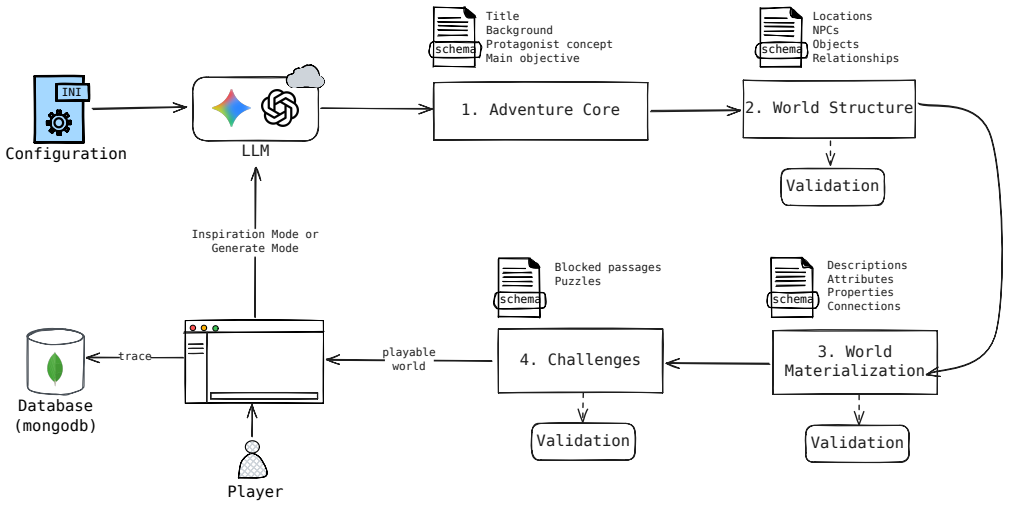
IVIE implements a four-stage incremental generation pipeline on top of the PAYADOR neuro-symbolic framework. Large language models handle creative decisions such as setting and character creation plus puzzle design, while symbolic validation enforces consistency across interconnected locations, functional items, non-player characters, and goal-oriented puzzles. Human evaluation of the generated worlds shows them to be immersive and thematically coherent with high player engagement, supporting the claim that symbolic grounding can constrain LLM output without removing generative flexibility.
What carries the argument
The four-stage incremental generation pipeline that delegates creative decisions to LLMs while grounding the world state through symbolic validation.
If this is right
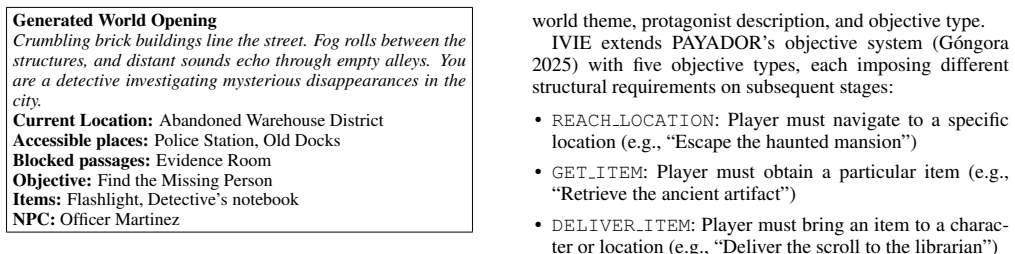
- Worlds can be produced with interconnected locations, functional items, non-player characters, and coherent puzzles structured around a central goal.
- Symbolic validation can constrain LLM output while still allowing creative flexibility in narrative elements.
- Human-evaluated outputs reach high levels of thematic coherence and player engagement.
- Future neurosymbolic storytelling systems can follow the same delegation pattern between neural creativity and symbolic grounding.
Where Pith is reading between the lines
- Adding automated metrics for goal reachability and structural validity would make the validation claims more testable.
- The pipeline might be applied to generate content for existing game engines rather than standalone text worlds.
- Similar incremental validation steps could address coherence issues in other LLM-driven narrative tasks such as multi-character dialogue.
Load-bearing premise
Symbolic validation catches most LLM-generated inconsistencies and human judgments alone are enough to confirm objective playability.
What would settle it
A generated world in which a player cannot reach the stated goal because of an inconsistency that passed the symbolic checks.
Figures

read the original abstract
Computational creativity in Interactive Fiction faces a fundamental tension: Large Language Models (LLM) may produce creative narratives but struggle with world coherence, while symbolic systems ensure consistency but lack creative flexibility. We present IVIE (Incremental & Validated Interactive Experiences), a neuro-symbolic approach to generating complete and playable interactive fiction worlds from scratch. Building upon PAYADOR's neuro-symbolic framework, IVIE implements a four-stage incremental generation pipeline that delegates creative decisions--setting and character creation, puzzle design--to LLMs while grounding the world state through symbolic validation. The system generates worlds with interconnected locations, functional items, non-player characters, and coherent puzzles, all structured around a central goal-oriented architecture. Human evaluation shows the approach generates immersive, thematically coherent worlds with high player engagement. Results seem to indicate that the neuro-symbolic approach successfully balances flexibility with narrative coherence: symbolic validation grounds LLM generation without eliminating generative freedom. However, challenges remain: LLM inconsistencies occasionally bypass puzzle constraints, and objective validation gaps allow some structurally impossible goals. We identify key design considerations for future neurosymbolic interactive storytelling systems, particularly regarding LLM capabilities and their limitations.
Editorial analysis
A structured set of objections, weighed in public.
Referee Report
Summary. The paper presents IVIE, a neuro-symbolic system for generating complete and playable interactive fiction worlds from scratch. It extends the PAYADOR framework with a four-stage incremental pipeline that assigns creative tasks (setting/character creation, puzzle design) to LLMs while using symbolic validation to enforce world-state consistency, interconnected locations, functional items, NPCs, and goal-oriented puzzles. Human evaluation is cited as evidence that the generated worlds are immersive, thematically coherent, and engaging, supporting the claim that the approach balances generative flexibility with narrative coherence, though the authors note residual issues with LLM inconsistencies bypassing constraints and gaps in objective validation.
Significance. If the central claim holds under stronger scrutiny, the work would contribute a concrete neuro-symbolic pipeline for computational creativity in interactive fiction, identifying design considerations for future systems. The incremental, validated generation approach and explicit acknowledgment of LLM limitations are constructive. However, the absence of quantitative metrics for playability reduces the strength of the significance assessment.
major comments (2)
- [Human Evaluation / Results] The central claim that the four-stage pipeline plus symbolic validation produces 'complete and playable' worlds rests on human evaluation alone. No quantitative results are reported for goal-reachability success rate, fraction of worlds containing dead-end states, or automated solvability checks, despite the abstract explicitly stating that 'LLM inconsistencies occasionally bypass puzzle constraints' and 'objective validation gaps allow some structurally impossible goals.'
- [Pipeline Description / Evaluation] The assertion that 'symbolic validation grounds LLM generation without eliminating generative freedom' is load-bearing for the neuro-symbolic contribution, yet the manuscript provides no breakdown of how often validation catches (or fails to catch) inconsistencies, nor any comparison against a pure-LLM baseline on the same metrics.
minor comments (2)
- [Abstract] The abstract uses the hedging phrase 'Results seem to indicate'; this could be replaced with a direct statement of the observed outcomes once the full evaluation numbers are presented.
- [Method] Clarify whether the symbolic validator operates on an explicit state representation (e.g., PDDL-style or custom logic) and how it interfaces with the LLM outputs at each of the four stages.
Simulated Author's Rebuttal
We thank the referee for the constructive comments. We address each major comment below.
read point-by-point responses
-
Referee: [Human Evaluation / Results] The central claim that the four-stage pipeline plus symbolic validation produces 'complete and playable' worlds rests on human evaluation alone. No quantitative results are reported for goal-reachability success rate, fraction of worlds containing dead-end states, or automated solvability checks, despite the abstract explicitly stating that 'LLM inconsistencies occasionally bypass puzzle constraints' and 'objective validation gaps allow some structurally impossible goals.'
Authors: We agree that quantitative metrics for playability would strengthen the claims. The manuscript's evaluation centers on human judgments of immersion and coherence because these are the primary qualities of interest for interactive fiction. In revision we will add any available internal statistics on validation pass rates and explicitly discuss the difficulty of automated solvability checks for open-ended worlds. We already flag the relevant limitations in the abstract and will expand that discussion. revision: partial
-
Referee: [Pipeline Description / Evaluation] The assertion that 'symbolic validation grounds LLM generation without eliminating generative freedom' is load-bearing for the neuro-symbolic contribution, yet the manuscript provides no breakdown of how often validation catches (or fails to catch) inconsistencies, nor any comparison against a pure-LLM baseline on the same metrics.
Authors: We will add a breakdown of validation interventions (number of constraints triggered and rejected outputs) drawn from generation logs. A head-to-head pure-LLM baseline on the same quantitative metrics was not run; we will therefore expand the discussion section to articulate the design rationale for the neuro-symbolic split and acknowledge the lack of direct empirical comparison as a limitation. revision: partial
- A full empirical comparison against a pure-LLM baseline on automated playability metrics would require new experiments outside the scope of the submitted work.
Circularity Check
No circularity; system description is self-contained
full rationale
The paper describes a four-stage neuro-symbolic pipeline for generating interactive fiction worlds, delegating creative elements to LLMs while applying symbolic validation, and reports human evaluation results for coherence and engagement. No equations, parameters, or derivations appear in the provided text. The reference to the prior PAYADOR framework supplies background context but does not serve as the sole justification for the central claim; the new pipeline stages and human-rated outcomes constitute independent content. No self-definitional reductions, fitted inputs presented as predictions, or load-bearing self-citations that collapse the result to its inputs are present.
Axiom & Free-Parameter Ledger
Reference graph
Works this paper leans on
-
[1]
Mark O. Riedl and Vadim Bulitko. Interactive Narrative: An Intelligent Systems Approach. AI Magazine. doi:10.1609/aimag.v34i1.2449
-
[2]
2003 , isbn =
Nick Montfort , title =. 2003 , isbn =
2003
-
[3]
Noor Shaker and Julian Togelius and Mark J. Nelson , title =. 2016 , publisher =. doi:10.1007/978-3-319-42716-4 , url =
-
[4]
Riedl , title =
Mark O. Riedl , title =. Medium , year =
-
[5]
Automated Story Generation as Question-Answering , doi =
Castricato, Louis and Frazier, Spencer and Balloch, Jonathan and Tarakad, Nitya and Riedl, Mark , year =. Automated Story Generation as Question-Answering , doi =
-
[6]
Kamrul Hasan Sarker and Lu Zhou and Aaron Eberhart and Pascal Hitzler , title =
Md. Kamrul Hasan Sarker and Lu Zhou and Aaron Eberhart and Pascal Hitzler , title =. AI Communications , year =. doi:10.3233/AIC-210084 , url =
-
[7]
Survey of Hallucination in Natural Language Generation , volume=
Ji, Ziwei and Lee, Nayeon and Frieske, Rita and Yu, Tiezheng and Su, Dan and Xu, Yan and Ishii, Etsuko and Bang, Ye Jin and Madotto, Andrea and Fung, Pascale , title =. 2023 , issue_date =. doi:10.1145/3571730 , journal =
-
[8]
2017 , doi=
What can you do with a rock? Affordance extraction via word embeddings , author=. 2017 , doi=
2017
-
[9]
ACM Transactions on Multimedia Computing, Communications and Applications (TOMM) , volume=
Procedural Content Generation for Games: A Survey , author=. ACM Transactions on Multimedia Computing, Communications and Applications (TOMM) , volume=. 2013 , publisher=
2013
-
[10]
Meehan , title =
James R. Meehan , title =. Proceedings of the 5th International Joint Conference on Artificial Intelligence (IJCAI-77) , year =
-
[11]
Copyright Contracts , editor =
Alina Trapova , title =. Copyright Contracts , editor =. 2023 , doi =
2023
-
[12]
AI Storytelling Game May Expand Publishing's Horizons , year =
-
[13]
Negative Feedback on LLM-Powered Storytelling and Roleplay Apps , year =
-
[14]
Proceedings of The 15th International Conference on Computational Creativity , year=
G. Proceedings of The 15th International Conference on Computational Creativity , year=
-
[15]
Proceedings of The 17th International Conference on Computational Creativity , year=
World-State Transformations for Neuro-symbolic Interactive Storytelling , author=. Proceedings of The 17th International Conference on Computational Creativity , year=
-
[16]
2024 , url =
Boluwatife Oluwadare , title =. 2024 , url =
2024
-
[17]
Retrieval-Augmented Generation for Knowledge-Intensive NLP Tasks , booktitle =
Patrick Lewis and Ethan Perez and Aleksandra Piktus and Fabio Petroni and Vladimir Karpukhin and Naman Goyal and Heinrich K. Retrieval-Augmented Generation for Knowledge-Intensive NLP Tasks , booktitle =. 2020 , pages =
2020
-
[18]
TattleTale: Storytelling with Planning and Large Language Models , year=
Nisha Ingrid Simon and Christian Muise , url=. TattleTale: Storytelling with Planning and Large Language Models , year=
-
[19]
Proceedings of the ACM on Human-Computer Interaction , year =
Kotaro Nishigori, Hideaki Takeda , title =. Proceedings of the ACM on Human-Computer Interaction , year =
-
[20]
arXiv preprint arXiv:2505.12439 , year =
Zihao Li and Zichong Wang and Caiming Xiong and Chen Xing , title =. arXiv preprint arXiv:2505.12439 , year =
-
[21]
Martin and Francis Ferraro , title =
Rachel Chambers and Naomi Tack and Eliot Pearson and Lara J. Martin and Francis Ferraro , title =. 4th Wordplay: When Language Meets Games Workshop @ ACL 2024 , year =
2024
-
[22]
2025 , school=
Approaches to interactive and improvisational storytelling , author=. 2025 , school=
2025
-
[23]
Skill Check: Some Considerations on the Evaluation of Gamemastering Models for Role-Playing Games
G \'o ngora, Santiago and Chiruzzo, Luis and M \'e ndez, Gonzalo and Gerv \'a s, Pablo. Skill Check: Some Considerations on the Evaluation of Gamemastering Models for Role-Playing Games. Games and Learning Alliance. 2024
2024
-
[24]
Proceedings of the 2022 Conference on Empirical Methods in Natural Language Processing , pages=
Dungeons and Dragons as a Dialog Challenge for Artificial Intelligence , author=. Proceedings of the 2022 Conference on Empirical Methods in Natural Language Processing , pages=
2022
-
[25]
and Lindsay, Alan and Cavazza, Marc , title =
Porteous, Julie and Ferreira, João F. and Lindsay, Alan and Cavazza, Marc , title =. Autonomous Agents and Multi-Agent Systems , year =
-
[26]
Kelly and A
J. Kelly and A. Calderwood and N. Wardrip-Fruin and M. Mateas , title =. Proceedings of the AAAI Conference on Artificial Intelligence and Interactive Digital Entertainment (AIIDE) , year =
-
[27]
The Thirteenth International Conference on Learning Representations, ICLR 2025, Singapore, April 24-28, 2025 , publisher =
Jailbreaking as a Reward Misspecification Problem , author =. The Thirteenth International Conference on Learning Representations, ICLR 2025, Singapore, April 24-28, 2025 , publisher =. 2025 , url =
2025
-
[28]
Liu, Nelson F. and Lin, Kevin and Hewitt, John and Paranjape, Ashwin and Bevilacqua, Michele and Petroni, Fabio and Liang, Percy. Lost in the Middle: How Language Models Use Long Contexts. Transactions of the Association for Computational Linguistics. 2024. doi:10.1162/tacl_a_00638
-
[29]
Contemporary Music Review , volume =
Giancarlo Schiaffini , title =. Contemporary Music Review , volume =. 2006 , doi =
2006
-
[30]
Keith Sawyer , title =
R. Keith Sawyer , title =. Mind, Culture, and Activity , volume =. 2000 , doi =
2000
-
[31]
2016 , type =
Henri Bomström , title =. 2016 , type =
2016
-
[32]
and Barr, Pippin , title =
Khaled, Rilla and Nelson, Mark J. and Barr, Pippin , title =. Proceedings of the SIGCHI Conference on Human Factors in Computing Systems , series =. 2013 , pages =
2013
-
[33]
ECAI 2012 , pages=
Computational creativity: The final frontier? , author=. ECAI 2012 , pages=. 2012 , publisher=
2012
-
[34]
arXiv preprint arXiv:2505.03547 , year=
STORY2GAME: Generating (almost) everything in an interactive fiction game , author=. arXiv preprint arXiv:2505.03547 , year=
-
[35]
The 4th Wordplay: When Language Meets Games Workshop , year=
Berall: Towards generating retrieval-augmented state-based interactive fiction games , author=. The 4th Wordplay: When Language Meets Games Workshop , year=
-
[36]
The 4th Wordplay: When Language Meets Games Workshop , year=
DAGGER: Data Augmentation for Generative Gaming in Enriched Realms , author=. The 4th Wordplay: When Language Meets Games Workshop , year=
-
[37]
International Conference on Interactive Digital Storytelling , pages=
From playing the story to gaming the system: Repeat experiences of a large language model-based interactive story , author=. International Conference on Interactive Digital Storytelling , pages=. 2023 , organization=
2023
-
[38]
arXiv preprint arXiv:2307.02483 , year =
Jailbroken: How Does LLM Safety Training Fail? , author =. arXiv preprint arXiv:2307.02483 , year =
-
[39]
Interactive Storytelling: 9th International Conference on Interactive Digital Storytelling, ICIDS 2016, Los Angeles, CA, USA, November 15--18, 2016, Proceedings 9 , pages=
Improvisational computational storytelling in open worlds , author=. Interactive Storytelling: 9th International Conference on Interactive Digital Storytelling, ICIDS 2016, Los Angeles, CA, USA, November 15--18, 2016, Proceedings 9 , pages=. 2016 , organization=
2016
-
[40]
2025 , type =
Vaucher, Micaela and Silveira, Santiago , title =. 2025 , type =
2025
-
[41]
Two Tales of Persona in LLM s: A Survey of Role-Playing and Personalization
Tseng, Yu-Min and Huang, Yu-Chao and Hsiao, Teng-Yun and Chen, Wei-Lin and Huang, Chao-Wei and Meng, Yu and Chen, Yun-Nung. Two Tales of Persona in LLM s: A Survey of Role-Playing and Personalization. Findings of the Association for Computational Linguistics: EMNLP 2024. 2024. doi:10.18653/v1/2024.findings-emnlp.969
discussion (0)
Sign in with ORCID, Apple, or X to comment. Anyone can read and Pith papers without signing in.