Symmetry-electronic fingerprints reveal competing magnetic phases in two-dimensional materials
Pith reviewed 2026-06-27 05:59 UTC · model grok-4.3
The pith
Symmetry-electronic fingerprints allow machine learning models to classify magnetic ordering in 2D materials and use uncertainty to identify competing ferromagnetic and antiferromagnetic phases.
A machine-rendered reading of the paper's core claim, the machinery that carries it, and where it could break.
Core claim
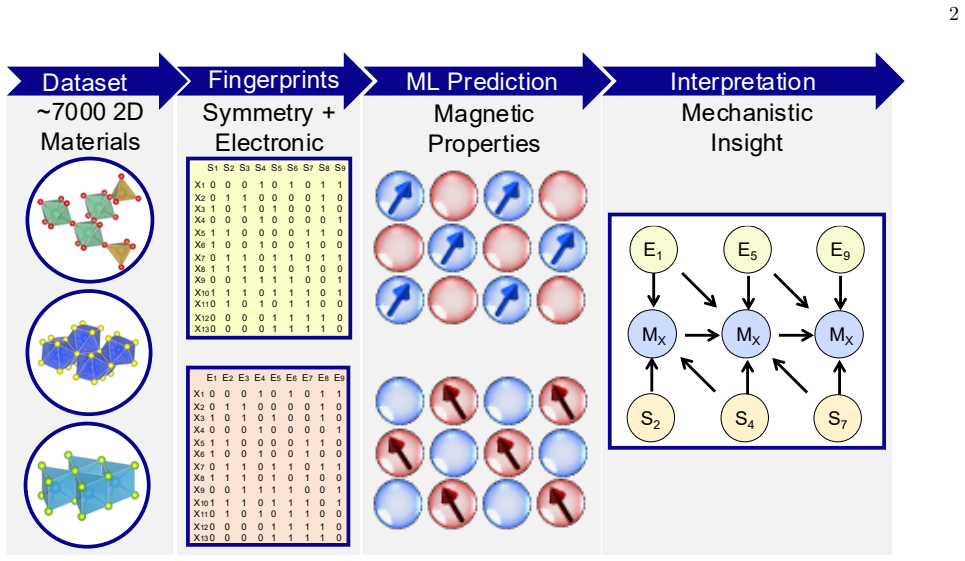
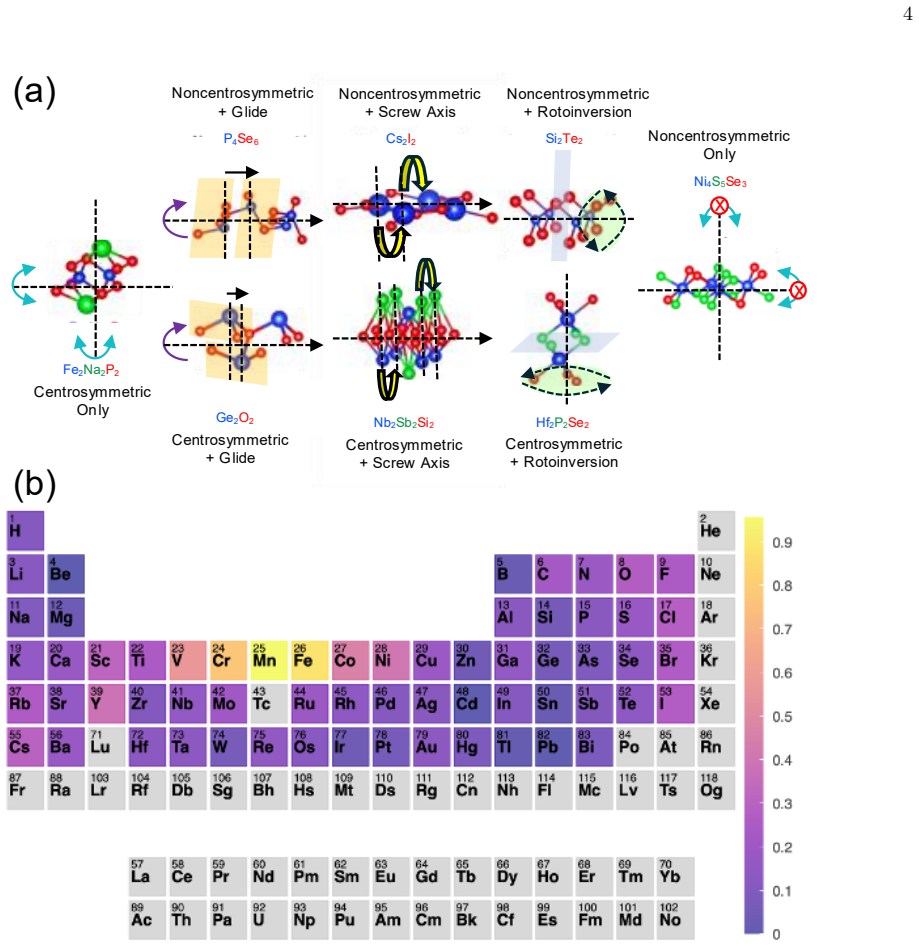
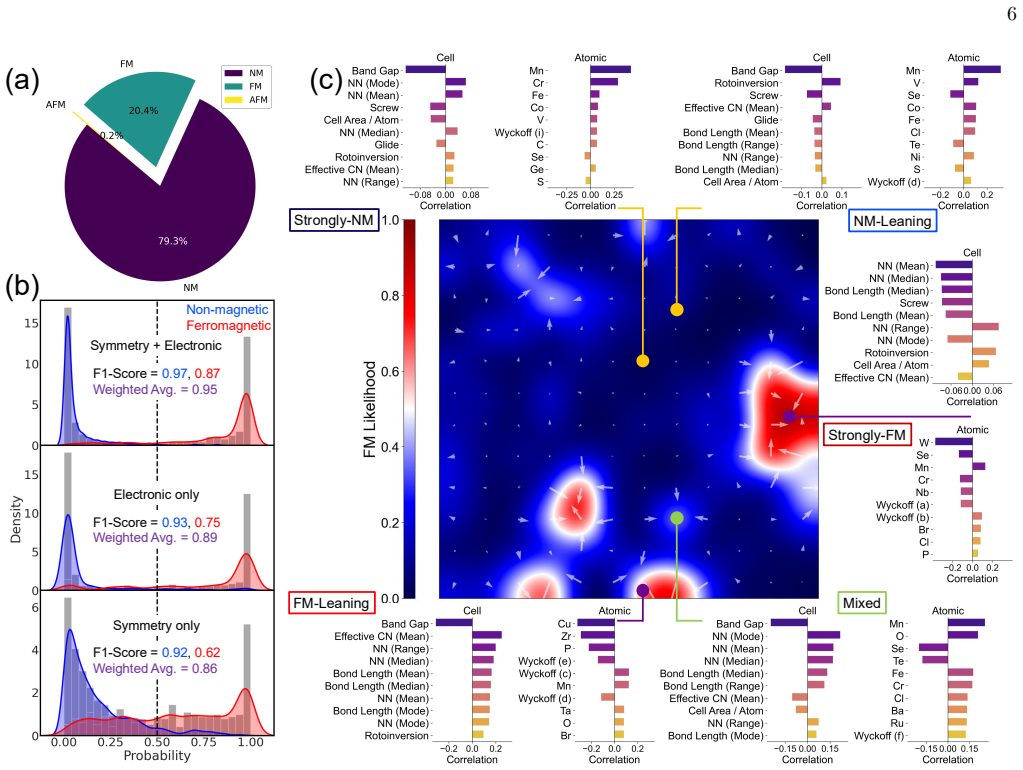
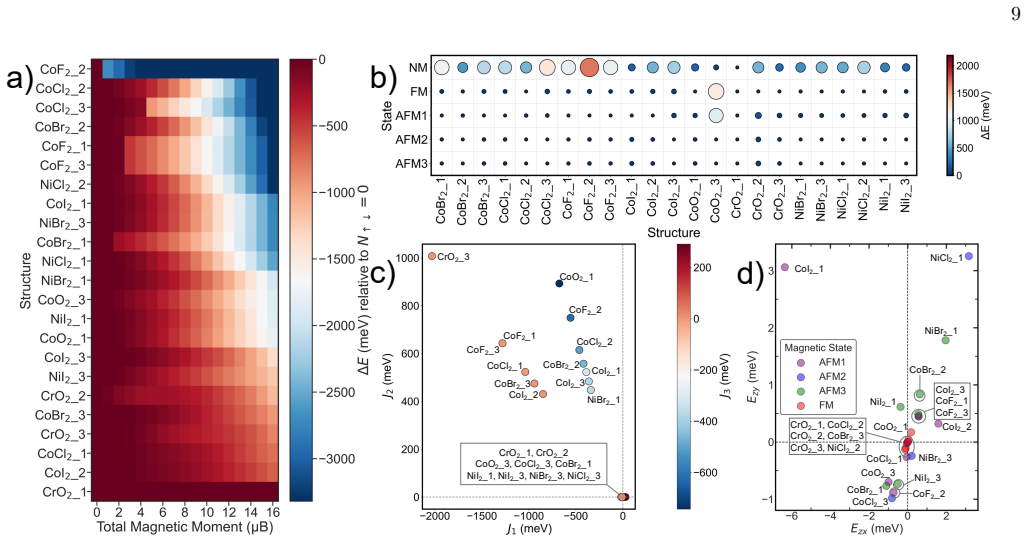
The symmetry-electronic fingerprint (SEF) encodes crystallographic symmetry operations, Wyckoff-site geometry, together with site-resolved electronic structure. When paired with ensemble random forest learning, SEF-trained models accurately classify magnetic ordering while regressing moments alongside anisotropy energies while simultaneously resolving the distinct regimes of itinerant Stoner ferromagnetism from localized superexchange. Regions of elevated model uncertainty identify materials where these mechanisms compete, corresponding to genuine near-degenerate FM and AFM phases with magnetic frustration, suppressed anisotropy, and emergent non-collinear ordering as validated by first-prin
What carries the argument
The symmetry-electronic fingerprint (SEF), a representation that encodes crystallographic symmetry operations, Wyckoff-site geometry, and site-resolved electronic structure to capture exchange physics for machine learning models of magnetism.
If this is right
- Models classify magnetic ordering accurately in two-dimensional materials.
- Models regress magnetic moments and anisotropy energies from the SEF representation.
- Models resolve distinct regimes of itinerant Stoner ferromagnetism from localized superexchange.
- Elevated uncertainty identifies materials with near-degenerate FM and AFM phases.
- These phases exhibit magnetic frustration, suppressed anisotropy, and potential non-collinear ordering.
Where Pith is reading between the lines
- The SEF approach could extend to databases of 2D materials beyond the Co- and Ni-based compounds used for validation.
- High-uncertainty materials may respond to external perturbations like strain or doping to switch between collinear and non-collinear states.
- The uncertainty-as-diagnostic strategy might apply to other competing order problems such as charge density waves or superconductivity.
- Integration with additional electronic structure features could refine predictions of anisotropy in frustrated systems.
Load-bearing premise
Elevated model uncertainty in the SEF-random forest models reliably signals genuine physical competition between magnetic phases rather than data sparsity or model limitations.
What would settle it
First-principles calculations on a high-uncertainty material that find a large energy separation between ferromagnetic and antiferromagnetic states instead of near-degeneracy would falsify the claim that uncertainty indicates competing phases.
Figures
read the original abstract
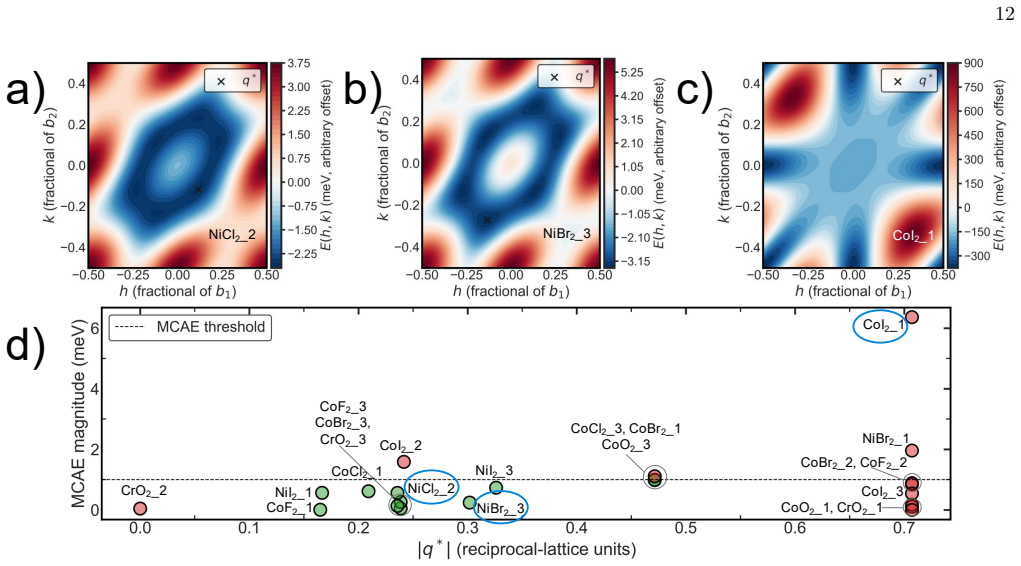
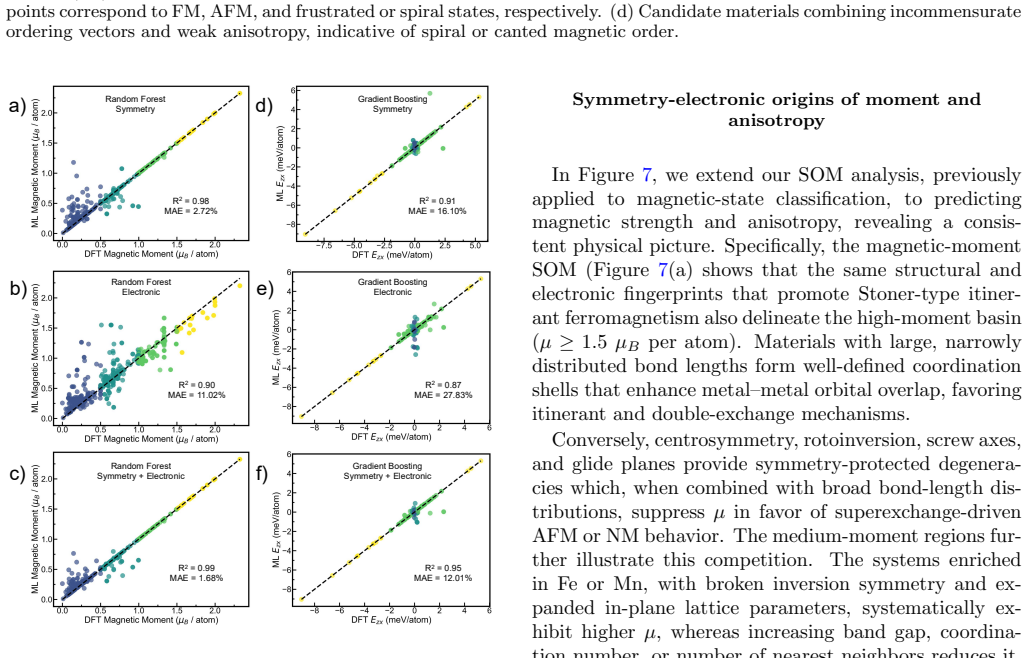
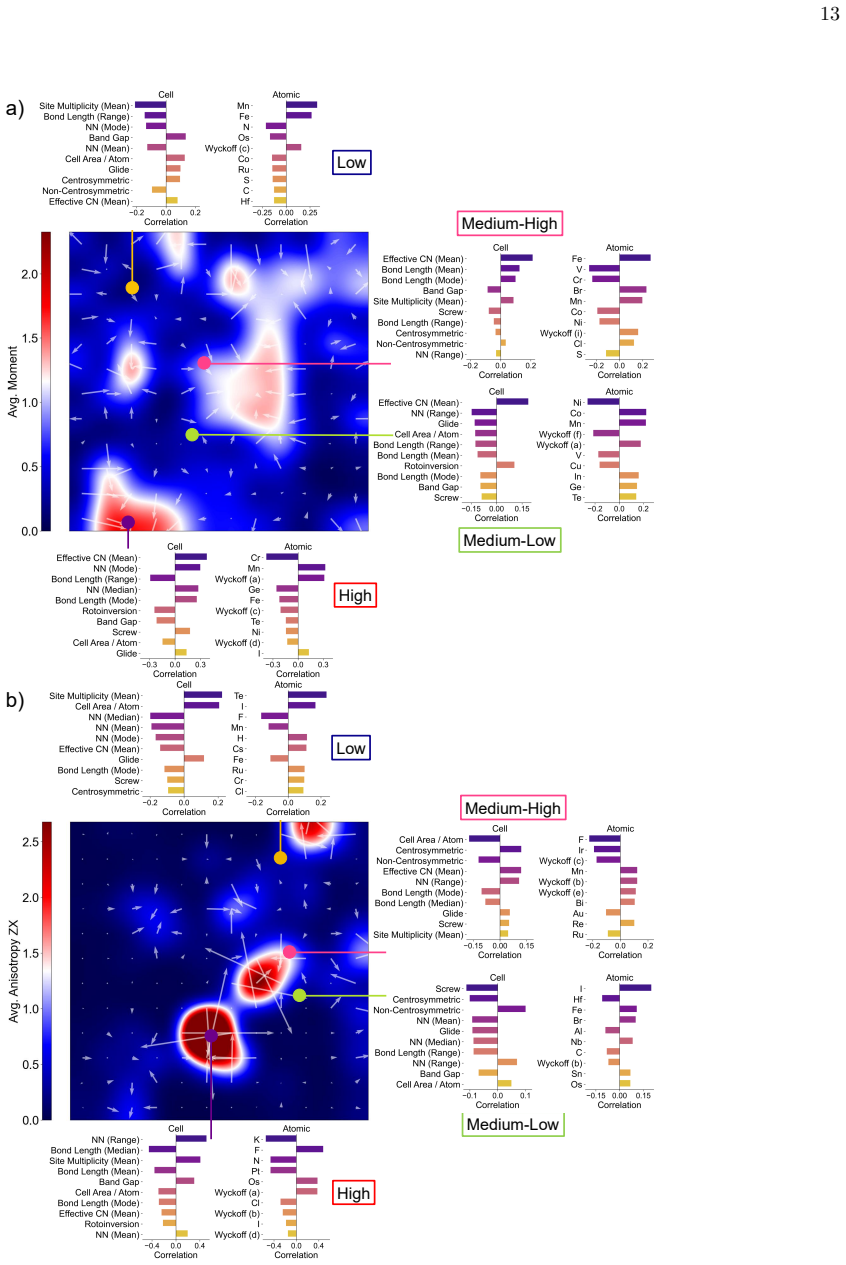
Two-dimensional magnets offer compelling platforms for spintronics and quantum technologies, yet predicting their magnetic ground states, moments, and anisotropy remains challenging. This limitation primarily arises because existing machine-learning representations encode chemical environments without capturing the symmetry or exchange physics that govern magnetism. In this work, we introduce the symmetry-electronic fingerprint (SEF), a physically interpretable representation that encodes crystallographic symmetry operations, Wyckoff-site geometry, together with site-resolved electronic structure. Combined with ensemble learning with random forests, the SEF accurately classifies magnetic ordering while regressing moments alongside anisotropy energies while simultaneously resolving the distinct regimes of itinerant Stoner ferromagnetism from localized superexchange. What sets the SEF-trained models apart is that regions of elevated model uncertainty are not a failure but a diagnostic, identifying materials where these mechanisms compete. First-principles calculations on Co- and Ni-based halides and oxides confirm that these regions correspond to genuine near-degenerate FM and AFM phases with magnetic frustration, suppressed anisotropy, and emergent non-collinear ordering. By encoding symmetry together with exchange physics directly into the representation unlike conventional descriptors, the SEF transforms model uncertainty into a compass pointing toward two-dimensional materials where small perturbations drive transitions between collinear, frustrated, or non-collinear magnetic phases.
Editorial analysis
A structured set of objections, weighed in public.
Referee Report
Summary. The manuscript introduces the symmetry-electronic fingerprint (SEF), a representation that encodes crystallographic symmetry operations, Wyckoff-site geometry, and site-resolved electronic structure for two-dimensional materials. Combined with random-forest ensemble learning, the SEF is claimed to classify magnetic ordering, regress magnetic moments and anisotropy energies, distinguish itinerant Stoner ferromagnetism from localized superexchange, and treat elevated model uncertainty as a diagnostic for materials exhibiting competing magnetic phases; first-principles calculations on Co- and Ni-based halides and oxides are presented as confirmation that high-uncertainty regions correspond to near-degenerate FM/AFM states with frustration and suppressed anisotropy.
Significance. If the quantitative performance and uncertainty interpretation hold under rigorous validation, the SEF would provide a physically motivated descriptor that turns ensemble variance into a pointer toward 2D materials with tunable or frustrated magnetism. The explicit incorporation of symmetry and exchange physics into the representation is a conceptual strength relative to purely chemical-environment descriptors.
major comments (2)
- [Abstract] Abstract: the central claims of accurate classification, regression, mechanism resolution, and diagnostic use of uncertainty are asserted without any reported quantitative metrics (accuracy, R², MAE, error bars), dataset size, train/test split protocol, or cross-validation details, rendering it impossible to assess whether the SEF-RF models actually outperform conventional descriptors or whether the uncertainty signal is load-bearing.
- [Validation] Validation (implied results section): first-principles checks are restricted to Co- and Ni-based halides/oxides; no quantitative correlation (e.g., uncertainty vs. DFT FM-AFM energy difference), no ablation on training-set density, and no test compounds outside this chemistry are provided, so the claim that elevated uncertainty specifically flags physical competition rather than data sparsity or extrapolation remains untested.
Simulated Author's Rebuttal
We thank the referee for the constructive feedback. The comments highlight important areas for clarification and strengthening of the presentation. We respond to each major comment below.
read point-by-point responses
-
Referee: [Abstract] Abstract: the central claims of accurate classification, regression, mechanism resolution, and diagnostic use of uncertainty are asserted without any reported quantitative metrics (accuracy, R², MAE, error bars), dataset size, train/test split protocol, or cross-validation details, rendering it impossible to assess whether the SEF-RF models actually outperform conventional descriptors or whether the uncertainty signal is load-bearing.
Authors: We agree that the abstract should include quantitative metrics to support the claims. In the revised manuscript we will update the abstract to report classification accuracy, regression R² and MAE values, dataset size, train/test split details, and cross-validation protocol. revision: yes
-
Referee: [Validation] Validation (implied results section): first-principles checks are restricted to Co- and Ni-based halides/oxides; no quantitative correlation (e.g., uncertainty vs. DFT FM-AFM energy difference), no ablation on training-set density, and no test compounds outside this chemistry are provided, so the claim that elevated uncertainty specifically flags physical competition rather than data sparsity or extrapolation remains untested.
Authors: The validation is focused on Co- and Ni-based systems because these permit direct first-principles confirmation of the physical meaning of high-uncertainty predictions. We will add a quantitative correlation between model uncertainty and DFT FM-AFM energy differences. We acknowledge the absence of ablation studies and external-chemistry tests as a limitation of the current scope and will expand the discussion section to address generalizability while retaining the core physical demonstration within the studied chemistry. revision: partial
Circularity Check
No significant circularity detected
full rationale
The paper defines the SEF representation from crystallographic symmetry, Wyckoff geometry, and site-resolved electronic structure, then trains random-forest ensembles on this descriptor against external first-principles data for classification of magnetic order, regression of moments and anisotropy, and use of ensemble variance as a diagnostic. No equation or workflow step reduces a claimed prediction or uniqueness result to a quantity defined in terms of the model's own fitted outputs; the validation on Co/Ni halides and oxides is presented as an independent first-principles check rather than a tautology. The derivation chain therefore remains self-contained against external benchmarks.
Axiom & Free-Parameter Ledger
axioms (1)
- domain assumption Machine learning models trained on symmetry-plus-electronic representations can distinguish itinerant Stoner ferromagnetism from localized superexchange mechanisms.
invented entities (1)
-
Symmetry-electronic fingerprint (SEF)
no independent evidence
Reference graph
Works this paper leans on
-
[27]
Kresse and J
G. Kresse and J. Furthm¨ uller, Computational materials science6, 15 (1996). 16
1996
-
[31]
M.-P. Miao, N. Liu, W.-H. Zhang, J.-W. Zhou, D.-B. Wang, C. Wang, W. Ji, and Y.-S. Fu, Proceedings of the National Academy of Sciences122, e2422868122 (2025). ∗ fuhras@ornl.gov † ghosha@iitm.ac.in thebibliography31
2025
-
[32]
Gong and X
C. Gong and X. Zhang, Science363, eaav4450 (2019)
2019
-
[33]
Gibertini, M
M. Gibertini, M. Koperski, A. F. Morpurgo, and K. S. Novoselov, Nature nanotechnology14, 408 (2019)
2019
-
[34]
Torelli, K
D. Torelli, K. S. Thygesen, and T. Olsen, 2D Materials 6, 045018 (2019)
2019
-
[35]
T. D. Rhone, W. Chen, S. Desai, S. B. Torrisi, D. T. Larson, A. Yacoby, and E. Kaxiras, Scientific Reports 10, 15795 (2020)
2020
-
[36]
S.-O. Kaba, B. Groleau-Par´ e, M.-A. Gauthier, A.-M. Tremblay, S. Verret, and C. Gauvin-Ndiaye, Physical Review Materials7, 044407 (2023)
2023
-
[37]
Ghosh, F
A. Ghosh, F. Ronning, S. M. Nakhmanson, and J.-X. Zhu, Physical Review Materials4, 064414 (2020)
2020
-
[38]
M. K. Horton, J. H. Montoya, M. Liu, and K. A. Persson, npj Computational Materials5, 64 (2019)
2019
-
[39]
Y. Xie, G. A. Tritsaris, O. Gr˚ an¨ as, and T. D. Rhone, The Journal of Physical Chemistry Letters12, 12048 (2021)
2021
-
[40]
C. M. Acosta, E. Ogoshi, J. A. Souza, and G. M. Dalpian, ACS Applied Materials & Interfaces14, 9418 (2022)
2022
-
[41]
Singh, P
S. Singh, P. Joshi, A. Sharma, and A. Kashyap, Journal of Magnetism and Magnetic Materials , 173541 (2025)
2025
-
[42]
Elrashidy, J
A. Elrashidy, J. Della-Giustina, and J.-A. Yan, The Journal of Physical Chemistry C128, 6007 (2024)
2024
-
[43]
A. Chotrattanapituk, R. Okabe, E. Rha, M. Al-Hinai, E. Jiang, D. Pajerowski, Y. Cheng, J. J. Turner, and M. Li, arXiv preprint arXiv:2605.16230 (2026)
Pith/arXiv arXiv 2026
-
[44]
Litvin, Foundations of Crystallography64, 419 (2008)
D. Litvin, Foundations of Crystallography64, 419 (2008)
2008
-
[45]
Bruno, Physical Review B39, 865 (1989)
P. Bruno, Physical Review B39, 865 (1989)
1989
-
[46]
Dzyaloshinsky, Journal of physics and chemistry of solids4, 241 (1958)
I. Dzyaloshinsky, Journal of physics and chemistry of solids4, 241 (1958)
1958
-
[47]
P. W. Anderson, Physical Review79, 350 (1950)
1950
-
[48]
J. B. Goodenough, Physical Review100, 564 (1955)
1955
-
[49]
Kanamori, Journal of Physics and Chemistry of Solids 10, 87 (1959)
J. Kanamori, Journal of Physics and Chemistry of Solids 10, 87 (1959)
1959
-
[50]
Oviedo, J
F. Oviedo, J. L. Ferres, T. Buonassisi, and K. T. Butler, Accounts of Materials Research3, 597 (2022)
2022
-
[51]
Zhong, B
X. Zhong, B. Gallagher, S. Liu, B. Kailkhura, A. Hisz- panski, and T. Y.-J. Han, npj computational materials 8, 204 (2022)
2022
-
[52]
Kohonen,Self-organizing maps, Vol
T. Kohonen,Self-organizing maps, Vol. 30 (Springer Sci- ence & Business Media, 2012)
2012
-
[53]
Haastrup, M
S. Haastrup, M. Strange, M. Pandey, T. Deilmann, P. S. Schmidt, N. F. Hinsche, M. N. Gjerding, D. Torelli, P. M. Larsen, A. C. Riis-Jensen,et al., 2D Materials5, 042002 (2018)
2018
-
[54]
A. Togo, K. Shinohara, and I. Tanaka, Science and Technology of Advanced Materials: Methods4, 2384822 (2024)
2024
-
[55]
S. P. Ong, W. D. Richards, A. Jain, G. Hautier, M. Kocher, S. Cholia, D. Gunter, V. L. Chevrier, K. A. Persson, and G. Ceder, Computational Materials Science 68, 314 (2013)
2013
-
[56]
D. E. Sands,Introduction to crystallography(Courier Corporation, 1993)
1993
-
[57]
Breiman, Machine learning45, 5 (2001)
L. Breiman, Machine learning45, 5 (2001)
2001
-
[58]
Kresse and J
G. Kresse and J. Furthm¨ uller, Computational materials science6, 15 (1996)
1996
-
[59]
Kresse and J
G. Kresse and J. Furthm¨ uller, Physical review B54, 11169 (1996)
1996
-
[60]
K. S. Burch, D. Mandrus, and J.-G. Park, Nature563, 47 (2018)
2018
-
[61]
Hou and R
Y. Hou and R. Wu, Advanced Functional Materials35, e09453 (2025)
2025
-
[62]
M.-P. Miao, N. Liu, W.-H. Zhang, J.-W. Zhou, D.-B. Wang, C. Wang, W. Ji, and Y.-S. Fu, Proceedings of the National Academy of Sciences122, e2422868122 (2025)
2025
discussion (0)
Sign in with ORCID, Apple, or X to comment. Anyone can read and Pith papers without signing in.