REVIEW 3 major objections 6 minor 1 cited by
Probing the fate of large primordial perturbations with exoplanets
T0 review · 3 major / 6 minor · reviewed 2026-07-12 · grok-4.5
Pith's one-line read Ultra-wide exoplanets already set competitive limits on large primordial density peaks that would seed ultra-compact dark minihalos.
desk verdict Solid new dynamical probe that converts non-disruption of a dozen ultra-wide exoplanets into competitive PPS peak limits via a careful UCMH population model; the statistics are the softest link but not fatal. read the letter →
The pith
A machine-rendered reading of the paper's core claim, the machinery that carries it, and where it could break.
The reading
What carries the argument
Impulsive heating rate of a planet–star binary by a Galactic population of ultra-compact minihalos, converted into a Poisson survival probability and combined across systems into a global P_surv that is compared with nσ thresholds.
What would settle it
Discovery of even one additional, older, more loosely bound planet whose calculated heating-to-binding ratio exceeds unity under the same minihalo population would push the global survival probability below the claimed nσ contour and falsify or tighten the exclusion.
Extended reading notes
Core claim
A carefully selected sample of twelve ultra-wide-orbit exoplanets already excludes primordial power-spectrum peaks of amplitude A• ≳ 10^{-4}–10^{-2} on comoving scales k• ∼ 10^2–10^4 Mpc^{-1} that would produce ultra-compact minihalos heavier than ∼10^5 solar masses, at 1–5σ depending on whether pre-accreted minihalos are counted.
Load-bearing premise
Each planet’s survival probability is treated as statistically independent and is computed from a Poisson number of encounters whose mean is fixed by a semi-analytic model of the local ultra-compact-minihalo density; any residual correlation or density error simply rescales the global exclusion.
Editorial analysis
A structured set of objections, weighed in public.
Referee Report
Summary. The paper proposes ultra-wide-orbit exoplanets as a dynamical probe of Galactic compact dark-matter objects, specializing to ultra-compact minihalos (UCMHs) formed from a peaked enhancement of the primordial power spectrum. Impulsive heating of a planet–star system is derived in the weak-encounter limit (Eqs. 2–11), disruption is diagnosed via a heating-to-binding ratio R_heat (Eq. 13), and a Poisson encounter model is used to define individual disruption probabilities that are multiplied into a global survival probability P_surv (Eq. 22). A semi-analytic excursion-set/merger-tree UCMH population (App. A), including tidal stripping, is mapped onto the two peak parameters (A•, k•). From a catalogue cut yielding twelve systems (Table I, Fig. 2), the authors report 1–5σ exclusions on large-amplitude peaks that produce UCMHs ≳10^5 M⊙ (Fig. 4), and they derive adiabatic-invariant evolution equations for semi-major axis, eccentricity, and inclination as potential positive signatures (Sect. V, App. B).
Significance. If the statistical combination and local UCMH density are under control, the work opens a genuinely new dynamical channel for small-scale primordial power, complementary to CMB, Lyman-α, spectral distortions, and PTA limits, and it is well timed for Roman and ELT direct-imaging yields. Strengths that should be credited include: (i) a self-contained EST-based UCMH mass function and host-halo merger tree (App. A) that cleanly links A• and k• to a Galactic population; (ii) closed-form orbital-evolution equations from actions (Eqs. 27–28, App. B) that make a falsifiable multi-planet inclination signature; and (iii) an explicit mock-population check against selection bias (App. C). The result is therefore of clear interest to both cosmology and exoplanetary dynamics, provided the load-bearing statistical steps are tightened.
major comments (3)
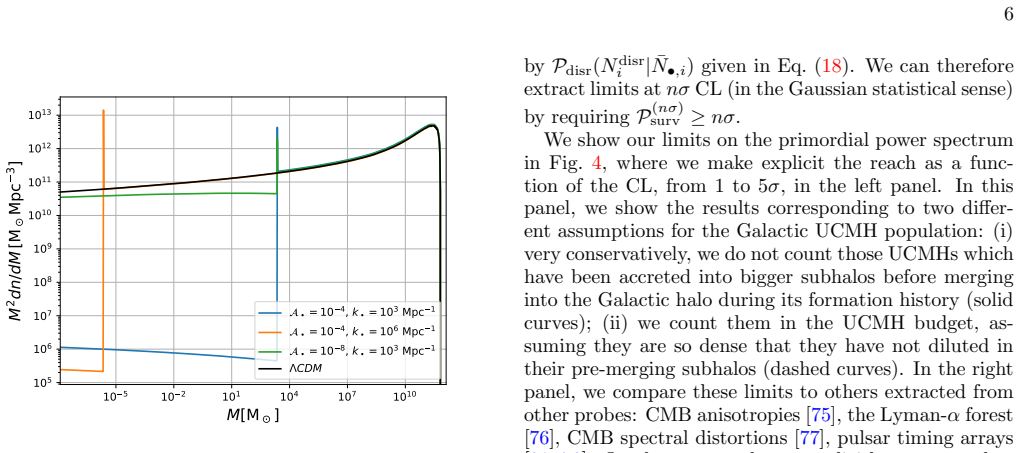
- Eq. (22) and surrounding text in Sect. IV define the nσ contours of Fig. 4 from the product of individual survival probabilities, treating the twelve systems as statistically independent. Fig. 2 shows that all selected systems lie within a few hundred parsecs to ~kpc of the Sun and therefore sample essentially the same local UCMH density and velocity field. Any residual spatial correlation or shared systematic in the App. A merger-tree/tidal-stripping prediction multiplies rather than averages in P_surv. The manuscript should either (a) quantify the impact of a coherent shift in local n• (or of a modest correlation coefficient) on the 3–5σ contours, or (b) report single-system and leave-one-out limits alongside the product so that the headline exclusion is not driven solely by the independence assumption.
- In the light-UCMH regime that sets the tightest bounds (b_min ≪ R_p; cf. the asymptotic scalings after Eq. 13 and the estimate in Eq. 19), the mean encounter number N_bar (Eq. 15) is typically ≪1. Disruption then sits in the Poisson tail of Eq. (17)–(18), which is sensitive to the precise local density, to 〈v_rel〉, and to the somewhat conventional b_max cut in Eq. (12). A 30–50% coherent uncertainty in the predicted local UCMH density (or a change in the b_max prescription) would rescale A• at fixed CL by a comparable factor. The paper should propagate these systematics into the exclusion bands of Fig. 4 (or show a dedicated sensitivity plot) rather than presenting only the two discrete ‘conservative/optimistic f’ curves.
- The disruption criterion R_heat ≥ 1 (Eq. 13) is converted to a Poisson probability of ‘enough’ encounters, each depositing the average heat 〈δε〉. For rare, high-impact encounters this mean-field step can mis-estimate the true disruption probability relative to a Monte-Carlo sampling of the full (m•, b) distribution. At minimum, the authors should validate the Poisson-plus-mean-heat approximation against a direct Monte-Carlo of encounter histories for a representative subset of the twelve systems (especially those with the largest R_p T / m⋆ in Table I), and state the fractional change in P_disr.
minor comments (6)
- Numerous typographical and spacing errors remain (e.g. abstract ‘noval’; p. 2 ‘deonstrate’, ‘indentical’; ‘Obvioulsy’; section headers with broken spaces such as ‘HEA TING’, ‘POPULA TION’; ‘seee.g.’). A full proof-read is needed.
- Fig. 4 left panel: the 1–5σ curves for conservative vs optimistic f are hard to distinguish at small k; a clearer linestyle/legend or separate panels would help.
- Eq. (12): the numerical prefactor in b_max = 〈v_rel〉 P / (3√3) is not derived in the text; a one-line justification (or a reference to the exact impulse-duration criterion) would improve reproducibility.
- Table I lists twelve systems but the text says ‘a selected sample of 128 objects’ and ‘the 10 most constraining… with 8 common’. A short table or appendix listing the full cut criteria and the discarded objects would make the sample transparent.
- App. A, Eq. (A17)–(A19): the (G0, γ1, γ2) = (0.57, 0.38, −0.01) correction is taken from the literature; state explicitly whether results change under pure Press–Schechter (no G factor), at least for the UCMH fraction F_host•.
- Sect. V / Fig. 5: the analytic low-e solutions underestimate a(t) and overestimate e(t); the text already notes this, but quoting the fractional error on t_ej (~20%) in the caption would help readers who use only the analytic formulae.
Circularity Check
No significant circularity: exoplanet catalogue is external data fed into a forward UCMH population model whose free parameters are the PPS peak parameters being constrained.
full rationale
The derivation chain is self-contained and non-circular. The heating rate (Eqs. 8–11), disruption criterion (Eq. 13), Poisson encounter statistics (Eqs. 14–18), and global survival probability (Eq. 22) are standard dynamical constructions applied to an external exoplanet catalogue (exoplanet.eu). The only free parameters of the model are the two PPS peak parameters (A•, k•) that are being constrained; no quantity is fitted to the exoplanet sample and then re-used as a prediction. The Galactic UCMH mass function and tidal-stripping model of App. A are built from excursion-set theory plus the authors’ earlier semi-analytic machinery (Refs. [71, 73, 74, 86]), but those citations supply an independent forward model of structure formation, not a result that already encodes the exoplanet survival data. The orbital-evolution signatures of Sect. V follow from adiabatic invariants and are likewise independent of the exclusion contours. The softest links (independence of the twelve systems, Poisson assumption for N̄ ≪ 1) are modelling assumptions that affect the numerical strength of the limits, not circular reductions of the claimed derivation. Score 1 reflects only the minor, non-load-bearing self-citation of the authors’ prior tidal-stripping papers.
Assumptions & free parameters
free parameters (4)
- A• (peak amplitude)
- k• (peak injection scale)
- local DM density ρ_dm(⊙)
- relative velocity 〈v_rel〉
assumptions (5)
- domain assumption Impulsive, weak-encounter approximation (deflection angle ≪ π/2, positions fixed during fly-by)
- domain assumption Number of encounters follows a Poisson distribution with mean fixed by the local UCMH density and b_max
- domain assumption UCMH population fully predicted by excursion-set theory with a δ-function peak in the PPS plus the semi-analytic merger tree of App. A
- ad hoc to paper Individual planet survival probabilities are statistically independent
- domain assumption Ages of the selected exoplanets equal the ages of their host stars and are accurately known
Cite this review
Pith. "Pith review of Probing the fate of large primordial perturbations with exoplanets." pith.science (2026). https://pith.science/paper/63GJYX4N
@misc{pith2026260614827,
  author       = {Pith},
  title        = {Pith review of: Probing the fate of large primordial perturbations with exoplanets},
  year         = {2026},
  howpublished = {\url{https://pith.science/paper/63GJYX4N}},
  note         = {Machine review of arXiv:2606.14827}
}
read the original abstract
We propose ultra-wide-orbit exoplanets as a novel probe of small-scale dark matter objects. These systems are highly sensitive to gravitational perturbations that could be induced by a Galactic population of compact baryon-free dark matter objects -- whether point-like or extended. Focusing on ultra-compact minihalos, which may arise from large primordial perturbations deviating from the canonical scale-invariant power spectrum, we derive new constraints on their injection scale and amplitude. These constraints complement existing dynamical limits and are expected to improve with upcoming exoplanet surveys. Furthermore, the detection of additional loosely bound exoplanets with these surveys could significantly tighten these constraints. Beyond constraints, we also identify characteristic observational signatures in these systems that could help trace a population of dark matter objects. All this strengthens the potential of exoplanetary science to probe the dark universe back to its very primordial properties.
Figures


Figures from the paper (8 more)


Forward citations
Cited by 1 Pith paper
-
Wide binaries in ultra-faint dwarf galaxies as a probe of extended dark objects
Wide binaries in Boötes I exclude dark-matter fractions down to ~10^-3 to 10^-2 for extended dark objects between 0.1 and 3000 solar masses with radii up to 10^7 solar radii, implying P_R ≲ 5×10^-6 at k ≈ 4×10^2-3×10^...
Reference graph
Works this paper leans on
-
[1]
The standard lore To go from the matter density contrast fieldδto the matter density fieldδ R averaged over some comoving scaleR, we resort to a filtering window function in real comoving space,W R — for the moment, we forget about the redshift or time dependence on purpose (it factors out, and will be recovered later on); all quantities are evaluated atz...
-
[2]
Such a description is perfectly fine to predict subhalo populations arising from the power-law part of the primordial power spectrum given in Eq
Adding an UCMH component So far, we have discussed the canonical DM case, with the varianceSstemming from a given matter power spec- trumP m. Such a description is perfectly fine to predict subhalo populations arising from the power-law part of the primordial power spectrum given in Eq. (21). How- ever, there should be another population coming from the a...
-
[3]
compactness
Basic tidal evolution of subhalos and UCMHs Since we have defined the subhalo mass function for both standard subhalos and UCMHs in a given host halo, we further need to specify how these objects are spa- tially distributed and evolve in their host halo, assumed spherically symmetric. Here, we will follow the semi- analytical approach developed in Refs. [...
-
[4]
P. J. E. Peebles, ApJL263, L1 (1982)
1982
-
[5]
G. R. Blumenthal, S. M. Faber, J. R. Primack, and M. J. Rees, Nature (London)311, 517 (1984)
1984
- [6]
-
[7]
W. H. Press and P. Schechter, Astrophys. J.187, 425 (1974)
1974
-
[8]
J. M. Bardeen, J. R. Bond, N. Kaiser, and A. S. Szalay, Astrophys. J.304, 15 (1986)
1986
Show all 118 references
-
[9]
J. R. Bond, S. Cole, G. Efstathiou, and N. Kaiser, As- trophys. J.379, 440 (1991)
1991
-
[10]
Lacey and S
C. Lacey and S. Cole, MNRAS262, 627 (1993)
1993
-
[11]
H. Mo, F. C. van den Bosch, and S. White,Galaxy Formation and Evolution(Cambridge University Press, 2010)
2010
-
[12]
Vogelsberger, F
M. Vogelsberger, F. Marinacci, P. Torrey, and E. Puchwein, Nature Reviews Physics2, 42 (2020), arXiv:1909.07976 [astro-ph.GA]
2020 arXiv
-
[13]
Abdallaet al., Journal of High Energy Astrophysics 34, 49 (2022), arXiv:2203.06142 [astro-ph.CO]
E. Abdallaet al., Journal of High Energy Astrophysics 34, 49 (2022), arXiv:2203.06142 [astro-ph.CO]
2022 arXiv
-
[14]
P. J. E. Peebles, Annals of Physics447, 169159 (2022), arXiv:2208.05018 [astro-ph.CO]
2022 arXiv
-
[15]
P. J. E. Peebles, Philosophical Transactions of the Royal Society of London Series A383, 20240021 (2025), arXiv:2405.18307 [astro-ph.CO]
2025 arXiv
-
[16]
Baumann, arXiv e-prints , arXiv:0907.5424 (2009), arXiv:0907.5424 [hep-th]
D. Baumann, arXiv e-prints , arXiv:0907.5424 (2009), arXiv:0907.5424 [hep-th]
2009 arXiv
-
[17]
Ach´ ucarroet al., arXiv e-prints , arXiv:2203.08128 (2022), arXiv:2203.08128 [astro-ph.CO]
A. Ach´ ucarroet al., arXiv e-prints , arXiv:2203.08128 (2022), arXiv:2203.08128 [astro-ph.CO]
2022 arXiv
-
[18]
Cirelli, A
M. Cirelli, A. Strumia, and J. Zupan, arXiv e-prints , arXiv:2406.01705 (2024), arXiv:2406.01705 [hep-ph]
2024 arXiv
-
[19]
Hofmann, D
S. Hofmann, D. J. Schwarz, and H. St¨ ocker, Phys. Rev. D64, 083507 (2001), arXiv:astro-ph/0104173 [astro- ph]
2001 arXiv
-
[20]
A. M. Green, S. Hofmann, and D. J. Schwarz, J. Cosmol- ogy Astropart. Phys.8, 003 (2005), astro-ph/0503387
2005 arXiv
-
[21]
Bringmann and S
T. Bringmann and S. Hofmann, J. Cosmology As- tropart. Phys.4, 016 (2007), hep-ph/0612238
2007 arXiv
-
[22]
D. J. E. Marsh, Phys. Rep.643, 1 (2016), arXiv:1510.07633
2016 arXiv
-
[23]
Dodelson and L
S. Dodelson and L. M. Widrow, Phys. Rev. Lett.72, 17 (1994), hep-ph/9303287
1994 arXiv
-
[24]
Colombi, S
S. Colombi, S. Dodelson, and L. M. Widrow, Astrophys. J.458, 1 (1996), astro-ph/9505029
1996 arXiv
-
[25]
W. Hu, R. Barkana, and A. Gruzinov, Phys. Rev. Lett. 85, 1158 (2000), astro-ph/0003365
2000 arXiv
- [26]
-
[27]
Zavala and C
J. Zavala and C. S. Frenk, Galaxies7, 81 (2019), arXiv:1907.11775 [astro-ph.CO]
2019 arXiv
-
[28]
Silk and A
J. Silk and A. Stebbins, Astrophys. J.411, 439 (1993)
1993
-
[29]
Diemand, M
J. Diemand, M. Kuhlen, P. Madau, M. Zemp, B. Moore, D. Potter, and J. Stadel, Nature (London)454, 735 (2008), arXiv:0805.1244
2008 arXiv
-
[30]
Springel, J
V. Springel, J. Wang, M. Vogelsberger, A. Ludlow, A. Jenkins, A. Helmi, J. F. Navarro, C. S. Frenk, and S. D. M. White, MNRAS391, 1685 (2008), arXiv:0809.0898
2008 arXiv
-
[31]
A. A. Starobinskii, Pisma v Zhurnal Eksperimentalnoi i Teoreticheskoi Fiziki55, 477 (1992)
1992
-
[32]
Baumann and L
D. Baumann and L. McAllister,Inflation and String Theory(Cambridge Monographs on Mathematical Physics, 2014) arXiv:1404.2601 [hep-th]
2014 arXiv
-
[33]
Ballesteros and M
G. Ballesteros and M. Taoso, Phys. Rev. D97, 023501 (2018), arXiv:1709.05565 [hep-ph]
2018 arXiv
-
[34]
C. T. Byrnes, P. S. Cole, and S. P. Patil, J. Cosmology Astropart. Phys.2019, 028 (2019), arXiv:1811.11158 [astro-ph.CO]
2019 arXiv
-
[35]
Franciolini, Y
G. Franciolini, Y. Gouttenoire, and R. Jinno, Phys. Rev. Lett.136, 171404 (2026), arXiv:2503.01962 [hep-ph]
2026 arXiv
-
[36]
B. J. Carr and S. W. Hawking, MNRAS168, 399 (1974)
1974
-
[37]
G. F. Chapline, Nature (London)253, 251 (1975)
1975
-
[38]
Carr and F
B. Carr and F. K¨ uhnel, Annual Review of Nuclear 20 and Particle Science70, 355 (2020), arXiv:2006.02838 [astro-ph.CO]
2020 arXiv
-
[39]
Berezinsky, V
V. Berezinsky, V. Dokuchaev, and Y. Eroshenko, Phys. Rev. D68, 103003 (2003), astro-ph/0301551
2003 arXiv
-
[40]
Ricotti and A
M. Ricotti and A. Gould, Astrophys. J.707, 979 (2009), arXiv:0908.0735 [astro-ph.CO]
2009 arXiv
-
[41]
Berezinsky, V
V. Berezinsky, V. Dokuchaev, Y. Eroshenko, M. Kachel- rieß, and M. A. Solberg, Phys. Rev. D81, 103529 (2010), arXiv:1002.3444 [astro-ph.CO]
2010 arXiv
-
[42]
V. S. Berezinsky, V. I. Dokuchaev, and Y. N. Eroshenko, J. Cosmology Astropart. Phys.12, 007 (2011), arXiv:1107.2751 [astro-ph.HE]
2011 arXiv
-
[43]
V. S. Berezinsky, V. I. Dokuchaev, and Y. N. Eroshenko, Physics Uspekhi57, 1 (2014), arXiv:1405.2204 [astro- ph.HE]
2014 arXiv
-
[44]
M. S. Delos, A. L. Erickcek, A. P. Bailey, and M. A. Alvarez, Phys. Rev. D98, 063527 (2018), arXiv:1806.07389
2018 arXiv
- [45]
-
[46]
C. G. Lacey and J. P. Ostriker, Astrophys. J.299, 633 (1985)
1985
-
[47]
K. V. Johnston, D. N. Spergel, and C. Haydn, Astro- phys. J.570, 656 (2002), arXiv:astro-ph/0111196 [astro- ph]
2002 arXiv
-
[48]
Pe˜ narrubia, A
J. Pe˜ narrubia, A. D. Ludlow, J. Chanam´ e, and M. G. Walker, MNRAS461, L72 (2016), arXiv:1605.09384 [astro-ph.GA]
2016 arXiv
-
[49]
Pe˜ narrubia, MNRAS474, 1482 (2018), arXiv:1710.06443
J. Pe˜ narrubia, MNRAS474, 1482 (2018), arXiv:1710.06443
2018 arXiv
-
[50]
B. T. Chiang, J. P. Ostriker, and H.-Y. Schive, MNRAS 518, 4045 (2023), arXiv:2211.07452 [astro-ph.GA]
2023 arXiv
-
[51]
P. W. Graham, H. Ramani, and M. Ruhdorfer, Phys. Rev. D113, 023047 (2026), arXiv:2510.01310 [hep-ph]
2026
-
[52]
Gilman, A
D. Gilman, A. M. Nierenberg, T. Treu,et al., arXiv e-prints , arXiv:2606.05277 (2026), arXiv:2606.05277 [astro-ph.CO]
2026 arXiv
-
[53]
Bringmann, D
T. Bringmann, D. Croon, and S. Sevillano Mu˜ noz, arXiv e-prints , arXiv:2506.20704 (2025), arXiv:2506.20704 [astro-ph.CO]
2025 arXiv
-
[54]
Ando, arXiv e-prints , arXiv:2603.04267 (2026), arXiv:2603.04267 [astro-ph.CO]
S. Ando, arXiv e-prints , arXiv:2603.04267 (2026), arXiv:2603.04267 [astro-ph.CO]
2026
-
[55]
J. A. Dror, H. Ramani, T. Trickle, and K. M. Zurek, Phys. Rev. D100, 023003 (2019), arXiv:1901.04490
2019 arXiv
-
[56]
Benito, K
M. Benito, K. Karchev, R. K. Leane, S. P˜ oder, J. Smirnov, and R. Trotta, J. Cosmology As- tropart. Phys.2024, 038 (2024), arXiv:2405.09578 [astro-ph.IM]
2024 arXiv
-
[57]
Phoroutan-Mehr and T
M. Phoroutan-Mehr and T. Fetherolf, Phys. Rev. D 112, 036012 (2025), arXiv:2503.00125 [hep-ph]
2025 arXiv
-
[58]
C. Ilie, C. Levy, and J. Diks, J. Cosmology As- tropart. Phys.2024, 082 (2024), arXiv:2312.13979 [astro-ph.CO]
2024 arXiv
-
[59]
B. V. Lehmann, A. Webber, O. G. Ross, and S. Pro- fumo, J. Cosmology Astropart. Phys.2022, 079 (2022), arXiv:2205.09756 [astro-ph.EP]
2022 arXiv
-
[60]
Halpern, E
P. Halpern, E. Cauley, M. Stoltzmann, and M. Wilshusen, arXiv e-prints , arXiv:2512.03118 (2025), arXiv:2512.03118 [gr-qc]
2025
-
[61]
Penarrubia, S
J. Penarrubia, S. E. Koposov, M. G. Walker, G. Gilmore, N. Wyn Evans, and C. D. Mackay, arXiv e- prints , arXiv:1005.5388 (2010), arXiv:1005.5388 [astro- ph.GA]
2010 arXiv
-
[62]
E. D. Ramirez and M. R. Buckley, MNRAS525, 5813 (2023), 2209.08100
2023 arXiv
-
[63]
Tyler, A
E. Tyler, A. M. Green, and S. P. Goodwin, MNRAS 524, 3052 (2023), arXiv:2207.08668 [astro-ph.GA]
2023 arXiv
-
[64]
Shariat, K
C. Shariat, K. El-Badry, M. Gennaro, K. Ding, J. D. Si- mon,et al., PASP137, 104103 (2025), arXiv:2509.04555 [astro-ph.GA]
2025
-
[65]
Bhalla, B
B. Bhalla, B. V. Lehmann, K. Sinha, and T. Xu, Phys. Rev. D111, 043029 (2025), arXiv:2408.04697 [hep-ph]
2025 arXiv
-
[66]
Crida, Comptes Rendus
A. Crida, Comptes Rendus. Physique24, 233 (2023)
2023
-
[67]
Mordasini, Planetary population synthesis, inHand- book of Exoplanets, edited by H
C. Mordasini, Planetary population synthesis, inHand- book of Exoplanets, edited by H. J. Deeg and J. A. Bel- monte (Springer International Publishing, Cham, 2018) pp. 2425–2474
2018
-
[68]
H. J. Deeg and J. A. Belmonte, eds.,Handbook of Exo- planets, 2nd ed. (Springer Cham, 2026)
2026
-
[69]
N. R. Deacon, M. C. Liu, E. A. Magnier,et al., Astro- phys. J.792, 119 (2014), arXiv:1407.2938 [astro-ph.SR]
2014 arXiv
-
[70]
Zhang, M
Z. Zhang, M. C. Liu, Z. R. Claytor, W. M. J. Best, T. J. Dupuy, and R. J. Siverd, ApJL916, L11 (2021), arXiv:2107.02805 [astro-ph.EP]
2021 arXiv
-
[71]
Rothermichet al., AJ167, 253 (2024), arXiv:2403.04592 [astro-ph.SR]
A. Rothermichet al., AJ167, 253 (2024), arXiv:2403.04592 [astro-ph.SR]
2024 arXiv
-
[72]
Cifuentes, J
C. Cifuentes, J. A. Caballero, J. Gonz´ alez-Payo, et al., A&A693, A228 (2025), arXiv:2412.12264 [astro- ph.SR]
2025 arXiv
-
[73]
Binney and S
J. Binney and S. Tremaine,Galactic Dynamics, 2nd ed., Princeton series in astrophysics (Princeton University Press, Princeton, NJ USA, 2008., 2008)
2008
-
[74]
Facchinetti, M
G. Facchinetti, M. Stref, and J. Lavalle, arXiv e-prints , arXiv:2201.09788 (2022), arXiv:2201.09788 [astro- ph.GA]
2022 arXiv
-
[75]
O. E. Gerhard and S. M. Fall, MNRAS203, 1253 (1983)
1983
- [76]
-
[77]
G. F. Abell´ an and G. Facchinetti, J. Cosmology As- tropart. Phys.2023, 032 (2023), arXiv:2304.02996 [astro-ph.CO]
2023 arXiv
-
[78]
The Planck Collaborationet al., A&A641, A6 (2020), arXiv:1807.06209 [astro-ph.CO]
2020 arXiv
-
[79]
S. Bird, H. V. Peiris, M. Viel, and L. Verde, MNRAS 413, 1717 (2011), arXiv:1010.1519 [astro-ph.CO]
2011 arXiv
-
[80]
Chluba, A
J. Chluba, A. L. Erickcek, and I. Ben-Dayan, Astrophys. J.758, 76 (2012), arXiv:1203.2681
2012 arXiv
-
[81]
Inomata and T
K. Inomata and T. Nakama, Phys. Rev. D99, 043511 (2019), arXiv:1812.00674 [astro-ph.CO]
2019 arXiv
-
[82]
Binney,Stellar dynamics for physicists(Indepen- dently published, 2026)
J. Binney,Stellar dynamics for physicists(Indepen- dently published, 2026)
2026
-
[83]
Spergelet al., arXiv e-prints , arXiv:1503.03757 (2015), arXiv:1503.03757 [astro-ph.IM]
D. Spergelet al., arXiv e-prints , arXiv:1503.03757 (2015), arXiv:1503.03757 [astro-ph.IM]
2015 arXiv
-
[84]
Chauvin, Comptes Rendus
G. Chauvin, Comptes Rendus. Physique24, 129 (2023)
2023
-
[85]
S. Cole, C. G. Lacey, C. M. Baugh, and C. S. Frenk, MN- RAS319, 168 (2000), arXiv:astro-ph/0007281 [astro- ph]
2000 arXiv
- [86]
-
[87]
A. J. Benson, New A17, 175 (2012), arXiv:1008.1786
2012 arXiv
-
[88]
Jiang, A
F. Jiang, A. Dekel, J. Freundlich, F. C. van den Bosch, S. B. Green, P. F. Hopkins, A. Benson, and X. Du, arXiv e-prints , arXiv:2005.05974 (2020), arXiv:2005.05974 [astro-ph.GA]
2005 arXiv
-
[89]
Hiroshima, S
N. Hiroshima, S. Ando, and T. Ishiyama, MNRAS 517, arXiv:2206.01358 (2022), arXiv:2206.01358 [astro- ph.CO]. 21
2022 arXiv
-
[90]
A. R. Zentner, International Journal of Modern Physics D16, 763 (2007), astro-ph/0611454
2007 arXiv
-
[91]
Dodelson,Modern Cosmology(Academic Press, 2003)
S. Dodelson,Modern Cosmology(Academic Press, 2003)
2003
-
[92]
D. J. Heath, MNRAS179, 351 (1977)
1977
-
[93]
S. M. Carroll, W. H. Press, and E. L. Turner, ARA&A 30, 499 (1992)
1992
-
[94]
D. J. Eisenstein and W. Hu, Astrophys. J.496, 605 (1998), astro-ph/9709112
1998 arXiv
-
[95]
R. K. Sheth and G. Tormen, MNRAS308, 119 (1999), astro-ph/9901122
1999 arXiv
-
[96]
R. K. Sheth, H. J. Mo, and G. Tormen, MNRAS323, 1 (2001), astro-ph/9907024
2001 arXiv
-
[97]
S. Cole, J. Helly, C. S. Frenk, and H. Parkinson, MN- RAS383, 546 (2008), arXiv:0708.1376 [astro-ph]
2008 arXiv
-
[98]
Cole, Astrophys
S. Cole, Astrophys. J.367, 45 (1991)
1991
-
[99]
R. S. Somerville and J. R. Primack, MNRAS310, 1087 (1999), arXiv:astro-ph/9802268 [astro-ph]
1999 arXiv
-
[100]
Jiang and F
F. Jiang and F. C. van den Bosch, MNRAS440, 193 (2014), arXiv:1311.5225 [astro-ph.CO]
2014 arXiv
-
[101]
X. Yang, H. J. Mo, Y. Zhang, and F. C. van den Bosch, Astrophys. J.741, 13 (2011), arXiv:1104.1757
2011 arXiv
-
[102]
H¨ utten, M
M. H¨ utten, M. Stref, C. Combet, J. Lavalle, and D. Maurin, Galaxies7, 60 (2019), arXiv:1904.10935 [astro-ph.HE]
2019 arXiv
-
[103]
P. J. McMillan, MNRAS465, 76 (2017), arXiv:1608.00971
2017 arXiv
-
[104]
Zhao, MNRAS278, 488 (1996), astro-ph/9509122
H. Zhao, MNRAS278, 488 (1996), astro-ph/9509122
1996 arXiv
-
[105]
J. F. Navarro, C. S. Frenk, and S. D. M. White, Astro- phys. J.462, 563 (1996), astro-ph/9508025
1996 arXiv
-
[106]
F. C. van den Bosch and G. Ogiya, MNRAS475, 4066 (2018), arXiv:1801.05427
2018 arXiv
-
[107]
F. C. van den Bosch, G. Ogiya, O. Hahn, and A. Burk- ert, MNRAS474, 3043 (2018), arXiv:1711.05276 [astro- ph.GA]
2018 arXiv
- [108]
- [109]
-
[110]
Hayashi, J
E. Hayashi, J. F. Navarro, J. E. Taylor, J. Stadel, and T. Quinn, Astrophys. J.584, 541 (2003), astro- ph/0203004
2003
- [111]
-
[112]
F. C. van den Bosch, MNRAS468, 885 (2017), arXiv:1611.02657
2017 arXiv
-
[113]
Moore, F
B. Moore, F. Governato, T. Quinn, J. Stadel, and G. Lake, ApJL499, L5 (1998), astro-ph/9709051
1998 arXiv
-
[114]
M. S. Delos, A. L. Erickcek, A. P. Bailey, and M. A. Alvarez, Phys. Rev. D97, 041303 (2018), arXiv:1712.05421
2018 arXiv
-
[115]
Aumer, J
M. Aumer, J. Binney, and R. Sch¨ onrich, MNRAS462, 1697 (2016), arXiv:1607.01972 [astro-ph.GA]
2016 arXiv
-
[116]
Zurlo, inEncyclopedia of Astrophysics, Volume 1, Vol
A. Zurlo, inEncyclopedia of Astrophysics, Volume 1, Vol. 1 (2026) pp. 395–418, arXiv:2404.05797 [astro- ph.EP]
2026 arXiv
-
[117]
E. E. Salpeter, Astrophys. J.121, 161 (1955)
1955
-
[118]
B. W. Carroll and D. A. Ostlie,An introduction to mod- ern astrophysics, 2nd ed. (Cambridge University Press, 2017)
2017
Reviewed July 12, 2026 · model on record in the stance chip above.
Discussion (0). Continue with ORCID to comment.