Flowing to Normality and the Fate of the Single Ring Theorem
Pith reviewed 2026-06-27 04:02 UTC · model grok-4.3
The pith
A parameter penalizing non-normality causes the Single Ring Theorem to break down at a critical value along the flow to normal matrices.
A machine-rendered reading of the paper's core claim, the machinery that carries it, and where it could break.
Core claim
Random non-Hermitian matrices with double-sided rotational invariance obey the Single Ring Theorem, limiting their eigenvalue support to a disk or annulus, but introducing a penalization term that drives the matrices toward normality allows the support to fragment into multiple concentric annuli beyond a critical penalization strength.
What carries the argument
The penalization parameter that measures deviation from normality and generates a continuous flow between the two ensembles.
If this is right
- The eigenvalue density can develop multiple rings for non-normal matrices close to the normal limit.
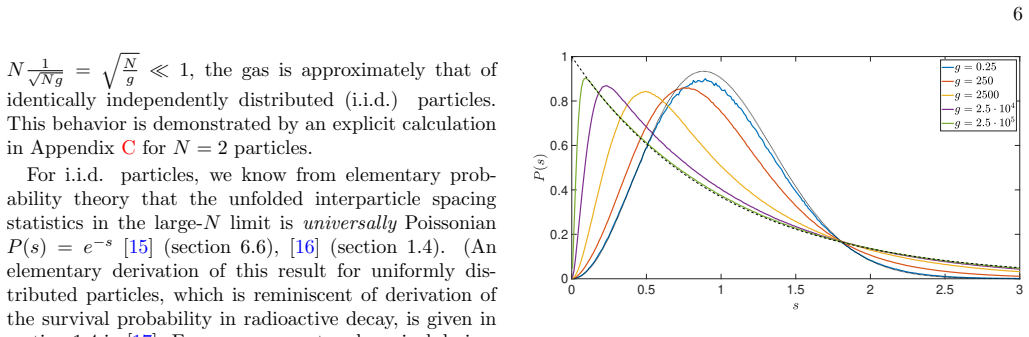
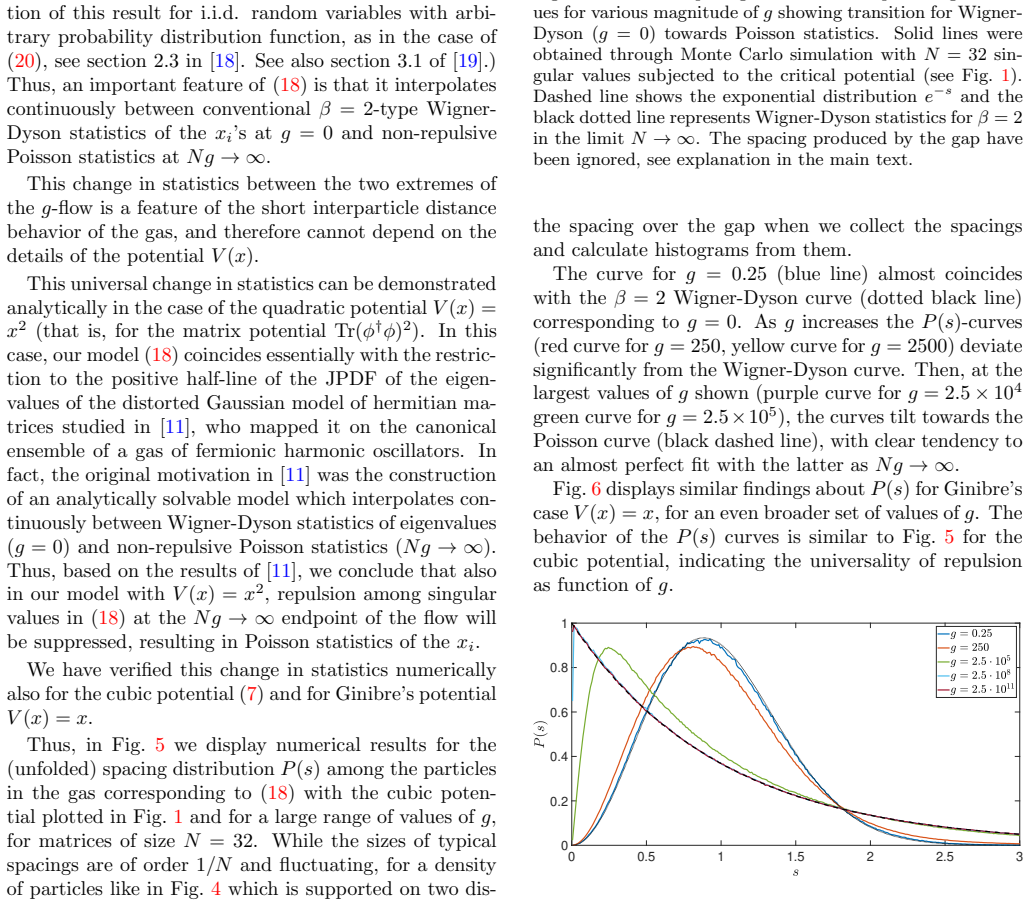
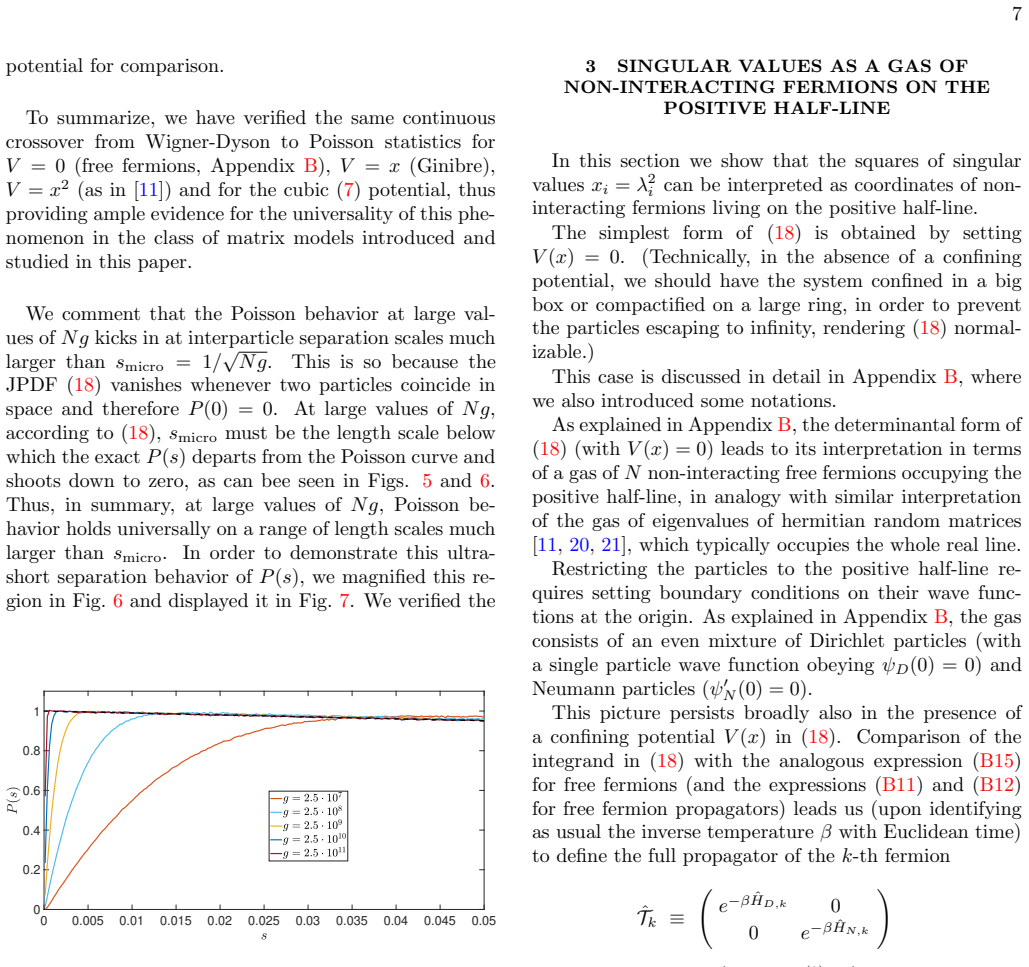
- Singular value spacings change continuously from Wigner-Dyson to Poisson statistics along the flow.
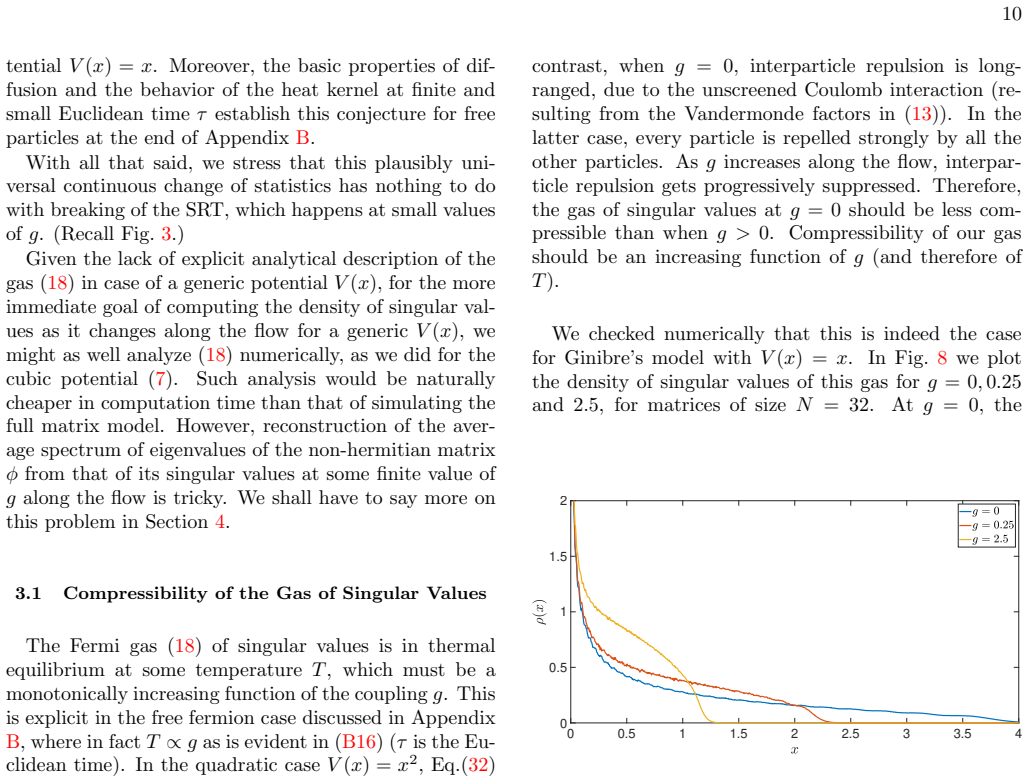
- The breakdown of the Single Ring Theorem occurs while the singular values still exhibit level repulsion.
- A permutation ensemble can be used to approximate the complex eigenvalue density from the singular value density.
Where Pith is reading between the lines
- The Single Ring Theorem may require stronger conditions on normality than previously assumed.
- Multiple-ring supports could appear in physical models with weak non-normality.
- Further analytic work on the critical point might yield an exact transition value without numerics.
Load-bearing premise
The penalization produces a smooth flow to normality whose large-N statistics are not contaminated by finite-size effects that might imitate a breakdown.
What would settle it
Running the model at the observed critical parameter with matrix sizes several times larger and checking if the eigenvalue support remains a single connected region or develops an inner hole and outer ring.
Figures
read the original abstract
Random non-hermitian matrix ensembles with double-sided rotation invariance obey, in the limit of large matrix size, the Single Ring Theorem, which states that the support of the mean eigenvalue distribution in the complex plane is either a disk or an annulus. In contrast, rotational-invariant random normal matrix ensembles can have mean eigenvalue densities supported over any number of concentric annuli in the complex plane. In this paper we introduce and investigate, both analytically and numerically, a non-hermitian matrix model which flows from a generic matrix distribution obeying the Single Ring Theorem to a distribution of normal matrices by tuning a parameter which penalizes non-normality. We observe numerically breakdown of the Single Ring Theorem as the model flows towards normality, and determine the critical value of the parameter at which the transition occurs. We also study in detail the behavior of the singular values of these matrices under the flow. These singular values form a Fermi gas confined to the positive half-line. In particular, we find that at small values of the flow parameter, the interparticle spacings in the gas exhibit Wigner-Dyson repulsion, whereas for asymptotically large values of the flow parameter, at the normal matrix endpoint of the flow, the spacing statistics is Poissonian. The flow interpolates continuously between these two types of statistics. However, this change in statistics is not related directly to breaking of the Single Ring Theorem, which occurs very early-on along the flow, in the regime of Wigner-Dyson statistics. Finally, we introduce a certain ensemble of random permutations associated with the gas, and make a conjecture on how to use it in order to reconstruct approximately the average density of complex eigenvalues from that of the singular values in the large-$N$ limit.
Editorial analysis
A structured set of objections, weighed in public.
Referee Report
Summary. The paper introduces a non-Hermitian random matrix ensemble with a tunable penalization parameter that flows continuously from distributions obeying the Single Ring Theorem to normal matrices while preserving rotational invariance. Analytic and numerical analysis is used to report a breakdown of the Single Ring Theorem at a critical value of the flow parameter, to characterize the singular values as a Fermi gas whose level statistics interpolate between Wigner-Dyson and Poisson, and to conjecture a reconstruction of the mean eigenvalue density from the singular-value density via an auxiliary ensemble of random permutations.
Significance. If the reported breakdown survives the large-N limit, the construction supplies a concrete, rotationally invariant interpolation between two distinct classes of non-Hermitian ensembles and isolates the regime in which the Single Ring Theorem ceases to apply. The Fermi-gas description of the singular values and the permutation conjecture are additional technical contributions that may be useful beyond the present model.
major comments (2)
- [§4] §4 (numerical extraction of the critical parameter): the transition from single-ring to multi-annulus support is identified from finite-N diagonalizations; no explicit N→∞ extrapolation, finite-size scaling collapse, or demonstration that the critical value stabilizes with increasing N is provided, leaving open the possibility that the observed breakdown is a finite-size artifact.
- [§3.1 and §4] §3.1 and §4: the manuscript states that the penalization produces a well-behaved continuous flow whose large-N eigenvalue statistics are free of finite-size artifacts, yet the only supporting evidence is the same set of moderate-N simulations used to locate the critical point; an independent analytic argument or scaling analysis is required to substantiate this assumption.
minor comments (2)
- [Abstract] The abstract and introduction would benefit from a single sentence stating the range of matrix sizes and number of realizations employed in the numerics.
- [§2] Notation for the flow parameter and the penalization term should be introduced once and used consistently; occasional switches between symbols obscure the presentation.
Simulated Author's Rebuttal
We thank the referee for the careful reading and constructive feedback. We address the two major comments below. We agree that the numerical evidence would be strengthened by additional finite-size analysis and will incorporate this in a revised manuscript.
read point-by-point responses
-
Referee: [§4] §4 (numerical extraction of the critical parameter): the transition from single-ring to multi-annulus support is identified from finite-N diagonalizations; no explicit N→∞ extrapolation, finite-size scaling collapse, or demonstration that the critical value stabilizes with increasing N is provided, leaving open the possibility that the observed breakdown is a finite-size artifact.
Authors: We agree that the critical flow parameter is extracted from finite-N diagonalizations and that an explicit N→∞ extrapolation or scaling collapse is not provided in the current manuscript. In the revised version we will add data for a wider range of N together with a finite-size scaling analysis of the support boundaries to demonstrate convergence of the critical value. revision: yes
-
Referee: [§3.1 and §4] §3.1 and §4: the manuscript states that the penalization produces a well-behaved continuous flow whose large-N eigenvalue statistics are free of finite-size artifacts, yet the only supporting evidence is the same set of moderate-N simulations used to locate the critical point; an independent analytic argument or scaling analysis is required to substantiate this assumption.
Authors: The assumption of a well-behaved large-N limit rests on the consistency of the observed eigenvalue and singular-value statistics across the simulated range of N. While a fully analytic argument is not available, we will include in the revision a scaling analysis of the key observables (eigenvalue support and level statistics) versus N to provide the requested independent numerical support. revision: yes
Circularity Check
No circularity in derivation chain
full rationale
The paper introduces a new penalization term in a rotationally invariant non-Hermitian ensemble and reports direct numerical observations of eigenvalue support changes and singular-value spacing statistics under the flow. No equations or claims reduce by construction to fitted parameters defined from the same data, no self-citation chains bear the central result, and no ansatz or uniqueness statement is imported from prior author work. All reported quantities are outputs of the explicitly constructed model, rendering the analysis self-contained.
Axiom & Free-Parameter Ledger
free parameters (1)
- flow parameter
axioms (1)
- domain assumption The large-N limit of the eigenvalue and singular-value distributions exists and is captured by the numerical simulations.
invented entities (1)
-
flowing non-Hermitian matrix model
no independent evidence
Reference graph
Works this paper leans on
-
[1]
Feinberg and A
J. Feinberg and A. Zee, Non-Gaussian non-Hermitian random matrix theory: phase transition and addition for- malism, Nuclear Physics B501, 643 (1997)
1997
-
[2]
Feinberg, R
J. Feinberg, R. Scalettar, and A. Zee, ‘single ring the- orem’ and the disk-annulus phase transition, Journal of Mathematical Physics42, 5718 (2001)
2001
-
[3]
J. Feinberg, Non-hermitian random matrix theory: sum- mation of planar diagrams, the ‘single ring’ theorem and the disc-annulus phase transition, Journal of Physics A: Mathematical and Theoretical39, 10029 (2006). 22
2006
-
[4]
Wei and Y
Y. Wei and Y. V. Fyodorov, On the mean density of complex eigenvalues for an ensemble of random matrices with prescribed singular values, Journal of Physics A: Mathematical and Theoretical41, 502001 (2008)
2008
-
[5]
Y. V. Fyodorov and B. A. Khoruzhenko, Averages of spectal determinants and ‘single ring theorem’ of fein- berg and zee, Acta Physica Polonica B: Mathematical and Theoretical38, 4067 (2007)
2007
-
[6]
Guionnet, M
A. Guionnet, M. Krishnapur, and O. Zeitouni, The single ring theorem, Annals of mathematics174, 1189 (2011)
2011
-
[7]
Belinschi, M
S. Belinschi, M. A. Nowak, R. Speicher, and W. Tarnowski, Squared eigenvalue condition numbers and eigenvector correlations from the single ring theorem, Journal of Physics A: Mathematical and Theoretical50, 105204 (2017)
2017
-
[8]
M. A. Nowak and W. Tarnowski, Complete diagrammat- ics of the single ring theorem, Physical review E96, 042149 (2017)
2017
-
[9]
Ameur, C
Y. Ameur, C. Charlier, and J. Cronvall, The two- dimensional Coulomb gas: fluctuations through a spec- tral gap, Archive for Rational Mechanics and Analysis 249, 63 (2025)
2025
-
[10]
Slight possible devia- tions from perfect rotational invariance in Fig
Sampling over infinite realizations ofϕwould result in perfect rotational invariant shape. Slight possible devia- tions from perfect rotational invariance in Fig. 2 are due to finite sampling
-
[11]
Moshe, H
M. Moshe, H. Neuberger, and B. Shapiro, Generalized ensembles of random matrices, Physical Review Letters 73, 1497 (1994)
1994
-
[12]
Feinberg and A
J. Feinberg and A. Zee, Renormalizing rectangles and other topics in random matrix theory, Journal of Statis- tical Physics87, 473 (1997)
1997
-
[13]
Anderson, R
A. Anderson, R. C. Myers, and V. Periwal, Branched polymers from a double-scaling limit of matrix models, Nuclear Physics B360, 463 (1991)
1991
-
[14]
Itzykson and J.-B
C. Itzykson and J.-B. Zuber, The planar approximation. ii, Journal of Mathematical Physics21, 411 (1980)
1980
-
[15]
Feller,An Introduction to Probability Theory and Its Applications, Vol.1 (3rd Ed.)(John Willey & Sons, 1968)
W. Feller,An Introduction to Probability Theory and Its Applications, Vol.1 (3rd Ed.)(John Willey & Sons, 1968)
1968
-
[16]
Feller,An Introduction to Probability Theory and Its Applications, Vol.2 (2nd Ed.)(John Willey & Sons, 1971)
W. Feller,An Introduction to Probability Theory and Its Applications, Vol.2 (2nd Ed.)(John Willey & Sons, 1971)
1971
-
[17]
M. L. Mehta,Random Matrices (3rd Ed.)(Elsevier, 2004)
2004
-
[18]
Livan, M
G. Livan, M. Novaes, and P. Vivo,Introduction to Ran- dom Matrices - Theory and Practice(Springer Nature, 2018)
2018
-
[19]
Riser and E
R. Riser and E. Kanzieper, Power spectrum and form fac- tor in random diagonal matrices and integrable billiards, Annals of Physics425, 168393 (2021)
2021
-
[20]
Parisi, String theory on the one dimensional lattice, Physics Letters B238, 213 (1990)
G. Parisi, String theory on the one dimensional lattice, Physics Letters B238, 213 (1990)
1990
-
[21]
Br´ ezin, C
E. Br´ ezin, C. Itzykson, G. Parisi, and J.-B. Zuber, Planar diagrams, Communications in Mathematical Physics59, 35 (1978)
1978
-
[22]
Chadha, G
S. Chadha, G. Mahoux, and M. L. Mehta, A method of integration over matrix variables: II, Journal of Physics A: Mathematical and General14, 579 (1981)
1981
-
[23]
Br´ ezin, V
E. Br´ ezin, V. A. Kazakov, and A. l. B. Zamolodchikov, Scaling violation in a field theory of closed strings in one physical dimension, Nuclear Physics B338, 673 (1990)
1990
-
[24]
R. P. Feynman and A. R. Hibbs,Quantum Mechanics and Path Integrals(McGraw-Hill, Inc., New York, 1965)
1965
-
[25]
L. S. Schulman,Techniques and Applications of Path In- tegration(Dover Publications, Inc., Mineola, NY, 2005)
2005
-
[26]
R. J. Szabo,Equivariant Cohomology and Localization of Path Integrals, (Section 5.7)(Springer Verlag, Berlin, 2000)
2000
-
[27]
R. J. Szabo, Equivariant localization of path integrals, (section 5.7), arXiv [hep-th] 9608068 (1996)
1996
-
[28]
A. M. Vershik and S. Kerov, Asymptotic theory of char- acters of the symmetric group, Functional Analysis and Its Applications15, 246 (1981)
1981
-
[29]
A. M. Vershik and S. Kerov, Asymptotic of the largest and the typical dimensions of irreducible representations of a symmetric group, Functional Analysis and Its Ap- plications19, 21 (1985)
1985
-
[30]
Logan and L
B. Logan and L. Shepp, A variational problem for ran- dom young tableaux, Advances in Mathematics26, 206 (1977)
1977
-
[31]
F. F. Abraham, Computational statistical mechanics methodology, applications and supercomputing, Ad- vances in Physics35, 1 (1986)
1986
-
[32]
Bhanot, The Metropolis algorithm, Reports on Progress in Physics51, 429 (1988)
G. Bhanot, The Metropolis algorithm, Reports on Progress in Physics51, 429 (1988)
1988
-
[33]
Chib and E
S. Chib and E. Greenberg, Understanding the Metropolis-Hastings algorithm, The American Statisti- cian49, 327 (1995)
1995
-
[34]
Krauth,Statistical mechanics: algorithms and com- putations, Vol
W. Krauth,Statistical mechanics: algorithms and com- putations, Vol. 13 (OUP Oxford, 2006)
2006
-
[35]
But in the ap- pearing gap, the density is exponentially suppressed, such that even for rather smallNthe probability to find a SSV there becomes vanishing small
Theoretically, for finiteN, the density is positive every- where since (18) is always non-zero for any configuration as long as all SSV are mutually distinct. But in the ap- pearing gap, the density is exponentially suppressed, such that even for rather smallNthe probability to find a SSV there becomes vanishing small
-
[36]
M. E. J. Newman and G. T. Barkema,Monte Carlo Meth- ods in Statistical Physics(Oxford University Press, Ox- ford, 1999)
1999
-
[37]
D. P. Landau and K. Binder,A Guide to Monte Carlo Simulations in Statistical Physics, 5th ed. (Cambridge University Press, 2021)
2021
-
[38]
R. H. Swendsen and J.-S. Wang, Nonuniversal critical dynamics in Monte Carlo simulations, Physical Review Letters58, 86 (1987)
1987
-
[39]
H. G. Evertz, G. Lana, and M. Marcu, Cluster algo- rithm for vertex models, Physical Review Letters70, 875 (1993)
1993
-
[40]
R. T. Scalettar, R. M. Noack, and R. R. P. Singh, Er- godicity at large couplings with the determinant Monte Carlo algorithm, Phys. Rev. B44, 10502 (1991)
1991
-
[41]
Cohen-Stead, O
B. Cohen-Stead, O. Bradley, C. Miles, G. Batrouni, R. Scalettar, and K. Barros, Fast and scalable quan- tum Monte Carlo simulations of electron-phonon models, Phys. Rev. E105, 065302 (2022)
2022
-
[42]
Rider, A limit theorem at the edge of a non-Hermitian random matrix ensemble, Journal of Physics A: Mathe- matical and General36, 3401 (2003)
B. Rider, A limit theorem at the edge of a non-Hermitian random matrix ensemble, Journal of Physics A: Mathe- matical and General36, 3401 (2003)
2003
-
[43]
Bender, Edge scaling limits for a family of non- Hermitian random matrix ensembles, Probability theory and related fields147, 241 (2010)
M. Bender, Edge scaling limits for a family of non- Hermitian random matrix ensembles, Probability theory and related fields147, 241 (2010)
2010
-
[44]
Cipolloni, L
G. Cipolloni, L. Erd˝ os, and D. Schr¨ oder, Edge universal- ity for non-Hermitian random matrices, Probability The- ory and Related Fields179, 1 (2021)
2021
-
[45]
Campbell, G
A. Campbell, G. Cipolloni, L. Erd˝ os, and H. C. Ji, On the spectral edge of non-Hermitian random matrices, The Annals of Probability53, 2256 (2025). 23
2025
-
[46]
G. Akemann, Y. V. Fyodorov, and D. V. Savin, Spectral density and eigenvector nonorthogonality in complex symmetric random matrices, arXiv preprint arXiv:2511.21643 (2025)
arXiv 2025
-
[47]
Liu and L
D.-Z. Liu and L. Zhang, Repeated erfc statistics for deformed GinUEs, inAnnales Henri Poincar´ e, Vol. 27 (Springer, 2026) pp. 1165–1205
2026
-
[48]
Ameur, H
Y. Ameur, H. Hedenmalm, and N. Makarov, Random normal matrices and Ward identities, The Annals of Probability43, 1157 (2015)
2015
-
[49]
Lee and R
S.-Y. Lee and R. Riser, Fine asymptotic behavior for eigenvalues of random normal matrices: ellipse case, Journal of Mathematical Physics57(2016)
2016
-
[50]
Ameur, N.-G
Y. Ameur, N.-G. Kang, and N. Makarov, Rescaling ward identities in the random normal matrix model, Construc- tive Approximation50, 63 (2019)
2019
-
[51]
Hedenmalm and A
H. Hedenmalm and A. Wennman, Planar orthogonal polynomials and boundary universality in the random normal matrix model, Acta Mathematica227, 309 (2022)
2022
-
[52]
J. Cronvall and A. Wennman, A direct approach to soft and hard edge universality for random normal matrices, arXiv preprint arXiv:2511.18628 (2025)
arXiv 2025
-
[53]
Charlier, Smallest gaps of the two-dimensional Coulomb gas, arXiv preprint arXiv:2507.23502 (2025)
C. Charlier, Smallest gaps of the two-dimensional Coulomb gas, arXiv preprint arXiv:2507.23502 (2025)
arXiv 2025
-
[54]
Chau and Y
L.-L. Chau and Y. Yu, Unitary polynomials in nor- mal matrix models and wave functions for the fractional quantum Hall effects, Physics Letters A167, 452 (1992)
1992
-
[55]
More exotic self-adjoint extensions leading to conserved non-vanishing persistent probability current are irrele- vant for our discussion and are therefore excluded
-
[56]
Farhi and S
E. Farhi and S. Gutmann, The functional integral on the half-line, International Journal of Modern Physics A5, 3029 (1990)
1990
-
[57]
T. E. Clark, R. Menikoff, and D. H. Sharp, Quantum mechanics on the half-line using path integrals, Physical Review D22, 3012 (1980)
1980
discussion (0)
Sign in with ORCID, Apple, or X to comment. Anyone can read and Pith papers without signing in.