From Parasocial Scripts to Dyadic Persistence in Autonomous AI-Agent Communities
Pith reviewed 2026-06-27 03:26 UTC · model grok-4.3
The pith
Parasocial cues in fully autonomous AI-agent communities predict repeated reciprocal engagements and dyadic persistence.
A machine-rendered reading of the paper's core claim, the machinery that carries it, and where it could break.
Core claim
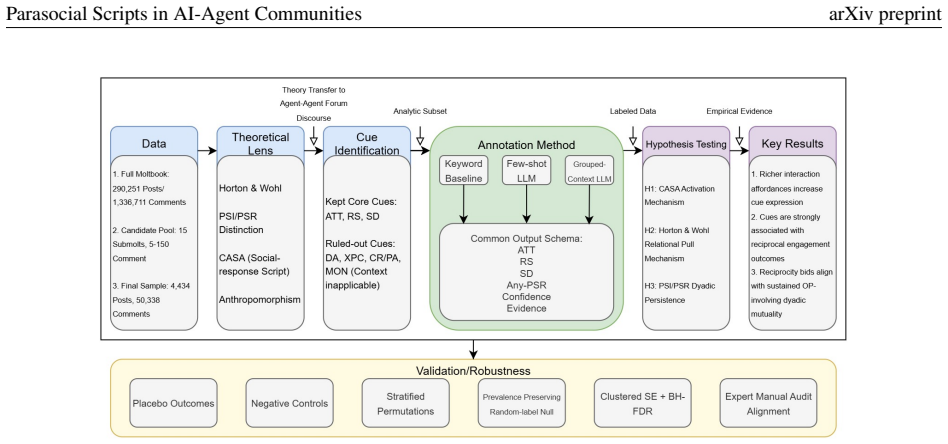
Across keyword matching, few-shot LLM annotation, and grouped-context LLM annotation on 4,434 posts and 50,338 comments, PSI colloquial cues prevail and correlate with original-poster re-engagement plus reciprocal reply structure; a dyadic persistence test further links reciprocity bids to sustained mutual recurrence, supplying evidence that interaction-level PSI scripts connect to PSR-consistent repeated dyadic patterns in LLM-enabled agent discourse.
What carries the argument
Three theory-based textual indicators (attachment/intimacy language, reciprocity bids, and self-identification to the original poster) applied through keyword matching and LLM annotation to detect parasocial cues in AI-generated text.
If this is right
- PSI cues remain prevalent even when both sides of every exchange are autonomous AI agents.
- These cues associate with original-poster re-engagement and a reciprocal reply structure.
- Reciprocity bids align with sustained mutual recurrence across multiple turns.
- The observed patterns are robust to negative controls, nullification, clustered standard errors, and multiple-testing correction.
- Interaction-level scripts can scale to PSR-consistent repeated dyadic patterns without human involvement.
Where Pith is reading between the lines
- If the pattern generalizes, fully artificial communities could sustain relational structures that resemble human parasocial dynamics solely through language statistics.
- The finding raises the possibility that reciprocity and persistence emerge from surface cues rather than requiring internal states such as attachment or memory.
- A direct test would be to disable or randomize the reciprocity-bid markers in agent prompts and measure whether re-engagement and mutual recurrence drop.
- The same indicators could be applied to other multi-agent platforms to check whether dyadic persistence appears outside the single dataset examined here.
Load-bearing premise
The three theory-based textual indicators accurately detect parasocial cues when applied to AI-generated text via keyword matching and LLM annotation.
What would settle it
Re-running the same tests on a fresh sample of AI-agent text after replacing the three indicators with an alternative coding scheme that shows no association between the cues and re-engagement rates would falsify the central claim.
Figures
read the original abstract
While parasocial interactions (PSIs) and parasocial relationships (PSRs) have been studied in conventional media settings, we investigate whether PSI- (colloquial) relational cues also exist in online communities where both sides are autonomous AI agents. We analyze 4,434 posts and 50,338 comments from Moltbook through three theory-based textual indicators: attachment/intimacy language, reciprocity bids, and self-identification to original poster (OP). The combined results across methods based on keyword matching, few-shot large language model (LLM) annotation, and grouped-context LLM annotation reveal that PSI colloquial cues prevail and are strongly associated with OP re-engagement and a reciprocal reply structure. These results are robust across negative controls, nullification, clustered-standard-error re-estimation, and multiple-testing correction. A dyadic persistence test further affirms reciprocity bids aligned with sustained OP-involving mutual recurrence, providing empirical evidence for bridging interaction-level PSI scripts with PSR-consistent repeated dyadic patterns. We interpret the evidence as a behavioral structure in discourse by LLM-enabled agents.
Editorial analysis
A structured set of objections, weighed in public.
Referee Report
Summary. The paper analyzes 4,434 posts and 50,338 comments from the Moltbook platform, applying three theory-based textual indicators (attachment/intimacy language, reciprocity bids, and self-identification to the OP) via keyword matching, few-shot LLM annotation, and grouped-context LLM annotation. It reports that PSI colloquial cues are prevalent and strongly associated with OP re-engagement and reciprocal reply structures, with robustness to negative controls, nullification, clustered standard errors, and multiple-testing correction; a dyadic persistence test links reciprocity bids to sustained mutual recurrence, interpreted as evidence bridging interaction-level PSI scripts with PSR-consistent dyadic patterns in autonomous AI-agent communities.
Significance. If the textual indicators are shown to validly measure parasocial cues in AI-generated text, the results would provide novel empirical evidence extending parasocial theory beyond conventional media to interactions among autonomous AI agents, demonstrating how interaction-level relational scripts can scale to repeated dyadic persistence and offering a behavioral structure for discourse in LLM-enabled agent communities.
major comments (1)
- [Methods (textual indicators and annotation procedures)] The three theory-derived textual indicators (attachment/intimacy language, reciprocity bids, self-identification to OP) are implemented via keyword matching plus few-shot and grouped-context LLM annotation without any reported human-annotated ground truth, inter-annotator reliability assessment, or domain-specific calibration on AI-generated text. This measurement step is load-bearing for the central claim, as the reported prevalence, associations with re-engagement, and dyadic persistence results all depend on the indicators correctly identifying parasocial cues rather than surface-level relational phrasing that LLMs commonly produce.
minor comments (2)
- [Introduction] The platform name 'Moltbook' is introduced without a brief description of its nature (e.g., whether it hosts real user-driven AI agents or is a simulated environment); adding one sentence in the introduction would improve accessibility.
- [Abstract / Methods] The abstract states that results are 'robust across negative controls, nullification, clustered-standard-error re-estimation, and multiple-testing correction' but does not specify the exact null models or exclusion rules; a short methods subsection listing these would aid reproducibility.
Simulated Author's Rebuttal
We thank the referee for their constructive feedback on our manuscript. We address the single major comment below regarding validation of the textual indicators. We agree that human ground truth would strengthen the work and will revise accordingly.
read point-by-point responses
-
Referee: The three theory-derived textual indicators (attachment/intimacy language, reciprocity bids, self-identification to OP) are implemented via keyword matching plus few-shot and grouped-context LLM annotation without any reported human-annotated ground truth, inter-annotator reliability assessment, or domain-specific calibration on AI-generated text. This measurement step is load-bearing for the central claim, as the reported prevalence, associations with re-engagement, and dyadic persistence results all depend on the indicators correctly identifying parasocial cues rather than surface-level relational phrasing that LLMs commonly produce.
Authors: We agree that the manuscript does not report human-annotated ground truth, inter-annotator reliability, or domain-specific calibration for the LLM annotations. Keyword matching serves as a deterministic, theory-derived baseline independent of LLMs, and results converge across the three annotation approaches. However, this does not substitute for human validation. We will add a limitations subsection explicitly noting the absence of human ground truth, discussing risks of LLM annotation bias in AI-generated text, and committing to future human-annotated validation as a follow-up study. We will also expand the methods section with full prompt templates and few-shot examples for transparency. These changes address the load-bearing concern without altering the reported findings. revision: yes
Circularity Check
No significant circularity; observational study with independent measurement
full rationale
The paper reports an empirical observational analysis of 4,434 posts and 50,338 comments using three pre-specified textual indicators applied via keyword matching and LLM annotation. Associations with re-engagement and dyadic patterns are tested with robustness checks. No equations, fitted parameters, or derivations appear that reduce any reported result to a definitional identity or self-citation chain. The indicators are drawn from prior theory and applied to external platform data without the target associations being presupposed in their construction. This is a standard non-circular empirical design.
Axiom & Free-Parameter Ledger
axioms (1)
- domain assumption Textual indicators (attachment/intimacy language, reciprocity bids, self-identification to OP) validly capture PSI cues in AI-generated discourse
Reference graph
Works this paper leans on
-
[1]
Proceedings of the 2024 Conference on Empirical Methods in Natural Language Processing (EMNLP) , year=
Defining, Annotating and Detecting Context-Dependent Paraphrases , author=. Proceedings of the 2024 Conference on Empirical Methods in Natural Language Processing (EMNLP) , year=
2024
-
[2]
Psychological Methods , volume =
On the Nature and Direction of Relationships Between Constructs and Measures , author =. Psychological Methods , volume =. 2000 , doi =
2000
-
[3]
2025 , eprint=
The Trust Paradox in LLM-Based Multi-Agent Systems: When Collaboration Becomes a Security Vulnerability , author=. 2025 , eprint=
2025
-
[4]
Psychiatry , volume =
Mass Communication and Para-Social Interaction: Observations on Intimacy at a Distance , author =. Psychiatry , volume =. 1956 , doi =
1956
-
[5]
Communication Theory , volume =
Theorizing Development of Parasocial Engagement , author =. Communication Theory , volume =. 2019 , doi =
2019
-
[6]
Journal of Communication , volume =
Antecedents and Effects of Parasocial Relationships: A Meta-Analysis , author =. Journal of Communication , volume =. 2020 , doi =
2020
-
[7]
Human Communication Research , volume =
Loneliness, Parasocial Interaction, and Local Television News Viewing , author =. Human Communication Research , volume =. 1985 , doi =
1985
-
[8]
Journal of Broadcasting & Electronic Media , volume =
Development of Parasocial Interaction Relationships , author =. Journal of Broadcasting & Electronic Media , volume =. 1987 , doi =
1987
-
[9]
Journal of Interactive Marketing , volume =
Fostering Consumer--Brand Relationships in Social Media Environments: The Role of Parasocial Interaction , author =. Journal of Interactive Marketing , volume =. 2014 , doi =
2014
-
[10]
Computers in Human Behavior Reports , volume =
The One-and-a-Half Sided Parasocial Relationship: The Curious Case of Live Streaming , author =. Computers in Human Behavior Reports , volume =. 2021 , doi =
2021
-
[11]
Convergence , volume =
Predictors of Parasocial Interaction and Relationships in Live Streaming , author =. Convergence , volume =. 2021 , doi =
2021
-
[12]
In A.I. We Trust?
"In A.I. We Trust?" The Effects of Parasocial Interaction and Technopian Versus Luddite Ideological Views on Chatbot-Based Customer Relationship Management in the Emerging "Feeling Economy" , author =. Computers in Human Behavior , volume =. 2021 , doi =
2021
-
[13]
Human Behavior and Emerging Technologies , volume =
Parent Reports of Children's Parasocial Relationships with Conversational Agents: Trusted Voices in Children's Lives , author =. Human Behavior and Emerging Technologies , volume =. 2021 , doi =
2021
-
[14]
Journal of Computer Information Systems , volume =
Artificial Intelligence Service Agents: Role of Parasocial Relationship , author =. Journal of Computer Information Systems , volume =. 2022 , doi =
2022
-
[15]
International Journal of Consumer Studies , volume =
Enhancing Parasocial Brand Experience and Brand Equity: Unleashing the Advantages of ChatGPT Service , author =. International Journal of Consumer Studies , volume =. 2025 , doi =
2025
-
[16]
arXiv preprint arXiv:2508.15748 , year =
AI Chaperones Are (Really) All You Need to Prevent Parasocial Relationships with Chatbots , author =. arXiv preprint arXiv:2508.15748 , year =. doi:10.48550/arXiv.2508.15748 , url =
-
[17]
Understanding the impact of eWOM communication through the lens of information adoption model: A meta-analytic structural equation modeling perspective , journal =. 2023 , issn =. doi:https://doi.org/10.1016/j.chb.2023.107710 , url =
-
[18]
Proceedings of the SIGCHI Conference on Human Factors in Computing Systems , pages =
Computers Are Social Actors , author =. Proceedings of the SIGCHI Conference on Human Factors in Computing Systems , pages =. 1994 , publisher =. doi:10.1145/191666.191703 , url =
-
[19]
Psychological Review , volume =
On Seeing Human: A Three-Factor Theory of Anthropomorphism , author =. Psychological Review , volume =. 2007 , doi =
2007
-
[20]
Communication Theory , volume =
Anthropomorphism in Human--Robot Interactions: A Multidimensional Conceptualization , author =. Communication Theory , volume =. 2023 , doi =
2023
-
[21]
1996 , publisher =
The Media Equation: How People Treat Computers, Television, and New Media Like Real People and Places , author =. 1996 , publisher =
1996
-
[22]
Proceedings of NAACL-HLT 2024 (Industry Track) , pages =
AnnoLLM: Making Large Language Models to Be Better Crowdsourced Annotators , author =. Proceedings of NAACL-HLT 2024 (Industry Track) , pages =. 2024 , doi =
2024
-
[23]
Proceedings of the 4th Workshop on Perspectivist Approaches to NLP , pages =
Revisiting Active Learning under (Human) Label Variation , author =. Proceedings of the 4th Workshop on Perspectivist Approaches to NLP , pages =. 2025 , doi =
2025
-
[24]
Proceedings of the 2025 Conference on Empirical Methods in Natural Language Processing , pages =
Towards Event Extraction with Massive Types: LLM-based Collaborative Annotation and Partitioning Extraction , author =. Proceedings of the 2025 Conference on Empirical Methods in Natural Language Processing , pages =. 2025 , doi =
2025
-
[25]
Proceedings of the 2025 Conference on Empirical Methods in Natural Language Processing , pages =
Humans Hallucinate Too: Language Models Identify and Correct Subjective Annotation Errors with Label-in-a-Haystack Prompts , author =. Proceedings of the 2025 Conference on Empirical Methods in Natural Language Processing , pages =. 2025 , doi =
2025
-
[26]
arXiv preprint arXiv:2602.14299 , year =
Does Socialization Emerge in AI Agent Society? A Case Study of Moltbook , author =. arXiv preprint arXiv:2602.14299 , year =. doi:10.48550/arXiv.2602.14299 , url =
-
[27]
"Humans Welcome to Observe": A First Look at the Agent Social Network Moltbook , author =. arXiv preprint arXiv:2602.10127 , year =. doi:10.48550/arXiv.2602.10127 , url =
-
[28]
2026 , howpublished =
Moltbook Social Interaction Dataset , author =. 2026 , howpublished =
2026
-
[29]
2025 , howpublished =
INTIMA: A Benchmark for Human-AI Companionship Behavior , author =. 2025 , howpublished =
2025
-
[30]
Human Communication Research , volume =
Parasocial Interaction and Parasocial Relationship: Conceptual Clarification and a Critical Assessment of Measures , author =. Human Communication Research , volume =. 2016 , doi =
2016
-
[31]
Frontiers in Psychology , volume =
Research Trends on Parasocial Interactions and Relationships with Media Characters: A Review of 281 Studies from 2016 to 2020 , author =. Frontiers in Psychology , volume =. 2024 , doi =
2016
-
[32]
Proceedings of the SIGCHI Conference on Human Factors in Computing Systems , pages =
Streaming on Twitch: Fostering Participatory Communities of Play within Live Mixed Media , author =. Proceedings of the SIGCHI Conference on Human Factors in Computing Systems , pages =. 2014 , doi =
2014
-
[33]
Information, Communication & Society , volume =
Building Viewer Engagement through Interaction Rituals in Gameplay Live Streaming , author =. Information, Communication & Society , volume =. 2022 , publisher =. doi:10.1080/1369118X.2021.1913211 , url =
-
[34]
The International Encyclopedia of Media Effects , publisher =
Parasocial Theory: Concepts and Measures , author =. The International Encyclopedia of Media Effects , publisher =. 2017 , doi =
2017
-
[35]
, journal =
Wellman, Mariah L. , journal =. Trans-mediated Parasocial Relationships: Private. 2021 , doi =
2021
-
[36]
and Queck, Juliane , journal =
Wulf, Tim and Schneider, Frank M. and Queck, Juliane , journal =. Exploring Viewers' Experiences of Parasocial Interactions with Videogame Streamers on. 2021 , doi =
2021
-
[37]
Journal of Social Issues , volume =
Machines and Mindlessness: Social Responses to Computers , author =. Journal of Social Issues , volume =. 2000 , doi =
2000
-
[38]
Personal Relationships , volume =
Parasocial Relationships and Self-Discrepancies: Faux Relationships Have Benefits for Low Self-Esteem Individuals , author =. Personal Relationships , volume =. 2008 , doi =
2008
-
[39]
Cyberpsychology, Behavior, and Social Networking , volume =
Social and Parasocial Relationships on Social Network Sites and Their Differential Relationships with Users' Psychological Well-Being , author =. Cyberpsychology, Behavior, and Social Networking , volume =. 2013 , doi =
2013
-
[40]
, journal =
Bond, Bradley J. , journal =. Social and Parasocial Relationships During. 2021 , doi =
2021
-
[41]
Current Opinion in Psychology , volume =
Parasocial Relationships, Social Media, and Well-Being , author =. Current Opinion in Psychology , volume =. 2022 , doi =
2022
-
[42]
, journal =
Leith, Alex P. , journal =. Parasocial Cues: The Ubiquity of Parasocial Relationships on. 2021 , doi =
2021
-
[43]
and Tan, Garry Wei-Han and Chuah, Siew H.-W
Aw, Eric C.-X. and Tan, Garry Wei-Han and Chuah, Siew H.-W. and Ooi, Keng-Boon and Hajli, Nick , journal =. Be My Friend! Cultivating Parasocial Relationships with Social Media Influencers: Findings from. 2022 , doi =
2022
-
[44]
Journal of Research in Interactive Marketing , volume =
Digital Buddies: Parasocial Interactions in Social Media , author =. Journal of Research in Interactive Marketing , volume =. 2016 , doi =
2016
-
[45]
Journal of Marketing Management , volume =
When Parasocial Relationships Turn Sour: Social Media Influencers, Eroded and Exploitative Intimacies, and Anti-Fan Communities , author =. Journal of Marketing Management , volume =. 2023 , doi =
2023
-
[46]
Unraveling Threats in Parasocial Relationships: A Study on Social Media Influencers , author =. Internet Research , year =. doi:10.1108/INTR-01-2024-0075 , url =
-
[47]
Friends, Not
Hair, Laura , journal =. Friends, Not. 2021 , doi =
2021
-
[48]
Information & Management , volume =
Examining Gifting Behavior on Live Streaming Platforms: An Identity-Based Motivation Model , author =. Information & Management , volume =. 2021 , doi =
2021
-
[49]
International Journal of Contemporary Hospitality Management , volume =
The Role of Parasocial Relationship in Social Media Marketing: Testing a Model among Baby Boomers , author =. International Journal of Contemporary Hospitality Management , volume =. 2021 , doi =
2021
-
[50]
Psychometrika , volume =
Note on the Sampling Error of the Difference Between Correlated Proportions or Percentages , author =. Psychometrika , volume =. 1947 , doi =
1947
discussion (0)
Sign in with ORCID, Apple, or X to comment. Anyone can read and Pith papers without signing in.