Physics-Informed Attention Mechanism and Generalization Capability of Deep Learning-Based Grain Growth Evolution Prediction
Pith reviewed 2026-06-27 02:36 UTC · model grok-4.3
The pith
Boundary-masked attention improves generalization of synthetic-trained grain growth models to experimental and bimodal microstructures without retraining.
A machine-rendered reading of the paper's core claim, the machinery that carries it, and where it could break.
Core claim
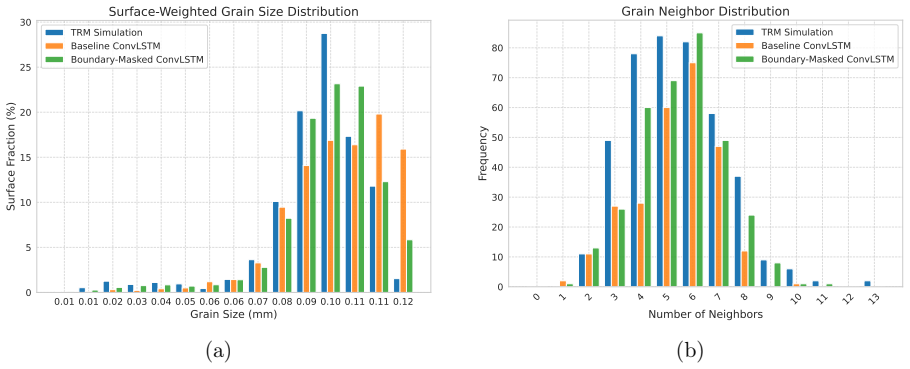
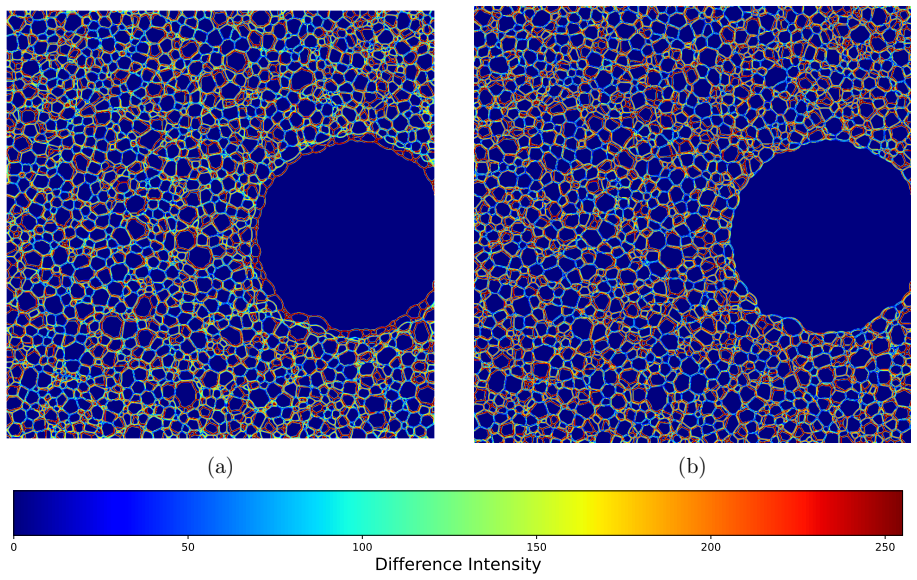
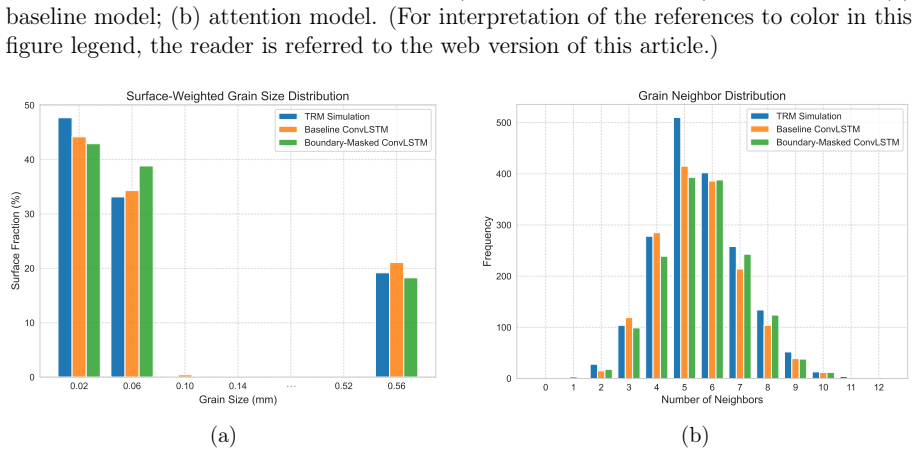
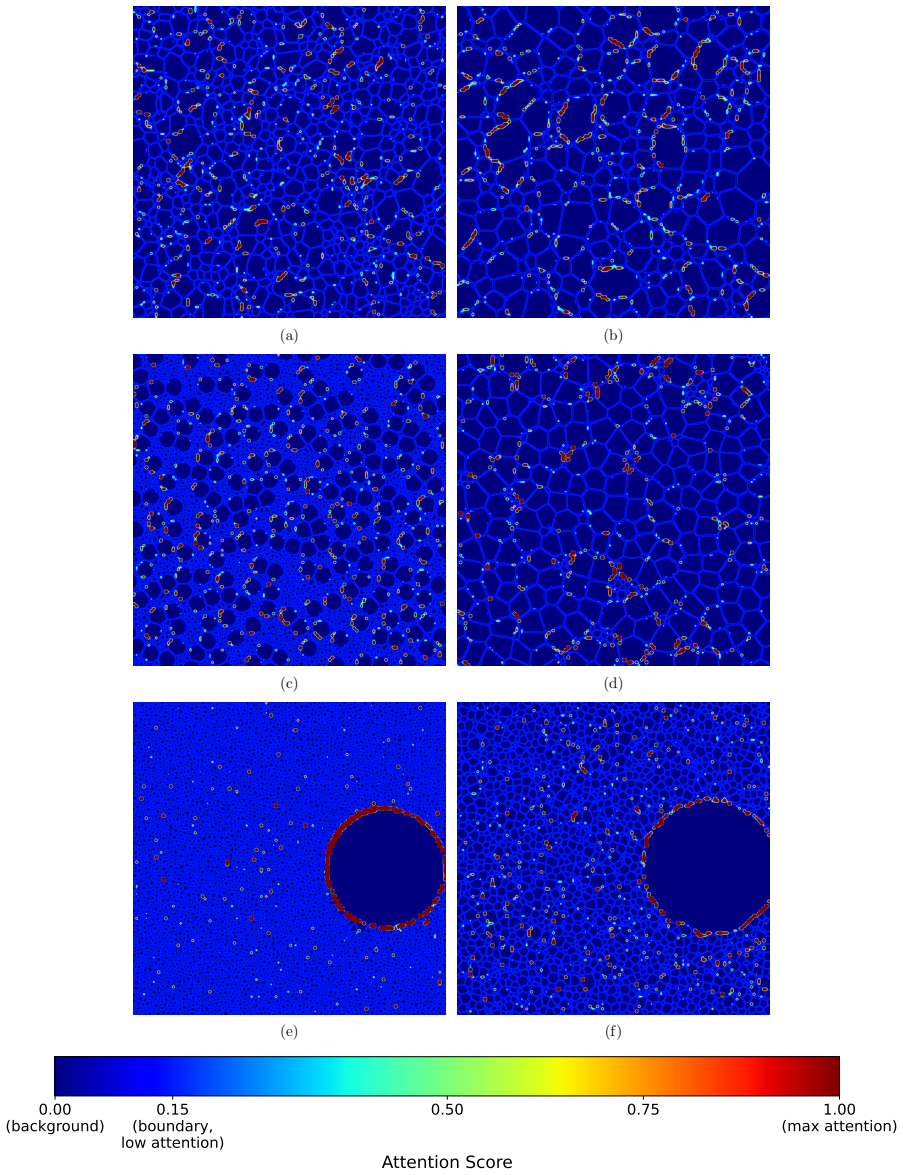
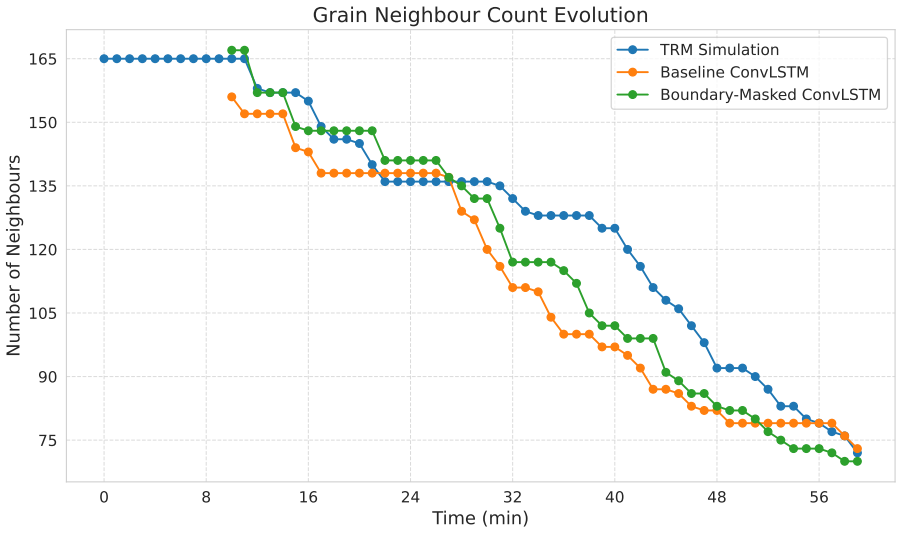
Both the baseline and the proposed physics-informed attention model were evaluated without retraining or fine-tuning on the OOD data. Both models successfully generalized to all three test cases, yet the boundary-masked attention mechanism provided substantial improvements, with the most notable gains for microstructures characterized by a bimodal grain size distribution, where Structural Similarity Index Measure (SSIM) improved from 0.6221 to 0.7609 and mean grain size error decreased from 8.75% to 3.57%. The attention heatmap analysis revealed that the boundary-masked attention model learned to concentrate attention on large grain boundaries in a manner consistent with curvature-driven gra
What carries the argument
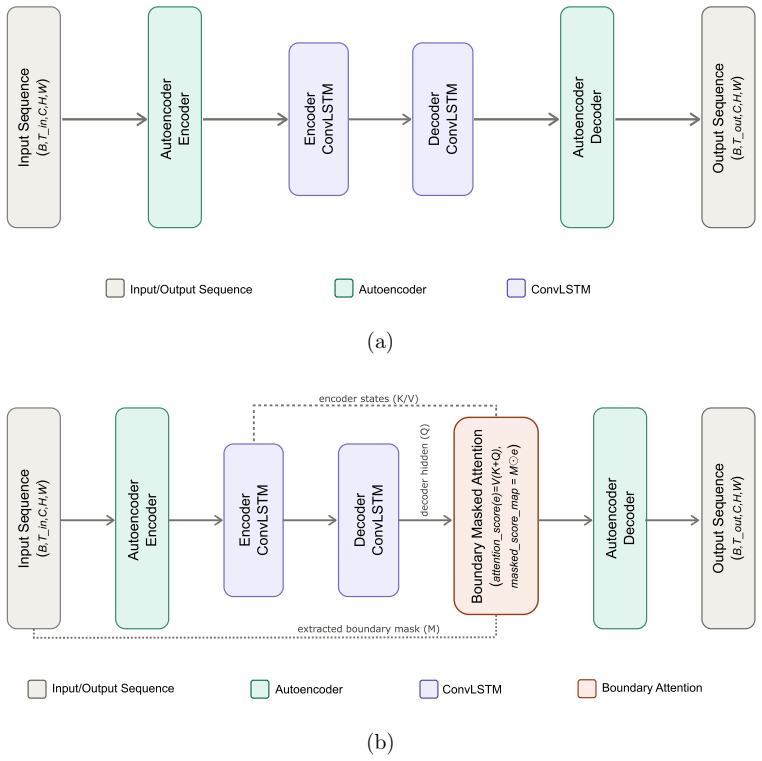
The boundary-masked attention mechanism, which constrains attention to grain boundary pixels to incorporate grain growth physics into the model.
If this is right
- Models trained solely on synthetic grain growth data can be applied directly to experimental microstructures.
- Physics-informed attention yields the largest accuracy gains on microstructures whose grain size distribution differs from the training set.
- Attention patterns consistent with curvature-driven growth emerge automatically during training on synthetic data.
- Similar boundary constraints could be added to other deep learning models for microstructure evolution.
Where Pith is reading between the lines
- Attention masking may offer a lightweight route to embed physical constraints in other materials simulation models without changing the loss function.
- The approach could reduce reliance on repeated retraining when grain growth conditions shift in industrial processing.
- Extending the mask to include additional physical features such as triple junctions might produce further robustness gains.
Load-bearing premise
The three chosen out-of-distribution test cases and the synthetic training data are representative of real deployment conditions, and SSIM plus mean grain size error adequately measure physical fidelity.
What would settle it
A new set of experimental grain growth microstructures outside the three tested OOD cases where the boundary-masked model shows equal or lower accuracy than the baseline on SSIM and grain size error.
Figures
read the original abstract
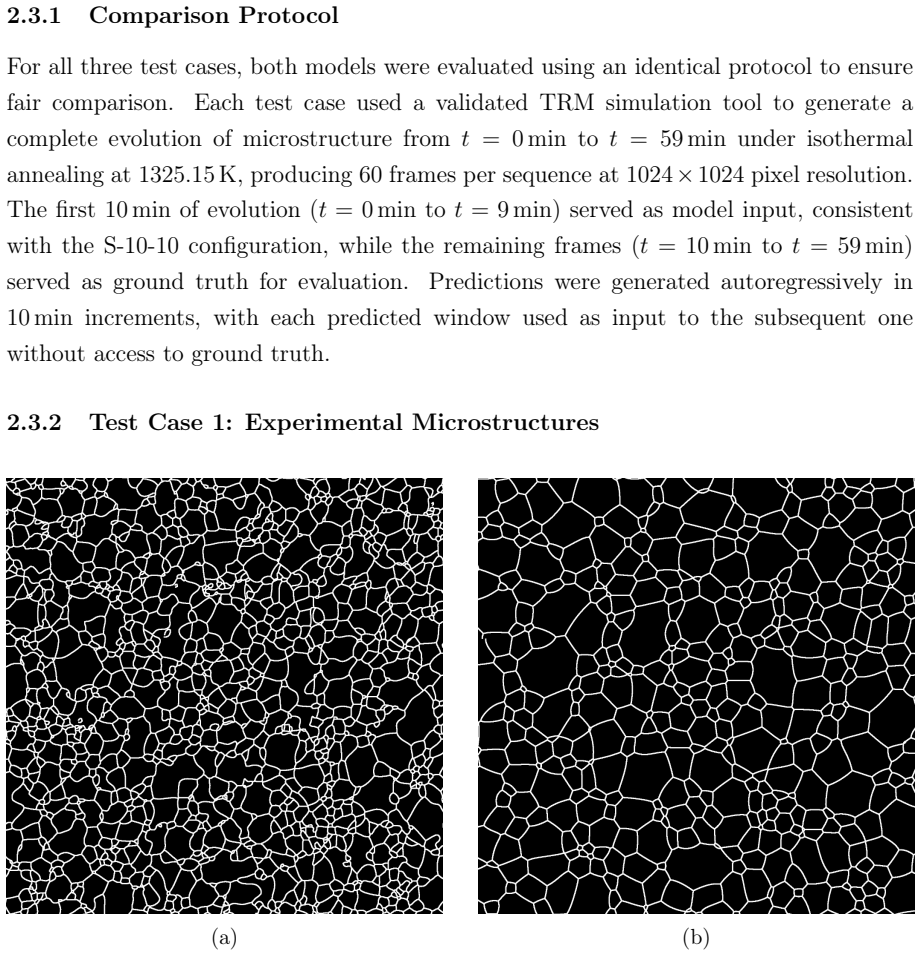
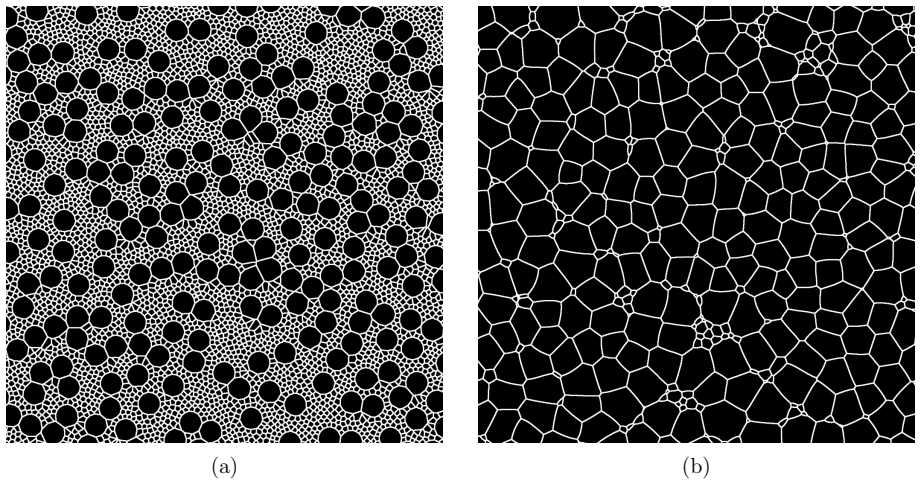
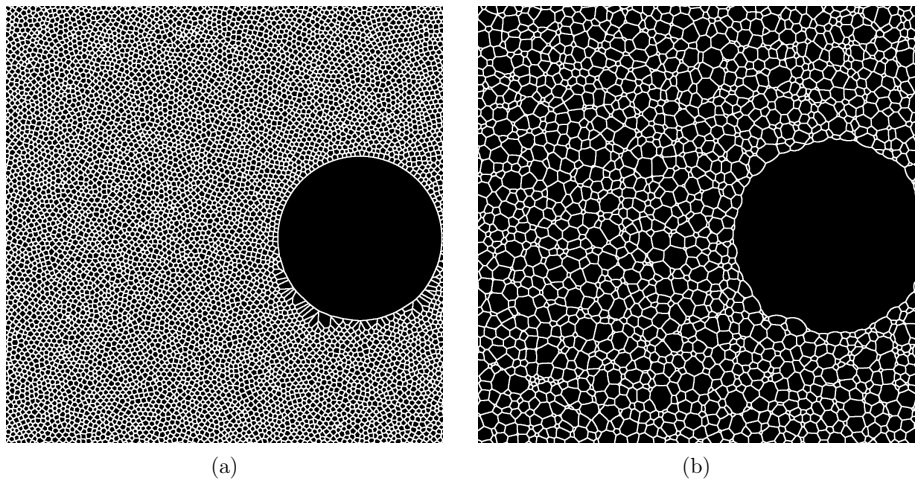
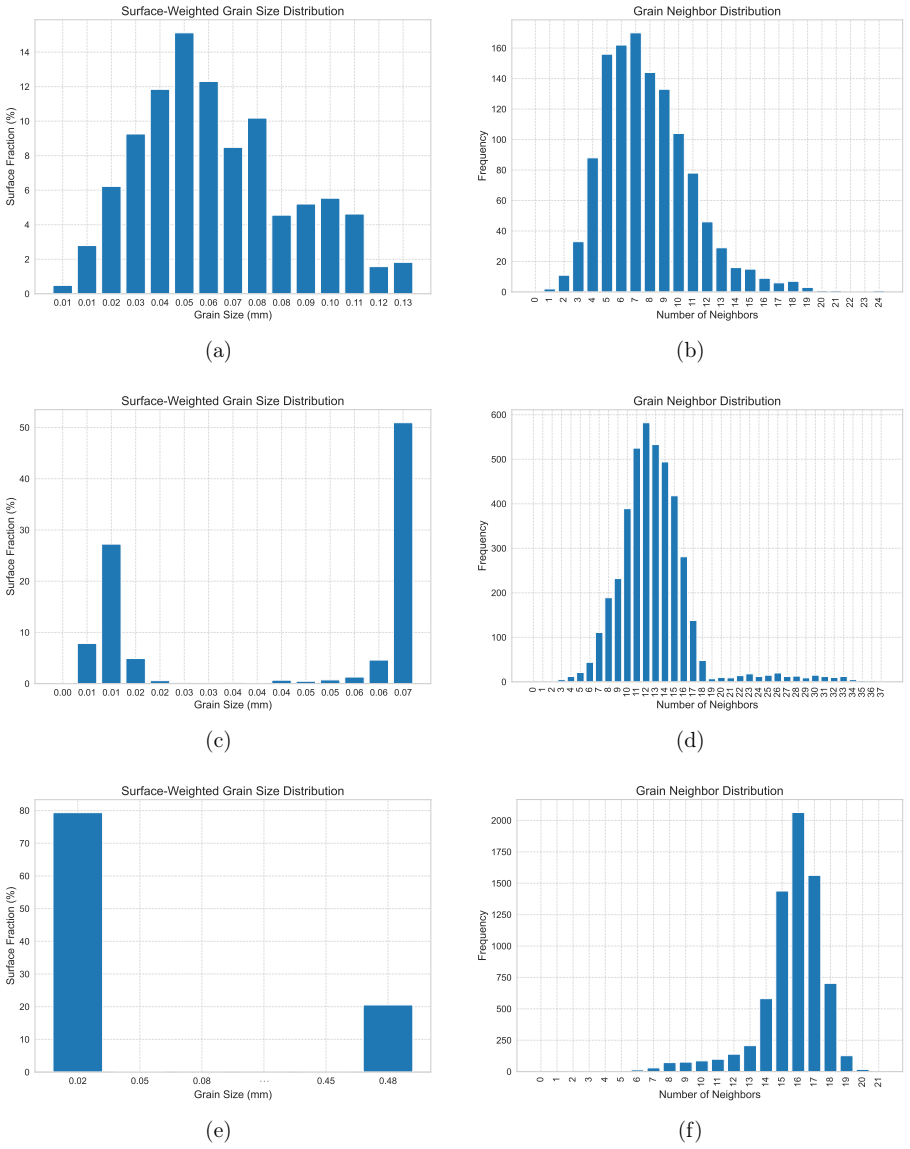
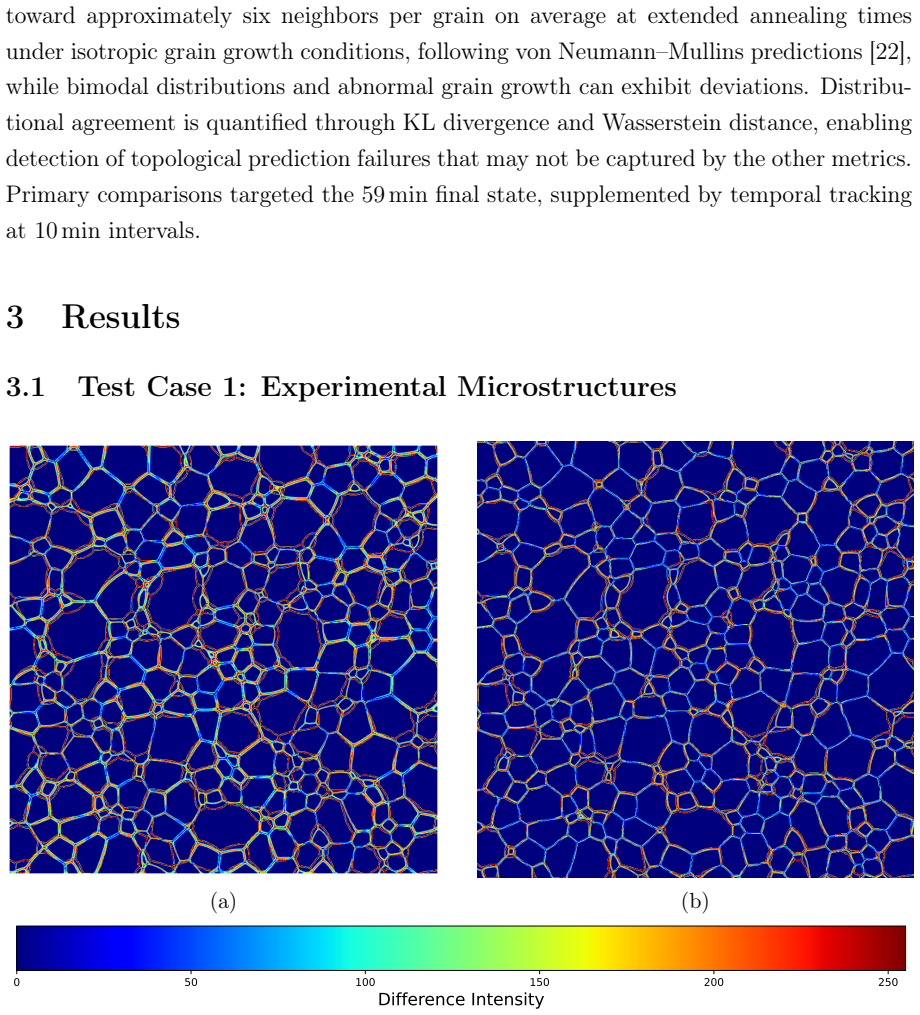
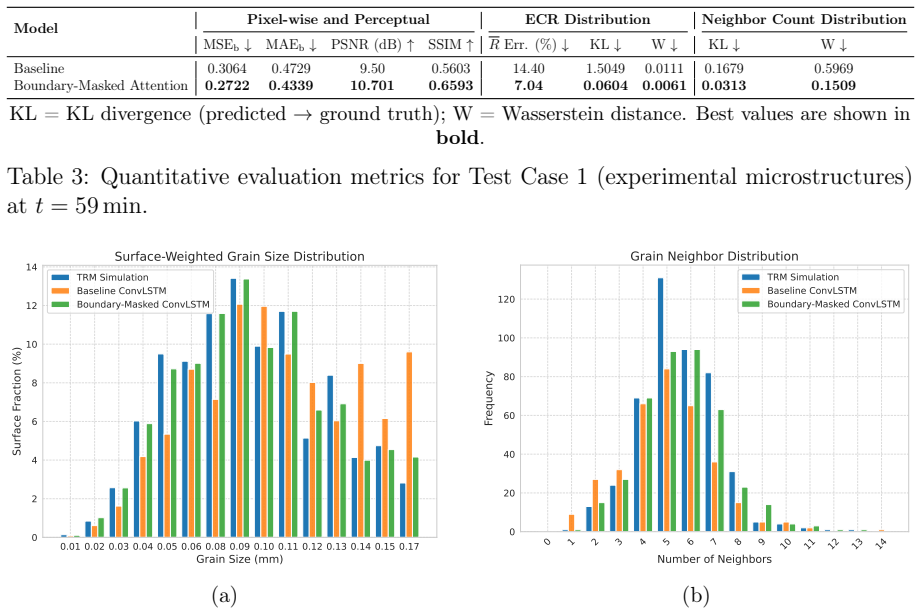
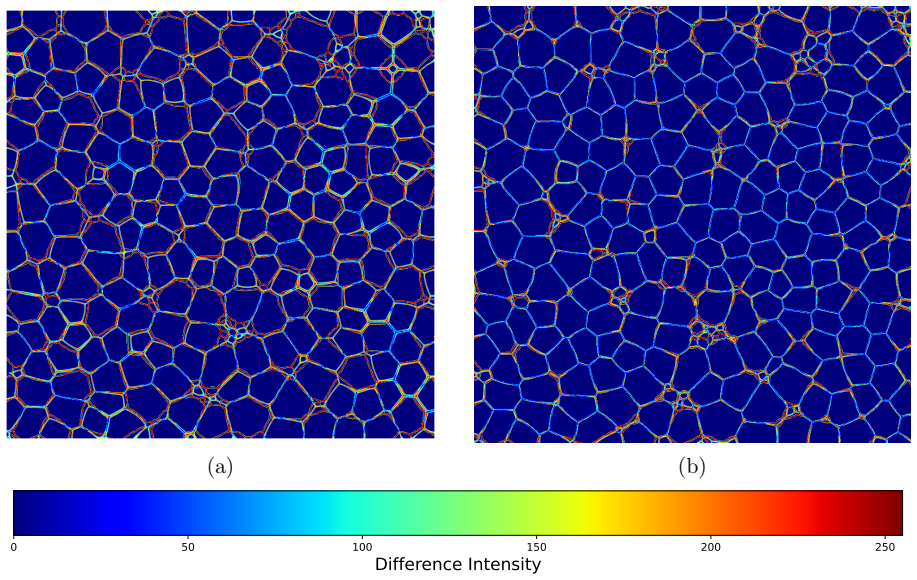
Machine Learning (ML) models for grain growth prediction are typically trained on idealized synthetic data, yet practical applications require generalization to conditions outside the training distribution. This study evaluated the Out-Of-Distribution (OOD) generalization capability of the trained model from our previous study across three test cases, including experimental microstructures, microstructures characterized by a bimodal grain size distribution, and abnormal grain growth. To further probe whether physics-informed architectural design could improve robustness under these different conditions, a boundary-masked attention mechanism was proposed specifically for grain growth, constraining attention to grain boundary pixels. Both the baseline and the proposed physics-informed attention model were evaluated without retraining or fine-tuning on the OOD data. Both models successfully generalized to all three test cases, yet the boundary-masked attention mechanism provided substantial improvements, with the most notable gains for microstructures characterized by a bimodal grain size distribution, where Structural Similarity Index Measure (SSIM) improved from \num{0.6221} to \num{0.7609} and mean grain size ($\overline{R}$) error decreased from \SI{8.75}{\percent} to \SI{3.57}{\percent}. The attention heatmap analysis revealed that the boundary-masked attention model learned to concentrate attention on large grain boundaries in a manner consistent with curvature-driven grain growth physics, emerging from training without being explicitly encoded into the architecture. These results indicate that models trained on synthetic data can generalize to diverse OOD conditions without retraining, and that physics-informed attention may improve accuracy when the boundary morphology matches the training domain.
Editorial analysis
A structured set of objections, weighed in public.
Referee Report
Summary. The manuscript evaluates the out-of-distribution (OOD) generalization of a prior deep learning model for predicting grain growth evolution, trained on synthetic data. It proposes a boundary-masked attention mechanism that constrains attention to grain boundary pixels and reports that both the baseline and proposed models generalize without retraining to experimental microstructures, bimodal grain size distributions, and abnormal grain growth cases. The attention model yields gains, most notably on bimodal cases (SSIM 0.6221 to 0.7609; mean grain size error 8.75% to 3.57%), with qualitative attention heatmaps interpreted as consistent with curvature-driven physics.
Significance. If the central claims hold under more rigorous physical validation, the work would indicate that targeted architectural constraints drawn from materials physics can enhance robustness of microstructure evolution predictors beyond training distributions, potentially reducing the need for domain-specific retraining in experimental settings.
major comments (3)
- [Abstract] Abstract: The headline generalization and 'physics-informed' benefit claims rest on SSIM and mean grain size error improvements, yet these metrics quantify image similarity and a single scalar aggregate rather than direct adherence to curvature-driven kinetics (e.g., von Neumann-Mullins relation dA/dt = k(n-6) or boundary velocity proportional to curvature); no such physical fidelity tests are reported, leaving the interpretation of the gains unsecured.
- [Abstract] Abstract: The reported metric gains (SSIM 0.6221→0.7609 and mean grain size error 8.75%→3.57% on bimodal cases) are given without error bars, number of microstructures evaluated, or statistical significance tests, which is load-bearing for asserting 'substantial improvements' and successful generalization across all three OOD regimes.
- [Abstract] Abstract: The attention heatmap analysis is described as showing concentration on large grain boundaries 'in a manner consistent with curvature-driven grain growth physics' emerging without explicit encoding, but the analysis is post-hoc and qualitative with no quantitative metric (e.g., correlation with local curvature or boundary velocity) supplied to support this interpretation.
minor comments (1)
- The abstract references 'our previous study' for the baseline without restating key architectural or training details here; ensure the full manuscript makes the comparison fully self-contained for readers.
Simulated Author's Rebuttal
We thank the referee for the constructive comments on our manuscript arXiv:2606.17235. We address each of the major comments below and outline the revisions we will make to strengthen the paper.
read point-by-point responses
-
Referee: [Abstract] The headline generalization and 'physics-informed' benefit claims rest on SSIM and mean grain size error improvements, yet these metrics quantify image similarity and a single scalar aggregate rather than direct adherence to curvature-driven kinetics (e.g., von Neumann-Mullins relation); no such physical fidelity tests are reported.
Authors: We acknowledge that our evaluation relies on SSIM and mean grain size error, which are standard metrics for assessing prediction accuracy in image-based models but do not directly verify adherence to specific physical laws such as the von Neumann-Mullins relation. The primary goal of the study was to demonstrate OOD generalization using these practical metrics. However, we agree that this leaves the physics interpretation somewhat unsecured. In the revised manuscript, we will add a paragraph in the discussion section acknowledging this limitation and suggesting that future work could include direct comparisons to curvature-driven models. We will also tone down the abstract claims to reflect the metrics used. revision: yes
-
Referee: [Abstract] The reported metric gains (SSIM 0.6221→0.7609 and mean grain size error 8.75%→3.57% on bimodal cases) are given without error bars, number of microstructures evaluated, or statistical significance tests.
Authors: This is a valid point. The values reported in the abstract are mean values across the evaluated OOD cases, but we omitted the supporting details for conciseness. We will revise the abstract and the results section to specify the number of microstructures tested for each OOD regime, include error bars or standard deviations, and report any statistical significance tests that were performed on the improvements. revision: yes
-
Referee: [Abstract] The attention heatmap analysis is described as showing concentration on large grain boundaries 'in a manner consistent with curvature-driven grain growth physics' emerging without explicit encoding, but the analysis is post-hoc and qualitative with no quantitative metric supplied.
Authors: We agree that the attention analysis is qualitative and post-hoc. It was included to offer insight into why the boundary-masked attention improves performance, based on visual examination of the heatmaps. To address this, we will revise the relevant text to clearly state that the consistency with physics is an interpretive observation rather than a quantitatively validated claim. If time permits, we may explore adding a simple quantitative correlation metric between attention weights and local curvature in the revision. revision: partial
Circularity Check
No circularity: OOD generalization claims rest on direct empirical testing of independent data
full rationale
The paper trains or re-uses models on synthetic data and then measures SSIM and mean grain size error on three separate OOD test sets (experimental microstructures, bimodal distributions, abnormal grain growth) without retraining. These metrics are computed on held-out inputs and do not reduce to the training distribution by construction. The boundary-masked attention is an explicit architectural modification whose performance difference is reported as an empirical observation. Self-citation of the baseline model supplies the starting point but does not carry the load-bearing claim; the new evidence consists of the OOD results themselves. No self-definitional loop, fitted-input-as-prediction, uniqueness theorem, or ansatz smuggling appears in the reported chain.
Axiom & Free-Parameter Ledger
Reference graph
Works this paper leans on
-
[1]
M. Yang, L. Wang, W. Yan, Phase-field modeling of grain evolutions in additive manufacturing from nucleation, growth, to coarsening, npj Comput. Mater. 7 (1) (2021) 56
2021
-
[2]
Moelans, B
N. Moelans, B. Blanpain, P. Wollants, Quantitative analysis of grain boundary prop- erties in a generalized phase field model for grain growth in anisotropic systems, Phys. Rev. B 78 (2) (2008) 024113
2008
-
[3]
C. E. Krill III, L.-Q. Chen, Computer simulation of 3-d grain growth using a phase- field model, Acta Mater. 50 (12) (2002) 3059–3075
2002
-
[4]
Chen, Phase-field models for microstructure evolution, Annu
L.-Q. Chen, Phase-field models for microstructure evolution, Annu. Rev. Mater. Res. 32 (2002) 113–140
2002
-
[5]
Steinbach, Phase-field models in materials science, Modell
I. Steinbach, Phase-field models in materials science, Modell. Simul. Mater. Sci. Eng. 17 (7) (2009) 073001
2009
-
[7]
Murgas, S
B. Murgas, S. Florez, N. Bozzolo, J. Fausty, M. Bernacki, Comparative study and limits of different level-set formulations for the modeling of anisotropic grain growth, Mater. 14 (14) (2021) 3883
2021
-
[8]
P. Tep, M. Bernacki, High-fidelity grain growth modeling: Leveraging deep learning for fast computations, Acta Mater. 301 (2025) 121486
2025
-
[9]
Z. Wang, A. C. Bovik, H. R. Sheikh, E. P. Simoncelli, Image quality assessment: from error visibility to structural similarity, IEEE Trans. Image Process. 13 (4) (2004) 600– 612
2004
-
[10]
Z. Shen, J. Liu, Y. He, X. Zhang, R. Xu, H. Yu, P. Cui, Towards out-of-distribution generalization: A survey, arXiv preprint arXiv:2108.13624 (2021)
arXiv 2021
-
[11]
K. Li, A. N. Rubungo, X. Lei, D. Persaud, K. Choudhary, B. DeCost, A. B. Dieng, J. Hattrick-Simpers, Probing out-of-distribution generalization in machine learning for materials, Commun. Mater. 6 (1) (2024)
2024
-
[12]
Florez, K
S. Florez, K. Alvarado, D. P. Muñoz, M. Bernacki, A novel highly efficient lagrangian model for massively multidomain simulation applied to microstructural evolutions, Comput. Methods Appl. Mech. Eng. 367 (2020) 113107. 25
2020
-
[13]
Florez, J
S. Florez, J. Fausty, K. Alvarado, B. Murgas, M. Bernacki, Parallelization of an efficient 2d-lagrangian model for massive multi-domain simulations, Modell. Simul. Mater. Sci. Eng. 29 (6) (2021) 065005
2021
-
[14]
M. Bernacki, Kinetic equations and level-set approach for simulating solid-state mi- crostructure evolutions at the mesoscopic scale: State of the art, limitations, and prospects, Prog. Mater. Sci. 142 (2024) 101224
2024
-
[15]
Hitti, P
K. Hitti, P. Laure, T. Coupez, L. Silva, M. Bernacki, Precise generation of complex statistical representative volume elements (rves) in a finite element context, Comput. Mater. Sci. 61 (2012) 224–238
2012
-
[16]
Vaswani, N
A. Vaswani, N. Shazeer, N. Parmar, J. Uszkoreit, L. Jones, A. N. Gomez, Ł. Kaiser, I. Polosukhin, Attention is all you need, Adv. Neural Inf. Process. Syst. 30 (2017)
2017
-
[17]
D. Bahdanau, K. Cho, Y. Bengio, Neural machine translation by jointly learning to align and translate, arXiv preprint arXiv:1409.0473 (2015)
Pith/arXiv arXiv 2015
-
[18]
C. E. Krill, E. A. Holm, J. M. Dake, R. Cohn, K. Holikova, F. Andorfer, Extreme abnormal grain growth: Connecting mechanisms to microstructural outcomes, Annu. Rev. Mater. Res. 53 (1) (2023) 319–345
2023
-
[19]
Rollett, G
A. Rollett, G. S. Rohrer, J. Humphreys, Recrystallization and Related Annealing Phenomena, 3rd Edition, Elsevier, 2017
2017
-
[20]
Kullback, R
S. Kullback, R. A. Leibler, On information and sufficiency, Ann. Math. Stat. 22 (1) (1951) 79–86
1951
-
[21]
Montavon, K.-R
G. Montavon, K.-R. Müller, Learning with wasserstein distances, in: Adv. Neural Inf. Process. Syst., 2013, pp. 689–697
2013
-
[22]
W. W. Mullins, Two-dimensional motion of idealized grain boundaries, J. Appl. Phys. 27 (8) (1956) 900–904. 26 (a) (b) (c) (d) (e) (f) 0.00 (background) 0.15 (boundary, low attention) 0.50 0.75 1.00 (max attention) Attention Score Figure12: Attentionweightheatmapsgeneratedbytheboundary-maskedattentionmech- anism at the first prediction step (t= 10 min) and...
1956
discussion (0)
Sign in with ORCID, Apple, or X to comment. Anyone can read and Pith papers without signing in.